Napier Nomad

Napier Nomad II

In the early years of jet development, during WWII, it became clear that the jet’s fuel efficiency was well below that of the reciprocating engine. The low continuous temperature tolerated by the combustion chambers, under 1200°K, was to blame. Piston engines tolerate a peak combustion temperature of some 4800°K, because this high temperature is sustained only for one or two milliseconds. The thermodynamic efficiency of an ideal engine is given simply by 100(1-Te/Tp) in percent, where Te is the exhaust temperature in Kelvin, and Tp is the peak combustion temperature. Thus, a jet could easily triple its fuel efficiency by using a diesel engine to inject the kerosene fuel and combust the fuel/air mixture. The best gasoline fuel (130 avgas) at the time was unsuitable as it tolerated a maximum compression ratio of about 10:1, whereas ordinary diesel engines could attain 18:1, and 22:1 with Ricardo indirect combustion chambers.

In 1945 the Air Ministry asked for proposals for a new 6,000 horsepower (4,500 kW) class engine with good fuel economy. Curtiss-Wright was designing an engine of this sort of power known as the turbo-compound engine, but Sir Harry Ricardo, one of Britain’s great engine designers, suggested that the most economical combination would be a similar design using a diesel two-stroke in place of the Curtiss’s petrol engine.

Before World War II Napier had licensed the Junkers Jumo 204 diesel design to set up production in the UK as the Napier Culverin, but the onset of the war made the Sabre all-important and work on the Culverin was stopped. In response to the Air Ministry’s 1945 requirements Napier dusted off this work, combining two enlarged Culverins into an H-block similar to the Sabre, resulting in a 75 litre design. Markets for an engine of this size seemed limited, however, so instead they reverted to the original Sabre-like horizontally opposed 12 cylinder design, and the result was the Nomad.

The objective of the design was to produce a civilian power plant with far superior fuel efficiency to the emerging jet engine. Thermal efficiency is given by 1-(Tx/Tp), where Tx is the exhaust temperature (any absolute scale) and Tp is the peak combustion temperature. Jet engines have relatively low-temperature combustion systems which produce a Tp of no more than about 1000 kelvin, much less than the typical 5000 kelvin of a reciprocating engine, and so jets have very poor thermal efficiency. The Nomad design focused on replacing the low temperature combustion chambers of the jet engine with highly efficient Diesel combustion chambers. In practice, it was much too difficult to couple the Diesel power output back into the turbine cycle. The maximum practical power of the Nomad was 4,000 horsepower (3,000 kW), and it was much heavier than a pure jet of the same power.

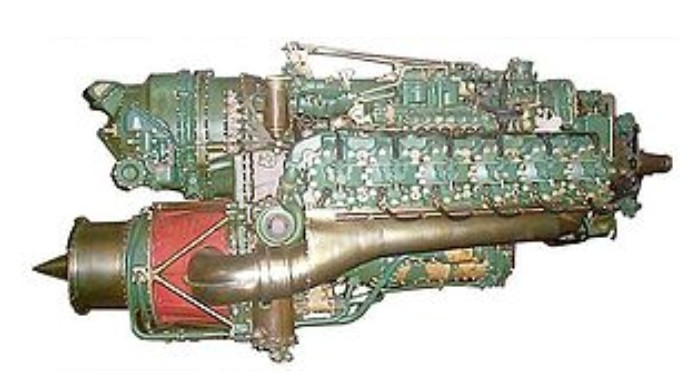
The Napier Nomad was a British diesel aircraft engine designed and built by Napier & Son in 1949. They combined a piston engine with a turbine to recover energy from the exhaust and thereby improve fuel economy. Two versions were tested, the complex Nomad I which used two propellers, each driven by the mechanically independent stages, and the Nomad II, using the turbo-compound principle, coupled the two parts to drive a single propeller. The Nomad II had the lowest specific fuel consumption figures seen up to that time.

The initial Nomad design (E.125) or Nomad 3 was almost two engines in one. One was a turbo-supercharged two-stroke diesel, having some resemblance to half of a Napier Sabre. Mounted below this were the rotating parts of a turboprop engine, based on the Naiad design, the output of which drove the front propeller of a contra-rotating pair. To achieve higher boost, the crankshaft drove a centrifugal supercharger, which also provided the scavenging needed for starting the engine from rest. During take-off additional fuel was injected into the rear turbine stage for more power, and turned off once the aircraft was cruising.

The compressor and turbine assemblies of the Nomad were tested during 1948, and the complete unit was run in October 1949. The prototype was installed in the nose of an Avro Lincoln heavy bomber for testing: it first flew in 1950 and appeared at the Farnborough Air Display on 10 September 1951. In total the Nomad I ran for just over 1,000 hours, and proved to be rather temperamental, but when running properly it could produce 3,000 horsepower (2,200 kW) and 320 lbf (1.4 kN) thrust. It had a specific fuel consumption (sfc) of 0.36 lb/(hp·h) (0.22 kg/(kW·h)). In contrast, a very efficient Pratt & Whitney R-1830 petrol radial engine consumes 0.49 lb/hp.h at cruise settings. However, in practice the jet engine is still preferable since it is much smaller and lighter, and operates at much higher altitudes and speeds. The jet thus consumes about the same amount of fuel for a given trip distance, due to its much shorter transit time at higher altitudes.

The prototype Nomad I is on display at the National Museum of Flight at East Fortune Airfield in Scotland.

Even before the Nomad I was running, its successor, the Nomad II (E.145) Nomad 6, had already been designed. In this version an extra stage was added to the axial compressor/supercharger, eliminating the separate centrifugal part and the intercooler. The turbine (which also received an additional stage) was now only used to drive the compressor, and feed back any excess power to the main shaft using a hydraulic clutch; the separate propeller from the turbine was deleted, just as the whole of the “afterburner” system with its valves etc. So the system was now like a combination of a mechanical supercharger, and a turbocharger without any need for bypass. The result was smaller and considerably simpler: a single engine driving a single propeller. Overall about 1,000 lb (450 kg) was taken off the weight. The wet liners of the cylinders of the Nomad I were changed for dry liners. While the Nomad II was undergoing testing, a prototype Avro Shackleton was lent to Napier as a testbed. The engine proved bulky, like the Nomad I before it, and in the meantime several dummy engines were used on the Shackleton for various tests.

A further development, the Nomad Nm.7, of 3,500 shp (2,600 kW) was announced in 1953.

By 1954 interest in the Nomad was waning, and after the only project, the Avro Type 719 Shackleton IV, based on it was cancelled, work on the engine was ended in April 1955, after an expenditure of £5.1 million. By this time civilian jets such as the Boeing 707 were nearing completion, and the Nomad was never seriously considered by any aircraft manufacturer.

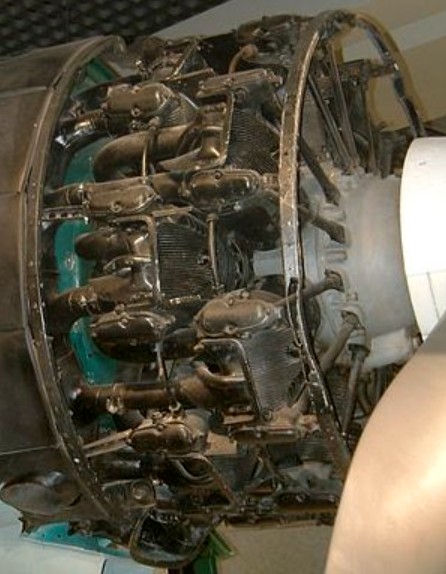
A Nomad II is on display at the Steven F. Udvar-Hazy Center in Virginia.

Specifications:
Nomad II
Type: Twelve-cylinder, two-stroke valveless diesel engine compounded with three-stage turbine driving both crankshaft and axial compressor.
Bore: 6.00 inches (152 mm)
Stroke: 7.375 inches (187.3 mm)
Displacement: 2,502 cu.in (41.1 lt)
Length: 119 inches (3,000 mm)
Width: 56.25 inches (1,429 mm)
Height: 40 inches (1,000 mm)
Dry weight: 3,580 pounds (1,620 kg)
Valvetrain: Piston ported two-stroke
Supercharger: Napier Naiad turboshaft and gas generator, maximum boost pressure 89 psi
Turbocharger: Engine exhaust gases ducted in to Naiad turbine section
Fuel type: Diesel oil or kerosene or wide-cut petrol or “other fuels”
Cooling system: Liquid-cooled
Power output: 3,150 ehp (2,344 kW) max take-off at 89 psi (610 kPa)(208″Hg)(6.9Atm) boost including 320 lbf residual thrust from the turbine at 2,050 rpm (crankshaft) and 18,200 rpm (turbine)
Specific power: 1.25 ehp/cu.in (57.0 kW/lt)
Compression ratio: 8.1 (cylinder ratio), 31.5:1 (combined pressure ratio)
Specific fuel consumption: 0.345 lb/(ehp·h) (0.210 kg/(kW·h))(combined unit) at 11,000 ft and 300 knots
Power-to-weight ratio: 0.88 ehp/lb (1.44 kW/kg)

Turbine section
Type: Gas generator based on Napier Naiad
Compressor: 12-stage axial flow compressor
Turbine: 3-stage axial flow
Maximum thrust: 320 lbf residual at 18,200 rpm
Overall pressure ratio: 8.25:1
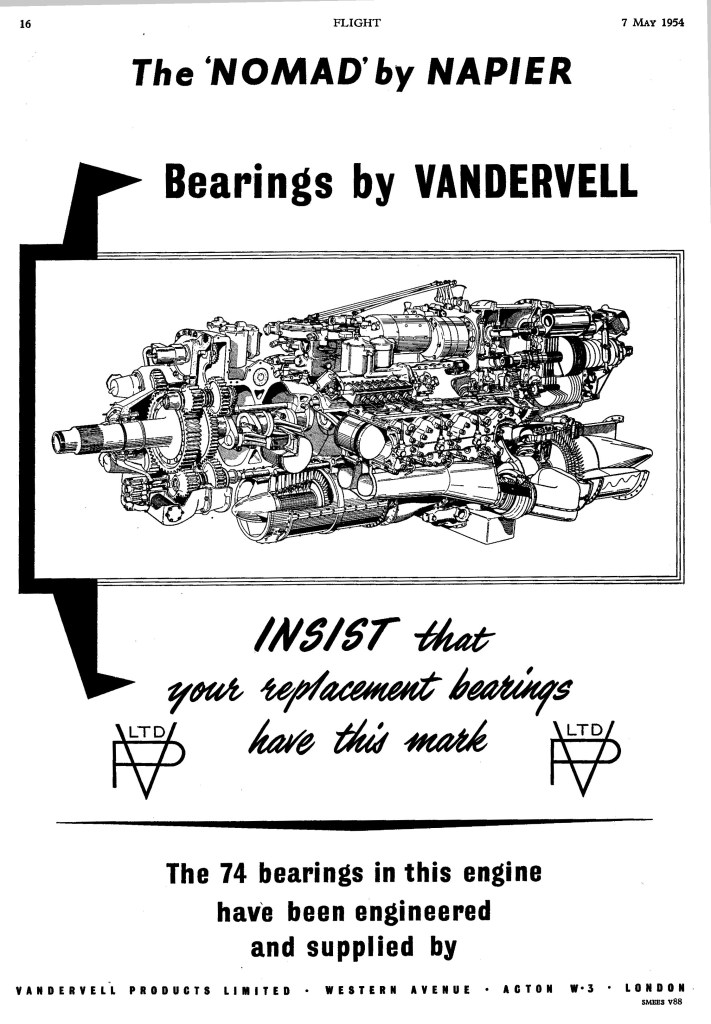
Flight 7 May 1954

Napier

By 1931, during the Great Depression, Bentley was having financial difficulties. When funds ran out in 1931, the receivers were negotiating with D.Napier & Sons Ltd for the sale of the remains of Bentley. However, Rolls-Royce put in a secret bid through a Liechtenstein company, and secured Bentley Motors for £125,256. For this, Rolls-Royce got the factory equipment, a number of incomplete car chassis, and the services of Walter Bentley for three years.

Nakajima SKT-97 Type 97

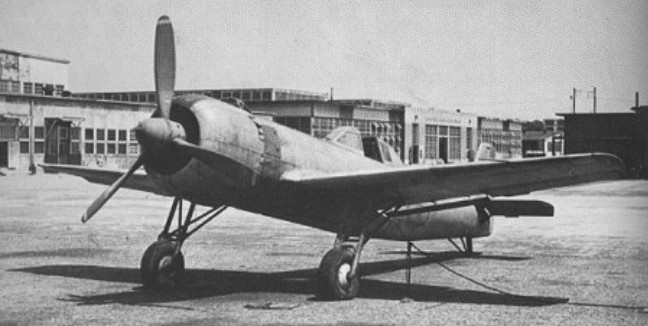
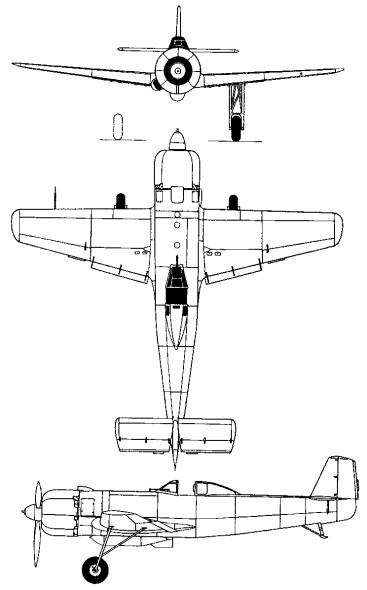
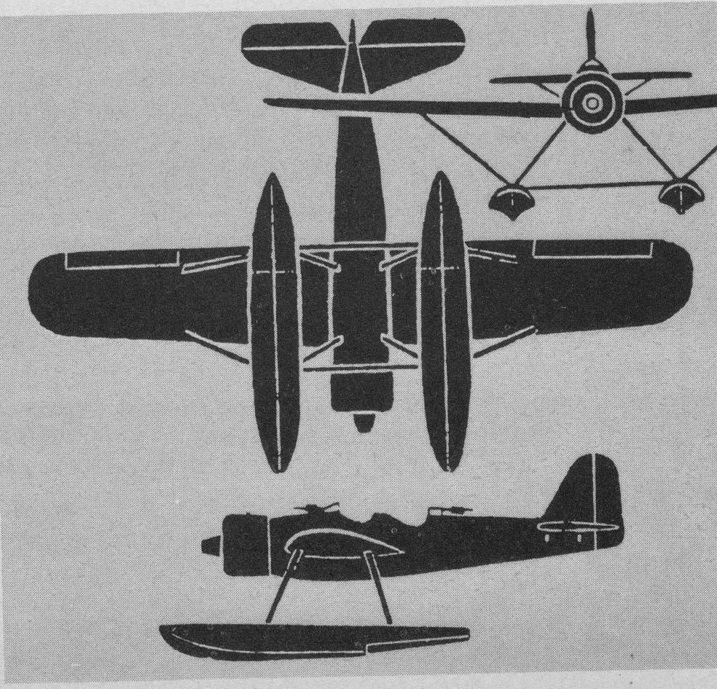
The so-called Nakajima SKT-97 Type 97 float fighter never existed, yet drawings and detailed descriptions were widely circulated early in the Pacific war.

An earlier unsuccessful experimental float plane built by Kawanishi in 1933, known as the 8-Shi E8Kq, was similar in appearance and may account for this fictional type.

Nakajima Sakae / Ha-25 / Ha-35 Model 11 / Ha105 / Ha-115-I / Army Type 99 / NK1

The Nakajima Sakae (栄, Prosperity) was a two-row, 14-cylinder air-cooled radial engine used in a number of combat aircraft of the Imperial Japanese Navy and Imperial Japanese Army before and during World War II.

The engine was designed by Nakajima Aircraft Company after acquiring a license for the French Gnome-Rhone 14K. The Imperial Japanese Army Air Force called the first of the series the Ha-25 (ハ25) and later versions were designated Ha35, Ha105 and Ha115, while the Imperial Japanese Navy Air Service designation was Nakajima NK1, with sub-types identified by Model numbers; thus Nakajima NK1 Sakae 10, 20 and 30 series.

A total of 21,166 were made by Nakajima; 9,067 were manufactured by other firms.

Variants:
Army Type 99 975 hp Air-cooled Radial
Long Army designation for the Nakajima NK1 radial engine named Sakae.

Nakajima Ha25
Short Army designation for the initial production version of the Nakajima NK1 radial engine named Sakae.

Nakajima Ha35
Nakajima Ha35 Model 11
Nakajima Ha35 Model 12
Nakajima Ha35 Model 23 – 1,150 hp (858 kW)

Nakajima Ha105

Nakajima Ha115
Nakajima Ha115-I
Nakajima Ha115-II

Nakajima NK1
NK1C Sakae 12 – 925 hp (690 kW), 940 hp (701 kW), 975 hp (727 kW)
NK1D Sakae 11 – 970 hp (723 kW), 985 hp (735 kW)
NK1F Sakae 21 – 1,115 hp (831 kW), 1,130 hp (843 kW)
NK1E Sakae 31 – 1,130 hp (843 kW), boosted to 1,210 hp (902 kW) with water-methanol injection

Applications:
Kawasaki Ki-48
Mitsubishi A6M
Mitsubishi C5M
Nakajima B5N
Nakajima J1N
Nakajima Ki-43
Nakajima Ki-115
Kawasaki Ki-56

Specifications:
Sakae 21
Type: 14-cylinder air-cooled two-row radial engine
Bore: 130 mm (5.1 in)
Stroke: 150 mm (5.9 in)
Displacement: 27.8 L (1,700 cu.in)
Length: 1,600 mm (63 in)
Diameter: 1,144 mm (45.0 in)
Dry weight: 533 kg (1,175 lb)
Valvetrain: Overhead valve
Supercharger: Gear driven, two speed.
Fuel system: Nakajima twin choke carburettor, automatic mixture and boost control.
Cooling system: Air-cooled
Power output: 761 kW (1,020 hp) at 2,600 rpm at 6,400 ft (1,950 m)
Specific power: 30.2 kW/L (0.66 hp/cu.in)
Compression ratio: 7:1
Power-to-weight ratio: 1.43 kW/kg (0.87 hp/lb)

Nakajima Hikari

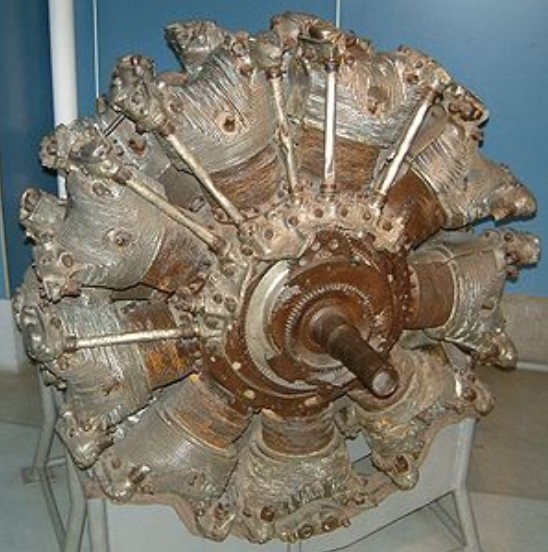
The Nakajima Hikari (Japanese: 光 “Light”) was a nine-cylinder, air-cooled, radial aircraft engine developed in Japan for Navy use during World War II by the Nakajima Aircraft Company. It was a development of the Nakajima Kotobuki and Wright Cyclone.

Variants:
Hikari 3 – 770 hp (574 kW)
Hikari 1 – 820 hp (611 kW)

Applications:
Aichi D1A
Aichi D3A (prototype only)
Mitsubishi F1M
Nakajima A4N
Nakajima B5N1 (B5N1 only)
Nakajima C3N
Yokosuka B4Y

Specifications:
Type: 9-cylinder air-cooled radial aircraft piston engine
Bore: 160 mm (6.30 in)
Stroke: 180 mm (7.09 in)
Displacement: 32.57 lt (1,987.7 cu.in)
Cooling system: Air-cooled
Power output: 611 kW (820 hp)

Nakajima Ha-5 / Ha-41 / Ha-109

The “Kotobuki” air-cooled aircraft engine was improved and developed into the “Hikari (light)” engine with the bore and stroke expanded to the limit of the cylinder (160 × 180 mm for a displacement of 32.6 L), with the power was increased to 720 PS. The “Hikari” was used in Type 95 carrier fighters and Type 96 Carrier Attack Plane.

Nakajima knew that engines of higher power would be needed and began work on a new two-row, 14 cylinder design that was based on the 160 × 180 mm cylinder design of the Hikari. The Ha-5 prototype engine was completed in 1933, producing 1,000 PS, combining features of the Bristol Jupiter and Pratt & Whitney R-1340 Wasp designs. The Ha-5 had separate camshafts for the front and rear rows of cylinders like American designs, rather than using a single, front-mounted camshaft and long pushrods to operate both rows of cylinder valves. An improved Ha-5 was developed as a 1,500 PS engine. In all about 5,500 Ha-5 engines were produced for the military.

Later on, as the weights of aircraft rose and higher speeds were required, Nakajima continued to improve the Ha-5 design, creating the “Ha-41” and “Ha 109”, which shared the same 146mm x 160mm bore and stroke as the Ha-5, but were increased from the 950 hp of the Ha-5 to 1,260 hp and 1,440 hp, respectively. The unified code for the Ha-41 was “Ha-34”. Later the engine was developed into an 18 cylinder, twin-row engine called the “Ha-219”, but this never got past the development phase. All these engines used essentially the same cylinder heads, the differences being in supercharging and engine revolutions per minute. The Ha-5 and Ha-41 shared the same weight of 630 kg, while the Ha-109 weighed 720 kg due to its larger, twin-stage supercharger system. The Ha-41 was the primary engine of early variants of the Nakajima Ki-49 “Helen” bomber, and the Nakajima Ki-44 “Tojo” fighter, later versions of both planes using the more powerful Ha-109 engine. Early versions of the Mitsubishi Ki-21 “Sally” used the Ha-5. The Ha-41 would have been an ideal powerplant in aircraft that used the Mitsubishi Kasei, being of smaller dimensions and displacement, yet making equivalent power levels.

About 7,000 civilian and 5,500 military Ha-5’s were built during World War II.

Variants:
Ha-5 634 kW (850 hp), Base design, (used on Mitsubishi Ki-21 Army Type 97 Heavy Bomber)
Ha-5 KAI 634 kW (850 hp), (used on Mitsubishi Ki-30)
Ha-5 660 kW (890 hp) (used on Nakajima Ki-19)
Ha-5 KAI 708 kW (950 hp), (used on Mitsubishi Ki-57 and Ki-57-I Army Type 100 Transport Model 1)
Ha-5-KAI 708 kW (950 hp) take-off, 805 kW (960 hp) at 3,000 m (11,810 ft), (used on Mitsubishi Ki-30 and on first prototype Nakajima Ki-49 Donryu)
Ha-5 KAI 708 kW (950 hp) take-off, 805 kW (1,080 hp) at 3334 m (13,125 ft), (used on Mitsubishi Ki-21-I Army Type 97 Heavy Bomber Model 1 and Ki-21-Ia, Army Type 97 Heavy Bomber Model 1A)
Ha-41 1,260 hp@2,500rpm takeoff, 1,260 hp@2,450rpm @ 3,700m
Ha-109 1,500 hp@2,650rpm takeoff, 1,440 hp@2,600rpm @ 5,200m

Applications:
The Ha-5 engine was used to power:
Mitsubishi Ki-21 “Sally”
Mitsubishi Ki-30
Mitsubishi Ki-57

The Ha-41 engine was used to power:
Nakajima Ki-49-I ‘Donryu’ (“Helen”)
Nakajima Ki-44-I ‘Shoki’ (“Tojo”)

The Ha-109 engine was used to power:
Nakajima Ki-49-II
Nakajima Ki-44-II

Specifications:

Nakajima Ha-5
Type: 14-cylinder, air-cooled, two-row radial piston engine
Bore: 146 mm (5.75 in)
Stroke: 160 mm (6.3 in)
Displacement: 37.5 L (2,288 cu.in)
Diameter: 1,260 mm (49.6 in)
Dry weight: 625kg (1,378 lb) (720kg Ha-109)
Valvetrain: four-valve intake and exhaust pushrod-operated overhead valve system
Supercharger: Centrifugal, 280mm impeller at 8.39:1 reduction (Ha-5 and Ha-41), 6.55:1 and 8.55:1 for Ha-109 (twin stage supercharger)
Cooling system: Air-cooled
Reduction gear: 0.6875:1 (11/16)
Power output:
890hp (663.7 kW) at 2,200 rpm at 4700m (15,490 ft) with -50mm boost (Nominal Power)
950hp (708.4 kW) at 2,200 rpm with +50mm boost (Takeoff Power)
Specific power: ( to ) 0.58 hp/ cu.in to 1.02 hp/ cu.in
Compression ratio: 6.7:1

Nakajima NK7 Mamoru / Mamoru-Kai / Ha-103

The Mamoru was Nakajima’s seventh air-cooled design, which lead to its designation: N for Nakajima, K for air-cooled, 7 for the 7th design, and A for the major model number. Designed by Kiyoshi Tanaka, the Nakajima Mamoru engine was a 14-cylinder, air-cooled, two-row radial engine of 1870 hp. It was one of the largest 14-cyl. engines in the world and was to compete with early 18-cyl engines. The Nakajima model designation for this engine was NAK while it was an experimental project, in service it was known as the NK7, and known as the Ha-103 by the Army and “Mamori” or “Mamoru” by the Navy. According to unified designation code it was Ha-36. The meanings of these two Japanese words are very similar, Mamori translates as protection and Mamoru, translates as to guard, protect, defend and obey.

First run in 1941, the first application of the Mamoru was on the first prototype of the G5N1 Genzan. The G5N1 had been designed on the basis of the Douglas DC-4E as Japan’s first four-engine bomber, and proved to be a disappointment. These problems were compounded by the unreliability of the early Mamoru engines, which had to be de-tuned and left the G5N1 underpowered. The G5N1’s maiden flight was on 10 April 1941, and a further four prototypes were built with the Mamoru. In an attempt to salvage the project, two additional airframes were fitted with 1,530 hp Mitsubishi MK4B 12 “Kasei” engines and redesignated G5N2s. Although the Mitsubishi engines were more reliable than the original Mamoru 11s, further development was halted. Of the six completed Shinzans, four of them (two G5N2s and two G5N1s re-engined with the Kasei 12) were relegated for use as long-range Navy transports under the designation Shinzan-Kai Model 12 Transport G5N2-L.

The Nakajima Mamoru was also used on the Nakajima B6N Tenzan (heavenly mountain) carrier based attack aircraft. The Navy requested this aircraft based on the Kasei, but Nakajima’s Kenichi Matsumara insisted on using their Mamoru. The B6N first flew on 14 March 1941, demonstrating several problems, notably the poor engine reliability. With the delay of 2 years, by 1943 the engine had improved to the point where serial production was allowed to start, but after only 133 B6N1s had been delivered the Navy ordered the switch to the 1,850 hp (1380 kW) Mitsubishi MK4T Kasei 25. The rest of the 1,268 B6N2s were Kasei powered.

Two sub-models were built with minor changes, the Model 11 for the Navy, and the Model 12 for the Army. Both produced 1,850 hp. Production of the Mamoru was ended by the Navy after only a few hundred production examples were built.

Variants:
Mamori 11 NK7A (for IJN aircraft)
1,870 horsepower (1,390 kW) at 2600 rpm (take-off)
1,750 horsepower (1,300 kW), 2500 rpm at 1,400 metres (4,600 ft)
1,600 horsepower (1,200 kW), 2500 rpm at 4,900 metres (16,100 ft)

Mamori 12 Ha-103 (for IJA aircraft)
1,870 horsepower (1,390 kW) at 2600 rpm (take-off)
1,750 horsepower (1,300 kW), 2500 rpm at 1,400 metres (4,600 ft)
1,600 horsepower (1,200 kW), 2500 rpm at 4,900 metres (16,100 ft)

Applications:
Nakajima B6N 1 X 1,870 hp (1395 kW) Nakajima NK7A Mamoru 11
Nakajima G5N 4 X 1,870 hp (1395 kW) Nakajima NK7A Mamoru 11
Nakajima Ki-49 2 X 1,870 hp Nakajima Ha-103
Mitsubishi Ki-67 (prototype) 2 X 1,870 hp Nakajima Ha-103

Specifications:
Nakajima NK7A Mamoru type 11, 12
Type: 14-cylinder supercharged, air-cooled two-row radial piston engine
Bore: 155 mm (6.1 in.)
Stroke: 170 mm (6.7 in.)
Displacement: 44.9 lt (2,740 cu.in)
Diameter: 1380 mm (54.3 in.)
Dry weight: 870-903 kg (1,918-1,991 lb.)
Valvetrain: push rod operated overhead-valve
Supercharger: Two-speed single stage centrifugal
Cooling system: Air-cooled
Reduction gear: 0.578
Power output: takeoff: 1870 hp at 2600 rpm, cruise: 1750 hp at 2500 rpm at 1400 m
Compression ratio: 6.5

Nakajima Ha-45 Homare / NK9 / NBA / Type 4

The Nakajima Homare (誉, “praise” or, more usually, “honour”) was an air-cooled twin-row 18 cylinder radial Japanese aircraft engine. Given the Navy service designation NK9, the “Homare” was also given the company designation NBA, Army experimental designation Ha-45 (ハ45) or, Army long designation Nakajima Army Type 4 1,900 hp Air-Cooled Radial and, (coincidentally), unified designation code of Ha-45.

Development of the Homare was started in 1940 by Ryoichi Nakagawa, and certification was completed in 1941. It succeeded Nakajima’s previous 14 cylinder Sakae (Ha-25) engine, with its forward seven cylinders staggered from the rear seven for efficient cooling.

The design was compact, with an external diameter of 118 cm. With a bore and stroke of 130 mm x 150 mm, it was classified as a short-stroke engine. It was designed to output around 1800 hp (1340 kW), or 100 hp (75 kW) per cylinder. However, the tight design of the engine made it difficult to maintain quality in manufacturing, and unreliability in the field was a significant problem; actual output of early models at altitude was in the range of 1300 hp (970 kW), far below the designed capability. Later models had improved performance, and it became one of the predominant powerplants of Japanese military aircraft in the latter part of the war. A total of 8,747 were produced.

Variants:
Homare 11 – 1,650 hp (1,230 kW), 1,820 hp (1,357 kW), 1,900 hp (1,417 kW)
Homare 12 – 1,825 hp (1,361 kW)
Homare 21 – 1,990 hp (1,484 kW)

Applications:
Aichi B7A
Kawanishi N1K-J
Mitsubishi A7M
Nakajima C6N
Nakajima G8N
Nakajima Ki-84
Yokosuka P1Y1

Specifications:
Type: 18-cylinder air-cooled twin-row radial engine
Bore: 130 mm (5.12 in)
Stroke: 150 mm (5.91 in)
Displacement: 32 lt (1,940 cu.in)
Length: 1,778 mm (70 in)
Diameter: 1,182 mm (46.5 in)
Dry weight: 830 kg (1,830 lb)
Valvetrain: push rod operated overhead-valve system with 2 valves per cylinder
Supercharger: Two-speed single stage centrifugal
Fuel system: Water-methanol injection
Cooling system: Air-cooled
Power output: 1,485 kW (1,990 hp) at altitude
Specific power: 46.4 kW/L (1.02 hp/cu.in)
Compression ratio: 7.0
Power-to-weight ratio: 1.79 kW/kg (1.09 hp/lb)

Nakajima Ki-115 Tsurugi

In January 1945 Nakajima was ordered by the Imperial Japanese Army to design and develop, as quickly as possible, a basic aircraft that could carry a bomb of up to 800kg weight for use in kamikaze attacks. The resulting Nakajima Ki-115 low-wing monoplane prototype was of mixed construction, powered by a Nakajima Ha-35 radial engine and had welded steel-tube main landing gear units, without any form of shock absorption, which were intended to be jettisoned after take-off on a kamikaze mission. Flight tests showed that ground handling was unacceptable in this configuration, leading to the introduction of main landing gear units with simple shock absorbers. In this form, and incorporating some minor modifications, the aircraft entered production as the Ki-115a Tsurugi (Sabre). However, Nakajima had built only 104 production aircraft by the time the war ended, and none of these was used operationally.

Ki-115
Engine: 1 x Nakajima Ha-35, 843kW
Wingspan: 8.6 m / 28 ft 3 in
Length: 8.55 m / 28 ft 1 in
Height: 3.3 m / 10 ft 10 in
Wing area: 12.4 sq.m / 133.47 sq ft
Max take-off weight: 2880 kg / 6349 lb
Empty weight: 1640 kg / 3616 lb
Max. speed: 550 km/h / 342 mph
Range: 1200 km / 746 miles
Armament: 800-kg bomb
Crew: 1

Nakajima Ki-115 Tsurugi

Nakajima Ki-87

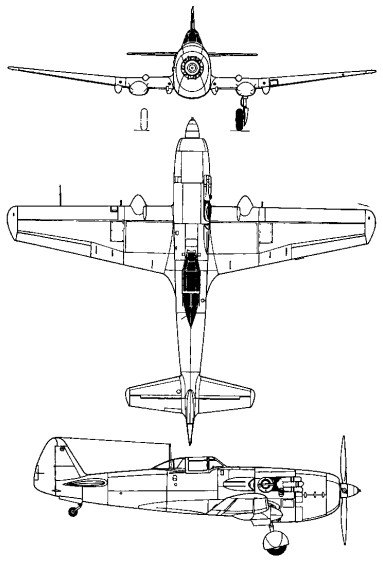
The Nakajima Ki 87 was an experimental high altitude fighter. The first and only example flew in April 1945.

Engine: 1 x Nakajima Ha-44 Model 11, 1800kW
Wingspan: 13.42 m / 44 ft 0 in
Length: 11.82 m / 38 ft 9 in
Height: 4.5 m / 14 ft 9 in
Wing area: 26 sq.m / 279.86 sq ft
Max take-off weight: 5632 kg / 12416 lb
Empty weight: 4387 kg / 9672 lb
Max. speed: 706 km/h / 439 mph
Ceiling: 12850 m / 42150 ft
Armament: 2 x 30mm cannons, 2 x 20mm cannons, 250-kg bomb
Crew: 1

Nakajima Ki-87