Best known as Nippi, original Yokohama works date from 1935. Atsugi works followed for maintenance and repair of Japanese aircraft and of U.S. Navy aircraft in region. Yokohama manufactured components/assemblies for Japanese aircraft and Boeing airliners. Has carried out YS-11EA ECM conversions (first flown 1991).
World War 2
Nieuport-Delage 622
Circa 1940.
NAF TDN / Interstate XBQ-4/TDR-1
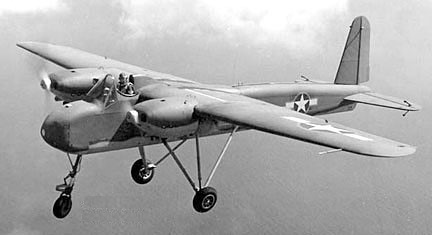
The 1943 NAF TDN was a maned or unmanned, radio-controlled, tv-directed torpedo drone. They carried ordnance loads up to a ton of bombs or torpedoes and was controlled from a “mother” aircraft in its vicinity or from ships at sea. It was able to release its weapons or be flown directly into the target.
In 1936, Lieutenant Commander Delmar S. Fahrney proposed that unpiloted, remotely controlled aircraft had potential for use by the United States Navy in combat operations. Due to the limitations of the technology of the time, development of the “assault drone” project was given a low priority, but by the early 1940s the development of the radar altimeter and television made the project more feasible, and following trials using converted manned aircraft, the first operational test of a drone against a naval target was conducted in April 1942. That same month, following trials of the Naval Aircraft Factory TDN assault drone, Interstate Aircraft received a contract from the Navy for two prototype and 100 production aircraft to a simplified and improved design, to be designated TDR-1.
Control of the TDR-1 would be conducted from either a control aircraft, usually a Grumman TBF Avenger, with the operator viewing a tv screen showing the view from a camera mounted aboard the drone along with the radar altimeter’s readout, or via a pilot on board the TDR-1 for test flights. Powered by two Lycoming O-435 engines of 220 horsepower (160 kW) each, the TDR-1 used a remarkably simple design, with a steel-tube frame constructed by the Schwinn bicycle company covered with a molded wood skin, thus making little use of strategic materials so as not to impede production of higher priority aircraft. Capable of being optionally piloted for test flights, an aerodynamic fairing was used to cover the cockpit area during operational missions. The TDR-1 was equipped with a fixed tricycle landing gear that would be jettisoned in operation after takeoff for improved performance.
In September 1942, the U.S. Navy chose DeKalb, Illinois to be the site for the manufacture of the drone TDR-1 aircraft, and built an airport on the city’s east side. This early airport consisted of an airfield and a large hangar that were fenced and guarded around the clock. DeKalb was chosen because Wurlizter, manufacturer of pianos, and known for its expertise in the production of wood products, was located there. Interstate Aircraft and Engineering Corporation (based in El Segundo, CA) assembled the planes at the new airport in DeKalb. About two hundred drones were built, tested, and boxed at the DeKalb Airport and were shipped to the South Pacific, where they were used against the enemy during World War II.
Under the code-named Operation Option, the U.S. Navy projected that up to 18 squadrons of assault drones would be formed, with 162 Grumman TBF Avenger control aircraft and 1000 assault drones being ordered. However technical difficulties in the development of the TDR-1, combined with a continued low priority given to the project, saw the contract modified with the order reduced to only around 300 aircraft. A single TDR-1 was tested by the U.S. Army Air Forces as the XBQ-4, however no production contract resulted from this testing.
In 1944, under the control of the Special Air Task Force (SATFOR), the TDR-1 was deployed operationally to the South Pacific for operations against the Japanese. Additional testing was conducted by SATFOR in July, complete with a strike against a previously beached Japanese freighter, Yumasuki Maru, including management of the flight from a 7 miles (11 km) distant TBM Avenger control aircraft, which could monitor the view from the TDRs via early television technology.
SATFOR equipped a single mixed squadron, Special Task Air Group 1 (STAG-1), with TDR-1 aircraft and TBM Avenger control aircraft; the first operational mission took place on September 27, conducting bombing operations against Japanese ships. Despite this success, the assault drone program had already been canceled after the production of 189 TDR-1 aircraft, due to a combination of continued technical problems, the aircraft failing to live up to expectations, and the fact that more conventional weaponry was proving adequate for the defeat of Japan. The final mission was flown on October 27, with 50 drones having been expended on operations, 31 aircraft successfully striking their targets, without loss to the pilots of STAG-1.
Following the war, some TDR-1s were converted for operation as private sportsplanes.
Engines: two Lycoming XA-435-4
Wingspan: approx. 50’0″
Length: approx. 36’0″
NAF N5N
The sole XN5N-1 (1521) of 1941 was a two place, open cockpit, low wing monoplane advanced trainer, with retractable undercarriage. A cockpit canopy was added later.
Engine: Wright R-760, 350hp
Wingspan: 42’0″
Length: 30’5″
Speed: 137 mph
Ceiling: 13,900 ft
Naval Aircraft Factory / NAF
USA
The U.S. Naval Aircraft Factory at Philadelphia, Pennsylvania, was authorized in 1917 and established in early 1918. Its first, and major, task was the construction of 150 Curtiss H-16 patrol flying-boats. Built improved H-16s as F-5L, as well as Hanriot seaplanes and Loening two-seat monoplanes. Original designs of NAF include the PT-1/2 torpedo seaplanes of 1922; TS-1/3 carrier-based biplane fighters of 1922; and extensively-built N3N-1/3 primary trainer biplanes, which originated in 1934 and remained in service for 27 years. Production in Second World War included 300 Vought-designed OS2 N-1 observation/scout monoplanes, and 156 Consolidated PBN Nomads (better known as the PBY Catalina).
Companhia Nacional de Navegagao Aerea HL-6
A batch of 50 HL-6 tandem two-seat low-wing monoplane trainers was begun 1943.
In 1947, improved Series B versions of the HL-1 and HL-6 appeared .
Companhia Nacional de Navegagao Aerea
Brazil
Companhia Nacional de Navegagao Aerea, took over manufacture of Muniz-designed aircraft from Companhia Nacional de Navegagao Costiera (CNNC) around 1941. Produced Muniz M-11 two-seat primary trainer, designated HL-1, with strong resemblance to Piper Cub; batch of 50 HL-6 tandem two-seat low-wing monoplane trainers was begun 1943. Other designs included HL-2 and HL-4. In 1947, improved Series B versions of the HL-1 and HL-6 appeared; the company’s activities had ceased by about 1950.
Nardi
Nardi Sa Per Costruzioni Aeronautiche
Established in Milan in 1933 by three brothers. Nardi’s first aircraft was the F.N.305 tandem two-seat lightplane, which flew in 1935 and was intended as a fighter-trainer. A1938 successor, the F.N.315, was exported to six countries, and a light-attack version was flown experimentally.
The first postwar product was the F.N.333 amphibian, a three/four-seat twin-boom design later acquired by SIAI-Marchetti and marketed from 1962 as the Riviera, and in America as the North Star amphibian.
Napier Sabre
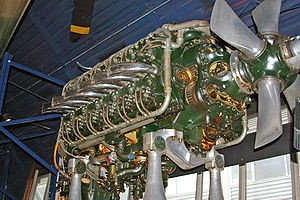
The Napier Sabre was a British H-24-cylinder, liquid-cooled, sleeve valve, piston aero engine, designed by Major Frank Halford and built by D. Napier & Son during World War II. The engine evolved to develop from 2,200 hp (1,600 kW) in its earlier versions to 3,500 hp (2,600 kW) in late-model prototypes.
Prior to the Sabre, Napier had been working on large aero engines for some time. Their Lion, had been a very successful engine between the World Wars and in modified form had powered several of the Supermarine Schneider Trophy competitors in 1923 and 1927, as well as several land speed record cars. By the late 1920s, the Lion was no longer competitive and work started on replacements.
Napier followed the Lion with two new H-block designs: the H-16 (Rapier) and the H-24 (Dagger). The H-block has a compact layout, consisting of two horizontally opposed engines, lying one atop or beside another. Since the cylinders are opposed, the motion in one is balanced by the motion on the opposing side, leading to no first order vibration or second order vibration. In these new designs, Napier chose air cooling but in service, the rear cylinders proved to be impossible to cool properly, which made the engines unreliable.
In 1927, Harry Ricardo published a study on the concept of the sleeve valve engine. In it, he wrote that traditional poppet valve engines would be unlikely to produce much more than 1,500 hp (1,100 kW), a figure that many companies were eyeing for next generation engines. To pass this limit, the sleeve valve would have to be used, to increase volumetric efficiency, as well as to decrease the engine’s sensitivity to detonation, which was prevalent with the poor quality fuels in use at the time. Halford had worked for Ricardo 1919-1922 at their London office and Halford’s 1923 office was in Ladbroke Grove, North Kensington, only a few miles from Ricardo, while Halford’s 1929 office was even closer (700 yards), and while in 1927 Ricardo started work with Bristol Engines on a line of sleeve-valve designs, Halford started work with Napier, using the Dagger as the basis. The layout of the H-block, with its inherent balance and the Sabre’s relatively short stroke, allowed it to run at a higher rate of rotation, to deliver more power from a smaller displacement, provided that good volumetric efficiency could be maintained (with better breathing), which sleeve valves could do.
The Napier company decided first to develop a large 24 cylinder liquid–cooled engine, capable of producing at least 2,000 hp (1,491 kW) in late 1935. Although the company continued with the opposed H layout of the Dagger, this new design positioned the cylinder blocks horizontally and it was to use sleeve valves. All of the accessories were grouped conveniently above and below the cylinder blocks, rather than being at the front and rear of the engine, as in most contemporary designs.
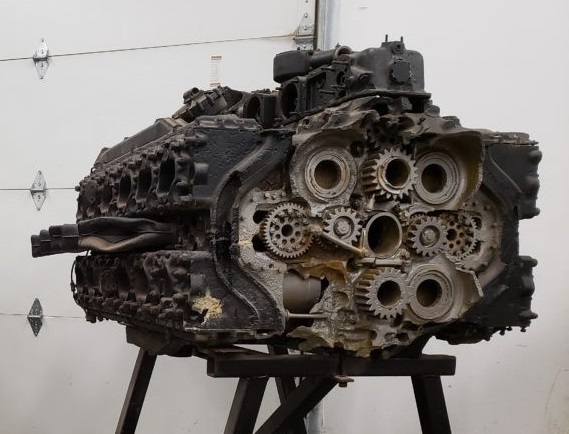
The Air Ministry supported the Sabre programme with a development order in 1937 for two reasons: to provide an alternative engine if the Rolls-Royce Vulture and the Bristol Centaurus failed as the next generation of high power engines and to keep Napier in the aero-engine industry. The first Sabre engines were ready for testing in January 1938, although they were limited to 1,350 hp (1,000 kW). By March, they were passing tests at 2,050 hp (1,500 kW) and by June 1940, when the Sabre passed the Air Ministry’s 100-hour test, the first production versions were delivering 2,200 hp (1,640 kW) from their 2,238 cubic inch (37 litre) displacements. By the end of the year, they were producing 2,400 hp (1,800 kW). The contemporary 1940 Rolls-Royce Merlin II was generating just over 1,000 hp (750 kW) from a 1,647 cubic inch (27 litre) displacement.
Problems arose as soon as mass production began. Prototype engines had been hand-assembled by Napier craftsmen and it proved to be difficult to adapt it to assembly-line production techniques. The sleeves often failed due to the way they were manufactured from chrome-molybdenum steel, leading to seized cylinders, which caused the loss of the sole prototype Martin-Baker MB 3. The Ministry of Aircraft Production was responsible for the development of the engine and arranged for sleeves to be machined by the Bristol Aeroplane Company from their Taurus engine forgings. These nitrided austenitic steel sleeves were the result of many years of intensive sleeve development, experience that Napier did not have. Air filters had to be fitted when a new sleeve problem appeared in 1944 when aircraft were operating from Normandy soil with its abrasive, gritty dust.
Quality control proved to be inadequate, engines were often delivered with improperly cleaned castings, broken piston rings and machine cuttings left inside the engine. Mechanics were overworked trying to keep the Sabres running and during cold weather they had to run them every two hours during the night so that the engine oil would not congeal and prevent the engine from starting the next day. These problems took too long to remedy and the engine gained a bad reputation. To make matters worse, mechanics and pilots unfamiliar with the different nature of the engine, tended to blame the Sabre for problems that were caused by not following correct procedures. This was exacerbated by the representatives of the competing Rolls-Royce company, which had its own agenda. In 1944, Rolls-Royce produced a similar design prototype called the Eagle.
Napier seemed complacent and tinkered with the design for better performance. In 1942, it started a series of projects to improve its high-altitude performance, with the addition of a three-speed, two-stage supercharger, when the basic engine was still not running reliably. In December 1942, the company was purchased by the English Electric Company, which ended the supercharger project immediately and devoted the whole company to solving the production problems, which was achieved quickly.
By 1944, the Sabre V was delivering 2,400 horsepower (1,800 kW) consistently and the reputation of the engine started to improve. This was the last version to enter service, being used in the Hawker Typhoon and its derivative, the Hawker Tempest. Without the advanced supercharger, the engine’s performance over 20,000 ft (6,100 m) fell off rapidly and pilots flying Sabre-powered aircraft, were generally instructed to enter combat only below this altitude. At low altitude, both planes were formidable. As air superiority over Continental Europe was slowly gained, Typhoons were increasingly used as fighter-bombers, notably by the RAF Second Tactical Air Force. The Tempest became the principal destroyer of the V-1 flying bomb (Fieseler Fi 103), since it was the fastest of all the Allied fighters at low levels. Later, the Tempest destroyed about 20 Messerschmitt Me 262 jet aircraft.
Development continued and the later Sabre VII delivered 3,500 hp (2,600 kW) with a new supercharger. The final test engines delivered 5,500 hp (4,100 kW) at 45 lb/in2 boost. By the end of World War II, there were several engines in the same power class. The Pratt & Whitney R-4360 Wasp Major four-row, 28-cylinder radial produced 3,000 hp (2,280 kW) at first and later types produced 3,800 hp (2,834 kW), but these required almost twice the displacement in order to do so, 4,360 cubic inches (71 litres).
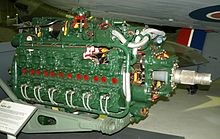
The first operational aircraft to be powered by the Sabre were the Hawker Typhoon and Hawker Tempest; the first aircraft powered by the Sabre was the Napier-Heston Racer, which was designed to capture the world speed record. Other aircraft using the Sabre were early prototype and production variants of the Blackburn Firebrand (in 21 early production aircraft), the Martin-Baker MB 3 prototype and a Hawker Fury prototype (2 built (LA610, VP207), 485 mph). The Napier also flew in Fairey Battle testbed, Folland Fo.108 testbed and Vickers Warwick prototype. The rapid introduction of jet engines after the war led to the quick demise of the Sabre, as there was less need for high power military piston aero engines and because Napier turned its attention to developing turboprop engines.
Variants:
Sabre I (E.107)
(1939) 2,000 horsepower (1,490 kW).
Sabre II
(1940) 2,300 horsepower (1,715 kW). Experimental 0.332:1 propeller reduction gear ratio.
Sabre II (production variant)
2,200 horsepower (1,640 kW). Reduction gear ratio 0.274:1: mainly used in early Hawker Typhoons.
Sabre IIA
2,235 horsepower (1,665 kW). Revised ignition system: maximum boost +9 lbs.
Sabre IIB
2,400 horsepower (1,790 kW). Four choke S.U. carburettor: Mainly used in Hawker Tempest V.
Sabre IIC
2,065 horsepower (1,540 kW). Similar to Mk VII.
Sabre III
2,250 horsepower (1,680 kW). Similar to Mk IIA, tailored for the Blackburn Firebrand: 25 manufactured and installed.
Sabre IV
2,240 horsepower (1,670 kW). As Mk VA with Hobson fuel injection: preliminary flight development engine for Sabre V series. Used in Hawker Tempest I.
Sabre V
2,600 horsepower (1,940 kW). Developed MK II, redesigned supercharger with increased boost, redesigned induction system.
Sabre VA
2,600 horsepower (1,940 kW). Mk V with Hobson-R.A.E fuel injection, single-lever throttle and propeller control: used in Hawker Tempest VI.
Sabre VI
2,310 horsepower (1,720 kW). Mk VA with Rotol cooling fan: used in 2 Hawker Tempest Vs modified to use Napier designed annular radiators; also in experimental Vickers Warwick V.
Sabre VII
3,055 horsepower (2,278 kW). Mk VA strengthened to withstand high powers produced using Water/Methanol injection. Larger supercharger impeller.
Sabre VIII
3,000 horsepower (2,240 kW). Intended for Hawker Fury; tested in the Folland Fo.108.
Sabre E.118
(1941) Three-speed, two-stage supercharger, contra-rotating propeller; test flown in Fo.108.
Sabre E.122
(1946) 3,500 horsepower. Intended for Napier 500mph tailless fighter
Napier Deltic
The Junkers Jumo Fo3 and 204 were licensed to Napier & Son, who built a small number as the Napier Culverin just prior to the war. Late in the war, they mounted three Culverins in a triangle layout to produce the Napier Deltic, which was for some time one of the most powerful and compact diesel engines in the world.
 All Aero