As a direct result of Great Britain’s experiences with the German V-1 “buzz bombs,” the USAAF considered the development of similar weapons. The MX-543 program was initiated in September 1942 to use US versions of Frank Whittle’s jet engine (US-named General Electric J31). In late 1943, Northrop was awarded an USAAF contract to design and develop a Flying Wing “Power Bomb”. Under secret Project MX-543, two Northrop Model JB-1 air vehicles were built.
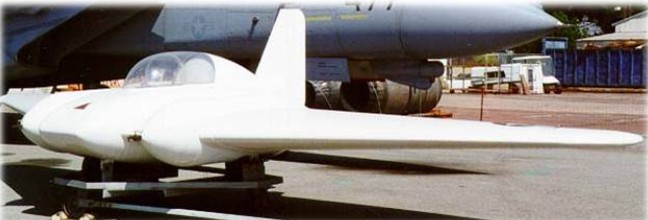
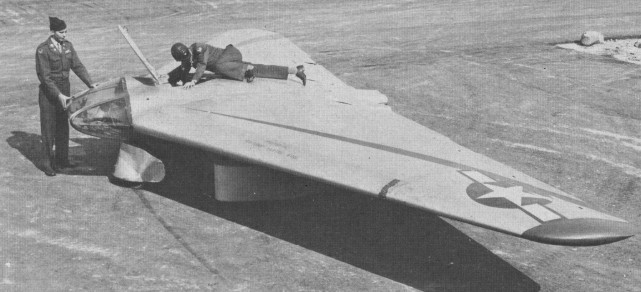
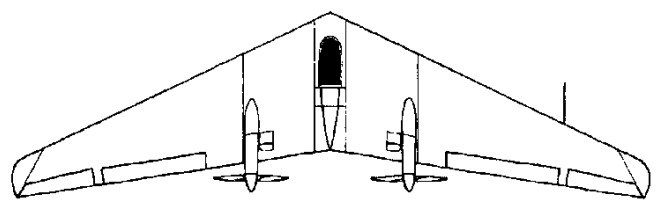
The first airframe built was the Western Museum of Flight’s JB-1 man-carrying glider. Its unusual shape earned it the name “Bat”. Except for the pilot’s cockpit and canopy, the JB-1 glider was the unpowered aerodynamic equivalent of the second version, the jet powered JB-1A. The JB-1 was used to explore the design’s flight characteristics. It was designed to aircraft standards and being made of aluminum and magnesium it was expensive.
The JB-1 piloted version was lifted aloft as a glider by means of a tow aircraft. Tow hitches are at the tips of the two bomb containers. Only one man-carrying JB-1 was built to test the flying qualities of this flying-wing design. The center section of the JB-1 glider version included two stream-lined “torpedo-shaped” bomb containers. The center section was fabricated of formed and welded magnesium alloy plate. The wing panels were made of riveted and spot-welded aluminum alloy sheet with magnesium wingtips. The pilot’s cockpit was located in the space that would be used for the jet engine installations in the unmanned JB-1A powered model.
On August 27, 1943, from Rogers Dry Lake, Northrop test pilot Harry Crosby made the initial glider flight, using airplane tows to get airborne. The machine flew satisfactorily on tow, and very nicely after cast off, but the trouble began when the pilot tried to land. It had a tricycle gear with low pressure tyres which projected just below the nose and the two side excrescences. The ground cushion was so powerful that, no matter what the pilot did, the thing would rise to about 10 feet and then stall ungraciously. The only answer any¬one could discover was to fly it firmly on at high speed.
Following the successful glider flights, the second model JB-1A was equipped with a pair of General Electric Type B1 turbojet engines replacing the pilot.
JB-1A
The JB-1A Power Bomb was designed as a ground-launched, pilotless airplane with a pre-programmed guidance system. This onboard system was to guide the Power Bomb with reasonable accuracy to a target approximately 200 miles away, at which point it was to make a terminal dive into the target zone with its bomb load. The design ordnance consisted of two 2,000-pound demolition bombs, one in each wing root container.
An unmanned JB-1 powered by an improvised General Electric B-1 turbojet with a wing span of 28 feet 4 inches (8.64 m) made its 1st flight from Eglin Field’s Santa Rosa Island, Florida, on December 7, 1944, and crashed 400 yards from the rail launcher.
Later the definitive buzz bomb was built, with a single body housing the propulsive duct and 3,7001b warhead. The 30ft span missile worked very well, but the Pentagon did not put it into the inventory.
Only 10 JB-1 airframes were built. With the successful USAAF flights of JB-2 pulsejet-powered copies of the V-1 flying bomb, the older JB-1 program was “reoriented towards pulsejet propulsion, and the remaining JB-1s were modified or completed as JB-10 missiles. Ford Motor Company provided the copy of the German V-1 pulsejet engine. Only one of the JB-10 variants was completed by the end of the war (with Ford PJ-31-1 pulsejet engine), and 1945 sled launches using 4 Tiny Tim rockets were at Muroc Field and Eglin. Finishing in June 1996, the Western Museum of Flight restored the only remaining airframe as a manned Northrop JB-1 Bat. The Western Museum of Flight’s JB-1 restoration team consisted of Rick Hilton, Alex Von Tol, and Fred Erb.
JB-10
Specifications:
JB-1 Bat Powerplant: None Wing Span: 28 ft 4 in Overall Length: 10 ft 6 in Overall Height: 4 ft 6 in Range: 670 miles Armament: None Crew: Pilot Number Built: One
JB-1A Bat Powerplants: 2 x General Electric Type B1 Turbojet, 400-lb thrust Wing Span: 28 ft 4 in Overall Length: 10 ft 6 in Overall Height: 4 ft 6 in Launch Weight: 7,080 lb Launch Speed: 160 mph Cruising Speed: 427 mph at 5,000 ft Range: 670 miles Armament: 2 x 2,000 lb bombs Crew: None Number Built: One
JB-10 Engine: 1x Ford PJ-31-1 Pulse Jet, 800 lb thrust Wing Span: 29 ft (8.8 m) Length: 12 ft (3.7 m) Height: 4′ 8” Weight: 7,080 lb Maximum Speed: 426 mph Armament: 1,826 lb War Head of high explosive Crew: None
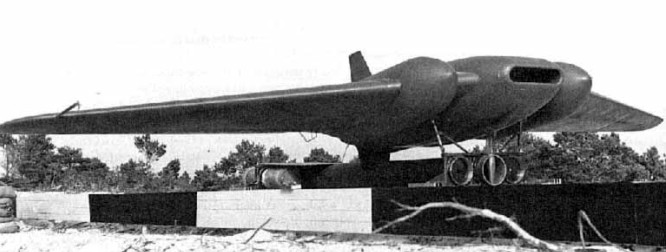
In January 1943, Northrop was awarded a USAAF contract for the design and construction of three prototypes of a highly original rocket-propelled interceptor fighter of all-wing configuration and designated XP-79. By 1944 Northrop had a range of projects stemming from the MX 324, including Ram Wing. This was a true flying wing with tip duct bellows spoilers, and a pilot lying prone to fit within the wing pro¬file and withstand violent combat manoeuvres. To be powered by a single 907kg Aerojet rocket motor, the XP-79 was to have accommodated its pilot in the prone position, but, in the event, development problems with the rocket led to cancellation of the project. However, a contract was placed for the redesign of the fighter for turbojet power, one prototype being ordered as the XP-79B.
It was schemed in various forms but the basic concept was that the wing should have a leading edge of thick magnesium endowing it with exceptional impact strength. Unlike almost every other flying machine in history the XP 79 was planned with mid air collision as a basic design case. Its four 0.50in guns were officially called “secondary”. There were still no powerful rocket motors and Northrop built the XP 79B with two of the new turbojets.
The engines chosen were the 19 inch Westinghouse Navy axials, which as the pre production J30 (model 19B) were each rated at about 1,150 1b / 619kg. This was judged enough to make the 8,670 lb XP 79B a practical proposition, and technically it was a design of exceptional interest. The pilot was accommodated in a modified cradle, stressed for sustained 12g manoeuvres, with an engine close on each side. To overcome the nose gear problem there was “a wheel at each corner”, each leg folding into the wing. After testing with no fin or with a central fin it was decided to fly with a fin above each jet. The aircraft that bore AAF serial 43 52437. It was delivered to Muroc in June 1945 to start testing with Harry Crosby as a test pilot.
Flown for the first time on September 12, 1945, after several days of preliminary tests, an incident marked the beginning of the flight when an Army Air Force fire truck crossed runway. Crosby had time to cut the power to avoid the collision, then he climbed to 10,000 feet. Crosby seemed quite at home, and flew confidently for 15 minutes. He returned to his take-off area by describing a large circle with a particularly high speed (estimated at more than 400 mph). On his second pass over the salt lake, Crosby started a climbing turn, then the Ram Wing went into an agonizingly slow roll and went straight into the ground in “a steep vertical spin”. Crosby was seen jumping at the last moment but was struck by a portion of the plane. His parachute never opened. The cause was attributed to a hard over runaway by the electric trim tab in the lateral control system. As the war was over ramming was dropped.
XP-79B Wingspan: 11.58 m / 37 ft 12 in Length: 4.27 m / 14 ft 0 in Height: 2.13 m / 7 ft 0 in Wing area: 25.83 sq.m / 278.03 sq ft Max take-off weight: 3932 kg / 8669 lb Empty weight: 2649 kg / 5840 lb Max. speed: 880 km/h / 547 mph Range: 1600 km / 994 miles Service ceiling: 40,000 ft / 12 000 m Rate of climb: 4,000 ft/mn / 1 220 m/mn Crew: 1
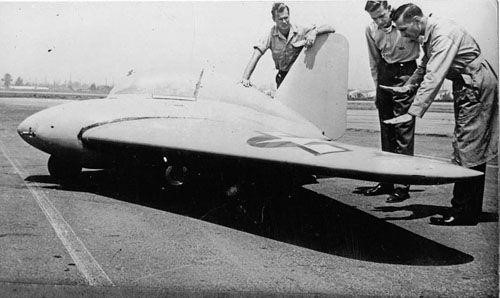
Northrop’s next flying wing project was the MX 324, planned as a research aircraft to pave the way for future flying wing fighters having jet propulsion. It was virtually a low speed glider at first, because no suitable jet power plant existed. It was also remarkably conventional, having ailerons, flaps /elevators, a minimal body and, later, a large wire braced fin. The first example had skids, and the towcar could not pull it off the ground. The second had a jettisonable trolley, which “was not a success.” The third had its own fixed tricycle landing gear, the main wheels having trousers and the nosewheel a spat. The nose leg was offset far to the left. This was because the centreline was occupied by the prone pilot, who had an interesting panel and control arrangement and rested his head in a cushioned sling inside the glass “bubble” nose. The span was about 28 feet.
Northrop went ahead with the project, under Don B Smith, in September 1942. An Army Air Force contract was awarded in January 1943 and John Myers flew the MX 324 as a glider on October 2, 1943.
By this time Northrop was talking with the infant Aerojet Engineering Corporation of Azusa, which had been formed to advance American rocketry. Their first engine planned for a manned aircraft was the XCAL 200. Though the single thrust chamber had but one thrust level, a mere 200 lb, the whole installation weighed 427 lb. This included a tank of monoethylaniline fuel, a tank of red fuming nitric acid oxidant, four gas bottles to feed the propellants, the thrust chamber and a lot of hydraulic and electric control systems. Most of it was still in bits during the first half of 1944. Early in June, the aircraft was trucked to Harper Dry Lake and static-fired on June 20. On June 22 the staked down machine was fired for the full burn time of five minutes. The next day company pilot Harry Crosby taxied under the thrust of the rocket, bringing out the need for “mods”. Finally, at dawn on July 5 Crosby smoothly rose into the cool sky on tow behind a P 38 Lightning. He cast off at 8,000 feet, paused for the tug to clear and then pressed the fire trigger on his miniature control column. It went perfectly.
The MX-334 flew under power for 3 minutes 30 seconds on 22 June 1944. On July 11 Crosby dived under power at about 350 mph to very low level before zooming up almost vertically to 6,000 feet. But the MX 324 was a bit of a dead end until new propulsion systems emerged.
Northrop Aircraft Inc was invited to submit proposals for a new pursuit aircraft (in the R 40C informal Army competition), allotted the designation XP 56, for a single engined pusher. An informal competition initiated late in 1939, the winning contractors being Vultee (XP-54), Curtiss (XP-55) and Northrop (XP-56).
Northrop began to scheme the N 2B in August 1941. A wing very similar to the N-1M, though thinner, was selected for the fighter. On each trailing edge was a single, large elevon, combining the, functions of elevator and aileron. Above each tip was a hinged spoiler for creating drag for yaw control. The fuselage was just a minimal nacelle, with a ventral fin to keep the propeller from hitting the ground.
Armament was to comprise two M 2 20mm cannon and four 0.5in Brownings, grouped in the nose, although this was never fitted. Tricycle landing gear was inevitable, the mainwheels being housed in. the lee of the large ducts that served the engine. Power was provided by a 2,000hp Pratt & Whitney R-2800-29 Double Wasp 18-cylinder radial engine buried in the rear fuselage and driving contra-rotating pusher propellers. The canopy hinged to the right, and for emergency escape the pilot was to jettison not only the canopy but also the propeller, Pratt & Whitney designing a jettison system with explosive cord surrounding the gearbox. The propeller eventually used was a Curtiss, Electric contraprop, with two three blade units. The primary structure was entirely magnesium, welded by the company’s patented Heliarc process (which sur¬rounded the are with inert helium) perfected during construction of this aircraft.
As far as possible it was based on the experience gained with the N-1M. It even retained the down sloping wing tips, though the angle was not acute and the control system was of the latest type with bellows¬ opening split “trim rudders” (i.e., ailerons) used as single surfaces for lateral control and opened into upper and lower spoilers for making properly banked turns. The actuation of these surfaces was novel. Air was rammed in through a forward facing intake on each tip, taken through a duct and diverted by valves to pressurise the bellows when required. In straight and level flight the duct was open at both ends, creating little drag.
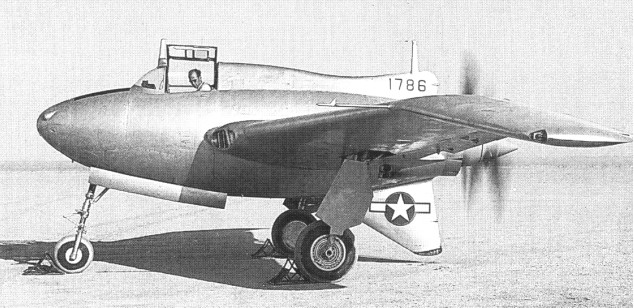
At first Northrop tried to stay as close as possible to the pure all wing concept, and planned for the pilot to lie prone, but when the Army began to talk about a prototype contract they made it clear they wanted a regular body with a conventional cockpit. Eventually they purchased two prototypes, ordered on 26 September 1940 and 13 February 1942 respectively, each having quite a fat body of symmetrical streamline form containing a 2,400 h.p. Pratt & Whitney R 2800 Double Wasp engine. Cooling the engine was, as in the N 1M, a major problem. Air was rammed in through large wing root intakes, ducted sharply in to the engine bay and allowed to escape past the baffled cylinders and out via the ejector assisted exhaust ducts. Cooling airflow was assisted by a high speed fan geared up from the engine, but to perfect the installation would have been a very large task. The unpressurised cockpit was immediately ahead of the engine, and the nose was planned for an eventual armament of two 20mm and four 0.50in guns. Elevators were fitted inboard of the tip droops, there was a large delta fin above and below the rear fuselage and the main wheels of the tricycle landing gear were housed in bays immediately behind the cooling ducts.
According to Northrop two prototypes were ordered on September 26, 1940, at a price of $411,000; other observers insist the second was not signed for until February 13, 1942. The first XP 56 was delayed by the decision of Pratt & Whitney to drop the X 1800. The R 2800 Double Wasp was already giving 2,000 h.p. while the, X 1800 did not look like maturing until after the war. The decision, was taken on, July 21, 1941, and Pratt & Whitney had to make a Double Wasp with concentric drive shafts and the jettison device (the R 2800 29), while Northrop had to rearrange, the, engine bay and central wing structure to pick up the big 18 cylinder radial and supply it with air, the latter augmented by a fan and discharged via gills ahead of the spinner. Another change was to alter the anhedral of the outer wing as a result of N-1M testing. Eventually the XP 56 emerged in March 1943. In April test pilot John Myers began taxiing tests and found directional stability unsatisfactory. Especially as speed was increased, the XP 56 by now for some – reason dubbed “The Black Bullet” tended to swerve violently, skidding the, tyres and rocking laterally. At least part of the trouble was due to the; brakes, and a new hydraulic brake system, was fitted to give smoother differential action.
After further cooling and system difficulties, the XP 56 first flew on September 30, 1943. It had been expected that the ventral fin added, to the contraprop side area would prove adequate for weathercock stability, but it was clear that directional stability was almost non existent. A larger upper fin was quickly added over the original, and from then on the handling seemed to be satisfactory. No photographs are known of the modified aircraft. In any case, USAAF 41 786 was soon written off. According to one set of writers it suffered a burst mainwheel tyre. According to another it suffered nose-wheel shimmy, leading to failure of the nose leg. For whichever reason, the aircraft somersaulted and was demolished. Myers broke his back, though his head was saved by the fact he habitually wore his polo helmet.
When the second aircraft, 42 38353, emerged the upper fin was even larger than on the modified No.1 aircraft. A further modification was that the, wingtips now carried bellows-type split ailerons for lateral and yaw control, replacing the upper and lower surface spoilers. Each tip was formed by a large venturi duct which normally sucked the split surfaces closed. For yaw control the surfaces were blown open by a bellows to which ram air from the tip duct was admitted via a diverter valve.
The second Bullet was flown by Harry Crosby from Hawthorne, on March 23, 1944. Though flight characteristics were better than for the first aircraft the engine did not deliver full power, the nosewheel would not lift off until an airspeed of 160 m.p.h. had been reached, and the flight was terminated after 7½ min. On the second flight, with gear retracted, the trim was normal but speeds were below prediction. So concerned were, Northrop at the failure to reach design speeds (the objective was 465 mph at 25,000ft), that they booked a place in the queue for the giant open jet wind tunnel of the NACA at Molfett Field. Meanwhile, testing continued, but on the tenth flight the pilot logged so many shortcomings that it was decided to discontinue further flying.
By this time the XP 56 had been outclassed by such conventional fighters as the P 51, and overtaken by the jet engine. In 1979 No 2 was still intact, held by the Smithsonian.
XP-56 Max take-off weight: 5148 kg / 11349 lb Empty weight: 3946 kg / 8699 lb Wingspan: 12.98 m / 42 ft 7 in Length: 8.38 m / 27 ft 6 in Height: 2.94 m / 9 ft 8 in Wing area: 28.52 sq.m / 306.99 sq ft Max. speed: 671 km/h / 417 mph Range: 1062 km / 660 miles Crew: 1
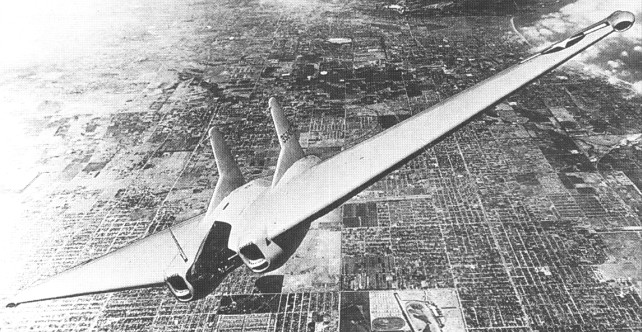
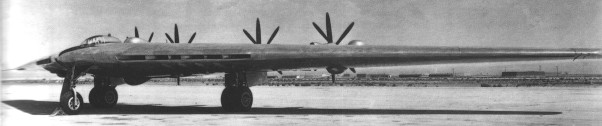
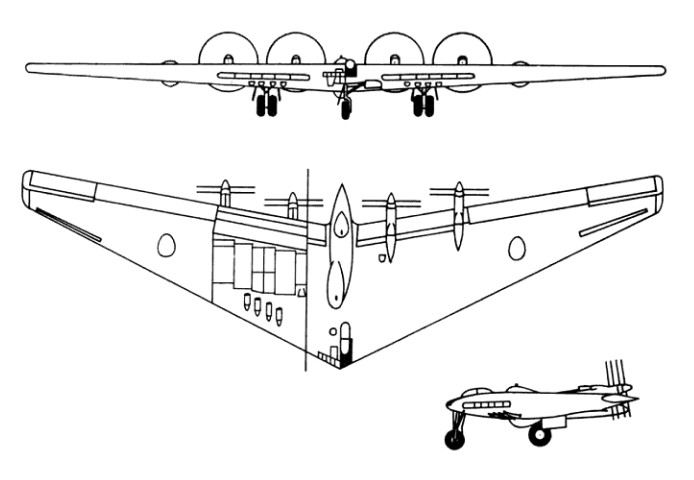
In 1941 Northrop developed a flying wing design to compete with the Consolidated Model 37. Conceptually more advanced than the B-36, the Northrop XB-35 was a low-drag flying wing with four piston engines in the wings driving contra-rotating pusher propeller units. The type was ordered in prototype form as the XB-35 in November 1941. Powered by four 2237kW Pratt & Whitney R-4360 Wasp Major piston engines driving eight-bladed counter-rotating pusher propellers behind the trailing edges of the 172-ft (52.43m) span wing they could carry a maximum bombload of 56,000 lb (25,402 kg), or a 20,000-lb (9072-kg) bombload over a radius of only 2500 miles (4023 km). The XB-35 was faster than the XB-36 (especially at lower altitude), possessed a usefully higher service ceiling, and was also considerably more agile than the XB-36.
There had been problems with the prototype, but these were concerned with factors such as the propeller gears stripped, blade pitch reversed in flight, propellers ‘ran away’, uncontrollable fires started, rather than the structure and flight characteristics of the basic airframe.
The first of 15 YB-35 aircraft ordered in early 1943, flew on 25 June 1946, followed by the second in the following year. With the B-36 slated for production, it was then decided to use the design for the evaluation of jet power in a strategic bomber the production contract was cancelled.
The second and third YB-35 pre-production prototypes were converted into YB-35B aircraft: their four 3250-hp (242 3-kW) Pratt & Whitney R4360 piston engines were replaced by eight 4000-lb (1814-kg) thrust Allison J35-A-5 turbojets, a quartet of the jets being grouped in each trailing edge and aspirated through the same arrangement of leading-edge inlets used to supply carburation and cooling air for the piston engines of the original aircraft.
The YB-35B was redesignated YB-49 while it was being rebuilt, and the first aeroplane flew in October 1947.
Engines: 4 x Pratt & Whitney R-4360 Wasp Major, 2624kW / 3250 hp Max take-off weight: 76340 kg / 168302 lb Wingspan: 52.4 m / 171 ft 11 in Length: 16.2 m / 53 ft 2 in Wing area: 372 sq.m / 4004.17 sq ft Max. speed: 605 km/h / 376 mph Range: 4023 km / 2500 miles Bombload: 20,000 lb / 9072 kg Crew: 9
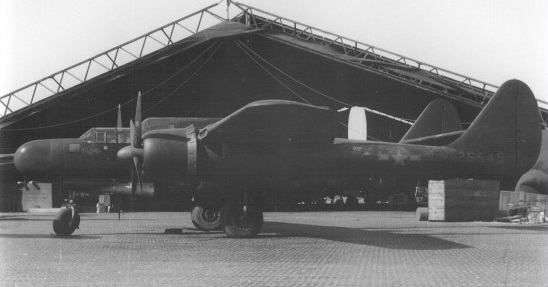
The Northrop P-61 Black Widow began in August 1940, at the height of the Blitz on London. During this time, the US air officer in London, Lt. Gen. Delos C. Emmons, underwent a briefing on British progress on radar. British scientists and engineers were at that time working on the early versions of AI (Airborne Interception) radar sets which could be carried aboard airplanes, enabling them to detect and intercept other airplanes in flight without having to rely on ground installations.
At the same time, the British Purchasing Commission that was shopping for aircraft in the USA announced that they urgently required a night fighter that would be capable of stopping the German bombers that were attacking London by night. Such a fighter would have to be able to stay on station above London all night, which meant at least an 8-hour loiter time. In addition, the night fighter needed to have sufficient combat altitude in order to take on the bombers when they showed up.
When General Emmons returned to the USA, he reported that the British had an urgent need for night fighter aircraft, and that American industry might be able to supply that need. A preliminary specification was drawn up by the Emmons Board and was passed on to Air Technical Service Command at Wright Field in late 1940. Because of the heavy weight of the early AI radar and because of the high loiter time required, a twin-engined aircraft was envisaged.
Northrop Chief of Research Vladimir H. Pavlecka happened to be at Wright Field at that time on an unrelated project, and was told of the Army’s need for night-fighters. However, he was told nothing about radar, only that there was a way to “see and distinguish other airplanes”. He returned to Northrop the next day. On October 22, Jack Northrop met with Pavlecka and was given the USAAC’s specification. At this time, no other company was known to be working on night fighters, although at about this time Douglas was starting work on their XA-26A night fighter and the AAC were considering the A-20B as an interim night fighter.
Northrop’s proposal was a twin-engined monoplane powered by a pair of Pratt & Whitney R-2800 Double Wasp air-cooled radial engines mounted in low-slung nacelles underneath the wings. The nacelles tapered back into twin tail booms which were connected to each other by a large horizontal stabilizer and elevator. The long fuselage housed a crew of three. The crew consisted of a pilot, a gunner for the nose turret, and a radar operator/rear turret gunner. Each turret housed four 0.50-inch machine guns. A tricycle landing gear was fitted. Estimated weights were 16,245 pounds empty, 22,654 pounds gross. Height was 13 feet 2 inches, length was 45 feet 6 inches, and wingspan was 66 feet. These dimensions and weights were more typical of a bomber than a fighter.
On November 14, Northrop presented this revised design to the USAAC. An additional gunner’s station was fitted. Nose and tail turrets of the original version were replaced by twin 0.50-in machine guns in the belly, and four 0.50-in machine guns in a dorsal turret. The crew was now up to four-a pilot, a radar operator, and two gunners. The airborne intercept radio was moved to the nose.
The design was revised still further on November 22. The belly turret was deleted, and the crew was changed back to three-pilot, gunner, and radar operator. The pilot sat up front, and the gunner sat immediately behind and above the pilot. The gunner was to operate the turret via remote control, using a special sight attached to a swiveling chair. A “stepped-up” canopy was used to provide a clear field of view for the gunner. The rear fuselage with its clear tail cone provided the radar operator with an excellent rearward view which enabled him to act as a tail gunner if the plane happened to be attacked from astern. Optionally, the dorsal turret guns could be “locked” into the forward-pointing position, so that they could be fired by the pilot. The belly guns were deleted, and four 20-mm cannon were to be fitted in the wings. This design was formalized into Northrop Specification 8A (or NS-8A), dated December 5, 1940.
Incorporated into the night fighter design was the Zap wing and Zap flap, named after Edward Zap, a Northrop engineer. These were attempts to increase the maximum lift coefficient and to decrease the landing speed by the use of improved lateral control and lifting devices
NS-8A was submitted to Wright Field. The Army was generally pleased with the design, but they suggested some changes. A letter of quotation prepared by Northrop for two experimental prototypes was presented to Materiel Command on December 17, 1940. Northrop signed the formal contract on January 11, 1941. A contract was let on January 30, 1941 for two prototypes and two wind-tunnel models. On March 10, 1941, a contract was issued for 13 YP-61 service test aircraft, plus one engineless static test airframe.
The mockup was ready for inspection in April of 1941. At that time, it was decided to move the four 20-mm cannon from the outboard portion of the wings to the belly. This was done to improve the ease of maintenance and to make the airflow over the wing smoother. The internal fuel capacity was increased from 540 gallons in two tanks to 646 gallons in four self-sealed tanks built into the wings.
In the meantime, development of the A/I radar had proceeded at a rapid pace. Radar development in the United States had been placed under the control of the National Defense Research Committee. The NDRC’s Microwave Committee in turn had established the Radiation Laboratory at the Massachusetts Institute of Technology. The Radiation Laboratory was to handle the development of the XP-61’s airborne interception (AI) radar. The designation of the radar was AI-10. The AI-10 radar was given the military designation SCR-520, where SCR stood for “Signal Corp Radio” (some references have this as standing for “Searchlight Control Radar”). The Western Electric corporation was assigned the responsibility of refining the design and undertaking the mass production of the radar.
In October 1941, a pedestal-type mount for the turret guns was substituted for the General Electric ring-type mount.
A letter of intent was initiated on December 24, 1941, which called for 100 P-61 production aircraft and spares. Fifty more were ordered on January 17, 1942. The order was increased to 410 aircraft on February 12, 1942, fifty of which were to be diverted to the RAF under Lend-Lease. The RAF order was eventually cancelled. The XP-61 flew at Northrop Field for the first time on May 26, 1942, piloted by contract test pilot Vance Breese. It was powered by a pair of Pratt & Whitney R-2800-10 radials of 2000 hp each. In keeping with its nocturnal role, it was finished in black overall, befitting its popular name that was taken from the poisonous North American spider. Wingspan was 66 feet, length was 48 feet 10 inches, and height was 14 feet 2 inches. Weights were 19,245 pounds empty, 25,150 pounds gross, and 28,870 pounds maximum. The aircraft was equipped with only a mockup of the top turret, as General Electric had not yet been able to deliver the real thing because of the higher priority of other projects.
The XP-61 had a maximum speed of 370 mph at 29,900 feet, and an altitude of 20,000 feet could be attained in 9 minutes. Service ceiling was 33,100 feet, and maximum range was 1450 miles.
In mid-June 1942, a new horizontal tail was designed to complement the full-span flaps. Eventually, the Zap flaps were completely eliminated because of their high cost and complexity of manufacture, and spoilers were added to supplement the conventional ailerons. The spoilers were located in the rear one-third of the wing, and were one of the most successful innovations introduced during the entire Black Widow program. Operating in conjunction with the conventional ailerons, the spoilers provided the desired rolling moment at speeds even below the stalling speed. Although the spoilers were fully capable of providing all necessary lateral control on their own, the ailerons were nevertheless still left on the airplane if only to provide “warm fuzzies” to pilots who were used to conventional ailerons.
On May 25, 1942, an agreement was reached between Northrop and the USAAC to produce 1200 P-61s at a government facility in Denver, Colorado. By the end of July, that order had been cut down to 207 aircraft and it was decided that the Northrop facilities at Hawthorne were to be used after all.
The thirteen YP-61s were delivered during August and September of 1943. In order to reduce vibrations from firing the 0.50-inch turret machine guns, some YP-61s were fitted with only two turret guns. The assignments of the YP-61s were varied. Some stayed at Northrop for flight testing and factory training of maintenance personnel. Some went to Wright Field in Ohio for service testing. Others went to Florida where they underwent operational suitability testing.
The YP-61s initially did not have any airborne interception radar fitted, but the SCR-520, a preproduction version of the SCR-720 which was to go into the production P-61A, was installed.
Northrop P-61A-5NO 42-5549, 9th AF
It made its operational debut in the South Pacific in the summer of 1944 and was the standard USAAF night fighter at the end of the war. Unlike other USAAF fighters such as the P-47 Thunderbolt or P-51 Mustang, the Black Widow did not chalk up a particularly impressive number of kills, because by the time of its entry into service, the Allies had already established almost overwhelming air superiority over virtually all fronts, and enemy aircraft were rather few and far between, especially at night.
The F-15A two-seat strategic reconnaissance variant first flew in 1946.
P-61A Engines: 2 x Pratt & Whitney R-2800-10, 2000 hp Wingspan: 66 ft / 20.12 m Length: 48 ft 11 in / 14.92 m Height: 14 ft 8 in / 4.49 m Empty weight: 24,000 lb / 10,886 kg Max loaded weight: 32,400 lb / 14,696 kg Max speed: 366 mph / 590 kph ROC: 2200 fpm / 670 m/min Service ceiling: 33,000 ft / 10,060 m Range max fuel: 500 mi Armament: 4 x 20mm M-2 cannon (belly), plus in first 37 A: 4 x 0.5in dorsal
P-61B Engines: 2 x Pratt & Whitney R-2800-65 Double Wasp, 1491kW / 2219 hp Wingspan: 20.12 m / 66 ft 0 in Length: 15.11 m / 49 ft 7 in Height: 4.47 m / 14 ft 8 in Wing area: 61.53 sq.m / 662.30 sq ft Max take-off weight: 16420 kg / 36200 lb Empty weight: 10637 kg / 23451 lb Max. speed: 589 km/h / 366 mph ROC: 2200 fpm / 670 m/min Ceiling: 10090 m / 33100 ft Range: 2173 km / 1350 miles Range max fuel: 2800 mi / 4500 km Bombload: 6400 lb Armament: 4 x 20mm M-2 cannon (belly), plus in last 250 B: 4 x 0.5in dorsal Crew: 3
P-61C Engines: 2 x Pratt & Whitney R-2800-73, 2800 hp Wingspan: 66 ft / 20.12 m Length: 49 ft 7 in / 15.1 m Height: 14 ft 8 in / 4.49 m Empty weight: 24,000 lb / 10,886 kg Max loaded weight: 40,300 lb / 18,280 kg Max speed: 430 mph / 692 kph ROC: 3000 fpm / 914 m/min Service ceiling: 41,000 ft / 12,560 m Range max fuel: 2800 mi / 4500 km Bombload: 6400 lb Armament: 4 x 20mm M-2 cannon (belly), 4 x 0.5in dorsal
F-15 2 seat strategic reconnaissance Engines: 2 x Pratt & Whitney R-2800-73, 2800 hp Wingspan: 66 ft / 20.12 m Length: 50 ft 3 in / 15.3 m Height: 14 ft 8 in / 4.49 m Empty weight: 22,000 lb / 9979 kg Max loaded weight: 28,000 lb / 12,700 kg Max speed: 440 mph / 708 kph ROC: 3000 fpm / 914 m/min Service ceiling: 41,000 ft / 12,560 m Range max fuel: 4000 mi / 6440 km Armament: none
Faced with the distinct possibility of a British defeat in the war in Europe, America’s most pressing need in 1941 was for a bomber with intercontinental range which could strike Germany and return home. The US Army gave the go ahead for an aircraft which spanned 52.4 m (172 ft), had a gross weight of 78,845 kg (165,000 lb) and could carry a 23,225 kg (51,200 lb) bombload. Four 3000 hp Pratt & Whitney Wasp Major engines driving contra rotating pusher propellers powered the aircraft which had a crew of 15 and was to have been defended by 20 remotely controlled 12.7mm (0.5 in) machine guns.
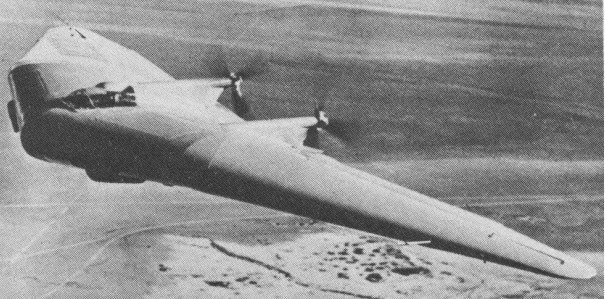
By mid 1941 Northrop was well advanced with a far more ambitious design based on the encouraging results obtained with the N-1M. This design was for a flying wing bomber.
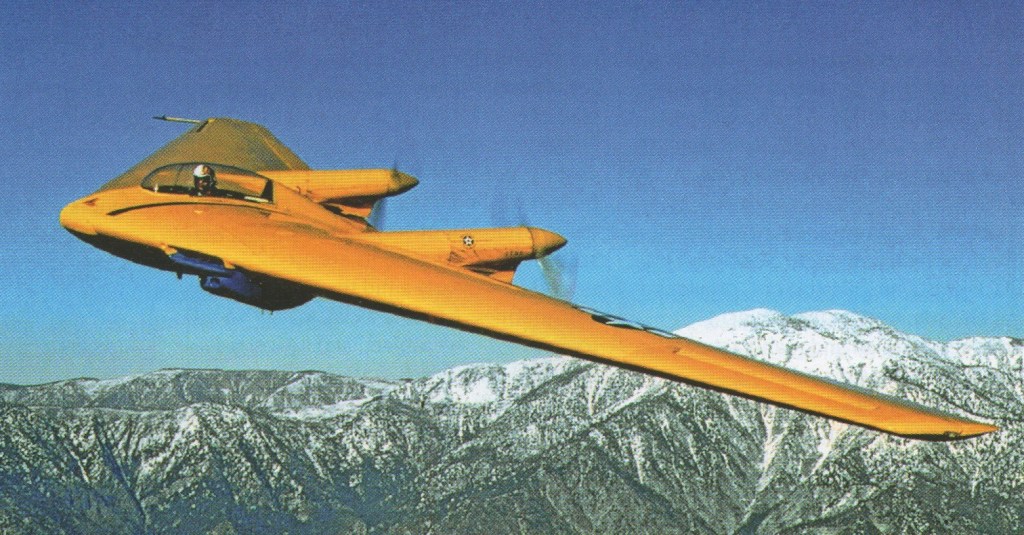
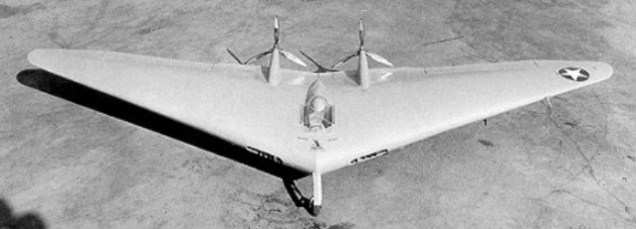
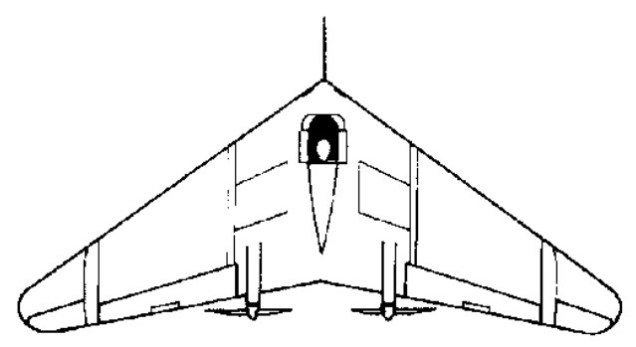
The scale model of the bomber was designated N 9M. This was approximately a one third linear scale of the great bomber, and thus weighed about 1/27th as much, the actual weight being of the order of 7,100 lb. The first two aircraft, and the third (designated N 9M A), had two 275 hp Menasco Buccaneer engines driving pusher propellers positioned midway between the thrust lines of the four propellers of the bomber; the fourth aircraft, designated N 9M B, had two 300 h.p. Franklins. The fact that four aircraft were needed is explained by the sheer volume of work that had to be accomplished. Not only was the definitive form of surface system controls and flaps far from settled, but there were also extensive development programmes for autopilot and other systems, while concurrently exposing the aircraft to the hands of the greatest possible number of Army test pilots in order both to acquire critical feedback from the customer and also allay a whole string of fears about how all wing aircraft behaved.
N9MB
The first N 9M was flown on December 27, 1942. After about 30 encouraging hours it crashed, killing the pilot. Nobody had the slightest indication of what happened. Northrop could not find evidence of in flight failure and decided the pilot must have got into a spin at low level. The other three N 9Ms gave no trouble at all, and in the course of many hundreds of hours were stalled and spun even with c.g. at the aft limit.
A three-year test programme was flown from Muroc Army Air Base, providing much data and giving pilots experience in the handling and performance of flying wings, and the autopilot for the XB-35 was developed in an N-9M. All N-9Ms had retractable landing gear and varying colour schemes; the first two were all yellow, the third (N-9MA) was blue on top and yellow underneath, while the fourth (N-9MB) had the colour reversed. The colours identified the top or bottom of the aircraft during observations of the flight programme.
N 9M A Engines: two 205kW / 275 hp Menasco Buccaneer
N-9MB Engines: 2 x Franklin 224kW / 300 hp Max take-off weight: 3200 kg / 7055 lb Wingspan: 18.3 m / 60 ft 0 in Length: 5.3 m / 17 ft 5 in Wing area: 46 sq.m / 495.14 sq ft Crew: 1
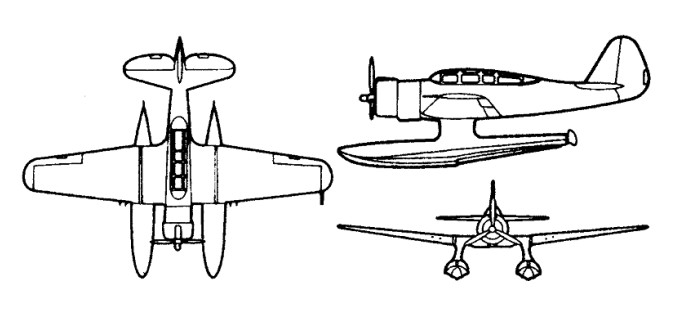
In 1940 Northrop received an order from a Norwegian Buying Commission for the design and construction of a single-engine monoplane patrol bomber with twin floats. The Norwegian order covered 24 aircraft, and in less than eight months the Northrop N-3PB prototype flew, on 1 November 1940, powered by an 895kW Wright Cyclone GR-1820 radial engine. It attained a speed of 414km/h and was then claimed to be the world’s fastest military seaplane.
Norway was invaded by the Germans shortly after the contract had been awarded, and the N-3PBs were delivered to a unit of the Royal Norwegian Naval Air Service, operating as an RAF unit from unimproved coastal sites in Iceland on anti-submarine patrol and convoy escort duties. All maintenance had to be performed in the open, often under extremely harsh environmental conditions, and during 19 months of 1941-42 several were lost during water landings in severe arctic weather, but there were no losses due to enemy action.
An aircraft was destroyed as late as 1965, in the collapse of a snow-laden hangar, but in the early 1980s an N-3PB was located and restored in Norwegian colours by the manufacturers.
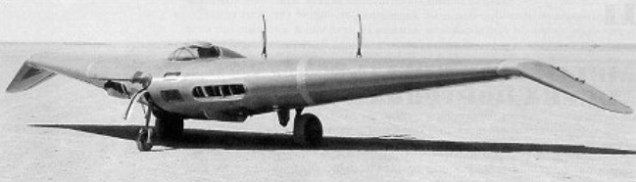
Northrop began to build one flying wing in 1939, designating it N 1M (Northrop model Mock up). Essentially it was just a 38 foot stressed skin wing, with a very fat section (and as much camber underneath as on top) and a slightly swept back shape. The upper surface had very slight dihedral, so that there was quite sharp dihedral on the underside, but the tips sloped sharply downwards so that the ailerons, which were entirely out¬board of the kink, could also serve as rudders. On the trailing edge were powerful elevators incorporating trim¬ming tabs. The pilot sat close to the centre of gravity, his head projecting above the upper surface under a small canopy and his forward vision being improved by four small windows in the remarkably fat leading edge. Just outboard of these windows were intakes for the cooling air for the two 65 hp Lycoming engines, which were buried in the wing and drove pusher propellers through 10 foot shafts housed in fairings which made no contribu¬tion to lift but which Northrop could not avoid. The N 1M rode on a short wheelbase retractable tricycle landing gear, with a long fixed tailwheel added to, keep the propellers from touching the ground.
Northrop bore most of the costs of building it himself, but in view of its long term importance he did not invite the press in to have a look at it. Indeed he had already come to the conclusion that the ideal role for an all wing machine was that of a long range bomber, and had discussed the possibility with the Army Air Corps and with the top technical staff at Wright Field. They were extremely interested, and it was agreed that the N-1M should be kept under wraps.
In May 1940 the completed machine was painted bright yellow, registered as NX 28311 and trucked by night from the plant at Hawthorne to the very new Army test base at Lake Muroc out in the remote Mojave Desert. Pilot Vance Breese tried taxying and then, on July 3, cautiously lifted off and held the yellow wing as close to the ground as he could as someone said, “to make the crash a bit easier”. Northrop’s comment was “It looks like we have a plane with a twenty foot ceiling”, but of course Breese later made proper flights which on the whole were remarkably successful. There was no catastrophic accident, and the N-1M explored a wide range of configurations with different planform, dihedral, tip shape, c.g. location and, most important of all, control system. Soon it was flying much faster with 117 h.p. Franklin 6AC 264 F2 engines driving three blade v p propellers.
The N 1M really flew extremely well, in the hands of several pilots (notably Moye Stephens), and the only persistent difficulty was the cooling of the engines. Ordinary flying had by mid 1941 become a safe and routine operation, with the whole design envelope, including stalls and spins, fully explored in 200 flights. The only control “problem” was that it took a long time to find the best arrangement to control yaw (weathercocking of the nose, for example, due to asymmetric thrust). The original idea of using the ailerons on the down turned tips to serve as rudders was not wholly adequate, and eventually Northrop considered the best answer was to eliminate the kinked tips and make the ailerons in the form of split upper and lower halves which could be opened to act as a powerful brake. With just one aileron thus opened there would be an extremely potent yawing moment amply capable of holding any asymmetric condition.
The N-1M has survived in the US National Air and Space Museum.
N-1M Engine: 2 x Lycoming, 48kW / 65 hp Max take-off weight: 1360 kg / 2998 lb Wingspan: 11.6 m / 38 ft 1 in Length: 5.2 m / 17 ft 1 in Wing area: 28 sq.m / 301.39 sq ft Crew: 1
In 1916, while working for the Loughead Aircraft Company (later Lockheed), he co-invented a process for making monoplane fuselages and helped design the F-1 flying boat. He became chief engineer at Lockheed in 1927 and built the Vega monoplane. With the help of designer Jack Northrop, Lockheed built the F1, but it was turned down by the Navy. In 1923 Northrop left to take a job with Donald Douglas, and later founded his own corporation.
Jack Northrop (1895-1981) was employed by United Aircraft and Transport Corporation. All went well until United decided Northrop should leave Burbank and join another United division. He remained in California to form a new company. In July 1929 Jack Northrop formed Northrop Aircraft Corp, as a division of United Aircraft and Transport Corporation and built the Alpha (first flown 1930), first all-metal stressed skin airplane, followed by the Beta 300 hp aircraft of 1931, first to exceed 200mph (322kmh).
New Northrop Corporation founded after split with United Aircraft and Transport Corporation, with Douglas Aircraft holding a majority shareholding.
Producing the Gamma high-speed mailplane in 1933 and other types. Northrop Corporation absorbed into Douglas 1937, and new independent Northrop Aircraft Inc established 1939 to concentrate on military projects, including the A-17 attack-bomber and P-61 Black Widow three-seat, twin-boom night fighter, first aircraft in this category to be ordered by USAAF. Northrop experiments with the tailless XP-56 interceptor led to a number of postwar flying-wing projects, culminating in eight jet engined YB-49 flying-wing bomber of 1947. The F-89 Scorpion all-weather fighter entered production two years later, serving USAF and Air National Guard Units until 1963.
Extending its activities into other fields, the company changed its name to Northrop Corporation in the year 1959. In May 1994 Grumman and Northrop merged to form Northrop Grumman Corporation. Northrop’s final pre-merger production aircraft included the F-5E/F Tiger II lightweight tactical jet fighter/fighter trainer, developed with U.S. Government funding mainly for export as International Fighter Aircraft (first F-5E flown August 1972), derived from the 1959 N-156 prototype and early production F-5A/B Freedom Fighters built for supply under Military Assistance Programs. The T-38 Talon two-seat advanced trainer variant of N-156 for the USAF (first flown April 1959) went out of production in 1972 after 1,187 had been built, but these are being modernized to T-38C standard for redelivery from 1999 by Northrop Grumman. Northrop developed the YF-17 Cobra for competition against the Lockheed YF-16 for the USAF’s Lightweight Fighter Program, but lost and became principal subcontractor to McDonnell Douglas on a proposed carrier borne naval fighter derivative. This eventually entered production as the carrier- and land-based F/A-18 Hornet. Finally developed the B-2 Spirit subsonic strategic stealth bomber (first flown July 1989) for the USAF. Two of the five main divisions of Northrop Grumman Corporation were Commercial Aircraft, to construct aerostructures and components for the commercial aircraft of other companies and engines, and Military Aircraft Systems, working on B-2 and all other Northrop Grumman aircraft production and modernization programs, and principal subcontractor to Boeing on Hornet. Delivered 21 B-2A Spirit stealth bombers, achieving initial operational capability with the USAF in April 1997 and full capability with the 715th Bomb Squadron in 1999. Undertakes F-5/T-38 modernization, F-14 work, EA-6B Prowler remanufacturing, production of E-2C Hawkeye in latest Hawkeye 2000 form (first flown April 1998; see Grumman entry for earlier development and production of E-2), and production of E-8C Joint STARS as joint USAF and U.S. Army co-operation program for an airborne surveillance and target acquisition system (first flown August 1995 for first production E-8C).
In 2000, Northrop Grumman is to sell its commercial aerostructures arm to the Carlyle Group for $1.2bn. NG was planning to specialise in the defence electronics and IT industries and its aerostructures business, which manufactures subassemblies for Boeing commercial aircraft, the C-17 and Gulfstream V, no longer fits the bill. Carlyle will rename the Dallas, Texas-based company Vought Aircraft and NG will reorganise its Integrated Systems and Aerostructures sector into the Integrated Systems Sector. NG, which recently acquired Comptek Reseach, has also cited expected decline in Boeing production schedules as one of the reasons for the sale. The Carlyle Group, however, has been active in the aero-manufacturing sector having purchased Textron’s aerostructures unit four years previous and buying out Gemini Air Cargo in 1999.











 All Aero