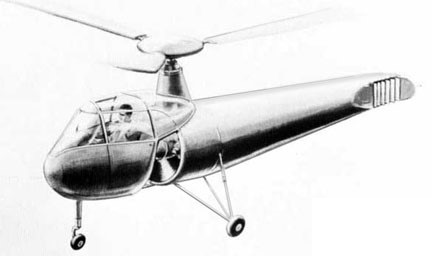
PV-1 1940 – Frank Piasecki and his P-V Forum’s first design was to be a single-rotor helicopter with a fan-forced, anti-torque system blowing air through the tail cone, and turned by control vanes in the exit, predating the NOTAR* by several decades. PV-1 was not developed beyond the design stage due to high development risk at the early stage of helicopter design. *Acronym for “No Tail Rotor” technology whereby the tail rotor was replaced as anti-torque control by a swiveling exhaust duct at the end of a hollow tail boom.
Towards the end of 1943, Frank Nicholas Piasecki also appeared on the scene. Piasecki had worked for the Kellett Autogyro Company and Budd Aircraft. He had previously been involved in development of the Platt-LePage XR-1 and had undertaken a small-scale project of his own. Frank N. Piasecki, President of the PV-Engineering Forum, an organization he formed with F.M.Vinsie and Elliott Daland for the purpose of building his helicopter. Records show he is the first American to be granted a license to fly a helicopter before first qualifying to fly a conventional airplane. He did, however, previous to flying his own helicopter design, get in some flying time in a light plane. This helped him, too, in building the PV.
P-V Engineering Forum had completed several rotary-wing contracts for NACA and the U.S. Navy. The latter ordered an XHRP-1 helicopter which flew in 1945; following successful tests it was placed in production. Further orders followed for XHJP-1 tandemrotor helicopters for USN shipboard operations and the large XH-16, which had a fuselage of DC-4 size.
P-V Engineering became Piasecki Helicopter Corp in 1946, formed by Frank Piasecki, who was concerned in development of vertical-lift aircraft and flew the Model 59K Sky-Car flying jeep with an Artouste turboshaft engine in 1958 under a US Army contract.
Technical interchange agreements signed with Breguet Aviation in 1957 included sales rights for that company’s STOL transports in the U.S.A. and Canada, but these were dropped in 1962. Also provided engineering assistance to Agusta from 1960 for the AZ-101G and AZ-105 helicopters.
Built prototype of PiAC 16H-1C Pathfinder compound helicopter in 1962, continuing development under a U.S. Navy contract, but no production. Work included developing vectorod-thrust ducted propeller system for attack helicopters under U.S Army contract, definition of a possible U.S. Marine Corps medium-lift replacement type, and marketing the PZL Swidnik W-3A in the Americas and Pacific Rim regions.
After F N Piasecki was forced out of his company in 1955, he founded Piasecki Aircraft Corp, and his original company became Vertol Aircraft Corp, which in turn became a division of Boeing Co in 1960.
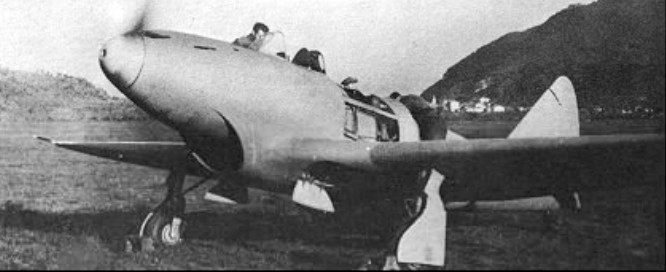
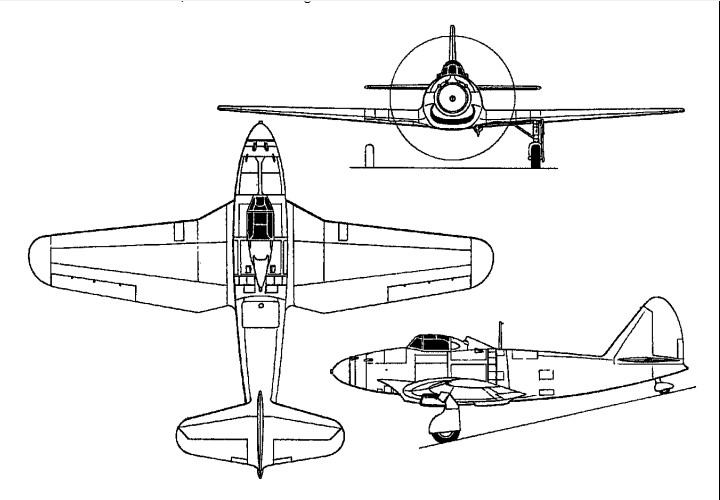
Flown for the first time on 19 December 1942 from the company’s Villanova d’AIbegna airfield, the Piaggio P.119 was an all-metal low-wing monoplane single-seat fighter with a slim fuselage. This was made possible by enclosing the 1230kW Piaggio P.XV RC.45 radial engine in the fuselage behind the pilot’s fully enclosed cockpit, the three-blade propeller being driven by an extension shaft. The clean lines were broken only by the engine air intake located beneath the fuselage, forward of the wing. It was intended to be re-engined with a RC50 of 1,650hp. Proposed armament was four nose-mounted 12.7mm machine-guns and one 20mm cannon firing through the propeller hub.
Test flights indicated a maximum speed of 620 km/h but the aircraft was plagued by engine vibration problems and after relatively slight damage suffered during a landing accident, on 2 August 1943, further development was abandoned and no attempt made to repair it.
Engine: 1 x Piaggio P.XV RC.45, 1230kW Max. speed: 620 km/h Armament: 1 x 20mm cannon, 4 x 12.7mm machine-guns
SA Piaggio & Co, an engineering and shipbuilding company, produced some Caproni aircraft and parts during the First World War at a Finale Ligure factory, but subsequently abandoned aircraft manufacture until it took over Pegna & Bonmartini in 1923. First product was the Piaggio-Pegna pursuit monoplane with Hispano-Suiza engine. Later was associated with Societa di Costruzioni Meccaniche Aeronautiche in license-construction of Domier Wal flying-boats. Built P.32 twin-engined heavy bomber at end of 1930s and several four-engined P.108 heavy bombers during Second World War.
Resumed aeronautical work in late 1946 with conversion of Dakotas for airline service. Built P.136 five-seat twin-engined amphibian, prototype flying in 1948, followed by a series of trainers for the Italian Air Force; the P.149 was also license-built by Focke-Wulf in Germany. Produced the P.166 executive transport in 1957, with two Lycoming engines and pusher propellers, as with the P.136; P.166-DL3 turboprop variant later developed and produced, with final P.166-DL3-SEM Maritime variant for search and surveillance, coastal patrol and other roles still available in 1998, but only to special order. Signed agreement with U.S. Douglas company in 1961 for joint development of light utility aircraft, first flown in 1964. Designated PD.808 and powered by two Bristol Siddeley Viper turbojets, only a small number was built.
The present Rinaldo Piaggio company was formed in February 1964 as a separate concern, but in 1994 was put under insolvency protection; 51 percent shareholding in the company was purchased by Tushav, a Turkish holding company, in mid-1998, and protection was thereafter lifted. P.180 Avanti twin-pusher turboprop business aircraft flown September 1986, but only 43 production aircraft ordered; turbofan derivative may be developed. Has manufactured components for Aeritalia/Alenia, AMX International, Dassault and Panavia. In 1998 three Italian industrial families bought the debt-free assets from the Government and formed Piaggio Aero Industries SpA.
In 2024 Italy approved the sale of Piaggio Aerospace to the Turkish unmanned combat aerial vehicle (UCAV) producer Baykar. In 2023, Baykar ranked among the top 10 exporters in Türkiye across all sectors, racking up $1.8 billion in exports. Türkiye dominates 65% of the global unmanned aerial vehicle (UAV) export market, with Baykar alone holding nearly 60% of the market – three times the size of its closest US competitor. In recent years, Baykar has generated more than 90% of its revenues from exports, delivering Bayraktar TB2 UCAVs and Bayraktar AKINCI UCAVs to 35 countries.
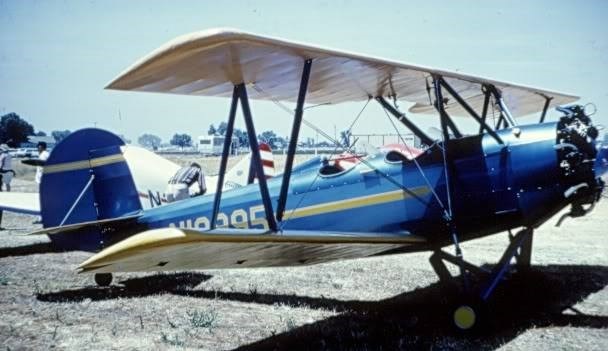
Argentina Took over production of El Boyero two-seat light monoplane from the Instituto Aerotecnico in late 1940s, and built 160 to government contracts for flying clubs and schools.
In 1935 Tupolev initiated work on a smooth skinned, four engined high altitude bomber which, while developed from the TB 3, was much more modern, with an oval section fuselage, retractable undercarriage and enclosed positions for the crew. Designated TB 7 (ANT 42), it is better known as the Pe 8 after V M Petlyakov, who undertook its further development.
The first prototype flew on 27 December 1936.
Production Pe-8 were well armed, carrying two 7.62mm machine-guns in a spherical nose turret, two machine-guns or a 20mm cannon in a dorsal turret, one hand-operated 12.7mm machine-gun in the rear of each inboard engine nacelle under the wing trailing edge and a 20mm cannon in a tail turret, plus up to 4,000kg of bombs stowed internally.
Initially the Pe-8 was powered by four 820kW M-105 engines and entered service in this form in 1940. The 1941 model had 1,080.5kW Mikulin AM-35A fitted. During the production run (which lasted until 1944) several other engines were installed either experimentally or as a standard type, including the 967kW AM-38, 1,304kW/ 1700 hp M-82 and, appearing in 1943, a 1500 hp M-40F diesel engine.
The Pe-8 had notable features such as defensive gun positions in the rear of the inner engine nacelles and, in the prototypes, a fuselage-mounted engine to drive the massive supercharger that supplied a larger volume of air to all four flight engines.
On the night of 21 July 1941 German bombers attacked Moscow for the first time. As a reprisal Soviet IL-4 bombers made their first attack on Berlin on the night of 7 August. The resulting damage was minimal but it cleared the way for further attacks. In the spring of 1942 the Soviet ADD or Long-Range Aviation was formed, using the Pe-8 as its main component. Pe-8 raids on Germany began in July 1942 with small numbers of aircraft attacking Konigsberg and then Berlin and elsewhere. However these were not very successful and extremely heavy losses were endured. Although Pe-8 remained operational as bombers until the end of the war, a number were converted into transports.
Engines: 4 x Mikulin AM-35A, 880kW / 1450 hp Wingspan: 39.1 m / 128 ft 3 in Length: 23.6 m / 77 ft 5 in Wing area: 188.7 sq.m / 2031.15 sq ft Max take-off weight: 32000 kg / 70548 lb Empty weight: 18000 kg / 39683 lb Max. speed: 440 km/h / 273 mph at 25,000 ft Cruise speed: 340 km/h / 211 mph Ceiling: 11000 m / 36100 ft Range w/max.fuel: 6000 km / 3728 miles Range w/max.payload: 3000 km / 1864 miles Armament: 2 x 20mm ShVAK cannon, 2 x 12.7mm Beresin machine-guns, 2 x 7.62mm ShKAS machine-guns Bombload: 2000-4000kg Crew: 8-12
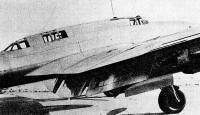
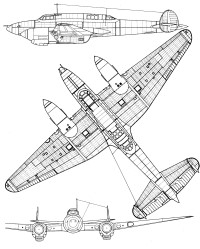
Arriving in small numbers in the ranks of the V-VS to witness the mass devastation of the summer of 1941, the Petlyakov Pe-2 was destined to become the best Soviet light bomber of World War II. The aircraft was derived from V.M. Petlyakov’s VI-100 pressurized high-altitude twin-engined interceptor, which displayed a phenomenal top speed of 623km/h at 10,000m, had a crew of two and was powered by 820kW M-105R V-12 engines.
The VI-100 first flew on 7 May 1939. With the approach of war in Europe the V-VS made urgent requests for dive-bomber aircraft, and to this end the design bureau adapted the VI-100 fighter by removing the TK-3 high-altitude turbo-chargers, fitting standard M-105R engines, lattice type dive-brakes, and giving the tailplane pronounced dihedral to increase stability. Two prototype PB-100 (pikiruyushchn bombardirovshchik, or dive-bomber) aircraft were built with these items installed in addition to an extensively glazed nose and defensive armament. This type became the Petlyakov Pe-2 light bomber and dive-bomber. The crew of three (pilot, bombardier and air-gunner) sat under a long glazed canopy with 9mm armour protection. Initial armament consisted of two fixed 7.62mm ShKAS guns in the nose, one in the dorsal station, and a fourth in the ventral aimed by a 120° vision periscope. The M-105R engines drove three-bladed VISh-61 propellers. The aircraft proved to be fast, highly manoeuvrable, but was guite demanding to novice pilots under asymmetric conditions.
By the time of the German invasion in June 1941 some 458 Pe-2s had been produced from the factories, but it is suspected that deliveries to service units was tardy. Certainly, even by September 1941 the numbers of Pe-2s in front-line units were few. Colonel General I.S. Konev’s Western Front had only five in commission with which to stem the German assault on Moscow, and the establishment of Pe-2s with the Bryansk and Kalinin Fronts was even lower. Although limited in numbers, Pe-2s contributed to the victories of the Soviet winter offensive of 1941-2, and were seen in increasing numbers during the defensive battles at Leningrad, Kharkov, Rostov, and in the Stalingrad campaign.
Late in 1942 came the improved Pe-2FT with 940kW Klimov M-105PF engines, and a 12.7mm UBT machine-gun in a dorsal turret. The Pe-2I and Pe-2M were fighter-bombers, powered by 1208kW VK- 107A engines. The reconnaissance version was the Pe-2R, whilst a dual-control trainer was termed the Pe-2UT. The aircraft saw distinguished service in every major Soviet campaign from 1941 to 1945, including operations in Manchuria against the Japanese in September 1945.
The Pe-3 was produced specificaly for night fighting and reconnaissance. Powered by two 1310 hp M-105PF engines, the Pe-3 featured a solid nose and a shorter cockpit enclosure with a dorsal turret to the rear, and was in service by 1943.
A total of 11,427 Pe-2s and Pe-3s (the fighter version) was produced.
The Pe-2RD was a version of the Petlyakov Pe-2 bomber with an additional Glushko RD-1 rocket engine (3 kN thrust) mounted instead of a fuselage tail cone. This conversion was a task of a special design bureau led by V. Glushko, based in Kazan, and working on rocket powerplants; Korolev’s post there was deputy chief designer of flight tests. Korolev made full aerodynamic calculations for Pe-2 equipped with RD-1; they indicated that maximum speed at sea level will increase by 82 km/h (and reach 542 km/h), while at 7000 m altitude it will increase by 108 km/h (although all this only for short time). The reworking of one production Pe-2 (No.15/185) into Pe-2RD began in 1943 spring. The nitric acid tanks were mounted in the bomb bay, kerosene tanks in the wing roots; full weight of rocket fuel system was 1050 kg. After many ground fire tests, on October 1, 1943 test pilot Alexander Vasilchenko first time fired rocket engine in the air for 2 minutes. During this time, flight speed increased by 92 km/h. On October 2 the rocket engine was fired already for 4 minutes, and next day the first takeoff with RD-1 working was performed. Later RD-1 was replaced by improved RD-1KhZ, with chemical ignition instead of electric. The tests were held until middle 1945; more than 100 fire flights were done. On May 12, 1945 the rocket engine exploded – aircraft’s empennage was seriously damaged, Korolev himself scorched; but Vasilchenko managed to land successfully.
Pe-2 Engines: 2 x VK-105PF, 920kW Max take-off weight: 8520 kg / 18783 lb Empty weight: 5870 kg / 12941 lb Wingspan: 17.2 m / 56 ft 5 in Length: 12.7 m / 42 ft 8 in Height: 4.0 m / 13 ft 1 in Wing area: 45.5 sq.m / 489.76 sq ft Max. speed: 581 km/h / 361 mph Cruise speed: 480 km/h / 298 mph Ceiling: 8800 m / 28850 ft Range w/max.fuel: 1200 km / 746 miles Armament: 3 x 12.7mm machine-guns, 2-4 7.62mm machine-guns Bomb load: 600-1000kg Crew: 2
Pe-2 Engines: 2 x Klimov VK-105R, 1100 hp Wingspan: 56 t 4 in Length: 41 ft 4 in Empty weight: 12,900 lb Loaded weight: 18,730 lb Crew: 2 Max speed: 335 mph at 16,400 ft Service ceiling: 29,520 ft Normal range: 1200 mi Armament: 1 x 12.7mm Beresin mg / 4 x 7.62 mm ShKA5 mg Bombload: 2200 lb
Pe-2RD Wing span: 17.60 m Length: 12.60 m Wing area: 40.50 sq.m Empty weight: 6044 kg Normal takeoff weight: 8200 kg MTOW: 9215 kg (with two 500-kg bombs external Maximum speed: 650 km/h Maximum speed at sea level: 542 km/h Range: 1200 km Service ceiling: 9000 m Takeoff run: 446 m (with RD-1 fired): 70 m shorter than ordinary Pe-2
In the summer of 1938 was Petlyakov able to return to work in the Special Technical Department (STO for Spetsialni Texnicheski Otdiel). These types of institutions were conceived with the aim of organizing the scientific and constructive work of specialists convicted of different causes and emerged in the USSR since the late 1920s when those accused of being part of the “Prompartia” conspiracy were concentrated in the Factory No.39, giving rise to the infamous TsKB-39, where famous aircraft builders such as DP Grigorovich and NN Polikarpov worked.
Under the direct supervision of LP Beria, the TsKB-29 NKVD was organized, a large joint construction bureau located in the TsAGI KOSOS building, on Radio Street No. 24.
Three main brigades were created: AN Tupolev ‘s working on a dive bomber, Petlyakov ‘s working on a high-altitude fighter, and Myasichev ‘s working on a long-range bomber. Later another brigade would be created under the leadership of Tomashevich . As the acronym STO corresponds in Russian to the number 100, the aircraft of this institution were known as “100” ( Petlyakov ), “102” ( Myasichev ) and “103” ( Túpolev). The STO would soon be renamed the Special Technical Bureau (OTB according to the acronym of Osoboye Texnicheskoye Byuro) and its direction was entrusted to the highest of the state security organs V. Kravchenko.
The brigade led by Petlyakov numbered about 50 specialists. Notable among them are AI Putilov, EI Pogosski, NS Nekrasov, KV Minknier, the pilot and engineer Ye. K. Stoman, also a pilot and creator of the well-known “Zvenó” NS Vaxmistrov compound aircraft , the hydraulic engineer GM Bashta, the electric AA Yengibaryan and IM Sklyanski, among others. As the first reserve of him was selected AM Izakson.
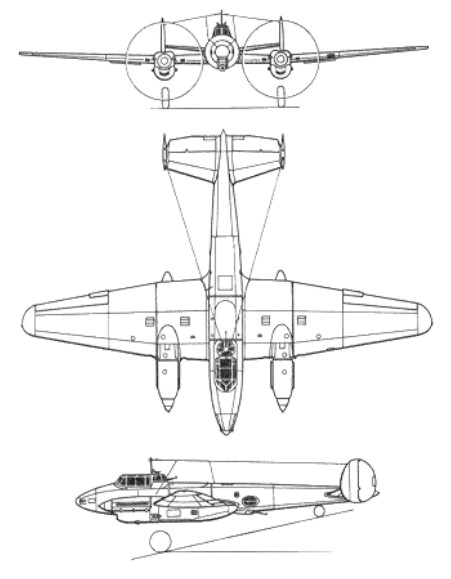
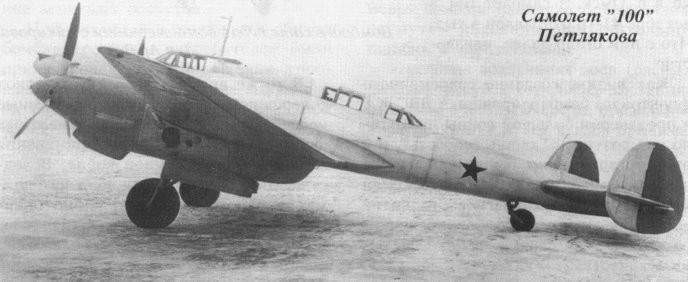
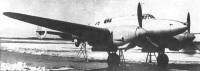
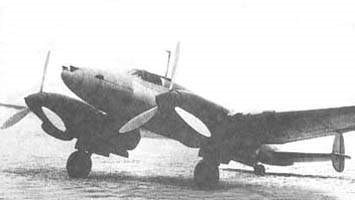
The task was to create a high-altitude fighter with a long range and powerful weaponry capable of complementing the ANT-42 bombers in their missions. In order to operate at high altitudes, a hermetic cabin was proposed. In the literature, this aircraft is referred to as “100” or VI-100, where the initials VI correspond to its conception as a high-altitude fighter (transliterated as Vysotny Istrebitel), although the official name of the prototype was: “100 with two M engines. -105, two TK-2 turbochargers and two sealed cabins”.(Russian: Петляков ВИ-100)
It is interesting to note that all the documents that left the OTB building, even those related to purely technical issues, had to be reviewed and signed by the head of the institution. The names of the builders were nowhere to be found. The internal documentation could be signed by the builders, but not with their name. Each specialist was assigned a numbered stamp with which they had to sign the documents.
The task assigned to Petlyakov’s brigade was complex. According to the technical specifications received from the military, the flight ceiling had to reach 12,500 meters and at a height of 10,000 meters the “100” had to reach a speed of 630 km/h. The deadline for the execution was also quite tense: the new high-altitude fighter had to be ready for 1939.
In May 1939 the life-size model was finished, which was approved by a commission chaired by A.I. Filin.
The fuselage of the new fighter was developed by AI Putilov and in its structure it was close to the monocoque composition. Of totally metallic construction, it presented three sections of circular section with an elongated cover in which the two hermetic cabins were located.
The fuselage skin averaged between 1.5 and 2 mm, with ribs implanted every 30 or 50 cm. No stringers were used to support the covering.
The structure was calculated to withstand overloads of 10, which allowed the fighter to execute all manoeuvres.
The wing had a trapezoidal shape in plan, with a double spar structure and practically no sagging on the leading edge. Its structure was made up of the center plane to which the motor nacelles were fixed and two consoles with a 0.6 – 0.8 mm coating. The wing mechanization included split ailerons and shrenk-type flaps. All control surfaces were made of metal and covered in fabric.
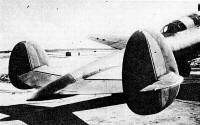
The tail unit presented horizontal planes with a positive dihedral. Almost at the end of each demiplane the double empennages with the rudders were inserted.
The landing gear, of the conventional type with a tailwheel, was designed by TP Saprykin. The main units had a single wheel and were collected by turning 90 degrees backwards, inside the motor nacelles. The tail unit was also retractable.
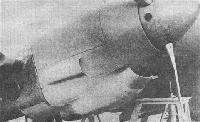
The selected powerplant was the Klimov M-105 engine, a 12-cylinder V-shaped linear engine, with two TK-2 turbochargers connected to the power scheme of the engine nacelles and moving two VISh-42 three-blade variable-pitch propellers, the latter a truly advanced quality. The compressor turbines were located on the sides of the engines, just below the wing leading edge. The engines were neatly shrouded, and like other contemporary Soviet twins, the radiators were inboard of the wing between the spars, fed through ducts from the leading edge and vented through adjustable louvers in the nose. wing extrados and planned to provide a certain increase in thrust. The fuel tanks were located in the fuselage, between the two cabins.
The “100” included two airtight cabins for the crew. The forward cockpit was dedicated to the pilot. There is divergence in the literature about the second cabin. Some well-known historians such as BV Shavrovd efine the VI-100 as a three-seater aircraft, placing the navigator and gunner in the rear cabin. In other literature it is suggested that the VI-100 was a two-seater and the second hermetic cabin was occupied by the radio gunner. This version seems to be more accurate in that an interceptor fighter did not need a navigator at all. Both cabins had independent access in the form of hatches located in the lower part of the fuselage, with emergency opening systems. These cabins worked with compressed air obtained from the turbochargers in order to maintain a constant pressure from a height of 3,700 meters and up to the operational ceiling of the plane.
The control system included remote electrical controls developed by electrical engineers AA Yengibaryan and IM Sklyanski. A 28-volt electrical system operated about 50 direct current actuators, which operated the landing gear, flaps, radiator grilles, fuel pumps, compensators and other equipment.
The aircraft featured powerful armament including two 20mm ShVAK cannons with 300 rounds each and two 7.62mm ShKAS machine guns with 900 rounds each, all located in the nose. To defend against the attack of the fighters in the rear hemisphere, the provision of a ShKAS machine gun with 700 shots was proposed, which in practice was never installed.
The “100” was conceived with a certain ground attack capacity. For this purpose it could carry two 250 kg or 500 kg bombs on external mounts. On the other hand, the “100” could carry a new type of weapon: the K-76 cassette with 40 unguided artillery projectiles with pre-adjustable explosion time. This weaponry had been conceived as a resource against enemy bomber formations, but could also be used against ground targets. Later the K-100 cassette with 96 2.5 kg bombs would also be developed.
The prototype was completed at Factory No.156 by the end of 1939. The entire skin of the plane had a layer of varnish and kept the original silver color. The ailerons and rudders were painted bright red. Red stars bordered in black were painted on the edges of the fuselage and on the wing intrados.
On 22 December 1939, the first flight was made, beginning the factory tests, which were carried out by test pilot PM Stefanovski. The main engineer was IV Markov. Since the beginning of these tests, a certain number of defects and problems appeared, something logical for a new and complex aircraft, but very dangerous for the situation of its creators in their condition as detainees.
During the first landing, a construction error was found in the calculation of the shock absorbers in the main landing gear, which caused the aircraft to bounce during touchdown. Incredibly, according to Stefanovski himself, this mistake saved his life, because during the flight one of the engines had stopped and the plane was descending. Without having height coverage for maneuvers, he was forced to land in an area of the aerodrome where various support structures were located. The collision was unavoidable, but during touchdown the plane made a big jump when it touched down, flying over the obstacle. This problem was soon fixed. Far more difficult was solving the problems with the engines. The oil cooling system was ineffective at altitudes above 5,000 meters. The water temperature was also rising to intolerable levels.
Despite the replacement of the engines, oil pumps and other elements of the aircraft on two occasions, it was not possible to obtain the required height and speed characteristics. Nor were the requested values achieved in relation to the rate of ascent at great heights. The maximum speed obtained at 6600 meters only reached 538 km/h. The height of 1,000 meters with a normal flight weight of 7,265 kg was reached in 6.8 minutes.
During the factory tests between December 22, 1939 and April 10, 1940, the plane only managed to fly 11 days, making 23 flights. For 122 days it was in the workshops for different reasons, including serious repairs after landing on its belly due to not being able to extend the ski gear.
From April 11, 1940, state tests began at the NII VVS. The first prototype was again flown by PM Stefanovski and Major Nikitin served as navigator.
On May 1, 1940, the “100” was presented over Red Square on International Workers’ Day, piloted by PM Stefanovski, while the group of designers and builders watched the flight, not from the grandstand, but from the roof of the distant KOSOS building. As a curious detail, it should be noted that this flight was carried out with the landing gear extended, since Stefanovski simply forgot to pick them up.
The second prototype, known as the “dublior”, was flown by Captain AM Khrinkov and navigator PI Perievalov. This prototype differed in details from the first. In addition to the bomb cassettes, it had the capacity to carry bombs from 25 to 110 kg in an internal hold. This aircraft proved unsuccessful. During the eleventh test flight a spark from an electrical contact caused a fire in the cockpit. AM Khrinkov was forced, with practically no visibility due to smoke, to urgently land the plane, which, due to the large landing angle, capsized. The crew members were hospitalized with serious traumas and the machine was practically destroyed and several people died who were at the landing site for different reasons. The tests were continued with the first prototype.
In order to increase the directional stability of the model, the area of the vertical surfaces of the tail was increased by about a third (from 0.77 to 1 m²). The transverse stability of the plane was also considered insufficient and to increase it, it was considered to increase the sagging of the leading edge of the wing consoles (this would already be introduced in the serial Pe-2). With the flaps fully extended, landing was difficult, since there was not enough rudder travel to achieve the necessary angle. For this reason it was recommended not to fully extend the flaps and in the series models to modify the angle of incidence of the stabilizers.
The most dangerous problem registered during the tests was the behavior of the airfoil at speeds close to the landing speed. In order to develop high speeds at great heights, a TsAGI V profile was selected at the root and a TsAGI VS profile at the ends. This composition actually presented less aerodynamic resistance at small angles of attack, but when this angle increased (typical of landing operations) an asymmetric behavior of the airflow appeared.
The state tests comprised a total of 34 flights with a total time of 13 hours and 25 minutes culminating on May 10. In general, the results fully corresponded to the technical requirements, with the exception of the maximum speed. Despite the problems encountered, the assessment of the aircraft was generally positive.
flaps extended
The conclusive report reflected: *1 – “The “100” aircraft represents the best achieved solution to the problem of creating an armed aircraft with a sealed cabin. It is necessary to build an experimental series…” • 3 – “In order to use the successful aerodynamics of the “100” aircraft, it is advisable to create a dive bomber without a sealed cabin on its basis. It is necessary to build an experimental series. The model of this aircraft must be submitted for approval by 1 June 1940…”
This third point of the report would radically change the fate of the “100”. Before the direction of the aeronautical industry was the unresolved need to replace the obsolete Tupolev SB bomber. The Winter War with Finland, despite the fact that this country’s aviation could not be considered among the advanced in Europe, had demonstrated the obsolescence of the 1934 model and the need to have specific bombers capable of attacking specific targets.
As a result, together with the summary of the tests of the “100”, the resolution of the head of the VVS of the Red Army, commander of the second rank Smushkevich, appeared: “The act is approved with the introduction of a correction in the conclusions: the aircraft “100” in dive bomber version consider recommendable for serial construction”.
With the appearance of the PB-100 and the beginning of its delivery, already under the name Pe-2, to operational units, the high-altitude fighter VI-100 was consigned to oblivion. The pre-series of 10 copies, which had been approved in 1940, was never produced. Attempts by Petlyakov (1941) and later by Putilov (1943) to launch a high-altitude fighter version known as the Pe-2VI were unsuccessful.
VI-100 / 100 Powerplant: 2 × 1050 hp Klimov M-105 with TC-2 turbochargers Wingspan: 17.15m Wing área: 40.50 m² Length: 12.69m Height: 3.95m Empty weight: 5172 kg Takeoff weight: 7260 kg Wing loading: 179 kg/m² Power load: 3.3kg/hp Maximum speed at sea level: 455 km/h Top speed at 6000m: 535km/h ROC: 588 m/min Practical range: 1400 km Practical ceiling: 12200 m Accommodation: 2 Armament: 2 x 20mm ShVAK cannons / 3 x 7.62mm ShKAS machine guns. Bomb load: 1000 kg




 All Aero