The P-5 “Cantilever Cub” was a circa 1944 J-3C-65 fitted with a strutless cantilever wing, also known as J-3X [NX42111].
World War 2
Piper P-1 Cub Clipper / Duck / Applegate Amphibian
In 1941 the Piper P-1 NX38300 four-place cabin, high wing monoplane was built. Originally known as the 1937 Applegate Amphibian, which used wings and other components of the Cub. Powered by a 130hp Franklin 6AC engine, the wing design appeared in PA-16.
Piper PT-1
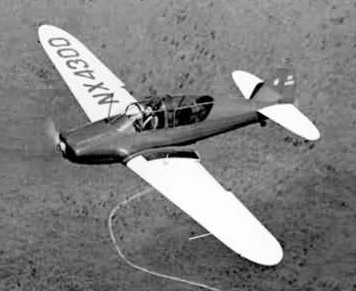
The Piper PT-1 was a 1940s American two-seat primary training monoplane designed and built by Piper for Army or Navy primary flight training. A low-wing tandem two-seat monoplane, the PT-1 was the first Piper aircraft to have a low-wing. It had a fabric covering over an all-metal fuselage frame and wooden spar wings and tail unit. The PT-1 had a retractable tailwheel landing gear and was powered by a 130 hp (97 kW) Franklin 6AC-2980D engine.
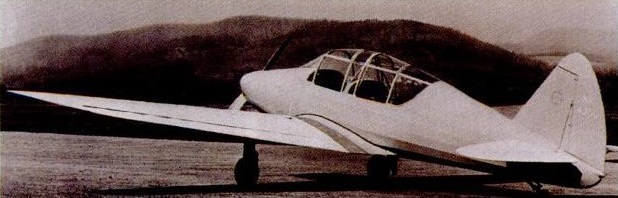
Designed by David Long, the prototype NX4300 first flew in 1942, no further aircraft were built. A four-seat development was designed as the Piper PWA-6 / PA-6 which did not go into production either.
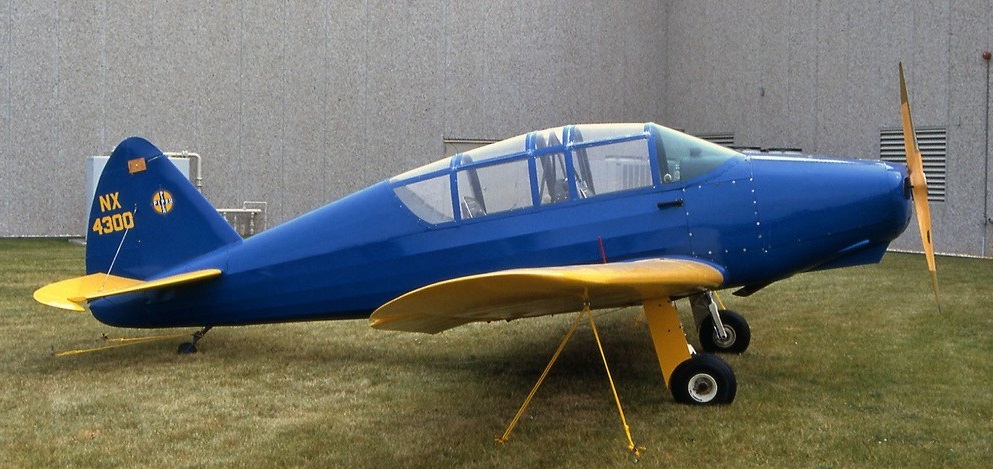
Engine: 1 × Franklin 6AC-298, 130 hp (97 kW)
Propeller: 2-bladed fixed pitch wooden airscrew
Wingspan: 35 ft 2 in (10.72 m)
Length: 22 ft 8 in (6.9 m)
Height: 6 ft 6 in (1.98 m)
Empty weight: 1,325 lb (601 kg)
Gross weight: 2,000 lb (907 kg)
Maximum speed: 150 mph (240 km/h, 130 kn) plus
Cruise speed: 135 mph (217 km/h, 117 kn) plus
Landing speed: less than 50 mph (43 kn; 80 km/h)
Range: 700 mi (1,100 km, 610 nmi)
Service ceiling: 12,400 ft (3,800 m)
Rate of climb: 750 ft/min (3.8 m/s) to 1,000 ft/min (300 m/min)
Crew: 2
Piper PA-7 Sky Coupe
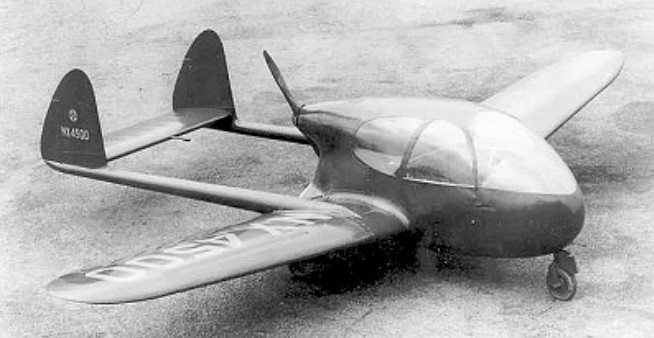
The only prototype of the PA-7 Sky Coupe / PWA-1 (Bradford) built, NX4500, flew for the first time in 1945.
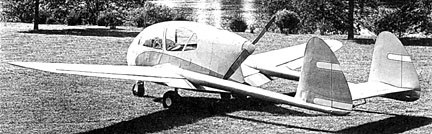
Engine: 1 x Franklin 4ACG, 113hp
Max take-off weight: 764 kg / 1684 lb
Empty weight: 346 kg / 763 lb
Wingspan: 9.14 m / 30 ft 0 in
Length: 6.98 m / 23 ft 11 in
Height: 2.12 m / 7 ft 11 in
Wing area: 16.43 sq.m / 176.85 sq ft
Max. speed: 177 km/h / 110 mph
Cruise: 100 mph
Stall: 48 mph
Ceiling: 4120 m / 13500 ft
Range: 856 km / 532 miles
Crew: 1
Passengers: 2
Piper L-14 Army Cruiser
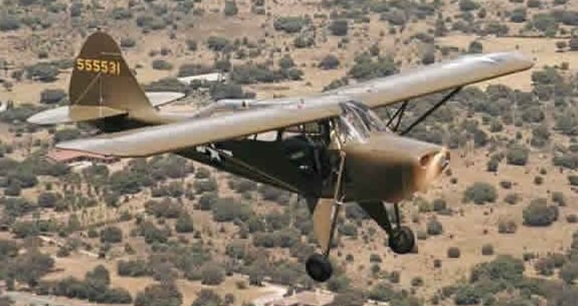
In 1943 the Piper Aircraft Company undertook to design and build for the United States Army Air Force (USAAF) an aircraft ambulance.
After studying the specification it was decided to base the design on an existing model, the Piper J-5C, the first prototype was built using an existing Piper J-5CO (O for Observation), this first aircraft being given the serial number (SN) 5-1387 and the registration: NX41552.
Piper L-14 Army Cruiser Article
The most noticeable change being the reconstructed upper fuselage, a large dorsal addition to cater for stretchers. Otherwise the aircraft was unchanged, including the engine which remained as in the Piper J-5C, the Lycoming O-235 producing 100 hp.
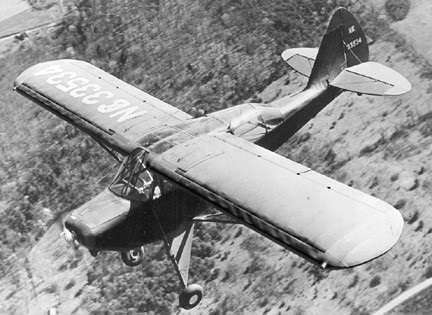
First flight was on the 16th June 1943 and after satisfactory flight trials from October of that year and into 1944 major modifications were made including larger windscreen and glazed areas, long landing gear shock absorbers, increased fin height and size, and a first for Piper, full span slots on the wing leading edges, generous flaps were also incorporated, another first. This aircraft was now designated the Piper J-5D.
In 1944 a second prototype was converted from another J-5C, registration NX33529, now designated as a Piper L-4X, in line with the military series of ‘L’, with the SN 5-3001, the first flight being on the 9th September 1944. All the changes were incorporated into this aircraft along with a larger engine, Lycoming O-290-A giving increased power.
The Approved Type Certificate for the new Model: Piper L-14 was issued 31st July 1945 (ATC 760) to the Piper Aircraft Company, Lock Haven, Pennsylvania.
The definitive and complete Piper L-14 incorporating all the changes including large glazed area, turtle deck, slots and flaps, and undercarriage shock absorbers was SN 5-3002, registered NX-33534 which flew on the 29th February 1945.
The production of five examples was completed for service evaluation, these aircraft were designated YL-14 with the serial numbers from 5-3001 to 5-3005.
The two original prototypes were modified to the same standard as the production examples, YL-14, and the service trails commenced in May 1945, the newly built Piper YL-14 were delivered in June of the same year, these last with the recessed slots, flaps and glazed, removable turtle deck which permitted a stretcher to be loaded, similar to the Naval models designated HE-1/AE-1.
The USAAF issued an order to build 850 examples of the Piper L-14 Army Cruiser.

Howard Piper was the engineer for this project, Dave Long the chief of design and Tom Piper the chief flight test pilot with Clyde Smith Senior, the pilot involved with the test flying and evaluation during the whole production run. It was found necessary to increase the wingspan by three feet outboard of the leading edge slots to improve flight handling.
The construction and dimensions for the L-14, now named ‘Army Cruiser’ was very similar to the Cub Cruiser or Super Cruiser, except for the larger engine and the changed interior to accommodate the stretcher. Alloy steel tube fuselage, aluminium alloy spars with aluminium ribs, fabric covered, wing struts, bracing wires for the tail surfaces, all standard for the pre-War Piper models.
The one big difference of this model was that this was the first model to incorporate flaps, up to 40% being available which when used with some power from the engine resulted in an airspeed of less than 20 Knots, these combined with the slots gave full control which was demonstrated on the first flight.
At the express wish of the USAAF, the capability to operate safely from rough and unprepared fields large balloon tyres were tested, (size 600 X 6) and a robust skid made by R.C.A. Scott.
The electrical system was the normal military specification: 28 Volts along with a voltage regulator using an engine driven generator, and a powerful starter motor.
In the cockpit the panel instruments were provided with lighting for night flying, a landing light was positioned on the left wing powered by a 24-volt battery. Two pilots in front, dual controls, and an observer’s seat in the rear that swivelled for viewing out the back or for writing at a built-in desk.
A full flying panel was installed, including, left to right: clock, air speed indicator, turn and slip, vertical speed indicator, compass, altimeter, engine rpm gauge, oil temperature and pressure, ammeter.
The engine fitted was a Lycoming O-290-1 (O-290-C) producing 130 hp at 2,600 rpm and a wooden Sensenich propeller, 76JB44, allowing for a maximum speed of 115 mph (190 km). Maximum take off weight of 1,800 lbs (820 kg).
This definitive model of the Piper L-14 Army Cruiser never went into production as in August 1945, right at the end of the Second World War, the USAAF ceased to have an interest in this model or a need for it.
The five initial aircraft, YL-14, and the other nine L-14 comprised the total production run for this aircraft, in all only fourteen were completed.
At the end of the War the USAAF authorised the Piper Aircraft Company to sell these aircraft into the civilian market.
The 14 aircraft produced:
Piper YL-14
5-3001 last reported in the Philippines: 22 July 1945
5-3002 last reported in Japan: 3 May 1948
5-3003 sold to the Philippines as P1-C159, never officially registered.
5-3004 sold within the USA as NC-66526, never officially registered.
5-3005 sold within the USA NC-69225, reregistered as N14YL, still airworthy.
Piper L-14 Army Cruiser
5-3006 sold within the USA NC-41399, reregistered as CU-P19. No records since 1946.
5-3007 sold within the USA NC-41594, exported to Cuba, CU-P18, CU-N18 then to Spain as EC-AAP. Now airworthy, May 2003.
5-3008 sold within the USA NC-41598, exported to Venezuela, no records since 1946.
5-3009 sold within the USA NX-41352, sold to Mexico XB-COP, no records since 1946.
5-3010 sold within the USA NC-41593, to Mexico as XB-CAQ, no records since 1946.
5-3011 sold within the USA NC-41595, to Uruguay as CX-AFX destroyed in a fire.
5-3012 sold within the USA NC-41596, to Argentina LV-NCM not officially registered.
5-3013 no details available.
5-3014 sold within the USA, NC-41597, to Argentina LV-NCY not officially registered.
L-14 / YL-14
Engine: 125hp Lycoming O-290-3
Wingspan: 35’10”
Length: 23’5″
Useful load: 800 lb
Max speed: 115 mph
Cruise: 100 mph
Stall: 20-38 mph
Range: 300 mi
Seats: 3
Piper J-5 Cub Cruiser / HE-1 / L-4F / L-4G / AE-1
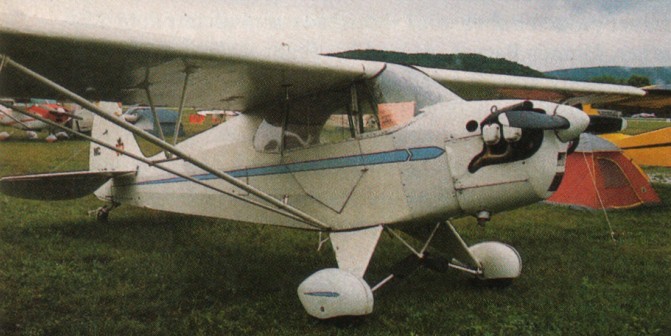
The J-5 Cruiser which, although basically similar to the J-3, had a minimal increase in fuselage width to provide three-seat accommodation.
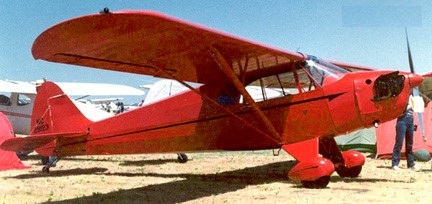
After two prototypes, NX24573 and NX26071, they were first seen in early 1940 as the J-5A Cruiser (ATC 725) with a 56kW Continental A75-8 engine sold for $1,833, it became available subsequently as the J-5B (ATC 725) with a similarly powered Avco Lycoming GO-145-C2 engine for $1,995, then being designated J-5C (ATC 2-563) with the installation of a 75kW Avco Lycoming O-235-C.
The one J-5D of 1946, NC91902, had a 125hp Lycoming engine.
Civil J-5A and J-5B aircraft were impressed for service with the US Army during World War II under the designations L-4F and L-4G respectively. Four J-5A impressed in 1942, 42-79551 to 4279554, were designated UC-83, becoming L-4F in 1943.
The US Navy procured 100 aircraft, 30197 to 30296, similar to the J-5C under the designation HE-1. These had the 75kW Avco Lycoming O-235-2, and a hinged top decking to the rear fuselage to allow the loading and unloading of a stretcher; when, in 1943, the designation letter H was allocated to identify helicopters, the HE-1s were redesignated AE-1 in 1943.
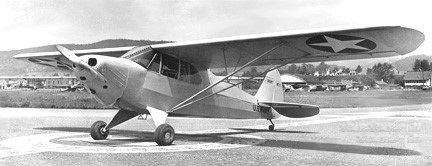
When production ended a total of 1,404 J-5 Cruisers had been built.
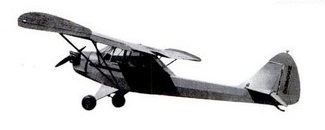
Piper J-5 Cub Cruiser – Cubbing

J-5A-75
Engine: Continental A-75B, 75 hp @ 2600 rpm
Gross weight: 1450 lb
Empty weight: 820 lb
Useful load: 630 lb
Wingspan: 35 ft 6 in
Wing area: 179.3 sq.ft
Length: 22 ft 6 in
Height: 82 in
Prop diameter: 74 in
Power loading: 19.3 lb/hp
Wing loading: 8.09 lb/sq.ft
Baggage capacity: 41 lb
Fuel capacity std: 25 USG
Optional fuel capacity: 38 USG
Tire size: 8.00 x 4
Max speed: 95 mph
Cruise 3000 ft: 80 mph
Stall: 43 mph
Rate of climb: 400 fpm
Service ceiling: 13,000 ft
Cruise range w/opt fuel: 380 sm
J-5B-75
Engine: Lycoming GO-145, 75 hp @ 23600 rpm
Gross weight: 1450 lb
Empty weight: 820 lb
Useful load: 630 lb
Wingspan: 35 ft 6 in
Wing area: 179.3 sq.ft
Length: 22 ft 6 in
Height: 82 in
Prop diameter: 74 in
Power loading: 19.3 lb/hp
Wing loading: 8.09 lb/sq.ft
Baggage capacity: 41 lb
Fuel capacity std: 25 USG
Optional fuel capacity: 38 USG
Tire size: 8.00 x 4
Max speed: 95 mph
Cruise 3000 ft: 80 mph
Stall: 43 mph
Rate of climb: 400 fpm
Service ceiling: 13,000 ft
Cruise range w/opt fuel: 380 sm
J-5C-100
Engine: Lycoming O-235-B, 75kW / 100 hp @ 2550 rpm
Gross weight: 1550 lb / 703 kg
Empty weight: 860 lb
Useful load: 890 lb
Wingspan: 35 ft 6 in / 10.82 m
Wing area: 179.3 sq.ft / 16.63 sq.m
Length: 22 ft 6 in
Height: 82 in
Prop diameter: 74 in
Power loading: 15.5 lb/hp
Wing loading: 8.64 lb/sq.ft
Baggage capacity: 41 lb
Fuel capacity std: 20 USG
Optional fuel capacity: 38 USG
Tire size: 8.00 x 4
Max speed: 110 mph / 177 km/h
Cruise 3000 ft: 95 mph
Stall: 45 mph
Rate of climb: 650 fpm
Service ceiling: 16,000 ft
Cruise range w/opt fuel: 238 sm
J-5D
Engine: 125hp Lycoming
HE-1
Engine: Lycoming O-235-B O-235-2, 75kW / 100 hp @ 2550 rpm
Piper
After being an investor in and later treasurer of that Bradford firm the Taylor Broth¬ers Aircraft Company a local oilman named William T. Piper bought the company at a bankruptcy sale for $761. It was 1930, and C. Gilbert Taylor, the former company’s designer and only surviving partner, was given half in¬terest in the new company, which he called the Taylor Aircraft Company.
About the time the J 2 rolled out, so did C.G. Taylor. There had been friction between Taylor and Piper for some time, so Taylor left and Jamouneau took over as chief engineer.
The company was beginning to see some improve¬ment in its always precarious financial situation, and then, in 1937, the plant burned down. By 1937 the company was producing 18 aircraft a week, but fire destroyed the facility on St.Patrick’s Day that year. It was a severe financial blow to the company and to William T. Piper. But instead of being an excuse to quit, the fire only in¬creased Piper’s determination to prove his point. Refi¬nancing was arranged, the name was changed to Piper Aircraft Company, and J 2 production was resumed in a vacant two storey Susquehanna silk mill conveniently located next to the Lock Haven, Pennsylvania airport. That same year, Piper assumed the presidency of the firm, making official a situation that had existed informally since the early 1930s.
In recog¬nition of Walter Jamouneau’s contribution to the E 2, subsequent models were called the J 2 and J 3.
The PA 11 followed next in the Cub line, and the PA 18 Super Cub with essentially the same structural and aerodynamic con¬figuration as the 1932 E 2 continued.
Initial production type was the Cub two-seat high-wing monoplane, of which 10,000 had been completed before the end of 1941.
Piper’s major contribution to the military in World War 2 was not, as often assumed, the Cub liaison and trainer, but steel radar masts.
In 1948 Piper took over the Stinson Division of Consolidated Vultee Aircraft Corporation and acquired the Stinson Voyager production rights, but production of this type was soon halted.
Piper’s first twin was the four-seat Apache, which entered production in 1954. The later four-seat single-engine Comanche first flew in 1956. A whole line of light aircraft has followed the original Cub, from the Pacer/Tri-Pacer/Colt series of high-wing monoplanes to their successors, the Cherokee low-wing series, first of which flew in 1960. Piper produced the specialized Pawnee agricultural monoplane in 1959.
William T. Piper died in 1970.
A series of twins developed from the Apache to Aztec, Twin Comanche, Seneca, and Navajo, plus other aircraft such as single-engined PA-38 Tomahawk. Company became subsidiary of Bangor Punta Corporation, then Lear Siegler Inc (1984), and later Romeo Charlie Inc (1987), finally with only Cheyenne and Malibu Mirage offered, but became insolvent early 1990s, though reduced-rate production continued while a buyer was sought.
The New Piper Aircraft Inc restarted production of Warrior, Archer, Arrow, Dakota, Saratoga and Seneca models at Vero Beach in June 1987 following the sale of the 50 year old aircraft company to Stuart Millar in May.
Pilatus
Pilatus Flugzeugwerke AG
Pilatus Aircraft Ltd
Formed as Pilatus Flugzeugwerke AG in 1939, as a subsidiary of the Oerlikon armaments company. First aircraft was SB-2 Pelican six-seat light transport of 1944, but prototype only built. Followed by P-2 advanced trainer, produced in quantity for the Swiss Air Force in late 1940s, and the P-3 advanced trainer from 1953. Series production of the P-3 followed for the Swiss Air Force, and six went to the Brazilian Navy. In May 1959 Pilatus flew the first PC-6 Porter STOL monoplane with a Lycoming piston engine; this type has been in continuous production ever since, later developments using Astazou, Garrett, and most recently Pratt & Whitney Canada PT6A turboprop engine as the PC-6/B2-H4 Turbo Porter. Pilatus also signed a license agreement for production of Turbo Porters by Fairchild-Hiller in U.S.A. Also undertook Mirage production and maintenance work for the Swiss Air Force.
Became known as Pilatus Aircraft Ltd, based at Stans, Switzerland,.the product range encompassing the PC-7 Turbo Trainer (first flown August 1978 in production form), PC-7 Mk II (M) Turbo Trainer (first flown September 1992), the PC-9 (M) Advanced Turbo Trainer (first flown May 1984) with the highest engine power of the range and also selected in 1995 for U.S. military service as the Raytheon/Beech T-6A Texan II, and the PC-12 utility and business turboprop transport (first flown May 1991 and also available in military form). Also, in 1979 Pilatus took control of the LJ.K.’s Britten-Norman Ltd company, becoming Pilatus Britten-Norman, but sold this company in July 1998.
Pilatus Aircraft Ltd., the Swiss aircraft manufacturer, has sold all manufacturing and marketing rights to the B 4 all metal, aerobatic glider to Nippi, Japan Aircraft Manufacturing Company. The glider license was sold because of a lack of space in the Pilatus factory, where much room is devot¬ed to production of the PC 7 Turbo Trainer. Seventy eight B 4s were sold in 1977, and 320 were in operation. The first Japanese airplanes were expected in April 1979.
The take-over of the assets of Britten-Norman by Pilatus Aircraft was finalised on 34 January 1979 when the necessary documents were signed. To conclude the deal, Pilatus – itself a member of the Oerlilon-Buehrje Group – set up a British subsidiary, Pilatus Britten-Norman Ltd, and this company has acquired the B-N assets which include the Bembridge factory, the complete Islander / Trilander production hardware (plus stock materials) located at the Fairey SA factory in Gosselies, Belgium and the exclusive production and marketing rights for all Britten-Norman products.
In July 1998 Pilatus sold Britten-Norman to private investment company Litchfield Continental Ltd.
Pietsuj, Alexei Ivanovich
Alexei Ivanovich Pietsuj (Russian: Алексей Иванович Пьецух) was born in 1918 in Vínnitsa, Ukraine. At age 16, he built a small glider, called PAI-1, in which he learned to fly and demonstrated at Aviation Day parties in Kiev. For this device he would receive the award for the youngest constructor in the national competition for light aircraft.
Later, working in the Osoaviajim Glider Factory and under the direction of Oleg Konstantínovich Antonov and BN Sheremetiev he would build his second model, called PAI-2 “Pavel Golovin” in 1937, followed by PAI-3in 1937 itself. Pietsuj worked as a teacher at the glider school, developing the PAI-4 tailless glider in that period.
From 1939 on he was called up to serve in the ranks of the Red Army.
During the Great Patriotic War he served as a tug pilot in the glider section of the air landing troops. He was tasked with piloting an Ilyushin Il-4 to tow gliders towards the front line, but Pietsuj requested a fight. After his request was denied three times, in reply he made a dead link between Nesterov and the Il-4. His performance was branded as “dangerous vandalism”, for which he was handed over to a court, demoted to the ranks and sent to a punishment battalion. On his first night he made seven combat sorties in a Polikarpov Po-2 bomber. After two months the accusation was withdrawn in court.
As a pilot of the 44th Guards Bombardment Aviation Regiment and the Don Red Flag belonging to the 9th Guards Bombardment Division, he carried out 91 combat sorties. He participated in the fighting for Warsaw.
In the spring of 1945 in Germany and with the help of several soldiers, he managed to assemble a flight-capable Messerschmitt Me-410 using components from three aircraft. At the controls of the Me-410 he airlifted it to Moscow. In June this aircraft was tested on the NII VVS.
After the victory he began working as a test pilot in the GK NII VVS, serving in the V. Ye squad. Golofastov. At this stage he built the PAI-5 (1947) and PAI-6 (1949) gliders with aerobatic capacity, which participated in several aerial demonstrations for the Air Fleet Day in Túshino. He was the test pilot PAI-5 (02- 1948) towed gliders Antonov A-7 from Ilyushin Il-4. As a test pilot he flew in more than 60 types of aircraft and gliders.
In the early 1950s Pietsuj organized a student construction bureau among the students of the Moscow Aviation Institute. In this institution he developed the glider models PAI-6M (1952), MAI-56 (1956), MAI-63 (1964), MAI-68 “Pushinka” (1970) and the MAI-58 (1958) and MAI- 62 (1962), as well as the MAI-63M motor glider. He personally tested the MAI-53 models in 1954, MAI-56 in 1958, MAI-62 in 1965, MAI-63 in 1964 and MAI-63M in 1965.
He lived in the village “Liotchik Ispitatiel” (Test Pilot) of the city Iksha, in the Moscow suburbs. He built a house made of bottles there. He died in 1994.
Military grade
Captain
Awards and distinctions
Order of the Great Patriotic War Second Class (5-02- 1988)
Twice Order of the Red Banner (04- 1945, 1948)
Medals
Pietsuj was the author of several articles published in the pre-war period in the magazine “Samoliot”.
He wrote the book “Krylya Molodiozhi” (Youth Wings), published by the Moscow publishing house “Oborongiz” in 1954.
Piasecki PV-2
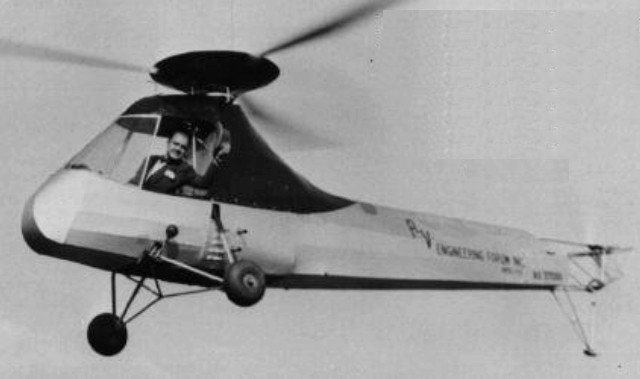
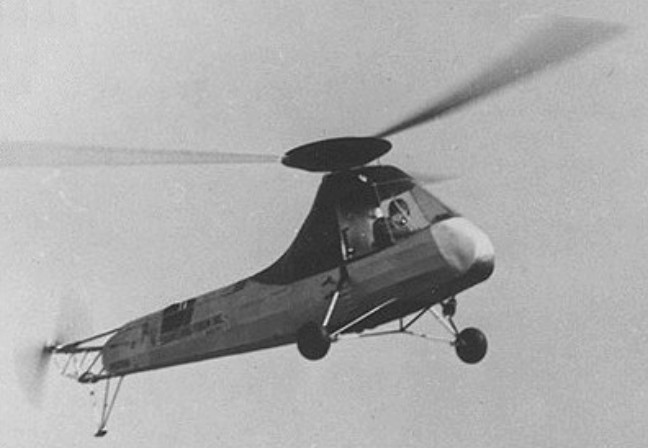
The PV.1 was an advanced design for its day with a tube and fabric fuselage and a tail-mounted anti-torque system involving an enclosed fan in the rear fuselage. This design did not fly but the single-seat PV.2 which took to the air in April 1943 was very similar – but with a conventional tail-mounted anti torque propeller. It was probably the first truly rigid rotor helicopter ever to fly.
There is room for one person (pilot), who sits in a conventional seat behind a rounded, glassed-in nose, similar to the front end of an early Aeronca light plane. The fuselage is fabric-covered. There are three blades. Two blades fold back like the wings on a fly to permit storage. Control of the PV-model has cyclic pitch control of its rotor blades. There is the conventional rudder-stick combination, rudder action manipulating a five-foot tail rotor similar to the vertical rotor on the XR-4. The PV-2 helicopter is powered with a four-cylinder, air-cooled Franklin engine, mounted with its crankshaft upright.
Piasecki himself was the pilot for the first flight, made on 11 April 1943. He flew the aircraft several times in public. Once he took off from the driveway of a private home in Falls Church, Virginia, and flew a short distance to a filling station, where he landed and spent an a ration stamp for three gallons of gasoline. The surprised attendant put in the gas, wiped off the helicopter’s windshield, and Piasecki took off again, heading for the golf course. A few minutes later he landed right beside the first tee, took his golf clubs out of the small baggage compartment, and proceeded to tee off for a game of golf.
It was then dropped because Piasecki turned his attention to the more ambitious field of large military helicopters; with the PV-3, he returned to the twin-rotor formula which had given rise to his earlier experiment.
Engine: 1 x 4-cylinder Franklin, 67kW / 90 hp
Main rotor diameter: 7.62m
Length blades folded: 6.7m
Height: 2.3 m
Width: 2.4 m
Take-off weight: 450kg
Empty weight: 340kg
Max speed: 160km/h
Cruising speed: 135km/h
Range: 240km
Endurance: 2hr
Crew: 1
 All Aero