RMI stood for Repülo Muszaki Intézet or Aviation Technical Institute. Aircraft were primarily (but not exclusively) designed for RMI by László Varga. As a result, RMI designs are often given the Varga name (in some cases, even when he was not a major designer).
In the summer of 1941, by order of Koku Hombu at the Rikugun Kokugijutsu Kenkyujo Army Aviation Research Institute, research began on the creation of a heavy twin-engine fighter. A team of specialists from several Japanese aircraft manufacturing companies was created at the institute. It was initially assumed that the new aircraft would be a single-seat long-range escort fighter. However, in July 1942, the design team was disbanded, and the engineers from its various companies were recalled to solve more urgent tasks.
It was decided to retask the machine as a heavy multi-purpose attack fighter designed for operations at low and medium altitudes and at the same time capable of hitting heavily armored ground and surface targets. To speed up work, several engineers from the 1st Army Aviation Arsenal located in Tachikawa were sent to the institute. Based on new tasks, it was decided to equip the aircraft with a cannon, large for aviation, 57-mm Ho-402 caliber, specially developed for this aircraft by Nippon Special Steel Dr. Masaya Kawamura.
The development of a new automatic gun, which received the designation No-402, went in parallel with the Ki-93 project. At the same time, Nippon Special Steel worked closely with Rikugun. The entire project of the attack aircraft was built around this gun, and the gun was created for the aircraft project. The No-402 cannon was located in a ventral gondola.
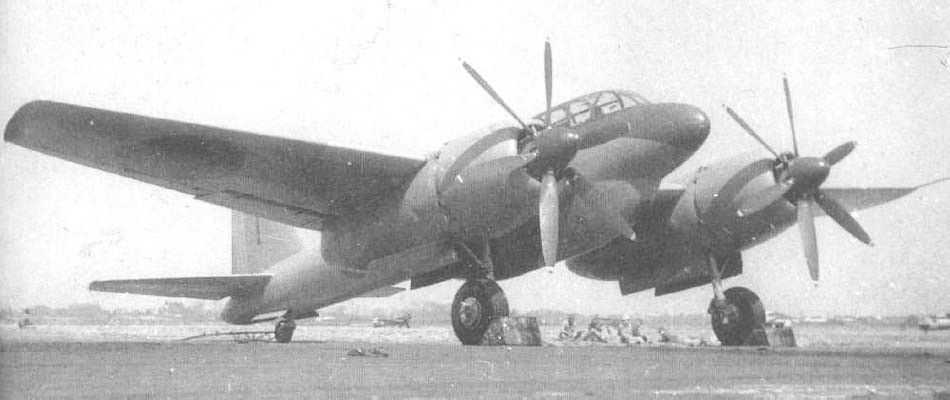
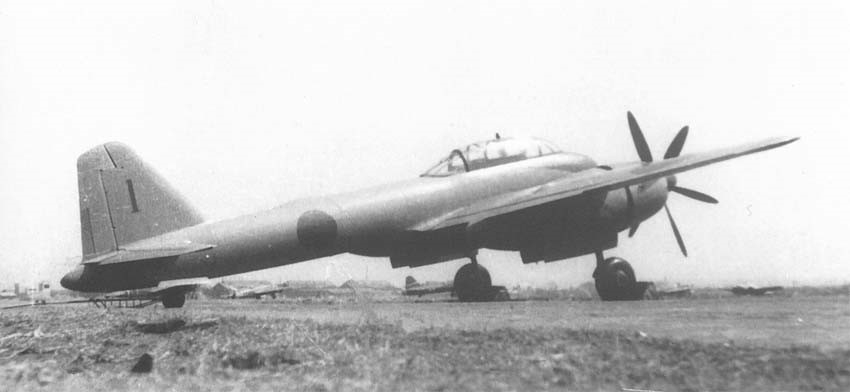
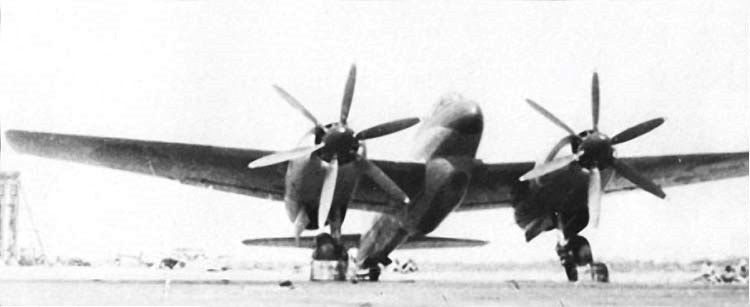
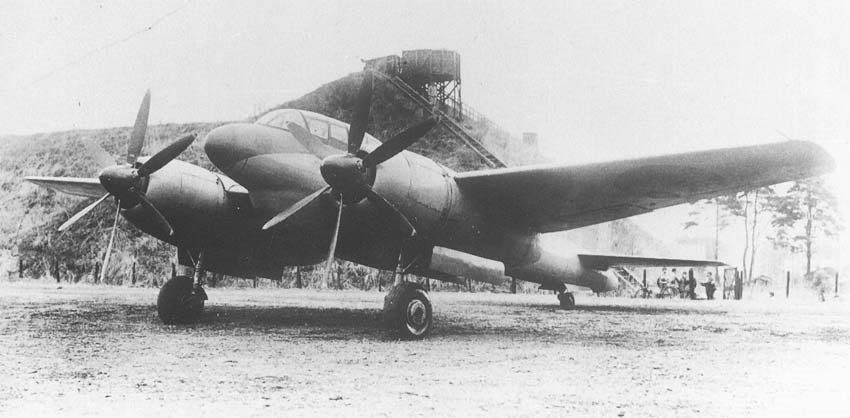
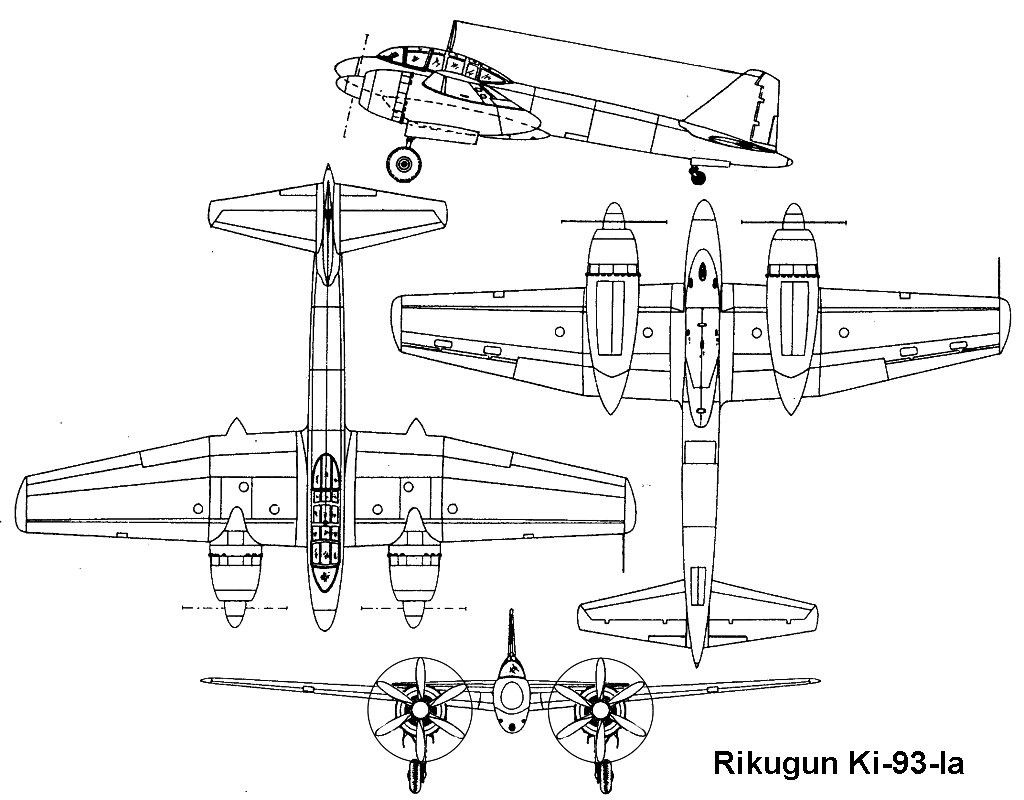
The Ki-93 was a low-winged monoplane of all metal construction, with the crew of two sitting in tandem under a canopy at the front of the fuselage, and a ventral gondola slung under the fuselage to accommodate large cannons. The wing was of laminar flow section.
On February 22, 1943, the new aircraft project was approved by Koku Hombu and received the designation Ki-93.
By the time the Ki-93 had already begun to take shape, the military situation in Japan was already very difficult. Japan suffered from the almost daily B-29 raids, and the US invasion of Japan loomed ever more clearly on the horizon. It was urgently necessary to seek means of fighting both the almost invulnerable B-29s and the anticipated Allied invasion fleet. As a result, the Ki-93 could become one and the other. When Rikugun Kokugijutsu Kenkyujo set about shaping the final look for the future Ki-93, the idea came up that the aircraft being designed could solve both anti-bombing and anti-ship missions equally well. In both cases, the aircraft had to be well protected in order to keep inevitable damage from both defensive fire of bomber machine guns and anti-aircraft artillery of ships. Therefore, it was supposed to build two versions of the Ki-93 in parallel. First, the Ki-93-I Co. is a heavy interceptor fighter. The second Ki-93-I Otsu is an anti-ship attack aircraft. Initially, it was planned to install Mitsubishi Ha-211 engines on the aircraft, but subsequently both models were equipped with two 18-cylinder air-cooled Mitsubishi Ha-214 engines, each of which developed 2,400 horsepower, for the most efficient removal of tremendous moment from engines equipped with six-bladed propellers 3.8 m in diameter
To ensure maximum survivability, the pilot was protected by five 12 mm armor plates. Two armor plates protected the cockpit in front, two on the sides and one on the back. Glazing of the cockpit was made of 70 mm bulletproof glass. The rear gunner was also protected by 12 mm of armor from the tail side of the aircraft. In addition, the fuselage fuel tanks were designed, had automatic fire extinguishing means, and were also protected by 8 mm armor. Each engine also had local armor protection. Defensive armament consisted of one 12.7-mm machine gun Ho-103, located in the rear of the cabin under the movable section of the flashlight. The difference in the two versions of the Ki-93 was the type of gun mounted in the lower gondola.
The Ki-93-I Co. was equipped with a 57-mm Ho-402 cannon with 30 rounds, reinforced with two 20-mm No-5 guns. It was expected that the 57-mm gun No-402 is capable of inflicting enough damage in one shot, guaranteed to destroy the B-29. But-402 had a rate of 80 rounds per minute, firing 2.7-kg shells with an initial speed of 700 m / s. For Ki-93-I Otsu, they provided weapons from the latest automatic 75-mm gun No-501, the total mass of which was 450 kg, the rate of fire reached 80 rounds / min, the initial projectile speed 500-550 m/s.
In addition to the Ki-93-I gun, the Otsu had to carry two 250 kg bombs. In the manufacture of prototypes, it turned out that it was not possible. This was due to a greater than expected weight of equipment. In order to somehow rectify the situation, the ammunition load of the No-402 gun had to be reduced from 30 to 20 rounds. Additional difficulties were brought by the undeveloped Na-214 engines, which lacked the declared power. As a result, the first prototype in the Ki-93-I Co. configuration was completed only in March 1945. On 8 April 1945 pilot Lt. Moriya of the Koku Shinsa-bu (Air Examination Department) with 2nd Lt. Ikebayashi in the second seat, first flew, from Tachikawa airport. During the tests, the armament was absent.
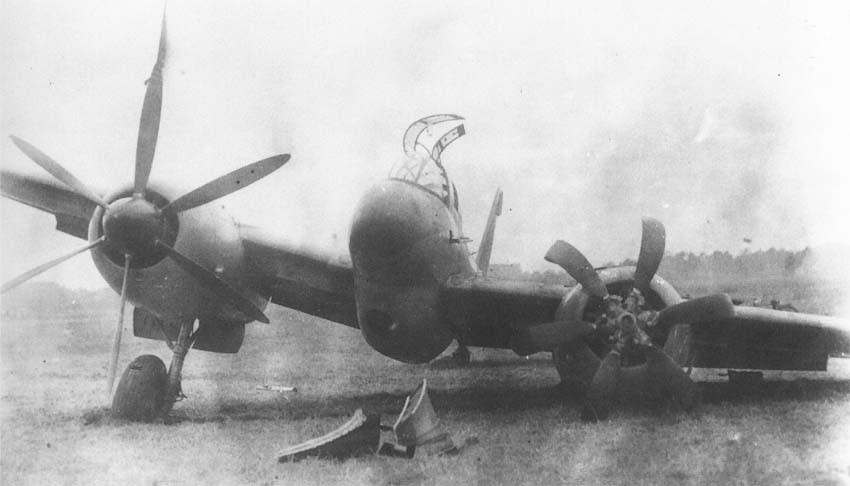
The first 20-minute flight turned out to be the last. When landing with too high landing speed, undershot the runway,and the left landing gear broke, resulting in severe damage to the left wing, prop, engine and landing gear. The only flight noted good controllability, good flight characteristics, and all on-board equipment worked flawlessly.
The prototype was returned to the factory for repair, which took four weeks. When the aircraft was ready for re-testing, an American bombing raid on the city of Tachikawa, completely destroyed the aircraft.
The second prototype Ki-93-I Otsu on the eve of the surrender of Japan was in the final stages of assembly.
After the raid on Tachikawa, it was evacuated to the Takahagi airfield in Saitama Prefecture, complete the assembly and make a test flight. Here, the incomplete prototype was captured by the Americans. After the war, he was taken to the United States as FE-152 at Middleton Air Material, where it was studied in September 1946. On 18 September 1946 was it was transported to Park Ridge, where all trace was lost after 1949.
Ki-93-Ia Engines: 2 × Mitsubishi Ha-214 1, 1,470 kW (1,970 hp) Propellers: 6-bladed VDM, 3.80 m (12 ft 6 in) diameter Wingspan: 19.00 m (62 ft 4 in) Wing area: 54.75 m2 (589.3 sq ft) Length: 14.215 m (46 ft 8 in) Height: 4.85 m (15 ft 11 in) Empty weight: 7,686 kg (16,945 lb) Gross weight: 11,440 kg (25,221 lb) Crew: 2 Guns: 1× 57 mm Ho-401 cannon in ventral gondola 2× 20 mm Ho-5 cannon in wing roots 1× 12.7 mm Ho-103 machine gun on flexible mounting in rear cockpit Estimated performance Maximum speed: 624 km/h (388 mph, 337 kn) at 8,300 m (27,200 ft) Cruise speed: 350 km/h (220 mph, 190 kn) at sea level Range: 3,000 km (1,900 mi, 1,600 nmi) Service ceiling: 12,050 m (39,530 ft) Time to altitude: 9 min 3 sec to 6,000 m (19,700 ft)
Training and liaison aircraft, Hungary, first flown in October 1940
Engine: Hirth HM 504 A2, 104 hp Wingspan: 31.004 ft / 9.45 m Wing area: 145.314 sq.ft / 13.5 sq.m Length: 19.948 ft / 6.08 m Height: 8.301 ft / 2.53 m Max take off weight: 1653.8 lb / 750.0 kg Weight empty: 1036.4 lb / 470.0 kg Max speed: 97 kts / 180 km/h Cruising speed: 86 kts / 160 km/h Service ceiling: 14764 ft / 4500 m Wing loading: 11.48 lb/sq.ft / 56.0 kg/sq.m Range: 351 nm / 650 km Armament: None Crew: 1
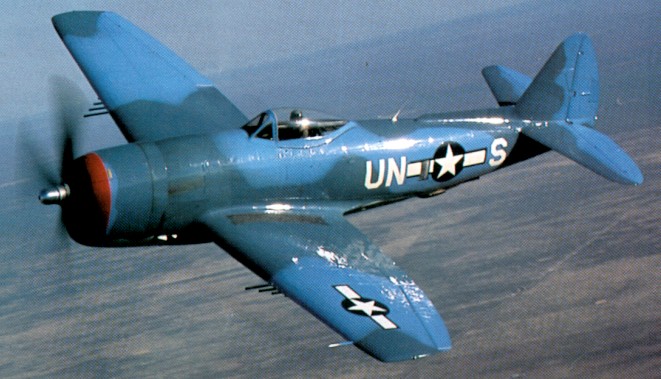
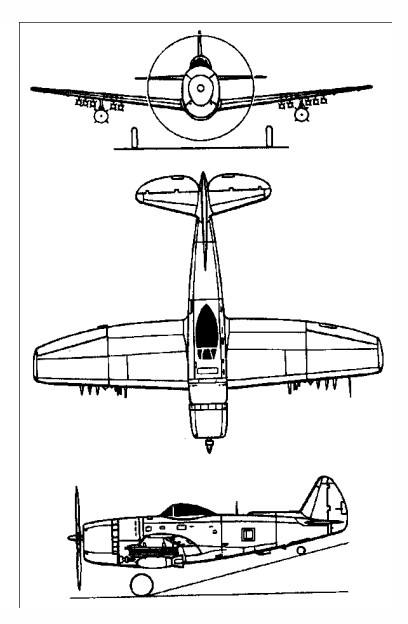
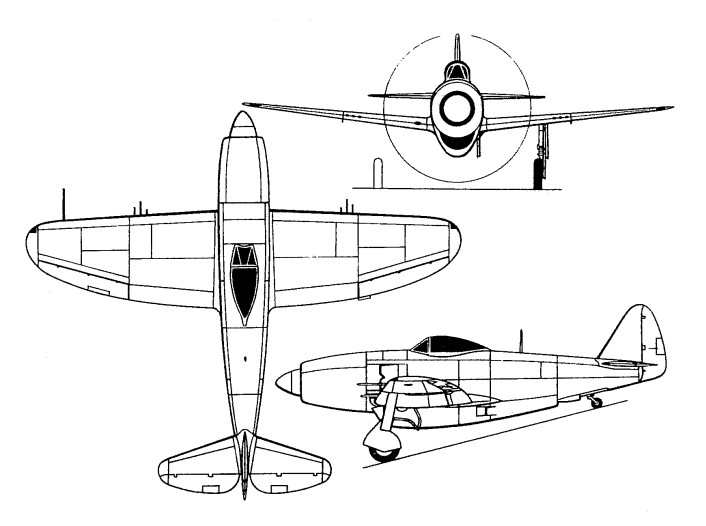
The P-43 Lancer design developed further into the P-47 Thunderbolt for USAAF. Designed by Alexander Kartveli, to provide ground clearance for the 12′ four-blade prop, the unique telescoping landing gear was 9″ shorter when retracted. First flew in its XP-47B prototype form on 6 May 1941.
Eglin Field testing effects of machine gun and cannon on P-47
The first P-47B production delivery was on 18 March 1942.
The P-47C had a mach .73 (556 mph) terminal dive and a .69 (525 mph) red-line.
A dorsal fin was added to compensate for the loss of aft keel surface and introduced on P 47D 27 RE and subsequent batches. P-47D had a mach .72 (550 mph) red-line dive speed and rolled 91 d/s @ 300 mph
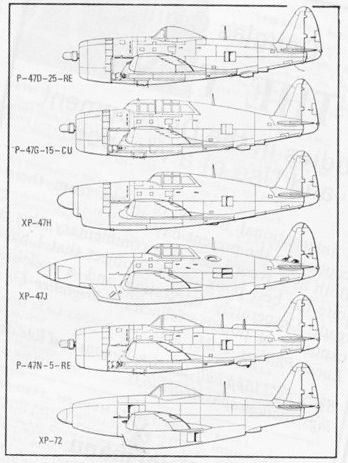
XP-47H
In 1943, two P-47D-15-RE airframes (serials 42-23297/23298) were selected for testing with the new experimental 2300 hp Chrysler XIV-2220-1 sixteen-cylinder inverted Vee liquid-cooled engine. These aircraft were redesignated XP-47H. The liquid-cooled Chrysler engine with its large under-fuselage radiator radically changed the appearance of the Thunderbolt, and increased overall length to 39 feet 2 inches. With the increased power and improved streamlining, a maximum speed of 490 mph was anticipated.
Although the project was begun in August 1943, the two P-47D-15-RE airframes were not actually converted until 1945. Test flights began on July 26, 1945. One of the XP-47Hs actually attained a speed of 490 mph in level flight. The Chrysler engine failed to deliver the promised power output, and the maximum speed attained during tests was only 414 mph at 30,000 feet, poorer performance than the “stock” P-47D. In any case, the Chrysler XIV-2220 engine never achieved production and the advent of jet propulsion killed any further USAAF interest in the development of even faster piston-engined fighters. Consequently, no further work was undertaken on the XP-47H project.
The XP-47J differed from other Thunderbolts in its engine, being powered by a ‘C’ series Double Wasp or Pratt & Whitney R-2800-57 driving a four-blade 13-ft Curtiss Electric propeller —employed after a plan to try out a contra-rotating propeller was dropped. But the XP-47J also had a distinctive cowling shape with an engine-cooling fan below and set back from the propeller hub. And there were other differences from standard Thunderbolts, some trivial: the six .50-calibre guns with 267 rounds per gun protruded from the wing leading edge in a different manner from those of other P-47s. The XP-47J was first flown on August 2, 1944 at the manufacturer’s Long Island, New York, facility and subsequently evaluated at Wright Field, Ohio. Apart from its remarkable high speed, the XP-47J could climb at 4,705 ft/min, reached a speed of 811kph, and the service ceiling was 45,000ft. Maximum range was 1,070 miles at 10,000ft. The XP-47J did not enter production.
XP 47J
P-47M had a P&W R2800-56.
Modified with longer, stronger wings, the P 47N could carry addi¬tional fuel for long distances flown in the Pacific War. Some 1,816 of this last production version were built. The P-47N dove to mach .83 (632 mph)
XP-47N Thunderbolt
Production began at Republic’s plant in Farmingdale, though others were also built at a Republic factory in Evansville, Indiana, and by Curtiss Wright in Buffalo, New York. A total of 15,863 built, of which 15,329 were built during Second World War. They were priced at $83,000+ Production was at Farmingdale (suffix -RE) and Evansville IN (suffix -RA), as well as subcontract to Curtiss for P-47G.
During WW2, Thunderbolt’s ratio of aerial combat victories to losses was 4.6:1 in downing 2,752 enemy aircraft, besides destroying 3,315 more on the ground. Official records also credit P-47 with some 9,000 locomotives and 86,000 railroad cars, 6,000 armored vehicles and tanks, and 68,000 trucks.
P-47B Engine: Pratt & Whitney R-2800-21 Double Wasp, 2000 hp Wingspan: 40 ft 9.25 in / 12.4 m Length: 34 ft 10 in Height: 12 ft 8 in Empty weight: 9010 lb / 4087 kg MAUW: 12,700 lb / 5760 kg Max speed: 412 mph ROC: 2800 fpm / 855 m/min Service ceiling: 38,000 ft Range int/fuel: 575 mi Armament: 8 x 0.5in Colt-Browning 267, 350 or 425 rds each
P-47C Engine: Pratt & Whitney R-2800-59 Double Wasp, 2300 hp Wingspan: 40 ft 9.25 in / 12.4 m Length: 36 ft 1.25 in / 11.03 m Height: 14 ft 2 in / 4.03 m MAUW: 14,925 lb Max speed: 433 mph ROC: 2800 fpm / 855 m/min Service ceiling: 42-43,000 ft / 13,000 m Armament: 8 x 0.5in Colt-Browning 267, 350 or 425 rds each
P-47D Engine: Pratt & Whitney R-2800-59 Double Wasp, 2300 hp (most) Wingspan: 40 ft 9.25 in / 12.4 m Length: 36 ft 1.25 in / 11.03 m Height: 14 ft 2 in / 4.03 m Empty weight: 10,700 lb / 4853 kg MAUW: 19,400 lb / 8800 kg Max speed: 428 mph / 690 kph ROC: 2800 fpm / 855 m/min Service ceiling: 42-43,000 ft / 13,000 m Range int/fuel: 1000 mi / 1600 km Max range ext/fuel: 1900 mi / 3060 km Armament: 8 x 0.5in Colt-Browning 267, 350 or 425 rds each Hardpoints: 3-5 Bombload: 2500 lb / 1134 kg
P-47D Engine: 1 x Pratt & Whitney R-2800-59W Double Wasp, 1890kW / 2800 hp Propeller: Hamilton Standard 24E50, 6507 A. O. Wingspan: 12.43 m / 41 ft 9 in Wing area: 27.87 sq.m / 299.99 sq ft Length: 11.02 m / 36 ft 2 in Height: 14 ft 2 in Empty weight: 4513 kg / 9950 lb Max take-off weight: 7938 kg / 17500 lb Fuel capacity: 308 Imp.Gal Max. speed: 697 km/h / 433 mph at 25,000 ft Max ROC: 7280 fpm Ceiling: 12495 m / 41000 ft Range: 950 mile Range w/max.fuel: 3058 km / 1900 miles Crew: 1 Armament: 6 x 12.7mm machine-guns, 1134kg of weapons External load: 2500 lb
Republic P-47D-28-RA Engine; 1 x 2,430 h.p. Pratt & Whitney R-2800-59 radial Prop; 13ft-diameter Curtiss Electric C5425-AI14 Wingspan; 40ft 9.5in Length; 36ft 1.75in Height; 14ft 0in Wing area; 300 sq.ft Empty weight; 10,0001b Gross weight; 14,5001b Maximum weight; 17,5001b Maximum speed; 423 m.p.h. at 30,000ft Landing speed; 105 m.p.h. Climb to 15,000ft; 6.2min Climb to 20,000ft; 8.5min Climb to 25,000ft; 11 min Climb to 30,000ft ; 14min Service ceiling; 42,000ft Maximum range; 1,030 miles at 10,000ft (5.3hr) Normal range; 590 miles at 25,000ft Armament; 6 or 8 x 0.50in machine guns 267-425 rounds per gun Maximum bomb load; 2,5001b Number built 1,028 P-47D-28-RA at Evansville, Indiana, USA
P-47G Engine: R2800, 2300 hp Max speed: 433 mph @ 30,000ft Service ceiling: 40,000 ft.
P-47M Engine: Pratt & Whitney R-2800-55 or -77 Double Wasp, 2800 hp Wingspan: 40 ft 9.25 in / 12.4 m Length: 36 ft 1.25 in / 11.03 m Height: 14 ft 8 in MAUW: 14,700 lb Max speed: 470 mph ROC: 2800 fpm / 855 m/min Service ceiling: 42-43,000 ft / 13,000 m Armament: 6 x 0.5in Colt-Browning mg
P-47N Engine: Pratt & Whitney R-2800-55 or -77 Double Wasp, 2800 hp Wingspan: 40 ft 9.25 in / 12.4 m Wing area: 321.951 sq.ft / 29.91 sq.m Length: 36 ft 1.25 in / 11.03 m Height: 14 ft 8 in Weight empty: 11003.0 lb / 4990.0 kg MAUW: 21,200 lb / 9616 kg Internal fuel: 594 Imp.Gal Wing load: 67.45 lb/sq.ft / 329.0 kg/sq.m Max speed: 467 mph / 751 kph / 406 kt Cruising speed: 261 kt / 483 km/h ROC: 2800 fpm / 855 m/min Service ceiling: 42-43,000 ft / 13,000 m Max range ext/fuel: 2350 mi / 3800 km Armament: 8 x 0.5in Colt-Browning 267, 350 or 425 rds each Hardpoints: 3-5 Bombload: 2500 lb / 1134 kg Crew: 1
XP-47H Engine: Chrysler.
XP-47J Max speed: 504 mph ROC: 4705 fpm Service ceiling: 45,000 ft Max range: 1070 miles
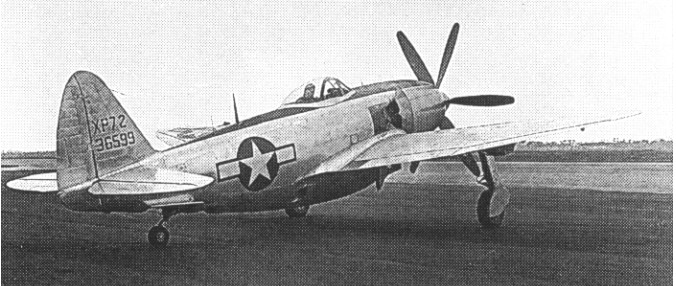
The Republic XP-72 was based upon the P-47 airframe and was designed by Alexander Kartveli’s fighter team as a ‘Super Thunderbolt’ around the 3,000-hp / 2237kW Pratt & Whitney R-4360-13 Wasp Major radial engine. The powerplant was the most powerful piston engine to reach production in any country during World War II.
Intended primarily to be faster than the Thunderbolt, the XP-72 was viewed in part as a remedy for the Third Reich’s high-speed V-l buzz bomb. The USAAF planned to use the fighter to intercept buzz bombs, with a maximum speed of 490mph and an initial climb rate of 3,100ft/min the XP-72 could reach 6000m / 20,000 ft in just under five minutes. Operational P-72s would have been armed with six .50-calibre (12.7-mm) guns.
The first of two examples flew at Farmingdale on 2 February 1944 using a large four-bladed propeller. The second XP-72 flew in July 1944 with the intended Aeroproducts six-bladed contra-rotating propeller. The second aircraft, however, was lost on an early flight.
With priority shifted to long-range escort fighters, this promising interceptor was not needed. Even with a range of 1,200 miles, the XP-72 failed to get a production order. The other XP-72 airframe is thought to have been scrapped at Wright Field around VJ-Day.
Engine: Pratt & Whitney R-4360-13 Wasp Major, 3,000-hp Max take-off weight: 6690 kg / 14749 lb Empty weight: 4973 kg / 10964 lb Wingspan: 12.49 m / 41 ft 0 in Length: 11.17 m / 37 ft 8 in Height: 4.42 m / 15 ft 6 in Wing area: 27.87 sq.m / 299.99 sq ft Max. speed: 788 km/h / 490 mph Ceiling: 12800 m / 42000 ft Range: 1930 km / 1199 miles Armament: 6 x 12.7mm machine-guns, 2 x 450kg bombs
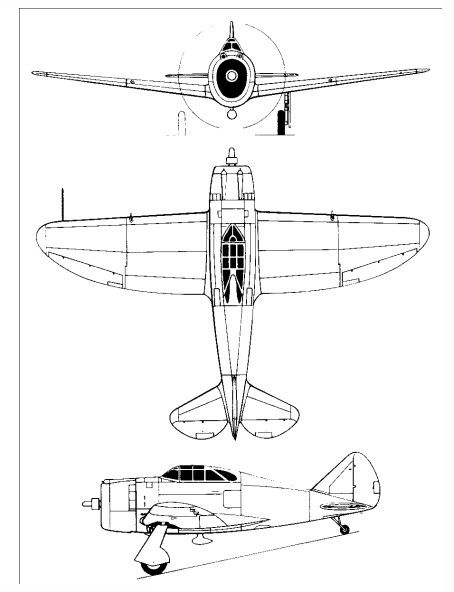
From its P-35 single-seat tighter Republic (latterly Seversky) developed the Model 2PA Guardsman two-seat escort fighter and fighter-bomber with the same type of rearward semi-retracting main landing gear units and the glazed rear portion of the cockpit expanded rearward to accommodate the second crewman. There was no US market for such an aeroplane, so the company looked for export sales.
Two were sold to the USSR as 2PA-L/As, 20 2PA-B3s went to Japan with the local designation A8V1, and 52 2PA-204Ls were ordered by Sweden to supplement her J 9 fighters (P-35s sold with the company designation EP-1-06s). Early in World War II the US administration embargoed the delivery of the 2PA-204Ls to Sweden, and these were taken into the USAAC inventory as AT-12 advanced fighter trainers with the designation AT-12. The aircraft saw limited use in this role during the first part of World War II.
AT-12 two-seat advanced tighter trainer Span: 12.5m (41ft ) Length: 8.43m (27 ft 8in) Powerplant: 1 x Pratt & Whitney R-1830-45, 783kW (1,050 hp) Armament: 4 or 7 x 7.62-mm (0.3-in) mg Bombload: 227 kg (500 lb) under wings Max T/O weight: 2918 kg (6,433 lb) Max speed: 285 mph at 10,000ft Operational range: 1,200 miles
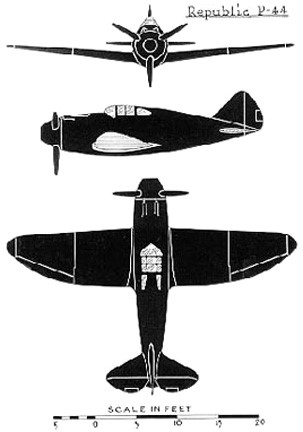
The Republic P-44 Rocket was a fighter design concept based on YP-43 with 1400hp P&W R-2180 engine. Never built, initial contracts for 80 and 827 units were cancelled in favour of P-47.
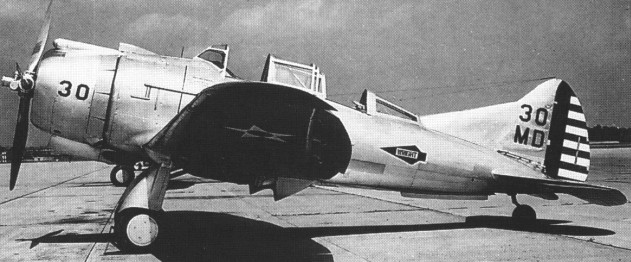
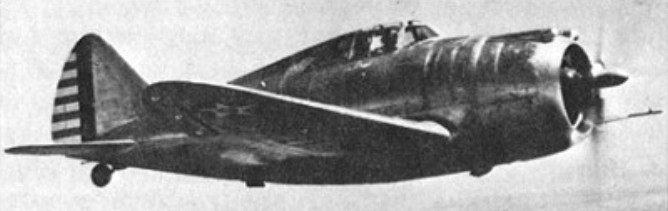
The Lancer was a single-seat interceptor fighter that first appeared in service evaluation YP-43 form in 1940. With a Pratt & Whitney R-1830 Twin Wasp radial engine and bulky fuselage, it was clearly a product of the Republic Aviation Corporation. Production for the USAAF, RAAF and China totalled 272 aircraft in three versions. Six P-43B reconnaissance fighters were allotted for Australian RAAF use, as PRU aircraft.
The P-43 Lancer design was developed further into the P-47 Thunderbolt.
P-43 Engine: 1 x Pratt-Whitney R-1830-47, 1167kW Length: 8.69 m / 29 ft 6 in Height: 4.27 m / 14 ft 0 in Wing area: 20.72 sq.m / 223.03 sq ft Max take-off weight: 3600 kg / 7937 lb Empty weight: 2565 kg / 5655 lb Wingspan: 10.97 m / 36 ft 0 in Max. speed: 562 km/h / 349 mph Ceiling: 11580 m / 38000 ft Range: 1287 km / 800 miles Crew: 1 Armament: 2 x 12.7mm machine-guns, 2 x 7.62mm machine-guns
Founded as Seversky Aircraft Corporation at Long Island, New York, in 1931. Since de Seversky had made somewhat of a pariah of himself in the USA by selling combat aircraft to Japan, the Army ordered no more P-35s from Seversky. By early 1939, his company had gotten itself into some deep financial trouble. In Apr 1939, while de Seversky was out of the country on a business trip, the board of directors of his company voted him out of office as CEO and changed the name of the company to Republic. The newly-formed company then recapitalized itself and Alexander Kartveli was appointed as vice president and technical director. Having been forced into involuntary early retirement, de Seversky spent the rest of his life writing and consulting, and Kartveli and the Republic company went on to design and produce the famed P-47 Thunderbolt.
Secured $56.5 million contract for fighter from the USAAC in 1940, largest single fighter order ever placed until then by U.S. Government. Built P- 35, P-44 and P-43 Lancers for USAAC plus some EP-1 s, based on P-35, for Swedish Government. Lancer design developed further into P-47 Thunderbolt for USAAF, of which 15,329 were built during Second World War.
Aircooled Motors, manufacturers of the Franklin aircraft engines, were acquired by Republic on 27 December 1945.
Immediate postwar designs included the Seabee single-engine amphibian, the XF-12 high-altitude long-range four-engine photo-reconnaissance aircraft prototype, and the F-84 Thunderjet/Thunderstreak/Thunderflash series of jetfighters. The larger and heavier F-105 Thunderchief followed in 1955, and in 1965 the company became the Republic Aviation Division of Fairchild Hiller Corporation. Republic became a division of Fairchild in 1965, becoming the Fairchild Republic Company in 1972.
Societe Anonyme Avions et Moteurs Renard Constructions Aeronautiques G. Renard
Belgium Societe Anonyme Avions et Moteurs Renard was established in 1927 as aero-engine manufacturer, and produced the Epervier all-metal single-seat fighter in 1928-1929 with Sabca Jupiter engine designed by Alfred Renard.
Constructions Aeronautiques G. Renard founded about 1929 to build commercial aircraft designed by Renard. First two types were R.17-100 four-seat single-engine cabin monoplane and R-30-300 tri-motor five-passenger cabin monoplane. R-31 reconnaissance and R-33 training monoplanes appeared in 1932-1933; advanced low-wing single-seat fighter R-36 with Hispano-Suiza engine exhibited at 1937 Brussels Aero Show.
Company was inactive during Second World War, but began to reorganise in 1945.




 All Aero