Salmson D.6 Cri-Cri

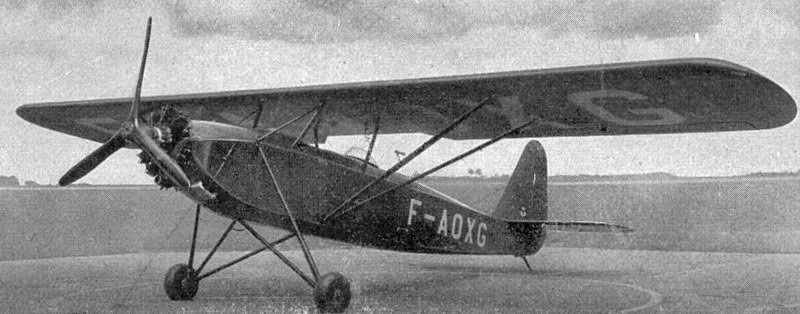
The Salmson Cricri (“Cricket”) was a French light aircraft designed by Paul Deville. Salmson launched work on this new aircraft in 1935, intended primarily for the military for intermediate and advanced training missions.

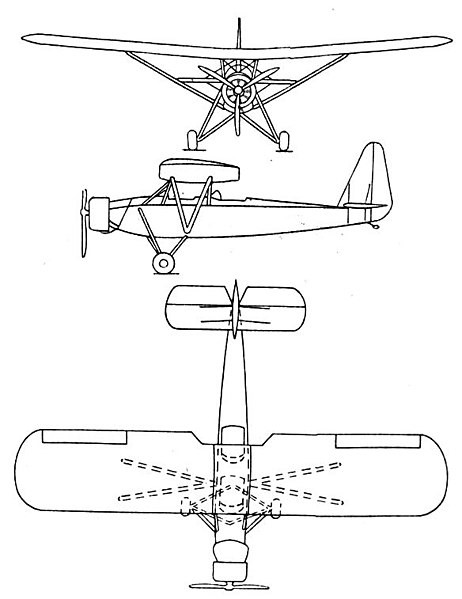
It was a conventional, parasol-wing monoplane with fixed tailskid undercarriage and seating in tandem open cockpits for the pilot and passenger. The negative dihedral wing had the distinction of having a very small forward sweep. A very large tail had been installed. Built mainly in canvas wood but also with metal inserts, it was powered by a Salmson 9Adr engine of 60hp driving a three-blade metal and wood propeller. A relatively high, relatively wide gauge fixed landing gear had been installed on the aircraft. The pilot and his passenger took place in two tandem open cockpits, separated from each other.

Officially designated D.6 by the manufacturer, it received the name of Cricri. Its first flight took place on April 14, 1936. Immediately thirty planes were acquired by the Air Force.
Shortly after receipt of the first of these aircraft, the Navy ordered two fairly similar aircraft for the intermediate training of combat aircraft pilots. These two aircraft received the official designation of D.6-3.

In September 1936, the Air Ministry placed an order for a hundred aircraft under the so-called Popular Aviation program which aimed to promote tourist aviation for the greatest number. These planes were therefore sent to schools and flying clubs across the country.
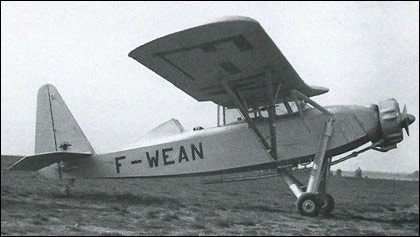
When World War II broke out in September 1939, production of the Cricri was still underway and several copies were urgently ordered for Air Force schools. But several dozen of them were camouflaged and received tactical codes from combat aircraft. Although generally disarmed, some machines carried in the rear position a mobile Darne 7.5mm machine gun for its own defense. They were widely used for the observation of the battlefield, border surveillance in particular along the Maginot line, or even the direction of ground artillery fire. At least half of the French military D.6s were used for missions other than training.

The majority of Cricri were used during all the French part of the war, and when in 1940 the Franco-German armistice was signed several planes joined the ranks of the German aviation for various secondary missions like the towing of gliders or transport and light postal flights.

345 were built.

Following the war, CFA attempted to revive the design as the Cricri Major. This differed from its predecessor mainly in having a more powerful engine and an enclosed cabin.

Variants:

D6 Cricri
Engine: 1 × Salmson 9 ADr, 45 kW (60 hp)
Wingspan: 9.66 m (31 ft 8 in)
Wing area: 16.0 m2 (172 ft2)
Length: 6.89 m (22 ft 7 in)
Height: 2.18 m (7 ft 2 in)
Empty weight: 287 kg (633 lb)
Gross weight: 575 kg (1,268 lb)
Maximum speed: 150 km/h (94 mph)
Range: 500 km (310 miles)
Service ceiling: 2,450 m (8,040 ft)
Crew: One pilot
Capacity: 1 passenger
329 built

D63 Cricri
dedicated flight trainer version
2 built
Salmson 18

After their successful water-cooled radial engines, developed from 1908 to 1918, Salmson changed their focus to air-cooling to reduce weight and increase specific power (power per unit weight). The majority of the engines produced by Salmson were of radial type with a few other arrangements such as the Salmson T6.E. In common with other engines produced by this manufacturer, the air-cooled radial engines featured the unorthodox Canton-Unné internal arrangement that dispensed with a master rod in favour of a cage of epicyclic gears driving the crankpin. Built from 1920, production ended in 1951 with the liquidation of the manufacturing company.

In common with several other French aero-engine manufacturers Salmson named their engines with the number of cylinders then a series letter in capitals followed by variant letters in lower-case.

18 AB
Type: 18-cyl 2-row radial
Bore: 125 mm (4.921 in)
Stroke: 180 mm (7.087 in)
Capacity: 39.76 l (2,426.30 cu in)
Power: 410.1 kW (550 hp) at 1,700rpm

18 ABs
Type: 18-cyl 2-row radial
Bore: 125 mm (4.921 in)
Stroke: 180 mm (7.087 in)
Capacity: 39.76 l (2,426.30 cu in)
Power: 484.7 kW (650 hp) at 1,700rpm

18 Cm
18 Z

Salmson 5 cyl / 5 Ac / 5 Ap-01 / 5Aq-01

After their successful water-cooled radial engines, developed from 1908 to 1918, Salmson changed their focus to air-cooling to reduce weight and increase specific power (power per unit weight). The majority of the engines produced by Salmson were of radial type with a few other arrangements such as the Salmson T6.E. In common with other engines produced by this manufacturer, the air-cooled radial engines featured the unorthodox Canton-Unné internal arrangement that dispensed with a master rod in favour of a cage of epicyclic gears driving the crankpin. Built from 1920, production ended in 1951 with the liquidation of the manufacturing company.

In common with several other French aero-engine manufacturers Salmson named their engines with the number of cylinders then a series letter in capitals followed by variant letters in lower-case.

5 Ac

5 Ap-01

5Aq-01

Sack A.S.6

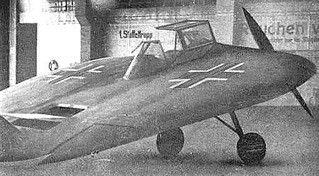
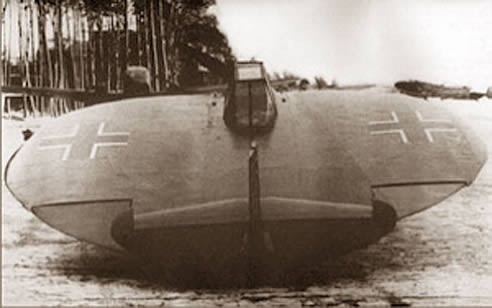
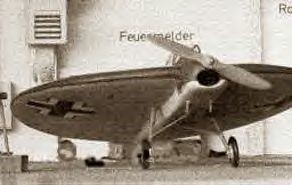
The odd-shaped model instantly caught the attention of Air Minister General Udet who was fascinated by the circular shape and gave Sack permission to proceed with his research with official backing. Sack immediately began construction of A.S. aero models of increasing size up to the A.S.5 which was by far the largest flying model. With a wingspan of 125 cm, length of 159 cm, and height of 65.3 cm the two-bladed propeller model took to the air and proved the soundness of the basic design.

From this point on Sack was determined to build a manned machine that would become the Arthur Sack A.S.6V-1.

The aircraft was built in Leipzig starting in January 1944 in the workshops of the Mitteldeutsche Motorwerke company. Assembly and final tuning were performed at the Flugplatz-Werkstatt workshop at Brandis air base during the same month.

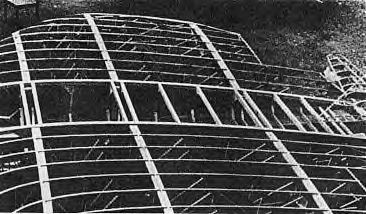
Wooden construction of A.S.6V-1, January 1944

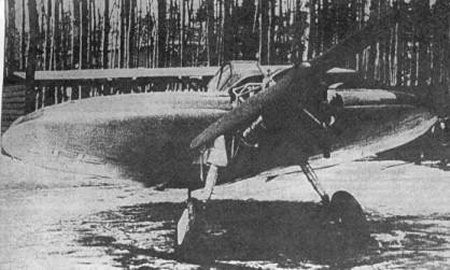
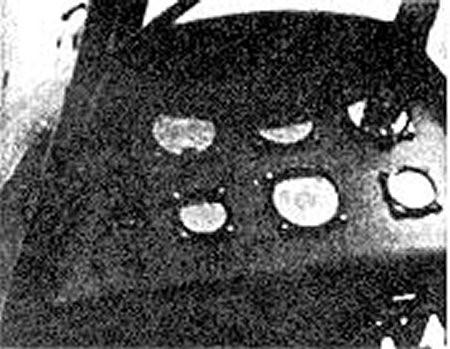
The basic structure was made of plywood while the cockpit, pilot seat, and landing gear all came from an old wrecked Me Bf 109B. The engine was taken from a Me Bf 108 Taifun, an Argus As 10C-3 of 240 hp working on an old wooden two-blade propeller.

In February 1944, the A.S.6V-1 taxi test started, piloted by Baltabol from the ATG/DFW of Leipzig. The first test proved that the rudder was not strong enough and some structural damage resulted from the test.

During the second test five separate take-off runs were attempted from the 1,200 meter landing strip at Brandis. It was soon discovered that the control surfaces failed to function properly because they were positioned in the vacuum area produced by the circular wing while taxiing. The right leg of the landing gear was damaged on the last run.

Due to war restrictions more powerful engines than the low-hp Argus were not available so the incidence angle was increased. The test pilot at this point proposed moving the landing gear back 20 cm, but due to structural reasons that could not be overcome, the modification was deemed too risky. Instead, brakes were installed from a Ju-88, 70 kg of ballast was added ahead of wing spar No.3 and the tail surfaces were increased by adding 20mm of corrugated plates.

The third test flight was performed over the 700 meter strip at Brandis on April 16, 1944. There was no wind and the plane rolled 500 meters without lifting its tail. No aerodynamic control of the empennages was achieved. The plane made a brief hop but could not get into the air.

During the fourth flight test the jump was a bit longer; however, the plane banked to the left because of torsion generated by the propeller, this being very difficult to balance in a small wingspan aircraft.

After this Baltabol lost all hope and recommended the installation of a proper Daimler-Benz engine from a current Me Bf 109 and a complete study of the basic design in an aerodynamic wind tunnel. Sack went on trying to solve the problem by himself in the traditional manner until the end of the war.

The A.S.6V-1 would have sat for the duration had it not been for the arrival of Gruppe I/JG400 at Brandis in the summer of 1944. These were the confident new Me-163 Komet pilots who had plenty of experience with difficult take-offs and landings with short wingspan aircraft. So, it was inevitable that one of them, Oberleutnant Franz Roszle, made an attempt to fly what the Gruppe named the “Bierdeckel” (Beer tray)!

His attempt, like Baltabol before him, ended with a short hop and collapsed landing gear. The Komet pilot made the same suggestion to Sack about testing the design in a wind tunnel and then turning the aircraft over to Messerschmitt for proper redesign with components of the latest Me Bf 109 fighter, including armaments. Sack refused to listen or ask any favors from the RLM. Messerschmitt got word of the A.S.6V-1 and actually proposed that a new A.S.7V-1 should be re-designated as Me-600.

The proposed Me-600 would have enlarged the circular wing considerably and featured a complete fuselage with the latest DB 605 ASCM/DCM of 2,000 hp with MW injection and a four-bladed propeller, repositioned gear, improved control surfaces, redesigned tail unit, Galland hood, and six MK-108 cannon buried in the reinforced circular wing! With wind tunnel data corrections and Messerschmitt construction the projected Me-600 would have been a formidable 500 mph fighter.

The odd circular wing already had the Komet pilots making suggestions for a new nickname. They would call any Sack aircraft that made it into combat the “Bussard” (Buzzard)! The name was proposed by the nature of the A.S.6V-1 which didn’t fly much but spent a lot of time on the ground and made out of “scavenged” parts!

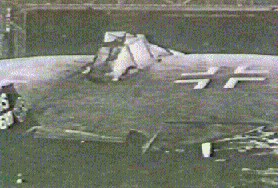
But Sack never got the chance to fix the A.S.6V-1 as it was strafed one day and then cut up and dismantled before US troops arrived at Brandis in April 1945. They found no trace of the aircraft.

Type: Experimental aircraft
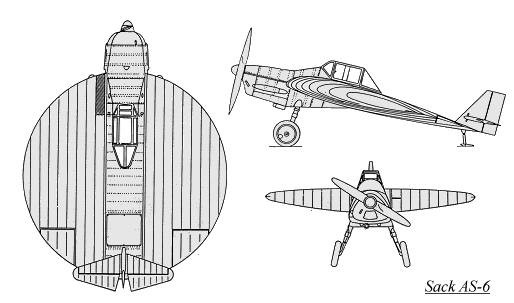
Wings: Circular shape, AVA Gottingen profile with triangular ailerons
Structure: Wooden
Coating: Plywood
Empennage: Conventional, based on the Klemm Kl 35 ones
Landing gear: Fixed, taken from a Me Bf-108 Taifun with Ju-88 brakes
Engine: Argus As 10C-3, inverted V-8, air-cooled, 240 hp
Propeller: Two wooden blades, 250 cm in diameter
Wingspan: 500 cm
Length: 640 cm
Height: 256 cm
Wing area: 19.62 sq.m
T/O weight: 900 kg
Wingload: 45.87 kg/sq.m

Sack, Arthur

Arthur Sack was a farmer who enjoyed constructing aero-models.
In June 1939 in Leipzig-Mockau he attended the First National Contest of Aero-models with Combustion Engines, where he hand-launched his first aero model with a circular wing, the AS-1. It possessed rather poor flying qualities. Arthur Sack’s aeromodel measured 125 cm and weighed just 4.5 kg, powered by a Kratmo-30 motor of 0.65 V and 4,500 RPM with a propeller measuring 600 mm in diameter. His circular aircraft was unable to lift off the ground by itself, and finally Sack had to throw it into the air in desperation. After this assisted takeoff, the model managed to perform 100 meters of stable flight, just barely reaching the finish line.

However, the odd-shaped model instantly caught the attention of Air Minister General Udet who was fascinated by the circular shape and gave Sack permission to proceed with his research with official backing. Sack immediately began construction of A.S. aero models of increasing size up to the A.S.5 which was by far the largest flying model. With a wingspan of 125 cm, length of 159 cm, and height of 65.3 cm the two-bladed propeller model took to the air and proved the soundness of the basic design.

From this point on Sack was determined to build a manned machine that would become the Arthur Sack A.S.6V-1.

SABCA / Societe Anonyme Belge de Constructions Aeronautiques

Belgium
Formed December 1920, SABCA had a close SABENA association and that airline used SABCA’s only S.2 single-engined monoplane transport. Built Handley Page 3-engined airliners for SABENA Belgian Congo service; also other private-owner prototypes.

At the end of 1920 the Société Anonyme Belge de Constructions Aéronautiques (SABCA) was created to ensure the construction, testing and overhaul of aeronautical equipment for the development of civil aviation and air transport (SABENA will be founded three years later). It will begin with the overhaul and overhaul of Belgian Military Aeronautics aircraft, before starting, in 1922, to build foreign aircraft under license.
The first designs and new realizations will be due to members of the staff of SABCA, encouraged and supported by the company. Among others, the moto-aviette Jullien SJ-1 (in 1923), of Henri JULLIEN, engineer director of the design office of the SABCA, and the “Limousine” Demonty-Poncelet of Mathieu DEMONTY (technical director) and Paul PONCELET (head of the wood section) (in 1924).

On his own, but with the support of SABCA, Paul PONCELET designed and built the “Castar” in 1922-1923, then in 1923 the “Vivette”.

SABCA’s first project was a small aeroplane called the Sabca J1, which was powered by the engine of a FN motorcycle. The company also constructed “Sabca” 1500 with a 200 HP engine and some gliders. It later assembled the Handley-Page, Fokker F VII, and the Savoia-Marchetti used by Sabena. Held Breguet and Avia licences, and from 1927 directed attention to metal construction. Outcome was S-XI 20- passenger monoplane with three 500 hp engines, as well as similar S-XII 4-passenger monoplane with three 120 hp engines. Built under license Renard R.31 reconnaissance monoplane and Savoia-Marchetti S.73 transport.

In October 1937, the Belgian aircraft manufacturer Société Anonyme Belge de Constructions Aéronautiques (SABCA) made a marketing agreement with the Italian company Caproni, with SABCA selling some of Caproni’s military aircraft in certain markets, including the Caproni Ca.135, Ca.310 and the Ca.312, which were to be designated SABCA S.45bis, S.46 and S.48 respectively. As part of this agreement, Caproni were to develop a replacement for the Belgium Air Force’s Fairey Fox biplanes, which were used as two-seat fighters and reconnaissance aircraft, but were obsolete.

Built S.47 2-seat low-wing monoplane fighter of 1937 in collaboration with Caproni. Company revived in 1950s. In 1960s assembled, maintained, and repaired Republic F-84; also collaborated with Avions Fairey on Hawker Hunter and made Vautour components for Sud- Aviation. Much work of various kinds on Lockheed Starfighter, Dassault Mirage, and Breguet Atlantic; also missile and space activities. Dassault Aviation took 53 percent shareholding, while in 1998 Fokker’s shareholding was then reportedly being sold. Recent work has included weapon system integration, development of the cockpit front panel, final assembly, and flight testing of Belgian ArmyA-109 helicopters; update of F-5s; production and upgrading of F-16s; upgrade of Mirage 5s and F1s; production of servo actuators; and construction of subassemblies for Dassault, Boeing, Airbus, and Fokker aircraft.

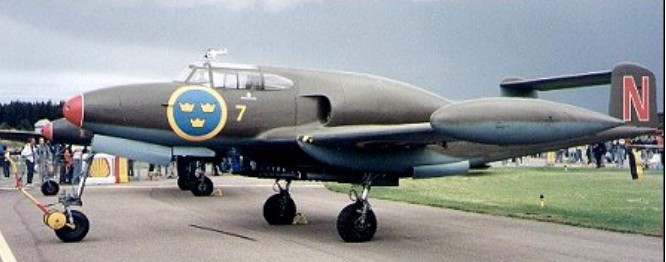
Saab J-21

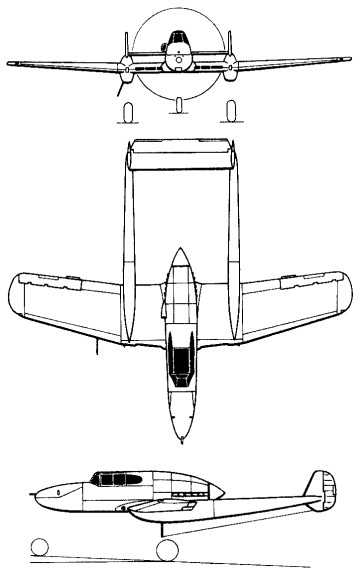
On 1 April 1939, the Air Force Materiel Administration invited AB Förenade Flygverkstäder to tender for a new fighter aircraft to be powered by the new Bristol Taurus engine, a sleeve-valve unit delivering 1,200 hp. The timetable was incredibly tight. Saab proposed a radical configuration (designated the Ll3) in which the engine was mounted behind the cockpit, offering the advantages of a twin-engined craft in terms of visibility and armament. Unfortunately, this proved to be impractical since the Taurus engine was air-cooled.

Saab J-21 Article

In March 1941, Saab was authorized to resume work on the fighter project. By this time, technology had outstripped the original Ll3 concept and a new liquid-cooled Daimler-Benz engine was available as though made to order. The modified design — the J21 — was presented to the Air Force chiefs on 1 April 1941.

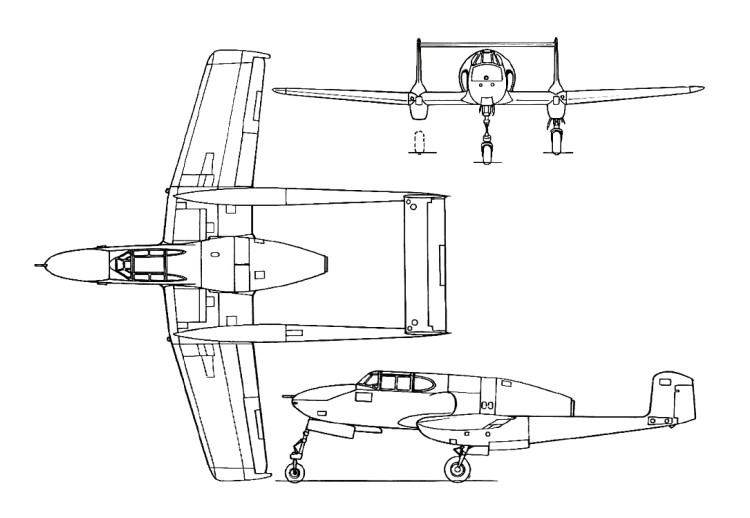
The design was a cantilever low-wing monoplane having moderate wing sweep, with central fuselage nacelle to accommodate the pilot on an ejection seat. Power was a rear-mounted powerplant in pusher configuration, twin booms extending aft from the wings with twin fins and rudders united by the tailplane with elevator, and retractable tricycle landing gear.

The first of three Saab-21A prototypes was flown on 30 July 1943 and these, like a few early production aircraft, were powered by the imported Daimler-Benz DB 605; all subsequent production had a Swedish licence-built version of this engine.

The first operational aircraft was delivered to F8 Wing at Barkaby on 1 December 1945.

When introduced into service in late 1945 as the J21A-1 the new type was the only pusher-engined fighter to become operational during World War II, being followed by the generally similar J21A-2 and, finally, by the A21A attack aircraft, these three versions being built to a total of 299 before production ended in 1948.

Continuous improvements were made and a bomb-carrying version, the J21A-3, made its debut on 22 May 1947.

The A21A had the same armament as the J21A fighter, was equipped to carry rockets or light bombs on under-wing racks, and had provision for the installation of a ventral gun pack housing eight 13.2mm machine-guns.

Although increasing the speed was the first priority of the plane’s designers at this time, all attempts to achieve this aim using piston engines were abandoned with the advent of the jet engine in late 1945, and four J21A-ls were modified in an initial attempt to adopt the new technology.

Svenska Aeroplan adapted its Saab-21 design to accept the installation of a de Havilland Goblin gas turbine. This seemed a simple way to gain experience with this form of powerplant and, at the same time, extend the performance capability of the proven Saab-21 design; however, it was to prove rather more difficult a process than had been anticipated. The redesign affected 50% of the airframe rather than 20% as had been anticipated. The first requirement was for the aft fuselage nacelle to be widened to accept the new engine and the tailplane moved to the top of the fin to be clear of the jet efflux. It was also decided that because of the higher performance of this aircraft some structural strengthening was essential, and as there was no longer any need to be concerned about propeller ground clearance the landing gear struts were shortened. In this form the first Saab-21R prototype was flown initially on 10 March 1947.

J-21R

Almost two years elapsed before all development-problem fixes had been finalised, the first deliveries of production aircraft starting during February 1949.

The original Saab-21 production order had been for 120 aircraft, but because of delay in its development, a programme for the specially-designed turbojet-powered Saab-29 was well advanced, with a result that the Saab-21R order was reduced to only 60 aircraft. These were produced as the J21RA with a 1361kg thrust de Havilland Goblin 2 engine, and J21RB with a licence-built Goblin turbojet, 30 of each being built. After comparatively short service in the fighter role, all were converted as attack aircraft, redesignated A21R and A21RB respectively, and carrying 10 100mm or five 180mm Bofors rocket projectiles, or 10 80mm anti-tank rockets.

In all, 298 J21s were built. The last of these was retired from service on 23 July 1954, al¬though the J21R continued to fly until 4 April 1957.

J21A
Engine: Daimler Benz 605B, 1475 hp / 1100kW
Span: 11.64 m (38 ft 2.25 in)
Length: 10.45 m (34 ft 3.5 in)
Height: 3.96 m / 13 ft 0 in
Wing area: 22.2 sq.m / 238.96 sq ft
Take-off weight: 4150 kg (13615 lb)
Empty weight: 3250 kg / 7165 lb
Maximum speed: 640 kph (398 mph)
Cruising speed: 495 kph (308 mph)
Landing speed: 145 kph (90 mph)
Range: 1500 km (930 miles)
Max. altitude: 11000 m (36090 ft)
Armament: 1 x 20mm cannon, 4 x 13.2mm machine-guns
Crew: 1

A21A
Engine: Daimler Benz 605B, 1475 hp
Span: 11.64 m (38 ft 2.25 in)
Length: 10.45 m (34 ft 3.5 in)
Take-off weight: 4413 kg (14478 lb)
Maximum speed: 640 kph (398 mph)
Cruising speed: 495 kph (308 mph)
Landing speed: 145 kph (90 mph)
Range: 1500 km (930 miles)
Max. altitude: 11000 m (36090 ft)

21RA
Engine: De Havilland Goblin 2 (2998 lb)
Span: 11.37 m (37 ft 3.75 in)
Length: 10.56 m (34 ft 7.75 in)
Take-off weight: 5033 kg (16512 lb)
Maximum speed: 800 kph (497 mph)
Cruising speed: 700 kph (435 mph)
Landing speed: 155 kph (96 mph)
Range: 900 km (560 miles)
Max. altitude: 12500 m (41010 ft)

21RB
Engine: De Havilland Goblin 3, 3307 lb / 1500kg
Span: 11.37 m (37 ft 3.75 in)
Length: 10.56 m (34 ft 7.75 in)
Height: 2.95 m / 10 ft 8 in
Take-off weight: 5033 kg (16512 lb)
Maximum speed: 800 kph (497 mph)
Cruising speed: 700 kph (435 mph)
Landing speed: 155 kph (96 mph)
Range: 900 km (560 miles)
Max. altitude: 12500 m (41010 ft)
Armament: 1 x 20mm cannon, 4 x 13.2mm machine-guns
Crew: 1

Saab 21
Saab 21R

SAAB 18

Design work on Aircraft 18 was commenced at the beginning of 1939 to meet an official Swedish requirement for a reconnaissance aircraft. The Air Force chiefs had announced a competition for the design of a twin-engined aircraft to replace the old B3. The competition was won by Saab.

A cantilever mid-wing monoplane, primarily of metal construction, the Saab-18 had retractable tailwheel landing gear, a twin-fin-and-rudder tail unit, and was powered as first flown by two 794kW Swedish-built Pratt & Whitney R-1830 Twin Wasp radial engines in wing-mounted nacelles. The crew comprised a pilot, navigator/gunner and bomb-aimer, the last having a position in the glazed nose of the fuselage.

The first prototype took to the air on 19 June 1942. As a result of changing requirements, the two Saab-18A prototypes were redesigned and equipped for the light bomber or dive-bomber role. Early testing of the prototypes revealed that the Saab-18A was underpowered, but with no immediate remedy available.

The type was ordered into production in B18A bomber and S18A photo-reconnaissance versions, built to a combined total of 60 aircraft; late production examples of the S18A also carried radar equipment. Delivered to Bomber Wing Fl in June 1944, the aircraft was designated the B18. Several B18s were con-verted for reconnaissance duties with the installation of radar and camera equipment. This version became known as the B18A.

The availability in 1944 of a Swedish licence-built version of the much more powerful Daimler-Benz DB 605B powerplant led to the single Saab-18B prototype, first flown on 10 June 1944 and followed by 120 B18B dive-bomber production aircraft. With new engines, this version was one of the fastest piston-engined aircraft in the world, reaching a top speed of 570 km/h (354 mph).

Final production version was the T18B (62 built) which had been developed to serve as a torpedo-bomber but was, instead, completed as an attack aircraft. With a crew of two, this could either be fitted with torpedoes for anti-shipping duties or armed with a single 157-mm and two 20-mm automatic Bofors cannons. Production of the last T18B ended in 1948.

242 production aircraft serviced until the last of them was retired in 1956.

B/S18A
Span: 17.04 m (55 ft 10.75 in)
Length: 13.23 m (43 ft 4,75 in)
Take-off weight: 8700 kg (1918 lb)
Maximum speed: 465 kph (289 mph)
Cruising speed: 415 kph (258 mph)
Landing speed: 135 kph (84 mph)
Range: 2200 km (1367 miles)
Max. altitude: 8000 m (26250 ft)

B18B
Engines: 2 x Daimler-Benz DB 605B, 1100kW
Span: 17.04 m (55 ft 10.75 in)
Length: 13.23 m (43 ft 4,75 in)
Height: 4.35 m / 14 ft 3 in
Wing area: 43.75 sq.m / 470.92 sq ft
Take-off weight: 8793 kg (1938 lb)
Maximum speed: 570 kph (354mph)
Cruising speed: 480 kph (298 mph)
Landing speed: 125 kph (78 mph)
Ceiling: 9800 m / 32150 ft
Range: 2600 km (1616 mph)
Max. altitude: 9800 m (32150 ft)
Armament: 1 x 7.9mm and 2 x 13.2mm machine-guns
Bombload: 1500kg

T18B
Span: 17.04 m (55 ft 10.75 in)
Length: 13.23 m (43 ft 4,75 in)
Take-off weight, kg (lb) 9272 kg (2044 lb)
Maximum speed: 595 kph (370 mph)
Cruising speed: 480 kph (298 mph)
Landing speed: 130 kph (81 mph)
Range: 2600 km (1616 miles)
Max. altitude: 9300 m (30150 ft)

Saab 18