Schweizer SGS 2-12

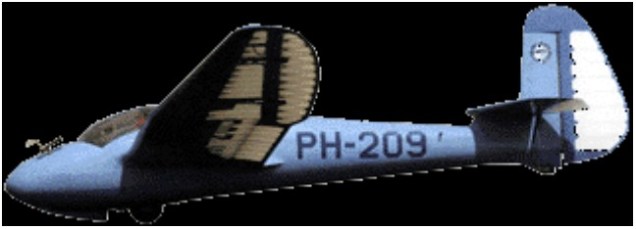
When aluminum became unavailable during World War II, Ernest and Paul Schweizer reworked the all-metal TG 2-8 (USAAC TG-2/ USN LNS-1) into a wooden sailplane. Besides being fabricated from wood, the wings were lowered from the 2-8’s shoulder position to a mid/ low mounting to improve rear seat visibility. The wing was thickened to allow cantilever construction and greater strenght for high speed aerotowing. Also upper and lower surface spoilers were used and the design simplified to ease of construction.

Harland Ross set an altitude record at 11,003 m / 36,100 feet in 1950, and Betsy Woodward held the feminine version of the same record.

One belongs to the National Soaring Museum. The Vintage Sailplane Association has the military manuals, color scheme drawing and paint chips.

Wing span: 16.6 m / 54 ft
Wing area: 22.02 sq.m / 237 sq.ft
Aspect ratio: 12.3
Airfoil: NACA 4416
Empty Weight: 390 kg / 860 lb
Payload: 154 kg / 340 lb
Gross Weight: 544 kg / 1200 lb
Wing Load: 24.7 kg/sq.m / 5.05 lb/sq.ft
L/DMax: 24 84 kph / 45 kt / 52 mph
MinSink: 0.92 m/s / 3.0 fps / 1.78 kt
Seats: 2
No. Built: 114

Schweizer Aircraft Corp

The Schweizer Aircraft Corporation was an American manufacturer of sailplanes, agricultural aircraft and helicopters located in Horseheads, New York. The company grew out of the Mercury Glider Club which produced the first two Schweizer gliders in the Schweizers’ barn. The company was originally called the Schweizer Metal Aircraft Company. Attorney Bob McDowell indicated to the Schweizers that they should move their manufacturing operation out of their father’s barn and relocate to the Elmira, New York area. The Schweizers received the suggestion positively as they needed more space to produce gliders, but they had no money with which to make the move.

It was incorporated in 1939 by three Schweizer brothers (Paul, William, and Ernest), who built their first glider in 1930.

McDowell convinced Elmira Industries Inc, the local business development corporation, to provide space for the Schweizers on the second floor of the Elmira Knitting Mill Building in return for stock in the company. This resulted in the Schweizer Metal Aircraft Company becoming the Schweizer Aircraft Corporation in 1939, with a sale of shares to Elmira Industries, local businessmen and soaring pilots.

Schweizer primarily produced light, piston-engined helicopters for use in utility and flight-training roles. The Schweizer 300CBi, originally designed and manufactured by Hughes aircraft as the Hughes 269 for the United States Army, is one of the most widely used training helicopters in the world. In 1986, Schweizer acquired all rights to the helicopter from McDonnell Douglas, who had purchased Hughes Helicopters in 1984. After Schweizer acquired the FAA Type Certificate, the helicopter was known for a short time as the Schweizer-Hughes 300C and then simply, the Schweizer 300C.

Schweizer is perhaps known best for its popular line of gliders (sailplanes), the earliest of which (the model SGP 1-1) was produced in 1930. Although very few of the early gliders were built, later models gained popularity, such as the SGS 2-8 and 2-12, which were adopted by the U.S. Army Air Corps for training as the TG-2 and TG-3, respectively.

The Schweizer SGS 1-23 was a world class competition and record setting glider between its first flight in 1948 and the end of its production in 1967.

In the 1950s and 60s the Schweizer Aircraft Corporation designed and manufactured the very popular SGS 1-26 and SGS 2-33 gliders. They are easy to fly, with simple construction, and are quite rugged and forgiving. A powered light aircraft, the Schweizer SA 1-30 was tested, but did not go into production.

The 2-33 was adopted by the United States Air Force Academy as the TG-4, for use in introductory airmanship training. The Academy used over a dozen such gliders until 2002 when they were replaced by more modern sailplanes. The Royal Canadian Air Cadets continue to operate a fleet of over seventy 2-33As.

Other popular Schweizer gliders include the single-seat SGS 1-26 and the two or three-seat 2-32, both of which can be found in many soaring clubs and in private ownership across the United States.

Primarily designers and makers of sailplanes, one of which (SGS 2-32) fitted with piston engine was tested by Lockheed Aircraft Corporation as Q-Star for ‘quiet reconnaissance’ in Vietnam. On Q-Star was based the Lockheed YO-3A, using Schweizer wings and tail, new fuselage and muffled engine.

Company also built for Grumman the Ag-Cat agricultural biplane, later for Gulfstream, before acquiring the rights in 1981 (Ag-Cat subsequently produced by Ag-Cat Corporation).

Schweizer produced the Grumman G-164 Ag Cat, a single-engine biplane agricultural aircraft originally developed by Grumman in the 1950s. Under the contract with Grumman the airplane was built almost continuously between 1957 and 1981. During this period of time Schweizer built 2,455 of the airplanes.

In 1981 Schweizer bought the rights to the design and continued production under the name Schweizer Ag Cat. In 1995 Schweizer sold the rights to the Ag Cat to Ag-Cat Corp. of Malden, Texas. In February 2001 the design was sold to Allied Ag-Cat Productions Inc. of Walnut Ridge, Arkansas. Allied Ag-Cat is not producing new aircraft although a related company operates a large fleet of Ag-Cats.

The basic airframe incorporates many safety innovations, including a pressurized cockpit to keep pesticides out, air conditioning and a fuselage structure that is designed to progressively collapse in the event of a collision.

The basic designof Schweizer S269C remained unchanged over the years. Between Hughes and Schweizer, nearly 3,000 copies of the Model 269/300 have been built and flown over the last 50 years. Schweizer continued to develop the Model 300 by adding a turbine and redesigning the body to create the Schweizer 330, and then further developments led to the development of the Schweizer 333.

An improved version in the series, the Sikorsky S-434, was released in 2008.

In 1972 Schweizer hired David Thurston and production of his Thurston Teal was part of the agreement to work at Schweizer. The company produced three Schweizer TSC-1A1 Teals and nine TSC-1A2 Teal IIs before production was moved to Teal Aircraft in 1976.

The development of the Schweizer SGM 2-37 two-place motor glider for the United States Air Force Academy in 1982 led to a new area of expertise for the company. In the mid-1960s Lockheed had used the Schweizer SGS 2-32 sailplane as the basis for its YO-3 quiet reconnaissance aircraft. Schweizer decided to develop the SGM 2-37 into a similar concept aircraft as the YO-3. The result was the SA 2-37A and B, known as the RG-8A in military use.

The RG-8A was later developed by the company into the twin piston-engined and twin-boom SA 2-38 Condor with the US military designation of RU-38A Twin Condor. This design was further refined into the turboprop-powered RU-38B Twin Condor. The RU-38 was still in production in 2008.

It is believed the US Drug Enforcement Administration purchased aircraft designated Shadowhawk from Schweizer. The aircraft had a poor operational history. They may be designated SA 38B.
Other projects

In partnership with Northrop Grumman (formerly Ryan Aeronautical), Schweizer is developing the MQ-8 Fire Scout helicopter UAV.

Schweizer is currently participating in development of Sikorsky’s X-2 Demonstrator, a prototype aircraft using co-axial rotor blades with a pusher propeller for extra forward thrust.

Makes fuselage assemblies for Piper Aircraft Corporation and structures for Bell Helicopters. Became license-holder for Hughes 300 helicopter in 1983, producing piston-engined three-seat Model 300C from 1984 to present day and developing new 3/4-seat Model 330 turboshaft-powered helicopter (first flown June 1988); also supports Hughes Model 269s.

In 1986 flew the SA 2-37A low-noise special-missions aircraft suited to surveillance and other roles, followed in May 1995 by a radical twin-boom SA 2-37A conversion known as SA 2-38A. Two joined the U.S. Coast Guard as RU-38A Twin Condors for covert patrol and surveillance (one by conversion, one built as new).

In December 1999, Schweizer Aircraft celebrated its 60th Anniversary, and had built more than 2,160 sailplanes. Schweizer was a major U.S. aerospace contractor and no longer manufactured gliders.

Helicopter products offered by the company as of February 2009 included the 300C, 300CBi, and 333.

Previously the oldest privately owned aircraft company in the United States, Schweizer was acquired by Sikorsky Aircraft Corporation of Stratford, Connecticut, in 2004, and became a diversified aerospace company.

In 2011 and 2012 Sikorsky Aircraft Corporation laid off all the workers and closed the plant.
Goppingen Habicht

During the war, the production was forcefully expanded to build parts for, amongst other things, the ME-109, the “Giant” and for the Bachem “Natter”. Alongside the GÖ-4 there were also complete aircraft which were built, like the GÖ-8 and the 13,6m-“Habicht”.

Goppingen GÖ-8

During the war, the production was forcefully expanded to build parts for, amongst other things, the ME-109, the “Giant” and for the Bachem “Natter”. Alongside the GÖ-4 there were also complete aircraft which were built, like the GÖ-8 and the 13,6m-“Habicht”.

Goppingen GÖ-4

In 1938 the company moved to Kirchheim/Teck and employed more than 300 people during the war time.
The first serial gliders were the aerobatic single seat trainer GÖ-1 ‘Wolf’ from Wolf Hirth and the renown GÖ-3 ‘Minimoa’ as well as the two seat GÖ-4 from Wolfgang Hütter.

Wing span: 14,8 m
Length: 6,74 m
Wing area: 19 sq.m
Empty weight: 180 kg
Max AUW: 350 kg
Wing load: 18,4 kg/m²
Min. sink rate: 1 m/sec
max L/D: 1:19

Schempp-Hirth Mini-Moazagotl / Minimoa Goppingen GÖ-3

In 1938 the company moved to Kirchheim/Teck and employed more than 300 people during the war time.
The first serial gliders were the aerobatic single seat trainer GÖ-1 ‘Wolf’ from Wolf Hirth and the renown GÖ-3 ‘Minimoa’ as well as the two seat GÖ-4 from Wolfgang Hütter.

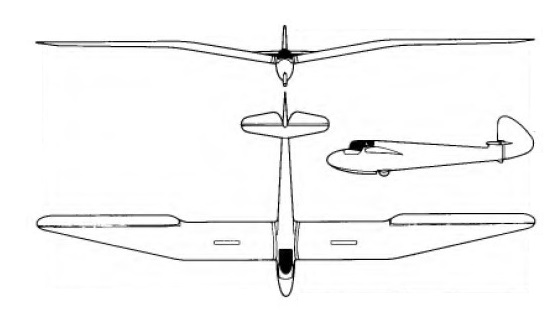
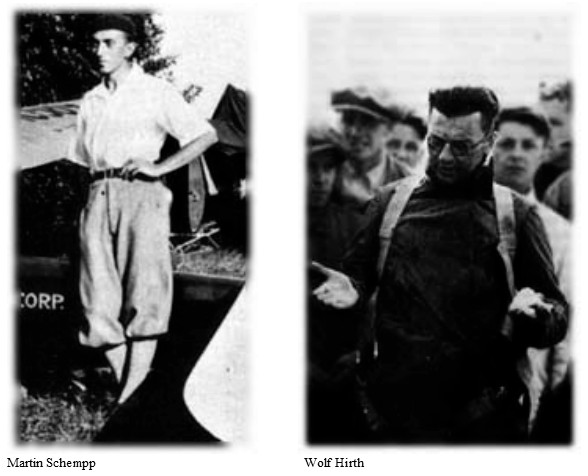
One of Germany’s leading high performance single seaters before the war, this gull-winged glider was designed by two of Germany’s leading sailplane pilots, Martin Schempp and Wolf Hirth. They designed and developed the Minimoa from the 20m span Moazagotl, and the name Minimoa is a contraction of miniature Moazagotl, although the design was also known as the Goppingen 3.

In its original form it had cantilever shoulder-mounted gull wings, and it was built by Wolf Hirth and Dipl-lng Wolfgang Mutter. Of conventional wood and fabric construction, the Minimoa is characterised by swept back wing outer panel leading edges and large ailerons with trailing edges projecting beyond those of the wing itself; air brakes of the same basic Schempp-Hirth type later to be featured on many other sailplanes are fitted. The tailplane is mounted ahead of the fin and is raised above the fuselage top line. The pilot sits under a one-piece hinged cockpit canopy that opens to starboard, and by prewar standards the cockpit was roomy. Landing gear consists of a non-retractable monowheel and a skid under the nose, plus a small tailskid. By 1938 the Minimoa 3B was introduced with the gull wings now in the mid position with a modified aerofoil section, and reduced weight. From July 1935 to 1939 a total of 110 Minimoas were built, of which 13 were sold abroad to Britain, France, the USA, Argentina, South Africa and Japan; a few survived the war and are still flying.

First flown in 1935, the Minimoa made its mark in contest flying, taking third place at the 1937 International Competition at the Wasserkuppe in Germany flown by Wolfgang Spate. Richard du Pont and Chet Decker flew Minimoas to win the U.S. Championships in 1937 and 1939. The Minimoa established a number of records, including the world altitude record in 1938 (using lift in cumulo nimbus cloud) of 6,687 m/ 21,939 ft. The name was an abbreviation of its original nickname, Mini- Moazagotl, as it was a smaller successor of Hirth’s earlier 20 m. Moazagotl.

Distinctive in many respects, the Minimoa was stable, but with poor roll control by later standards. It was the first sailplane to carry water ballast, in a tank behind the cockpit. Structure: wood/ fabric wings and tail, wood fuselage

Gallery

Göppingen Gö 3 Minimoa
Wing span: 17m /55.7ft
Wing area: 19.05sq.m / 205sq.ft
Length: 23.261 ft / 7.09 m
Empty Weight: 200kg
Payload: 105kg / 230lb
Gross Weight: 275kg
Wing Load: 14.5kg/sq.m
Length: 6,9 m
Wing chord: 1,3 m
Aspect ratio: 16
Airfoil: Go 681, 693
L/DMax: 28 @ 72 kph / 39 kt / 45 mph
MinSink: 0.61 m/s / 2.0 fps / 1.18 kt
Seats: 1

Schempp-Hirth Minimoa
Span: 17.0 m / 55 ft 9.25 in
Length: 7.0 m / 22 ft 11.5 in
Wing area: 19.0 sq.m / 204.5 sq ft
Wing section: Gottingen 681
Aspect ratio: 15.2
Empty weight: 216 kg / 476 lb
Max weight: 350 kg / 772 lb
Water ballast: None
Max wing loading: 18.42 kg/sq.m / 3.77 lb/sq ft
Max speed: 136 mph / 119 kt / 220 km/h
Stalling speed: 32.5 kt / 60 km/h
Min sinking speed: 0.65 m/sec / 2.1 ft/sec at 39.5 mph / 34 kt / 63 km/h
Best glide ratio: 26:1 at 53 mph / 46 kt / 85 km/h

Schempp-Hirth / Göppingen

Sportflugzeugbau Göppingen (Sport Aircraft Göppingen)
Sportflugzeugbau Schempp-Hirth
Schempp-Hirth Flugzeugbau Gmbh

Martin Schempp and Wolf Hirth first met in 1928 and beginning in 1935, the team developed the Minimoa, the first high performance glider to sell more than 100 models. The production of Schempp-Hirth gliders began in the municipal building yard in Göppingen, near Stuttgart, where Martin Schempp founded the Sportflugzeugbau Göppingen (Sport Aircraft Göppingen) company in 1935.

In 1938 the company moved to Kirchheim/Teck and employed more than 300 people during the war time.

The first serial gliders were the aerobatic single seat trainer GÖ-1 ‘Wolf’ from Wolf Hirth and the renown GÖ-3 ‘Minimoa’ as well as the two seat GÖ-4 from Wolfgang Hütter. Occasionally there are single examples which are preserved and maintained as oldtimers which can still be found at airshows.

During the war, the production was forcefully expanded to build parts for, amongst other things, the ME-109, the “Giant” and for the Bachem “Natter”. Alongside the GÖ-4 there were also complete aircraft which were built, like the GÖ-8 and the 13,6m-“Habicht”.

The period after the war till 1955 was bridged with the production of plywood suitcases, leg prosthesis, furniture, weaving looms etc, yet also with fighter jet dummies (F-86) and sound studios for television stations.

The connection to the aviation industry was implemented early on with the production of the Matteson M-1 glider, the production of the powered aircraft GS-6a “Milan” and with works on engine pod and tail section of the “Trumpf” airship D-LEDA.

Licenced production such as “Emeraude” and “Smaragd”, subcontracting for “Kl-107” “, “Do-27”, “Do-28” and subsequently the production of the Standard Austria glider in several versions, ensured the employment of the about 50 employees till 1965.

In 1960s company renamed and built the Milan 656 light tourer, also French Piel Emeraude under licence. During early 1960s production of powered aircraft ceased, licence rights for Emeraude being transferred to Binder Aviatik KG.

Regaining a foothold in the world market was achieved with an own design, the SHK, by Rolf Kunz which was flown into third place in its first attempt at the 1965 World Championships in South Cerny/England.

After that the technology revolution from wood to fiberglass was completed in quick steps – at Schempp-Hirth under the directorship of Klaus Holighaus, who, with the maiden flight of his Cirrus in January 1967, was able to celebrate a successful debut.

Two years later, again in January, he already flew his first “Super Orchid”, the Nimbus-1. With this glider George Moffat won the 1970 World Championships in Marfa/Texas, USA.

With more than 700 produced examples, (of which 200 were produced by Grob), the Standard Cirrus was Schempp-Hirth’s second most successful aircraft in produced units. Further successes followed in 1972 and 1974 when Göran Ax in Yugoslavia and George Moffat in Australia became World Champions in the Open Class flying the Nimbus-2 (the production version of the Nimbus-1).

1974 also marked the maiden flight of the Janus, being the worlds first two seat glider in fiberglass construction. Constantly refined (e.g. 20 m CFK wings) it was only retired from production in 1996 after over 20 years. The last variants were the janus-Ce and janus-CT.

Also in 1974, there was the maiden flight of the single seat motorglider Nimbus-2M. Not only were the first experiences with retractable engines achieved, but also numerous world records were set, from the limited series production.

For the FAI introduced “15 m Racing Class”, Schempp-Hirth delivered the Mini-Nimbus, which came on to the market in many versions and was superseded in 1980 by the Ventus.

A new material had found its way, however, into the Kirchheimer production halls: the carbon fiber. What was included into the Nimbus-2C in a rather inconspicuous manner, proved itself to be the start of, at that time not appreciative of how large, an effective future in the production of high performance gliders. The thin wing profiles of the succeeding developments would not have been possible without the higher strength and stiffness of the carbon fiber.

The lengthening of the lifespan for fiberglass constructed gliders from 3000 to 6000 hours was for example, proven with a Nimbus-2 inner wing.

Serial introduction of carbon fiber was first included on the Nimbus-2C, Mini-Nimbus-C, Janus-C and Janus-CM. the optimal qualities of this new material were only utilized fully later on in the Ventus and Nimbus-3, in the production of the long and thin wings of these models.

Just a few months after its maiden flight, the Nimbus-3 won the 1981 World Championships in Paderborn.

Then the Ventus and Nimbus-3 won the 1983 World Championships in Hobbs/USA and subsequently the Nimbus-3 was also at the front in Rieti in 1985. Together with this, a string of national championships titles for both models and a number of world records for the Nimbus-3 were achieved.

Whilst the production of the single seat Nimbus-3 had to be discontinued after a fire in one of the production halls, this enabled the production of the Racing Class glider Ventus to be increased, allowing the increase in demand for its motorized variant Ventus-bT to be satisfied.

Constant refinement was also the key for the success of the Racing Class glider Ventus which debuted in spring 1986 as the model Ventus-c (on request with wing tip extensions for 17,6 m wingspan). Production of this model was ceased in 1994 after over 600 examples were produced (including self launchers and turbos).

January 1998 saw the delivery of the 4000th built Schempp-Hirth aircraft since the start of the company (including aircraft built under licence).

Today thousands of their gliders are flying around the world. Schempp-Hirth sailplanes include the Ventus A, an advanced 15-meter-class plane with carbon-fiber technology, thin wings, and a low-profile fuselage. The Ventus B is a 15-meter-class craft with a larger cockpit for tall pilots. The Nimbus 2C (open class) has a 20.3- meter wingspan with either carbon or carbon/fiberglass construction. The Janus B has an 18.2-meter wingspan for high-performance tandem two-place flying. The Janus C has a 20-meter span with carbon wings, seating for two, and competition-type performance. The Janus CM, with a 20-meter span, is a two-place motorglider with carbon wings and fully retractable engine. Schempp-Hirth’s newest sailplanes include the Discus, Duo Discus, Ventus and Nimbus, available in a variety of variations, including pure gliders and powered sailplanes.

January 1998 saw the delivery of the 4000th built Schempp-Hirth aircraft since the start of the company (including aircraft built under licence).

2014: Schempp-Hirth Flugzeugbau GmbH
Type Certificate: EASA.A.532

Scheibe

Scheibe-Flugzeugbau GmbH

Egon Scheibe was a young German aircraft engineer, who designed and built some of the most successful gliders before WW2. After the war, he founded Scheibe Flugzeugbau and built a large number of successful gliders, most notably the Bergfalke tandem 2-seater.

Formed at Dachau, near Munich, in 1951 by Egon Scheibe, who at first built gliders designed by Scheibe in Austria. This company had some success with the Mü 13E Bergfalke 1 and then produced a number of conventional gliders. His Sperling two-seat light high-wing monoplane first flew August 1955, and was developed with new wing and tail as SF-23A and built in numbers until 1963. SF-24A Motorspatz built from 1959. SF-25 Motorfalke licencebuilt from 1970 by Slingsby Sailplanes Ltd in UK as Type 61 Falke. SF-28A Tandem-Falke tandem two-seat motorglider no longer offered. Available were the SF-25C Falke 2000 and Rotax-Falke two-seat motorgliders, and the SF-40 two-seat lightplane (first flown 1994), the latter originally offered in A and B versions with tailwheel undercarriages, but the latest version was the SF-40-C with a nosewheel undercarriage. SF-34B Delphin was produced in France as the S.N. Centrair Alliance 34 two-seat glider, while the SF-36 R two-seat motorglider was also expected to go into production in France.

The firm had produced more than 2300 machines by 1983 plus numerous kits for homebuilders.

1983-98: Scheibe Flugzeugbau GmbH, August Pfaltz-Strasse 23, Postfach 1829, D 8060 Dachau bei Mfinchen, West Germany.

Scheibe Flugzeugbau GMBH eventually closed its doors in 2006, partly because of the lack of a successor for Egon Scheibe, but probably also due to the increasingly difficult trading conditions after the boom of Ultralight/Microlight aircraft that have taken over a large portion of the market for fun, relatively cheap, and easy to fly recreational aircraft. The Motorfalke design was subsequently taken over by the newly formed Scheibe Aircraft GMBH based in Heubach (Germany), which has certified the Turbo-Rotax powered version with the glider towing market in mind.

Savoia-Marchetti SM.95

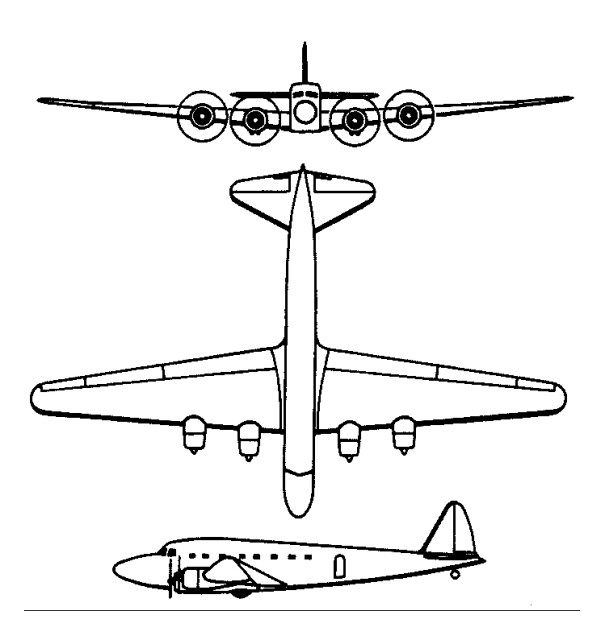
The first prototype flew on May 8, 1943. 23 built.

Milan-Forlanini Airport 1948

Gallery

S.M.95
Engines: 4 x Alfa Romeo 128 RC.18, 641kW
Max take-off weight: 21600 kg / 47620 lb
Loaded weight: 12800 kg / 28219 lb
Wingspan: 34.28 m / 112 ft 6 in
Length: 24.77 m / 81 ft 3 in
Height: 5.7 m / 19 ft 8 in
Wing area: 128.3 sq.m / 1381.01 sq ft
Max. speed: 400 km/h / 249 mph
Ceiling: 6500 m / 21350 ft
Range: 2000 km / 1243 miles
Crew: 4-5
Passengers: 44

Savoia-Marchetti S.M.95