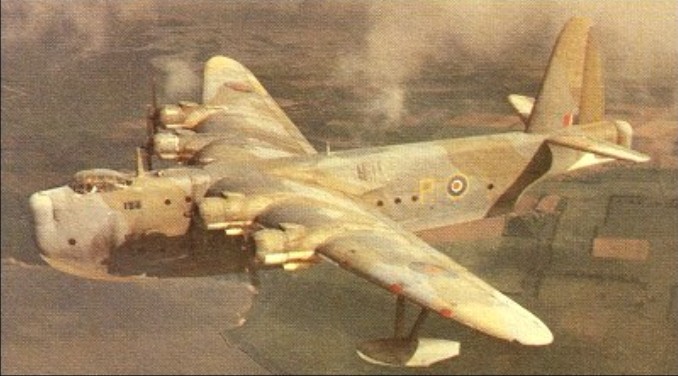
Intended as a long-range flying-boat with a heavy armament, and much bigger than Short Sunderland. The first of two prototypes flew in 1944. The second prototype would have been a 40-passenger aircraft but was cancelled due to low demand.
Intended as a long-range flying-boat with a heavy armament, and much bigger than Short Sunderland. The first of two prototypes flew in 1944. The second prototype would have been a 40-passenger aircraft but was cancelled due to low demand.

In 1936 the RAF also decided to investigate the feasibility of the four-engined bomber. The Air Ministry Specification B.12/36 had several requirements. The bomb load was to be a maximum of 14,000 lb (6,350 kg) carried to a range of 2,000 miles (3218 km) or a lesser payload of 8,000 lb (3,629 kg) to 3,000 miles (4,800 km) (incredibly demanding for the era). It had to cruise at 230 or more mph at 15,000 ft (4,600 m) and have three gun turrets (in nose, amidships and rear) for defence. The aircraft should also be able to be used as a troop transport for 24 soldiers, and be able to use catapult assistance for takeoff. The idea was that it would fly troops to far corners of the British Empire and then support them with bombing. To help with this task as well as ease production, it needed to be able to be broken down into parts, for transport by train. Since it could be operating from limited “back country” airfields, it needed to lift off from a 500 ft (150 m) runway and able to clear 50 ft (15 m) trees at the end, a specification most small aircraft would have a problem with today.
Initially left out of those asked to tender designs, Shorts were included because they already had similar designs in hand and they had ample design staff and production facilities. Shorts were producing several four-engined flying boat designs of the required size and created their S.29 by removing the lower deck and boat hull of the S.25 Sunderland. The new S.29 design was largely identical otherwise: the wings and controls were the same, construction was identical and it even retained the slight upward bend at the rear of the fuselage, originally intended to keep the Sunderland’s tail clear of sea spray.
In October 1936, the S.29 was low down on the shortlist of designs considered and the Supermarine Type 317 was ordered in prototype form in January 1937. However it was decided that an alternative design to Supermarine was needed for insurance and that Shorts should build it as they had experience with four-engined aircraft. The original design had been criticized when considered and in February 1937 the Air Ministry suggested modifications to the original Short design, including considering the use of the Bristol Hercules engine as an alternative to the Napier Dagger, increasing service ceiling (28,000 ft) and reducing the wingspan. Shorts accepted this large amount of redesign. The project had added importance due to the death of Supermarine’s designer causing doubt in the Air Ministry. The S.29 used the Sunderland’s 114 ft (35 m) wing and it had to be reduced to less than 100 ft (30 m), the same limit as that imposed on the P.13/36 designs (Handley Page Halifax and Avro Manchester). In order to get the needed lift from a shorter span and excess weight, the redesigned wing was thickened and reshaped. It is often said that the wingspan was limited to 100 ft so the aircraft would fit into existing hangars. “The wing span was limited by the Air Ministry to 100 ft” but the maximum hangar opening was 112 ft (34 m) and the specification required outdoor servicing. The limitation was to force the designer to keep overall weight down.
The original layout of the bomber was tried out by the construction of a half-scale model S.31 fitted with four 97kW Pobjoy engines. Flying trials with this proved the feasibility of the design. Short had originally decided on an incidence of 3° giving the best possible cruise performance, but the RAF asked that the incidence be increased to 6.5°, being more concerned with improving take-off performance than the cruising speed. In order to accommodate the RAF request for increased wing incidence a major re-design of the central fuselage would have normally be undertaken, but because of time restraints, Short decided on a “quick fix” by lengthening the main landing gear legs to give a higher ground angle.
At the end of 1938, this change was incorporated on the Short S.31 prototype.
While testing with the S31/M4, construction began on two full size prototypes now officially known as the Stirling MkI/P1. Shortly after construction of the prototypes began, the Air Ministry decided to order the Stirling into production with a contract of 100 Stirling MkI’s as the second string for the Supermarine 316 and formally ordered in October. 1938. The prototype S29 was rolled out of the company’s Rochester factory on 13 May 1939.
Given the RAF serial number L7600, the prototype made its maiden flight on 14 May 1939 (with four Bristol Hercules II engines). After a graceful takeoff and short test flight it suffered an undercarriage failure on landing and was damaged beyond repair. The failure was traced to the light alloy undercarriage back arch braces which were replaced on succeeding aircraft by stronger tubular steel units.
The second prototype (L7605) was fitted with the strengthened undercarriage and made its maiden flight on 3 December 1939. For this flight the gear was left down, but happily for both Short and the RAF, the revised undercarriage held up when put to the tests of retraction, lowering and landing. During the spring of 1940, the prototype spent four months undergoing service tests at Boscombe Down.
Deliveries of production aircraft to the RAF began in August 1940. It was built initially by the parent firm at Rochester and by Short and Harland at Belfast, where the Air Transport Auxiliary (ATA) opened No.8 Ferry Pool (FP) to clear them.
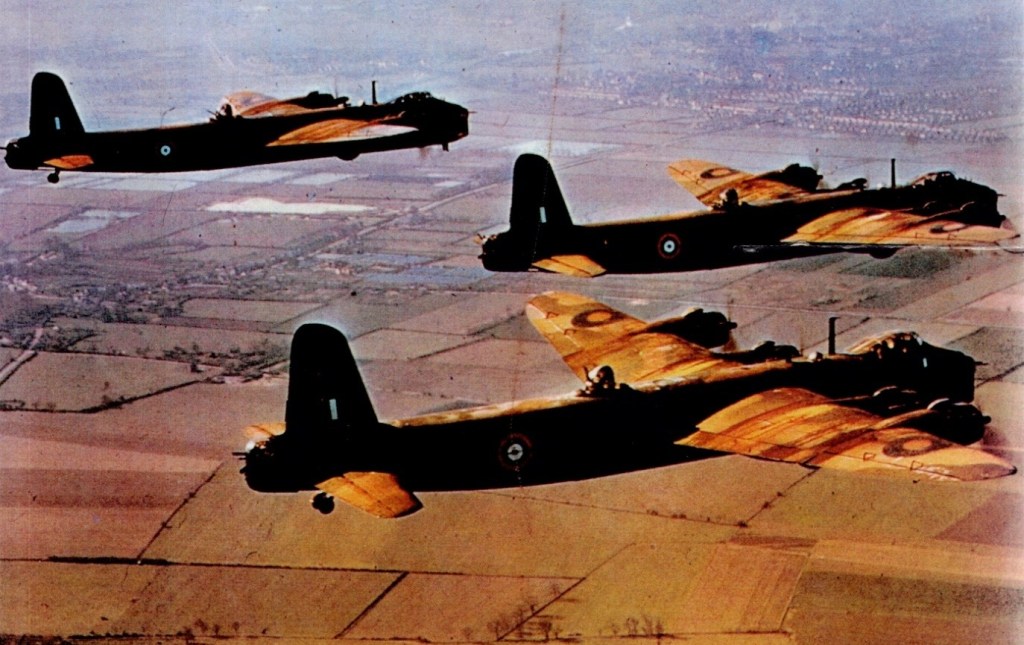
The first production version for the RAF was the Stirling I powered by four 1185kW Bristol Hercules XI radial engines and without a dorsal turret fitted. First in action in February 1941, the Stirling carried 7 tons of bombs for 590 miles, and was armed with eight machine guns. It went into service with 7 Squadron at Leeming in August 1940, and remained in production throughout the war. Prior to its first operational sortie, ATA is recorded as having ferried 12.
Both the factories were bombed in the summer of 1940, after which production was further distributed to the Austin Motors shadow factory at Longbridge, Birmingham, and to a new Shorts factory at South Marston, Swindon.
The Stirling II, only a few of which were completed, was a conversion of the Mk I with Wright R-2600-A5B Cyclone engines. The Mk III had four 1,230kW Bristol Hercules XVI engines and featured a mid-upper turret.
In order to train pilots on the new aircraft, each Stirling squadron formed its own conversion flight and in December 1941, a training unit was created at Thruxton with the specific purpose of training ATA pilots who would have to ferry them. This unit moved to Hullavington in May 1942, to Marharn in August and to Stradishall in October.
When by 1943 the output of heavy bombers had risen to over 400 a month, more ATA four-engined rated pilots were urgently needed to move them. When in February 1943 an ATA Halifax training unit, which had been opened at Pocklington stood down, to fill the gap in four-engined training, ATA reverted to a previous arrangement for its pilots to be given conversion courses with 1647 Stirling Conversion Unit at Stradishall.
From 1943, when the Stirling was no longer a suitable bomber, unlike the Mk III, the Stirling IV was produced from new as a long-range troop transport and glider tug (Horsa glider), the nose and upper turrets being removed and replaced by fairings, although the four-gun tail turret was retained. Up to 24 paratroops or 34 airborne troops could be carried. The final version of the Stirling was the Mk V, an unarmed military transport and freighter with a redesigned nose.
Total production of the Stirling – the Mk III of which was the major variant – was about 2,380.

On the night of 7-8 April 1945, RAF Stirlings of 38th Group dropped two battalions of French parachutists, including both regular soldiers and members of the French Resistance, into Holland south of Groningen. The aim was to support the advance of the Canadian Second Division.
Stirling I
Max speed: 260 mph
Range: 1930 miles
Crew: 7/8
Armament: 8 x .303 Browing mg
Bombload: 14,000 lb
Stirling Mk III
Engines: 4 x Bristol Hercules XVI, 1230kW / 1627 hp
Max take-off weight: 31751 kg / 69999 lb
Empty weight: 19595 kg / 43200 lb
Wingspan: 30.2 m / 99 ft 1 in
Length: 26.59 m / 87 ft 3 in
Height: 6.93 m / 23 ft 9 in
Wing area: 135.63 sq.m / 1459.91 sq ft
Max. speed: 235 kt / 435 km/h / 270 mph
Cruising Speed: 200mph (323kmh)
Service ceiling: 5180 m / 17000 ft
Max range: 1747 nm / 3235 km
Range w/max.payload: 950 km / 590 miles
Range: 2,010 miles (3,242km) with 3,500lb (1,589kg) bombload
Armament: 8 x .303in / 7.7mm machine-guns
Max. bomb load: 14,000 lb / 6,350 kg
Crew: 7-8

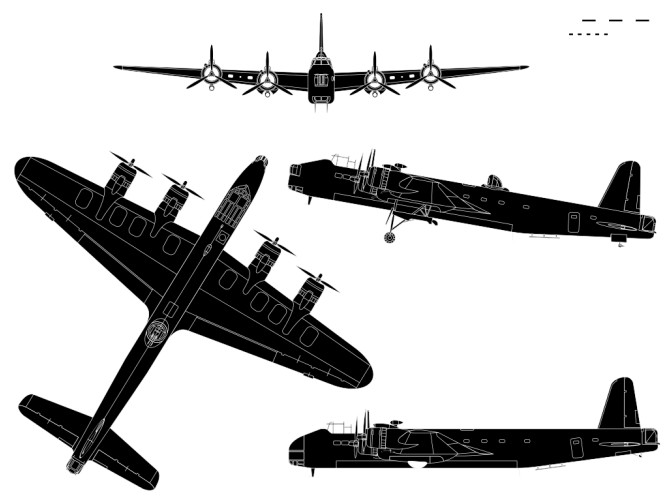

Following on from the Empire class flying boats, Short was keen to explore the limits of the flying-boat design, while also investing in the S.32 land airliner. A number of drag and stability improvements were proved and then embodied in the enlarged version of the Empire boat named the G class, or Golden Hind, and featuring improved power and range. The intention for this design (of which three were ordered by Imperial Airways) was to implement a regular scheduled service across the Atlantic in association with Pan Am.
World War II intervened and the three G boats were sequestered by the RAF and converted for ASW/reconnaissance use for which gun turrets and depth charge housings were installed. In 1942 they were reconverted to carry up to 40 passengers and used on services to Africa.
In late 1941 the two surviving G boats were returned to civil duties, but only one example survived the war. After a brief operational period the aircraft fell into disuse.
Engines: 4 x Bristol Hercules IV or XIV 14-cylinder radial, 1380 hp
Wingspan: 40.90 m / 134 ft 2 in
Length: 31.40 m / 103 ft 0 in
Height: 11.45 m / 38 ft 7 in
Wing area: 2159.904 sq.ft / 200.66 sq.m
Weight empty: 37712.1 lb / 17103.0 kg
Max take-off weight: 33800 kg / 74517 lb
Max. speed: 181 kts / 336 km/h / 209 mph
Cruising speed: 157 kts / 290 km/h
Service ceiling: 16896 ft / 5150 m
Cruising altitude: 7497 ft / 2285 m
Range: 2781 nm / 5120 km / 3182 miles
Crew: 5
Passengers: 40
Armament: 12x cal.303 MG (7,7mm), 907kg Bomb.
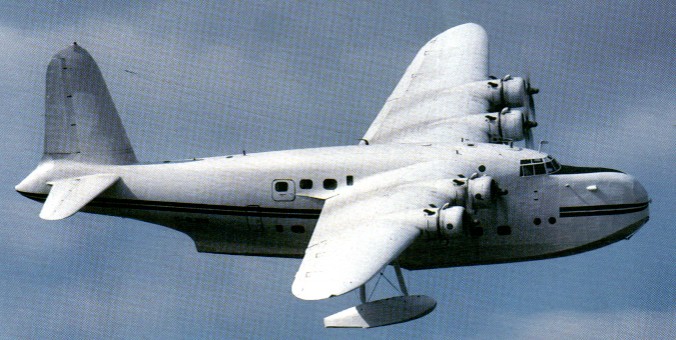
The Sunderland maritime-patrol and reconnaissance flying-boat was designed to meet the requirements of Air Ministry Specification R.2/33 and was virtually a military version of the Empire boat. The prototype flew for the first time on 18 October 1937, just over a year after the first Empire began its trials.
Entering service in June 1938, by the outbreak of war there were three squadrons of RAF Coastal Command operational with it and others in the process of re-equipping or forming. The Sunderland was notable for being the first flying-boat to be equipped with power-operated gun turrets.
The first production version was the Sunderland I powered by Bristol Pegasus 22 engines and armed with eight 7.7mm machine-guns: two in a Fraser-Nash nose turret, four in a Fraser-Nash tail turret, and two on hand-operated mountings in the upper part of the hull aft of the wing trailing edge.

The Sunderland II had Pegasus XVIII engines, but was otherwise similar to the Mk I, although late models were fitted with a two-gun dorsal turret in place of the manually operated guns.
The Mk III used the same power plant as the Mk II, but had a modified hull with a stream-lined front step and a dorsal turret as standard.
The final military version was the Sunderland V, the IV having become the Seaford. The Mk.5 was used mainly as a maritime reconnaissance flying boat they were powered the more powerful l200hp Pratt & Whitney R-1830 Twin Wasp. Wing span remained the same, however, the aircraft was slightly longer at 85’ 4”. Due to the increased power, the MAUW was 65,000lbs, but the maximum speed remained relatively unchanged. Armed with six Browning .303 machine-guns carried in two turrets (four in the rear and two in the forward), and four .303s fixed, that were controlled by the pilot. There were also two 0.5 Browning, which were manually operated, positioned in the beam hatches. Eight depth charges were carried on racks which were run out from the bomb room, along rails which extended under the wings. As with all the guns, these could be reloaded in flight.
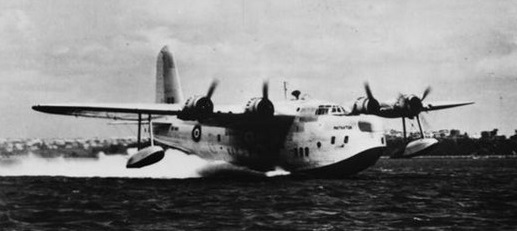
Production continued until October 1945 and seven hundred and forty-nine Sunderlands were built, and they served throughout the war. The final Coastal Command Sunderland operational mission was in June 1945 over four weeks after the German surrender. Long-range Sunderland operations also took place overseas from bases in Africa and the Far East.
In 1943 a number of Sunderlands were de-militarised, equipped to carry 20 passengers and turned over to BOAC. The Short S.25 Sandringham was produced during the Second World War by the demilitarized conversions of Short Sunderland military flying boats previously operated by the Royal Air Force.

Post-war the type took part in the Berlin Airlift carrying 4920 tonnes (4847 tons) of freight. During the Korean War Sunderlands based in Japan undertook nearly 900 operational sorties totally over 13350 hours of flying. The Sunderland finally retired from RAF service in 1959 when the last aircraft were scrapped at RAF Seletar, Singapore.

Sandringham
Engines: 4 x Bristol Pegasus XVIII
Cruise: 200 mph
Pax capacity: 16-24
Sunderland Mk. III
Engines: 4 x 1065hp Bristol Pegasus radials
Wing span: 112 ft 10 in
Length: 84 ft 4in
MAUW: 58, 000 lb
Top speed: 210mph at 7,000ft
Sunderland Mk V
Engines: 4 x Pratt-Whitney R-1830-90B Twin Wasp, 895kW / 1200 hp
Max take-off weight: 29480 kg / 64993 lb
Empty weight: 16740 kg / 36906 lb
Wingspan: 34.38 m / 113 ft 10 in
Length: 26 m / 85 ft 4 in
Height: 10.52 m / 35 ft 6 in
Wing area: 156.72 sq.m / 1686.92 sq ft
Max. speed: 185 kt / 343 km/h / 213 mph
Cruising speed: 116 kt / 214 km/h
Service Ceiling: 5455 m / 17900 ft
Range: 2337 nm / 4300 km / 2672 miles
Armament: 2 x .5in / 12.7mm Browning machine-guns, 10 x .303in / 7.7mm machine-guns
Bombload: 2250kg / 8 x depth charges
Crew: 13
Founded by brothers Horace, Eustace and Oswald Short in November 1908 as Short Brothers Ltd., though Eustace and Oswald had made balloons since 1898. The capital was £600, equally shared between the brothers Horace Leonard, Albert Eustace, and Hugh Oswald.
At Leysdown, Isle of Sheppey, completed first biplane glider, construction of which had begun at Battersea, London, in 1909. It was designed by Horace Short from photographs of the Wright Flyer.
Received order for six Wright biplanes, in one of which Hon. C. S. Rolls made first return crossing of English Channel.
The Short Brothers moved their factory from Battersea to Leysdown in 1909 and completed a tailess biplane of their own design.
In February 1909, Eustace Short and Wilber Wright signed a licence agreement for six of the Wright biplanes. The deal was worth £8400 to the Wright Brothers. The Short brothers already had cash buyers for the aircraft.
Company pioneered multi-engine and multi propeller types, and tractor biplanes with folding wings for naval use. Did more to aid development of early naval flying than any other British firm. New works at Rochester, Kent, started 1914. Most famous type was 184 torpedo-bomber, which was used at Battle of Jutland and was also the first to sink a ship at sea. During First World War established airship works at Cardington, Bedfordshire.
After First World War developed Cromarty flying-boat but diversified in other fields. Gave special attention to all-metal aircraft (Silver Streak of 1920 and derivatives) and concentrated later on large civil and military flying-boats (Singapore biplane series for RAF from 1926; Calcutta and Kent for Imperial Airways). Six-engined Sarafand of 1936 was then largest British flying-boat. Wing form developed for Scion and Scion Senior monoplanes used for famous fleet of Empire flying-boats in 1936, for equally-famous Sunderland military development; also on Short-Mayo composite aircraft and Stirling four-engined monoplane bomber.
Jointly established Short and Harland Ltd. in 1936 with shipbuilder Harland & Wolff; became British Government run 1943, leading to integration of Short Brothers (Rochester & Bedford) Ltd. and Short and Harland into Short Brothers and Harland Ltd. in 1947.
In Second World War built and had built under subcontract Short Stirling four-engined bombers and Sunderland flying-boats; also Handley Page Herefords. In 1947 Short & Harland joined Short Brothers (Rochester & Bedford) Ltd. and altered name to Short Brothers and Harland Ltd., concentrating activities at Belfast, Northern Ireland. Sealand twin-engined amphibian flying-boat of 1948 was produced in small numbers. Sandringham and Solent flying-boats used by BOAC stemmed from the Sunderland. Of great technical significance was the SC.1 VTOL (jet-lift) research program, which followed exploratory research by Rolls-Royce. First free vertical take-off made October 25,1958. Company became heavily involved in production of English Electric Canberra and Bristol Britannia. From 1963 built Belfast heavy transports (four turboprops) and many Skyvan light piston-engined transports (first flown January 1963). Twin-turboprop Shorts 330 30-passenger regional airliner flown August 1974, with Sherpa offered as freighter derivative. Much important manufacture and modification work carried out for leading international constructors and operators under subcontract.
Name Short Brothers Ltd. readopted June 1977, but named Short Brothers PLC, as part of Bombardier Aerospace Group since Bombardier acquired, in October 1989, Short Brothers of Northern Ireland.
Operating three principal business units, as Aerospace producing aircraft components and engine nacelles, Missile Systems, and Belfast City Airport. Shorts 360 36- passenger transport (first flown June 1981) followed Shorts 330/Sherpa, with final complete aircraft built by Shorts becoming the Tucano for the RAF, a variant of the EMBRAER turboprop trainer.
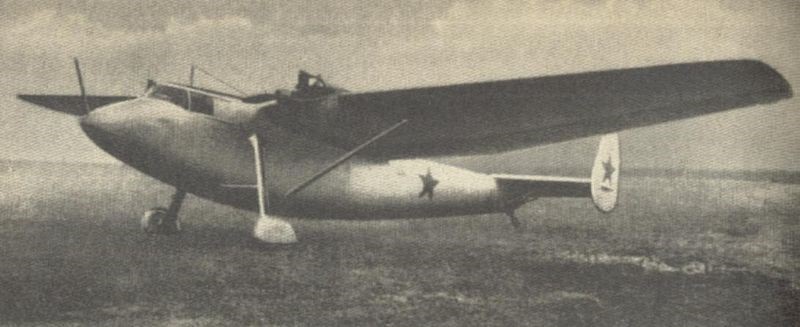
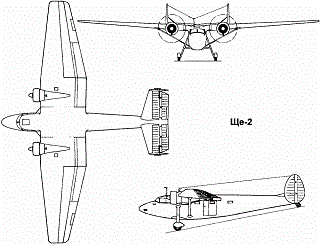
The Shcherbakov Shche-2 (Russian: Ще-2), also known as the TS-1 and nicknamed “Pike”, was a twin-engined utility aircraft manufactured in the Soviet Union, designed by Alexei Shcherbakov for construction by OKB-47, to meet an urgent requirement for a light transport and liaison aircraft for operation by the Soviet Air Force during the Second World War.
The German invasion of the USSR revealed that there was an urgent requirement for a light transport and utility aircraft for use by the Soviet Air Force at the front. To meet this requirement, Aleksei Shcherbakov, who had previously worked at the Kalinin design bureau, and who had also heavily influenced the design of the Polikarpov I-153 fighter before conducting work on pressure cabins and gliders, was directed to design and develop an aircraft that received the designation “TS-1” in the autumn of 1941.
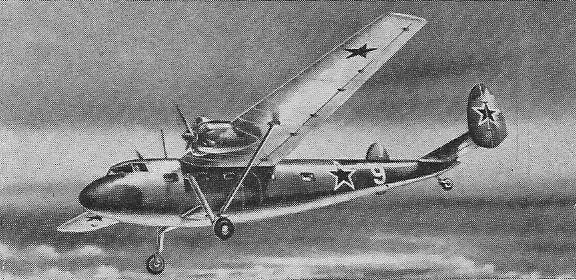
A cabin monoplane of semi-cantilever, high-wing configuration, the TS-1 was designed to minimise the use of strategic materials, utilising mostly wood in the construction of its remarkably streamlined airframe, and being powered by two readily available Shvetsov M-11 radial engines. Parts of the Lavochkin La-5 aircraft were also used, along with undercarriage parts from the Ilyushin Il-2. The aircraft was equipped with a fixed, conventional taildragger undercarriage, and a twin-fin tail from the Petlyakov Pe-2 was also utilised.
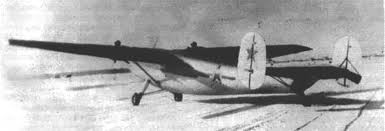
Test-flown in early February 1942 and early 1943, the aircraft, by now having been re-designated Shche-2, proved to be capable of meeting the requirement, and production began in October 1943 at OKB-47, the bureaux being established at Chkalov (Orenburg) for use by Yakovlev, but being transferred to Shcherbakov’s control for the manufacture of his type. The first machine was ready in the summer of 1944. In total, up to the beginning of 1946, several hundreds of aircraft were built.
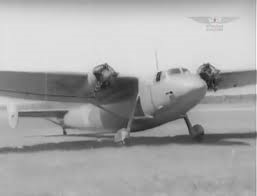
The Shche-2 was capable of transporting up to 16 troops, with an alternative air ambulance configuration for up to 11 wounded, or cargo up to 1.43 metres (4 ft 8 in) by 1.64 metres (5 ft 5 in) in size. Alternatively, the aircraft could be used as an aircrew and navigational trainer. It was extensively used in the transport and communications roles on the Eastern Front, providing essential, if unglamorous, service.
The power of two engines of 100 hp to carry a cargo weighing about 1000 kg was not enough. The Shche-2 required engines of 150-200 hp. Because of the installation of M-11 engines, the aircraft had very long take-off run, sluggish acceleration, and low rate of climb. Front pilots negatively reacted to the new aircraft.
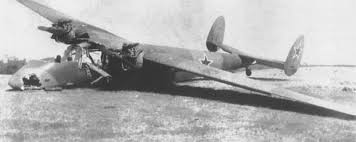
In 1945, the improved Shche-2TM variant entered flight test, powered by uprated M-11FM engines of 108 kilowatts (145 hp) each, and fitted with a modified wing. Despite the improvements in the design, the decision was made not to produce the aircraft due to a reduction in requirements for the type with the end of the war in May of that year. A proposed diesel-engined version, which began flight tests in July 1945, met the same fate.
Proving in service to be underpowered yet still easy to fly, and establishing a reputation for reliability and ease of maintenance, the Shche-2 was widely used by Soviet forces during the war. Seeing extensive service supplying guerrilla and partisan forces, the Shche-2 also proved to be useful for the delivery of paratroopers.
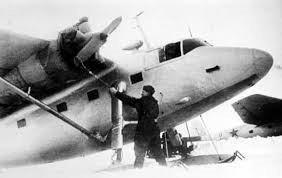
In 1945 a single copy of an agricultural variant was created. This aircraft had a lightweight design with a reduced wing. It was installed GMC diesel engines from an American tank. Also, the design of a two-body Shche-2 with three M-11D engines was developed, but not implemented.
In May 1945, a newsreel of the latest street battles in Berlin was delivered to one of the Shche-2 aircraft in Moscow.
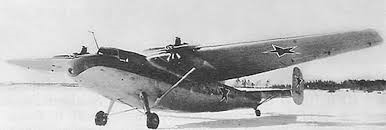
It is estimated that at least 550 Shche-2 aircraft were completed before the close of production in 1946, the OKB-47 factory being closed down at the conclusion of production. After the end of the war, the aircraft remained in service for several years, with the air forces of Yugoslavia (5 aircraft, delivered in 1945, used through 1952) and Poland (5 aircraft, used 1945–1947) making use of the type, in addition to the aircraft being extensively utilised in transport and air ambulance duties in civilian service within the Soviet Union. In addition, the Shche-2 was operated by Aeroflot on several local airline routes within the Soviet Union for several years after the end of the war, before its replacement by the Antonov An-2.
Shche-2
Engines: 2 × Shvetsov M-11d, 86 kW (115 hp) each
Propellers: 2-bladed
Wingspan: 20.54 m (67 ft 5 in)
Wing area: 63.90 m2 (690 sq ft)
Length: 14.27 m (46 ft 10 in)
Height: 3.80 m
Empty weight: 2,235 kg (4,927 lb)
Normal takeoff: 3400 kg
Max takeoff weight: 3,700 kg (8,157 lb)
Fuel: 370 kg
Maximum speed: 155 km/h (96 mph, 84 kn)
Cruising speed: 140 km / h
Range: 980 km (610 mi, 530 nmi)
Service ceiling: 3,000 m (9,800 ft)
Rate of climb avg: 1.20 m/s (236 ft/min)
Max ROC: 72 m / min
Wing loading: 53 kg/m2 (11 lb/sq ft)
Power/mass: 0.05 kW/kg (0.03 hp/lb)
Crew: two
Capacity: up to 16 troops, 9 paratroopers or 11 stretcher / 1000-1330 kg
TO run: 275 m
Ldg roll: 160 m
USSR
A. Y.Shcherbakov was the leader of a design group which developed the twin-engined high-wing monoplane Shch-2 light transport, used for such duties as liaison, transport and supply of partisan forces late in Second World War. After war adopted by Aeroflot. Robust structure, with fixed landing gear and large double freight doors, made the Shch-2 adaptable for a wide variety of transport duties.
Incorporated February 1931 by Russian-born Alexander P. Seversky (or De Seversky), First World War military pilot who became U.S. citizen 1927. A test pilot and consulting engineer, he established the Seversky Aero Corporation in 1922.
Developed novel amphibious landing gear, promoted by Seversky Aircraft Corporation for fast all metal fighter-type aircraft. Aircraft design owed much to Alexander Kartveli, who developed landplane fighters with retractable landing gear.
In 1935 Seversky established new speed record for amphibious aircraft, and land-fighter development culminated in order for 77 single-seaters for USAAC, designated P-35.
In 1939-1940, following orders for amphibians from USSR and landplanes from Japan, Sweden contracted for 120 export versions of P-35. Several fighter, multipurpose and trainer variants developed, and BT-8 (first purpose-built machine of its class) adopted in U.S.A.. Seversky Executive (2 passengers in cabin behind pilot) won 1937 Bendix Trophy race. In 1939 company offered USAAC XP-41 single-seat fighter.
In October 1939 the company was reorganized as Republic Aviation Corporation. Since de Seversky had made somewhat of a pariah of himself in the USA by selling combat aircraft to Japan, the Army ordered no more P-35s from Seversky. By early 1939, his company had gotten itself into some deep financial trouble. In Apr 1939, while de Seversky was out of the country on a business trip, the board of directors of his company voted him out of office as CEO and changed the name of the company to Republic. The newly-formed company then recapitalized itself and Alexander Kartveli was appointed as vice president and technical director. Having been forced into involuntary early retirement, de Seversky spent the rest of his life writing and consulting, and Kartveli and the Republic company went on to design and produce the famed P-47 Thunderbolt.
Special supercharger evolution for late Seversky fighters led to the famous Republic P-47 Thunderbolt long-range escort fighter/bomber.
1965: Republic Div, Fairchild-Hiller Corp.
1972: Fairchild-Republic Co.
Seversky’s method of assigning c/ns was at best enigmatic and illogical, especially to outsiders—c/n 1 shows up two years after c/n 301, and 301 changed to c/n 35 for one modification, there were found two c/n 2s, and curious large gaps between numbers.
1943: (Charles W) Seibel,
Kenmore NY
USA
(while working for Bell Co).
1946:
Wichita KS
USA
(while working for Boeing Co on XL-15).
In 1943 designed the Seibel S-1 twin-tilt rotor. Preliminary first design, patented in March 1944.
With two collaborators built in 1947 S-3 light helicopter (lateral and longitudinal control effected by changing center of gravity).
The S-2 of 1947 was a single-place open coaxial design study. No specs or data found.
Established early 1948 Seibel Helicopter Co Inc, Wilson Field, Wichita.
S-4A of 1948 had special blade-attachment system patented for S-3. Followed by S-4B with more powerful engine and side-by-side seats.
1949: 5613 N Broadway,
Wichita
USA
1951; 3400 N Broadway,
Wichita.
USA
In March 1952 company taken over by Cessna.
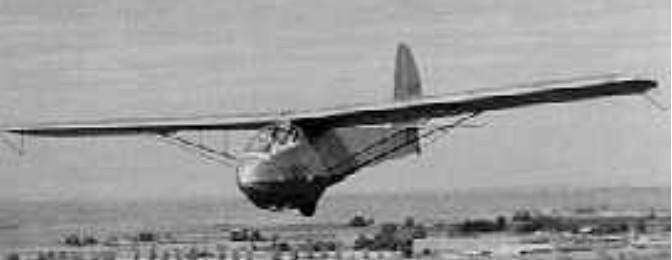
The 1-19, designed by Ernest Schweizer and produced as a low cost utility ship intended for the post war market, first flew in 1944.
The 1-19A was the kit version. Despite being small and light, rigging is complicated with many pins, and through it was produced with an open cockpit, many owners have added canopies. The structure is wood/ fabric, 2-spar, constant chord, 2-strut-braced wings; metal/ fabric tail; steel-tube/ fabric fuselage.
Wing span: 10.97 m / 36 ft
Wing area: 15.79 sq.m / 170 sq.ft
Aspect ratio: 7.9
Airfoil: NACA 4301 2A
Empty Weight: 145 kg / 320 lb
Payload: 104 kg / 230 lb
Gross Weight: 249 kg / 550 lb
Wing Load: 15.76 kg/sq.m / 3.25 lb/sq.ft
L/DMax: 16 68 kph / 36 kt / 42 mph
MinSink: 1.07 m/s / 3.5 fps / 2.07 kt
Seats: 1
No. Built: 50
 All Aero