Even before work on the Sk 257 began, Otto Kauba had begun work on a full-fledged fighter to have a 1,750 hp Daimler Benz DB-603 engine. Though it was in direct competition with the Focke-Wulf Ta 152, the RLM were not interested and it did not enter production.
World War 2
Skoda-Kauba SK V4 / SK 257
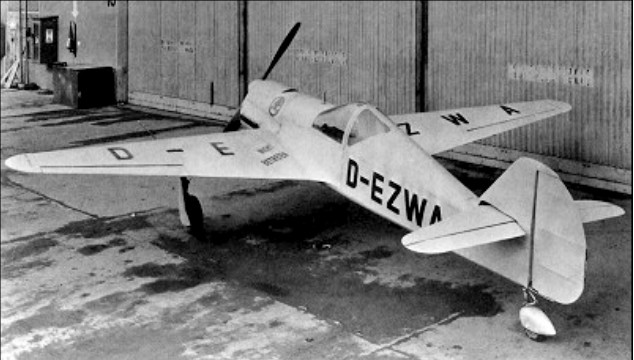
The Škoda-Kauba Flugzeugbau produced the Škoda-Kauba V4 as a single-seat low-wing cantilever monoplane powered by a 240 hp (179 kW) Argus As 10C-3 engine with a retractable tailwheel landing gear. First flying in 1943, the first prototype proved very fast for its low power. The second included a number of changes and, despite increased power, was not as fast. A third was also completed.
The SK V4 fighter trainer was the only Otto Kauba design put in to production as the SK 227. The production was somewhat limited though.
The potential for development was recognized and the German Reichsluftfahrtministerium ordered four prototypes of an enlarged aircraft with a more powerful 485 hp Argus As 410 engine and allocated the designation Sk 257. The four prototypes performed well and the type was ordered into production but the build quality of the prototypes did not pass the Luftwaffe quality control inspections and after only five production aircraft had been built the order was cancelled.
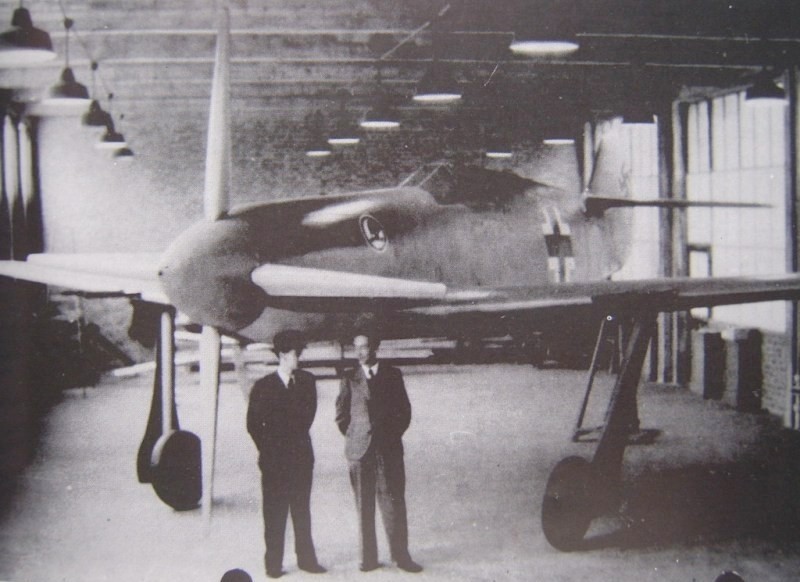
The SK257 development received a German production order and five were completed before the Russians captured the factory.
SK V4
Engine: 1 x 240hp Argus As 10C-3
Max take-off weight: 1250 kg / 2756 lb
Wingspan: 7.60 m / 24 ft 11 in
Length: 5.60 m / 18 ft 4 in
Height: 2.90 m / 9 ft 6 in
Max. speed: 420 km/h / 261 mph
Ceiling: 7500 m / 24600 ft
Range: 900 km / 559 miles
Crew: 1
SK 257
Engine: 1 × Argus As 410 362 kW (485 hp)
Wingspan: 7.6 m (24 ft 11 in)
Wing area: 8.4 m2 (90 sq ft)
Length: 7.1 m (23 ft 4 in)
Maximum speed: 350 km/h (217 mph, 189 kn)
Crew: 1
Skoda-Kauba SK V3
Other designs in the series included the SK V3 light sports aircraft
Skoda-Kauba SK V1 / SK V2
The Austrian aeronautical engineer Otto Kauba approached the Reichsluftministerium (RLM) with a proposal for a flying-bomb early in 1942. The ministry was sufficiently interested in his ideas to assist in establishing the Skoda-Kauba design bureau in Prague, Czechoslovakia. The proposed flying-bomb layout was tested in a light monoplane, the SK V1, which was written off in a crash. Two modified aircraft, the SK V1A and SK V2, were tested before the project was abandoned in 1943.
Skoda-Kauba
Czechoslovakia
Founded spring 1942 at Cakowitz, near Prague. Worked for Germans. Experimental types included Sk-V4 light fighter-trainer with German Argus engine. SK257 development received German production order; five completed before Russians captured factory.
Skandinavisk Aero Industri As / SAI / Kramme & Zeuthen
Skandinavisk Aero Industri A/S (abbreviated SAI) was a Danish manufacturer of aeroplanes that existed between 1937 and 1954. The company was founded by technician Viggo Kramme (1905–1984) and engineer Karl Gustav Zeuthen (1909–1989) and based in Copenhagen.
The company’s aeroplanes were labelled “KZ” for Kramme and Zeuthen, the first being the KZ I from 1937. The KZ IV was built as an ambulance plane for Zone-Redningskorpset and introduced in 1944. Post-war sales never reached the company’s expectations, and production turned unprofitable in the early 1950s, driving the company to shutdown. In mid-1950s turned increasingly to repair and maintenance of military aircraft, and aircraft production had ended by late 1950s. In total, about 200 planes were built by the company.
A number of the KZ planes have been preserved. As of 2005, Dansk Veteranflysamling (The Danish Collection of Vintage Aircraft) exhibits a specimen of each of the 11 aircraft models manufactured by the company.
Skandinaviska Aero BHT-1 Beauty

On 7 May 1943 three young engineers sat in the Bacchi Wapen restaurant in Stockholm together with Åke Forsmark, manager of Skandinaviska Aero, and chatted about aircraft. The three were Erik Bratt, Karl-Erik Hilfing and Björn Törnblom, all students at Kungliga Tekniska Högskolan, the Royal Technical University in Stockholm. Their ideas gradually evolved into this sketch, on the back of a menu. It was originally meant to be a glider towing aircraft, and by May 1944 the design work was complete, with 4,000 drawings and 2,500 load calculations, performed by Törnblom, the only one of the three who had previous experience in aircraft design. He also designed the wings, fin and rudder. Hilfig was responsible for the fuselage and Bratt worked on the engine installation, propeller and landing gear.
The BHT-1 is a wooden low-wing cantilever monoplane with a retractable tailwheel landing gear. Powered by a 60 hp (45 kW) Walter Mikron 4 piston engine it has an enclosed single-seat cockpit. The wings include slotted flaps.

The BHT-1 Beauty was built by Skandinaviska Aero of Stockholm and first flew on 4 December 1944. Only one, SE-ANX, wa built.
The BHT-2 was a proposed two-seat development. A prototype constant speed propeller was developed for the aircraft using differential between engine oil, and ram air pressure to control pitch.
Engine: 1 × Walter Mikron 4, 45 kW (75 hp)
Length: 5.80 m (19 ft 0 in)
Wingspan: 6.82 m (22 ft 4½ in)
Height: 1.90 m (6 ft 3 in)
Wing area: 7 m2 (75.3 ft2)
Empty weight: 240 kg (538 lb)
Gross weight: 420 kg (924 lb)
Maximum speed: 250 km/h (155 mph)
Cruising speed: 210 km/h (130 mph)
Range: 1700 km (1056 miles)
Service ceiling: 7500 m (24600 ft)
Crew: 1
SIPA / Societe Industrielle Pour I’Aeronautique
Formed 1938 and until 1940 was manufacturing parts under subcontract for Liore et Olivier, Amiot, and Morane types and overhauling Mureaux aircraft. First postwar production aircraft was S.10 (French version of Arado 396, for which the company had wartime responsibility).
Developed versions were built in quantity. SIPA 901 (derived from S90 of 1947) flew 1948 and ordered by Government for Service de I’Aviation Legere et Sportive. Minijet, flown in 1952, was world’s first all-metal 2-seat light jet; SIPA 300 was more conventional jet trainer.
In 1954 Max Fischl was SIPA test pilot.
Later trainers and light aircraft included Coccinelle 2-seater, and 5-seat turboprop Antilope. Company was associated with production of Caravelle, Mirage, Alouette, and Concorde, and specialised in furnishing and equipping airliners.
Taken over by subsidiary of Aerospatiale.
Sikorsky VS-327 / R-5 / HO2S / S-51 / H-5 / Westland WS.51 Dragonfly / Widgeon

The development of the XR-5 officially began when the British Air Commission placed an order for two “large” (compared to the diminutive XR-4) prototype Vought-Sikorsky helicopters on April 29, 1942. At this time, German U-boat wolfpacks remained a considerable threat to the lifeline of trans-Atlantic convoys that sustained Great Britain. The convoys were particularly vulnerable in mid-Atlantic, beyond the range of shore-based anti-submarine patrol aircraft. There were also very few aircraft carriers available to sail with the convoys and provide air cover. A helicopter that could carry bombs or depth charges and operate from the decks of escort vessels or even merchant ships appeared to offer an ideal solution to the U-boat problem.
The US Army Air Forces caught on to the possibilities of an upgraded XR-4 and quickly submitted a request on May 8, 1942, for an upgraded design, a “workhorse” helicopter with a useful load of over 495 kg (1,100 lb). The request stated, “it is urgently desired to develop a helicopter with greater useful load, endurance, speed, service ceiling, which would have greater utility than the XR-4.” On May 27, the Air Material Command issued Technical Instruction 1124. This order released funds for the construction of four helicopters of the “workhorse” type, designated XR-5. The requirements of the AAF and the British were similar enough that a single design could probably fulfill both needs. Two of the four machines described in TI 1124 were earmarked for Britain to be paid for using Lend-Lease funds.
The XR-5 came about as a direct result of lessons learned from Sikorsky’s development of the R-4. While the R-4, and its developmental cousin, the R-6, saw operational service in World War II, they were underpowered, difficult to fly, and required excessive maintenance, which led to a limited service life. The production R-5s and their civilian counterpart, the S-51, overcame these difficulties and played an important role in establishing the helicopter as an indispensable aircraft for military and civilian operators.
The design process for the XR-5 was already well under way by the time TI 1124 was issued. More than six months earlier, Igor Sikorsky had anticipated a military request for a purpose-built observation helicopter. The Platt-LePage XR-1 had already won the AAF contract for development of an observation helicopter, but Sikorsky knew it would never become a practical service machine. Well ahead of actual events, he launched a program to develop a more practical design called the VS-327 (V for Vought and S for Sikorsky. Vought, like Sikorsky, was one of several companies owned by the holding company United Aircraft). Development began on September 26, 1941, and William E. Hunt was named project manager. When the Technical Instruction for the XR-5 was issued, the VS-327 handily met the requirements.
Work on the design progressed quickly, but when construction began on the first prototype, the pace slowed. As chief designer, Igor Sikorsky had a pivotal role to play but the demands of other projects distracted him. There was also considerable difficulty obtaining certain strategic materials such as aluminum to build the helicopter. The AAF considered helicopters interesting and promising, but gave conventional warplanes a higher priority. Sikorsky had to build certain sections of the helicopter, such as the tailcone and fuselage panels, from non-strategic materials, such as wood. This increased the aircraft’s weight, reduced structural integrity, and delayed the project. Aluminum versions replaced these wooden components when the predicted shortages failed to materialize. The 450hp Pratt & Whitney R-985 Wasp Junior engine chosen for the XR-5 was also a source of trouble. At that time, this power plant was used in Vought’s OS2U Kingfisher naval floatplane. To speed construction, Sikorsky retained the Kingfisher engine mount arrangement in the XR-5 but during ground runs, the helicopter overheated badly. A fan was needed to force more cooling air through the engine compartment, but there was not enough space to install it within the Kingfisher engine mount. Revising the mount and adding the fan further delayed the program.
Sikorsky was aware that the box-top fuselage of the XR-4 obstructed airflow from the main rotor and reduced the rotor’s lifting capacity. He also knew that visibility out of this earlier design could be much improved and these two design goals drove the overall layout of the XR-5. The fuselage was more streamlined and slimmer in profile, and nearly the entire nose of the helicopter was covered in Plexiglas windows. The observer occupied the front seat of this “fishbowl,” while the pilot occupied the seat directly behind him. The XR-4 used a tricycle undercarriage supplemented by a strut and wheel extending attached beneath the rear fuselage to prevent the tail rotor from striking the ground during flight-testing. Sikorsky dispensed with this wheel and strut on the production models.
Each of the three rotor blades resembled the fixed-wing of a conventional airplane. A laminated wooden spar supported wooden ribs and the whole assembly was covered with fabric. These blades were difficult to build, hard to balance, and easily damaged by rain. Sikorsky replaced the wooden spars with steel tubes in production versions of the XR-5 and this resulted in safer, more durable blades. However, he had to retain the fabric covering. It was not yet possible to build a rotor blade skinned with metal that was also flexible enough to flap and flex in flight. The S-51 had a three-blade rotor which had flapping and drag hinges and could be folded to facilitate storage. The early machines had manual control for the rotor pitch, later replaced by hydraulic servo-controls with power from a hydraulic pump driven by the tail transmission shaft.
Company chief test pilot Les Morris carried out the first flight of the XR-5 (s/n 43-28236) on August 18, 1943. Following adjustments to blade tracking and lead-lag dampers, flights soon exceeded 30 minutes. On September 13, the XR-5 lifted a pilot, observer, and eight passengers perched on the landing gear strut fairings, and exceeded the military useful load requirement by 270 kg (600 lb).
Testing progressed well until October 12. With Sikorsky’s nephew, Jimmy Viner, at the controls, the tail rotor failed at an altitude of 23 m (75 ft). Viner crash-landed and neither he, nor his observer were injured, but the aircraft suffered significant damage. Production on the next XR-5 (s/n 43-28237) was quickly stepped up and test flying resumed the last week of November 1943.
AAF leaders authorized series production of the XR-5 on March 24, 1943, to commence whenever the final development phase of the XR-5 was complete. This contract specified a production run of 250 aircraft, 100 of them earmarked for Great Britain. The contract soon increased by 150 helicopters for the AAF, and the Navy ordered 50 more. The development process had continued at a steady but relatively slow pace, as much of Sikorsky’s effort was focused on series production of the R-4 and R-6. These helicopters had met their contract requirements while the XR-5 was still struggling through the test program. Great Britain cancelled two XR-5s on March 25, 1944, because aircraft carriers and long-range patrol aircraft had filled the antisubmarine role originally envisioned for the R-5. The AAF quickly moved to take over this order, as Lt. Col. Frank Gregory, head of the AAF helicopter program, remained enthusiastic about XR-5. He considered it more advanced than any other American helicopter developed up to that time. Flight tests began on the fifth and final XR-5 at the Sikorsky plant in Bridgeport, CT, on January 17, 1944. The AAF accepted this aircraft and transferred it to Wright Field for further development on September 30, 1944.
That this dawn of a new technological era remained perilous for both man and machine is graphically illustrated by the fate of the XR-5s. The third (s/n 43-28238) was destroyed on November 4, 1944. The fabric covering one of the rotor blades tore loose and in the ensuing crash, the helicopter rolled over. The second XR-5 suffered a fatal crash at Gainesville, Florida, on December 2, 1944, when welds in one of the steel collars holding the blades to the rotor mast failed. As a result, a different welding technique was adopted on the assembly line. The first XR-5 suffered an engine failure while flying to a war bond rally in Nebraska. The pilot crash-landed but the airframe was too damaged to repair it was scavenged for spare parts. The AAF continued to test the last XR-5 (s/n 43-47954) until 1946, when the service handed the helicopter over to the National Air Museum (later the Smithsonian National Air and Space Museum).
By March 29, 1945, the AAF declared the XR-5 development program complete and service planners cleared the R-5A for series production. The AAF designated the first 26 aircraft off the line as YR-5A service test aircraft, but these helicopters did not otherwise differ from production R-5As. Two were assigned to the Navy under the designation HO2S-1 (75689 and 75690). In 1946 they were handed over to USCG as HO2S-1G. Trouble returned to the program after the R-5A began flying. Poor aerodynamic analysis by the National Advisory Committee for Aeronautics (NACA) caused Sikorsky to turn out unbalanced rotor blades, and the company was forced to correct the flaw with makeshift repairs that hurt performance of the production aircraft. When World War II ended, the AAF cancelled or reduced a number of aircraft contracts, including the R-5A, and Sikorsky completed 60 YR-5A and R-5A aircraft, of which, only nine were delivered before V-E Day. Ironically, the cancellation allowed the designer to further refine the aircraft, and to develop it for the civil market. This work produced the R-5F and its civilian counterpart, the S-51. In these models, the rear-seat cockpit was converted into seating for three and the observer seat became the pilot’s position.
Of the five XR-5, 43-28236/28239 to -47954, two were fitted with British equipment and redesignated as XR-5A.
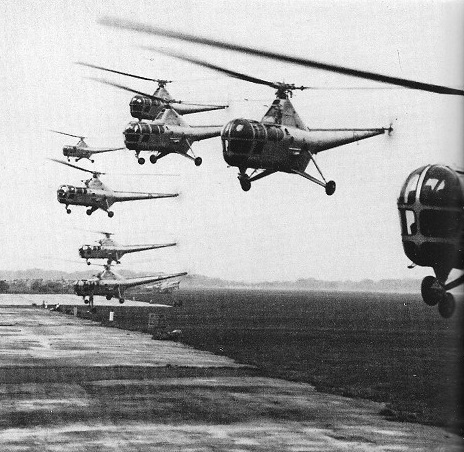
While production of the R-5A was getting under way (34 built, 43-46626 to -46659), five pre-series aircraft, 43-46611 to 46615, were converted into the R-5E, which had dual control. The YH-5E were redesignated as YH-5E in 1948. Twenty-one modified R-5As, 43-46606 and -46640 to -46659, were later given new, 600hp Wasp Junior engines and redesignated R-5D, then H-5D in 1948. The R-5D featured with nose wheel, rescue hoist, and external fuel tank. From the latter, the S-51 was developed, with a slightly enlarged four-seat cabin and a tricycle landing gear. The R-5A were fitted with external litters for SAR duty.
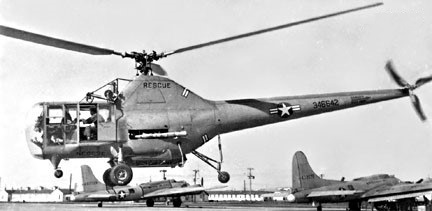
Modified from a military design for the civil market (TC H-2), the S-51 was the world’s first commercial helicopter, inaugurated Philadelphia’s Helicopter Air Transport service. With a three-blade main rotor the S-51 first flew on 16 February 1946, and went to the USAF as R-5F, and USN as HO3S-1. Eleven of the 1948 R-5F were built, 47-480 to -490, basically a four-place military S-51 (with nose wheel). Licensed production in Great Britain as Westland-Sikorsky Dragonfly (with 520hp Alvis). The S-51 was a prototype for S-53.
Ninety-two of the 1946 HO3S-1 were built (57995 to 57998, 122508 to 122529, 122709 to 122728, 123118 to 123143, and 124334 to 124353). Nine HO3S-1s were used by the US Coast Guard as HO3S-1Gs (1230 to 1238). HO3S-1s served with distinction in the Korean War with Squadron HU-1. In 1950 Sikorsky built and tested a single XHO3S-3 with a redesigned rotor head and blades.
HO3S-2 was a designation reserved for a USN version of the H-5H but not used.
One HO3S-1 was fitted with a different rotor in 1950 as the XHO3S-3.
Although the AAF accepted R-5A helicopters before the end of World War II, these never reached operational units and service interest in the aircraft appeared to be waning. Sikorsky believed that without military customers, the civilian S-51 held the key to continued growth of the helicopter market and he promoted it vigorously.
On November 29, 1945, an S-51 dramatically rescued two seamen from a foundering barge off the coast at Bridgeport during severe weather. This event renewed military interest and a number of R-5 variants served until after the Korean War. Before the arrival of Bell’s H-13 (Model 47) into the Korean combat zone in 1951, military pilots flying the H-5 (H for helicopter replaced R for rotorcraft) conducted most of the thousands of medical evacuation (medevac) missions flown during that war. The H-5 and the H-13 reduced the fatality rate among wounded soldiers during the Korean War by more than 50 percent, however, the narrow center of gravity range on the H-5 soon made it obsolete compared to newer helicopters. Sikorsky attempted to extend the longevity of this classic design by offering the U. S. Navy a new five-seat version, the XHJS-1, but the helicopter lost out to Piasecki’s tandem-rotor HUP-1.
In 1950 Sikorsky built and tested a single XHO3S-3 with a redesigned rotor head and blades. The R-5B, R-5C and HO3S-2 were planned variants later cancelled.
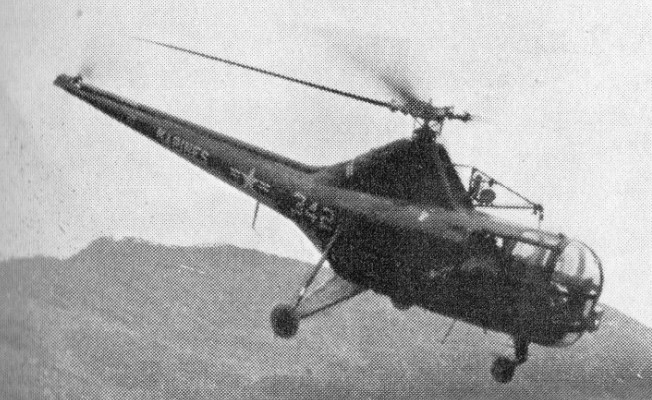
Thirty-nine of the 1948 H-5G SAR version with hoist were built: 48-524 to -562.
Sixteen of the 1949 H-5H combination wheel and pontoon gear variant were built: 49-1996 to -2100.
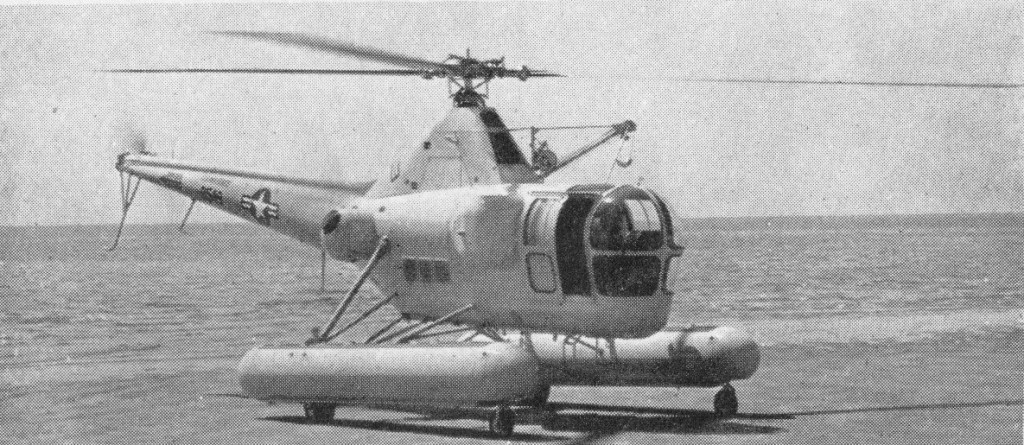
As the H-5 disappeared from the U.S. military inventories, Westland Aircraft Limited of England continued to build the aircraft, under license, as the HR.1 Dragonfly. These aircraft served with the Royal Air Force and Royal Navy throughout most of the 1950s. The British built version has a 520 hp Alvis Leonides radial engine installed with the crankshaft vertical, and having all metal rotor blades.
In December 1946 Westland Aircraft of Yeovil purchased a licence to build the S-51 in Britain. When they ceased production in 1953 they had built 139 machines. The Dragonfly, as the British-built machine was known, had a 520hp Alvis Leonides engine, a redesigned cabin for four passengers plus the pilot, and a three-blade rotor.
Basically similar to the US-built aircraft, the type was assembled from British-built components and in all but one variant was powered by the Alvis Leonides engine. The first civil Westland/ Sikorsky WS-51 was flown on 5 October 1948 and on 24 July 1951 the type became the first British-built helicopter to gain a certificate of airworthiness. Before that, in 1950, a version designated Dragonfly HR.Mk 1 equipped the Royal Navy’s first helicopter squadron, No. 705 formed at RNAS Gosport.
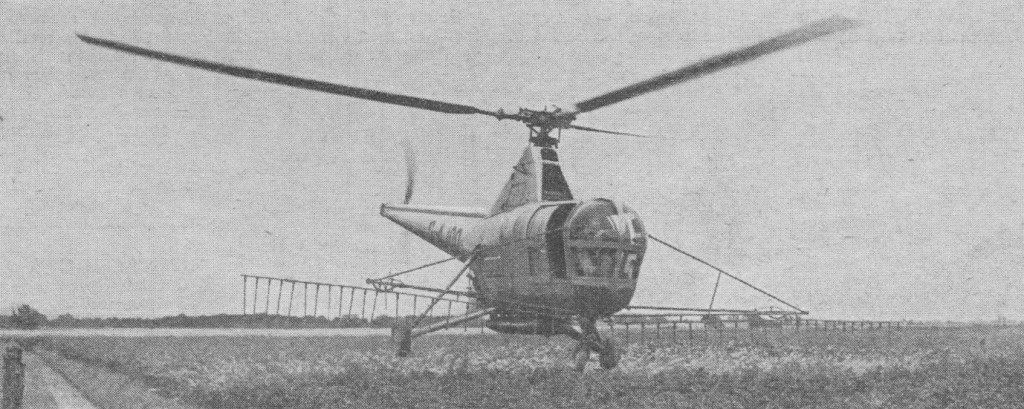
Commercial versions are the Mk. 1A with Alvis Lconides and Mk. 1B with Wasp Junior engine, as in the American model. In the British services the type is known as the Dragonfly: the H.R. Mk. 1 (composite blades) and H.R. Mk. 3 (metal blades) are used by the Royal Navy; similar models in service with the R.A.F. are designated H.C. Mk. 2 and H.C. N1k. 4 respectively.
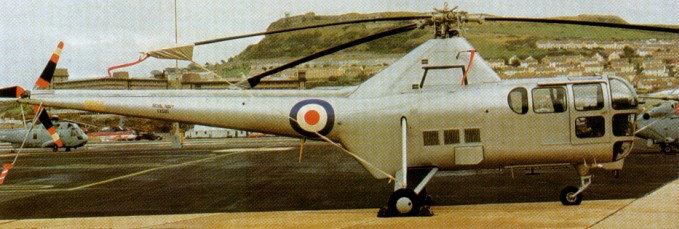
Built to a total of 133, the Dragonfly was followed by a developed version, the Westland Widgeon, the prototype of which was a conversion of a Dragonfly to provide five-seat capacity and which benefited from the introduction of the improved rotor of the Sikorsky S-55. It had a four-blade main rotor with a 520hp Leonides 521 engine. The Widgeon original airframe was given a new front fuselage for a pilot and four passengers in a two/three arrangement, and small clamshell nose doors. The first Dragonfly converted to Widgeon standard, first flew on 23 August, 1955, for 30 minutes, at Yeovil, piloted by Roy Dradley.
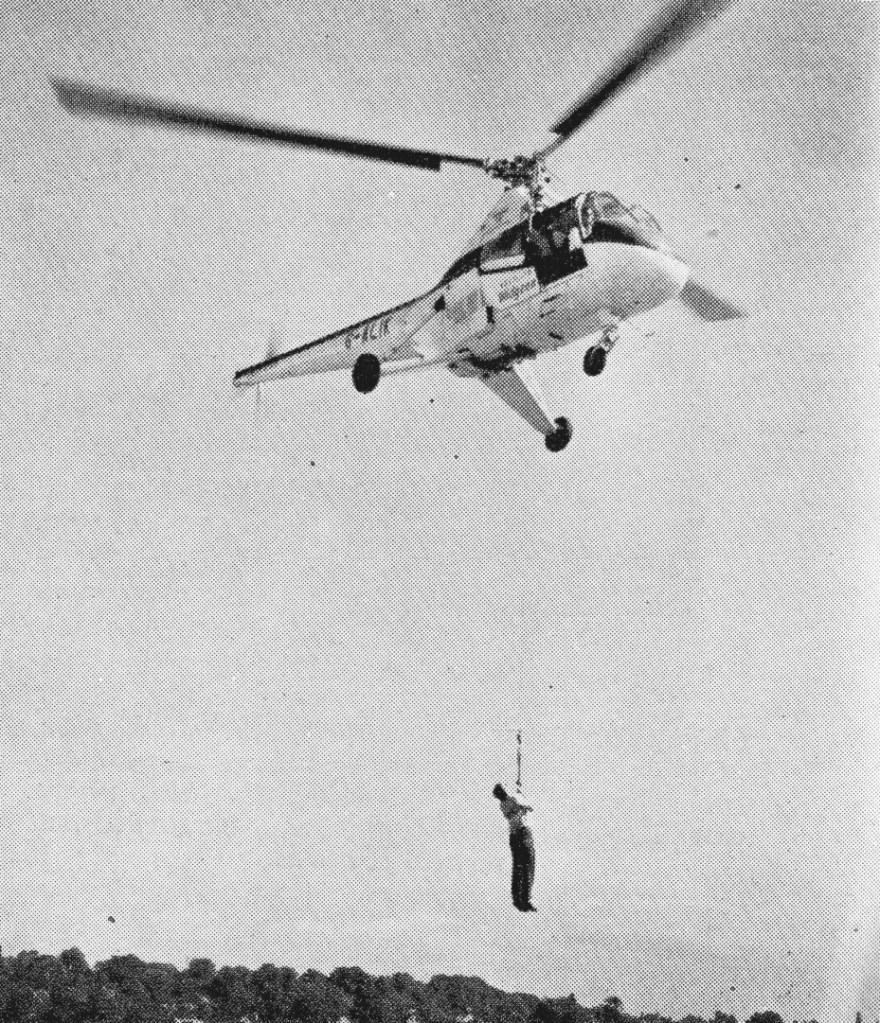
During 1957, the five seat Widgeon obtained a Type Certificate of Airworthiness.
Westland produced 15 Widgeons and sold them to Ceylon, Jordan, Brazil and the Hong Kong police department. The Widgeon used an S-55 rotorhead which employs an offset flapping-hinge system, thus allowing more latitude in the centre of gravity and the position of cargo or passengers.
Westland sold their UK-built helicopters to Belgium, Ceylon, Egypt, France, Iraq, Italy, Japan, Thailand and Yugoslavia. At least one model was equipped for rescue operations with an external hoist capable of lifting up to 455kg. The bulk of these sales were for military use, but Belgium became a European pioneer in the civil field when Sabena bought three. The S-51 had a three-blade rotor which had flapping and drag hinges and could be folded to facilitate storage. The early machines had manual control for the rotor pitch, later replaced by hydraulic servo-controls with power from a hydraulic pump driven by the tail transmission shaft.
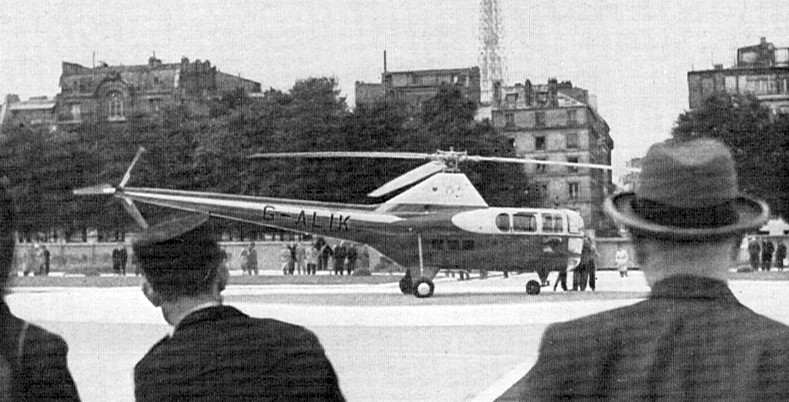
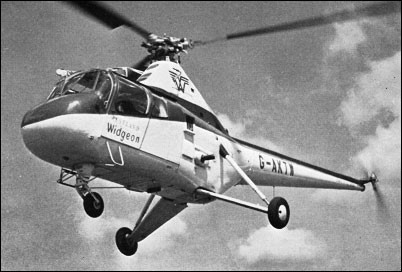
B.E.A. commenced helicopter operations on 21 February 1949 with S-51s. BEA ran a trial helicopter service between Cardiff and Liverpool during 1950-51 and later, a service between Birmingham and London using the Sikorsky S-51.
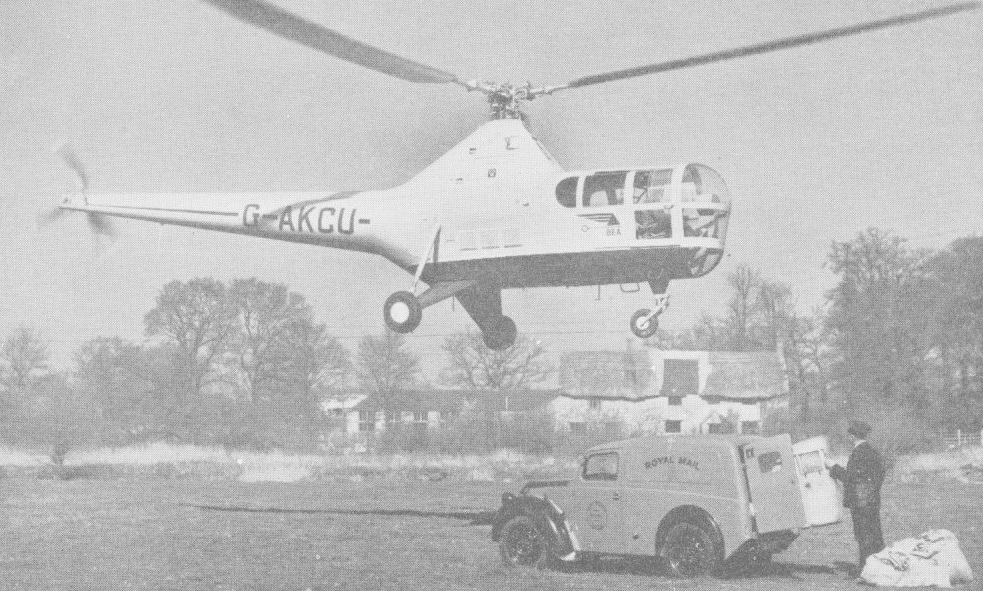
Helicopter Air Transport (HAT), based in New Jersey, became one of the first commercial helicopter operators when it took delivery of several S-51s in 1946. The operating cost of these aircraft proved too high for HAT’s primary business, flight training, and the company went bankrupt. A number of airlines and other companies experimented in the late 1940s and early 1950s with the S-51 for passenger, freight, and mail service but again, the costs of operating and maintaining the helicopter were simply too high for any of these enterprises too succeed. The S-51 failed to develop into a commercially viable aircraft but it proved that civilian helicopters could perform useful jobs, and it paved the way for more advanced designs. However, no helicopter airline has survived without massive government subsidies.
The S-51 has the distinction of being the first helicopter in the world to fly a regular service, and it did so in the United Kingdom. It flew in British European Airways’ colours between Liverpool and Cardiff in June 1950.
Variants:
Dragonfly HR.Mk 1
Initial air/sea rescue (ASR) version for Royal Navy with the Alvis Leonides 50 radial engine
Dragonfly HC.Mk 2
Similar to Dragonfly HR.Mk 1 but equipped as casualty evacuation aircraft for the RAF
Dragonfly HR.Mk 3
Major production ASR version for Royal Navy (58 built); generally as Dragonfly HR.Mk 1 but introduced all-metal rotor
Dragonfly HC.Mk 4
Casualty evacuation version for RAF, similar to Dragonfly HR.Mk 3
Dragonfly HR.Mk 5
Final ASR version for Royal Navy, similar to Dragonfly HR.Mk 3
Westland/Sikorsky Mk 1A
Civil version with 388kW Alvis Leonides 521/1 engine; most used as civil transports, but small numbers to Japan for rescue, and to Italian and Thai air forces
Westland/Sikorsky Mk 1B
Civil version similar to Mk 1A but with 336kW Pratt & Whitney R-985-B4 Wasp Junior engine
Sikorsky XR-5 / VS-327
Rotor Diameter: 14.6 m (48 ft)
Length: 13.71 m (44 ft 11.5 in)
Height: 3.9 m (13 ft)
Weight empty: 1,656 kg (3,650 lb)
Sikorsky S-51 DragonFly (H-5)
Engine: One P&W R-985-AN-5 Wasp Junior, 450 hp / 336kW
Rotor diameter: 14.63 m
Length rotors turning: 13.70m
Fuselage length: 12.45 m
Height: 3.96 m
Weight: Empty: 1715 kg
Max take-off weight: 2263kg
Speed: Max: 171 km/h
Range: 579 km
Service Ceiling: 4389 m
Crew: 1
Passengers: 3
H-5
Engine: 450 h.p. Pratt & Whitney R985-5 or -7 Wasp Junior
Rotors: 3-blade main; 2-blade tail
Rotor dia.: 49 ft
Fuselage length: 44 ft 11.5 in
Loaded weight: 5,500 lb
Max. Speed: 103 mph
Ceiling: 13,500 ft
Typical range: 260 miles at 85 mph
Seats: 4
H-5E
H-5F
R-5F
Engine: 450hp P&W R-985-AN-5
Main rotor: 49’0″
Length: 41’1″
Seats: 4
H-5G
HO2S-1
Engine: 450hp P&W R-985-AN-5
Rotor: 48’0″
Length: 41’10’
Max speed: 93 mph
HO3S-1
Engine: 450 hp P&W R-985-AN-5
Rotor: 49’0″
Length: 41’1″
Max speed: 105 mph
Westland WS.51 Dragonfly HR.5
Engine: 520 hp Alvis Leonides radial
Main rotor diameter: 14.99m
Cruising speed: 142km/h
Westland WS.51 Dragonfly NR.1
Engine: 520 hp Alvis Leonides radial
Main rotor diameter: 14.99m
Cruising speed: 142km/h
Westland Widgeon
Engine: 520hp Leonides 521
Rotor dia: 49 ft 2 in
Length overall: 57 ft 7.5 in
Height: 12 ft 11.5 in
Empty weight; 4424 lb
MTOW: 5900 lb
Max payload: 1108 lb
Range max payload: 20 nm
Max range: 262 nm.
Max speed: 83 kt
Normal cruise: 70 kt
ROC: 970 fpm
Service ceiling: 10,500 ft
HIGE: 7500 ft
Seats: 5
Westland Widgeon 5
Engine; Alvis Leonides Major
Empty weight: 5262 lb
MAUW: 8000 lb
Max speed SL/ 95 kt
ROC: 825 fpm
Service ceiling: 12,500 ft
HIGE: 7,000 ft
Range: 300 nm
Max range; 1214 nm
Westland Dragonfly
Engine: 520 h.p. Alvis Leonides 50
Rotors: 3-blade main; 3-blade tail
Rotor diameter: 49 ft
Fuselage length: 57 ft 0.1 in
Loaded weight: 5,870 lb
Max speed: 103 mph
Ceiling: 14,200 ft
Typical range: 300 miles at 85 mph with full load
Seats: 4.
Sikorsky VS-316B Hoverfly II / R-6 / S-49
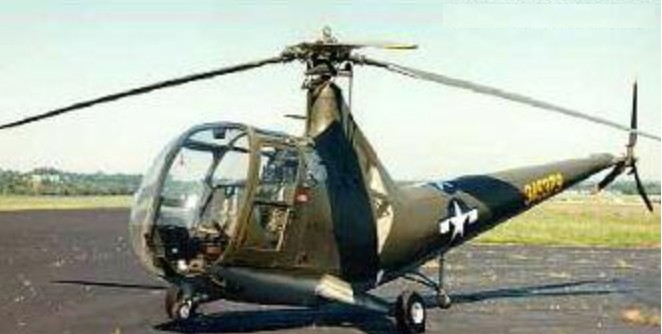
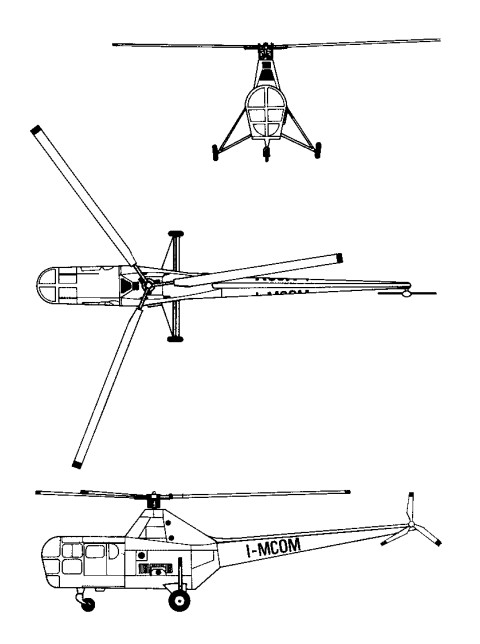
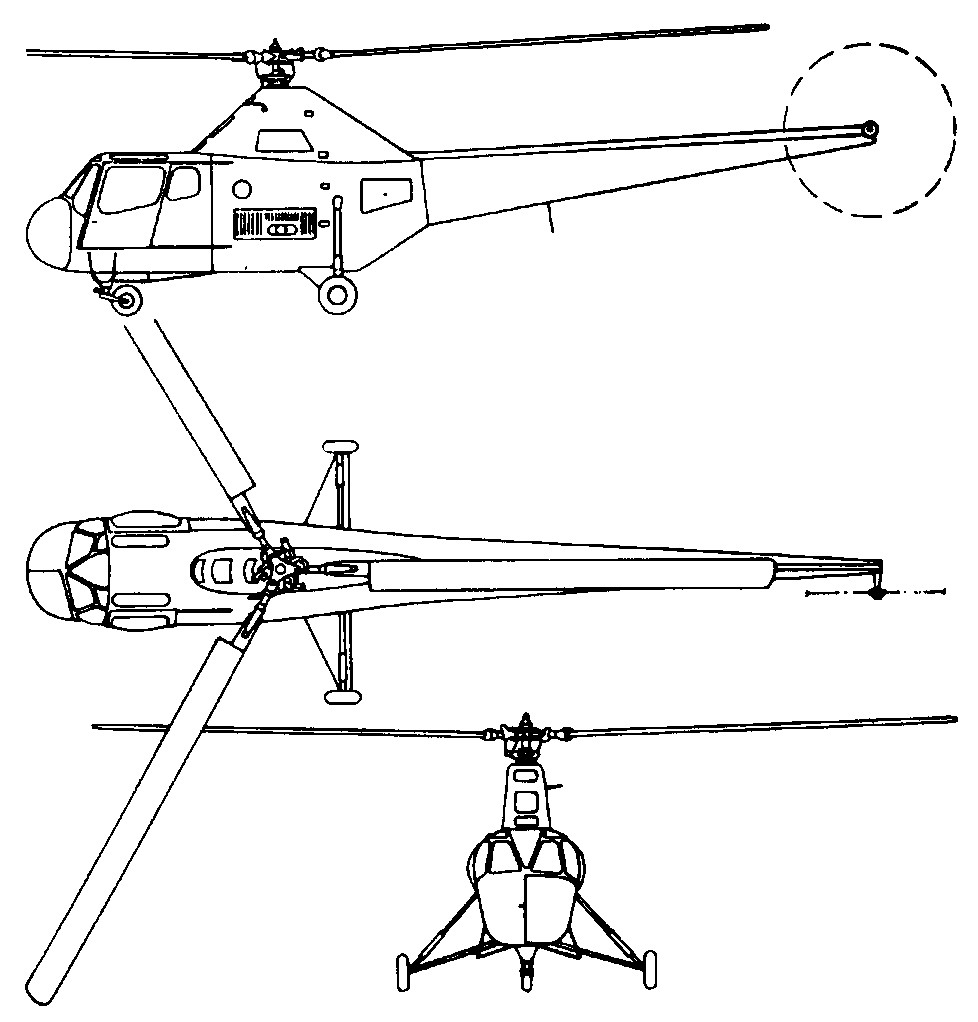
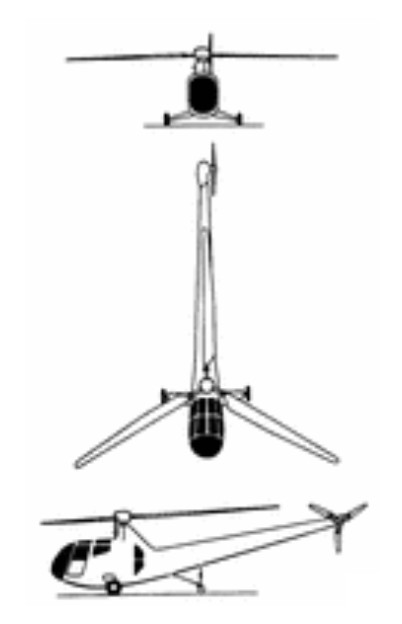
The Sikorsky R-6 was developed parallel with the improved R-5. Ordered in 1943, the Sikorsky VS-316B or XR-6 prototype (43-47955) made its maiden flight on 15 October 1943. It was essentially a refined and developed version of the R-4, and the same rotor and transmission system was used in both types. A 225hp Lycoming O-435-7 engine provided the power, and the fuselage was transformed into a highly streamlined, metal-skinned unit with a one-piece moulded plexiglas cabin for the 2 crew members, and a four-wheel landing gear arrangement
First flown on Oct 15, 1943, Les Morris, was the Chief Test Pilot on the Sikorsky VS-300 starting in March, 1941 (and on the XR-4, XR-5 and XR-6 which followed).
On a March 1944 the XR-6 set new helicopter distance, endurance and altitude records when it made a non-stop flight of 623km from Washington, D.C, to Dayton, Ohio, in 4 hr. 55 min, climbing to 1524m over the Allegheny Mountains en route.
The XR-6 was followed by five 2-seat service test XR-6A’s for the USAAF (43-28240 to 28244) of which three, 46446 to 46448, went to the U.S. Navy (as XHOS-1), built by Sikorsky with 240hp Franklin O-405-9 engines.
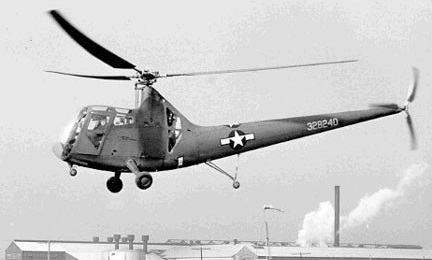
Twenty-six generally similar pre-production YR-6A’s, 43-45316 to 45341, were built by the Nash-Kelvinator Corporation under license from Sikorsky. Sikorsky Co, heavily involved in F4U production, contracted Kelvinator—then a licensee of Pratt & Whitney building airplane engines—to take over production of the R-6A. Redesignated as YH-6A in 1948. Kelvinator had an available plant in Detroit, and the tooling for the project was moved there. Kelvinator carried out the production of the one hundred and ninety-three R-6A’s (43-45342 to -45534) built from 1945. Thirty-six of these were delivered to the U.S. Navy as the HOS-1, 75589 to 75624 and 75729 to 75730, and formed the equipment of that service’s first helicopter squadron, which commissioned in July 1946. Twenty-seven were later were handed over to the USCG as HOS-1G. Those remaining in service in 1948 were redesignated as H-6A. One hundred and fifty went to the RAF in 1946 as Hoverfly II.
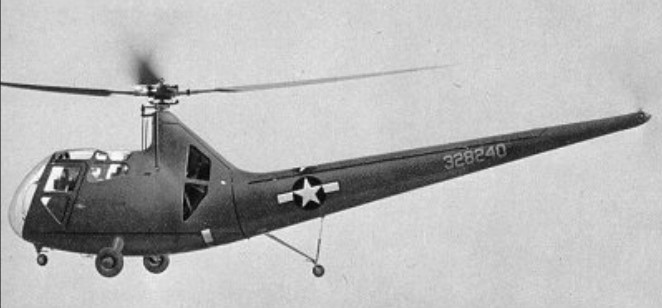
Forty R-6A’s were supplied to Britain under Lend-Lease, these being named Hoverfly II in British service. Fifteen of them were allocated to the Fleet Air Arm for communications and training in 1946; others served with No.657 (AOP) Squadron RAF and the Airborne Forces Experimental Establishment.
Like the R-4, the R-6 could be fitted with pontoons as an alternative to a wheeled landing gear, and was employed on a variety of duties including air/sea rescue, casualty evacuation and observation.
Beginning with the R-6, helicopters flown by the U.S. Coast Guard had Navy designations with the suffix letter G (as HOS-1G) until the 1962 redesignation of U.S. military aircraft.
Its career was, however, a short one: it was frequently beset by engine difficulties, and soon gave way to the more reliable R-5 and its derivatives. A proposed Lycoming-powered R-6B version by Nash-Kelvinator was cancelled.
XR-6
Engine: Lycoming O-435-7, 225hp
R-6
Engine: One Lycoming O-405-9, 235 hp/168kW
Rotor diameter: 11.58 m
Length: 11.60 m
Height: 3.4 m
Max take-off weight: 1317kg
Empty weight: 923kg
Cruise Speed: 110 km/h
Max speed: 161km/h
Range: 565 km
Rate of climb: 4.0m/s
Service ceiling: 3050m
Passengers: 1
Crew: 1
R-6A / H-6A
Engine: Lycoming O-435
Main rotor: 38’0″
Length: 38’3″
Max speed: 96 mph
HOS
Engine: Franklin O-405-9
Main rotor: 38’0″
Length: 38’3″
Max speed: 105 mph
 All Aero