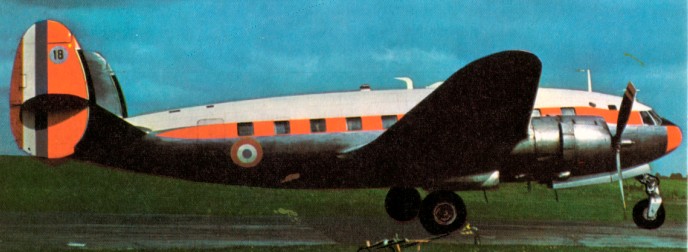
Early in 1941, the Groupe Technique de Cannes initiated the design development of a twin-engined pressurised 23-passenger transport, the SO 30N Bellatrix. Prototype construction was complete by November 1942, but the Italo-German Armistice Commission would not permit flight testing. When, a year later, the line of demarcation between occupied and unoccupied zones of France was abolished, the Bellatrix prototype was hurriedly dismantled and the components distributed in farm outbuildings and barns in the vicinity of Draguignan. After the liberation of the area, the components were recovered and returned to the factory where the aircraft was reassembled and, registered F-BALY, flown for the first time on 26 February 1945. In the meantime, design development had been continuing and a 30-passenger version evolved, this, the SO 30R having 1,650 hp Gnome-Rhóne 14R engines in place of the 1,180 hp G-R14Ns and wing area increased from 775 sq ft (72,00 sq.m) to 88264 sq ft (82,00 sq.m). Two prototypes of this version were built, the SO 30R-01 (F-WAYA) with a single fin-and-rudder assembly and which flew on 6 November 1945, and the SO 30R-02 (F-WAYB) with twin fins and rudders.
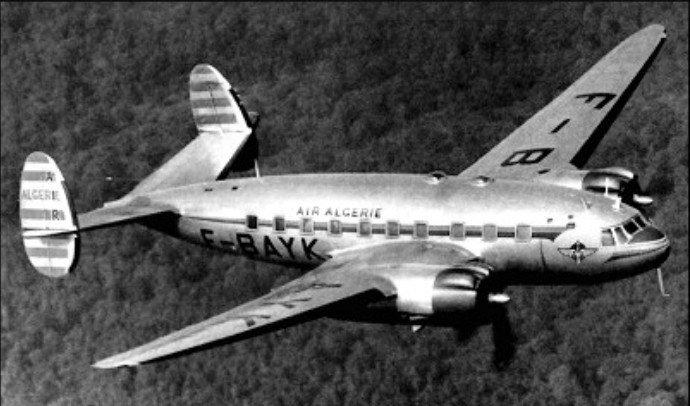
Various changes were subsequently in¬corporated in the design in order to conform with ICAO requirements and Air France recommendations, and the design was still further scaled-up, and a production prototype powered by 1,620 hp Pratt & Whitney R-2800-B43 engines and designated SO 30P Bretagne was flown on 11 December 1947. Production was initiated, and with the 10th aircraft (F-WAYL), flown in September 1949, the -B43 engines gave place to R-2800-CA18s rated at 1,800 hp and developing 2,435 hp with water injection. Internal layouts provided accommodation for 30 or 37 passengers, and the 12th production aircraft (F-WAYO) was later converted as the all-cargo SO 30C with under-fuselage loading doors, trials with this variant commencing on 6 January 1950. Forty-five SO 30P Bretagnes were built, of which 19 went to the Aéronavale and others subsequently to the Armée de lAir. The 24th production example was delivered as a personal transport for the then President of France, eight were used by Air Algêrie, 12 by Air Atlas-Air Maroc (and its successor, Air Maroc), six by Aigle Azur and at least seven by Société des Transports Aèriens de l’Extréme Orient (COSARA).
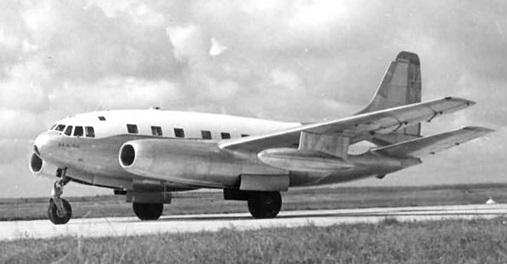
The SO 30R-02 was eventually modified as a test-bed for Hispano-Suiza-built Rolls–Royce 101 Nene turbojets, this being fitted with a new single fin-and-rudder tail assembly and flown in this form on 15 March 1951, and the second SO 30P (F-WAYD) underwent similar modification for use as a test-bed for the SNECMA Atar 101.
SO 30P Bretagne Engines: 2 x 1620hp Pratt & Whitney R-2800-B43 Double Wasp 14-cylinder radial Max take-off weight: 18900 kg / 41668 lb Wingspan: 26.89 m / 88 ft 3 in Length: 18.95 m / 62 ft 2 in Height: 5.89 m / 19 ft 4 in Max. speed: 416 km/h / 258 mph Ceiling: 6500 m / 21350 ft Range: 1500 km / 932 miles Crew: 2 Passengers: 30-37
SO 30P Engines: 2 x R-2800-CA18 Double Wasp, 1620 hp Empty equipped weight: 29,762 lb (13 500 kg) Loaded weight: 42,990 lb (19 500 kg) Maximum speed: 303 mph (488 km/h) at 18,045 ft (5 500 m) Cruise: 272 mph (438 km/h) at 17,390 ft (5 300 m) Ranges with full reserves: 850 mls (1370 km) with a 7,275-lb (3 300-kg) payload Ranges with full reserves: 310 mls (500 km) with 9,259-lb (4200-kg) payload Wing span: 88 ft 3 in (26,90 m) Length: 62 ft 2in (18,95 m) Wing area: 925.69 sq ft (86,00sq.m) Pax cap: 35
France Formed 1935 at Bordeaux-Merignac by the Potez group when it took over the Societe Aerienne Bordelaise. Was intended as a decentralized production source for Potez and Bloch aircraft. A prime responsibility was development and production of Bloch types, especially single-seat fighters derived from MB.150 of 1936. Redesign facilitated production and improved performance, resulting in MB.151 and 152. By June 1940 production totaled about 600, involving five plants. MB.175 twin-engined bomber was in production and was revived after Second World War as torpedo aircraft. Several other prototypes built, including four-engined bomber.
In France, the Socialist Government of the so called Popular Front brought all the companies building military aircraft, aero engines and ar¬mament under its control in 1936. The im¬mediate result was the socialized oblivion of such established companies as Marcel Bloch, Bleriot, Nieuport, Potex, Dewoitine, Hanriot and Farman within half a dozen nationalized groups or Societies Nationales, named ac¬cording to their geographical location (Nord, Ouest, Centre, Midi and so on).
Incorporated in SNCASO 1936, incorporating the factories of Marcel Bloch, Bleriot and Liore et Olivier, subsequently merging with SNCASO and changing name to Ouest Aviation in 1956.
In 1942 completed forerunner of Bretagne twin-engined transport, though not flown until 1945; then used commercially and experimentally. Numerous and varied post-Second World War types included distinctly unusual forms of rotary-wing aircraft. Aeriel (1948) and Djinn (1953) with tip jets, and Farfadet convertiplane (1953).
Aerocentre went into liquidation during 1949, its plants and work being shared by SNCAN (Nord), SNCASO (Sud-Ouest) and engine form SNECMA.
Original designs included S.O.94R twin-engined trainer; S.O.95 Corse, and S.O.30 Bretagne military transports; S.O.4050 Vautour twin-jet bomber; and the S.O.9000 Trident. The S.O.1221 Djinn two-seat helicopter was produced, and Vertol H-21 helicopters were manufactured under license for the French Army. Ouest became part of Aerospatiale.
After World War II, although four of the nationalized groups continued operating un¬der state control, private companies were al¬lowed to resume the design and manufacture of both civil and military aircraft. Some of the pioneering names of French aviation, such as Breguet and Morane Saulnier, returned to prominence, and by 1950 a new one had been added Avions Marcel Dassault.
Loire-Nieuport joined SNCASO in 1942.
SNCASO and SNCASE joined to form Sud-Aviation in 1958.
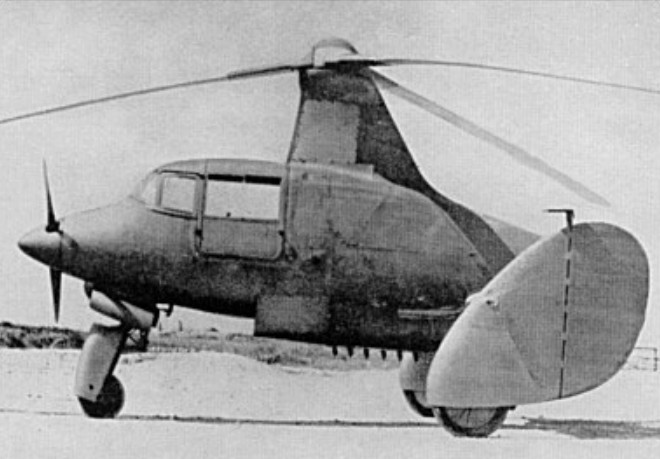
During the war, SNCASE worked on an autogyro known as the SE.700, which flew for the first time in 1945. This three-seater could take off from where it stood by changing the pitch of the rotor. The airscrew was also of the variable-pitch type.
Societe Nationale de Constructions Aeronautiques du Sud-Est SNCASE
In France, the Socialist Government of the so called Popular Front brought all the companies building military aircraft, aero engines and ar¬mament under its control in 1936. The im¬mediate result was the socialized oblivion of such established companies as Marcel Bloch, Bleriot, Nieuport, Potex, Dewoitine, Hanriot and Farman within half a dozen nationalized groups or Societies Nationales, named ac¬cording to their geographical location (Nord, Ouest, Centre, Midi and so on). Liore-et-Olivier, Potez, Romano, and SPCA formed SNCASE in 1936. Sud-Est was a nationalised company that had taken over manufacture from Bloch.
Company thus became responsible for development and production of LeO.45 twin-engined bomber, first flown January 1937, outstanding in many points of design and much used and adapted during and after Second World War. Built also Romano trainers and LeO.43 catapult floatplane, of type first flown December 1934.
In 1941 the company absorbed SNCAM. Early post-Second World War products included Languedoc four-engined airliner, developed from Bloch 161 of 1939, which entered service between Paris and Algiers in 1946, and was ordered additionally for military use.
Dewoitine joined SNCASE in 1942.
After World War II, although four of the nationalized groups continued operating un¬der state control, private companies were al¬lowed to resume the design and manufacture of both civil and military aircraft. Some of the pioneering names of French aviation, such as Breguet and Morane Saulnier, returned to prominence, and by 1950 a new one had been added Avions Marcel Dassault.
Military types in development included Grognard twin-jet attack aircraft of 1950; the unique trolley-launched skid-landing Baroudeur strike aircraft of 1953; and Mistral and Aquilon developments of the British de Havilland Vampire and Sea Venom. Especially notable original developments were the Alouette helicopter series first flown in 1951, and the rear-engined twin-jet Caravelle in 1955.
Until 1 September 1956 known as Societe Nationale de Constructions Aeronautiques du Sud-Est (SNCASE). On the 1st September 1956 the S.N.C.A. du Sud-Est was merged with the S.N.C.A. du Sud-Oest into Sud-Aviation.
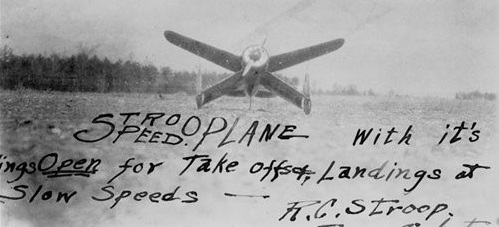
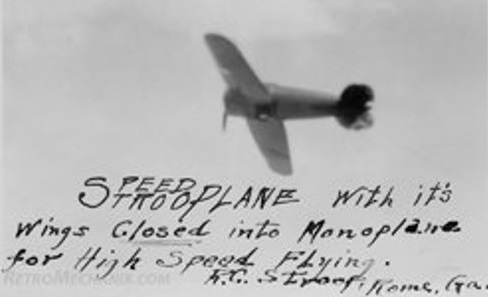
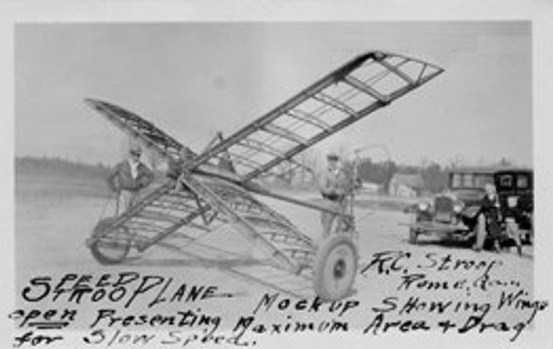
The Robert C. Stroop SP-7, created in 1940, was to combine the biplane’s landing characteristics and the monoplane’s speed characteristics.
On the runway the wing is in the X-wing position, and when in the air the wings are retracted to the monoplane position, the wheels automatically retracted.
The Stinson 76 Sentinel of 1940, designed by A P Fontaine, featured full-span slots, which created a problem during testing with near-fatal results. It first flew on 28 June 1941, powered by a 175hp Lycoming, and piloted by Al Schramm. With modification to half-span slots and enlarged tail surfaces it became final prototype for L-5.
While the YO-54s were being evaluated by the Air Corps, Stinson expected rejection and on speculation they reconfigured the fuselage for tandem seating and added a Plexiglas “greenhouse”, hoping the military would be more interested in this modified version. Known as the V-75B, and later as the V-75C with a more powerful engine, this lightly reworked version of the Voyager was also rejected by the Air Corps without undergoing formal trials. Stinson was advised that if they wished to obtain a contract for a low-cost replacement for the Vigilant that it had to be designed to Army-Navy engineering requirements as the O-49 had, not the lighter-duty CAA standard for civilian airplanes.
At that point, Stinson went back to the drawing board and designed a “clean sheet” tandem-seat airplane that met all of the military requirements. The only features that it shared with the civilian Model 10 / YO-54 were the NACA 4412 airfoil, wing slots, slotted flaps, and oleo-damped cantilevered main landing gear, but no parts were interchangeable and most were of different size and / or construction. Outwardly, it looked similar to the V-75C, but it was a completely different and much stronger airframe from the wheels up. It was also powered by a Lycoming six-cylinder O-435 engine of 175 horsepower that had been designed specifically for use on the new prototype V-76 (a designation in keeping with Stinson’s new parent company Vultee). This aircraft, nicknamed the “Flying Jeep” by factory personnel, was now a very distant third cousin of the HW-75 / Model 105. Accepted in principle by the Wright Field Material Division after accelerated service trials were completed in September 1941, a purchase agreement was reached just days before the Japanese surprise attack on Pearl Harbor. The formal contract for 275 airplanes was signed in January 1942. In succeeding months and years, that contract would be greatly expanded to eventually number 3,590 planes delivered before the war’s end. The RAF in India received 100 of them, and the U.S. Marine Corps 306.
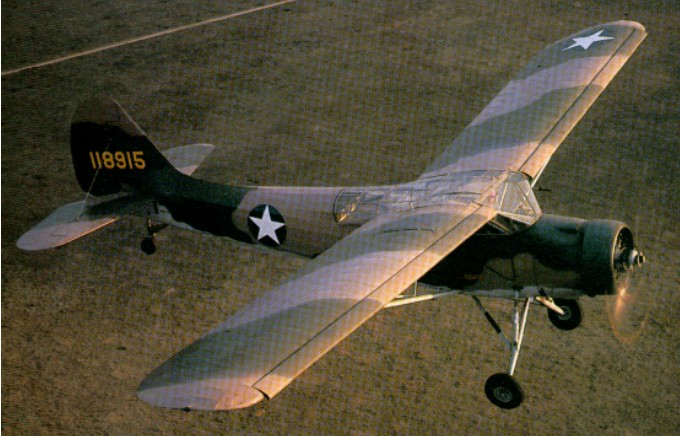
The fuselage was constructed using chrome-moly steel tubing covered with doped cotton fabric. The wings and empennage were constructed of spruce and mahogany plywood box spars, plywood ribs and plywood skins. These components were also covered with fabric. The use of aluminum, which was in critically short supply and more urgently needed for other aircraft, was limited to the engine cowling, tail cone, framework for the ailerons, rudder and elevator, and the landing gear fairings. The L-5 was powered by a six-cylinder Lycoming O-435 engine of 185 horsepower (the prototype was 175) that was increased to 190 hp on the L-5G with improvements a better carburetor and changes in the induction system.
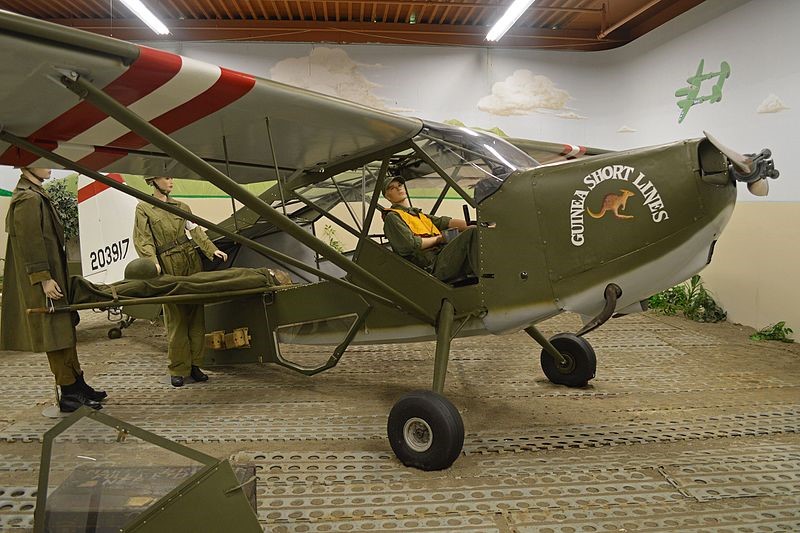
First flying on June 28, 1941 and originally assigned the designation O-62 (‘O’ for observation) in 1941, by the time the first production examples were ready in November of 1942 the light observation category had been renamed “liaison” by the recently re-organized Army Air Forces. This occurred in March 1942 when all the light planes received the L-designation. Under the new system, the Taylorcraft O-57 became the L-2, the Aeronca O-58 became the L-3, and the Piper O-59 Cub became the L-4. The primary purpose of liaison category aircraft was courier and communication work and artillery spotting. In 1943 this was expanded to casualty evacuation. The fuselages of later models of the L-4 and L-5 were modified so that the aircraft could also be used for air ambulance or light cargo work. With a wider and deeper rear fuselage section and a large rear door that folded downward, the L-5B and subsequent variants could accommodate litter patient on all types of American and British “stretchers”, or up to 250 pounds of cargo distributed between the fore and aft platforms. It was designated as the Model 76 (V-76 under the Vultee system)
The USN OY version was adapted from 10 Voyager, with wing tanks and glazed cabin. Popularly, but unofficially, known as “Flying Jeep,” it became the most widely-used Allied utility plane during the war. Designations for those in ambulance service were appended with suffix -VW.
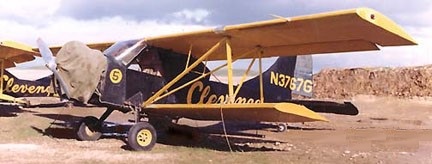
Some surplus L-5s were converted by (Wayne) Clevenger Aircraft Co in 1955 to biplane crop dusters with 220hp Continental W-670.
Stinson L-5 Clevenger duster mod N3767G
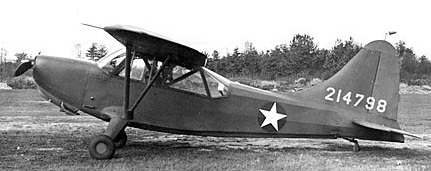
275 were built as O-62-ST; 42-14798 to 42-15072, and 1,538 as L-5-VU and -VW; 42-98036 tp 42-99573, included USN/USMC batch as OY (total transfers from L-5, -5B, and -5E numbered 458), and 40 to the RAF as Sentinel I for service in CBI theater. ATC 764 was issued on 17 December 1945 which covered all production models.
Stinson O-62 Prototype 42-14798
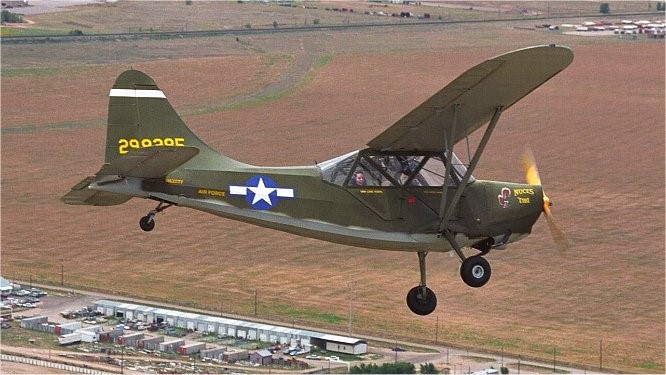
Capable of operating from roads, meadows or short, hastily prepared airstrips, the L-5 “Sentinel” carried messages and VIP’s, delivered troops, supplies, mail and ammunition to front line units. On return flights, wounded or critically ill personnel were often evacuated to rear area field hospitals for medical treatment, boosting the morale of combat troops fighting in remote areas. L-5s were also used for aerial photography, controlling vehicle convoys, para-dropping food, medical supplies and ammunition, laying communication wire, distributing propaganda leaflets, spraying pesticide, transporting prisoners, and directing fighter-bombers to ground targets. The L-5 was also popular with generals and other high-ranking officers for fast, efficient short-range transportation.
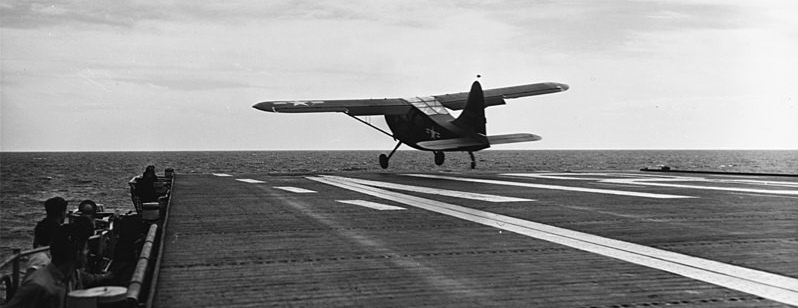
After tests on land, the “Brodie” system was first tested in September 1943 for shipboard use with an installation on the liberty ship City of Dalhart. Staff Sergeant R. A. Gregory made ten good takeoffs and hookups with a Stinson L-5 light plane. During the Battle of Okinawa, L-5s operated from an LST using the Brodie landing system which allowed a light aircraft to take off and land without a flat surface by snagging a wire hung between two booms.
USMC OY-2 takes off from the USS Sicily, 1950
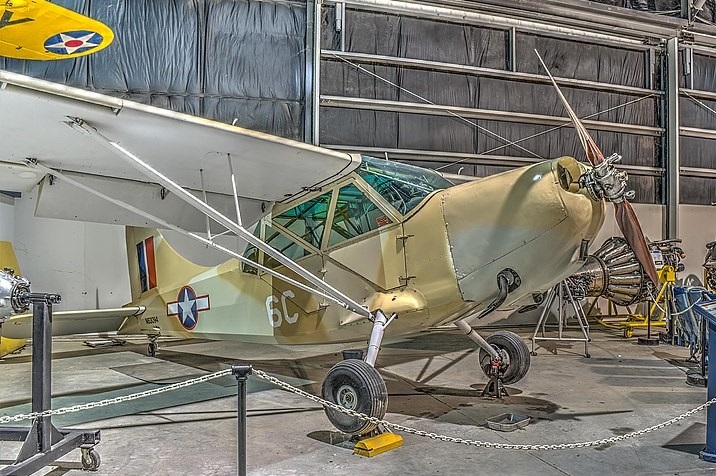
One of the L-5s that used the Brodie system off Okinawa is now on display in the Boeing Aviation Hangar facility of the Smithsonian’s NASM’s Udvar-Hazy Center annex at Dulles Airport just west of Washington, DC.
The USAAF, US Marines, and US Navy used this aircraft in the European, Pacific, and Far East theatres during World War II, and in Korea during the Korean War.
The L-5A designation of 1942 applied to conversions of L-5 with a 24v electrical system and revised gear fairings, but all were cancelled, and revisions became standard equipment on later models.
The 1942 L-5B had an opening aft hatch for a stretcher or 200 lb cargo, and a twin-float capability. 730 were built; 42-99574/99753, 44-16703/17102, -17104/17252, including USN/USMC batch as OY-1, and 60 to the RAF as Sentinel II.
Stinson L-5B Rebuilt from OY-1 N25046
The 1944 L-5C were a photo-recon version of the L-5B with a K-20 camera. 200 were built serials 44-17253 to 44-17452
The 1943 L-5D were L-5C modification from L-5 in service.
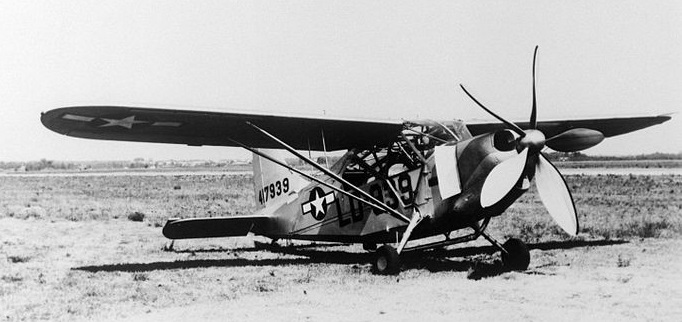
The 750 L-5E of 1944, 44-17453 to 44-18202, had STOL capability with 15-degree drooped ailerons and larger brakes. They included a USN/USMC batch as OY-2. One, 44-17939, was modified by NACA in 1948 with a 5-paddle-bladed prop and geared-down engine (2.8:1) in tests as a low-noise stealth recon.
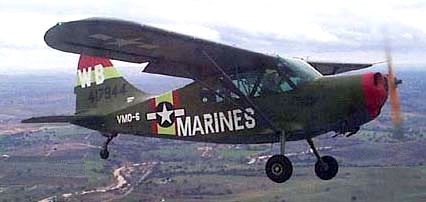
Stinson L-5E Ex-USAF marked as USMC OY-2 44-17944=N44CV
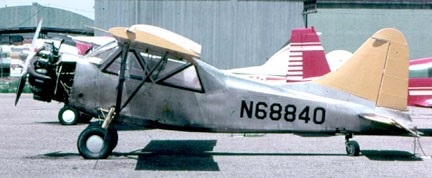
Stinson L-5E with 175hp Lycoming N68840
One XL-5F built in 1945, 44-17103, had a 24v electrical system.
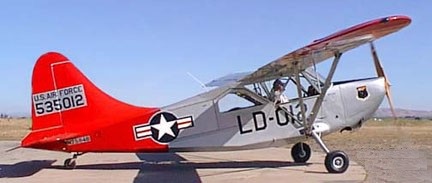
115 L-5G of 1945 were built, 45-34911/35025, 57-6278, with 190hp O-435 engines, controllable-pitch prop, and new radios. The last one was redesignated as U-19B. 785 orders were cancelled at the end of hostilities.
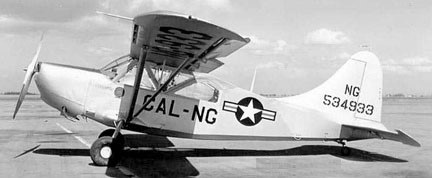
Stinson L-5G CA Natl Guard 45-34933
The U-19B 57-6278 of 1957 was an L-5G used as a glider tug at the AF Academy, and was active up to 1962.
The Navy and Marine version of the L-5 through L-5E were designated OY-1, and all these aircraft had 12-volt electrical systems.
OY-1 on display at the Travis AFB Heritage Center
The 24-volt L-5G became the OY-2. Neither the L-5G nor OY-2 saw combat during World War II because production did not begin until July 1945, just weeks before the war ended, but they were used extensively during the Korean War. The British Royal Air Force (RAF) procured 40 L-5s and 60 L-5Bs, and designated them Sentinel Is and Sentinel IIs respectively. These aircraft were used exclusively in the India-Burma theatre of operations.
Some aircraft had jury rigged anti-tank rocket launchers (mainly bazookas) installed and used with success against ground targets in WWII.
After World War II, the L-5 was widely used by the Civil Air Patrol for search and rescue work. Many other countries also received L-5s after the war, particularly India which received 200. A number of these went to Pakistan after the partition of India in 1948. From 1950 in India, L-5s were used by flying clubs to teach civilian pilots until about 1973 when a lack of spares forced their retirement.
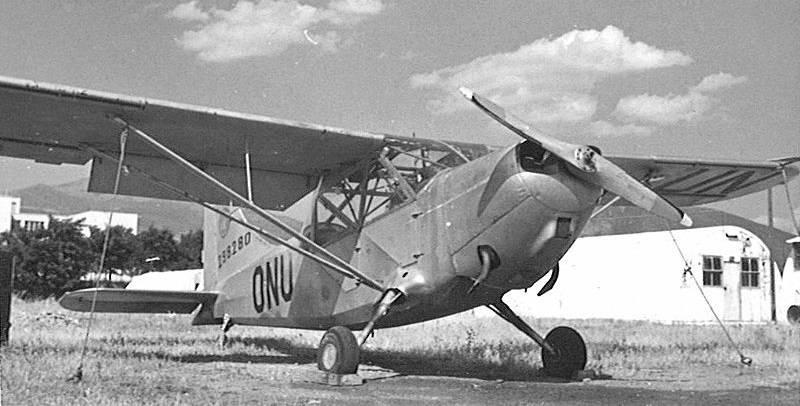
UN liaison service in Greece during the Greek Civil War
Five versions of the Sentinel were produced for the U.S. Army Air Force (USAAF); the L-5, L-5B, L-5C, L-5E and L-5G. There was no official L-5A variant as is often reported because the designation was intended for a version of the aircraft that was never built. Nonetheless, many people in and out of the military still refer to the standard “observer” version of the L-5 as an L-5A. Like the L-5A, the L-5D was a planned version that was not adopted.
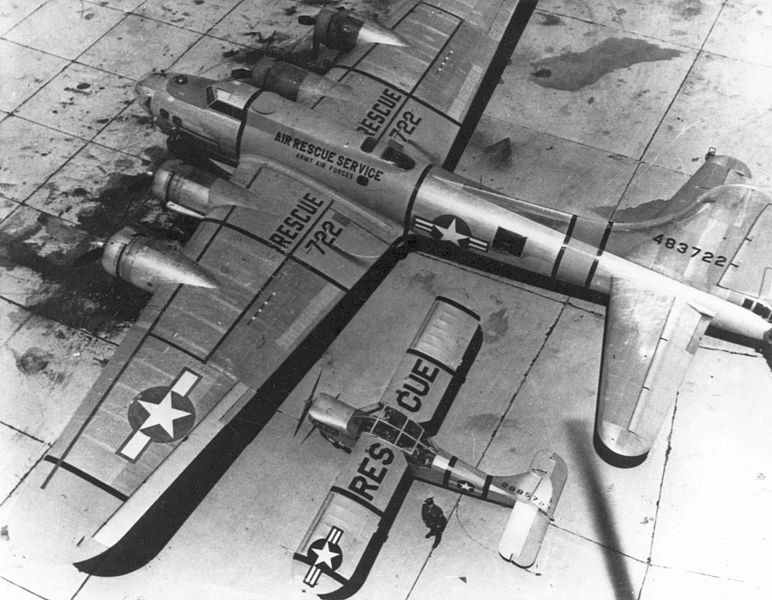
An L-5 Sentinel beside a search-and-rescue B-17 Flying Fortress.
A single L-5E was an L-5B equipped with an experimental low-noise “stealth” propeller and exhaust system for research purposes.
L-5E with “Quiet Flight” modifications at Langley
The L-5B through L-5G models were modified to carry a litter patient or light cargo, or a rear seat passenger sitting in the normal position. An L-5H version was on the drawing boards at Stinson when the war ended, and it never reached the prototype stage.
L-5E on display at the Museum of Aviation
306 of the 1943 OY-1 and OY-2 were built; 02747-02788, 03862-04020, 60460-60507, 75159-75182, and 120442-120474.
The L-5 series was manufactured between November 1942 and September 1945, during which time over 3,896 of the unarmed two-seaters were built for the United States armed forces, making it the second most numerous liaison aircraft of the war behind the Piper L-4 Cub.
O-62 Observation, artillery spotting and liaison aircraft, powered by a Lycoming 0-435-1 piston engine; 275 built.
L-5 / OY-1 / Sentinel Mk I Observation, artillery spotting and liaison aircraft; 1,538 built, 79 transferred to USN/USMC as OY-1.
L-5A Cancelled conversions of L-5 with 24V electrical system and 200 hp (150 kW) ranger engine.
L-5B / OY-1 / Sentinel Mk II 729 aircraft with rear fuselage hatch to permit loading of a stretcher or cargo; twin-float capability; 60 transferred to RAF as Sentinel Mk II, 40 transferred to USN/USMC as OY-1.
L-5C 200 L5-B were equipped K-20 reconnaissance cameras.
L-5D Not adopted. No prototype built.
L-5E / OY-2 750 STOL variants with larger tires and brakes and manually drooping ailerons allowing shorter takeoff and landing; 152 transferred to USN/USMC as OY-1. An L-5E-1 variant included larger wheels and tires and heavy-duty brakes. Thirty L-5E’s were later converted to 24 volt electrical systems and re-designated OY-2.
L-5G / U-19B Similar to L-5E but with a 24 volt electrical system and powered by 190-hp (142-kW) Lycoming 0-435-11 piston engine with improved cylinders and carburetor and fitted with controllable pitch propellers. 115 were built by end of the war and the contract for 785 others was cancelled. Final production model redesignated U-19B in 1962.
XL-5F One test and evaluation aircraft, powered by a Lycoming 0-435-2 piston engine.
U-19A L-5 variants still in service redesignated U-19A by the USAF in 1962.
U-19B L-5G redesignated U-19B in 1962. One used as a glider tug at the United States Air Force Academy.
OY-1 306 L-5 and L-5Bs transferred to the United States Marine Corps and United States Navy.
OY-2 152 transfers of L-5E to USN/USMC; 30 OY-1 conversions to 24V electrical system.
Sentinel Mk I 40 L-5s supplied to the RAF under Lend-Lease.
Sentinel Mk II 60 L-5Bs supplied to the RAF under Lend-Lease.
L-5/235 variant powered by Lycoming O-540-B, 235 hp (175 kW), used for glider towing.
Specifications:
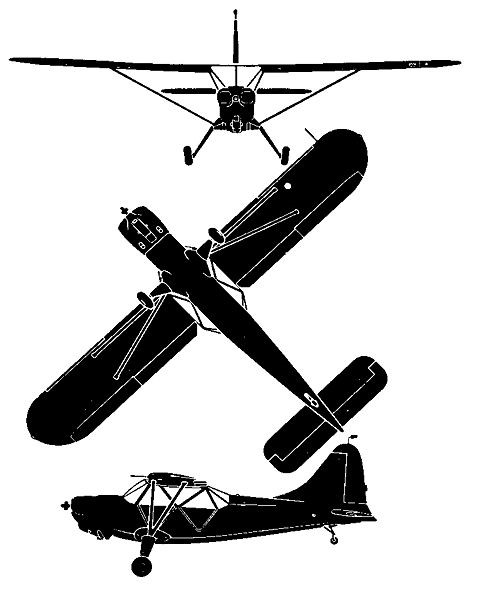
L-5 Powerplant: 1 × Lycoming O-435-1, 185 hp (138 kW) Propeller: 2-bladed fixed-pitch Wingspan: 34 ft 0 in (10.36 m) Wing area: 155 sq ft (14.4 m2) Airfoil: NACA 4412 Length: 24 ft 1 in (7.34 m) Height: 7 ft 11 in (2.41 m) Empty weight: 1,550 lb (703 kg) Max takeoff weight: 2,050 lb (930 kg) Cruise speed maximum: 130 mph (210 km/h, 110 kn) Cruise speed normal:105 mph (91 kn; 169 km/h) Stall speed: 42 mph (68 km/h, 36 kn) Never exceed speed: 163 mph (262 km/h, 142 kn) Range: 375 mi (604 km, 326 nmi) Service ceiling: 15,800 ft (4,800 m) Rate of climb: 900 ft/min (4.6 m/s) at sea level Crew: 2 (pilot and observer)
L-5 Sentinel Engine: Lycoming O-435-A, 187 hp Length: 24.114 ft / 7.35 m Height: 6.89 ft / 2.1 m Wingspan: 34 ft / 10.35 m Wing area: 178.252 sq.ft / 16.56 sq.m Max take off weight: 2183.0 lb / 990.0 kg Weight empty: 1472.9 lb / 668.0 kg Max. weight carried: 710.0 lb / 322.0 kg Max. speed: 117 kt / 216 km/h Initial climb rate: 944.88 ft/min / 4.8 m/s Service ceiling: 14764 ft / 4500 m Wing load: 12.3 lb/sq.ft / 60.0 kg/sq.m Range: 324 nm / 600 km Endurance: 3 h Crew: 2
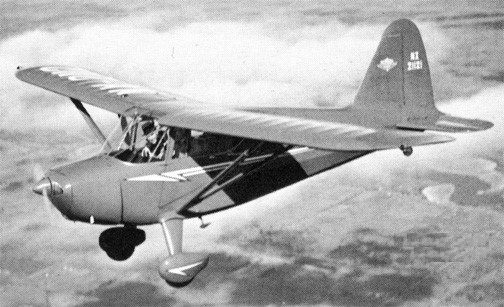
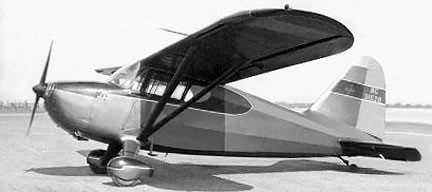
The pre-war civilian Stinson HW-75 (ATC 709) was a 75-horsepower civilian high-wing design built by Peter Altman, William Mara, Maurice A Mills, and Lewis E Reisner at the Stinson Aircraft Company at Wayne, Michigan and marketed as the Model 105. The “105” designation was unofficial, indicating cruising speed and used for publicity when first introduced at NY World’s Fair, priced at $2,995. The prototype HW-75, NC21121 c/n 7000, first flew on 3 February 1939 (piloted by Al Schramm) with a 50 hp engine but the production Model 105 airplanes were fitted with either the standard 75 hp engine, or an optional 80 hp Continental for $3,375. The Stinson 105 featured two side-by-side seats up front and a third “jumpseat” in the rear of the small cabin on which a child or small adult small could sit sideways. Featuring aerodynamic Handley-Page style slots on the outer third of the wings, the design was easy to fly, difficult to stall aerodynamically, and nearly impossible to spin.
Stinson HW-75 NC26222
275 HW-75 were built, including 20 to the RCAF. The design was modified in 1941 as the Stinson-Vultee V76 with a 185hp Lycoming O-435 engine.
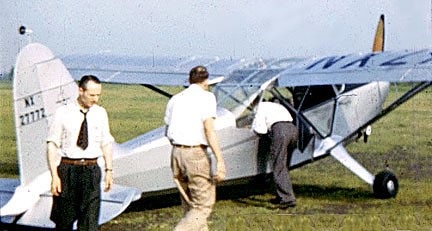
Stinson V76 First flight NX27772
The Model 76, NX27772, first flew on 28 June 1941, piloted by Al Schramm.
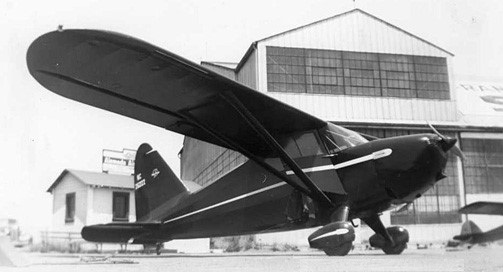
In 1940, the Model 105 saw some minor improvements and was marketed as the “New 105”. Four months later, in keeping with the automobile industry practice of introducing a new model in the spring each year, Stinson came out with the Model 10 Voyager that had a slightly wider cabin and some cosmetic changes but was essentially still a Model 105 with a new look. The engineering designation was HW-80, but the 75 hp engine was also offered as a cheaper option. The 80 hp engine was now standard and they called it the “Voyager”. In early 1940, Stinson moved production from Michigan to a new factory built in Nashville, Tennessee where the Model 10’s were built. Shortly after this move, the company became a subsidiary of the Vultee Aircraft Corporation.
For the 1941 model year, more cosmetic changes and interior refinements were made and a 90 hp Franklin 4-cylinder engine was fitted. This version was sold as the Model 10A Voyager. In the postwar era, the fuselage of the 10A was enlarged to accommodate four seats, and the four-cylinder powerplant was replaced with a Franklin 125 hp six-cylinder engine, and eventually a 150hp and 165 hp “heavy case” version. This 4-seat conversion became the Stinson Model 108 Voyager and was the only civilian plane commercially produced by Stinson after WWII. The prototype first flew in December 1944.
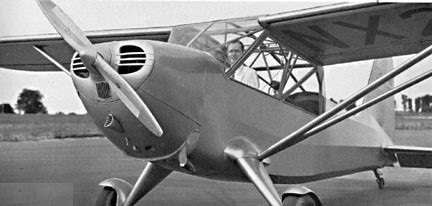
Six examples of the Model 10 Voyager equipped with 80 horsepower Continental A-80 engines, Lear radios and wind-driven electric generators were purchased by the military for testing under the experimental designation YO-54 41-143 to 41-148.
Stinson YO-54
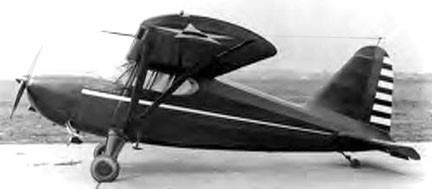
The Stinson 75, or Vultee-Stinson V75, of 1940 was the first prototype of L-5, militarized from the Model 10 with a 100hp Lycoming engine. Designed by A P Fontaine, it was first flown on 19 June 1940, piloted by Al Schramm. Evaluated in September 1940 by the Air Corps for potential use as a low-cost off-the-shelf replacement for the complex, expensive and much larger O-49 Vigilant that Stinson had designed in 1939, the YO-54 failed to meet performance requirements and other military criteria. The only addition not found on the stock Model 10 was a wind generator used to run a radio set specified in the contract. Four of the six were passed to the Civil Air Patrol. The other two were scavenged for parts.
The sole 75C, NX27711, was a 75B modified with a 125hp Franklin engine.
The US Army Air Corps used at least six 1940 V-75 for observation and liaison in 1942. They were 10-A (Model HW-90 ATC 738) powered by 90 hp Franklin O-200 engines and designated L-9A and YO-54. About 500 of the 10A were built, priced at $3,355. Eight civilian Model 10-A with 90 hp Franklin 4AC engines were used designated O-49/L-9B with Franklin O-200 engines. A few of 600 ordered by France were operated in France. One went to the RAF. One -75B was modified with a 125hp Franklin as the -75C, NX27711.
Stinson 10 NC26222
Stinson 10-A
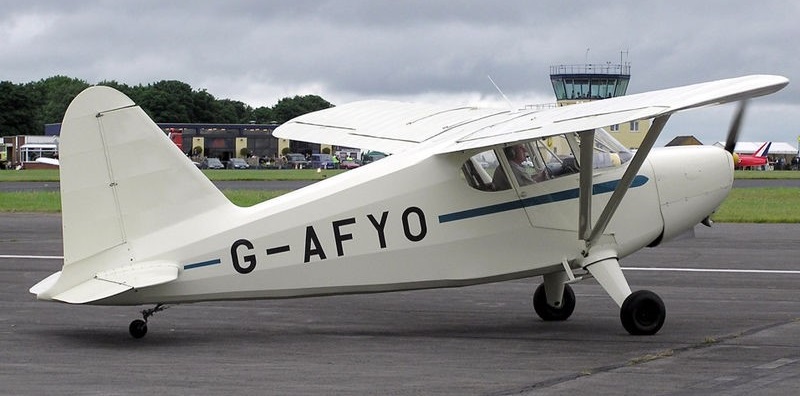
The Stinson 10-A, also known as the Voyager 90, was a three place high wing monoplane, powered by a four cylinder, 90 hp Franklin 4AC engine, with a fixed pitch, wooden propeller. It received ATC #738 in early March 1941. The Voyager was a new version of the Model 105. It had improved attributes and performance, the cowling had been redesigned and shortened, and along with a newly contoured windshield, provided better visibility. Over 700 of those Voyagers were built in 1941.
The 10-A was equipped with ball-bearing mounted flight controls and leading edge slots. Three position flaps, shock absorbing oleo spring gear struts, 48 inch tread main gear, hydraulic brakes and a steerable tail wheel suited short field work.
The 10-A wings had spruce spars, and the fuselage was welded steel tube. A 20 USG fuel tank was installed in the right wing and another 20 USG tank could be installed in the left wing. The vertical stabiliser was steel, while the horizontal stabiliser was built up from spruce and covered with poplar plywood.
The aircraft had a fly away price of US$3355. The plane was available as a Standard or Deluxe model. The Deluxe having navigation lights, an electric starter and a generator, and bonding for a radio that could be later mounted in its walnut finished instrument panel.
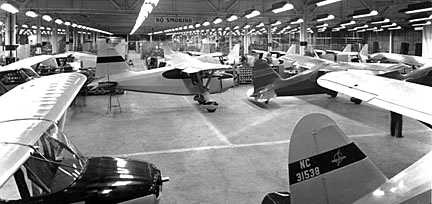
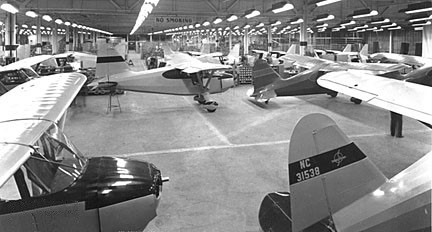
Stinson 10As on the assembly line 6 March 1941
The 10-B of 1941 (ATC 738) was a conversion of 10-A NC27714 c/n 7761 to 75hp Lycoming GO-145-C3 engine.
In 1948 Piper took over the Stinson Division of Consolidated Vultee Aircraft Corporation and acquired the Stinson Voyager production rights, but production of this type was soon halted.
10-A Voyager / L-9B Engine: Franklin 4AC, 90 hp Height: 6 ft 6 in TO dist: 550 ft ROC: 600 fpm Max speed: 115 mph Cruise range; 330 miles Landing speed: 47 mph Landing roll; 150 ft
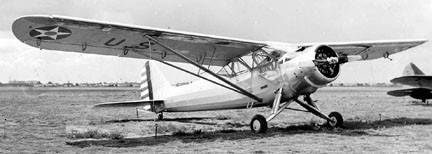
The 1940 L-1 Vigilant liaison aircraft is the military variant of the Stinson model V-74. The prototype L-1 with full-span automatic slots and slotted flaps for Army evaluation first flew on 15 July 1940, piloted by Al Schramm. It operated in and out of a 200′ circle.
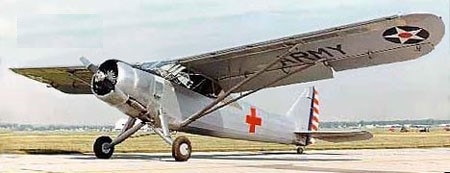
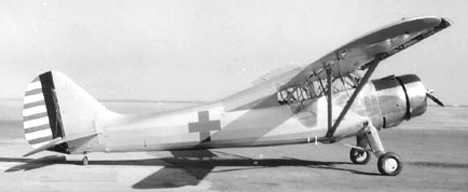
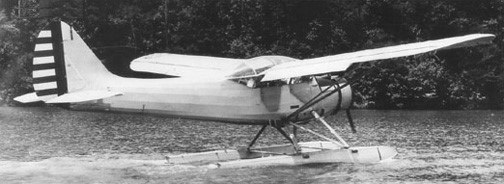
Originally designated the O-49, redesignated from O-49 to L-1 in April 1942, with early ones briefly designated L-49, the 334 O-49s were designated L-1C for the air ambulance role, L-1D as trainers in glider pick-up techniques, and the L-1E and L-1F air ambulances with floats. Designations for those in ambulance duties were appended with suffix -VW.
Stinson O-49
First flying on 15 July 1940, piloted by Al Schramm, priced at $21,000, one hundred and forty-two were built; 40-192 to 40-291, and 40-3101 to 40-3142, of which 14 went to the RAF as Vigilant IA.
One hundred and eighty-two L-1A / O-49A were built; 41-18900/19081, plus 54 to the RAF as Vigilant I.
Stinson L-1A 41-19039
Four L-1A were converted to L-1B / O-49B Ambulance version in 1942.
Stinson O-49B Ambulance
The L-1C of 1942 were L-1A 113 converted as ambulances
Twenty-one L-1A were converted to glider tug trainers as L-1D.
The 1943 L-1E were seven L-1 converted to amphibious ambulance, equipped with twin-EDO floats.
Stinson L-1E
The L-1F of 1943 is similar to L-1E with minor modifications. Four conversions from L-1A and 1 from L-1C were made, plus a few converted to CQ-2 target controllers.
The L-1T was a glider tug conversion of L-1.
105 L-1s were received by the RAF as the Vigilant I.
A few L-1F were used as aerial target controller late in the war, designated CQ-2.
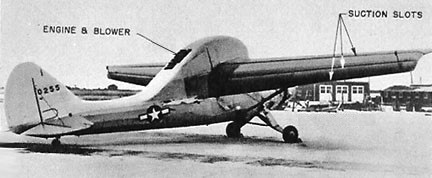
Professor E A Stalker conducted numerous wind tunnel and aeroplane design studies in the late 1930s and in 1942 was given a $50,000 contract by the USAAF to modify Stinson-Vultee L-1 40-255 with a suction flap arrangement. The contract was actually to the Dow Chemical Co of Bay City MI, where Stalker was employed.
Modifications consisted essentially of a new plywood wing that contained full-span, double-segment flaps together with full-span suction slots and ducts, plus addition of a suction blower in the fuselage driven by an auxiliary 80hp Franklin O-180-1.
Stinson L-1 Dow Co experiment in BLC 40-255
The two-section flap covered 40 percent of the chord—the front section deflecting to 35 degrees and the rear to 82 degrees in the fully down position. The outboard section of the aft flap had an additional independent travel of 22 degrees and 33 degrees in the flap’s down and up positions, respectively, which provided lateral control. A large hump in the fuselage housed the blower, and louvres on the rear of the hump controlled the pump’s exit flow.
Its first flight was made on 6 Mar 1944 at Tri-City Airport (p: Maj R E Horner), followed by 19 flights by Dow test pilot R B Gorrill. After a limited amount of testing by Stalker’s group, the L-1 was transferred to Wright Field for additional tests. During early stall tests it entered an uncontrollable spin and crashed, killing pilot Lt P A Hobe.
This first effort was something of a state-of-the-art experiment. The mechanism for boundary layer control was bulky and complicated and, although it worked satisfactorily (a maximum lift coefficient of 3.6 was obtained), the benefit to aircraft performance was difficult to measure—indeed, the gain was practically cancelled by the increased weight of the special wing, engine, and ducting.
Besides, the L-1 was perhaps an unfortunate choice for this experiment since the standard model itself had slotted leading edges, flaps, and an unusually large wing area, all of which made it a high-lift aircraft in its original configuration. When Stalker on 20 Jan 1945 reviewed the L-1 programme, he noted that ‘mechanical, structural, and weight difficulties have thus far prevented successful application to military or commercial airplanes,’ despite the general acceptance of laboratory and theoretical demonstrations of boundary layer control. He felt that the major drawbacks made evident by the L-1 modifications were very poor lateral control and restrictive weights of wing and blower. He also forecast future problems from lack of internal wing space for fuel, guns, or wheels, as well as structural difficulties in adapting boundary layer control to thin wings.
L-1A / O-49 Engine : Lycoming R-680, 295 hp Length : 36.844 ft / 11.23 m Height : 10.531 ft / 3.21 m Wingspan : 54.724 ft / 16.68 m Max take off weight : 3384.7 lb / 1535.0 kg Max. speed : 106 kts / 196 km/h Cruising speed : 94 kts / 175 km/h Service ceiling : 19373 ft / 5905 m Range : 244 nm / 451 km
1919: (Edward) Stinson Airplane Syndicate, Detroit MI.
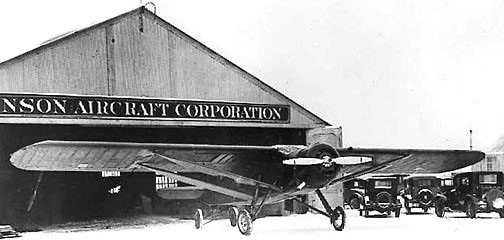
In 1926 the Stinson Aeroplane Syndicate, West Detroit, Michigan, founded by E. A. Stinson, made Detroiter four passenger biplane designed jointly by Stinson and F. Verville. Name Detroiter was confusingly retained for later monoplanes. Three Detroiter biplanes acquired in 1926 by Northwest Airways Inc, at which time manufacturing company renamed Stinson Airplane Corporation.
Stinson 1927
1927: Stinson Aircraft Corp, Northville MI.
Detroiters of several forms used widely by commercial and private operators; e.g. flew first regular airmail service in China. Detroiter monoplanes much developed, though general type was claimed as first U.S. aircraft with soundproofed and heated cabin, engine starter and wheel brakes.
Detroiter Junior of 1928 was scaled-down version for private and executive work. Detroiters established several records, including 174 hr airborne, July 1929.
1929: Wayne MI. 1931: Merger with E L Cord Corp.
About 1933 new tapered wing form adopted for Reliant single-engined series, which succeeded Detroiter line. Reliant series was especially successful and built in great quantities, 500 being transferred to Royal Navy under Lend-Lease. Voyager was later two-seat high-wing monoplane. Sentinel liaison type very widely used under Vultee name.
1940: Stinson Aircraft Div, Vultee-AVCO, Wayne.
Stinson factory and 10-As, 6 March 1941
1946: Stinson Aircraft Div, Convair.
By the end of 1947, Stinson Aircraft had built over 5200 Voyagers, including a Station agon version, but by then the boom had ended and 200 unsold Voyagers were parked at Willow Run Airport.
In July 1948 the Stinson factory was closed and five month later Convair sold Stinson Aircraft to Piper Aircraft. The company that Eddie Stinson had founded 22 years earlier had built over 12,000 aircraft.
1962: Inventory and rights sold by Piper to Univair, Aurora CO.
 All Aero