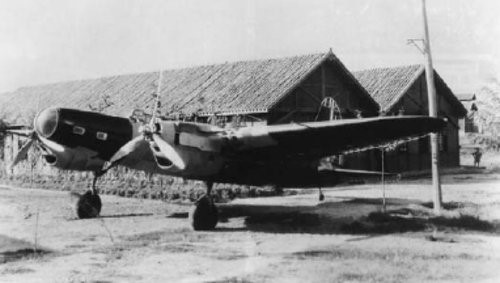
The XB-3 Bomber was designed by the 1st, 2nd or 3rd AFAMF (Air Force Aircraft Manufacturing Factory).
The XB-3 Bomber was designed by the 1st, 2nd or 3rd AFAMF (Air Force Aircraft Manufacturing Factory).
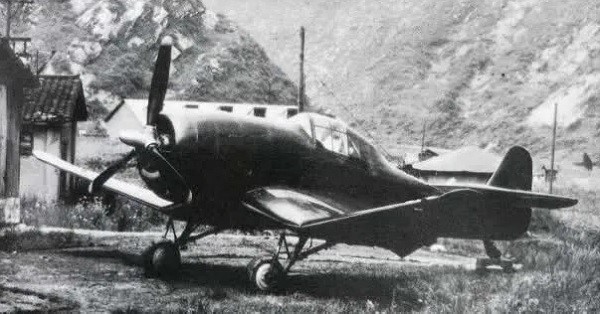
This aircraft seems to have drawn inspiration from the Vought Corsair and contemporary Japanese fighters. The XP-1 had the rear fuselage cut down, assumable to give a good all-round view for the pilot. It also had a rather peculiar wing, which was both bent and swept forward, to quite a strong degree apparently.
The XP-1 was designed in 1942 by Constantin Zakharchenko and built in Guiyang in 1944. with fixed undercarriage, The XP-1 was powered by one 1,200 hp Wright Cyclone R-1820-71 from A C-49D. It had wood/plywood inverted-swept wings, with automatic flaps, and the fuselage was built in steel tube/fabric.
Completed at some point in 1944, it reportedly first flew in January 1945.
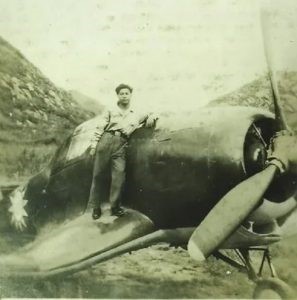
And on this first flight its engine, which was supposedly recovered from a crashed C-47, failed and the aircraft crashed. A second prototype is reported to have been under construction at the time but cancelled after this and the program scrapped.
The chaos of the Chinese Civil War seems to have destroyed most traces of the XP-fighters and all that remains of them are a few snippets.
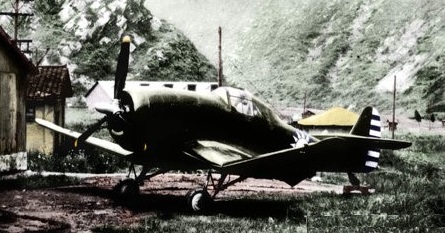
Engine: 1,200 hp Wright Cyclone R-1820-71
Wingspan: 12.10 m
Length: 8.72 m
Max weight: 2,930 kg
est.Max speed: 580 kph
Armament: two 12.7 mm machine guns
The NX1272 Model 3 of 1944 fuselage was of fabric-covered welded steel tubing, and resembled that of a light aircraft with the engine located in the forward section and placed horizontally forward of the cabin.
Power from the engine, cooled by a fan mounted directly above it, was transmitted by pulleys and vee belts to a horizontal main drive shaft, then through a bevel gear drive to the main rotor shaft which passed between the pilot’s and the passenger’s seats.
Mounted on the vertical rotor drive shaft was the main gearbox for the tail shaft operating the two-bladed anti-torque rotor, with a diameter of 1.71 metres, the pitch of which was controlled by rudder pedals. This rotor’s maximum rotational speed was 1200 r.p.m.
The three blades of the main rotor were made with tapered tubular spars and also connected to the root spars by a double-action hydraulic shock absorber.
Cyclic pitch control was obtained by a hanging stick while on the engine throttle support was the collective pitch control.
The A-3 was tested in 1945.
A-3
Engine: 1 x Franklin 6AC-298, 165hp
Number of Seats: 2
Rotor Diameter: 9.14m
Weight Fully Loaded: 544kg
Tail rotor diameter: 1.71 m
Tail rotor speed: 1200 rpm
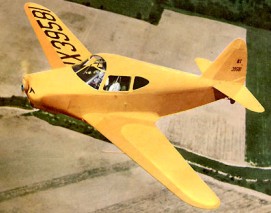
Designed by Edward Burn, the single model 9 Arrow of 1943, NX39581, was destroyed in a test flight after propeller failure.
The aircraft had featured a manual undercarriage retraction.
Engine: Franklin 4AC, 90hp
Wingspan: 29 ft 11 in
Length: 19 ft 9 in
Max speed: 135 mph
Cruise speed: 120 mph
Stall speed: 50 mph
Undercarriage: retractable

The Aeronca C-3 evolved into the Aeronca K Scout (ATC 634) in 1937, designed by Roger Schlemmer, the prototype being NX17440. A total of 344 were built, priced at $1,480, and $1,745 in 1938.
The 1937 KC Scout (ATC 655) sold for $1,590, and $1,295 in 1939. Thirty-four were built, and the float version was the two-door KC Sea Scout.

The 1938 KCA Chief (ATC 675) was priced at $1,695, and with65hp, $1,795. Sixty-two were built, the KCA evolving into the wide-cabin 50C Chief.
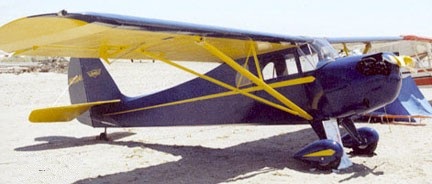
The model 50C Chief was the first lightplane to fly non-stop from Los Angeles to New York City, on 19-39 November 1938, covering 2,785 miles in 30h 47m, avg: 90mph (registration NX21300 and piloted by Johnnie Jones).
The 1941 L-3 and O-58 Grasshopper was the military version of 65 with a greenhouse cabin and 65hp Continental YO/O-170-3. There were fifty-four; 42-456 to 42-459, and 43-2809 to 42-2858. These were followed by twenty L-3A (O-58A), 42-7793 to 42-7812, and 875 L-3B (O-58B), 42-14713 to 4214797, 42-36075 to 42-36324, 42-38458 to 42-38497, and 43-26754 to 43-27253.
The L-3C had no radio and weight reduction. 490 were built, three to the US Navy as XLNR-1; 36422 to 36424.
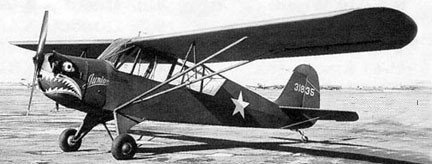
Others were;
L-3D = Impressed 65TF with Franklin AC-167. POP: 11.
L-3E = Impressed 65TC with Continental A-65-8. POP: 12.
L-3F = Impressed Super Chief with A-65-8. POP: 19 including 42-78044
L-3G = Impressed Super Chief with Lycoming O-145-B1. POP: 4.
L-3H = Impressed 65TL with O-145-B1. POP: 1.
L-3J = Impressed 65TC with A-65-7. POP: 1.
The original model, the YO-58, was a conversion of the civil 65TAC Defender. Production models were the O-58, O-58A and O-59B, later designated L-3, L-3A and L-3B in 1942. L-3D to -3J were impressed by USAAF.
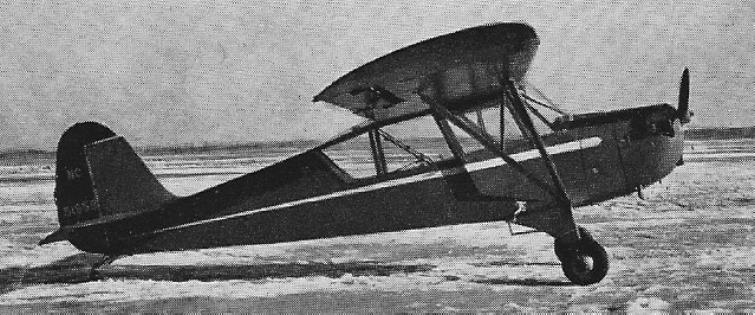
The O-58B differs primarily in having a more extensively glazed cabin.
Performance and specifications were similar to the civil models.
The difference between the 1938 L and LA Chief models (ATC 702) was that the 50L Lycoming O-145 had exposed cylinders, while the 50LA had a closed cowling. Priced at $1,695, there were 65 50L and 20 50LA models built, some for the USAAF as the L-3.
The 50C Chief of 1938 (ATC 675) was an improved KCA with a wider cabin. Priced at $1,795; $1,695 in 1939, 248 were sold. A 50C was the first lightplane to fly non-stop Los Angeles-New York City, on 29-30 November 1938, covered 2,785 miles in 30h:47m, avg: 90mph. NX21300 piloted by Johnnie Jones had a fuel cost-per-mile of about one cent was most impressive, even in 1938 dollars.
Forty of the 1938 50F Chief (ATC 688) were built, powered by a 50hp Franklin 4AC engine.
The 1938 KF Chief (ATC 688) was powered by a 50hp Franklin 4AC engine. Selling for $1,595, five were built, including; NC21067, NC21063, and NC21092. The KF Chief evolved into 50F Chief.
The 1938 KM Chief (ATC 676) was powered by a 50hp Menasco M-50 engine. Priced at $1,590, nine were built. The KM Chief evolved into the one 50M Chief built, NC21070.
The 1937 KS Sea Scout (ATC 634) was a floatplane version of the model K; thirteen were built.
The 50TC and 50TL Tandem (T-series) of 1939 were the first tandem Aeronca as competition for the Piper Cub. A total of 16 were built.

In turn, the K evolved into the SOC Chief in 1938.
The 1940 60TF Tandem (ATC 728) was the same as 50TC, with 60hp Franklin and slightly increased performance. 60TL with 60hp Lycoming. Priced at $1,695, 118 were built, going to USAAF as O-58B with 65hp Continental A-65.
In 1939, the 65-series appeared and featured the 65 hp Continental option. The 65TC Defender (112 built), a tandem two-seat trainer, was widely used throughout the war, particularly in the Civilian Pilot Training Program. The CPTP and CAP versions were the 65TAC of which 154 were built. The Model L-3, the military version of the same airplane, featured a wider fuselage and larger window area to facilitate its role as an observation plane. Although provided with dual controls, the L-3 was designed to be flown from the front seat. The observer’s seat might face forward or aft. Many of the planes reached civilian hands after World War II.
The 1938 65C Chief and 65CA Super Chief (ATC 675) differed by the 65CA having an optional 8-USG auxiliary fuel tank and other deluxe appointments. The 65C price was US$1,795, and the 65CA US$1,895. Of the 279 model 65C built, many were impressed by USAAF as the O-58/L-3 in 1942. A total of 655 65CA models were built.
87 of the 1939 65LA Chief and 199 of the 65LB Super Chief (ATC 702) model were built. The 65LB with 65hp Lycoming O-145 in 1940.
One 50M Chief was built, 1938 (ATC 676), NC21070, priced at $1,695.

65TAF (ATC 728) was CPTP and CAP versions of the 65TF with 59 of the 65TF built, and 115 of the 65TAF during 1940.
The 65TF Tandem and 65TAF Defender of 1940 were powered by 65hp Franklin 4AC engines. Fifty-nine 65TF were built and 115 of the 65TAF CPTP and CAP versions.
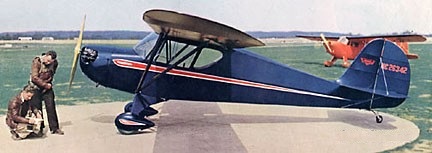
299 of the 1940 65TL Tandem and 65TAL Defender (ATC 728) were built plus military versions: 4 YO-58, 20 O-58, 701 L-3B, and 499 L-3C, plus 253 TG-5 gliders to AAF. The 65TAL was CPTP and CAP version with 100 built.

Aeronca L-3 Raggedy Ann 1983 Article
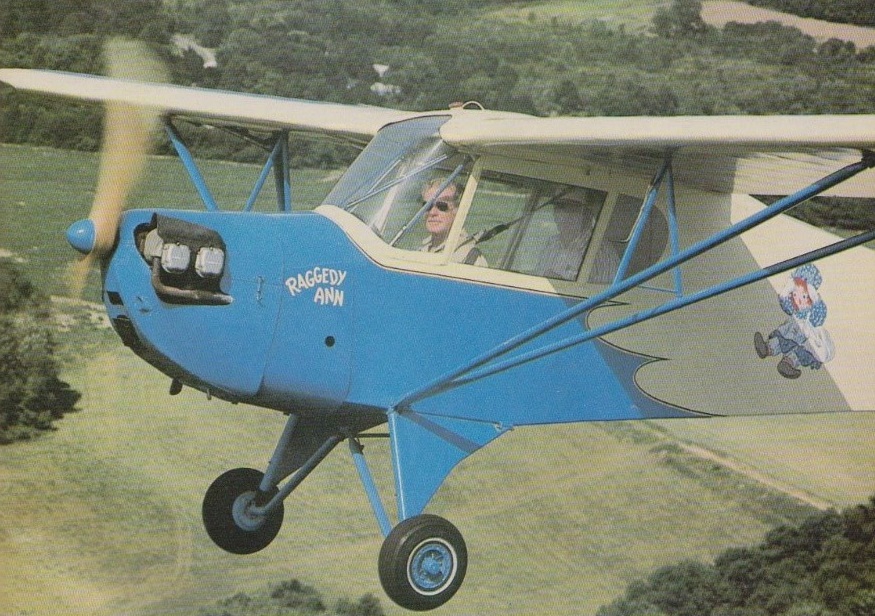
The 1939 models 50TC and 50TL Tandem (ATC 728) designed by James Weagle were the first tandem Aeronca, as competition for the Piper Cub. Sixteen 50TC (50hp Continental) were built, and 33 TL with the 50hp Lycoming engine.
K
1937
Engine: Aeronca E-113C, 36 hp
Gross weight: 1040lb
Empty weight: 590lb
Fuel capacity: 10 USG
Top speed: 80 mph
Cruise speed: 70 mph
Stall speed: 35 mph
Initial climb rate: 400 fpm
Service ceiling: 12,500 ft
Range: 175 nm
Seats: 2
Engine: Aeronca E-113C, 42hp
Wing span: 36 ft 0 in
Length: 20 ft 7 in
Payload: 450 lb
Max speed: 93 mph
Cruise speed: 85
Stall speed: 38 mph
Range: 255 nm
Price 1937: US$1,480
Price 1938: US$1,745
Seats: 2
Number built: 344
KC Scout
1937
Engine: Continental A-40, 40hp
Wing span: 36 ft 0 in
Length: 20 ft 7 in
Payload: 452 lb
Max speed: 93 mph
Cruise speed: 85
Stall speed: 35 mph
Range: 225 nm
Price 1937: US$1,590
Price 1939: US$1,295
Number built: 34
Float version was the two-door KC Sea Scout
KCA Chief
1938
Engine: Continental A-50, 50hp
Wing span: 36 ft 0 in
Length: 21 ft 1 in
Payload: 450 lb
Max speed: 100 mph
Cruise speed: 90
Stall speed: 35 mph
Range: 250 nm
Price std: US$1,695
Price, 65hp: US$1,795
Number built: 62
Seats: 2
Evolved into the wide-cabin 50C Chief
KF Chief
1938
Engine: Franklin 4AC, 50hp
Wing span: 36 ft 0 in
Length: 20 ft 7 in
Payload: 452 lb
Max speed: 100 mph
Cruise speed: 90
Stall speed: 35 mph
Range: 225 nm
Price: US$1,595
Number built: 5
Seats: 2
Evolved into 50F Chief
KM Chief
1938
Engine: Menasco M-50, 50hp
Wing span: 36 ft 0 in
Length: 20 ft 7 in
Payload: 452 lb
Max speed: 100 mph
Cruise speed: 90
Stall speed: 35 mph
Range: 250 nm
Seats: 2
Price: US$1,590
Number built: 9
Evolved into 50M Chief
KS Sea Scout
1937
Engine: Continental A-40, 40hp
Wing span: 36 ft 0 in
Length: 20 ft 7 in
Seats: 2
Number built: 13
A float version of the KC model
50C Chief
1938 (ATC 675)
Engine: Continental A-50, 50hp
Wing span: 36 ft 0 in
Length: 21 ft 1 in
Payload: 460 lb
Max speed: 100 mph
Cruise speed: 90 mph
Stall speed: 36 mph
Range: 270 nm
Seats: 2
Number built: 248
Price 1938: US$1,795
Price 1939: US$1,695
Improved KCA with a wider cabin.
50F Chief
1938 (ATC 688)
Engine: Franklin 4AC, 50hp.
Number built: 40
50L, 50LA Chief / L-3
1938 (ATC 702)
Engine: Lycoming O-145, 50hp
Wing span: 36 ft 0 in
Length: 21 ft 1 in
Payload: 460 lb
Max speed: 95 mph
Cruise speed: 88 mph
Stall speed: 35 mph
Range: 275 nm
Price: US$1,695
50M Chief
1938 (ATC 676)
Engine: Menasco M-50, 50hp
Wing span: 36 ft 0 in
Length: 21 ft 0 in
Payload: 460 lb
Max speed: 100 mph
Cruise speed: 90 mph
Stall speed: 36 mph
Range: 250 nm
Price: US$1,695
50TC Tandem
1939 (ATC 728)
Engine: Continental, 50hp
Wing span: 35 ft 0 in
Length: 22 ft 4 in
Seats: 2
50TL Tandem
1939 (ATC 728)
Engine: Lycoming, 50hp
Wing span: 35 ft 0 in
Length: 22 ft 4 in
Seats: 2
60TF, 60TL Tandem, O-58B
1940 (ATC 728)
Gross weight: 1260 lb
Empty weight: 793lb
Fuel capacity: 12 USG
Top speed: 95 mph
Cruise speed: 87 mph
Landing speed: 42 mph
Range: 25 nm
Initial climb rate: 450 fpm
Service ceiling: 10,000 ft
Number built: 118
60TF Tandem
Engine: Franklin, 60hp
Wing span: 35 ft 0 in
Length: 22 ft 4 in
Seats: 2
Gross weight: 1260 lb
Empty weight: 793lb
Fuel capacity: 12 USG
Top speed: 95 mph
Cruise speed: 87 mph
Landing speed: 42 mph
Range: 25 nm
Initial climb rate: 450 fpm
Service ceiling: 10,000 ft
60TL Tandem
Engine: Lycoming, 60hp
Wing span: 35 ft 0 in
Length: 22 ft 4 in
Seats: 2
Gross weight: 1260 lb
Empty weight: 793lb
Fuel capacity: 12 USG
Top speed: 95 mph
Cruise speed: 87 mph
Landing speed: 42 mph
Range: 25 nm
Initial climb rate: 450 fpm
Service ceiling: 10,000 ft
O-58B
Engine: Continental A-65, 65 hp
Wing span: 35 ft 0 in
Length: 22 ft 4 in
Seats: 2
Gross weight: 1260 lb
Empty weight: 793lb
Fuel capacity: 12 USG
Top speed: 95 mph
Cruise speed: 87 mph
Landing speed: 42 mph
Range: 25 nm
Initial climb rate: 450 fpm
Service ceiling: 10,000 ft
65TC / 65TAC Defender
1940 (ATC 728)
Engine: Continental A-65, 65 hp
Wing span: 35 ft 0 in
Length: 22 ft 4 in
Gross weight: 1260lb
Empty weight: 793lb
Payload: 423 lb
Fuel capacity: 12 USG
Top speed: 94 mph
Cruise speed: 80 mph
Stall speed: 35 mph
Range: 225 nm
Initial climb rate: 450 fpm
Service ceiling: 10,000 ft
Seats: 2
Price: US$1,695
L-3J
Engine: Continental A-65-7, 65 hp
One impressed 65TC
L-3E
Engine: Continental A-65-8, 65
Twelve impressed 65TC
65C Chief, 65CA Super Chief
1938 (ATC 675)
Engine: Continental A-65, 65hp
Wing span: 36 ft 0 in
Length: 21 ft 0 in
Payload: 480 lb
Max speed: 105 mph
Cruise speed: 95 mph
Stall speed: 37 mph
Range: 260 nm
Seats: 2 side-by-side
L-3F
Engine: Continental A-65-8, 65 hp
Ninteen impressed Super Chief
65LA Chief
1939 (ATC 702)
Engine: Lycoming, 65hp
65LB Super Chief
1940 (ATC 702)
Engine: Lycoming O-145, 65hp
L-3G
Engine: Lycoming O-145-B1, 65 hp
Four impressed Super Chief
65TF Tandem, 65TAF Defender
1940 (ATC 728)
Engine: Franklin 4AC, 65hp
L-3D
Engine: Franklin AC-167, 65 hp
Eleven impressed 65TF
65TL Tandem / 65TAL Defender / O-58 / L-3C
1940 (ATC 728)
Engine: Lycoming O-145-B1, 65hp
L-3H
Engine: Lycoming O-145-B1, 65hp
One impressed 65TL
L-3C
No radio, weight reduction. 490 built; additionally 253 built as TG-5 gliders
TG-5 / XLNR-1
65TL Tandem / 65TAL Defender Army Air Force glider version.
Number built: 253
3 transferred to USN as XLNR-1 (36422/36424).
L-3 (O/YO-58)
Engine: Continental O-170-3, 65 hp
Length: 20.997 ft / 6.4 m
Height: 7.677 ft / 2.34 m
Wingspan: 35.07 ft / 10.67 m
Wing area: 158.016 sq.ft / 14.680 sq.m
MTOW: 1301.0 lb / 590.0 kg
Weight empty: 835.7 lb / 379.0 kg
Max speed: 76 kts / 140 km/h
Cruising speed: 40 kts / 74 km/h
Service ceiling: 10007 ft / 3050 m
Wing load: 8.2 lb/sq.ft / 40.0 kg/sq.m
Range: 174 nm / 322 km
Number built: 54 (42-456/459, 43-2809/2858).
L-3A (O-58A)
Number built: 20 (42-7793/7812)
L-3B (O-58B)
Engine: Continental O-170-3, 65 hp
Wing span: 35 ft
Length: 21 ft 10 in
Empty weight: 835 lb
Loaded weight: 1260 lb
Max speed: 87 mph
Cruise: 79 mph
Range: 218 mph
Number built: 875 (42-14713/14797, -36075/36324, -38458/38497, 43-26754/27253 )
Formed from Roché-Dohse organization, Lunken Airport, Cincinnati OH originally in November 1928, the Aeronca Aircraft Corporation was founded November 11, 1928 in Cincinnati, Ohio. Backed by the financial and political support of the prominent Taft family and future Ohio senator Robert A. Taft who was one of the firm’s directors, Aeronca became the first company to build a commercially successful general aviation aircraft.
Jean A. Roche was a senior aeronautical engineer for the US Army Air Service, and by 1929 Aeronca had bought production rights to his recreational aircraft design. Production began with the Jean A. Roche-designed Aeronca C-2 monoplane, often called the “Flying Bathtub”, in 1929. The next major model was the Scout of 1937, a two-seater, which was developed into the Chief and Super Chief the next year.
In 1937 there was a major flood at the Lunken Airport, resulting in the entire airport area being washed away. Aeronca’s factory was destroyed, along with the tooling and almost all of the very early blueprints and drawings. At this time a decision was made to move the operation to a more stable area. Middletown, Ohio was chosen, and the company has remained there ever since. All of the airplanes produced from the start of production in 1929 to 1937 are known as the “Lunken” Aeroncas. The first Aeronca built in Middletown was produced on June 5, 1940, and after this time all Aeroncas were built there.
The name was changed to Aeronca Aircraft Corp in 1941. Quantity production of Fairchild trainers and liaison aircraft ceased 1944, and for postwar production the company developed new types. Aeronca had license for the Erco “two control” system.
The Defender, a tandem trainer version of the Chief with a higher rear seat, was used in training many of the pilots who flew in World War II. Several observation and liaison aircraft designs were also produced during and after the war, including the L-3, L-16 and O-58.
In 1945, following the end of World War II, Aeronca returned to civilian production with two new models, the 7AC Champion and the 11AC Chief. While the Champ shared its tandem seating arrangement with the prewar tandem trainer and the Chief shared its name with the prewar Chief designs, both were new designs. A benefit of the concurrent development was that the new designs had about 80% of their parts in common. Nevertheless, the Champ was favoured by the public, evidenced by its outselling its sibling at a rate of 4 to 1. Between 1945 and 1951, nearly 8,000 Champions were manufactured; while over the same period, approximately 2,000 Chiefs were produced.
Ended aircraft production in 1951, but the design was continued by Bellanca and Champion. Since 1950 company has been a subcontractor, but towards the end of the 1960s undertook, in conjunction with American Jet Industries Inc., development of a light strike version of the Super Pinto, built originally as a jet primary trainer. In January 1978 entered an agreement to build the Foxjet ST600 twin-turbofan light transport aircraft designed by Tony Team Industries Inc., but later terminated due to lack of WR-44 engine availability.
Aeronca built components for aerospace companies including Boeing, Northrop Grumman, Lockheed and Airbus. In its 23-year history as a general aviation and military aviation manufacturer, Aeronca produced 17,408 aircraft spanning 55 different models.
In 1954 Aeronca sold the Champion design to the new Champion Aircraft Corporation of Osceola, Wisconsin, which continued building variants of the Champion as well as the derivative design, the Citabria. The aircraft design was acquired again by the Bellanca Aircraft Company in 1970 and again to American Champion in 1988, where it remained in production.
Aeronca became a division of Magellan Aerospace, producing aircraft, missile, and space vehicle components at the same location adjacent to Middletown’s Hook Field.
A glider tug built 1943
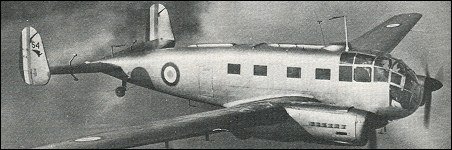
Production of the twin-engined eight-passenger Siebel Si.204A transport aircraft and Siebel Si.204D military instrument trainer for French and Luftwaffe service began at the SNCAC factory at Bourges in 1942.
Post-war SNCAC put the aircraft back into production as the NC.701 (Si.204D) and NC.702 (Si.204A) powered by Renault 12S engines (440kW SNECMA S-12-SO2-3Hs, French-built Argus As.411s). Approximately 300 were built.
The NC.702 version accommodated a crew of two and eight passengers (four on each side of a central aisle), with a toilet and luggage compartment aft. As a freighter, the interior equipment was removed and the cabin divided into four compartments. Among the many operators of the Martinet were Air France and CSA of Czechoslovakia.
NC.702 / Si.204A
Engines: 2 x Renault 12S, 440kW
Take-off weight: 5600 kg / 12346 lb
Wingspan: 21.83 m / 72 ft 7 in
Length: 12.81 m / 42 ft 0 in
Cruise speed: 325 km/h / 202 mph
Range: 810-1400 km / 503 – 870 miles
Range max.fuel: 2000 km / 1243 miles
In France, the Socialist Government of the so called Popular Front brought all the companies building military aircraft, aero engines and ar¬mament under its control in 1936. The im¬mediate result was the socialized oblivion of such established companies as Marcel Bloch, Bleriot, Nieuport, Potex, Dewoitine, Hanriot and Farman within half a dozen nationalized groups or Societies Nationales, named ac¬cording to their geographical location (Nord, Ouest, Centre, Midi and so on).
Farman and Hanriot formed the new Societe Nationale de Constructions Aeronautiques du Centre, known as SNCAC or Aerocentre.
After World War II, although four of the nationalized groups continued operating un¬der state control, private companies were al¬lowed to resume the design and manufacture of both civil and military aircraft.
Aerocentre conducted the final development of the Farman line of four-engined heavy bombers which had engines in tandem underslung pairs, derived from the F.211 of 1931.
Aerocentre went into liquidation during 1949, its plants and work being shared by SNCAN (Nord), SNCASO (Sud-Ouest) and engine form SNECMA.
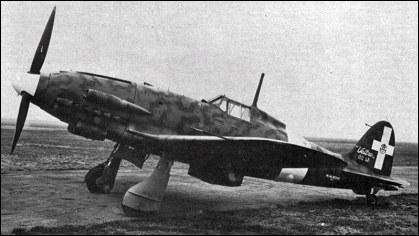
Re-powering the Folgore with a 931kW Fiat R.A.1050 RC.58 Tifone engine – a licence-built Daimler-Benz DB.605 resulted in the Veltro (Greyhound).
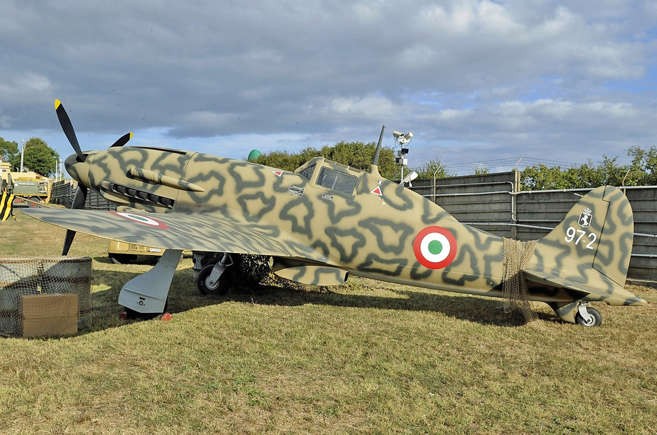
First flown as a prototype on 19 April 1942, production aircraft entered service in the following year but saw little action before the Italian surrender to the Allies. Most of the 262 MC.205V production aircraft served with the fascist Italian and German air arms. Later aircraft had two 20-mm cannon in place of the two rifle-calibre wing machine-guns to provide an effective armament.
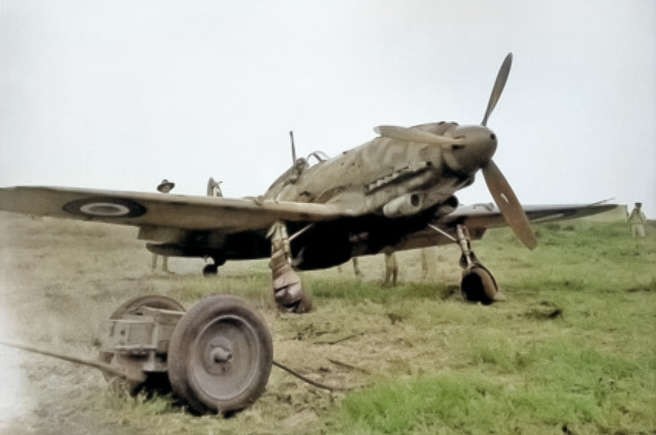
A variant that failed to enter production was the MC.205N Orione high-altitude fighter with increased-span wings and an armament of one 20-mm cannon and four 12.7-mm (0.5-in) machine-guns in the N-1 variant or three cannon and two machine-guns in the N-2 variant.
Engine: Fiat RA. 1050 RC.58 Tifone, 1455 hp
Length: 29 ft 0.5 in / 8.58 m
Height: 9.974 ft / 3.04 m
Wingspan: 34 ft 8.7in / 10.58 m
Wing area: 180.835 sq.ft / 16.8 sq.m
Max take off weight: 7514.6 lb / 3408.0 kg
Weight empty: 5691.1 lb / 2581.0 kg
Normal TO weight: 3224kg / 7,108 lb
Max. speed: 347 kts / 642 km/h at 23620 ft
Cruising speed: 270 kts / 500 km/h
Service ceiling: 53707 ft / 16370 m
Wing load: 41.62 lb/sq.ft / 203.0 kg/sq.m
Range: 562 nm / 1040 km
Crew: 1
Armament: 2x MG 12,7mm, 2x MG 7,7mm up to 320 kg (1706 lb) of bombs
Macchi C.205 Veltro
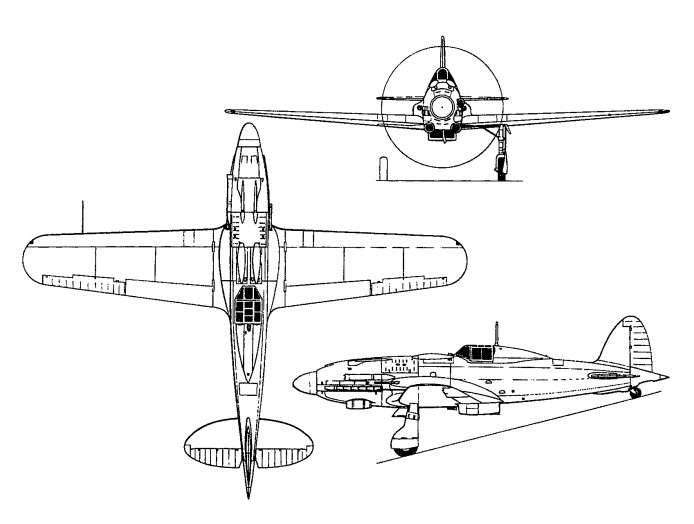
 All Aero