Turbay sa

Turbay T-1 Toucan with Alfredo Turbay May 16, 1943

Alfredo Turbay was born in Monteros in the province of Tucuman Argentina on December 15, 1912, he grew up and studied there. He received his Civil Engineering from the National University of Tucuman in 1938 and expanded his knowledge of aeronautical distance learning courses L’Ecole d’Aéronautique of France and Cornell University in the US. He obtained the brevet of pilot in April 1937 and in March 1939 began his career as aircraft manufacturer together with other enthusiasts who built a Grunau 9 primary glider.

First design by Ing Alfredo Turbay was the T-1 Tucan parasol- wing lightplane, first flown April 1943. Six Tucans ordered from Sfreddo & Paolini were halted when the latter firm was seized and nationalized by the government and plans to revive production in 1963 were also thwarted. The T-2 five-seat twin-engined monoplane was destroyed by fire in early 1949 before it had flown; thus the next design to fly was the T-3A six-passenger light transport in December 1964. Turbay SA was formed in January 1961 to build the proposed T-3B production version and a lengthened fuselage development, theT-4, but no production was achieved.

Tupolev ANT-58 / ANT-59 / ANT-60 / Tu-2

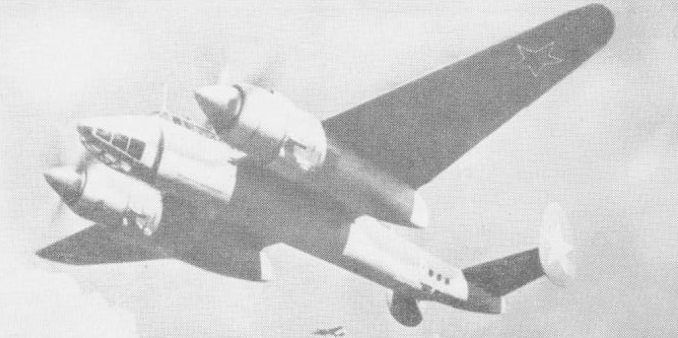
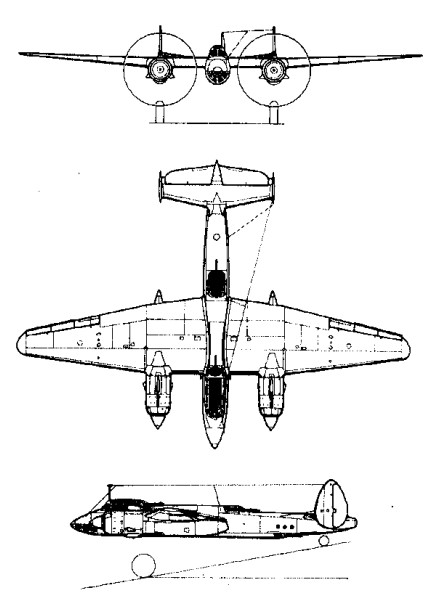
The origin of the Tupolev Tu-2 lay in the ANT-58, ANT-59 and ANT-60 light bomber prototypes that came from the design bureau of Andrei N. Tupolev during 1938-40. Powered by two 1044kW Mikulin AM-37 V-12 engines, the ANT-58 made its first flight on 29 January 1941.

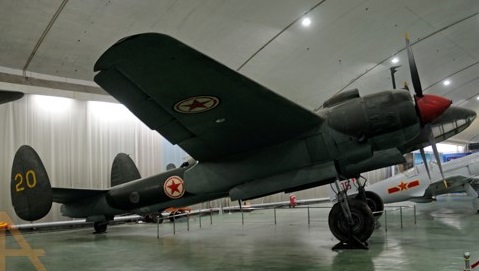
The ANT-60 was re-engined with the big and powerful 1104kW M-82 radials because of the relative unreliability of the AM-37s. The result was the definitive Tu-2 bomber that was to see service with the V-VS during the last year of World War II and well into the 1950s.

Soviet industry was still in a state of upheaval following the years of 1941-2, when the German army struck deep into Belorussia and the Ukraine. The Tu-2 was too complicated an aircraft for the conditions prevailing, and after many months in which the Tu-2 was modified and simplified for the mass production lines, the Tu-2S (Seriinyi, or series) appeared, flying for the first time on 26 August 1943. A small number of Tu-2s had previously been passed to front line regiments in September 1942, where their performance, armament and bombload had received general enthusiasm.

Tupolev Tu-2 Article

By January 1944 the first production Tu-2 and Tu-2S bombers had been passed to the regiments of the V-VS, but it was not until June of that year that Tu-2s saw action on a large scale. The sector was the Karelian (Finnish) front in the north where the V-VS forces, under the overall command of General A.A. Novikov, numbered 757 aircraft of the 13th VA (Air Army), the V-VS KBF (Red Banner Baltic Fleet) and the 2nd GVIAK (guards fighter corps). Of the 249 Tu-2 and Petlyakov Pe-2 light bombers in the Soviet order of battle, many came under Colonel I.P. Skok’s 334th Bomber Air Division which subsequently received a citation for its work. Reconnaissance work was now being carried out by Tu-2D and Tu-2R aircraft with modified mainplanes, nose glazing, and capacity for vertical and oblique cameras. Wartime production of the Tupolev Tu-2 and its sub-types amounted to 1,111. As a bomber it did not come into its own until the autumn of 1944. However, as German resistance stiffened on nearing the eastern borders of the Reich V-VS bombers, including Tupolev Tu-2s, were called up to attack strongpoints at Kustrin and other fortified ports and cities. September 1945 saw many Tu-2s in action against the Japanese Kwantung Army in Manchuria before the final surrender.

Tu-2

Tupolev was awarded a Stalin Prize for his Tu 2 medium bomber, the only wholly new Soviet wartime aircraft to go into production.

Variation:
Sukhoi UTB-2

Gallery

Tu-2S
Engines: 2 x ASh-82FNV, 1380kW
Max take-off weight: 11360 kg / 25045 lb
Empty weight: 7474 kg / 16477 lb
Wingspan: 18.86 m / 62 ft 11 in
Length: 13.8 m / 45 ft 3 in
Height: 4.55 m / 15 ft 11 in
Wing area: 48.8 sq.m / 525.28 sq ft
Max. speed: 550 km/h / 342 mph
Ceiling: 9500 m / 31150 ft
Range: 1400 km / 870 miles
Crew: 4
Armament: 2 x 20mm cannons, 3 x 12.7mm machine-guns
Bombload: 4000kg

Tupolev Tu-2

Tupolev

Born in 1888, Andrei N Tupolev was an early pupil, at the Moscow Technical High School, of the internationally famous aerodynamicist, Professor N E Zhukovski. His studies and early gliding experiments were, however, interrupted in 1911 when he was arrested for revolutionary activities. During part of the first World War, Tupolev worked in the Duks aircraft factory in Moscow, then the largest in Russia.

Andrei Tupolev Article

After the Bolshevik Revolution, Tupolev became one of Zhukovski’s leading assistants in setting up the Central Aero and Hydro dynamics Institute (TsAGI). This brought together pre war Russian research establishments with other, newly created bodies, and in 1920 Tupolev became head of its design department (AGO) and president of commission to design and build all-metal aircraft 1922.

Initially followed Junkers formula, using corrugated metal skins; first to appear were ANT-1 and ANT-2 (A. N. Tupolev) cantilever monoplanes. Became head of AGOS department of the Moscow TsAGI in 1922; during 1920- 1936 most designs bore ANT designations although some emanated from his design team leaders, chief deputy A. A. Archangelskii, W. M. Petlyakov and P. O Sukhoi (e.g. Sukhoi designed ANT-25 and 37).

Tupolev’s first major design was ANT-4 (TB-1) heavy bomber of 1925, forerunner of several very large machines including ANT-6 (TB-3) bomber; ANT-9 commercial passenger transport and huge ANT-20 Maxim Gorkii propaganda aircraft of 1934. Also designed ANT-40 (SB-2) twin-engined medium bomber.

The enormous creativity of the Tu¬polev group stemmed in part from this designer’s ability to train and direct others, such as Sukhoi and Petlyakov. Petlyakov, for example, was responsible for the PE 8, a four en¬gine bomber that was larger and more powerful than the B 17.

In 1936 Tupolev was arrested during Stalin’s purges and condemned to death, but sentence commuted and after some five years’ imprisonment was released and restored to favour (ostensibly in recognition of Tu-2 medium bomber, designed while in prison) and given his own design bureau. After Second World War continued to place emphasis on large aircraft; Tu-4 copy of Boeing B-29 Superfortress helped win him a Stalin Prize in 1948.

Main early post-war products included Tu-14 twin-jet naval medium bomber; Tu-16 intermediate-range twinjet bomber (first flown April 1952; also produced in China as the Xi’an H-6); and a quartet of four-turboprop swept-wing giants: the Tu-95 long-range strategic bomber (first flown November 1952 and built up to 1992), Tu-142 naval variant for long-range antisubmarine warfare and communications relay (first flown June 1968), Tu-114 200-passenger transport based on Tu-95 (first flown November 1957) and Tu-126 AWACS aircraft (first flown 1962).
Later military types included the twinjet Tu-22, the first Soviet supersonic bomber that first flew in 1959, and the Tu-128 very large all-weather interceptor (first flown March 1961), the variable-geometry wing Tu-22M Backfire intermediate- range Mach 1.8 bomber and missile launcher (first flown August 1969 and 514 built during 1971-90) and the variable-geometry wing Tu-160 Blackjack heavy missile bomber with a speed of Mach 2.05 and range of over 12,215km without in-flight refueling (first flown December 1981 and entered Soviet service from 1987), while projects include the Tu-204P maritime patrol derivative of the Tu-204 airliner, Tu-2000 hypersonic bomber, and a subsonic strealth bomber.

Early turbojet and turbofan powered transport aircraft included twin-jet Tu-104 (based on Tu-16 and first flown June 1955); Tu-124 (first flown March 1960); Tu-134 (first flown July 1963) and tri-jet Tu-154 (first flown October 1968). Tu-144 became, in December 1968, the first supersonic airliner in the world to fly. It exceeded Mach 2 for the first time in May 1970 and was the first of its type to enter regular service when, in December 1975, it began freighting for Aeroflot prior to initial passenger services in 1977. However, Tu-144 was not a success and services were terminated in June 1978; in November 1996 a converted Tu-144D flew again as the Tu-144LL, used thereafter for an international High-Speed Civil Transport research program to assist in the development of a nextgeneration supersonic transport.

Most recent Tupolev commercial transports, programs and projects include the convertible cargo/passenger Tu-130 (to fly on standard and liquid natural gas in the 21st century), Tu-136 projected light passenger/cargo transport with twin Pratt & Whitney turboprop engines, Tu- 155/Tu-156 conversions of Tu-154 to use cryogenic fuel engines (Tu-155 for research flew 1988), Tu-204 medium-range airliner for typically 214 passengers (first flown January 1989) and its projected Tu-206 cryogenic fuel derivative, Tu-214 and Tu-224 airliners based on Tu-204 but featuring increased take-off weights and longer range (first flight of Tu-214 March 1996), Tu-230 projected light/medium freighter, 166-passenger Tu-234 airliner as a short-length variant of Tu-204, Tu-244 projected supersonic airliner, Tu-304 and Tu-306 (cryogenic fuel variant) projected long-range airliners for up to 392 passengers, projected Tu-324 regional and business transport, Tu-330 and liquid-gas Tu-338 freighters, Tu- 334 medium-range airliner for typically 102 passengers (first flown February 1999) and its Tu-336 cryogenic fuel derivative, Tu-404 projected giant 850-seat airliner, and Tu-414 projected 70-passenger regional jet.
Tupolev general-aviation projects include Tu-34 pressurized five/seven-seat STOL transport with twin turboprop engines and pusher propellers, Tu-54 single-seat agricultural monoplane, Tu-400 eight/ten-seat business jet with regional airliner potential, and Tu 4X4 four/seven seat business jet as smallest aircraft in the Tu- 324/400/414 range.
Tucker XP-57

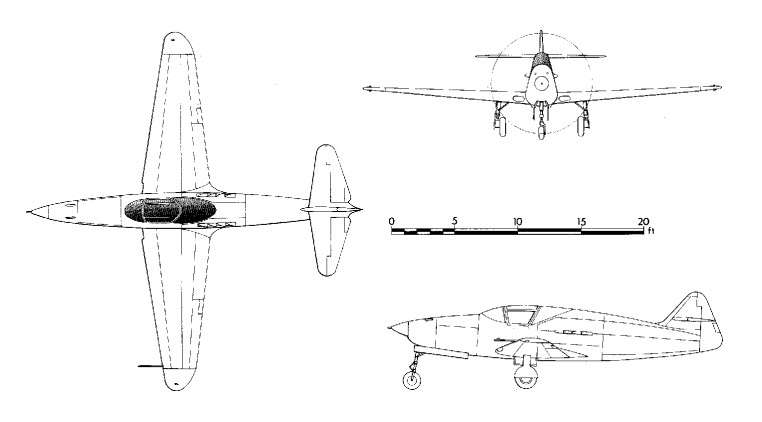
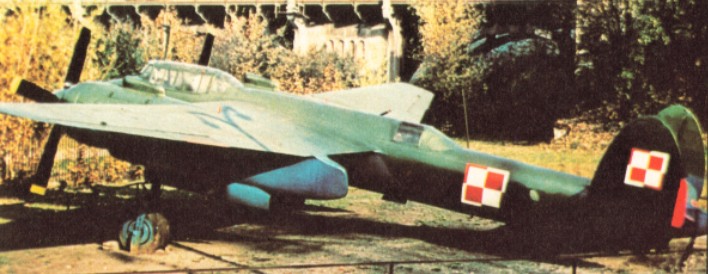
In 1940 the Tucker Aviation Co, of Detroit, proposed a fighter that was conventional, simple, and intended to yield thousands of cheap, easily maintained and tough pursuits in a matter of months. Powered by the 720 hp Miller L 510 V 8, driving a 2-blade propeller via a long shaft, it was to have, a metal skinned steel tube fuselage and wooden wings, with two or three guns in the nose, one firing through the propeller hub. Gross weight was estimated at 3,000 lb and speed 308 m.p.h. The company were unable to fulfil the Army contract.

TsAGI 11-EA / Bratukhin 11-EA PV

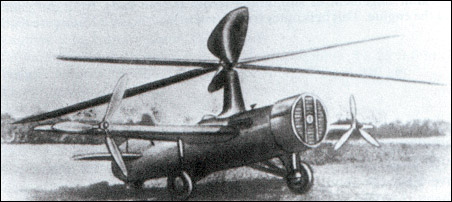
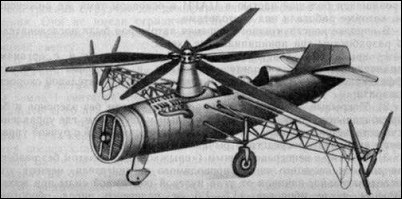
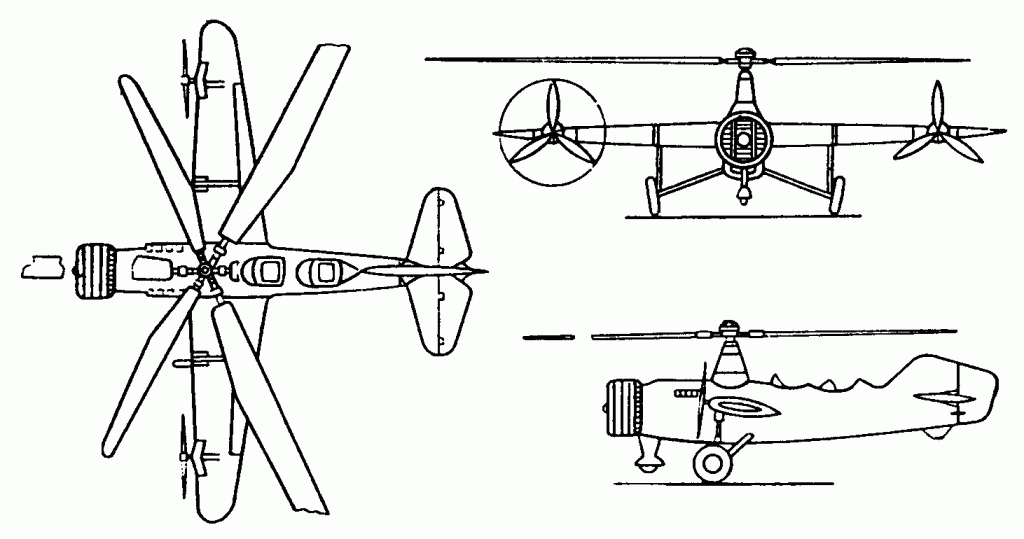
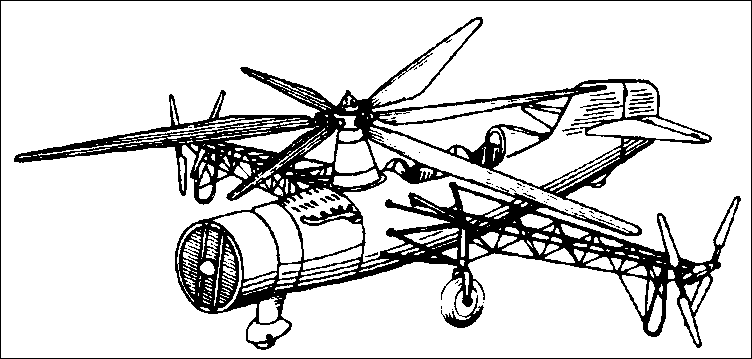
Experiments with 5-EA rotor allowed I.P.Bratukhin to build substantially bigger and heavier aircraft. Designed 1934, this used Bratukhin’s rotor with alternate large articulated blades and small rigid blades but sealed up to absorb power of large US water-cooled V-12 engine. Latter mounted in nose of steel-tube fuselage covered in fabric for streamlining, with tandem cockpits at rear behind main rotor pylons. Main rotor was same as on the 5-EA. Engine arranged facing to rear with reduction gear driving second reduction gearbox at foot of rotor shaft. Auxiliary drive from rear wheelcase to three-blade cooling fan drawing air through main radiator on nose. Rotor torque reacted by two 2250mm three-blade propellers near tips of small fixed wing. Complete aeroplane flght controls – ailerons, elevators, rudder – in addition to improved cyclic/collective controls on main rotor. Intention was to test as helicopter and later arrange for drive to main rotor to be disconnected and aircraft flown as autogyro, with all power used for forward populsion via propellers, with aeroplane flight control.

11-EA was completed summer 1936 and completed tethered testing on a platform, using front cockpit as observer and rear as pilot, though dual controls provided. Considerable difficulties with distribution of power, main blade construction and maintenance of steady height whilst varying pull power of propellers. Late 1937 wave of arrests removed Chyeremukhin, Izakson and many other helicopter engineers and virtually halted further work through fear of accusation of sabotage.

Bratukhin began alterations and in spring 1938 the aircraft emerged as 11-EA PV (Propulsivnyi Variant). The main rotor hub fitted with improved blades entirely dural with better profile. Auxiliary propellers replaced by pairs of anti-torque rotors from 5-EA mounted at tips of outriggers of welded steel tube, borrowed temporarily from older models 1-EA and 3-EA, increasing distance between there axes from 8.0 to 11.0m. Removal of wing improved vertical performance, and smaller screws at greater distance from fuselage reduced power loss in countering torque. Idea of making convertible helicopter autogyro abandoned. The main rotor blades were of all metal construction.

The PV was ready late 1939 and in Chyeremukhin’s absence, D.I.Savelyev took over flight test, making tethered flights early 1940 and free flights from October. Under test director V.P.Lapisov reconstructed machine demonstrated excellent lifting power and good control, but ancient engine no longer ran well (no spares for many years) and the programme halted early 1941 due to worn engine. It never flew again.

Only the one was built.

11-EA
Engine: 1 x Curtiss Conqueror, 630hp
Rotor diameter: 15.4m and 9.2m
Length: 8.5m
Height: 3.5m
Wingspan: 10.6m
Wing area: 11.3sq.m
Max take-off weight: 2600kg
Ceiling: 40m
Crew: 2

11EA
11EA-PV

Troyer Sportplane VX

Originally built by Kermit R Troyer in 1940, the Troyer Sportplane N18471 has a welded steel tube fuselage and tail assembly. Its wings use spruce spars and ribs built from ¼-inch square spruce, ply gusseted. Steel tubing also forms the flying struts for the wing, but here a little balsa wood does creep in. It is used for fairing.

Originally power was a Heath B-4 engine but plans provided for a converted VW engine.

Gross Wt. 456 lb
Empty Wt. 306 lb
Fuel capacity 5 USG
Wingspan 23’9”
Length 15’9”
Top speed 95 mph
Cruise 85 mph
Stall 34 mph
Climb rate 600 fpm
Takeoff run 195 ft
Landing roll 150 ft
Range 200 miles

Timm S-160-K / PT-160K / PT-175K / N2T Tutor / PT-220

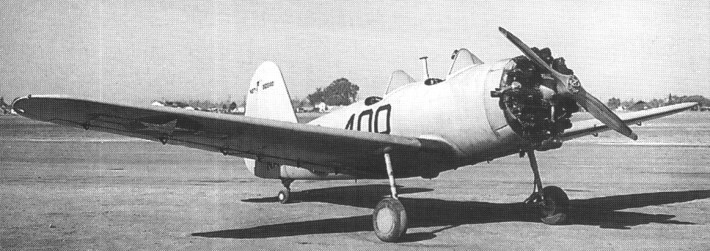
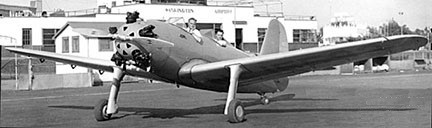
Under the trade name Aeromold, the Timm Aircraft Corporation developed a special form of construction using bonded plywood. To validate the new structural medium and ultimately to provide a commercial outlet, the company produced its private-venture S-160 / PT-160K (747) cantilever low-wing trainer with tandem accommodation in open cockpits and fixed tailwheel landing gear whose main units looked very spartan with their unfaired tubular metal legs. Designed by Otto Timm the sole S-160, NX15593, had an optional cockpit canopy.

Timm S-160 NX15593

Don Mitchell went to the new Timm Aircraft factory in Van Nuys, where he helped with the molding of the fuselage of the S-160, a plastic-bonded wood basic trainer developed for use by the U.S. Navy and U.S. Army Air Corps. Mitchell later assisted the Civil Aeronautics Administration when the time came to perform the static tests of the aircraft. It passed with flying colours and later became, in April 1941, one of the first if not the very first ever plastic-bonded aircraft to receive an American Approved Type Certificate.

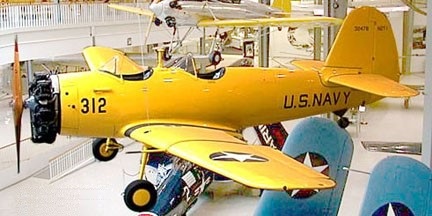
This prototype was developed into the PT-175K (750 2-573) for the civil market, and 262 of a modified variant with the Continental R-670 radial engine were ordered by the US Navy with the designation N2T-1, the aircraft being delivered in three batches during the course of 1943. The one prototype was NX15593 and 262 to the USN as N2T-1 were 41-05875 & 41-05876, 41-32387-32636, and 41-39182-39191.

Timm N2T-1 32478

The USAAF operated them as PT-220.

S-160 / PT-160K
Engine: Kinner R-5, 160hp
Wingspan: 35’0″
Length: 26’4″
Useful load: 614 lb
Max speed: 137 mph
Cruise speed: 125 mph
Stall: 42 mph
Range: 450 mi
Seats: 2

PT-175K
Engine: Kinner R-5, 175hp
Length: 25’6″
Useful load 700 lb
Max speed: 140 mph
Cruise speed: 126 mph
Stall: 50 mph
Range: 520 mi
Seats: 2

N2T Tutor
two-seat primary trainer
Powerplant: l x Continental R-670-4, 164kW (220 hp)
Span: 10.97m (36ft)
Length: 7.57m (25ft 10 in)
Max TO weight: 1236 kg (2,725 lb)
Useful load: 680 lb
Max speed: 144 mph at sea level
Cruise speed: 120 mph
Stall: 50 mph
Range: 350 mi
Seats: 2
Armament: none

Timm Aircraft Corp

Several experimental planes were produced during 1911-20, but data are lacking. Company logo proclaims 1911 as starting year.

Formed at Van Nuys, California, USA, circa 1922 as the O W (Otto William) Timm Aircraft Corp,
901 N San Fernando Rd, Glendale CA.

c.: 1928: Timm Airplane Co.

Was inactive in aircraft manufacture for several years, but in late 1930s produced prototype T-840 twin-engined six-seat transport.

1935: Timm Aircraft Co.

1937: Acquired Kinner Aircraft

1939: Metropolitan Airport, Van Nuys CA.

It developed a plastic-bonded plywood Aeromold, applying this first to the S-160-K two-seat primary trainer of 1940, which was built in Second World War as N2T-1 trainer for U.S. Navy.

Timm also built 434 Waco CG-4A cargo gliders, and did wartime subcontract work for Harlow, Lockheed, Vultee and other companies.

1941: Sold to Aetna Aircraft Corp, Los Angeles.

Charles Lindbergh’s first airplane ride was with barnstormer Timm.

Thorp Aircraft Co

1940: (Rudy Paulic and John W) Thorp Aircraft Corp,
Oakland CA.
USA

In 1949 became Thorp Aircraft Co at Pacoima, California by John W. Thorp to develop his Sky Skooter two-seat light aircraft, first flown August 1946, itself developed from Lockheed Little Dipper.

1956: Thorp Engr Co,
Burbank CA.
USA

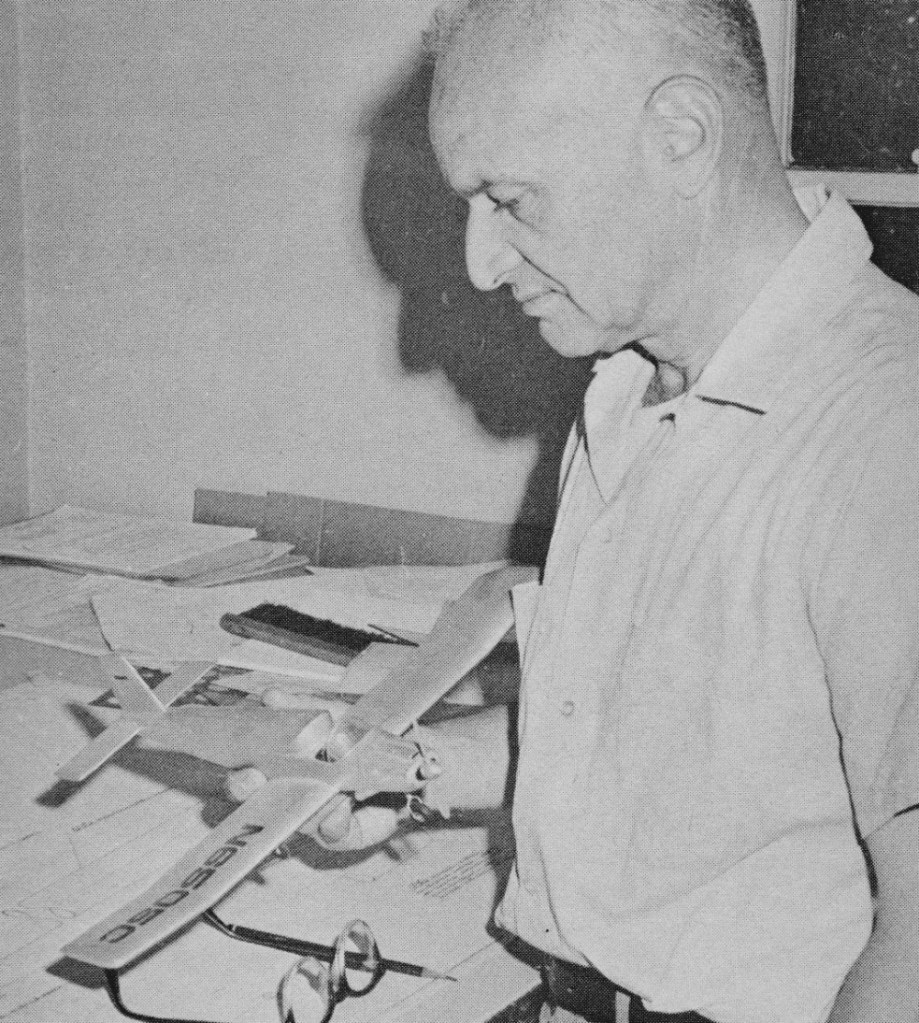
John Thorp with model of Fletcher Fu-24

Built three of T-111 model; introduced T-211 in 1953, production of which undertaken by Tubular Aircraft Products Company. Thorp Engineering markets plans for T-18 Tiger homebuilt.

c.1980: Lockeford CA.
USA

1985: Thorp 211 Aircraft Co.

1990: Thorp Aero Inc (foreign marketing only), KY.

THK THK-2 / MKEK 2

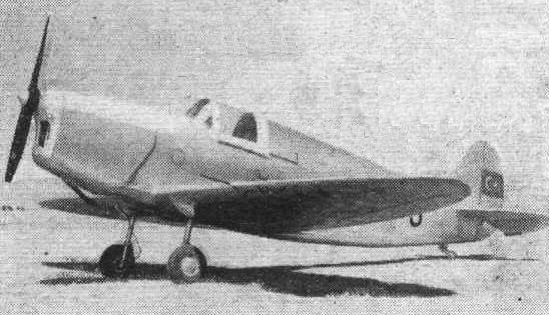
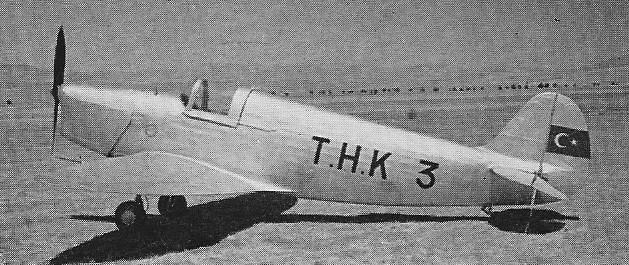
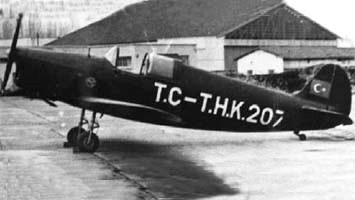
In 1936, Turkey bought 36 Polish R.24E fighter, simultaneously launching construction of an aircraft factory in Etimesgut near Ankara. The director of the factory became a Pole Jeri Vedrichovsky. The first aircraft built with the help of Polish engineers was the TNK-2 training monoplane. Stanislav Rogalsky, Jeri Telsiye and Leszek Duleba took part in its development. The design team took the RWD-10 as a basis, with several modifications. Preserving the same wooden construction of the Polish prototype. The single cockpit made completely closed. The English DH “Gipsy Major” motor, was also installed on Miles M.14 training aircraft built under licence.

The design and construction of the aircraft took place in 1943-1944 at the Turkish Aviation League (Turk Hava Kurumu).

Designed for aerobatic training, the first prototype of the TNK-2 was airborne in mid-1944. The second prototype took to the air in 1945, showing better performance than the first and the British Miles M.14.

Serial production amounted to only four aircraft that served in the Turkish Air Force until the mid-1950s. In 1952, after changing the name of the company, these aircraft were renamed MKEK-2.

Engine: de Havilland Gipsy Major, 135hp
Wingspan: 8.00m / 26 ft 2 in
Wing area: 10.20sq.m
Length: 7.00m / 23 ft
Height: 2.10m / 7 ft 1 in
Empty weight: 490kg / 1078 lb
Normal takeoff weight: 660kg / 1452 lb
Maximum speed: 265km / h / 164 mph
Cruising speed: 235km / h / 136 mph
Landing speed: 59 mph
Initial ROC: 1710 fpm
Practical range: 700km / 435 mi
Service ceiling: 6000m / 19,685 ft
Crew: 1