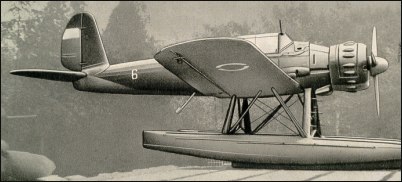
Arado Ar.196

A development of the Ar.95, the Ar 196 was designed to replace the Heinkel He 60 floatplane aboard the warships as a shipboard catapult-launched reconnaissance floatplane (with a secondary role as a coastal patrol platform). Arado submitted their design consisting of a two-seat monoplane with all-metal skin and after an evaluation period, the Arado design was selected with development beginning in 1937.

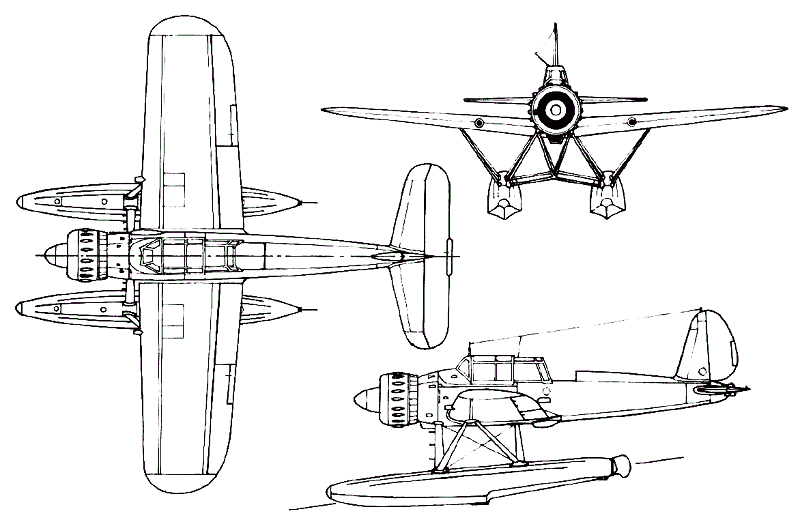
The first prototype flew in 1938. The development, which produced four prototypes, tested two arrangements of floats. One prototype was fitted with a centerline float and two outboard floats whilst the remaining three utilized the more traditional twin pontoon floats each situated under their respective wing.

Following a number of pre-production aircraft, production proper began with twenty Ar.196A-1, which were delivered from mid-1939. Production continued with A-2 to A-5 versions and a few modified single-float Ar.196B.

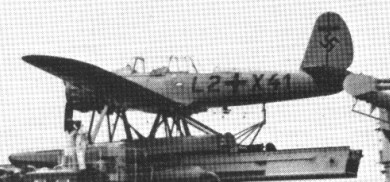
The Ar 196 was constructed as two production series separated by classification role. The “shipboard” Ar 196 series was designed for catapulting from German warships. This series was comprised of the A-1 and A-4 models. The “coastal” Ar 196 variant operations involved taking off and returning to their respective port areas. This production series comprised of the A-2 and A-3 models. An A-5 model was later offered that featured improved radio equipment and twin 7.92mm machine guns for the radio operator in the rear cockpit. Basic armament consisted of varying quantities of 20mm cannons and 7.92mm machine guns. The Ar 196 could field two 110lb bombs in the strike role.
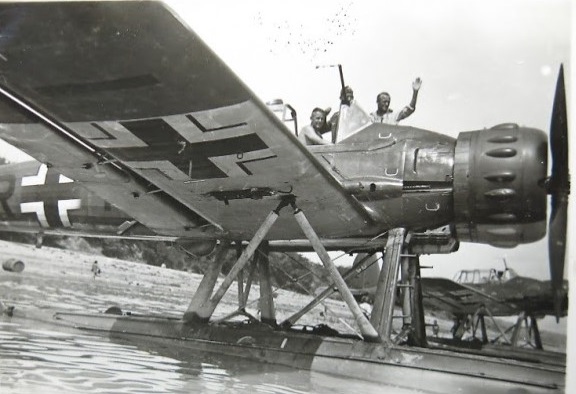
Ar.196 seaplanes were operational with the German Navy in reconnaissance, patrol and anti-submarine roles throughout World War II and were for many years the standard catapult sea-plane of the Navy, up to four being carried on board some battleships. The aircraft was eventually deployed on German warships that included the Deutschland, the Admiral Scheer, the Admiral Hipper and the Leipzig. This floatplane was in use with Bulgaria and Romania.

About 435 were built.

Gallery

Ar 196A fication
Engine: 1 x BMW 132K, 705kW
Take-off weight: 3600 kg / 7937 lb
Empty weight: 1265 kg / 2789 lb
Wingspan: 12.4 m / 40 ft 8 in
Length: 11.0 m / 36 ft 1 in
Height: 4.5 m / 14 ft 9 in
Wing area: 28.3 sq.m / 304.62 sq ft
Max. speed: 315 km/h / 196 mph
Cruise speed: 268 km/h / 167 mph
Ceiling: 6600 m / 21650 ft
Range w/max.fuel: 1080 km / 671 miles
Range w/max.payload: 820 km / 510 miles
Crew: 2
Armament: 2-3 machine-guns, cannon, 100kg of bombs
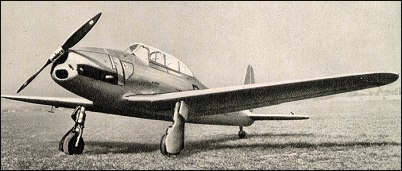
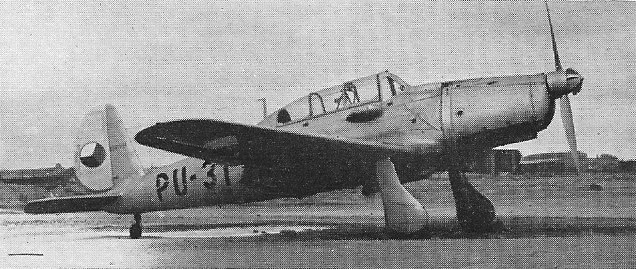
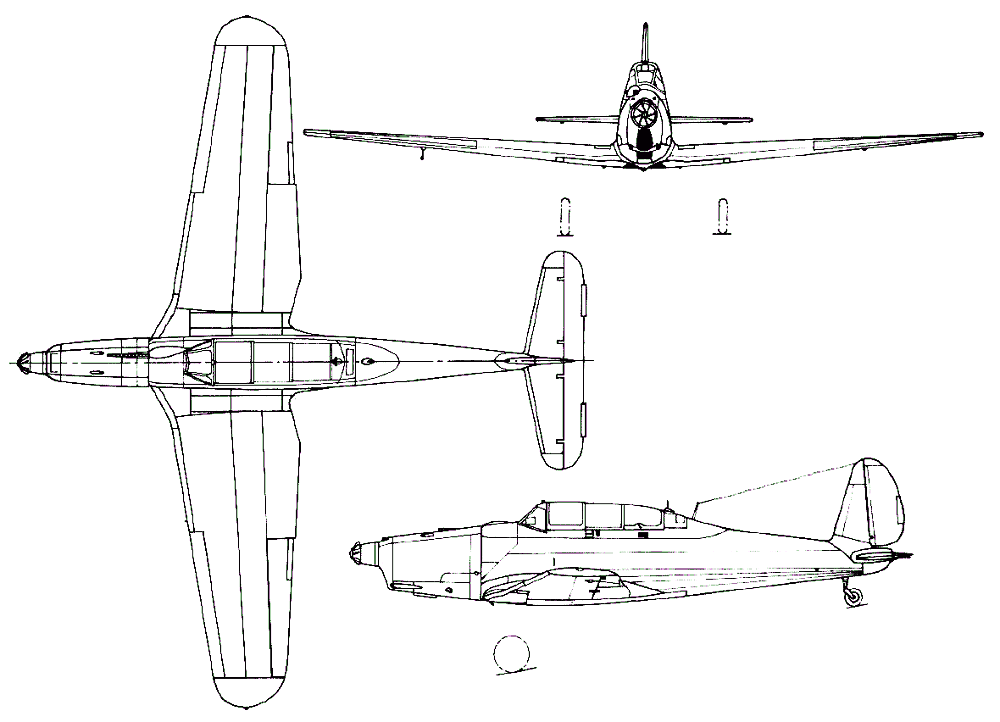
Arado Ar.96 / Avia C.2 / Letov C.2

A 1936 tandem two-seat monoplane trainer with retractable landing gear. Powered by one 335kW Argus As.410A engine on Ar.96B production aircraft built from 1940 (prototype had one 179kW Argus As.10C). The Ar.199 was a development of the design.

During the war years, production was transferred to Letov and Avia in Czechoslovakia where manufacturing continued until the end of 1948 as C.2B-1. Letov built the Arado Ar-96B trainer as the C-2A (back designation for wartime production Ar-96 for Luftwaffe), and C-2B (Arado Ar-96B produced for Czech Air Force).

Avia C.2-1

The C.2B-1 was a standard basic trainer in the Czechoslovak Air Force and National Security Guard.

Engine: 1 x As 410A, 340kW
Wingspan: 11.0 m / 36 ft 1 in
Length: 9.1 m / 29 ft 10 in
Height: 2.6 m / 8 ft 6 in
Wing area: 17.1 sq.m / 184.06 sq ft
Take-off weight: 1750 kg / 3858 lb
Empty weight: 530 kg / 1168 lb
Max. speed: 330 km/h / 205 mph
Cruise speed: 275 km/h / 171 mph
Ceiling: 7000 m / 22950 ft
Range w/max.fuel: 990 km / 615 miles
Crew: 2
Armament: 1-2 machine-guns

Ar 96B / Avia C.2B-1
Engine: Argus As 410A, 465 hp
Wingspan: 35 ft 11.5 in
Wing area: 186.22 sq.ft
Length: 29 ft 11.25 in
Height: 8 ft 6 in
Empty weight: 2854 lb
Loaded weight: 3747 lb
Max speed: 219 mph
Cruise: 175 mph
Range: 428 mi

Arado Flugzeugwerke Gmbh / Arado Handelsgesellschaft mbH

Arado originated in early 1917 with the creation of Werfte Warnemiinde der
Flugzeugbaus Friedrichshafen as a subsidiary of Flugzeugbau Friedrichshafen
GmbH. Aircraft work ceased in 1918, but the factory was acquired in 1921 by
Hugo Stinnes, and was briefly engaged in shipbuilding. In 1924 Walter Rethel
(formerly with Kondor and Fokker) joined as designer, and Stinnes created a
Yugoslav subsidiary named
Ikarus.

Arado Handelsgesellschaft mbH was established in 1925, and the SI trainer biplane was
flown that year, followed by other trainers, SD II and III fighters, and civil
aircraft, notably VI of 1928 (high-wing transport) and LII light cabin
monoplane. Walter Blume (formerly with Albatros) was appointed chief engineer
1932, and the name Arado Flugzeugwerke was adopted March 4, 1933.


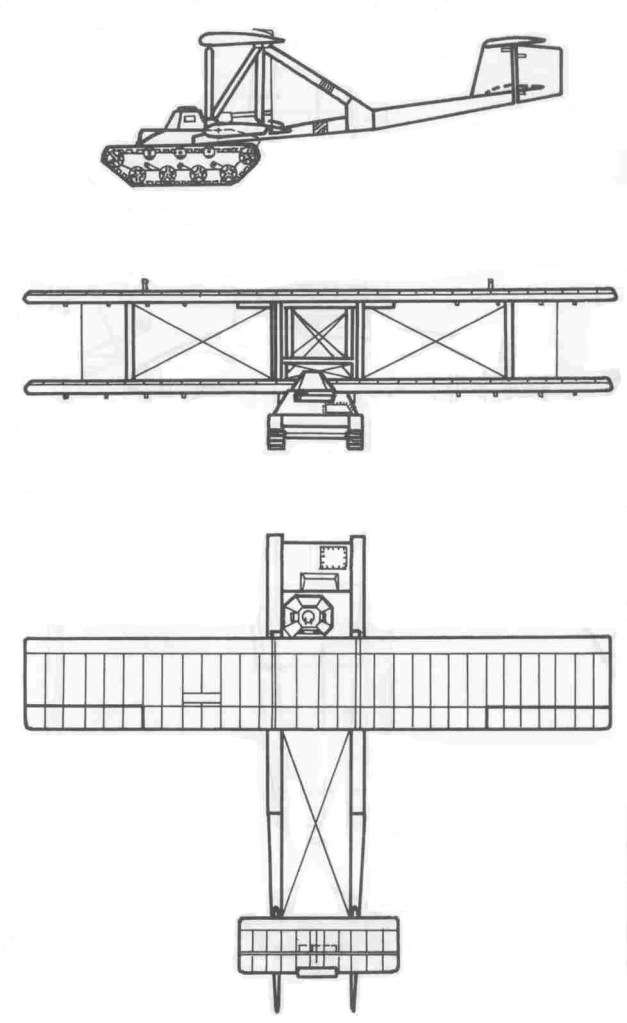
Antonov A-40 Krylya Tanka / KT  

During the 1940 occupation of Bessarabia, light tanks may have been dropped from a few meters up by TB-3 bombers, which as long as the gearbox was in neutral, would allow them to roll to a stop.

The biggest problem with air-dropping vehicles is that their crews drop separately, and may be delayed or prevented from bringing them into action. Gliders allow crews to arrive at the drop zone along with their vehicles. They also minimize exposure of the valuable towing aircraft, which need not appear over the battlefield. So the Soviet Air Force ordered Oleg Antonov to design a glider for landing tanks.

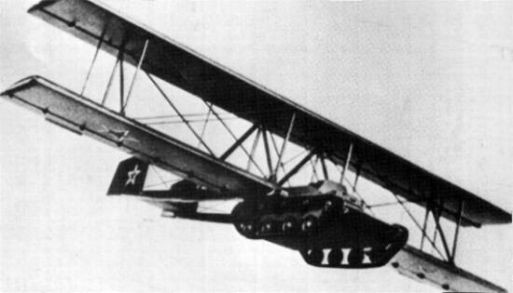
Instead of building a glider, he added a detachable cradle to a T-60 light tank bearing large wood and fabric biplane wings and a twin tail, the Antonov A-40 Krylya Tanka (Russian: крылья танка, meaning “tank wings”). Such a tank could glide into the battlefield, drop its wings, and be ready to fight within minutes.

One T-60 was converted into a glider in 1942, intended to be towed by a Petlyakov Pe-8 or a Tupolev TB-3. The tank was lightened for air use by removing its armament, ammunition and headlights, and leaving a very limited amount of fuel. Even with the modifications, the TB-3 bomber had to ditch the glider during its only flight, on September 2, 1942, to avoid crashing, due to the T-60’s extreme drag (although the tank reportedly glided smoothly). The A-40 was piloted by the famous Soviet experimental glider pilot Sergei Anokhin. The T-60 landed in a field near the airdrome, and after dropping the glider wings and tail, the driver returned it to its base.

Due to the lack of a sufficiently-powerful aircraft to tow it at the required 160 km/h (99 mph), the project was abandoned.

Crew: Two
Capacity: 1 × T-60 tank
Length: 12.06 m (39 ft 6¾ in)
Wingspan: 18.00 m (59 ft 0¾ in)
Wing area: 85.8 m2 (923.5 ft2)
Empty weight: 2,004 kg (4,418 lb)
Gross weight: 7,804 kg (17,205 lb)

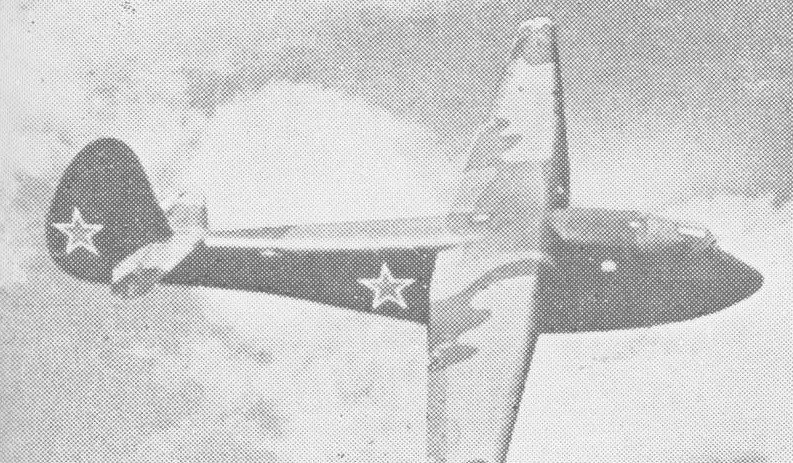
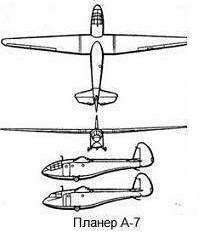
Antonov A-7

The Antonov A-7 won a design competition held in December 1940 for a “partisan transport glider.

In September 1941 the Germans were approaching Voronezh, but even under these circumstances the aviation factory continued to deliver Il-2 assault aircraft to the front. At the beginning of September 1941, the decision was made to evacuate Factory No. 18 and OKB-31 led by Moscaliov.

The new production base was established in the Siberian village of Zavodoukovsk, located in the Tyumen Oblast, where a new factory was organized that was numbered 499. AS Moscaliov was selected as director and main constructor.

Some time later the factory began to deliver the Antonov A-7 7-seater landing glider productions and a little later the A-2 training gliders, from the same manufacturer.

Some 400 were built.

Wingspan: 62 ft 3 in
Length: 37 ft 9 in

Antonov A-2

Other Antonov designs were the A-1 single-seat elementary training glider, the A-2, a modernised version of the US-5 two-seat training glider, and the A-9 and A-10 single and two-seat high-performance sailplanes.

In September 1941 the Germans were approaching Voronezh, but even under these circumstances the aviation factory continued to deliver Il-2 assault aircraft to the front. At the beginning of September 1941, the decision was made to evacuate Factory No. 18 and OKB-31 led by Moscaliov.

The new production base was established in the Siberian village of Zavodoukovsk, located in the Tyumen Oblast, where a new factory was organized that was numbered 499. AS Moscaliov was selected as director and main constructor.

Some time later the factory began to deliver the Antonov A-7 7-seater landing glider productions and a little later the A-2 training gliders, from the same manufacturer.

ANT / Central Aero-Hydrodynamic Institute / TsAGI

USSR, Moscow.
Founded by Bolshevik government December 1,1918 under Prof N. E. Zhukovskii; based on Moscow Technical University’s pre-Revolution research organization. Departments for study of propellers, aero engines, aeronautical construction materials, flight testing, etc. Separate flight test center for Soviet Air Force established 1920; alternative centers for aero engines 1930 and materials 1932. Zhukovskii died 1921; succeeded by S. A. Chaplygin (1921-1941), N. I. Kharlamov, M. N. Shulzhenko and (since early 1960s) V. M. Myasischchev.

In 1924, Pavel Sukhoi joined the Central Aero and Hydrodynamic Institute, or TsAGI, eventually becoming a bureau design leader under Andrei N. Tupolev.

The creation of the BOK practically coincided with the restructuring of the experimental building in the USSR. The 27 of August of 1931 the TsKB and TsAGI were merged into one organization which was named TsKB-TsAGI and controlled directly by the OGPU. ES Paufler was appointed by the control structure and SV Ilyushin as technical director.

After collaborating in the design of the ANT 25, Sukhoi was responsible for the design, in 1932, of one of the world’s first single seat low wing cantilever monoplane fighters to embody such innovations as a. fully enclosed cockpit and a retractable undercarriage. This aircraft, the ANT 31, or 1 14, flew in October 1933, and series production of an improved version, the 1 14bis which first flew on February 14, 1934, was, in fact, ordered but cancelled two years later when it was found impossible to eradicate some of the fighter’s shortcomings.

New facility built 1931 at Stakhanov, Moscow; continued until 1939. Most aircraft designs before Second World War carried ANT designations, other designers also employed, some eventually heading their own bureaus, e.g. Petlyakov and Sukhoi.

Aircraft with TsAGI designations included Komta twin-engined 10-passenger triplane of 1922; 1- EA to 5-EA and A-4 to A-15 series of helicopters and autogyros from various designers between 1928-1940; and TsAGI-44 (MTB-2) four-engined flying-boat bomber, redesignated from ANT-44 after arrest of Tupolev in 1936.
After Second World War TsAGI became purely research center and moved to new premises at Zhukovskaya, near Ramenskoye. New facilities since provided for new Hydrodynamic Institute at Novosibirsk.

Ansaldo A1 Balilla

Ansaldo achieved aeronautical eminence in 1917 by providing a single-seat fighter of original Italian design (Italy having previously used French types). The aircraft was the A-1 Balilla (“Hunter”). About 150 built; others, license-built in Poland, served well into 1920s.

The Ansaldo A 1 Balilla was a basic biplane fighter design with a four-blade propeller and a 220 horsepower SPA 6A water-cooled in-line engine. A single pilot saw behind the biplane wing. Armament consisted of two 7.62mm British Vickers machine guns mounted forward of the cockpit seating area in a forward-firing fixed position. Endurance amounted to 1 hour and 30 minutes.

The A 1 appeared in the final stages of the First World War, limiting its use to post-war defence of Italy. Some models found their way into American hands and were converted to air racers fitted with a Curtiss powerplant. Still others would see combat at the hands of Russian and Polish flyers in the Russo-Polish war in 1920.

Ansaldo A 1 Balilla (Hunter)
Engine: SAP 6A water-cooled in-line, 220 hp
Length: 22.441 ft / 6.84 m
Height: 8.301 ft / 2.53 m
Wingspan: 25.197 ft / 7.68 m
Wing area: 228.197 sqft / 21.2 sq.m
Max take off weight: 1951.4 lb / 885.0 kg
Weight empty: 1378.1 lb / 625.0 kg
Max. speed: 119 kts / 220 km/h / 119kt
Service ceiling: 16404 ft / 5000 m
Wing load: 8.61 lbs/sq.ft / 42.00 kg/sq.m
Range: 324 nm / 600 km
Crew: 1
Armament: 2 x 7.62mm Vickers machine guns

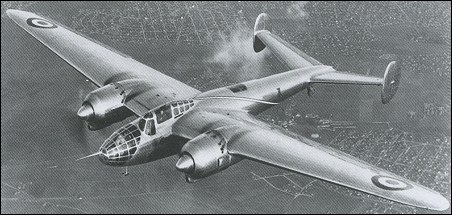
Amiot 350 / 351 / 354       

Amoit 351

Developed from the Amiot 370 and the Amiot 340, converted to the Amiot 351.01 Gnome-Rhone 14N -20/21 761-kW (1,020-hp) engined prototype bomber, it was followed by production Amiot 351s and 354s. Each version had a streamlined all-metal fuselage, a tapered mid-wing with considerable dihedral and twin Gnome-Rhone 14N radial engines. They differed by the 351 having twin oval fins and rudders and the 354 a large single vertical tailplane. The Amiot 351 had shorter span and greater length than the Amiot 351.01, and was powered by two 708-kW (950-hp) 14N-38/39 radials, while the Amiot 354 was higher powered and reverted to the original tail unit.

Amiot 350 / 351 / 354 Article

Armament was a 20 mm HS 404 cannon on a flexible mounting at the rear of the crew canopy plus single 7.5 mm MAC machine-guns in nose and ventral positions. The bomb load was up to 1,200kg.
Eighty-six Amiot 350 series aircraft had been completed including 17 351s and 45 354s, before the Germans occupied the Le Bourget factory in June 1940.

After a number of bombing and reconnaissance missions, the Amiots were converted by the Vichy French for long-range liaison flights.

Amiot 354
Engines: 2 x Gnome-Rhone 14N-48/49, 790kW (1,060 hp)
Span: 22.83m (74ft 10.75 in)
Length: 14.5m (47ft 6.75 in)
Height: 13.39ft / 4.08m
Empty Weight: 10,417lbs (4,725kg)
Max T/O weight: 11300 kg (24,912 lb)
Max speed: 298 mph (480kmh; 259kts) at 13,125 ft
Operational range: 1,553 miles with max bombload.
Maximum Range: 2,175miles (3,500km)
Service Ceiling: 32,808ft (10,000m)
Crew: 4
Armament: 1 x 20-mm HispanoSuiza cannon and 2 x 7.5-mm (0.295-in) MAC mg plus
Internal bombload: 1200 kg (2,646 lb)

Amoit 354