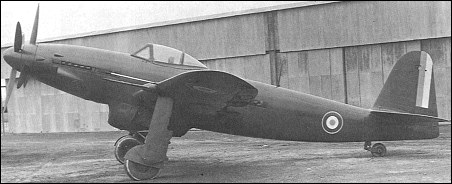
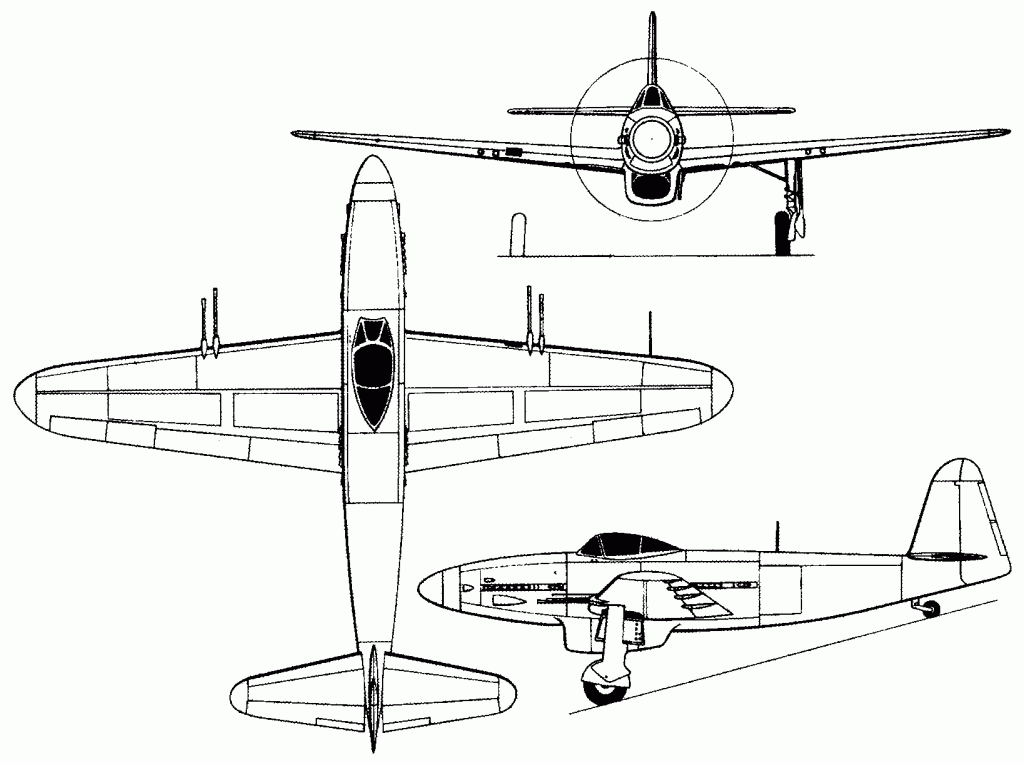
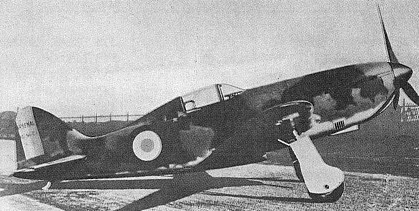
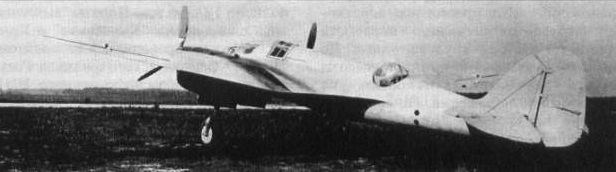
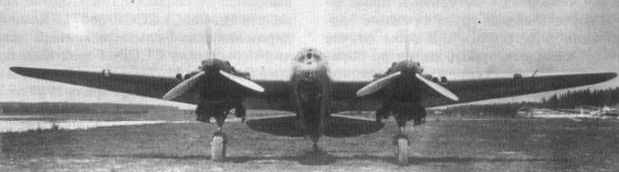
Designed by Ingenieur-General Vernisse and M Badie, the VB 10 was an all-metal single-seat fighter powered by engines mounted in tandem fore and aft of the pilot’s cockpit and driving contra-rotating co-axial propellers. Thirty VG 10s were ordered off the drawing board in May 1940, and work continued under the Vichy government. The first prototype with two 860hp Hispano- Suiza 12Y31 12-cylinder liquid-cooled engines was flown on 7 July 1945. The second prototype with 1150hp HS 12Z12/13 engines and an armament of four 20mm Hispano-Suiza cannon and six 12.7mm Browning machine guns flew on 21 September 1946. A contract for 200 aircraft had been placed on 22 December 1945 (this later being cut back to 50 aircraft), and the first production VB 10 flew on 3 November 1947 with 1150hp HS 12Z Ars 15/16 engines and an armament of four 20mm cannon. Production was cancelled on 21 September 1948 after completion and testing of four series aircraft.
VB 10 Take-off weight: 8860 kg / 19533 lb Empty weight: 6230 kg / 13735 lb Wingspan: 15.49 m / 50 ft 10 in Length: 12.98 m / 42 ft 7 in Height: 5.20 m / 17 ft 1 in Wing area: 35.50 sq.m / 382.12 sq ft Max. speed: 700 km/h / 435 mph Range: 1700 km / 1056 miles
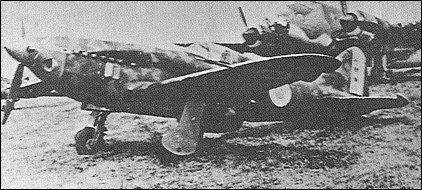
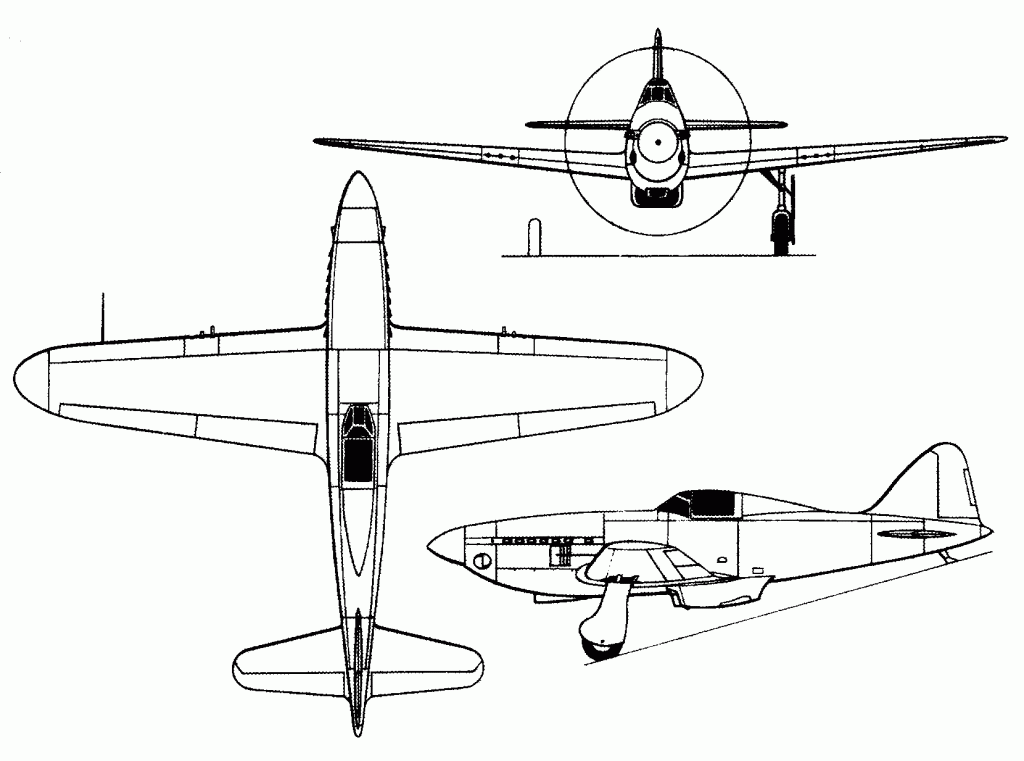
The VG 39 development in the VG 30 series of fighters commenced its flight test programme on 3 May 1940. The prototype differed from the VG 33 mainly by having a 1200hp Hispano-Suiza Type 89ter 12-cylinder liquid-cooled engine with an elongated propeller shaft, a revised wing structure, and a wing-mounted armament of six 7.5mm MAC 1934 M39 machine guns. During flight testing the prototype VG 39 attained a maximum speed of 625km/h at an altitude of 5750m. The planned production model, the VG 39bis, was to have embodied a fuselage similar to that of the VG 36 and to have supplemented the wing armament with a 20mm engine-mounted cannon, the definitive model having a 1600hp Hispano-Suiza 12Z engine.
VG 39 Wingspan: 10.80 m / 35 ft 5 in Length: 8.75 m / 28 ft 8 in Wing area: 14.00 sq.m / 150.69 sq ft Max. speed: 625 km/h / 388 mph
Developments of the VG 33 under test in 1940 included the VG 34, flown on 20 January 1940 with a 910hp Hispano-Suiza 12Y45 engine, and the VG 35 with a 1000hp Hispano-Suiza 12Y51 which flew on 25 February 1940. The VG.35 attained a maximum speed of 575km/h at 6200m during tests, and the airframes and armament of both the VG 34 and VG 35 were identical to those of the VG 33. The VG 36 flown on 14 May 1940, had the 1000hp HS12Y51 of the VG 35, but included some redesign of the rear fuselage with a shallower, wider faired radiator bath. Armament of the VG 36 comprised one 20mm HS 404 cannon and four 7.5mm MAC 1934 M39 machine guns.
VG 36 Wingspan: 10.80 m / 35 ft 5 in Length: 8.10 m / 26 ft 7 in Height: 3.31 m / 10 ft 10 in Wing area: 14.00 sq.m / 150.69 sq ft Max. speed: 590 km/h / 367 mph Ceiling: 7000 m / 22950 ft Range: 1100 km / 684 miles
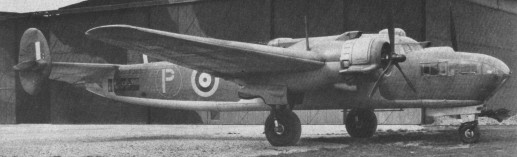
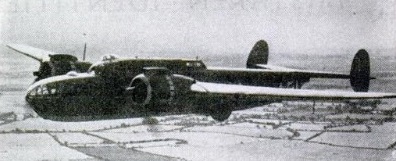
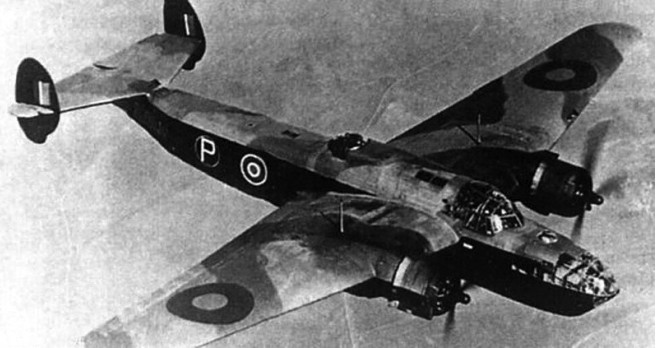
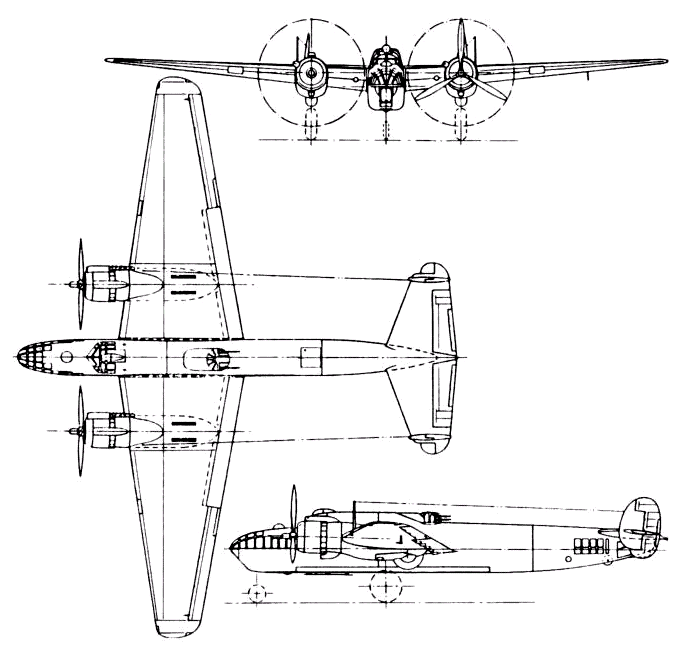
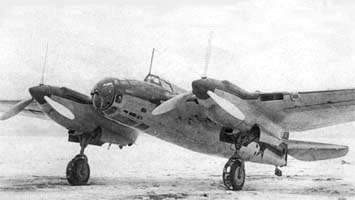
With a possible shortage of light alloys Air Ministry Specification B.9/38 for a twin engined medium bomber, was issued. This required that the aircraft was to be of simple construction, using materials other than light alloy wherever possible. AWA’s chief designer, John Lloyd, and his team were able to submit the initial proposals for their project, the AW.41, to the Air Ministry in February 1938. These initial proposals were for a mid wing monoplane of 61ft 8in span powered by two Rolls Royce Merlin engines and capable of carrying the normal bomb load of 1,500 lb for a range of 1,500 miles cruising at 320 mph at 20,000ft. The sole defensive armament consisted of a four gun power operated turret in the tail. From the outset the AW.41 was to have a retractable tricycle undercarriage. The construction of the airframe was to have been almost exclusively of wood and steel. The project was changed to meet Specifica¬tion B.18/38 for a twin engined reconnaissance bomber. The design study to meet B.18/38, although using the same type of construction, was very different to the original concept. The wing span was increased to 67ft and the Rolls Royce Merlins were replaced by Bristol Hercules XI radial engines driving three bladed de Havilland constant speed hydromatic airscrews.
On August 18, 1938, Contract 816726/38 was placed with AWA for the manu¬facture of two prototypes. Construction of the two prototypes was transferred to AWA’s factory at Hamble, and it was provisionally planned that the ensuing production would he undertaken at the new “shadow” factory being built at Yeadon, near Leeds. The plan for Yeadon was abandoned and in November 1939, production contract No B40671/39 for 198 aircraft was placed with Gloster Aircraft at Brockworth. A second contract, No B53250/39 for a further 800 aircraft, was placed with Gloster on January 30, 1940. Shortly after this the Hawker Siddeley Group formed a new com¬pany at Brockworth, A. W. Hawkesley Ltd, to be responsible for the assembly of the AW.41, which by then had been named the Albemarle.
The first prototype, P1360, com¬menced taxiing trials at Hamble on March 18, 1940, and AWA’s chief test pilot, F1t Lt C. K. Turner Hughes, continued the trials of P1360 on March 20, when, after satisfactorily completing the taxiing tests, he carried out a series of straights before taking P1360 off on its maiden flight.
Retraction of the undercarriage was carried out for the first time during the second flight on April 5. The company’s flight trials showed take off performance to be unsatisfactory and in July and August 1940, P1360 was grounded while the wings were modified, increasing the span by 10ft to 77ft. In September an A&AEE crew from Boscombe Down started the official performance and handling trials. During a flight on September 30 the pilot became lost and was compelled to make a forced landing in a small field. This was successfully accomplished with only minor damage to the air¬craft. October was to see further modifica¬tions to P1360, when the areas of the fins and rudders were increased. On November 16 the machine was delivered to the A&AEE at Boscombe Down for continuation of its official trials. It was during a flight from Boscombe Down on February 4, 1941, that a portion of plywood upper skin broke away from the port mainplane. The noise and effect of this led the pilot to believe that the aircraft was having engine trouble, so he immediately shut down the port engine. As a result the aircraft broke away into a spin from which the pilot was unable to recover. He ordered his two observers to abandon the aircraft, and the first cleared the aircraft safely, but the “D” ring of the other’s parachute caught in the fuselage, the observer finding that he was suspended by his harness from the fuselage. The parachute released and developed over the tailplane, acting in an anti spin role and enabling the pilot to regain control. Unaware of the drama being enacted behind him, the pilot found that he could control the aircraft if he did not allow the speed to fall below 30 or 40kt above stalling speed. With this knowledge the pilot decided to make a wheels up landing, still unaware that his observer was suspended below the fuselage. Just prior to landing, and when he was some 6 to 8ft above the ground, the observer released himself and fell to the ground. Although seriously injured, he survived, the pilot completed his wheels up landing with only minor injuries to himself, although the aircraft was totally destroyed in the ensuing fire. The second prototype, P1361, first flew on April 20, 1941, continued the flight test programme. This machine also had the 77ft span wing, and was the only Albemarle to be fitted with the ventral power operated turret. Production problems were caused by over 1,000 sub-contractors who lacked aircraft experi¬ence but were to manufacture all the details and sub assemblies required for the Albemarles. The technical problems with the prototype, particularly the increased wing span, required many of the jigs to be rebuilt. Only two Albemarles, the prototypes, had flown by June 1941, the first 200 were not completed until March 1943, and production ceased with the completion of the 602nd Albemarle in March 1945. Although contracts were placed for 1,000 Albemarles, this quantity was reduced to 602, including the two prototypes, in June 1943, when it was decided that the facilities at Brockworth were required for Meteor production. In 1941 the Albemarle programme was investigated by a Select Com¬mittee on National Expenditure, chaired by Sir John Wardlow Milne. The Committee issued its report on August 20, 1941, and it concluded that the Albemarle was not value for money, calling for immediate and urgent reconsideration of the programme.” It is interesting to note that an Albemarle airframe, less engines and equipment, cost £24,950, compared with £19,159 for a Lancaster. The Prime Minister, Winston Churchill, was concerned about the Committee’s findings, and on August 26, 1941, asked the Secretary of State for Air to provide him with the current views and intentions of the departments involved with the Albemarle. Explanations from the Air Staff and the Ministry of Aircraft Production, defending the Albernarle and their decisions made in regard to it, did not appear to satisfy Churchill, and it apparently took a letter from Lord Beaverbrook on October 12 to finally reassure him. In his letter, Beaverbrook advised that the Alhemarle would be useful for short-range work, and would supplement the Wellingtons in attacks on invasion ports, for bombing in France and for bombing in the event of an invasion. He also explained that the tooling was practically complete at a cost of over £1,500,000, and that more than 75 per cent of the raw materials had been delivered and 50 per cent of the details manufactured. Deliveries of production aircraft from Brockworth commenced in September 1941, although it was not until June 1942 that monthly deliveries exceeded double figures, with 14 air¬craft being delivered. The first 32 production aircraft were completed as B.Mk.1’s, but the delays had already rendered the Albemarle obsolete as a bomber, and consequently no further aircraft were completed as such, all subsequent machines being produced as glider tugs or special transports. Projects to cater for any shortage of Hercules engines that may have arisen were the Mk.III with Merlins and the Mk.IV with Wright GR2600 Double Cyclone engines. Cyclones were installed in Mk.I P1406, and a single GTIV, V1760, was completed. The Merlin installation was not proceeded with.
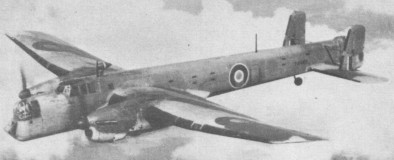
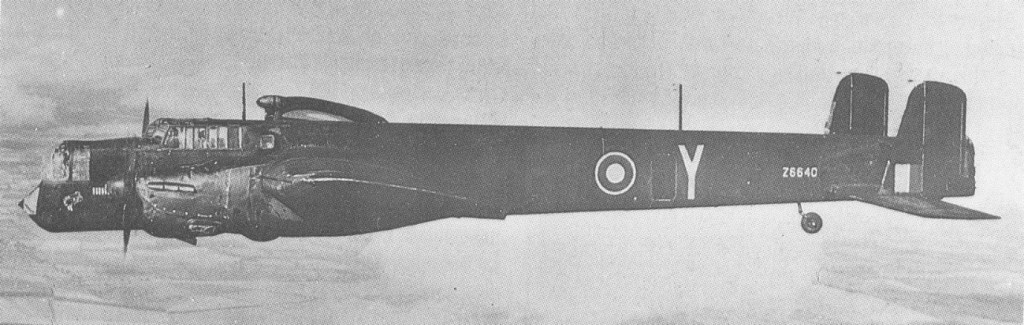
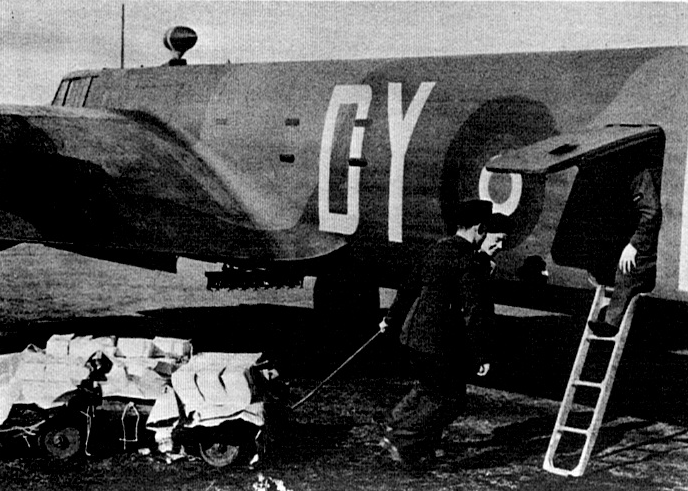
Albemarle I V1599 was experimentally fitted with a long travel undercarriage by AWA during 1943. This was to enable it to fly directly on to the ground without the necessity of a flare out before touch down. Flight testing commenced on November 8, 1943, but it did not prove to be a complete success because the undercarriage oleos failed to compress sufficiently under drag load during flight. 600 Albemarles were produced between 1941 and 1943. It was widely used as a glider tug, although it suffered from overheating through sustained high power at low airspeed. There were many GT (general transport) and ST (special transport) versions, some equipped with four gun dorsal turrets (a few had a two gun belly turret) or twin manually aimed dorsal guns. Most could carry freight, paratroops or special equipment. The first ST.I and GT.I entered RAF service in mid-1942 and early 1943 respectively, and subsequent versions brought the total number of Albemarles built to 600. One batch was supplied to the Soviet Union.
The Albemarle took part in the invasion of Sicily to which they were used to tow support gliders into action. Additionally, the aircraft took part in the D-Day invasion landings of June 1944 (again as glider tugs) and served with airborne elements during the airdrops over Arnhem campaign to end the war before Christmas.
Armstrong Whitworth AW 41 Albemarle Engine: 2 x Bristol Hercules XI, 1568 hp Length: 59 ft 11 in / 18.26 m Height: 15 ft 7 in / 4.75 m Wingspan : 77.00 ft / 23.47 m Wing area : 803.533 sqft / 74.65 sqm Max take off weight : 22603.5 lb / 10251.0 kg Max. speed : 230 kts / 426 km/h Cruising speed : 148 kts / 274 km/h Service ceiling : 17995 ft / 5485 m Wing load : 28.09 lb/sq.ft / 137.00 kg/sq.m Range : 1130 nm / 2092 km Crew : 4 Armament: 2x cal.303 MG Vickers “K” (7,7mm)
Air Ministry Specification B.3/34 called for a bomber that could carry a bomb load of 2000 lbs for 1250 miles at a height of 15,000 feet at a maximum speed of 225 mph. As the RAF’s existing hangar doors were little more than 100 feet wide, putting a firm limit on the aircraft’s wingspan which was only 84 feet but with a wide chord and thick wing section. There were four contenders to build to specification B.3/34 with Armstrong Whitworth becoming the chosen company. The A.W.38 (which was later named Whitley after the airfield and works near Coventry) contained design features that had previously been tested by the company in the A.W.23 transport/bomber. The new light alloy wing construction consisting of a basic torsion box of web corrugated vertically, and spanwise gave it strength aided by an internal bracing of steel struts.
The prototype Whitley, K4856, was first flown on March 17, 1936. With increasing urgency for the RAF to re-equip and after an original order for 80 aircraft, a second order for 240 Whitleys was signed on 13 May 1936, two months after the prototype’s first flight.
The second prototype and 34 Mk I production aircraft which followed were all powered by two 592.5kW Armstrong Siddeley Tiger IX radial engines. The first production Whitley, K7183, was delivered in the early months of 1937, with the second aircraft, K7184, being flown direct on March 9 from Baginton to No 10 Squadron, which was then equipped with Handley Page Heyfords.
The original design had no wing flaps but later flaps – with a maximum deflection of 60o – were incorporated. With a wing area of over 1,200 square feet and a high angle of attack, the type had superb lift, but the original power plants – 795 hp Armstrong Siddeley Tiger IX air cooled radials – left the early Marks of Whitley under-powered. Half way through the first production batch, after 34 aircraft had been completed, the Whitley 1 was superseded by the Mk II version in which the 795 hp Armstrong Siddeley Tiger IX engines were replaced by 845 hp Tiger VIII engines incorporating a two speed supercharger.
The Mk III would appear shortly after the initial batch, introducing a Nash & Thompson ventral gun position that was retractable.
The need for still more performance and greater reliability resulted in a decision to adopt 1,745 hp Rolls Royce Merlin Xs for the Mk IV. The first Merlin powered example flew on February 11, 1938. A subvariant of the Mk IV would appear with a newly-configured powered tail turret housing quad 7.7mm machine guns.
The first Mark V came off the line on 28 August 1939 and production of this Mark lasted four years and accounted for 90 percent of the total number of type built; over 2,000 in all.
Whitley V of 78 Sqn, RAF
At the outbreak of the Second World War almost all of the Whitley Is and IIs had been withdrawn from operational status as heavy bombers, although seven squadrons (Nos 10, 51, 58, 77, 78, 97 and 102) were equipped with the Mk IIIs, IVs or Vs.
102 Sqn Whitley leaflet dropping
After the introduction of four engined bombers such as the Halifax, Stirling and Lancaster during 1940 41 Whitleys continued bombing operations over Germany until April 1942 the last raid taking place on April 29 30 to Ostend.
At the end of the war the type was still in service for training and other miscellaneous duties. The Whitley was responsible for the first bombing raid on Germany, in May 1940; the first bombing raid on Italy, in June 1940; and the first paratroop operation over Southern Italy, in February 1941. The last Whitley built, LA951, was retained by the Armstrong Whitworth company on its completion in 1943. It was used for general test and experimental flying, one of its main tasks being to act as a tug for the A.W.52G glider. Four years later, in March 1949, LA951 was withdrawn from service and dismantled.
Whitley Mk I Engines: 2 x Armstrong Siddeley Tiger IX, 795 hp / 592.5kW
Whitley Mk II Engines: 2 x Armstrong Siddeley Tiger VIII, 845 hp
Whitley III Engines: 2 x Armstrong Siddeley Tiger VIII, 920 hp. Max speed: 215 mph Cruise speed: 177 mph Range: 1300 mi
Whitley IV Engines: 2 x Rolls-Royce Merlin, 1030 hp Wingspan: 84 ft 0 in Length: 70 ft 6 in Max speed: 245 mph Cruise: 215 mph Normal range: 1250 mi Max range: 1800 mi
Whitley V Engines: 2 x Rolls-Royce Merlin X, 840kW / 1,145hp Wingspan: 25.6 m / 84 ft 0 in Length: 21.5 m / 72 ft 6 in Height: 4.6 m / 15 ft 1 in Wing area: 114.4 sq.m / 1231.39 sq ft Maximum Take-off weight: 12800 kg / 28219 lb Empty weight: 8770 kg / 19335 lb Wing load : 29.52 lb/sq.ft / 144.0 kg/sq.m Fuel cap: 837 Imp.gal. Max. speed: 357 km/h / 222 mph Cruise speed: 297 km/h / 185 mph Rate-of-Climb: 938ft/min (286m/min) Op. Ceiling: 5360 m / 17600 ft Service ceiling: 26,000 ft / 7,925m Range w/max.fuel: 2600 km / 1616 miles Range w/max.payload: 760 km / 472 miles Armament: 1 x 7.7mm machine gun in nose turret 4 x 7.7mm machine guns in tail turret Bombload: 7,000lb / 3150kg Crew: 4-6
The Deerhound I was a triple-row, 21-cylinder, air-cooled radial engine design with the unusual feature of inline cylinder banks. Unlike earlier Armstrong Siddeley engines the Deerhound featured overhead camshafts to operate its poppet valves, using one camshaft for each row of three cylinders.
Flight testing began in 1938 using an Armstrong Whitworth Whitley II, serial number K7243, during which cooling problems were encountered with the rear row of cylinders. This problem was solved by engineering a ‘reversed-flow’ cooling system with a large air duct at the rear of the cowling taking in air and directing it forward to exit behind the propeller. The project suffered a severe setback when the Whitley crashed on takeoff in March 1940, fatally injuring its crew. The accident was attributed to an incorrect elevator trim setting and was not related to the engines. A single prototype Deerhound III was built and ran, and survived until the late-1970s before being scrapped. Development work on the early engines was cancelled by the Air Ministry on 23 April 1941 (when the company factory was bombed) with running of the Mk III being allowed to continue until 3 October 1941, at which point all records were ordered to be handed over to Rolls-Royce.
A projected increased capacity variant known as the Boarhound was planned but never built, and a related much larger design, the Wolfhound, existed on paper only. The latter engine featuring six banks of four cylinders, would have had a displacement of around 61 litres (3,733 cu in) and a projected takeoff power rating of 2,600–2,800 horsepower (1,900–2,100 kW).
In all 11 engines were built.
Variants:
Deerhound I 1,115 hp (831 kW): four built.
Deerhound II 1,500 hp (1,118 kW), capacity enlarged to 41 L (2,509 cu in) by increasing bore and stroke: six built.
Deerhound III 1,800 hp (1,342 kW), major redesign by Stewart Tresilian: one engine built.
Applications: This engine’s sole aircraft application was in a modified Armstrong Whitworth Whitley which was used as a testbed.
Specifications:
Deerhound I Type: 21-cylinder, 3-row air-cooled radial engine with 7 inline banks Bore: 5.26 in (135 mm) Stroke: 4.95 in (127 mm) Displacement: 2,259.75 cu in (38.19 L) Valvetrain: Overhead camshaft Supercharger: Fully supercharged Fuel type: 87 Octane Avgas Cooling system: Air-cooled Power output: 1,115 hp (831 kW) at 1,500 rpm
The Armstrong Siddeley Cheetah is a seven-cylinder British air-cooled aircraft radial engine of 834 cu in (13.65 lt) capacity first run in 1935 and produced until 1948. Early variants of the Cheetah were initially known as the Lynx Major. The Cheetah was used to power many British trainer aircraft during World War II including the Avro Anson and Airspeed Oxford.
The Cheetah was developed from the earlier Lynx using the increased bore cylinders from the Armstrong Siddeley Panther but the engine retained the stroke of the Lynx. Initially only direct-drive variants were produced with later engines being made available with propeller reduction gear of various ratios. Superchargers were also available for later variants, both geared and directly driven by the crankshaft.
The basic design of the Cheetah remained unchanged from its introduction in 1935 to the last examples built in 1948. It was the first engine of its type to be certified for 1,200 hours of operational time between overhauls, with over 37,200 examples built.
Variants:
Lynx V (Lynx Major) 1930, 230 hp (171 kW).
Cheetah V 1935, 270 hp (201 kW) at 2,100 rpm.
Cheetah VA 1935, 285 hp (212 kW) at 2,425 rpm.
Cheetah VI 1935, 307 hp (229 kW) at 2,425 rpm.
Cheetah VIA 1936, as Mk VI but with Mk IX cylinders.
Cheetah IX 1937, 345 hp (257 kW) at 2,425 rpm.
Cheetah X 1938, 375 hp (280 kW) at 2,300 rpm.
Cheetah XI 345 hp (257 kW) at 2,425 rpm, geared version of Cheetah X.
Cheetah XII Similar to Mk X, adapted for target drone aircraft.
Cheetah XV 420 hp (313 kW) at 2,425 rpm.
Cheetah XVII 1948, 385 hp (287 kW) at 2,425 rpm.
Cheetah XVIII 385 hp (287 kW) at 2,425 rpm, carburettor modified for aerobatics.
Cheetah XIX 355 hp (265 kW) at 2,425 rpm
Cheetah 25 345 hp (257 kW) at 2,425 rpm, Cheetah XV uprated to 475 hp (355 kW) at 2,700 rpm, modified constant-speed unit.
Cheetah 26 385 hp (287 kW).
Cheetah 27 1948, 385 hp (287 kW).
Applications: Airspeed Consul Airspeed Courier Airspeed Envoy Airspeed Oxford Airspeed Queen Wasp Airspeed Viceroy Avro 626 Avro 652 Avro Anson Blackburn Lincock Bristol Bulldog 626 Prefect CASA C-201 Alcotán de Havilland Hawk Moth Edgar Percival Prospector Handley Page H.P.R.2 Hispano HS-42 IAe.22 DL Kingsford Smith PL.7 Koolhoven F.K.51 Marinens Flyvebaatfabrikk M.F.8 Marinens Flyvebaatfabrikk M.F.10 Percival Provost (prototype) VEF JDA-10M
Specifications:
Cheetah IX Type: Seven-cylinder single-row supercharged air-cooled radial engine Bore: 5.25 in (133 mm) Stroke: 5.5 in (140 mm) Displacement: 834 cu in (13.65 L) Length: 52.8 in (1,342 mm) Diameter: 47.6 in (1,210 mm) Dry weight: 637 lb (289 kg) Valvetrain: Two pushrod-actuated valves per cylinder Supercharger: Centrifugal, 5.4:1 reduction Fuel system: Claudel-Hobson carburettor Fuel type: 87 octane rating petrol Cooling system: Air-cooled Reduction gear: No Power output: 338 hp (252 kW) at 2,100 rpm for takeoff
345 hp (257 kW) at 2,425 rpm at 7,875 ft (2,400 m) Specific power: 0.41 hp/cu in (18.83 kW/L) Compression ratio: 6.35:1 Specific fuel consumption: 0.45 lb/hp/hr (271 g/kW/hr) Oil consumption: 0.24–0.45 oz/hp/hr (9–17 g/kW/hr) Power-to-weight ratio: 0.54 hp/lb (0.89 kW/kg)
Between March 11 and 16, 1938, tests were carried out on an experimental version of the SB equipped with an open cockpit for the instructor pilot, located in the position of the navigator’s cockpit.
For this purpose, a series SB was taken from the production batch of Factory 22 and equipped with a second cabin with double control and all the necessary instrumentation for the instructor. First flying in March 1938, this cabin was designed in such a way that it could easily replace the navigator’s cabin directly in the operational units.
After the tests, which were favourable, a small series was developed as the Arjanguelsky USB (Russian: Архангельский УСБ). During 1938, 110 cabins were prepared for instructors, of which 29 were located in new aircraft and the other 81 were delivered to the units for operational conversion.
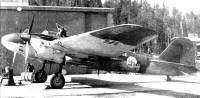
At least one was captured by the Finnish forces during the Winter War, being used by T-LeLv 17 of their Air Force.
USB captured by the Finns and operated by T-LLv 17, summer 1943.
USB Engines: 2 x М-100А, 860 hp Wingspan: 20.33 m Length: 12.57 m Height: 3.48 m Wing area: 256.00 m² Empty weight: 4138 kg Normal takeoff weight: 5738 kg Maximum speed: 425 km / h Cruising speed: 315 km / h Ascent speed: 437 m / min Practical ceiling: 9000 m Practical range: 900 km Accommodation: 3
In early 1939, the construction bureau headed by Arjangelsky at Factory No.22 was working hard to improve the design of the SB fast bomber. The experience of the fighting in Spain, and the experiences of serial production allowed development work along two fundamental lines:
The first and less complex (called Minor) was aimed at achieving improvements in the aerodynamics with the aim of obtaining a speed of 500 km / h.
The second (called Major), which included modifications in the construction and, if necessary, the development of a superior model capable of reaching speeds of 600 km / h.
By decision of the Defense Committee of the 5 of May of 1939 is demanded of the bureau Arjanguelsky — “… present state test on June 15 , a model SB modernized with two engines Klimov M-105 and the following results: Speed maximum at 4500 m – 470 km / h and practical ceiling of 9500 m. A second example with two M-104 engines to be presented on July 1 with the same results as the previous model, excluding the maximum speed, which should be 470 km / h at 7000 meters. ” —.
The modernized model should begin production at Factory No.125 with deliveries beginning in April 1940. Factory No.22 had to prepare to start the production of copies with a Klimov M-106 engine from January 1940 and from March all the SBs to be delivered had to have this engine, which would allow reaching 500 km / h at 6500 m. height.
The armament also had to be modified with — “ a frontal ShKAS machine gun with 500 shots and in the upper middle position an Ultra-ShKAS with a cassette for 500 additional shots above the 800 shots of the ‘ SB. The weaponry in the lower hatch had to be removed. ” — The bomb load capacity had to also be modified to accommodate a capacity of 1000 kg in the following variants: 8 bombs of 100 kg in the interior bay and two bombs of 100 kg under the wings or 4 bombs of 250 kg (two interiors and two exteriors) or 3 500 kg bombs (one in the hold and two under the wings.
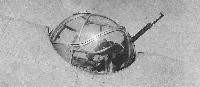
Detail of the MV-3 turret at the MMN.
The 16 of May of 1939 finished the preparation with two motors Klimov M-105 which was renamed Arjanguelsky MMN (In Russian: Архангельский ММН). The name stood for Minor Modification of Object N (Малая Модификация самолета “Н”) – as the SB was factory known.
The main differences with the standard SB consisted of: Use of Klimov M-105 engines with ViSh-22E three-bladed propellers Decrease in wing area by 8 m². Modifications in the wing structure to facilitate the production process. Changes to the nose of the device to improve aerodynamics. The two bow machine guns were replaced by a single ShKAS with a greater firing angle. Double controls in the navigator’s position. The TUR-9 nacelle was replaced by the armored MV-3 and the lower firing point was permanently closed. The manual landing gear removal system was moved to the cockpit. New fuel tanks were introduced towards the wing end with a capacity of 205 liters. Total fuel capacity was increased to 2000 liters The area of the ailerons and the shape of the vertical tail surface were slightly modified.
From 1 July to 16 of August of 1939 state tests were conducted by the engineer of the second rank test pilot Efimov. Khripkov. The results of the tests showed that with a cargo of 500 kg of bombs in the hold and normal takeoff weight of 6420 kg, the speed at sea level was 405 km / h and the calculated height of 4200 m – 458 km / h. The ascent time to 5000 meters was 9.3 minutes and the practical ceiling was 9000 meters.
With the calculated load of 1000 kg (four FAB-250 bombs) the takeoff weight reached 7240 kg, the speed at sea level – 383 km / h, at 4200 meters – 425 km / h and the ascent time to 500 meters – 13.8 minutes. The practical ceiling dropped to 8000 meters.
Despite the increase achieved in relation to the series SB, the result of the tests was negative since it was considered that the speed obtained did not satisfy the established requirements. It was also noted the poor defensive capacity and the deterioration of the landing performance. As a conclusion of the test plan report, it was written:
[…] « The flight characteristics of the MMN in horizontal flight, rate of climb and maneuverability are similar to those presented by the SB series specimens. Take-off is characterized by an increase in the run and greater action on the part of the pilot, which makes a good aerodrome necessary. Landing is more complex compared to the standard aircraft, as an approach is required at a speed of 180 km with flaps extended due to excessive running. This worsening of the results is motivated by the reduction of the wing surface. »
As an interesting detail, it is noteworthy that the report expressed its dissatisfaction with the decision to eliminate the lower firing point and the total closure of the hatch, which left the lower rear hemisphere completely unattended. The change in the upper shooting point was rated as highly positive.
In December 1939 the preparation of the second, known as MMN-2 was completed, this time with the Klimov M-104 powerplant. No documents have been found on the flight tests of this model, but it is known that it flew in January 1940.
MMN Engines: 2 Klimov M-105 1050 hp Wingspan: 18.0 m Wing area: 48,214 m² Length: 12.78 m Height: 4.7 m Empty weight: 4820 kg Maximum takeoff weight: 6420kg Wing loading: 133.5 kg / m² Power load: 3.23 kg / hp Speed at sea level: 360 km / h Speed at 4200m: 458 km / h Cruising speed: 398 km / h Landing speed: 160 km / h Ascent speed: 538 m / min Ceiling: 9000 m Range: 760 km Take-off run with 500 kg: 520 m Landing run with 500 kg and use of brakes: 665 m Accommodation: 3 crew Armament: 1x 7.62 mm ShKAS machine gun in the nose and 1c 12.7 mm UltraShKAS in a MV-3 turret in dorsal position. Bonbload: 1000 kg
The war in Spain showed the obsolescence of the “fast” SB bombers. In an attempt to improve performance, the Arjanguelsky MMN had been developed with M-105 engines, but the results had not been as expected. In parallel, solutions had been developed to increase the range and fire capacity.
Already in 1939 the specialists of the NIP AV VVS together with the NII VVS and the TsAGI, developed the methodology for dive bombing for the SB bomber. The tests of the dive bomber SB had participated the crews of Major Zhdanov, Captain Kobalchuk and Major Lieutenants Subbotin and Piskunov.
As a result of this work, recommendations were created for the flight personnel of the operational units related to the use of the SB dive bomber, which was followed by the request to modernize the aircraft and its weapons.
SB aircraft with M-103 and M-104 engines had participated in the dive tests. The SB 2M-104 aircraft performed poorly due to problems with this engine. For the same reasons, the operational tests in the operating units of the SB with this engine were also unsuccessful.
Under these results the resolution No.230 of 29 July 1939 would see the SNK USSR establishing responsibility from January 1940 modernized copies SB 2M-105 with a rate productive no less than 1939 and from March introduce the version with M-106 engines and speed no less than 500 km / h from Factory No.22.
The October of 1940 the director of the Factory No.22 Okulov and Arjangelsky sent a letter to the NKAP (НКАП or People ‘s Committee for Aviation Industry) with satisfactory results of tests radiators inserted in the wing of the SB bomber with Klimov M-105 engines.
This new location considerably improved the aerodynamics. Authorization was received to continue experimenting with the new model that received the designation SB-RK (СБ-РК – Cамолет СБ с Радиаторами в Крыле – SB with wing radiator).
The field testing of five SB 2M-105 standard bombers with vish-22Ye chopped propellers began on 15 July 1940. In these, the PB-3 supports were installed. The second of these SB-RK N1 / 281 for the first time was equipped with aerodynamic brakes and an automatic dive system.
This equipment was produced by Factory No. 213 in Moscow. Testing of this SB-RK version took place between July 27 and August 11, 1940.
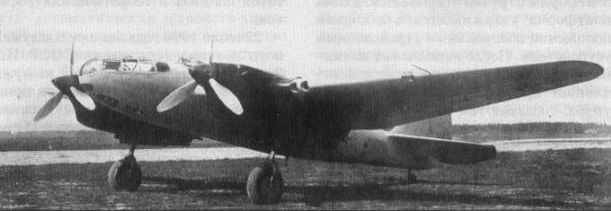
SB-RK prototype
In parallel, an attempt was made to try to use the RS reactive rockets in a dive. As a result, it was found that the reactive force of these rockets in the SB affected the structure of the ailerons, so the decision was made not to use them in this aircraft.
Throughout this process and taking into account the results of the tests of the experimental models MMN 2M-105 and SB-RK 2M-105 and the development of the short-range bomber SB-B, the modernization process was continued.
From Resolution No.240 of the SNK USSR issued on 1 June 1940, the factory No.22 was tasked to prepare three SB-RK with improved aerodynamics for testing by August 15. It was required to obtain a maximum speed of 490 km / h at the height of the practical ceiling.
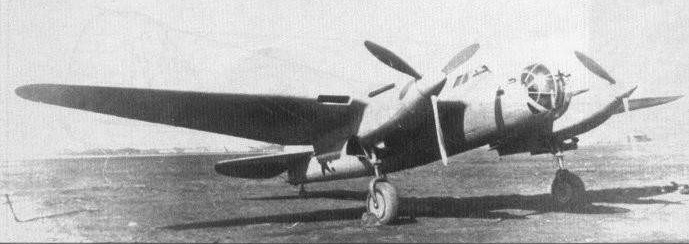
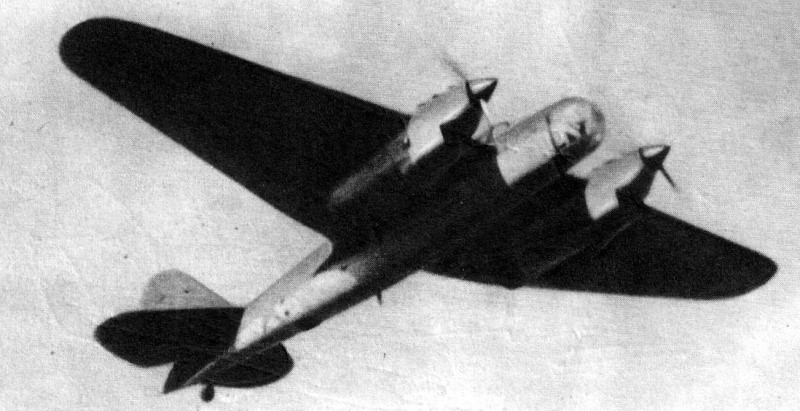
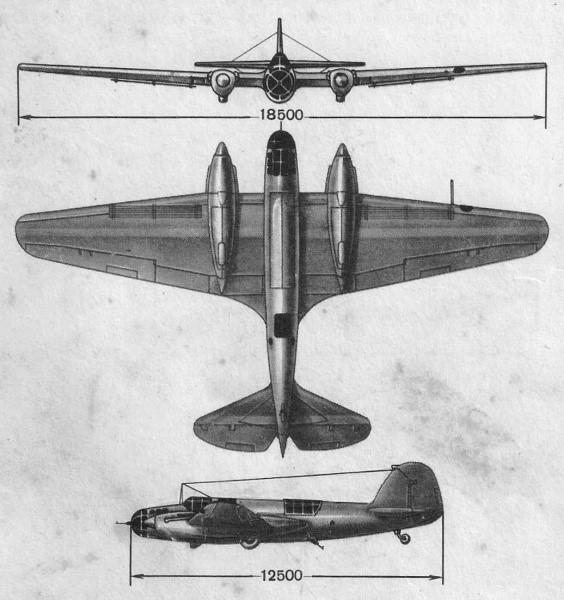
The general configuration, which was not modified, was that of a metal-built, cantilever mid-wing monoplane, fitted with a retractable tail wheel landing gear. The wingspan was reduced by 2.33 m, which led to the reduction of the wing area to only 48.7 m².
The engine exhaust pipes were modified to improve aerodynamics as well as the shape of the cowls. A reduction in the weight was also obtained by 270 kg, of which 110 kg were obtained by modifying the wing, 87 kg by modifying the engines and cowls and 70 kg by modifying the radiators.
The pre-series SB-RK models replaced the nose of the SBs with the new F-1 bow section, with better aerodynamic lines, originally introduced on the Arjanguelsky MMN model. Another significant change was the modification of the shape of the canopy of the gunner-radio operator’s cabin, which lost height, reducing drag.
Other changes related to the construction of the plane were made. The coating of the extrusions in the centroplane, between frames 4 and 8, was made with bakelite plywood fixed with VIAM glue to the wood planes of frames 5, 6 and 7.
Important modifications were made to the drive structures by equipping the aircraft with new mounts and cowls. The radiators and the oil cooling system were modified. Fuel tanks were installed in the wing consoles with a capacity of 330 liters and new VISh-22Ye propellers of 3 meters in diameter and variable pitch.
The modification made to the nose of the aircraft made it possible to improve the navigator’s working conditions and guarantee communication with the pilot. In this position, the ability to control the aircraft was also installed in cases where the pilot was injured. Relative to the nose used on the Arjanguelsky MMN, the SB-RK featured enlarged glazing.
In order to provide the pilot with downward visibility through the navigator’s glass during landing and dive, his seat was moved to the left and the instrument panel to the right.
The aiming during the bombardment in horizontal flight was guaranteed by an NKPB-3 collimator designed to operate at night and at low altitude and another of the OPB-1M type, both located in the navigator’s cabin.
To ensure target tracking during dive bombing, the pilot had a PBP-1 collimator. An artificial dive horizon and an overload signal were installed on the instrument panel.
Under the wing consoles were installed mesh brakes with hydraulic operation system and an automatic dive exit system that was activated once the bombs were launched.
When diving and after releasing the command key, the aerodynamic brakes were extended perpendicular to the air flow. The pilot could know that the brakes were extended by means of mechanical markers that rose above the covering of the wing surface, between the 10 and 11 of the consoles.
The elevator trimmers were automatically raised, forcing them to descend. Once the bomb launch button was pressed, the trimmers returned to their normal position.
The defensive armament included three 7.62mm ShKAS machine guns positioned:
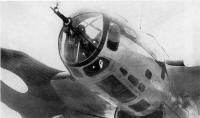
one in the nose with a mechanical collimator located in a spherical turret with 500 rounds and operated by the navigator capable of firing in a 50º cone;
one with a K-8T type collimator on the TSS-1 upper turret with 1000 shots covering the upper rear area. This machine gun could fire at 90º to the left and right, up to 60º upwards and up to 30 degrees downwards;
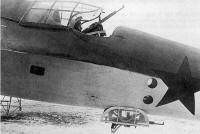
one with OP-2L collimator located in a retractable MV-2 turret in the ventral region with 600 projectiles capable of covering up to 30º to both sides and 55º downwards.
TSS-1 turret at the top and MV-2 at the bottom
The bombing system was also improved in relation to the standard SB. In dive flights, the new model could carry 4 FAB-250 250 kg bombs (two in the external supports and two in the internal ones) or three FAB-500 bombs (two in the external supports and one in the internal one), using the NP-1 brackets developed at Factory No.22.
During the horizontal flight bombardment, three FAB-500s or six FAB-250s (four external and two internal) or 12 FAB-100 bombs (4 external and 8 internal) could be transported. The normal capacity of pumps was raised to 1000 kg, reaching 1500 in the overloaded version.
The SB-RK could also carry two VAP-500 type chemical weapons containers and two UJAP-500 universal chemical dispensers, located on the outer brackets. These two containers guaranteed to be able to use all the types of substances in the arsenal of the VVS.
With these modifications the speed increased by almost 60 km / h, the ceiling also increased to reach 10,100 meters and the range to 1,500 km, without detriment to the landing characteristics.
In October 1940, factory tests began on the first SB-RK prototype, which was selected as the basis for series production. By November 11, 11 flights had been made.
The results of these tests showed that overheating of the water and oil was recorded. Directional stability was not assessed as positive either.
On October 29, the second pre-series copy would leave the production workshops, which was used to test the weapon system. By this time the third copy was finished, which was delivered to the NII VVS for the development of state tests.
At the forefront of these tests was military engineer MI Yefimov. The test pilots were Major VI Zhdanov and Captain AM Khripkov. The tests were completed in January 1941 and the report of conclusions was signed by the head of the NII VVS General-Major AI Filin on January 20, 1941.
On January 31, this document was put for the signature of the head of the Main directorate of the VVS General-Lieutenant PV Rychagov. From 9 December of 1940 and under the order No.704 NKAP, the experimental model SB-RK was redesignated Ar-2. Around 1940 the Soviet denomination system had changed. According to the new system, each model reflected the origin of its design, using the first two letters of the name of the office or designer responsible for it, therefore the SB-RK was renamed Arjanguelsky Ar-2 (Russian: Архангельский Ар-2).
SB-RK during flight tests
During the state tests, it was possible to reach a maximum speed of 475 km / h at 4,700 meters high with a weight of 6,600 kg. The ascent time to 5000 meters was set at 7.1 minutes.
With normal flight weight, the ceiling exceeded 10,000 meters and with a weight of 7,100 kg and two FAB-250 bombs on external supports, 9,000 meters were reached. The technical range with two FAB-250 bombs, flying at 5000 meters at a speed of 390 km / h was 990 km. The take-off run was 340 meters.
In the tests, it was possible to maintain flight with a single engine and 25 dives were made with angles between 40 and 75º, with the aerodynamic brakes retracted and extended in order to be able to measure the behavior of the plane in this maneuver.
Dives were also carried out with the launch of bombs. The dive speed was about 275 – 295 km / h at a height of 4000 meters. The initial exit speed of the dive was 550 km / h with a registered overload of 4.5 units.
The main problems were linked to the power plant. In winter conditions of -10º C, the water temperature reached values close to the maximum allowable, which meant that it would be impossible to use the plane in the summer. The engine oil was also reaching 110 degrees and the system was problematic. During the tests, 12 changes were made to the water and oil radiators.
Although the M-105 engines were fitted to the Ar-2 well after their tests at the unsuccessful Polikarpov SPB, they were not yet ready for production.
It was pointed out that the 7.62 mm machine guns did not guarantee the necessary defense in the conditions of modern combat, but this was a deficiency of practically all the Soviet models of the time, so it was not considered so important.
The report concluded: “The Ar-2 aircraft, produced on the basis of the SB aircraft, considerably exceeds the SB series aircraft due to its performance, but due to its speed it does not exceed modern domestic or foreign medium bombers … The characteristics of Ar-2 flights are similar to those of the SB, but the control is lighter.
For its control and visibility of the pilot can be flown in formation … The plane Ar-2 will enter service with the units of the VVS of the Red Army provided with limited use their motive power … “
In February 1941, the Ar-2 N1 / 511 was delivered to the NII VVS, which tried to resolve the indications of the first tests. In this example the M-105R engines (version made for use in bomber aircraft. It is characterized by the reduction of the reduction ratio, a power of 1100 horsepower) were moved forward by 150 mm with the aim of improving directional stability.
New 3.1 meter VIT1T-22E propellers were installed. The drive reduction was modified to take better advantage of the new propellers. New, more compact louver aero brakes and reactive tailpipes were fitted to harness the exhaust gases to generate additional thrust.
They worked with special interest in improving the finish of the plane’s surface. This allowed obtaining a maximum speed at sea level of 443 km / h and 512 km / h at 5000 meters.
It seems that it only remained to improve the aerodynamics a bit and improve the armament to achieve the dive bomber desired by the VVS, but luck was not in favor of the Ar-2. The successes achieved by the PB-100 (Petlyakov Pe-2), which had managed to reach 540 km / h in tests without difficulty, demonstrated the potential of this model, which would soon begin to be mass-produced at factories No. 22 and No.39.
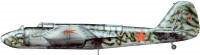
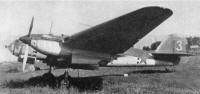
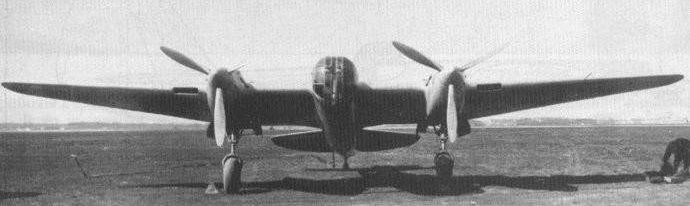
series Ar-2 from 1941
Moreover, the 29 of January of 1941 made its first flight dive bomber “103” 2 AM-37, designed from the outset for this purpose and predecessor of the renowned Tupolev Tu-2. From the first tests, the VVS hoped to obtain an attack aircraft capable of outperforming all known models of this type, both domestic and foreign.
As a result of these changes in the environment issued November to February of 1941 the resolution of the Defense Committee which suspended mass production of the bomber Yakovlev Yak-4 (formerly BB-22 2M-105) in the factory No.81 and of the Arjanguelsky Ar-2 2M-105 at Factory No.22.
As AA Arjanguelsky had been in charge of the development of the MoV-2 project with an AM-38 engine, as of April 10 and by virtue of NKAP order No. 309, the entire work group was transferred to the Factory. No.32 to be in charge of the projection and production of this model.
Much has been argued about this decision. Although the Petlyakov Pe-2 had higher speed than the Ar-2, it actually also had several drawbacks: it had a lower offensive load capacity, had poor take-off and landing characteristics, which caused 30% of the model’s losses and was a new aircraft, while the Ar-2 was a derivative of the well-known SB, which greatly facilitated unit conversion.
Post-war analyzes have theoretically shown that the Ar-2 may have been more effective than the Petlyakov Pe-2 in the dive bomber role, being second only to the Tupolev Tu-2. This disadvantage of the Pe-2 increased in the final period of the war. Upon entering enemy territory, the VVS encountered a large number of well-defended objects and solid constructions (bunkers and fortified constructions) that required great explosive power to destroy them.
Under these conditions, the low capacity of the Pe-2 was insufficient and the large Petlyakov Pe-8 bombers were too vulnerable to antiaircraft defense. The Ar-2 may have played a far more significant role at this stage of the contest with its ability to dive 6 FAB-250 or 3 FAB-500 bombs on these targets.
Some 190 copies were produced before production at Factory No.22 was reassigned to the Petlyakov Pe-2 in the first half of 1941.
Arjangelsky continued work to improve the design of the SB on other models, the most prominent of which was the SB-B.
Since 1940, the Ar-2 was assigned to units already equipped with the SB bomber, which made it possible to speed up the transition process to the new model.
Ar-2 in Ukraine in 1941
For 1 of June of 1941 in units of SVV 164 copies Ar-2 2M-105, of which 147 (three out of service) located directly in combat units, the remaining units of the direction of were VVS and at Factory No.22.
In the initial conditions of the war, with the withdrawal of the Soviet forces and the lack of organization of the fighting forces, the Ar-2 bombers were unable to show their potential. On the other hand, the lack of air coverage and the poor preparation of many crews, contributed to the fact that a large number of these aircraft were lost in the first months of the war. According to the official data of the VVS, the losses of Ar-2 in 1941 accounted for 95 copies.
A certain quantity of Ar-2 remained operational until 1943.
It is noteworthy that the management and specialists of the Naval Fleet Aviation (AVMF), when creating the manning plans for their units for 1941, requested the Ar-2 as the main dive bomber and the Pe-2 as acting hunting escort. Unfortunately this request was not honored.
Units that used the model: In the VVS: 2 SBAP of the 2 SAD 46 SBAP of the 7SAD 54 SBAP of the 54 SAD 13 SBAP of the 9 SAD 33 BAP of the 19 BAD 27 IAP (Fighter squad that used the model as a trainer in dive bombing)
In the VMF: 73 BAP of the 10 SAD in the Baltic Fleet
SB-RK prototype
SB-RK Prototype Engines: 2 x 1050 hp Klimov M-1 05 Propellers: VISh-22E Wingspan: 18.00 m Length: 12.27 m Wing area: 48.2 m² Empty weight: 4430 kg Normal take-off weight: 6300 kg Wing loading: 131kg / m² Maximum speed at sea level: 410 km / h Maximum speed at 4700 m: 480 km / h Cruising speed: 320 km / h Ascent time to 5000 m: 7.25 min Service ceiling: 10 100 m Practical range: 1500 km Armament: 4 x ShKAS 7.62 mm machine guns Internal bombload: 600 kg External bombload: 1,500 kg Crew: 3
Ar-2 serial from 1940 Engines: 2 x 1100 hp Klimov M-105R Wingspan: 18.00 m Length: 12.50 m Wing area: 48.2 m² Empty weight: 5106 kg Normal take-off weight: 6600 kg Maximum takeoff weight: 8150 kg Wing loading: 139 kg / m² Maximum speed at sea level: 415 km / h Maximum speed at 4700 m: 475 km / h Ascent time to 5000 m: 7.1 min Practical range: 1500 km Service ceiling: 10 100 m Armament: 3 x 7.62 mm ShKAS machine guns Internal bombload: six 100kg bombs, or two 250kg bombs, or one 500kg bomb External bombload: up to 1000kg of bombs underwing (500kg under each wing) Crew: 3
1941 serial Ar-2 Engines: 2 x 1100 hp Klimov M-105R Wingspan: 18.00 m Length: 12.78 m Wing area: 48.2 m² Empty weight: 6500 kg Normal take-off weight: 7200 kg Wing loading: 135 kg / m² Maximum speed at sea level: 443 km / h Maximum speed at 4700 m: 512 km / h Time to 5000 m: 6.55 min Service ceiling: 10 100 m Practical range: 1500 km Armament: 3 x 7.62 mm ShKAS machine guns Internal bombload: six 100kg bombs, or two 250kg bombs, or one 500kg bomb External bombload: up to 1000kg of bombs underwing (500kg under each wing) Crew: 3

 All Aero