The expansion of US training facilities in 1941 created a need for trainer aircraft to conserve raw materials, notably aluminium and magnesium alloys, would have to be needed for first-line types.
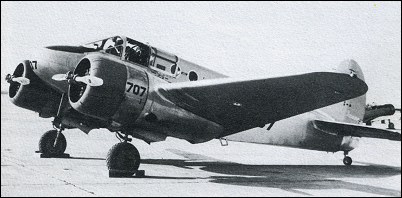
Built as the model 25 prototype, Beech’s T.A. Wells engineering team evolved the Beech Model 26, which was the first all-wood trainer to be accepted by the US Army Air Force, designated AT-10 Wichita. The design avoided the use of compound curves and of hot moulding processes for the structure’s sub-assemblies, allowing them to be sub-contracted to non-specialist wood-working firms: 85 per cent of the airframe was manufactured on this basis, with final assembly by Beech.
Metal airframe parts were limited to engine nacelles and cowlings, and panelling around the cockpit section. The wooden fuel tanks were lined with synthetic rubber. For operation as a multi-engined conversion trainer, the Wichita was equipped with dual controls and an autopilot, and entry to the cockpit was via rearward-sliding side windows.
The AT-10 was powered by two 220kW Lycoming R-680-9 engines, and by 1943 Beech had completed four contracts, for 150, 191, 1,080 and 350 aircraft respectively, bringing the total built at Wichita to 1,771. The last of these was delivered on 15 September 1943. Beech then supplied engineering and production data to the Globe Aircraft Corporation of Dallas, Texas, so that an additional 600 could be manufactured.
Engines: 2 x Lycoming R-680-9 radial, 295 hp /220kW Take-off weight: 2781 kg / 6131 lb Loaded weight: 2155 kg / 4751 lb Wingspan: 13.41 m / 43 ft 12 in Length: 10.46 m / 34 ft 4 in Wing area: 27.68 sq.m / 297.94 sq ft Max. speed: 319 km/h / 198 mph Ceiling: 5150 m / 16900 ft Range: 1239 km / 770 miles
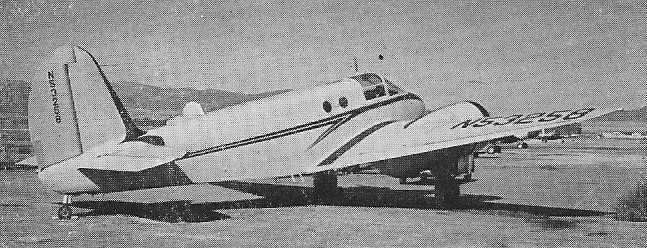
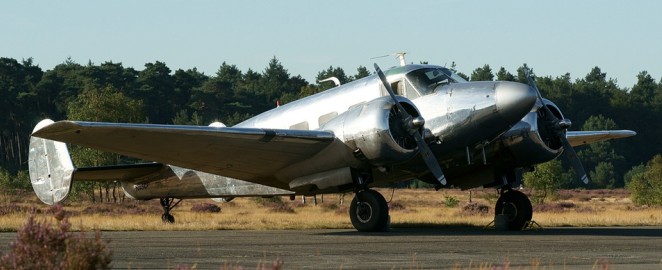
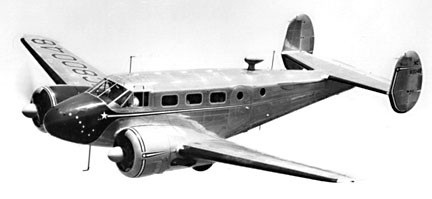
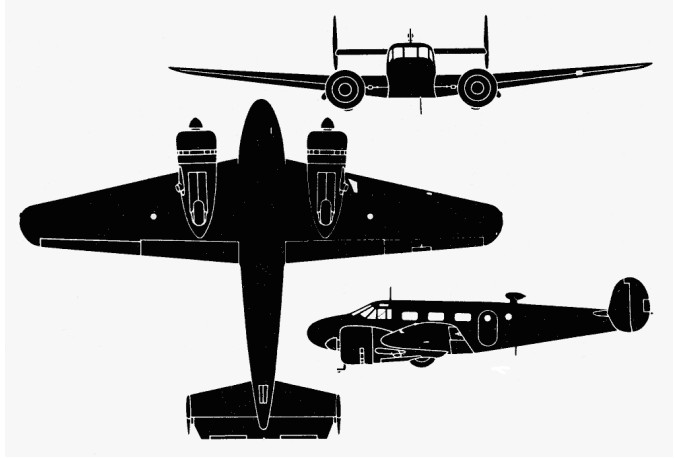
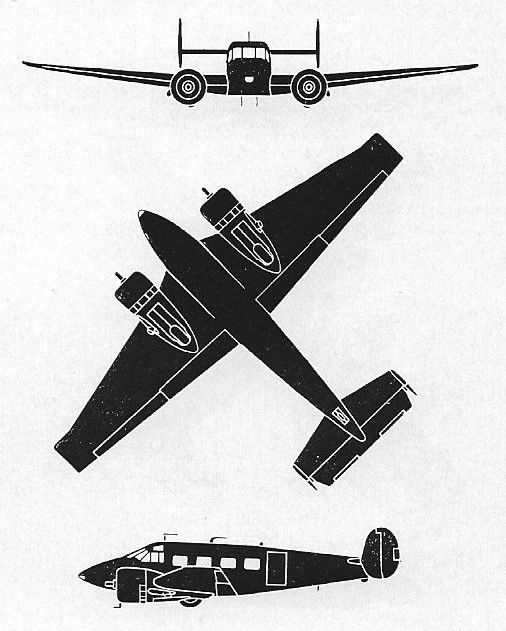
Beech began in 1935 the development of a six/eight-seat commercial transport identified as the Beech Model 18. Designed by Ted Wells, this was a a low-wing monoplane of all-metal construction, with a semi-monocoque fuselage of light alloy, a cantilever tail unit incorporating twin end-plate fins and rudders, and electrically retractable tailwheel landing gear. Float or ski landing gear later became optional. The initial engine installation was two 239kW Wright R-760-E2 radial engines mounted in wing leading-edge nacelles, and accommodation for two crew and six passengers.
The initial 1937 Model 18A (ATC 630) was first flown on 15 January 1937 (certified on 4 March 1937) and the first one, NC15810, was delivered to the Ethyl Corporation in that year at an equipped price of $32,752. It was later converted to a model 18B. About five were built, the rest going to Canada.
An improved Model 18B (ATC 656) with lower-powered 285hp Jacobs engines also sold in small numbers in 1937 for $33,500. Four were built; NC15810, NC18567, NC18569, and NC18583.
By the time war had broken out in Europe, only 39 Model 18 had been sold, even with five versions powered by Wright, Pratt & Whitney and Jacobs engines had been manufactured.
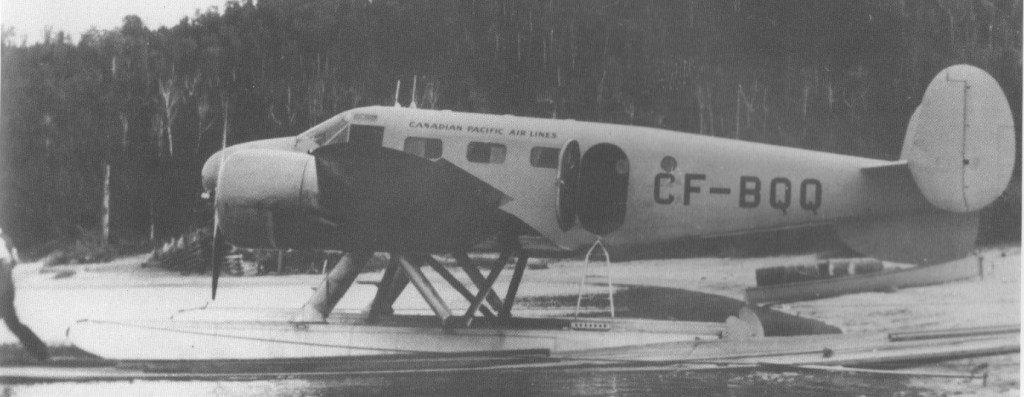
The ability to operate on skis and floats was an advantage in Canada.
A-18A CF-BQQ
The Model D18-C Expeditor could be converted to a Model E18-S if Pratt & Whitney engines replaced the original Continentals.
The Model 18D (ATC 684) of 1939 had 200hp / 246kW Jacobs L-6 engines, giving improved performance. Only 34 of these were sold in 1940, for $37,000 but the wartime demand for these aircraft was to total more than 4,000. A18D also amended under this ATC issued in 1940.
Beech 18G N6B
The first military version was supplied to the Philippine Army Air Corps. Dwight D. Eisenhower, as Chief of Staff of the American mission to the Philipines, selected the Beech 18 for service with the Army Air Corps.
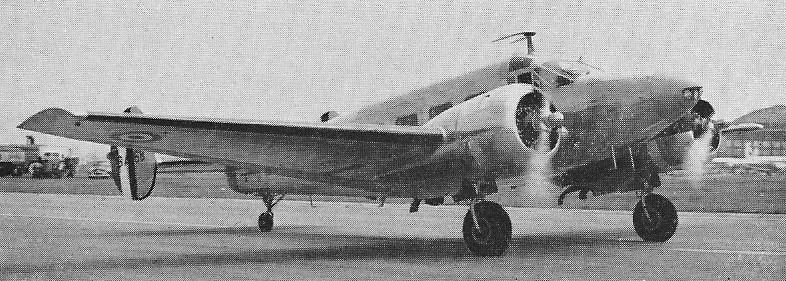
In total the US forces used purchase-built and impressed Model 18s as light transports under the overall designations C-45 (1,401 USAAF aircraft) and JRB (377 US Navy aircraft), the same basic airframe was used in larger numbers as a trainer.
A total of 5,200 1939 18S model (ATC 710) were built going to the Army Air Corp as AT-7, AT-11, C-45, and F-2; and to USN as JRB-1 and SNB-1.
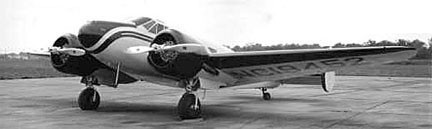
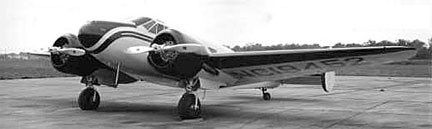
Beech 18-S NC19452
The 1938 A18D (ATC 684) was powered by 330hp Jacobs and sold for $37,000. Sixty-six were built, including SA18D float version under an ATC amendment in 1940.
The first US Army Air Corps order, placed during 1940, was for 11 aircraft under the designation C-45, for use as staff transports. These were similar to the civil Model B18S. Subsequent procurement covered 20 C-45As for use in a utility transport role, with interior and equipment changes being made in the 223 C-45Bs that followed. Some of these aircraft were supplied to the UK under Lend-Lease, being designated Expediter I in RAF service. The USAAF designations C-45C, C-45D and C-45E were applied respectively to two impressed B18S civil aircraft, two AT-7s completed for transport duties, and six AT-7Bs similarly modified. Major and final production version for the USAAF was the seven-seat C-45F, with a slightly longer nose and of which at least 1,137 were built. Lend-Lease deliveries served with the Royal Navy and RAF as Expediter Iis, and with the Royal Canadian Air Force as Expediter IIIs. All of the C-45 designations were changed to a new UC-45 category in January 1943.
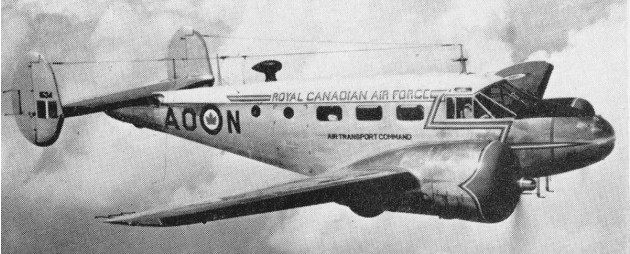
The RCAF received its first Expeditors in 1939 and flew them until the Services were unified in 1968. Retirement from the Canadian Forces came in 1970.
In 1940 six were delivered to the Nationalist Chinese government as M18R (or AT18R) with bomb racks, machineguns and a bombardier position in the nose, and one delivered to Sweden equipped as a flying hospital. Sixty-one were built with six M-18R appearing on the US civil register (NX25474 to 25479), possibly the Chinese airplanes.
In 1941, the Beech AT-7 Navigator was introduced to provide navigation training, equipped with three positions for trainee navigators, plus a dorsal astrodome and 336-kW (450-hp) R-985-25 radials. A total of 577 were built, being followed by six AT-7As with float landing gear and a large ventral fin. Nine AT-7Bs, basically winterized AT-7s were built to USAAF order: five were supplied to the UK, one being used by Prince Bernard of the Netherlands during his wartime exile. The AT-7C final version of the Navigator had R-985-AN-3 engines, production totalling 549.
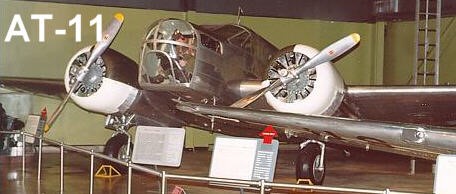
The AT (advanced trainer) version of the Model 18 appeared during 1941. The AT-11 Kansan (originally named Kansas) with R-985-AN-1 engines, for the USAAF was a bombing and gunnery trainer. It incorporated a small bomb bay capable of holding up to 1000 lb of light bombs, had small circular portholes in place of the standard rectangular cabin windows, a redesigned nose to provide a bomb aiming position, and two 7.62mm machine-guns, one in the nose, the other in a dorsal turret.
AT-11 Kansan
The AT-11 was the standard WW II bombing trainer; about 90 percent of the more than 45,000 AAF bombardiers trained in AT-11s. Student bombardiers normally dropped 100-lb. sand-filled practice bombs. In 1943, the AAF established a minimum proficiency standard of 22 percent hits on target for trainees. Combat training missions were flown taking continuous evasive action within a ten-mile radius of the target and final target approaches had to be straight and level and no longer than 60 seconds. After September 30, 1943, these missions were generally flown using the Norden Bombsight and the C-1 automatic pilot, the aircraft being guided by the bombardier student during the bombing run.
Production from 1941 to USAAF orders totalled 1,582 and of them, 36 were converted for navigation training as AT-11As. Twenty-four AT-11s ordered by the Netherlands for service in the Netherlands East Indies were, instead, taken on charge by the USAAF. They were delivered to the Royal Netherlands Military Flying School at Jackson, Mississippi, in early 1942.
The 1942 B18S featured an upgrade interior and electric system. Fourteen went to USAAF as C-45.
The last of the US Army Air Force’s wartime versions of the Beech Model 18 were photographic reconnaissance F-2s. 14 civil Model B18S were purchased and converted with cabin-mounted mapping cameras and oxygen equipment. They were supplemented later by 13 F-2As with four cameras, converted from C-45As, and by 42 F-2Bs, which were conversions from UC-45Fs: these had additional camera ports in both sides of the fuselage.
The 1944 C18S Expediter (ATC 757) sold from $63,000, going to USAAF as C-45/AT-7 and to USN as JRB/SNB.
Beech built a total of 4,526 C-45 military version for the Army Air Forces between 1939 and 1945 in four versions, the AT-7 “Navigator” navigation trainer, the AT-11 “Kansan” bombing-gunnery trainer, the C-45 “Expeditor” utility transport anf the F-2 for aerial photography and mapping. The AT-7 and AT-11 versions were well-known to WW II navigators and bombardiers, for most of these men received their training in these aircraft. Thousands of AAF pilot cadets also were given advanced training in twin-engine Beech airplanes.
The 1947 D18C Feeder Twin (ATC 770) was designed as a short-route air carrier. Powered by 525hp Continental engines, four were built, priced at $64,250. The D18CT Feeder Twin had added equipment, and increased baggage area. Sixteen sold at $64,890.
In June 1948, under a general revision of the USAF designation system, all of the surviving F-2 photo/reconnaissance aircraft were redesignated RC-45A. Similarly, AT-7, AT-7C and AT-11 s dropped their A prefix: at the same time a small number of drone-directors converted from UC-45Fs and given the designation CQ-3 became instead, DC-45Fs.
The US Navy and US Marine Corps used more than 1,500 Model 18s. Initial versions were similar to the US Army’s F-2, this being designated JRB-1, and followed by a JRB-2 transport, and JRB-3s and JRB-4s equivalent to the C-45B and UC-45F respectively. The designations SNB-1 (320 aircraft), SNB-2 (509 aircraft and 376 SNB-2C) and SNB-3 were applied respectively to aircraft that were equivalent to the USAAF’s AT-11, AT-7, and AT-7C. US Navy ambulance and photographic versions were the SNB-2H and SNB-2P respectively; the SNB-3Q was an electronic counter-measures trainer.
During 1951-2, about 900 in-service USAF UC-45E, T-7 and T-11 aircraft were re-manufactured to zero-time condition and modernised, and given the new designations C-45G and C-45H. The C-45G had an autopilot and R-985-AN-3 engines, the C-45H no autopilot and R-985-AN-14B engines. At the same time, US Navy SNB-2s, SNB-2Cs, and SNB-2Ps were remanufactured under the designations SNB-5 and SNB-5P. Later, with introduction of the tri-service unified designation scheme in 1962, in-service SNB aircraft were redesignated TC-45J and RC-45J respectively in the training and photographic roles.
Post war Beech resumed manufacture of the civil Model 18, and in 1953 introduced a larger and improved version of the D18S.
Beech D18S NC80048
Known as the Super 18 (E18S), the prototype was flown for the first time on 10 December 1953. Structural improvements included external refinements to reduce drag, Geisse safety landing gear for cross-wind operations, a separate flight deck, and improved soundproofing. Wingspan was increased and integral steps fitted. All-up weight was increased with the cabin accommodating five to seven passengers. Some were supplied to the French Armee de l’Air.
The 1946 D18S Executive (ATC 765) sold from $63,550 with around 1,000 by 1953. USAF version was the C-45G.
E18S Super 18
The 1953 E18S Executive Super Twin, or Super 18 (ATC 765) first flew on 10 December 1953. Selling for $61,500, 464 were built before replaced in 1962 by the H18. Powered by 450hp P&W R-985 Wasp Jr engines they were nine-place.
The 1959 G18S were an improved E18S with two-piece windshield and a large center cabin window. One hundred and fifty-six were built.
The last of the model 18 were the 1962 H18 ten-place. One hundred and forty-nine were built, priced at $179.500.
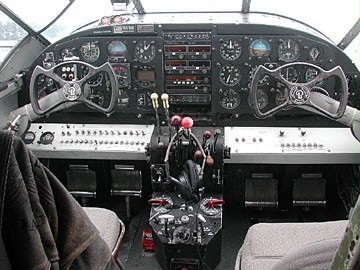
Beech H18 Panel
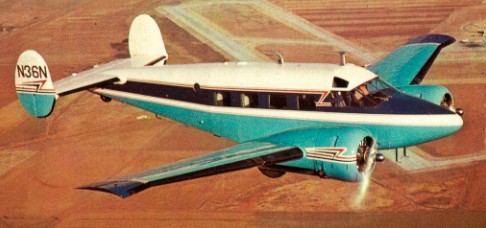
Progressive improvements continued throughout the production of 754 Super 18s, the last examples of the final Model H18 version being built during 1969. The H18 Super-Liner is an advanced version with more engineering improvements than any previous model, including electric cowl flaps, a redesigned exhaust system, lightweight props, and automatic oil coolers.
In September 1963 Beech introduced optional factory-installed retractable tricycle landing gear which had been developed by Volpar Inc. of Los Angeles, California. Some other options include fuel injection, air conditioning, an autopilot and weather radar. Post-war production of the Model 18 finally come to an end in with the tri-gear H18S Super 18 leaving the factory in 1969. In 1969, the last 10 planes were sold to Japan, ending a 32-year production cycle.
In total, the Beech 18 line had 32 variants, and more than 9,000 civil and military planes had been built when the last one (a Super 18H) rolled off the assembly line on 26 November 1969, accounting for the longest production run in aviation history.
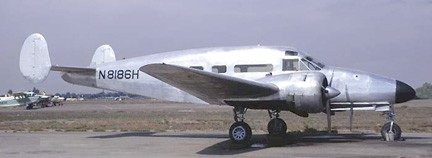
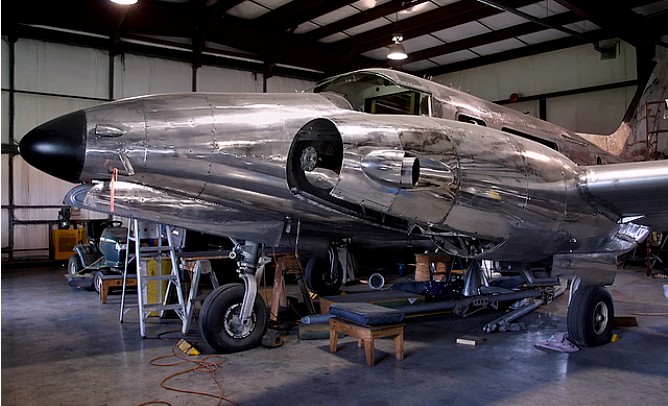
Beech D18S Rausch “headroom” conversion N8186H
Pacific Airmotive Super 18S N36068
In 1940 Volpar offered conversion of Beechcraft 18 to executive light transport with tricycle or conventional gear, redesigned nose, custom interior etc.
Volpar 18 NC19452
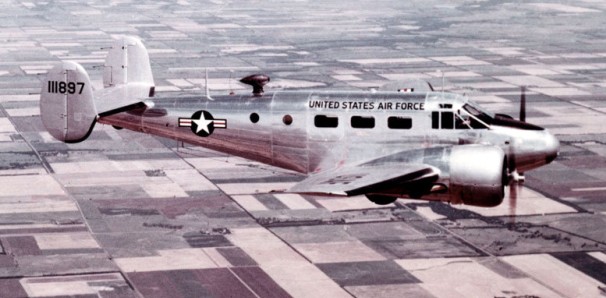
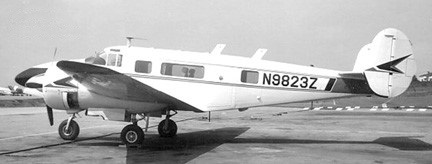
C-45G N8823Z
Volpar also offered conversions of standard Beech 18s to Volpar Turbo 18 standard, with tricycle landing gear and TPE331 turboprop engines kits, and also the lengthened turboprop-powered 15-passenger Volpar Turboliner, first flying in December 1964. Conversions offered by other manufacturers have included the nine-passenger Dumod I and 15-passenger Dumod Liner retaining the original Pratt & Whitney R 985 radial piston engines, offered by Dumod Corporation with larger windows and glass-fiber control surfaces; and Pacific Airmotive Corporation’’ 10-passenger PAC Tradewind and turboprop-powered PAC Turbo Tradewind. The Tradewind, a re-manufactured D-18, offering tricycle gear, new windscreen, increased fuel capacity and other updated equipment.
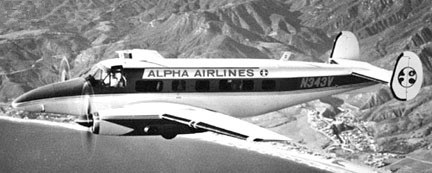
Volpar Super 18 NC343V
Pacific Airmotive Tradewind
Available from Hamilton Aviation in late 1981 were the Hamilton Westwind II STD and Westwind III turboprop-powered conversion of 17-and eight-passenger capacity respectively. The Westwind III was powered by 579 ehp United Aircraft of Canada turboprops. In production for over 32 years, more than 9100 airplanes in 32 variants were built.
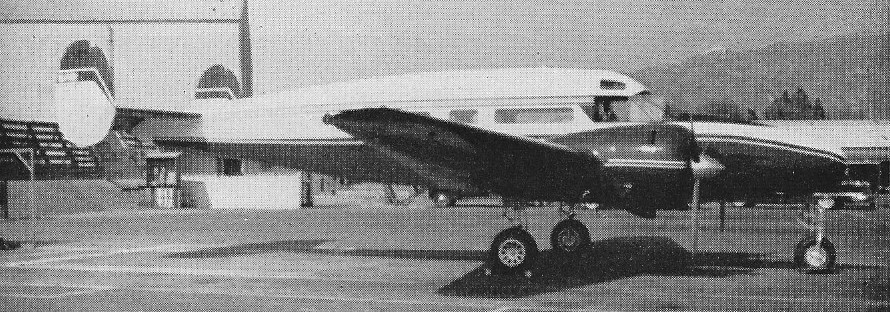
Around 1960 Rausch Engineering modified Beech 18 with a tricycle undercarriage and extended nose. The cabin windows were altered in shape and the fuselage deepened.
Rausch Engineering modified Beech 18
In 1964 Conrad International Corp offer an FAA certified re-worked C-18S, Certified at 10,200 MTOW, modifications at Ft. Lauderdale included tricycle gear, oval passenger windows, airstair door, cargo door and executive interior for nine passengers.
18A Engines: 2 x Wright R-760-E2, 320 hp / 239kW Useful load: 2400 lb Max speed: 202 mph Cruise: 167 mph Cruise: 55 mph Range: 800 mi Crew: 2 Passengers: 6
Beechcraft A-18A 1940 Engines: 2 x Wright Whirlwind, 350 hp Wingspan: 47 ft 8 in Length: 34 ft 3 in Height: 9 ft 5 in Empty weight: 4600 lb MAUW: 7500 lb Cruise: 205 mph Range: 1200 mi Crew: 1-2 Max passengers: 9
18D 1938 Engines: 2 x Jacobs L-6, 300 hp / 246kW Wingspan: 47 ft 8 in Length: 31 ft 11 in Height: 9 ft 5 in Empty weight: 4336 lb MAUW: 7200 lb Cruise: 195 mph Range: 800 mi Crew: 1-2 Max passengers: 9
D18S Engines two 450-hp Pratt & Whitney R-985-AN-14B Wasp Junior. Gross Wt. 8750 lbs. Empty Wt. 5770 lbs. Fuel capacity 206-286 USG. Wing Span: 47ft 7in (14.5m) Length: 32ft (9.74m) Height: 9ft 8in (2.95m) Top speed: 230 mph. Cruise: 211 mph. Stall: 77 mph. Initial climb rate 1190 fpm. Range 985 sm. Ceiling 20,500 ft. Takeoff distance (50’) 1760 ft. Landing distance (50’) 1460 ft. Seats 5-7.
E18S Engines: 2 x Pratt & Whitney R-985, 450 hp. Prop: Hamilton Standard Constant speed 95 in. Pwr loading: 17.7 lbs/hp. Wing span: 49 ft 8 in. Wing area: 310 sq.ft. Wing loading: 31.2 lbs/sq.ft. Length: 35 ft 2.5 in. Height: 10 ft 5 in. Seats: 5 pax. Crew: 2. MTOW: 9700 lbs. Max ldg wt: 9400 lbs. Empty wt: 5910 lbs. Fuel cap: (Std) 198 USG, (with aux.) 318 USG. Max cruise: 214 mph. Maneuvering speed: 153 mph. Stall, clean: 93 mph, Flap & U/c: 84 mph. Vmc: 94 mph. T/o dist: 1455 ft, (50 ft) 1980 ft. Ldg dist: 1036 ft, (50 ft) 1850 ft. ROC S/L: 1410 fpm. SE ROC: 255 fpm. Service ceiling: 21,000 ft. SE Service ceiling: 7750 ft. Max endurance @ 155 mph, std fuel, no res: 4.2 hr, 651 sm. Max range with aux fuel, no res: 6.7 hr, 1038 sm.
C-45 Expeditor / 18S Engines: 2 x 450 h.p. Pratt & Whitney R985-AN-1 Wingspan: 47 ft. 8 in. Length: 33 ft. 11.5 in. Loaded weight: 8,727 lb. Max. Speed: 218 m.p.h. Ceiling: 26,000 ft. Typical range: 1,200 miles at 160 m.p.h. at 5,000 ft. with normal load. Seats: 2 plus 6 passengers.
E18S Super 18 Engines: 2 x Pratt & Whitney R-985-14-ANB Empty weight: 6150 lb Loaded weight: 9300 lb Max speed: 234 mph at 5000 ft Cruise: 207 mph at 5000 ft ROC: 1250 fpm Wingspan: 49 ft 8 in Length: 35 ft 2.5 in Height: 9 ft 6 in Wing area: 361 sq.ft
H18S Super 18 Engines: 2 x Pratt & Whitney R-985-AN-14B, 336kW Take-off weight: 4491 kg / 9901 lb Empty weight: 2651 kg / 5844 lb Fuel capacity: 198-318 USG Wingspan: 15.15 m / 49 ft 8 in Length: 10.73 m / 35 ft 2 in Height: 2.84 m / 9 ft 4 in Wing area: 33.51 sq.m / 360.70 sq ft Max. speed: 354 km/h / 220 mph Cruise speed: 298 km/h / 185 mph Stall: 87 mph Initial climb rate: 1400 fpm Ceiling: 6525 m / 21400 ft Range: 3060 km / 1901 miles Takeoff distance (50’) 2072 ft. Landing distance (50’) 1850 ft. Seats 9-10 Undercarriage: tri-gear
Beechcraft UC-45 Expeditor Engines: 2 x Pratt & Whitney R-985-AN-1 Wasp Junior radial, 450hp each. Length: 34.15ft (10.41m) Width: 47.67ft (14.53m) Height: 9.68ft (2.95m) Maximum Speed: 224mph (360kmh; 194kts) Maximum Range: 1,181miles (1,900km) Rate-of-Climb: 1,850ft/min (564m/min) Service Ceiling: 26,017ft (7,930m) Accommodation: 2 + 8 Empty Weight: 6,173lbs (2,800kg) Maximum Take-Off Weight: 7,496lbs (3,400kg)
C-45A / F-2A / RC-45A / UC-45A Range: 850 mile (with 2,500 pounds of cargo or six pax).
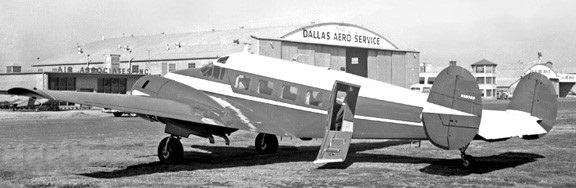
C-45B Expediter I / UC-45B / JRB-3
C-45F Expediter II / Expediter III / F-2B / RC-45A / UC-45F / JRB-4 Seats: 7
AT-7C Navigator / T-7C / SNB-3 Engines: 2 x R-985-AN-3
AT-11 Engine: 2 x Pratt & Whitney R-985-14B
AT-11 Kansan / Kansas / T-11 / SNB-1 six/seven-seat bombing and gunnery trainer Engines: 2 x Pratt & Whitney R-985-AN-1, 336kW (450 hp) Span: 14.50m (47ft 8in). Length: 10.41 m (34ft 2in). Height: 9 ft. 7 3/4 in Max T/O weight: 3959 kg (8,727 lb). Max speed: 215 mph at sea level. Cruising speed: 150 mph Operational range: 850 miles Service Ceiling: 20,000 ft Bomb load: 1000 lb Armament: 2 x 7.62mm (0.3-in) machine-guns Original Cost: $67,000
AT-11A / T-11A Navigation training conversion of AT-11. Engines: 2 x R-985-AN-1
C-45G Engines: 2 x R-985-AN-3, 450 hp Empty weight: 5,785 lb (2624 kg) Loaded weight: 9,000 lb (4082 kg) Span: 47 ft 7 in (14.5 m) Length: 33 ft 11 in (10.3 m) Height: 9 ft 3 in (2.8 m) Wing Area: 349 sq ft (32.4 sq m) Undercarriage: tailwheel.
C-45H Expeditor Engines: Two Pratt & Whitney R-985, 450 hp Span: 47 ft 8 in Length: 34 ft 2 in Height: 9 ft 2 in Max weight: 9,300 lb Maximum speed: 219 mph Cruising speed: 150 mph Range: 1,140 miles Service Ceiling: 18,200 ft Original Cost: $57,838
UC 45J Undercarriage: tricycle
CQ-3 / DC-45F Drone-directors converted from UC-45Fs
SNB-2
SNB-2C
SNB-2H
SNB-2P
SNB-3Q
SNB-5
SNB-5P
TC-45J Trainer
RC-45J Expediter Photographic role
Volpar Turboliner II / Beechcraft 18 Engines: 2 x Garrett TPE 331-1-101B, 705 shp. Seats: 17 Wing loading: 30.75 lb/sq.ft. Pwr loading: 8.15 lb/hp. Max TO wt: 11,500 lb. Empty wt: 6820 lb. Equipped useful load: 4442 lb. Payload max fuel: 206 lb. Range max fuel/cruise: 2041 nm/7.7 hr. Service ceiling: 24,000 ft. Max cruise: 243 kt. Vmc: 84 kt. Stall: 80-84 kt. 1.3 Vso: 104 kt. ROC: 1500 fpm. SE ROC: 225 fpm @ 111 kt. SE ceiling: 13,000 ft. Min field length: 3245 ft. Fuel cap: 2025/3654 lb.
Volpar Turbo 18 / Beechcraft 18 Engines: 2 x Garrett TPE 331-1-101B, 705 shp. Seats: 9. Wing loading: 27.51 lb/sq.ft. Power loading: 7.3 lb/hp. Max TO wt: 10,286 lb. Empty wt: 6200 lb. Equipped useful load: 3844 lb. Payload max fuel: 190 lb. Range max fuel/cruise: 1822 nm/6.5 hr. Service ceiling: 26,000 ft. Max cruise: 253 kt. Vmc: 85 kt. Stall: 77-80 kt. 1.3 Vso: 100 kt. ROC: 1700 fpm. SE ROC: 560 fpm @ 109 kt. SE ceiling: 14,000 ft. Min field length: 2380 ft. Fuel cap: 2025/3654 lb. Undercarriage: tricycle
Dumod I Engines: Pratt & Whitney R 985 radial Passenger capacity: 15
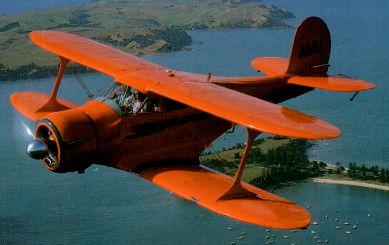
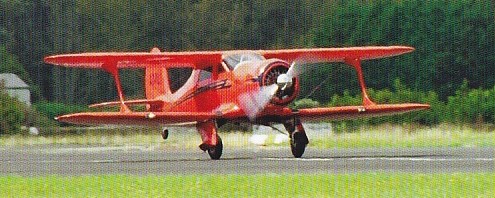
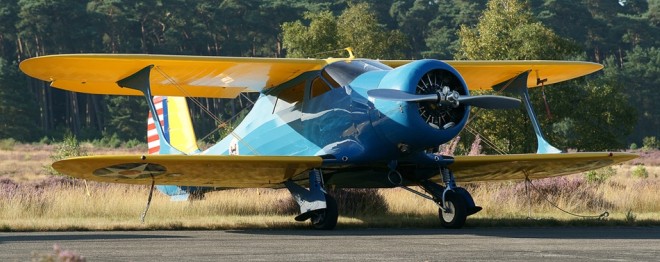
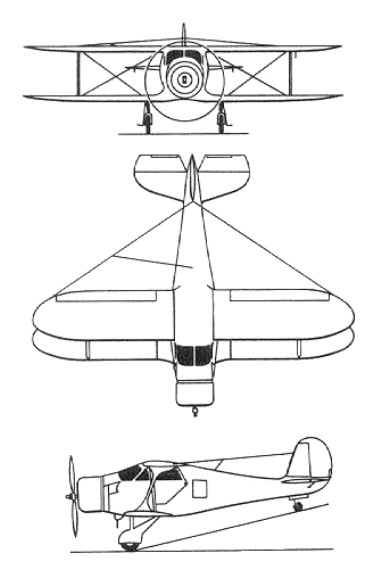
By 1931 Beech resurrected a cabin biplane design started by engineer Ted Wells at Travel Air but rejected by that company’s Curtiss-Wright owners. Aimed at the business executive end of the private owner market — a bold move at the height of the Depression — was the Beech Model 17, continuing the by now-defunct Travel Air series numbers which had ended at CW-16. Apart from its compact dimensions, the four-to-five-seat radial-engine biplane had the unusual layout of its top wing set behind the bottom. This negative or backward stagger arrangement offered several advantages over the more common forward stagger, providing an elegant solution to such problems as pilot visibility and undercarriage location, as well as providing good stall and recovery characteristics.
On paper, the 17 promised to be an airplane of outstanding performance for any category, let alone a four-place commercial biplane. A top speed of 200 mph and landing speed of 60 was what they were looking for. The powerplant would be a 420 hp Wright R-975-E2 radial with a Smith controllable prop. While the narrow landing gear was basically fixed, it has enormous streamlined fairings that al¬lowed room for the wheels themselves to retract 0.15m (6in) in flight. The basic structure was welded steel tube, largely fabric-covered; the braced tail unit was conventional; but with a non-swivelling tail-wheel.
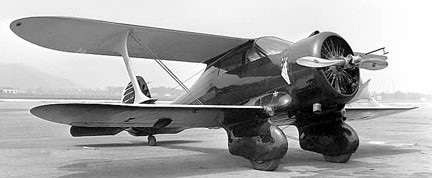
Rather than having a neutral stagger the upper wing stacked directly above the lower wing or a positive stagger, with the upper wing leading, as it did on most biplanes, the 17 had a negative stagger: the lower wing was almost 26 inches farther forward than the upper one. The unique wing configuration had three immediate advantages. Visibility had always been a problem with biplanes and high wing monoplanes, but with the upper lead¬ing edge so far back, the pilot had an excellent view. There was an aerodynamic benefit, too: the center of lift of the upper wing was behind the center of gravity, and that of the lower wing was in front of the CG. The lower wing let go first in an approach to a stall, and since the upper wing was still flying, the rearward cen¬ter of lift would automatically bob the nose down, the plane would pick up speed, and the lower wing would be flying again. At the time, this docile stall was an unusual feature for an airplane of such high performance.
A third benefit of the lower wing’s for¬ward position was that it allowed the gear to be wing mounted rather than attached to the fuselage with drag producing struts and brac¬es. This foresight led to the complete retrac¬tion of the gear into the wing and belly, begin¬ning with the B17 model in 1934.
The nickname Staggerwing was soon coined and shows no signs of going away after almost 65 years. The airframe broke no new structural grounds, having wooden wings and steel tube load-bearing fuselage with wooden formers to carry the aerodynamic shape, all but the forward fuselage covered in fabric. Cessna let his old partner use part of the Cessna plant, temporarily closed by the Depression, to begin building Beechcrafts. Careful attention to streamlining achieved Walter Beech’s specifications of 200 mph top speed while landing at 60 mph, a speed range unknown in 1932, on the 420 hp of a Wright R-975 Whirlwind. On 4 November 1932, six months after the factory opened, test pilot W H “Pete” Hill flew the number one Model 17R, NC499N, at a top speed clocked at 201.2 mph.
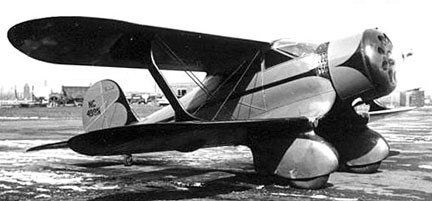
Beech 17R NC499N
NC499N was destroyed in a crash on 10 December 1936. In its first two years, the Beech Aircraft Company sold just one airplane, NC58Y. Beech demonstrated the 17R to Tom Loffland who ran a Tulsa oil drilling outfit and had shown an interest during the construction stage. He paid a large deposit and also paid the Beech payrolls while it was being constructed. Work started on the second Model 17 early in 1933, and by July that year the finished aircraft was delivered to its new owner. For his first hundred hours in the airplane, the pilot reported laconically, he had very little idea where it was going during takeoff or landing. It was returned to Beech Co as a trade in mid-1935 and reportedly dismantled
The airplane would have to be improved. As a first step just to see what would happen, he advertised the plane, which already had 420 hp, as available also with the 700 hp Wright Cyclone engine. What happened was an order for one such model from a worsted mill in Maine. Beech built the airplane, but just running up the engine shook the airframe so badly that it continually broke weld joints. In the air it was smoother, and could hit 250 mph, which was faster than any fighter of the time. The pilot who flew it for the customer was given one hundred days to live by his friends, but he confounded them by flying it safely for a year. Thereafter it was sold to Howard Hughes, in whose service it was cracked up on takeoff in the 1937 Bendix Race.
The preproduction model, the A17F with fixed undercarriage, was fitted with a 690-hp Wright R-1820-F11 Cyclone, but although the basic design would appear to give stable flight characteristics, the horsepower was excessive, resulting in “porpoising” due to the short fuselage. There were four fixed gear 17s built – ¬the two 17Rs, an A17F and an A17FS. The A17FS powered with an SR-1820-F3 super-charged Cyclone engine of 710 hp. All stood on tall, stiff, narrow gear and had short coupled fuselages. It was a beautiful airplane in the air but it was very touchy taking off and landing If you were just a second off your timing on the use of the rudder, you were in trouble.
The word on the plane’s high speed spread quickly, and it got a reputation as a hot ship. This notoriety, plus its ground handling characteristics, didn’t help sales. You might also note that the A17F and A17FS had modest little Wright Cyclone engines of 690 and 710 hp, respectively. They went 250 mph, though faster than many military ships and in the air were said to be just as sweet as all models of the Staggerwing were. The A17F, incidentally, was owned at one time by a well known pilot named Howard Hughes.
Meanwhile, Waiter Beech reversed direction, and designed a lightweight, low powered Staggerwing, the B model.
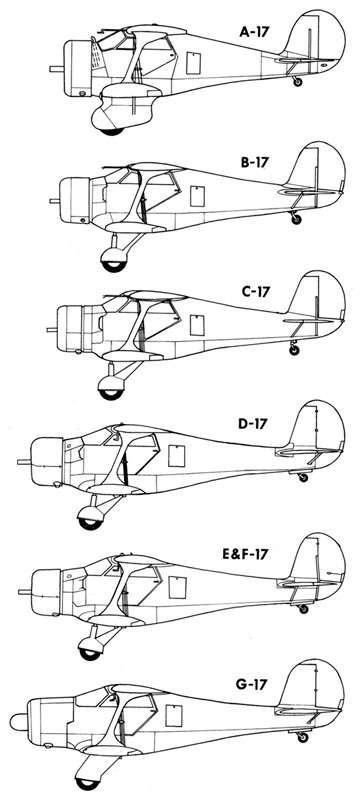
The first production model, built from March 1934 to 1936, was the B17 powered by a 285-hp JacobsR-830-1 L-5 (B17B), a 285-hp Wright R-760-E1 Whirlwind (B17E), a 225-hp Jacobs R-755 L-4 (B17L) or a 420-hp Wright R-975-E2 or 450 hp E3 (B17R). Wingspan was reduced to 32 feet and electrically operated flaps replaced the split rudder for landing drag, but the biggest change was to the undercarriage; a wider, shorter and which now retracted, again by electrical means but with hand-crank backup, folding inwards to house the wheels under the forward fuselage. Other changes included the use of wooden wing spars instead of metal, and a different airfoil. This machine was much more accurately tuned to the market in those still depressed times, and Beech at last began to sell Staggerwings: 18 in 1934 and twice that in 1935 when business began to pick up, as it did for everyone. The Staggerwing had finally achieved commercial success. Commercial success was helped when B17R G-ADLE piloted by H.L.Farquhar completed a 21,332 mile around the world flight in 1935.
Structurally, the Staggerwing uses a mixture of materials and methods. The fuselage has a basic framework of welded steel tube over which is a web of wooden formers and stringers to shape the fabric covering. The wings are all wood: wood spars, wood truss ribs, and, again, fabric skin. The landing gear em¬ploys big metal springs instead of oleos, and is electrically operated. The structure proved strong, except for an era of flutter failures of the top wing, which Beech cured by aileron balancing and plywood stiffening for the wing tips.
The 1936 C model Staggerwing gained a shorter landing gear and had the flaps on the lower wing to improve ground handling which was still a little hairy. A negative four degree angle of incidence was introduced to the tailplane to keep the tail down while landing. Other than these changes, the C17 was identical to the B17, including the choice of engines (with the C17B, E, L and R having the same engines as the respective B17s). Walter Beech never lost an opportunity to market his airplane.
Staggerwings were regularly seen at air shows and did well in racing. The 1936 New York to Los Angeles Bendix cross country race was won by Louise Thaden and copilot Blanche Noyes in a C17R, in 14 hours 44 minutes.
Introduced in 1936 (to 1937), more than 60 C17 were made, but the following year the D17 brought in a number of changes. The most obvious was a rear fuselage extension of 18 inches, while the windscreen profile was altered and the tailplane made a cantilever unit. By now the peripatetic flaps had migrated to their final place on the bottom wing and the ailerons, of similar shape and length, were on the top, while the wings had a new NACA 23012 section and plywood covering outboard of the I-struts. Toe brakes replaced the unloved Johnson bar.
The D17 was built with a range of engines starting with the D17A with 350 hp Wright R-975-E2, followed by the D17R with a 420 hp Wright R-975-E2.
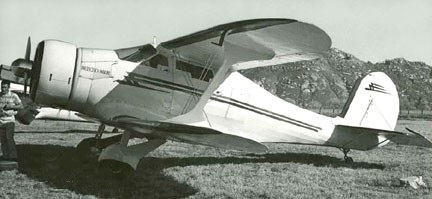
D17S
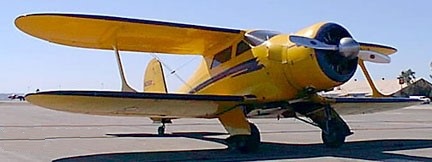
The most popular model was the D17S introduced in 1937, with a 420-hp Pratt & Whitney R-985 Wasp Junior nine-cylinder, air-cooled radial engine, built from 1937 to 1945. The D-17-S obtained its type certificate on 16 July 1937. 66 of the D-17-S had been sold by the time the US entered WW2.
Wartime production of USAAF UC-43 Traveller (based on the D-17S) and USN GB-1s and GB-2s amounted to 412.
When in 1939 the US Army Air Corps needed a small communications aircraft, the excellent performance of the Model 17 resulted in the procurement of three Model D17s for evaluation under the designation YC-43.
However, it was not until expansion of the USAAF began during 1941-2 that an initial production order for 27 was received, this leading to a total procurement of 207 Beech 17s under the designation UC-43, these being powered by the 336kW Pratt & Whitney R-985-AN-1 engine. After the United States became involved in World War II, an additional 118 civil Model 17s were impressed for military service, and comprising D17R, D17S, F17D, E17B, C17R, D17A, C17B, B17R, C17L, and D17W variants under the respective designations of UC-43A, UC-43B, UC-43C, UC-43D, UC-43E, UC-43F, UC-43G, UC-43H, UC-43J and UC-43K.
The US Navy had acquired a single example of the Staggerwing as early as 1939. This was a 1937 civil C17R which became designated JB-1 [0801]. The designation GB-1 applied to 10 more, equivalent to the civil D17, acquired in 1939 and, later, to eight civil D17s impressed for military service, plus 63 from USAAF inventory [1589/1595, 1897]. Wartime procurement totalled 342 GB-2s (first flying in 1941), of which 105 were supplied to the UK under Lend-Lease, used primarily by the Royal Navy which named them Traveller, a name adopted also by the US Navy, and the RAF. Some went to Brazil.
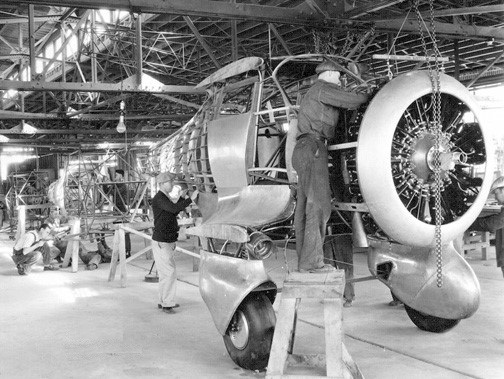
Beech 17R assembly line
The E17, built from 1937 to 1944, and the F17, built for the military from 1938 to 1944, were cheaper versions powered by Jacobs with strut-braced tailplane. A 1940 price list shows that an E17B went for $12,380, while the higher ¬powered D17S listed at $18,870. The price in 1936 was $14,500.
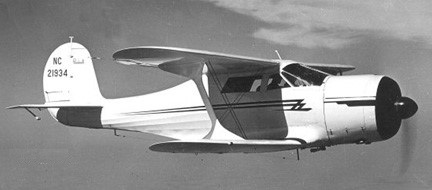
The last in the series was the G17 built from 1946 to 1948. The postwar model was the G17S. Based on the D17S with Pratt & Whitney R-985 Wasp Junior, it was fitted with enclosed gear fairings, cowl flaps, a longer windshield, larger vertical fin, and the engine was moved forward 12 inches with a longer, low-drag engine cowl and more modern disc brakes. At 9700 feet, pulling 65 per cent power, the G17 exceeds 200 mph. Most of the time it cruises at 53 per cent power and 185 mph, burning around 22 gph, with its 450-hp radial. Six fuel tanks (one in each wing, one forward fuselage tank, and one rear fuselage tank) carry 170 gallons to yield a seven-hour endurance or 1300-mile range. Approximately 20 G17 models were built and sold new for $29,000. Its labour-intensive production methods worked against it, especially when Beechcraft introduced its Model 35 Bonanza at only $8,000. Only 20 of the final model were made in 1946, but were not assembled and sold until orders were received over the next two years. The last G17S, serial number B20, assembled from parts in Texas, flew in 1949.
Beech G17 NC21934
In all, a total of 781 Staggerwings were built, of which 353 were commercial and 105 to USAF and 320 to USN, excluding 20 built in Japan as C17E.
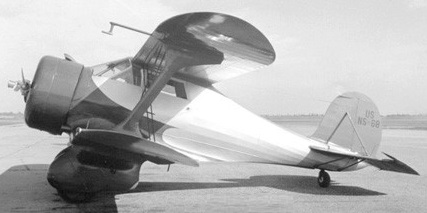
A17FS 1935 (ATC 577) Engine: Wright SR-1820-F3 Cyclone, 710 hp. Wingspan: 34’6″ Length: 24’3″ Max speed: 235 mph Cruise speed: 215 mph Stall speed: 65 mph Range: 750 mi Ceiling: 20,000′ U/C: fixed. Price: $30,000 No built: 1 registered by Beech NR12569 transferred to the Bureau of Commerce as NS68 Dismantled c.1937
Beech A17FS NS68
B17B / SB17B 1934 (ATC 560) Engine: Jacobs R-830-1 (L-5), 285-hp Wingspan: 32 ft Length: 24’6″ Useful load: 1300 lb Max speed: 185 mph Cruise speed: 173 mph Stall speed: 45 mph Range: 500 mi Ceiling: 18,000′ U/C: retractable. Price: $9,000 No built: 2 NC14408, CZ116 CZ116 converted to B17L SB17B was the twin-float designation
B17E 1935 (ATC 566) Engine: Wright R-760-E1 Whirlwind, 285-hp Wingspan: 32 ft Length: 24’5″ Useful load: 1263 lb Max speed: 185 mph Cruise speed: 165 mph Stall speed: 50 mph Range: 680 mi Ceiling: 18,000′ U/C: retractable. Price: $12,980 No built: 4, NC12593, NC14413, NC14458, NC15412 NC14413 converted to B17R
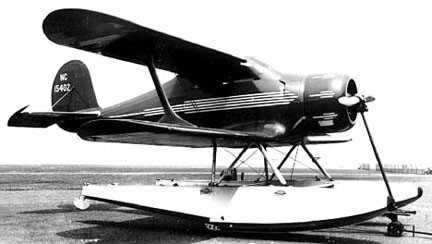
B17L / SB17L 1934 (ATC 560) Engine: Jacobs R-755 L-4, 225-hp. Wingspan: 32 ft. Useful load: 1350 lb Max speed: 166 mph / 282 kph Cruise: 130 kt / 150 mph. Stall speed: 39 kt / 45 mph / 72 kph Range: 560 mi Ceiling: 15,500′ U/C: retractable. Price: $8,000-8,550 No built: 45 the first Staggerwing on floats, SB17L
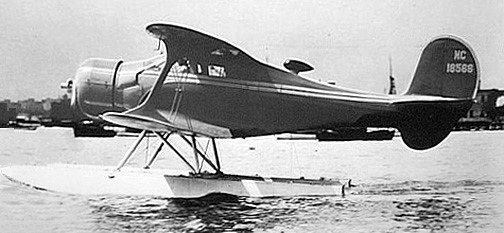
Beech SB17L NC15402
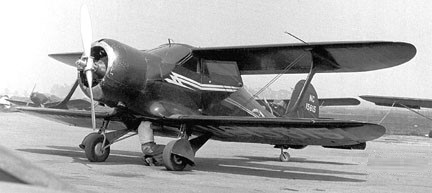
B17R / UC-43H 1935 (ATC 579) Engine: Wright R-975-E3 Whirlwind, 420-hp. Wingspan: 32 ft. Useful load: 1362 lb Max speed: 211 mph Cruise speed: 202 mph Stall speed: 55 mph Range: 760 mi Ceiling: 22,000′ U/C: retractable. Price: $14,500 No built: 16 3 to USAAF as C-43H 1 converted from B17E, NC14413
Beech B17R NC15815
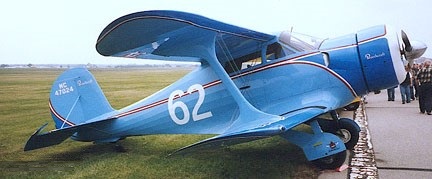
C17B / SC17B / UC-43G 1936 (ATC 602) Engine: Jacobs L-5, 285 hp Wing span: 32’0″ Length: 24’5″ Max speed: 185 mph Cruise speed: 165 mph Stall speed: 45 mph Range: 480-680 mi Price: $9,250 No built: 39, including conversions to C17L, of which 10 to USAAF as UC-43G 1 built as experimental amphibian NC16440 SC17B was twin-float version
Beech C17B NC47024
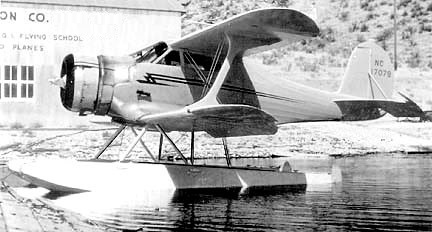
Beech SC17B NC17078
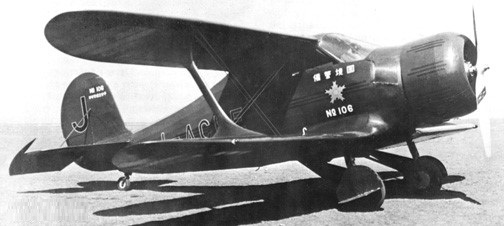
C17E 1936 (ATC 615) Engine: Wright R-760-E1, 285 hp Useful load: 1550 lb Max speed: 185 mph Cruise speed: 165 mph Stall speed: 48 mph Range: 865 mi Seats: 4 No built: 3, NC15487 plus 2 exported to Japan in 1937, incl. NC15836/J-BAOI Japanese construction under license of 20 C17Es from 1938-40
Beech C17E Japanese assembly
C17L / UC-43J 1936 (ATC 602) Engine: Jacobs L-4, 225hp Wing span 32ft MAUW 3165lbs Useful load: 1340 lb Max speed: 175mph. Cruise speed: 166 mph Stall speed: 45 mph Range: 560 mi Price: $8,550 Seats: 4 U/C: retractable No built: 5, of which 3 to USAAF as UC-43J, 1 converted to C17B, NC16441
Beech C17L NC15846
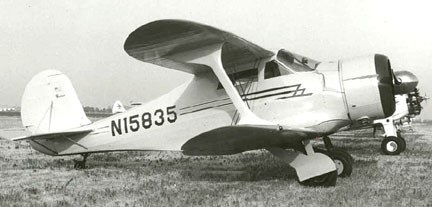
C17R / UC-43E / JB-1 1936 (ATC 604) Engine: Wright R-975-E2, 420 hp Wingspan: 32’0″ Length: 24’5″ Useful load: 1650 lb Max speed: 211 mph Cruise speed: 185 mph Stall speed: 59 mph Range: 800 mi Seats: 4 U/C: retractable Price: $14,500 No built: 17 of which 1 to USN as JB-1, and five to USAAF as UC-43E Winner of 1936 Bendix Trophy [NC15835] (p: Louise Thaden & Blanche Noyes) SC17R with Edo ponyoons.
Beech C17R N15835
D17 / GB-1
D17A / UC-43F 1939 (ATC 713) Engine: Wright R-975-3, 350 hp Wingspan: 32’0″ Length: 26’11” Useful load: 1733 lb Max speed: 180 mph Cruise speed: 170 mph Stall speed: 50 mph Range: 850 mi Price: $16,350 Seats: 4 U/C: retractable No built: 8, of which 1 to USAAF as UC-43F First of the lengthened fuselage models (D-17 through E-17)
Beech D17A NC582
D17R / UC-43A 1937 (ATC 638) Engine: Wright, 420 hp Wingspan: 32’0″ Length: 26’11” Useful load: 1680 lb Max speed: 211 mph Cruise speed: 202 mph Stall speed: 60 mph Range: 825 mi Seats: 4 U/C: retractable Price: $18,870 No built: 28, of which 13 to USAAF as UC-43A, plus 2 conversions from D17W – NC17081, NR18562
D17S / UC-43B / SD17S / GB-1 1937 (ATC 649) Engine: Pratt &Whitney R 985-AN-1 Wasp Junior, 424 hp Span: 32ft (9.75m) Wing area: 296.01 sq.ft / 27.5 sq.m Wing load: 15.79 lb/sq.ft / 77.0 kg/sq.m Length: 25ft 9in (7.85m) Height: 10.236 ft / 3.12 m Max take off weight: 4681.2 lb / 2123.0 kg Weight empty: 3084.8 lb / 1399.0 kg Max speed: 212mph (341kmh) Cruising speed 65%: 148 kt / 274 km/h / 202 mph Vne: 256mph. Stall: 61 mph. Service ceiling: 19997 ft / 6095 m Range: 840 miles (1350 km) Seats: 4 U/C: retractable Price: $18,870 No built: about 50, of which 13 to USAAF as UC-43/UC-43B, 11 to USN as GB-1 SD17S was floatplane The last D17S NC34R became prototype for G17S
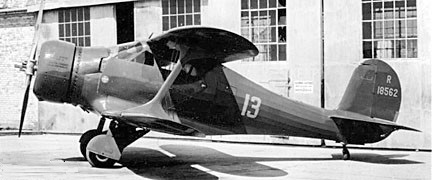
Beech SD17S NC18562
D17W / UC-43K / GB-1 1937 Engine: supercharged P&W R-985-SC-G Wasp, 525-600 hp Seats: 4 U/C: retractable No built: 2 1 for Jacqueline Cochran to set speed and altitude records in 1937-38 – NX/NR18562 1 for Frank Hawks, NC17081, later repowered with 420hp Wright R-975 Both converted to D17R, the NX/NR18562 serving in USAAF as UC-43K, NC17081 serving in USN as GB-1
Beech D17W NC18562
E17B / UC-43D / SE17B 1937 (ATC 641) Engine: Jacobs L-5, 285 hp Wingspan: 32’0″ Length: 25’11” Useful load: 1270 lb Max speed: 188 mph Cruise speed: 177 mph Stall speed: 50 mph Range: 700 mi Seats: 4-5 U/C: retractable Price 1937: $10,490 Price 1939: $12,380 No built: about 52, of which 31 to USAAF as UC-43D
E17L 1937 (ATC 641) Engine: Jacobs L-4, 225 hp Useful load: 1335 lb Max speed: 175 mph Cruise speed: 166 mph Stall speed: 50 mph Seats: 4 U/C: retractable No built: about 3 – CF-BHA, NC17071, NC18785 Similar to E17B
Beech E17L N41663
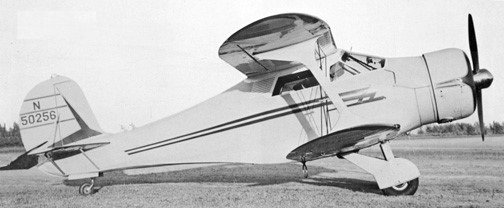
F17D / UC-43C 1938 (ATC 689) Engine make/model: 915-cu Jacobs L6MB, 330 hp Wingspan: 32 ft Length: 25 ft 11.5 in. Height: 8 ft Wing area: 296.5 sq. ft Max gross weight: 3550–3590lb Empty weight, std: 2155lb Fuel capacity: 125 USgals Wing loading: 10.75 lbs./hp Seating capacity: 6 Cruise speed: 182 kts Max speed: 195 mph Cruise speed: 18 mph Stall speed: 50 mph Range: 600 sm Rate of climb: 1300 fpm Service ceiling: 18,000 ft U/C: retractable Upper-wing ailerons, lower-wing flaps Price: $13,980 No built: about 60, of which 38 to USAAF as UC-43C
Beech F17D NC50256
G-17S 1946 (ATC 779) Engine: 1 x Pratt & Whitney R-985-AN-4 Wasp Junior, 336kW / 450 hp Max Take-off weight: 1928 kg / 4251 lb Empty weight: 1270 kg / 2800 lb Useful load: 1,450 lbs. Wingspan: 9.75 m / 32 ft 0 in Length: 8.15 m / 26 ft 9 in Height: 2.44 m / 8 ft 0 in Wing area: 27.65 sq.m / 297.62 sq ft Max. speed: 341 km/h / 212 mph Max cruise (65% @ 9,700ft.): 175 kts. Cruise speed: 298 km/h / 185 mph Normal cruise (53% @ 9,500 ft.): 161 kts. Stall: 60 mph Fuel consumption @ normal cruise: 22 USG/hr. Range @ normal cruise, no res: 1,242 nm. Seats: 4-5 Fuel capacity: 170 USgals Initial climb rate: 1,500 fpm Service ceiling: 20,000 ft Takeoff distance, 50 ft.: 1,130 ft Landing distance, 50 ft.: 980 ft Baggage capacity: 125 lbs. Endurance: 7 hour Range: 1300 sm Price: $29,000 U/C: retractable No built: 17 to 20 Post-war model, and last of the “Staggerwings,” the final one built in 1949 – NC80321
The Austrian engineer, Paul Baumgartl, concerned himself during the Second World War with the design of small single-seat helicopters, in the suburbs of Vienna. Baumgartl’s first product was the Heliofly I of 1941, which was little more than a strap-on autogyro glider for sporting use.
The Heliofly III-57 resulted from previous work. This had a rotor consisting of two co-axial contea-rotating single blades, each of which was to be driven by its own 8 hp Argus As 8 engine, which also acted as a counter-balance.
Baumgartl Heliofly III-59
When it became apparent that the Argus engines could not be readily obtained, the helicopter was redesigned in 1943 as the Heliofly III-59 to be powered by a single 16 hp engine. In this design, the engine drove and counterbalanced the lower blade and, through gearing, also drove the upper blade, so that torque was still counterbalanced by contra-rotation. A weight, instead of an engine, counterbalanced the upper blade, and the flapping rotor system had cyclic pitch control. Heliofly III-59 Engine: 16 hp / 12kW Rotor diameter: 6.10m Max take-off weight: 120kg Empty weight: 35kg Crew: 1
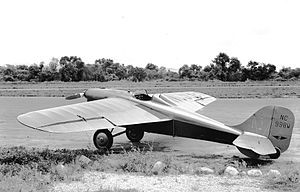
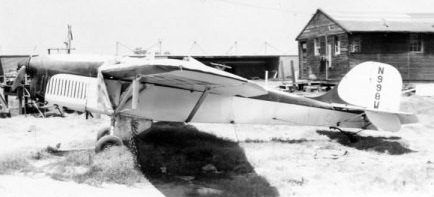
Derived from the side-by-side two-seat cabin monoplane Babcock-Vlcek X Airmaster, the LC-13A featured an open cockpit and an enlarged vertical tail. It was powered by a 75 hp Roché L-267 four-cylinder air-cooled inverted in-line engine. Originally designed and manufactured by Rover of Lansing, Michigan, the manufacture of the 267 cu.in (4.38 l) engine was taken over by Jean A Roché of Dayton, Ohio in 1932. An auxiliary fin on the underside of the stabilizer had to be fitted according the Aircraft Type Certificate 2-389.
Babcock LC-13A racer NR998W
Originally marketed as the Babcock LC-13 by its original manufacturer, then the Taubman LC-13 when the Babcock Airplane Corporation was acquired by Taubman Aircraft. Vearne Babcock left the aviation industry in 1945, and sold the rights to produce his LC-13 to Bartlett Aircraft Corp. at Rosemead, California. This aircraft was developed from the Babcock monoplane of the mid-1930s.
The Bartlett Zephyr was a mid-wing braced monoplane of conventional design with side-by-side seating for two and fixed, tailwheel undercarriage.
Babcock LC-13A Taube (Dove) (N998W c/n 601)
NR998W was modified as a racer.
Plans to mass-produce it were halted by the outbreak of World War II after two were built, X/NC998W and NX18165. There was a brief attempt to revive the design at the end of the war, but nothing came of this. Price was $3,995.
The LC-13A Zephyr of 1941 was a streamlined, single-strut version of the Taubman LC-13, still under ATC 2-389.
1944 Bartlett Blue Zephyr at Rosemead, California
Engine: 1 × Franklin 6A4-150-B3, 150 hp (112 kW) Length: 21 ft 0 in (6.40 m) Wingspan: 30 ft 9 in (9.38 m) Maximum speed: 150 mph (240 km/h) Range: 500 miles (800 km) Service ceiling: 18,000 ft (5,500 m) Crew: one pilot Capacity: 1 passenger
LC-13A Engine: 130hp Franklin 6AC or 120hp Martin 333 Wingspan: 30’10” Length: 20’5″ Max speed: 150 mph Cruise: 135 mphRange: 450 miles Seats: 2
LC-13A Wngine: 150hp Franklin 6A4-150-B3 Wingspan: 30’9″ Length: 21’0″ Load: 685 lb Max speed: 150 mph Cruise: 135 mph Stall: 42 ph Range: 500 miles Ceiling: 18,000′
Bartlett Aircraft Corp. was a US aircraft manufacturer founded in Rosemead, California in 1941 to build light aircraft from designs acquired from the purchase of Taubman Aircraft, who in turn bought them from Babcock Airplane Co.
World War II interrupted plans for mass-production. Immediately after the Second World War the Bartlett Aircraft Corporation of Rosemead, California, began production of a lightweight two-seat cabin monoplane designated the Bartlett LC13-A Zephyr 150. This aircraft was developed from the Babcock monoplane of the mid-1930s.
In August, 1944, that the idea of “Natter” (German for Viper) was conceived and four designers, Heinkel, Junkers, Messerschmitt and Bachem, were directed to submit plans. Diplomeur Ingenieur Erich Bachem who made his first appearance with his submission of the BP(Bachem Projekt)20 Natter (Adder). The BP-20 was envisioned as a small lightweight expendable interceptor, capable of destroying any enemy bomber using the least possible weapon expenditure. Dr. Bachem’s design was chosen and in November of that year Natter BP-20 was flown for the first time. Smaller than the Me-163 (span, 13 feet; length, 20 feet, 6 inches) and simpler to build (wooden airframe required only 600 man hours) it looks more like a mock-up than a full-fledged fighter. Because of the short take-off area required it was well suited to close defense of vital targets and pilots required very little training. Launched from a nearly vertical ramp, powered by a Walter rocket unit similar to that used in the Me-163, the initial rate of climb was calculated at 37,000 feet per minute, its top speed at more than 600 miles per hour. A controlled missile until within a mile of its target, the pilot then takes over, jettisons the nose cone exposing 24 Fohn 7.3 caliber rockets which are fired in one salvo. Protected by exceptionally heavy cockpit armor and presenting a small head-on target, the pilot is virtually invulnerable to enemy fire. His principal danger is in take-off and descent. Going into a dive after two minutes or less in the air he bails out and a section of the fuselage containing the rocket unit likewise descends by parachute. It was the first vertical-takeoff fighter ever built and certainly the first where the pilot was expected to bail out on every mission.
That project had its origin in a proposal in 1939 by rocket engineer Dr. Werner von Braun. This proposal was rejected as unworkable by the Reichluftfahrtministerium (RLM-German Air Ministry) but found an enthusiastic supporter in Bachem who tried, and failed, to generate interest in several different proposals for a rocket interceptor along the lines suggested by von Braun. The airframe was comparatively crude, largely of wood construction and was to be built without the use of gluing presses or complex jigs. Most parts could be made in small woodworking shops through Germany, without interfering with the existing needs of the aircraft industry. According to Bachem, only 600 man-hours would be required for the production of one airframe, excluding the rocket motor, which was relatively simple to manufacture when compared to a sophisticated turbojet. This motor was the same basic engine used in the Me-163 Komet interceptor, a Walter 109-509A-1 that used the reaction between two chemicals, T-Stoff (a highly caustic solution of concentrated hydrogen peroxide and a stabilizer) and C-Stoff (a mixture of hydrazine hydrate, methanol alcohol, and water) to provide 3,740 lb (1,700 kg) of thrust. Extra power for lift-off was generated by four 1,102 lb thrust solid-fuel rocket boosters bolted to the rear fuselage giving a combined thrust of 4,800 kgf (47 kN or 10,600 lbf) for 10 seconds.
The short, untapered, stubby wings had no ailerons, lateral control being exercised by differential use of the elevators mounted on a cross-shaped tail augmented by guidel vanes positioned in the exhaust plume of the main rocket. The cockpit was armored and armament consisted of 24 unguided Henschel Hs 217 Föhn 73 mm rockets mounted in tubes in the nose of the aircraft and covered by a nose cone. The cockpit was equipped with only basic instruments, the instrument panel actually serving as the pilot’s frontal armour. The pilot was protected by armour on each side of the seat, and a rear armoured bulkhead at his back separated the cockpit from the fuel tanks, which contained 6gal of a hydrogen peroxide and oxyquinoline stabiliser solution and 41.8gal of 30 per cent hydrazine hydrate solution in methanol. In operation, the Natter would be launched from a 79 ft (24 meter) tower. Guide rails would stabilize the wingtips and lower tailfin until the tower was cleared. (Towards the end of the war, as steel became scarce, the tower was replaced with a simple 29 ft [9 meter] wooden pole with a pair of shortened launch rails bolted to it. There was the need for a solid concrete foundation into which the gantry could be secured, though the wood pole version could be quickly dismantled and removed from a mounting set into such a base.) Controls would be locked during launch. About 10 seconds after launch, the solid-fuel boosters would burn out and be detached by explosive bolts and the controls would become operational. The aircraft’s autopilot would be controlled from the ground by radio; the pilot could assume manual control at any time. The Natter would accelerate upward with a proposed climb rate of 37, 400 ft (11,563 meters) per minute until it reached the altitude of the Allied bomber formations which could range from 20,000 ft to 30,000 ft (6,250 meters to 9,375 meters). The pilot would then take control of the Natter, steer it in close, jettison the nose cone, and fire all 24 of the rockets simultaneously at the bomber. The rocket fuel would be exhausted by now and the pilot was to glide downward to about 4,500 ft(1,400 meters). He would then release his seat harness and fire a ring of explosive bolts to blow off the entire nose section. A parachute would simultaneously deploy from the rear fuselage and the sudden deceleration literally throw the pilot from his seat. The pilot would activate his own parachute after waiting a safe interval to clear the bits of falling Natter. Ground crews recovered the Walter motor to use again but the airframe was now scrap. It was also envisioned that the Natter could be used on the remaining surface fleet with an air defense capability previously denied to ships. Bachem now pulled strings to get his proposal accepted. The strings that he pulled belonged to Reichsführer Heinrich Himmler, head of the Shutzstaffel (SS-Protective Staff). Himmler saw the possibility of establishing a fleet of aircraft beyond the control of the Luftwaffe and the RLM and signed an order for 150 of Bachem’s machines using SS funds. Alarmed, the RLM now approved Bachem’s design and placed their own order for 50 of the aircraft under the designation Ba-349 Natter (Adder). With orders from both the Luftwaffe and the SS Führungshauptamt (Planning Office), Bachem set up a factory to design and build his dream at Waldsee in the Schwarzwald (Black Forest) about 25 miles (40 km) from the Bodensee (Lake Constance). Wind-tunnel models which were built early in the program were shipped off for testing and the only results returned to the Bachem designers were that it would be satisfactory up to speeds of about 685 mph (1,102 km/h). An initial series of 50 Natters was built within three months of the launching of the project, and unpowered gliding trials began in November 1944. The first successful pilotless launch was accomplished on December 22, 1944, with a dummy in the cockpit. A Heinkel He-111 bomber carried one to 18,000 ft (549 meters) and released it. The pilot found the aircraft easy to control. At 3,200 ft (1000 meters), he fired the explosive bolts and the escape sequence worked as designed. A powered vertical launch failed on December 18 because of faulty ground equipment design. On December 22, the aircraft made its first successful launch with the solid fuel boosters only because the Walter motor was not ready. Ten more successful launches followed during the next several months. Early in 1945, the Walter engine arrived and the Natter launched successfully with a complete propulsion system on February 25, 1945, carrying a dummy pilot. The launch proved that the complete flight profile was workable. All went according to plan, including recovery of the pilot dummy and Walter rocket motor. Although Bachem wanted to conduct more pilotless tests, he was ordered to begin full power piloted trials immediately. On February 28, 1945, a volunteer, Oberleutnant Lothar Siebert, attempted the first manned, full power Natter launch. However, the cockpit canopy detached itself at an altitude of 1,650 ft because of improper locking. Siebert was knocked unconscious as the Natter continued to climb to 4,800ft before nosing down and crashing, with fatal consequences. More pilots volunteered to fly and the Bachem team launched three flights in March. Manned flights continued, seven of them, but only 36 of the 200 Natters ordered were completed. Altogether 25 Natters actually flew, though only seven of the flights were piloted, in April 1945 ten Natters were set up at Kirchheim near Stuttgart to await a chance to intercept Allied bombers. However, Allied tanks arrived at the launching site before the bombers appeared, and the Natters were destroyed on their ramps to prevent their capture. French tanks advanced into Waldsee on April 1945 and a great number of spare parts from the Bachem factory were captured. Only a few days before the French arrived, fifteen rocket engines destined for Nattern had been thrown into Lake Waldsee to prevent their capture. The secret was not well kept however and all were later recovered. A B model Natter, with revised armament and an auxiliary cruise chamber in the engine to increase powered endurance from 2.23min to 4.36min, was in the works at the end of the war. Three Ba 349Bs were built before VE Day, but only one was test flown. Only two authentic Nattern survive. One is at the Deutsches Museum in München (Munich), restored in the colors and markings of one of the unmanned test aircraft. The Smithsonian Institution’s National Air and Space Museum in Washington DC has the other Natter which was captured by U. S. forces at the war’s end and shipped it to Freeman Field, Indiana, for analysis. The captured equipment number T2-1 was assigned to the Natter and the US Air Force transferred it to the National Air Museum (now NASM) on May 1, 1949.
Ba 349 Engine: One Walter HWK 509A rocket + 4 solid rocket boosters, 16.7 kN (10,600 lbf) Launch weight: 800 kg (1940 lb) (empty), 2,232 kg (4,920 lb) (full load) Length: 6.02 m (19 ft 9 in) Height: 7 ft 4.5 in Wing span: 3.60 m (11 ft 10 in) Wing area: 51.6 sq.ft Speed: 1,000 km/h (620 mph) Range: 6 min of flight Flying altitude: 14,000 m (46,000 ft) Warhead: 24x 73 mm Hs 217 Föhn rockets or 33x 55 mm R4M rockets
Ba 349A Powerplant: one 1700 kg (3,748 1b) thrust Walter 109 509A 2 liquid fuel rocket motor (of 70 sec power duration) and four 1200 kg (2,646 lb) thrust Schmidding 109 533 solid fuel jettisonable booster rockets (of 10 sec power duration). Max speed: 800 km/h (497 mph) at SL / 560 mph at 16,400ft Service ceiling: 14000 m (45,930 ft) Initial ROC: 11140 m (36,550 ft)/min. Radius of action: 40 km (24.8 miles). Launch Weight: 2200 kg (4,850 lb). Wing span: 3.60 m (11 ft 9.75 in) Length: 6.10 m (20 ft 0 in) Wing area: 2.75 sq.m (29.6 sq.ft) Armament: 24 Fohn 7.3 cm (2.87 in) unguided rocket projectiles in nose.
Ba 349B-1 Engine: One 4,409 lb (2,000 kg) st Walter HWK 509C 1 bi fuel rocket motor, plus (for take off) four 1,102 lb(500kg) or two 2 205 lb (1,000 kg) Solid fuel rockets. Wing span: 13 ft 1.5 in (4.00m). Length: 19 ft 9in (6.02 m). Wing area: 50.59 sq.ft (4.70sq.m) Gross weight: 4,920 lb (2,232 kg). Max endurance: approx 4 min. Crew: 1 Initial ROC: over 37,000 ft (11,280 m)/min. Max speed: 620 mph (1000 kph) at 16,400 ft (5,000 m).
Bachem Werke GmbH was founded on February 10, 1942, by Diplomeur Ingenieur Erich Bachem, formerly the Technischer Direktor of Fieseler Flugzeugbau. Bachem manufactured spare parts for piston-engine fighters and other aircraft equipment before their moment of fame with the Natter project. From 1944 this company, with a design team led by Dipl Ing Erich Bachem (formerly technical director of Fieseler- Werke), began development of the Ba 349 Natter, a vertically launched rocket-powered piloted missile that was intended to attack Allied bomber concentrations. Following launch, the pilot would attack the enemy aircraft with unguided rockets, and complete his sortie with a parachute extraction from the expendable aircraft and descent to the ground. The rear fuselage of the Natter and its Walter rocket motor was also recovered by parachute. So far as is known only one piloted launch was made, in February 1945, when test pilot Lothar Siebert was killed. The Allied advance prevented completion of the project, and none of these aircraft was used operationally.
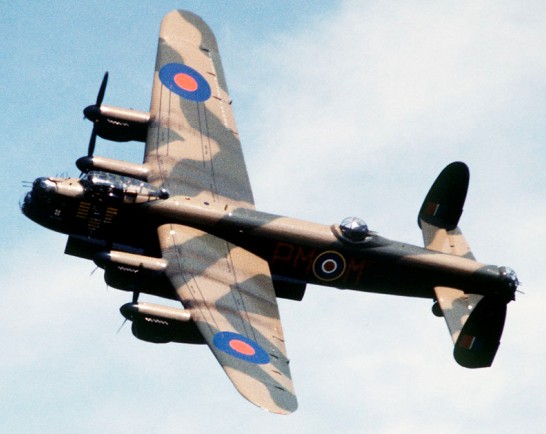
Owing to delays in the full development of the Vulture engine, the decision was taken in mid-1940 to design a new version of the Manchester with four Rolls-Royce Merlin engines. The first conversion made use of about 75 per cent of the Manchester’s parts and assemblies, the principal change being the provision of a new centre-section of the wing with mountings for Merlin engines. This aeroplane became the first prototype of the Lancaster mading its first flight on 9 January 1941. A second prototype fitted with Merlins and significantly modified in detail was designed, built and flown in just eight months.
The first production Lancaster I flew just over five months later, its was powered by four 954kW Rolls-Royce Merlin XX in-line liquid-cooled engines, each driving a three-blade constant-speed and fully feathering propeller.
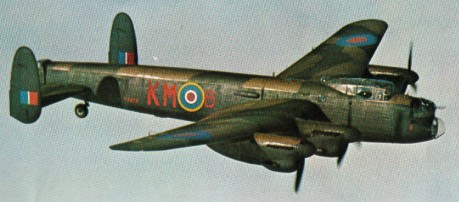
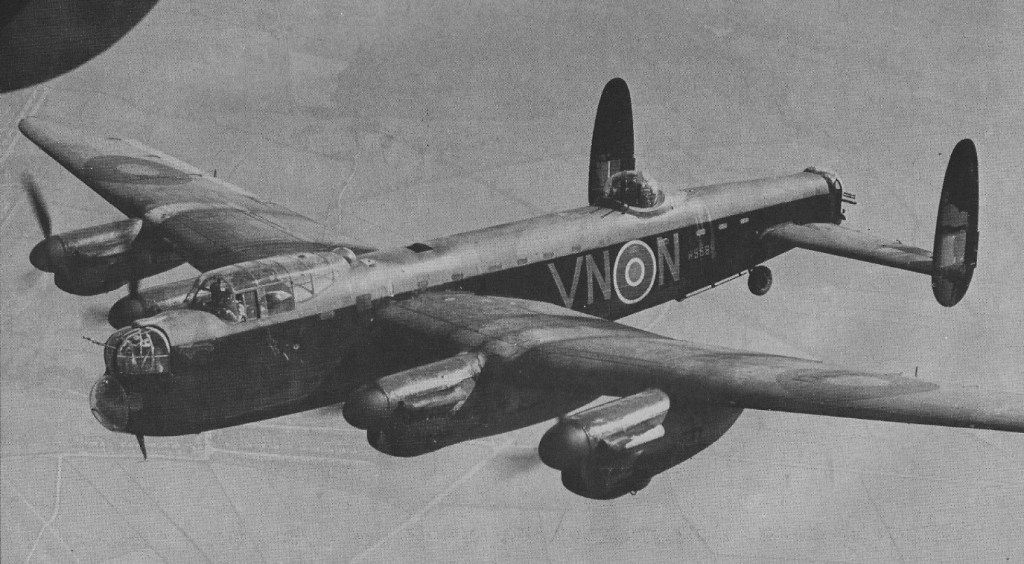
Lancaster I
By 1942, the Mk I was now redesignated with the more traditional B.Mk I naming convention. The system was put into full production at such a pace that the aircraft production lines were outpacing the engine lines. The American Packard company developed the same Merlin engines for shipment back to England. As further insurance, the Bristol company was in line with its own Hercules VI and XVI engines capable of 1,735 horsepower.
The Lancaster II was built with 1,229.5kW Bristol Hercules VI radial engines but only 300 Lancaster IIs were built. The first of Bomber Command’s squadrons to be equipped with the Lancaster was No 44 based at Waddington, Lincs, in early 1942. No 44 used them operationally for the first time on 3 March 1942 laying mines in the Heligoland Bight. Improving engines provided improving performance: the Lancaster VII, with 1,207kW Merlin 24 engines, had a maximum take-off weight of 30,844kg by comparison with the 22,680kg of the early Lancaster I. The bomb bay was modified progressively to carry the 9,980kg Grand Slam bomb. Six major companies built 7377 aircraft at ten factories on two continents; at the height of production over 1,100,000 men and women were employed working for over 920 companies.
The Lancaster operations included the breaching of the Mohne and Eder dams on the night of 16-17 May 1943 by No 617 Squadron (led by Wing Cdr Guy Gibson); and the sinking of the German battleship Tirpitz.
During World War II 608,612 tons of bombs were delivered in 1156,000 sorties, which represented two-thirds of the total bomb load dropped by the RAF from March 1942 to May 1945. At wars end there were 56 squadrons of Lancasters in RAF Bomber Command.
1944 at Friskerton
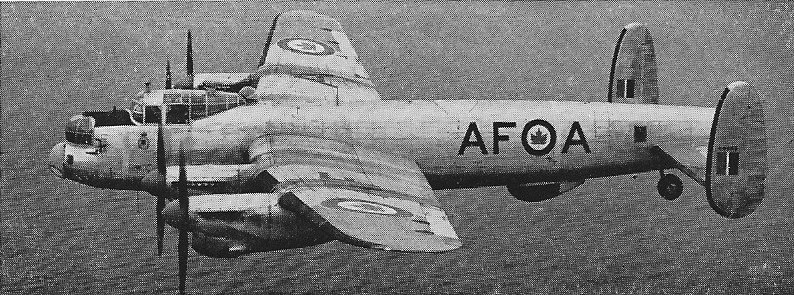
On average Lancasters completed twenty-one missions before being lost. From 1951 until early 1953, France took delivery of 54 reconditioned Lancasters for maritime patrol, general reconnaissance and search and rescue (SAR) work 32 Mk Is and 22 Mk VIIs. In all 13 French Lancasters were destroyed in accidents, or struck off charge following damage. The bulk of the fleet was withdrawn and scrapped with the arrival in strength of the Neptunes in 1958 1959. Others served on with the surviving Escadrilles de Servitude until 1961 1962. It fell to 9S in New Caledonia to be the last French unit to operate Lancasters, giving them up operationally in 1964, ferrying the last two to preservation in April (No 13) and August (No 15) that year. In Canada, 408 Squadron, RCAF, withdrew its last Mk X examples in March 1964 at Rockcliffe.
Lancaster 10-MR
Victory Aircraft in Malton (Toronto), Ontario, produced over 400 Lancaster Mk X’s. The basic aircraft built in Canada was the Lancaster 10-B. Eight were converted for photo-reconnaissance as Lancaster 10-Ps in 1948, and others were converted to Lancaster 10-ASR (Air-sea rescue) and 10-BR (Bomber-reconnaissance) during 1949-50. The Lancaster 10-MR maritime reconnaissance aircraft succeeded the 10-BR, the first conversion flying on 29 December 1950.
Of the 7366 Lancasters built, all but 300 radial engines Mk.IIs had Merlin engines of 1460-1640 hp. All carried a crew of seven. 3487 were lost on operations over Germany during WW2.
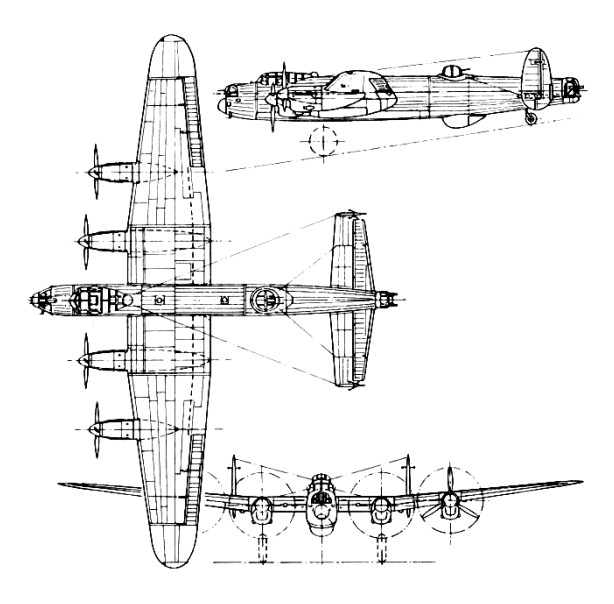
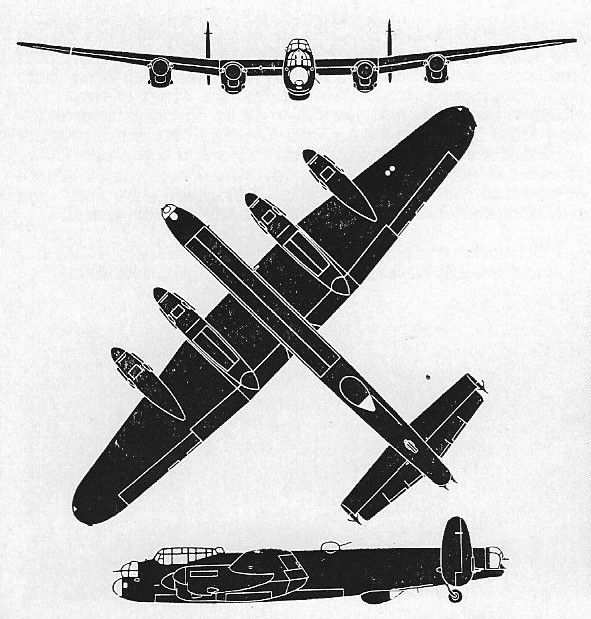
Avro Lancaster I Engines: 4 x Rolls-Royce Merlin XX, 1280 hp(955 kW) or Rolls-Royce Merlin 22, 1460 hp(1089 kW) or Rolls-Royce Merlin 24, 1640 hp(1223 kW) Wing span: 31.09m Length: 21.18m Height: 6.25m Wing area: 120.49sq.m Empty eight: 16,783 kg MTOW: 30,845 kg Max speed: 44s kph @ 4570m Range: 4072 km Armament: 9 x 7.7 mm Browning mg Bombload: 9979 kg
Avro 683 Lancaster Mk I Engine: 4 x Rolls Royce Merlin XXIV, 1618 hp Length: 69.488 ft / 21.18 m Height: 20.013 ft / 6.1 m Wingspan: 102.001 ft / 31.09 m Wing area: 1296.954 sq.ft / 120.49 sq.m Max take off weight: 70013.2 lb / 31752.0 kg Weight empty: 36907.3 lb / 16738.0 kg Max. speed: 249 kts / 462 km/h Cruising speed: 183 kts / 338 km/h Service ceiling: 24606 ft / 7500 m Cruising altitude: 20013 ft / 6100 m Wing load: 54.12 lb/sq.ft / 264.0 kg/sq.m Range w/max.fuel: 3600 km / 2237 miles Range w/max.payload: 1800 km / 1118 miles Range with 14,000 lb. (6,350 kg.) of bombs: 660 miles (2,700 km.). Crew: 7 Armament: 10x MG 7,7mm, 8185 kg Bombs
Lancaster II Engines: 4 x Bristol Hercules. Length: 70ft.
Lancaster III Length: 69 ft 6 in Wingspan: 102 ft Top speed: 275 mph Armament: 8-10 x .303 mg Bomload: 18,000 lb Crew: 7 Range: 2530 miles
Lancaster X Type 7 Seat Heavy Bomber Engines: 4 x Rolls Royce Merlin 224, 1620 hp Wing Span: 102 ft (31.1 m) Length: 69ft 6″ (21.1 m) “ Height: 20ft 4″ (6.2 m) Speed: 272 Mph (438km/h) Armament: Nose and Dorsal Turrets with two 0.303in Brownings, tail turret four 0.303in Brownings. Bombs-14,000lbs – 22,000lbs with modification
683 Lancaster 10-MR Engines: 4 x Rolls Royce Merlin 224, 1620 hp Empty weight: 41,000 lb Loaded weight: 68,000 lb Max speed: 250 mph Cruise: 216 mph Range: 2250 mi Wingspan: 102 ft Length: 68 ft 10 in Height: 20 ft Wing area: 1297 sq.ft
Designed by Roy Chadwick in 1934 the Anson featured twin-engines, a cantilever low-wing with retractable landing gear, and a steel tube fuselage with wooden wings construction. Two were built to an Imperial Airways order of 1933.
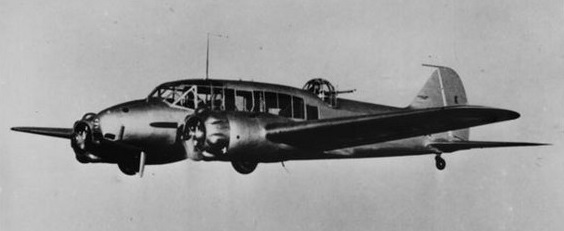
The Anson itself was produced to fulfill Specification 18/35 brought about by the British Air Ministry and originally intended for use as a maritime reconnaissance platform. The Anson protoype (Avro 652A, K4771) achieved first flight in this new militarized form on March 24, 1935. Evaluation of the system led to first-run production of the Anson Mk I model series with first deliveries occurring in March of 1936. The Royal Air Force’s No.48 Squadron became the types first user.
The Anson had capabilities that made it useful in the training of pilots, bombardiers and gunners. The arrival of the Second World War sealed the future of the Anson as a primary trainer and multi-role platform for Britain, her Commonwealth nations and nations across the globe.
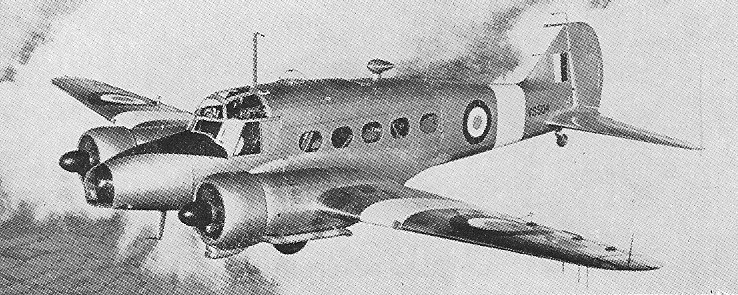
The Avro 652A Anson I was both a general reconnaissance aeroplane and advanced crew and navigation trainer, descended directy from the Avro 657. Only 6 Mk.1 Ansons were delivered from Avro in 1938. The Anson Mk.1s were later re-winged to the Mk.XIX full metal mainplane.
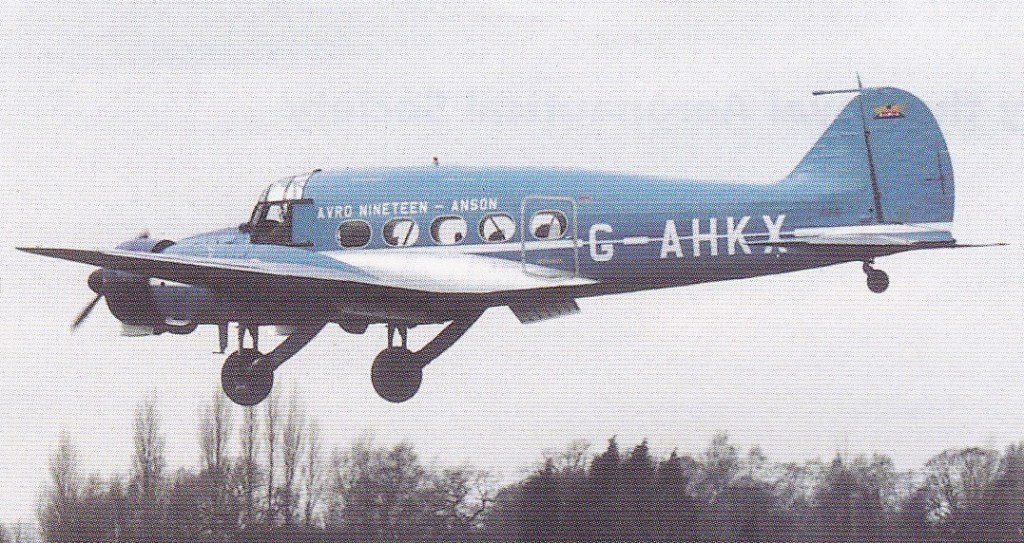
Avro XIX G-AHKX post 20-year restoration flight 8 March 2001
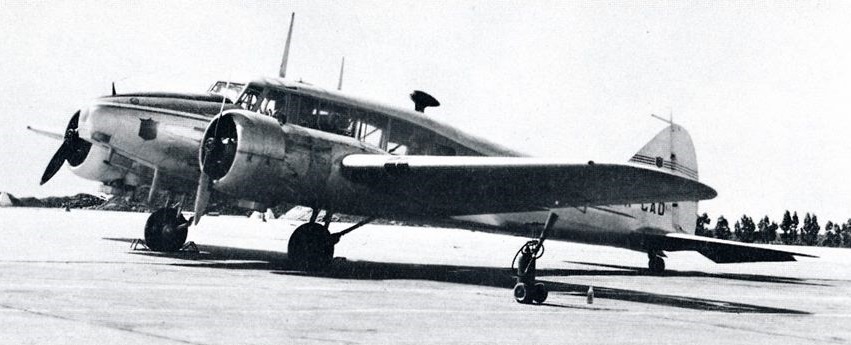
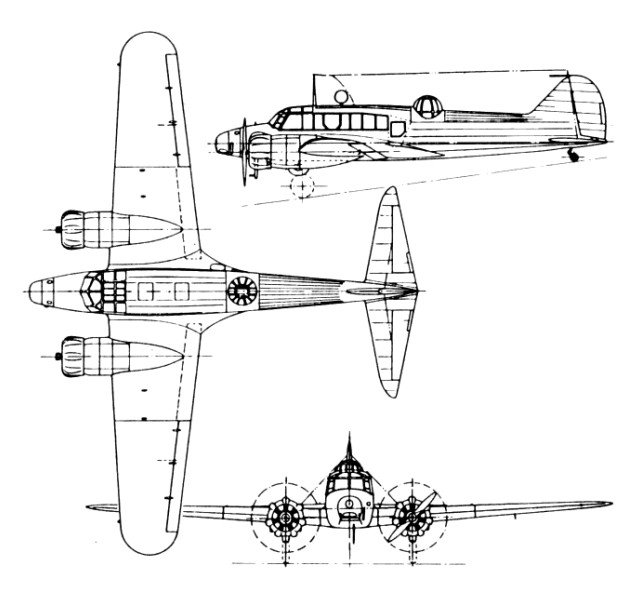
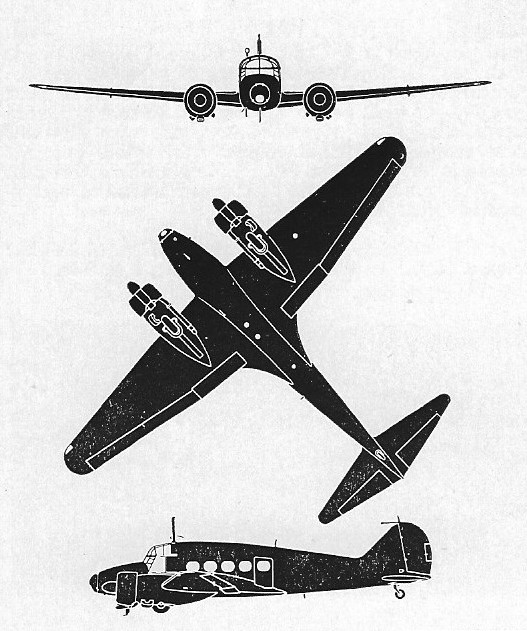
Outwardly, the Anson fuselage was rounded and decidedly streamlined (sometimes showcasing rounded cabin windows – five windows to a side). Perhaps the most distinct feature of the aircraft’s profile was its “duckbill” nose assembly, protruding well past the front windscreen. The aircraft sported low-mounted monoplane wings with rounded wingtips. Each wing held a radial piston engine housed in nacelles powering two-bladed propellers. The engines were placed well-forward of the wing leading edge and met up nearly at the length of the fuselage nose. The undercarriage was typical of the time, featuring two main landing gears and a tail wheel. The main landing gears retracted forward into the bottom of each engine nacelle. The Anson became the first RAF aircraft to feature a fully-retractable undercarriage, this accomplished via a manual hand-crank controlled by the pilot. The empennage was of a conventional sort, with a rounded vertical tail fin and low-mounted horizontal planes. Typical crew accommodations amounted to 3 or 4 personnel. Armament consisted of up to 4 x 7.7mm (.303 cal) Vickers-type machine guns in the front fuselage, a dorsal turret and at two other cabin locations. Additionally, the Anson could be fitted with up to 500lbs of internal ordnance.
The legacy of the Anson was solidified by its sheer production numbers and quantity of variants the line evolved into. The Mk I represented the most quantitative Anson, with 6,688 examples seeing delivery. This version was powered by the Armstrong Siddeley Cheetah series engines of 350 (Cheetah IX) or 395 (Cheetah XIX) horsepower. Maximum speed for Cheetah IX-powered Ansons was reported to be around 188 miles-per-hour with a range topping off at 790 miles. Service ceiling figures put the Anson Mk I at 19,000 feet with a rate-of-climb nearing 750 feet-per-minute.
The production prototype flown in December 1935 was a forerunner of 7,195 Avro-built Anson I for the RAF, RN, RAAF, SAAF, RGAF, Greece and Egypt. Production Ansons were first issued to No 48 Squadron, which put them into service on 6 March 1936. Armament included two 45kg and eight 9kg bombs, a forward-firing Vickers gun and a Lewis gun in a turret amidships.
Operational with Coastal Command between 1936 and 1939 and for air-sea rescue until 1942, the majority were delivered as turretless trainers for the Commonwealth Air Training Plan in Canada, Australia and South Africa. Canadian Car and Foundry became involved in the programme to produce the Avro Anson 1, which had been adopted as the main twin engined trainer for pilots in the British Commonwealth Air Training Programme (BCATP) in Canada. Originally the aircraft were to be assembled in Canada from British components, but problems with shipping and supply caused these plans to be abandoned in 1940. Canada, with a commitment to provide a training scheme, but without the necessary aircraft, was forced to establish its own manufacturing and production programme. Almost all of the Canadian aircraft manufacturers, including CCF, became involved in the production of what was now designated the Anson II, production being co ordinated by Federal Aircraft Ltd, a company specifically formed for that purpose.
Can Car was involved at two levels, producing components as well as entire aircraft. During a two year production period from 1941 to 1943, the company manufactured some 800 wings and 300 fuselages at its plants in Quebec and later produced more than 4,400 Hoover variable pitch propellers to replace the wooden propellers fitted as original equipment. The Anson II built in Canada was basically a copy of the British Anson 1 with Canadian made components and a number of engineering and structural modifications such as the adoption of the Jacobs L6MB engine in place of the Armstrong Siddeley Cheetah, the addition of an engine driven hydraulic system, modifications to the undercarriage and the replacement of some of the metal fittings by moulded plywood components. Can Car built 341 complete aircraft at its new factory in Amherst, Nova Scotia, and it was the prototype from that plant which was the first of the Anson IIs to take to the air in August 1941. In all, 1,832 Anson IIs were built, most destined for the flying schools of the BCATP, although fifty were ordered by the USAAF where they were designated Federal AT 20. The last one left RCAF active service in 1954. Britain took to producing these Ansons as well and designated them as Anson Mk III.
Anson MK IV’s were produced in Britain and fitted Wright Whirlwind engines.
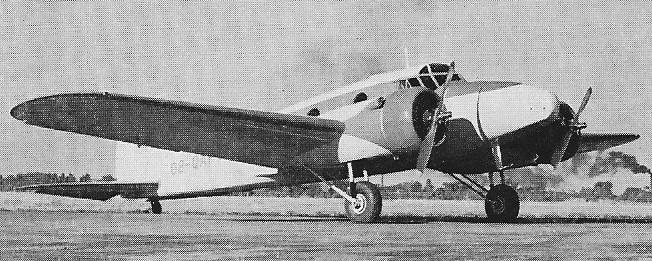
The Anson V variant grew out of experience with the Mk II as well as the Canadian interest in replacing metal structures with the more readily available, cheaper and more easily worked wooden equivalents. The Mk V incorporated the Anson II wing, horizontal tail and undercarriage, but the fuselage was almost completely redesigned and the more powerful Pratt and Whitney R-985 Wasp Junior engines were installed. Apart from the cockpit section, which was of welded steel tube construction covered by plywood panelling, the fuselage consisted of US developed, moulded plywood, monocoque units bolted together, comprising a nose section and three after sections, the rearmost of which included the tail fin. The net result was a fuselage with a larger capacity, which was both warmer and quieter than that of the Anson II. In addition, being aerodynamically cleaner than its predecessor and with more powerful engines, the Mk V had an improved performance in all categories from load to service ceiling. The first Anson V flew in January 1943 and by the time production ceased two years later, 1,048 had been built. Of these, 300 came out of the Can Car plant at Amherst. Like the Mk II, the Anson V saw service with the BCATP, mainly in a navigational training role, although a small number were fitted for communications and photo reconnaissance work. Following the war, the Anson V became a favourite with aerial survey companies in North America, from Mexico to the high Arctic.
The Anson 5, built during the war years by Federal Aircraft Ltd in Canada, differs from British-built Ansons, featuring a Vidal moulded veneer fuselage and two 450 hp Pratt & Whitney R-985 AN-12B or 14B supercharged radials. Production commenced in 1942 as a navigation trainer for the CAF. The Anson 6 was similar but equipped as a gunnery trainer. 1050 Mk.4 and 6 were built.
Anson 5
The post-war series of Anson trainers and transport all possess the raised cabin roof first introduced on the Anson C.11. The majority later received metal wings and tailplane. Of the 326 Mk.19 built, 143 had wooden wings and tail unit, and the remaining aircraft were all metal.
Anson T.20
The Anson Mk VI was a “one-off” Canadian Anson fitting two Pratt & Whitney Wasp Junior engines of 450 horsepower and intended for gunnery and bombardier training.
Anson 10
Increased headroom created the Anson 11 or 12 according to engine. The Anson 10, introduced in 1943, had strengthened floors for continental freight runs by Air Transport Auxiliary. The Anson Mk X represented at least 104 Anson Mk I models converted to the new Mk X designation. Similarly, the Anson Mk 11 was formed from 90 Mk I models conversions. The Anson Mk 12 was well-formed in two-hundred twenty-one new-build production examples along with 20 conversions from Anson Mk I models.
The Anson 12, furnished as a feeder-liner eight-seater, became the Avro 19 Series 1 or Series 2 (tapered metal wing) for the RAF, BEA and civil operators in the UK and abroad.
The Anson Mk XIII was a proposed gunnery trainer that was never put into production. These would have been powered by twin Cheetah XI /XIX series engines. The Mk XIV was another gunner trainer proposal that never saw the light of day. These would have fitted the Cheetah XV series engines. The Mk XVI was to be a navigational trainer and the Mk XV would have been used as a bomber trainer – both of these designs were never put into production.
The Royal Air Force used 264 Ansons as transport and communications platforms under the C 19 designation. Navigational trainers were also fielded, these coming in 252 examples under the T 21 designation. Anson T 22s were 54 radio trainers for the Royal Air Force. RAF Ansons made up 26 squadrons at their peak of usage. Australia was a major Commonwealth operator, utilizing no fewer than 1,028 Ansons up until 1955.
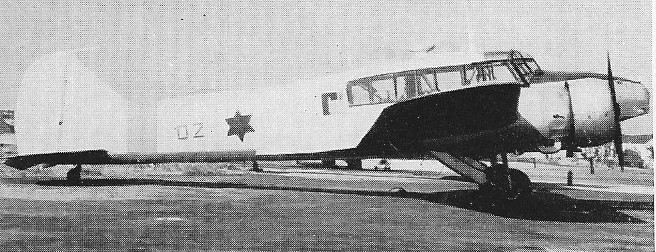
After the war surplus Ansons were sold to civil charter firms and the air forces of Belgium, Holland, Iran, Israel, Norway, Portugal and Saudi Arabia. Development continued during and after the war, culminating in the adaption of the civilian Avro XIX for service use as the Anson C19. With a completely re-designed fuselage, and metal wings and tail plane, this second generation Anson continued in RAF service until 1968. Two production series made up this mark, totaling 56 examples.
Final variants of 1948-49 were twelve communications and reconnaissance Anson 18s (spawned from the Avro XIX) delivered to Afghanistan and the thirteen pilot trainers Anson 18Cs delivered to India; 60 Anson T.20 (perspex nose) for navigation training in Southern Rhodesia; T.21 (metal nose) for the RAF in the UK; and T.22 radio trainer.
A total of 8138 built in the UK (3,881 Ansons at the Avro factory at Yeadon, plus enough parts to build another 900 Ansons) and another 2882 built in Canada, during 17 years of production.
The Avro Anson was produced from 1935 to 1952, to which some total 11,020 examples were built. Avro handled production in Britain with 8,138 total examples being produced there while Canadian Federal Aircraft LTD provided for a further 2,882 examples locally-produced in Canada. The last one was delivered to the Royal Air Force on 15 May 1952, and RAF Ansons were retired as late as 1968, thirty-three years after the type’s inception into service. No fewer than 27 nations across the world ended up fielding the Anson in some form or another.
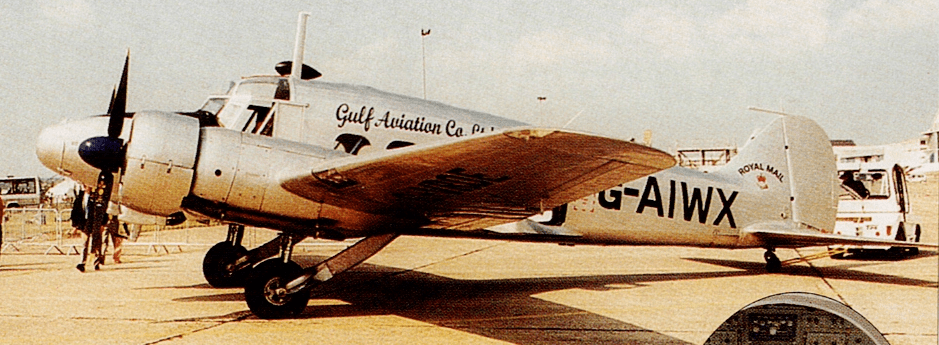
Anson G-AROE, painted as G-AIWX, left Coventry on 10 March 2000 for France, Italy, Greece, Egypt, Jordan and Saudi Arabia for Gulf Air’s 25 March official anniversary on 25 March.
Avro 652 A Anson Mk I Engine: 2 x Armstrong Siddeley Cheetah Mk IX, 345 hp Length: 42 ft 3 in / 12.88 m Height: 13 ft 1 in / 3.99 m Wingspan: 56 ft 6 in / 17.2 m Wing area: 410.001 sq.ft / 38.09 sqm Max take off weight: 8000 lb / 3629.0 kg Weight empty: 5375.8 lb / 2438.0 kg Max. speed: 164 kts / 303 km/h Cruising speed: 137 kts / 254 km/h Service ceiling: 18996 ft / 5790 m Wing load: 19.48 lb/sq.ft / 95.00 kg/sq.m Range: 686 nm / 1271 km Crew: 3 Armament: 2x MG 7,7mm, 163kg Bomb
Avro Anson C.Mk 1 Engines: 2 x Armstrong Siddeley Cheetah IX 7-cylinder radial, 350hp Length: 42.26ft (12.88m) Width: 56.50ft (17.22m) Height: 13.09ft (3.99m) Maximum Speed: 188mph (303kmh; 164kts) Maximum Range: 808miles (1,300km) Rate-of-Climb: 750ft/min (229m/min) Service Ceiling: 18,999ft (5,791m) Armament: Up to 4 x 7.7mm Vickers machine guns Up to 500lbs of bombs held internally. Accommodation: 3 to 5 Empty Weight: 5,512lbs (2,500kg) Maximum Take-Off Weight: 8,598lbs (3,900kg)
Avro 652A Anson Powerplant: 2 x Pratt & Whitney R-985AN-14 Wasp Jr, 450hp. Wing Span : 56ft 6in (17.2 m) Length : 42ft 3in (12.9 m) Height : 13ft (4 m) Range: 790 mi(1,271 km) Speed : 190 mph 304 km/h
652A Anson C.10 Engines: 2 x 320 hp Armstrong Siddeley Cheetah 9 Wingspan: 56 ft 6 in Length: 4 ft 3 in Empty weight: 6510 lb Loaded weight: 9450 lb Max speed: 188 mph Cruise: 158 mph
Anson T.21 Engines: 2 x 420 hp Armstrong Siddeley Cheetah 15 Wing span: 57 ft 6 in Wing area: 440 sq.ft Length: 42 ft 3 in Height: 13 ft 10 in Empty weight: 7766 lb Loaded weight: 10,306 lb Max speed: 171 mph at 5000 ft ROC: 700 fpm
Anson T.22 Engines: 2 x 420 hp Armstrong Siddeley Cheetah 15 Wing span: 57 ft 6 in Wing area: 440 sq.ft Length: 42 ft 3 in Height: 13 ft 10 in Empty weight: 7766 lb Loaded weight: 10,306 lb Max speed: 171 mph at 5000 ft ROC: 700 fpm
Anson II Engines: 2 x L6MB Jacob.
Anson III Engines: 2 x L6MB Jacob.
Federal Anson 5 Engines: 2 x 450 hp Pratt & Whitney R-985 AN-12B or 14B Wingspan: 56 ft 6 in Wing area: 463 sq.ft Length: 42 ft 3 in Height: 13 ft 1 in Empty weight: 6750 lb Loaded weight: 9450 lb Max speed: 194 mph at 3500 ft Cruise: 150 mph Range: 650 mi
Federal Anson 6 Engines: 2 x 450 hp Pratt & Whitney R-985 AN-12B or 14B Wingspan: 56 ft 6 in Wing area: 463 sq.ft Length: 42 ft 3 in Height: 13 ft 1 in Empty weight: 6750 lb Loaded weight: 9450 lb Max speed: 194 mph at 3500 ft Cruise: 150 mph Range: 650 mi





 All Aero