Giuseppe Mario Bellanca was born in 1886 in Sciacca, Sicily. As a young man, he attended the Technical Institute in Milan, graduating with a teaching degree in mathematics in 1908. During his quest for a second mathematics and engineering degree, he became enamoured of aviation, and set out to design and build his own airplane. Bellanca’s first aircraft design was a “pusher” aircraft, somewhat similar to the Wright Flyer. Lacking funds for such an endeavor, he joined with two partners, Enea Bossi, and Paolo Invernizzi. The union of the three produced the first flight of a totally Italian-designed and Italian-built aircraft in December of 1909. Bellanca’s second design, was a tractor-type aircraft. Although the aircraft was successfully constructed, it was never flown due to insufficient funds for an engine. At the urging of his brother Carlo, who was already established in Brooklyn, New York, Giuseppe Bellanca immigrated to America in 1911. Before the end of the year, he began construction of his third airplane design, a parasol monoplane. After construction was completed, he took the small craft to Mineola Field on Long Island, NY, and proceeded to teach himself to fly. He began by taxiing. He then, taxied faster, which gave way to short hops. The hops got longer, until, on May 19, 1912, there was not enough room to land straight ahead, and Bellanca had to complete a turn in order land safely. Having successfully taught himself to fly, Bellanca then set about teaching others to fly, and from 1912 to 1916, he operated the Bellanca Flying School. One of his students was a young Fiorello La Guardia, the future mayor of New York City. In return for flying lessons, La Guardia taught Bellanca how to drive a car. In 1917 the Maryland Pressed Steel Company of Hagerstown, MD hired Bellanca as a consulting engineer. While there, he designed two trainer biplanes, the CD, and an improved version, the CE. With the conclusion of WWI, Maryland Pressed Steel’s contracts were cancelled and the company entered into receivership. Thus, the CE never went into production. In 1921, a group of investors lured Bellanca westward to Omaha, NE, in hopes of establishing that town as a center for aircraft manufacture. Before the aircraft could be built, the company went bankrupt, but construction of the aircraft continued under the financial backing of a local motorcycle dealer named Victor Roos. The resultant aircraft, the Bellanca CF, was called by Janes’s All the World’s Aircraft “the first up-to-date transport aeroplane that was designed, built, and flown with success in the United States.” Among the local people helping to build the aircraft was the daughter of Bellanca’s landlord, Dorothy Brown. Giuseppe and she were married on November 18, 1922. Despite its advanced design, the Bellanca CF could not compete with the economics of the time. In the days just after World War I, a surplus Curtiss Jenny could be purchased for as little as $250.00. A Bellanca CF, with a price tag of $5000.00, was just too expensive and the aircraft never went into production. After the disappointment of the CF, Bellanca designed wings for the Post Office Department’s DH-4’s. His new wings were a tremendous improvement over the original design, but only a few aircraft were so modified. In 1925, Bellanca went to work for the Wright Aeronautical Corporation of Paterson, NJ. His assignment there was to develop an aircraft around the new Wright Whirlwind engine. He already had a design in mind, which was an improved version of the CF, called the CG. This design evolved into the Wright-Bellanca WB-1. The WB-1 enjoyed a short, but successful flying career. The aircraft had already won one race and efficiency contest before an untimely accident destroyed the craft during preparation for an attempt to break the world’s non-refueled endurance record. Fortunately, at the time of the crash, Bellanca was already working on an improved version, of the WB-1 designated the WB-2. During 1926, the WB-2 won two efficiency trophies at the National Air Races in Philadelphia. Wright considered putting the aircraft into production, but decided against it to avoid alienating other aircraft companies that were potential customers for their engines. Disappointed by Wright’s decision, Bellanca left the company and joined with a businessman named Charles Levine to form the Columbia Aircraft Company. Wright sold the WB-2 and all drawings and production rights to the new company. The WB-2 went on to a long and fruitful flying career starting with establishing a new world’s non-refueled endurance record of 51 hours, 11 minutes, and 59 seconds in April of 1927. In the latter half of 1926, Charles Lindbergh wanted to buy the WB-2, now named the ‘Columbia’, for his proposed flight from New York to Paris. He was rebuffed by Levine who also had designs on the flight and the $25,000 prize money. Lindbergh then went to Ryan for his “Spirit of St. Louis”. Meanwhile Levine, in choosing the crew, managed to promise two seats to three people. So while the Columbia was grounded by a court order brought by the third party, Lindbergh took off on his successful flight to Paris. Eventually, the ‘Columbia’ was cleared of litigation and took off on its successful transatlantic flight on June 4, 1927. In the cockpit were Clarence Chamberlin, one of the pilots of the endurance record and Charles Levine, who became the first transatlantic passenger. The plan was to fly all the way to Berlin, and Chamberlin had vowed to fly until they ran out of fuel. Forty-three hours later, they landed in Eisleben, Germany, the first of two successful Atlantic crossings for Bellanca’s most famous aircraft. Disappointed because the ‘Columbia’ was not the first aircraft to accomplish the New York to Paris flight, Bellanca severed all relations with Levine, and started his own company, the Bellanca Aircraft Corporation of America, and rented facilities on Staten Island, NY. The new Bellanca model was designated the CH, and was basically a commercial version of the WB-2. The new company also had two other models that were built for special orders, the Bellanca Model J and the Model K. It was not long before Bellanca caught the attention of the Du Pont family of Delaware. They wanted to start aircraft manufacturing in Delaware, and in late 1927, an agreement was made with Bellanca to locate his factory outside of Wilmington. The site was large enough for a first-class airfield, with a seaplane ramp on the nearby Delaware River. This was a busy time in Bellanca’s life. Along with all that was happening in his professional life, he and Dorothy celebrated the birth of their son August T. Bellanca in March of 1927. With the exception of a few years immediately before and during the early stages of WWII, Bellanca was President and Chairman of the Board from the corporation’s inception on the last day of 1927 until he sold the company to L. Albert and Sons in 1954. All assets were acquired by Northern Aircraft in 1955 and Bellanca name finally dropped 1959 after merger with non-aviation companies. After his departure from the company, Giuseppe and his son, August, formed the Bellanca Development Company with the purpose of building a new aircraft. It would have increased performance due to the use of lighter materials for its structure. Work on this aircraft was progressing when Giuseppe Bellanca succumbed to leukemia and died on December 26, 1960. After his father’s death, August continued the project, and under his guidance, the aircraft, a record breaker, first flew in 1973. Northern Aircraft became Downer, then Inter-Air, and in 1967, Bellanca Sales, a subsidiary of Miller Flying Services. As the company grew, its name became Bellanca Air¬craft Corporation. Champion Aircraft Corporation was merged into it in 1970, adding two place aerobatic, sport and utility aircraft to the line. 1974 closed with the firm still in the busi¬ness only of building Vikings in Alexandria and Champi¬ons in Osceola, Wisconsin, and with sales slowing a bit. In late 1974, Bellanca was forced to suspend production in order to work off an in¬ventory of airplanes. In 1978 Bellanca became a wholly-owned subsidary of Anderson, Greenwood, of Houston, Texas, subsequently developing the T-250 Aries and Eagle. Work stopped in 1980 and the firm liquidated in 1981. Assets were sold to Viking in 1982. Viking resumed Viking production in 1984. Work stopped in 1988. The original Bellanca company was restarted by Guiseppe Mario Bellanca and son August in 1968, initially in West Virginia and later Maryland. Work stopped in 1986. The firm was resurrected as AviaBellanca. In 1993, August Bellanca donated his father’s 1920 CF to the Smithsonian along with many personal and corporate papers and correspondence. NASA craftsmen restored the aircraft and it is on display at the Smithsonian Air & Space Museum’s new Steven F. Udvar-Hazy Center near Washington’s Dulles International Airport. The far-sighted, innovative designer and builder of American aircraft, Giuseppe M. Bellanca was enshrined in the National Aviation Hall of Fame in 1993, the Delaware Aviation Hall of Fame in 1999.
1998: Avia Bellanca Aircraft Corp 11800 Sunrise Valley drive, Suite 322 Reston Virginia 20191 USA
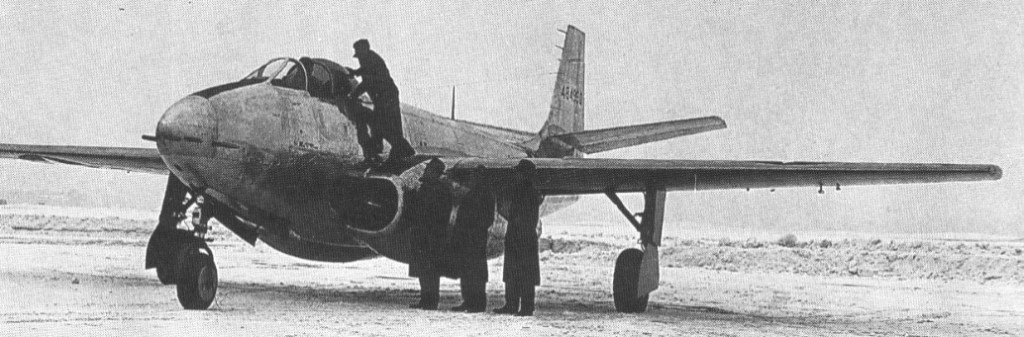
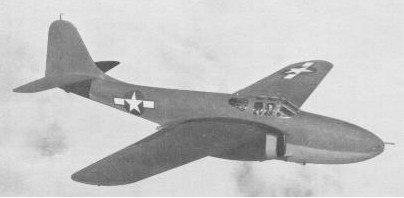
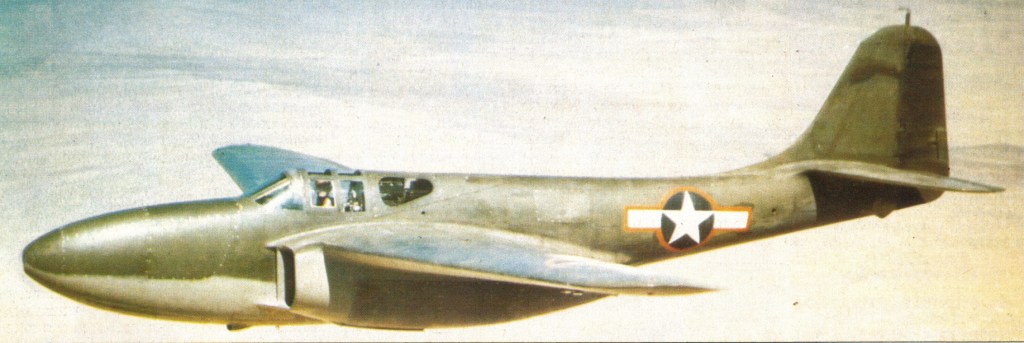
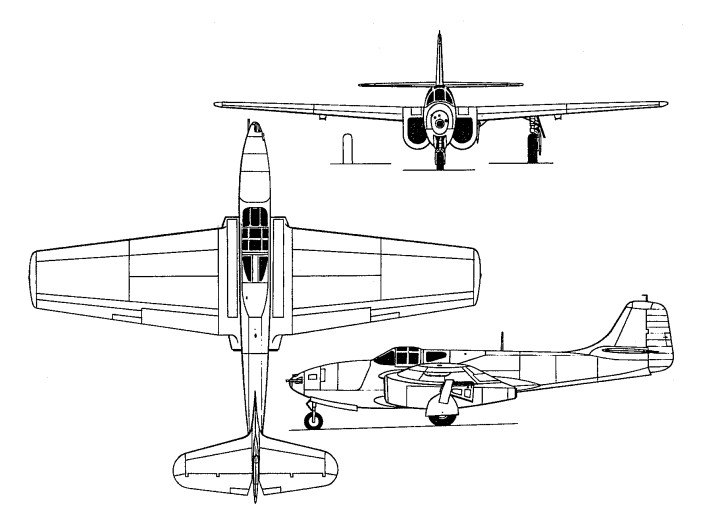
Bell’s last fighter, designed to replace the P-51, was the long range single seat XP-83. On 24 March 1944 the USAAF tasked Bell to build a larger, longer-range jet fighter to superceed the P-51 Mustang. Bell assigned engineer Charles Rhodes to develop the XP-83, powered by two 1633kg thrust General Electric 1-40 (later J33-GE-5) turbojets, and to be armed with six 12.7mm Browning nose machine-guns. First flown on 25 February 1945, the first XP-83 proved underpowered and unstable. The close proximity of the two low-slung powerplants caused hot exhaust gases to buckle the tail-plane unless, during run-ups, fire trucks were used to play streams of water over the rear fuselage.
The second XP-83 was completed with a slightly different bubble canopy and extended nose to accommodate six 15.2mm guns, the increase in barrel diameter being based on anticipated firepower needs for the planned amphibious invasion of Japan. This airframe was used in gunnery tests at Wright Field, Ohio. Modified tailpipes, angled outwards, resolved the heat/buckling problem. Wind tunnel tests showed than a 45.7mm extension of the vertical tail would assure stability, though it is not clear whether this modification was actually made. Except range, which was 3540km with underwing drop-tanks, the Bell XP-83 offered no improvement over the Lockheed F-80 Shooting Star then in production. For the post-war fighter-escort role, the newly independent USAF turned to the North American F-82 Twin Mustang. The redesignated XF-83 operated as a flying testbed for new technology. The first XP-83 was assigned to a ramjet engine test programme. A hatch was cut in the belly to provide entry into the aft fuselage and an engineer’s station with a small port-side window, was created behind the pilot. Experimental ramjets were slung under the wings. The intent was for the XF-83 to serve as a proving vehicle for ramjet power, once aloft flying with the ramjets alone. On 4 September 1947, just as this test programme had begun, a ramjet caught fire and flames spread to the wing. Pilot Chalmers ‘Slick’ Goodlin and engineer Charles Fay, without benefit of ejection seats, bailed out safely and the XF-83 was destroyed.
XF-83 Engines: 2 x General Electric J33-GE-5, 1814kg Max take-off weight: 10927 kg / 24090 lb Empty weight: 6398 kg / 14105 lb Wingspan: 16.15 m / 52 ft 12 in Length: 13.66 m / 44 ft 10 in Height: 4.65 m / 15 ft 3 in Wing area: 40.04 sq.m / 430.99 sq ft Max. speed: 840 km/h / 522 mph Ceiling: 13715 m / 45000 ft Range w/max.fuel: 2784 km / 1730 miles Crew: 1 Armament: 6 x 12.7mm machine-guns
Initially, the idea of a small, cheap, all-wood fighter built with few strategic materials had held high appeal. In early 1941, Larry Bell’s upstate New York fighter team had begun work on a plane at first called the ‘Tri-4’, shorthand for an informal USAAF requirement for ‘400hp, 4,000lbs, 400mph’. On 16 May 1942, the USAAF ordered 25 ‘Tri-4’ aircraft. Delays, technical problems with subcontracting on plywood construction, and disappointing wind-tunnel tests caused the manufacturer to suggest by early 1943 that the number of machines on order be reduced to six. In May 1943, the USAAF reduced this to two, seeing the XP-77 as having no operational utility but as useful in lightweight fighter research.
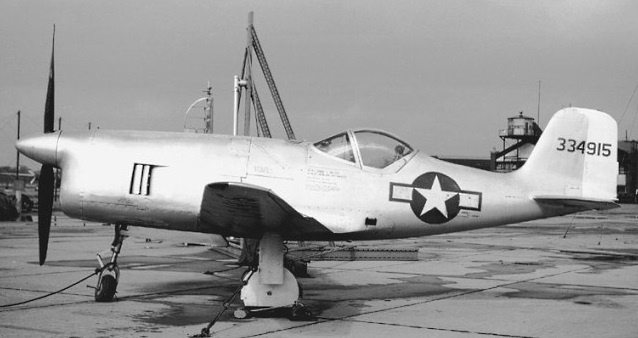
The all-wood Bell XP-77, using a Ranger inverted V-12 inline piston engine, was of Sitka spruce and intended to operate from grass and the first of two XP-77s flew on 1 April 1944 at Niagara Falls, New York, test pilot Jack Woolams at the controls.
Beginning in July 1944, the second XP-77 was tested at Eglin Field, Florida. Spin problems led to a crash of this aircraft on 2 October 1944, which the pilot survived.
Plagued by noise and vibration, an unexpectedly long take-off run, and general performance ‘inferior to the present fighter aircraft employed by the USAAF’, the XP-77 programme was stopped on 2 December 1944. The prototype went to Wright Field, then back to Eglin, then to Wright again. It was seen at post-war displays wearing spurious markings and its final disposition is unknown.
XP-77 Engine: 1 x Ranger XV-770-7, 388kW Prop: 2 blade Wingspan: 8.38 m / 27 ft 6 in Length: 6.97 m / 22 ft 10 in Height: 2.50 m / 8 ft 2 in Wing area: 9.29 sq.m / 100.00 sq ft Max take-off weight: 1827 kg / 4028 lb Empty weight: 1295 kg / 2855 lb Max. speed: 531 km/h / 330 mph / 285 kt Ceiling: 9175 m / 30100 ft Range: 885 km / 550 miles Crew: 1 Armament: 2 x 12.7mm machine-guns Bombload: 136kg / 300 lb
In 1938 the US Navy became involved in three new fighter projects the Grumman XF5F 1 and similar USAAF XP 50, the Bell XF1 1 and the Vought XF4U 1. The long term intention was to bolster the Navy’s car¬rier forces whose squadrons flew the Grumman F3F 2 biplane fighter of the mid¬1930s.
The XFL-1 experimental shipboard fighter was developed in parallel with the XP-39 Airacobra, and was flown for the first time on 13 May 1940 with test pilot Brian Sparks at the controls. Powered by a 1150hp Allison XV-1710-6 12-cylinder liquid-cooled engine, the XFL-1 had a tailwheel undercarriage and underwing radiators. The airframe was re-stressed for shipboard operation, and proposed armament comprised a single 12.7mm machine gun or a 37mm cannon firing through the propeller hub and a pair of fuselage-mounted 7.62mm guns, although, in the event, no armament was installed.
The use of the conventional undercarriage also worked against the XFL as problems began to develop during testing. As a result, the system had to be shipped back to Bell Aircraft for further revisions in late 1941. By this time, however, the United States Navy decided to pursue a different direction and cancelled development of the XFL in whole.
The XFL-1 failed its carrier qualification trials and further development was abandoned at the beginning of 1942. The single XFL-1 prototype cost US$125,000, and was then used in a series of armament tests until it was eventually scrapped.
Engine: 1150hp Allison XV-1710-6 Max take-off weight: 3271 kg / 7211 lb Empty weight: 2341 kg / 5161 lb Wingspan: 10.67 m / 35 ft 0 in Length: 9.09 m / 29 ft 10 in Height: 3.90 m / 12 ft 10 in Wing area: 21.55 sq.m / 231.96 sq ft Max. speed: 494 km/h / 307 mph Range: 1725 km / 1072 miles Rate-of-Climb: 2,630ft/min (802m/min) Service Ceiling: 30,922ft (9,425m) Accommodation: 1
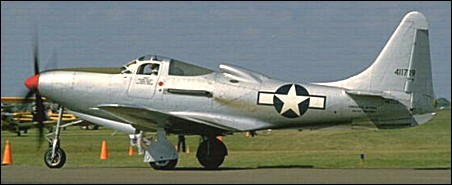
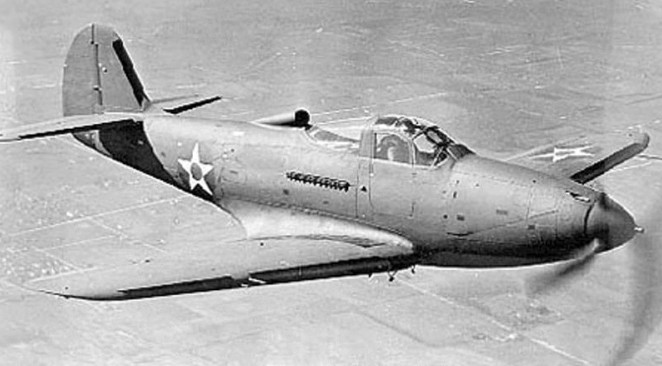
At a fairly early stage in the development of the Bell P-39 Airacobra, work had been carried out to enhance the per-formance of this aircraft by the introduction of aerodynamic improvements. A line of investigation resulted in a USAAF contract for two “XP-63” prototypes awarded in June 1941. Three experimental aircraft were built, each utilising the basic fuselage of the P-39D, to which were added a new laminar-flow wing with square wingtips and a revised tail unit. In fact, each of the three XP-39Es, as these aircraft were designated, had a different tail unit. It was planned originally to power the prototypes with the Continental Aviation and Engineering Corporation’s IV-1430 12-cylinder inverted-vee piston-engine, which had demonstrated a power output in excess of 1491 kW (2,000 hp). However, Allison V-1710 engines of little more than half of that power output were installed.
As it emerged, the P-63 was similar enough to the P-39Q to be mistaken for it, the P-63A being a low-wing aircraft with tricycle landing gear, mid-mounted Allison engine, car doors on each side of the cockpit, and armament consisting of a 37 millimeter cannon firing through the prop hub, two 12.7 millimeter Brownings on top of the nose, and a single 12.7 millimeter Browning in a fairing under each wing, for a total of five guns.
The P-63 was a generally new design, featuring little parts commonality with the P-39. The P-63 was slightly longer than the P-39, with the most distinctive recognition feature being that the trailing edge of the rudder on the P-63 was straight, while it was rounded on the P-39; the P-63’s tailfin was also taller. Another distinctive recognition feature was a four-bladed prop.
Other changes were subtler. The wingspan and wing area were increased, and the wing featured the new “laminar” airfoil configuration established by NACA. More importantly, the P-63 was powered by an Allison V-1710-93 engine with a second supercharger stage — not a turbocharger, giving it good high altitude performance.
Bell was distracted by producing the P-39 in volume, and the initial XP-63 design turned out to be badly overweight, demanding a redesign. The same basic fuselage design and engine (with two superchargers) was fitted into an enlarged airframe – essentially based on the XP-39E with a laminar flow wing, improved supercharger and new Continental I-1430 engine. Three prototypes were ordered, two with Allison V-1710-47 engines and one with a Packard V-1650 Merlin. The Packard-engined XP-63 was never built. The prototype was powered by an Allison V-1710-93 engine and a four-bladed propeller. Armament remained as the P-39Q model design with a 37mm nose cannons, 12.7mm heavy machine guns in the engine cowl and an additional 2 x 12.7mm heavy machine guns under the wings in pods. The designation was set as Bell Model 33, or P-63 Kingcobra. The first XP-63 (serial number 41-19511) flew on 7 December 1942, though the aircraft was lost in a crash a few weeks later.
The second prototype (serial number 41-19512) took to the air on 5 February 1943, but was lost in a crash in May. Both powered by the 988-kW (1,325-hp) Allison V-1710-47 engine. Fortunately for the program, a third prototype had been ordered in mid-1942. The third prototype, the XP-63A, first flown on 26 April 1943 and powered by a V-1710-93 engine with a war emergency rating of 1119kW (1,500 hp). It was planned subsequently to flight-test this prototype with a Packard-Merlin V-1650-5 engine installed, under the designation XP-63B, but this did not happen.
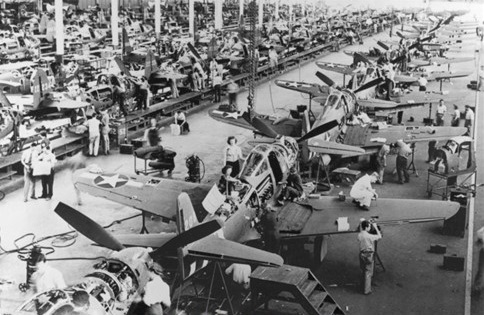
The type was ordered into production, with the first “P-63A Kingcobra” machines rolled out in October. Some 4,000 aircraft were to be built at Bell’s Marietta, Ohio, facility but were cancelled only three months later.
A total of 50 initial production P-63A-1 machines was built. They were followed by improved subvariants: The “P-63A-5” was much the same as the P-63A-1 but featured some minor detail changes and new radios. 20 were built. The “P-63A-6” added a stores attachment under each wing for an external tank or bomb. 130 were built. The “P-63A-7” was a minor change on the P-63A-6, featuring a modified tailplane with wider span, revised mountings for the nose machine guns, and other fixes. 150 were built. The “P-63A-8” featured an Allison engine with water-methanol injection, which permitted several minutes of combat power under redline operation, further improving the P-63’s performance. Ammunition supply for the wing guns was cut from 250 to 200 rounds per gun. 200 were built. The “P-63A-9” was similar to the P-63A-8, but featured more cockpit armour. 445 were built. The “P-63A-10” replaced the old M4 37 millimeter cannon with the improved M10 model, and also raised the cannon’s ammunition supply from 30 rounds to 58 rounds; the small ammunition supply for the cannon had been a persistent pilot complaint. In addition, the P-63A-10 featured an N-9 lead-computing gunsight. 730 were built.
The first five of these target aircraft were designated RP-63A-11. Five P-63A-9s were initially built as “RP-63A-11” targets, with armor but no armament. They featured the rear cockpit glazing faired over, a modified carburetor scoop, and were fitted with a light on the prop spinner and on each side coupled to an array of sensors that would cause the lights to flash when the aircraft was hit by special “frangible” ammunition broke up on impact. The primary rationale was to train gunners on bombers to counter fighter attacks.
The 95 RP-63A-12s based on the P-63-10 which followed had increased fuel tankage; the next produc¬tion version, with the V-1710-117 engine, became designated RP-63C (200 built) and the final version was the RP-63G (32 built), this having the V-1710-135 engine. RP-63A/C’s were based on five P-63A completed production models modified for the role while at least 95 other A-models were modified as such while still on the production lines. Although never flown as pilotless drone aircraft, the designations of these three versions were changed subsequently to QF-63A, QF-63C and QF-63G respectively.
RP-63 Pinball
The Soviet Union operated the P-39 and, with input from Soviet test pilot Andrey G. Kochetkov, the P-63 Kingcobra was modified for the better and ultimately shipped to the Soviet Union from Nome, Alaska, to be used solely against Japanese forces in the East. Despite this “agreement” on the part of the Soviets, P-63 air groups were set up in the West to battle the Germans. The P-63 excelled in the ground attack role, and as tank busters. Soviet use of the P-63 amounted to over 72% of all Kingcobras produced, making them the primary operator of the aircraft.
Equipment of production batches varied considerably, resulting in many sub-types. The first production P-63A-ls had V-1710-93 engines, a nose-mounted 37-mm M4 cannon and two 12.7-mm (0.5-in) machine-guns in underwing fairings; other sub-types had two additional 12.7-mm (0.5-in) guns mounted in the fuselage nose. P-63A-ls and P63A-5s could accommodate a 284-litre (75-US gal) or 662-litre (175-US gal) drop tank, or a 237-kg (522-lb) bomb beneath the wing centre-section; P-63A-6s had underwing racks for two similar bombs or additional fuel; and P-63A-10s could mount three air-to-surface rockets beneath each wing. The weight of defensive armour, intended primarily to give protection from ground weapons, increased progressively from 39.8 kg (87.7 lb) on the P-63A-1 to 107.2 kg (236.3 lb) on the P-63A-10.
A “P-63B” variant with a Rolls-Royce Merlin engine was considered but never built, and so the next Kingcobra variant was the “P-63C”. The P-63A was succeeded on the production line by the P-63C with the improved V-1710-117 engine, this offering with water injection an emergency war rating of 1342 kW (1,800 hp), wingspan clipped by 25 centimeters (10 inches) and, after early production at least, a prominent ventral fin to improve yaw stability; it is unclear if the fin helped reduce the aircraft’s propensity to spin.
P-63C-5 two-seat conversion
The “P-63C-1” was the initial production subvariant, with 215 built; they were followed by 1,012 “P-63C-5” machines with minor improvements. 200 more P-63C-1 machines were manufactured as “RP-63C-2” Pinball targets, for a total of 215 + 1,012 + 200 = 1,427 P-63C machines built.
Only one “P-63D” – technically a “P-63D-1” – was built. It was similar to the P-63A-10, with no ventral fin, but featured a bubble canopy and the carburetor intake moved back, presumably to allow the canopy to be slid back to open. The wingspan was increased over that of the P-63A, to 11.94 meters (39 feet 2 inches); the P-63D was powered by an Allison V-1710-109. The aircraft was lost in a crash due to an engine fire that claimed the life of pilot Bob Borchardt.
The P-63D was followed by the “P-63E”, which was along the lines of the P-63C-10, with the ventral fin and the M10 cannon, but with the wider wingspan, stepped-back carburetor intake, and V-1710-109 engine of the P-63D. It retained the old car-door cockpit scheme; it featured more fuel capacity and a new Aeroproducts propeller.
Thirteen of the P-63E (or Bell Model 41), all that had been produced of 2,930 on order when contracts were cancelled at the war’s end, and which were generally similar to the P-63D except for a reversion to the standard cockpit canopy. The P-63E was similar to the D-model but sported the original automotive-style doors of the P-39 Airacobra and P-63A and P-63C Kingcobras. The underside fin was extended some and a new propeller were fitted though only 13 examples of this Kingcobra made it out the door. The E-model exhibited a top speed of 408 miles per hour, a cruising speed of 280 miles per hour, a range of 450 miles and a service ceiling of 43,000 feet.
There were two P-63F-1 built on an experimental basis. A version of the P-63E with a V-1710-135 engine and modified tail surfaces and substantially taller tailfin.
P-63F Kingcobra N6763 / 43-11719
The XP-63H was a single conversion attempt based on a modified P-63E and featuring a new engine.
One other unusual version of the King-cobra was built extensively (in excess of 300) for use by the USAAF in a training programme involving the use of live ammunition. Developed from the P-63A, all armour and armament was removed, and the external surface of the wings, fuselage and tail unit were protected externally by the addition of a duralumin alloy skin weighing some 680kg (1,500 lb). Other protection included the installation of bulletproof glass in windscreen and cockpit side and upper windows, the provision of a steel grille over the engine air intake and steel guards for the exhaust stacks, and the use of a propeller with thick-walled hollow blades All of these precautions were to make possible for the aircraft to be flown as a target that could withstand, without significant damage, the impact of frangible bullets. When a hit was made by an attacking aircraft a red light blinked to confirm the accuracy of the weapon being fired against it.
The first five of these target aircraft were designated RP-63A-11; the 95 RP-63A-12s which followed had in-creased fuel tankage; the next production version, with the V-1710-117 engine, became designated RP-63C (200 built). The final production version of the Kingcobra was the “RP-63G” Pinball target, with 32 built, for a total of 100 + 200 + 32 = 332 Pinballs. The RP-63G had the V-1710-135 engine. RP-63A/C’s were based on five P-63A completed production models modified for the role while at least 95 other A-models were modified as such while still on the production lines. Although never flown as pilotless drone aircraft, the designations of these three versions were changed subsequently to QF-63A, QF-63C and QF-63G respectively. The Pinballs remained in service after the war, but were generally retired in 1947.
Two P-63C production models were converted into L-39 test aircraft for swept wing and wind tunnel evaluation.
Bell considered but never built a trainer version, though the company did add a secondary cockpit on the rear fuselage to one P-63A and two P-63Es, the rear cockpit being used to seat an observer to keep an eye on trials aircraft. The Soviets did perform at least three conversions of P-63As to “TP-63A” trainer configuration, with a configuration along the lines of that of the TP-39 trainers.
At the time of their production, a single P-63 cost American tax payers $48,000 to produce. A total of 3,303 were built.
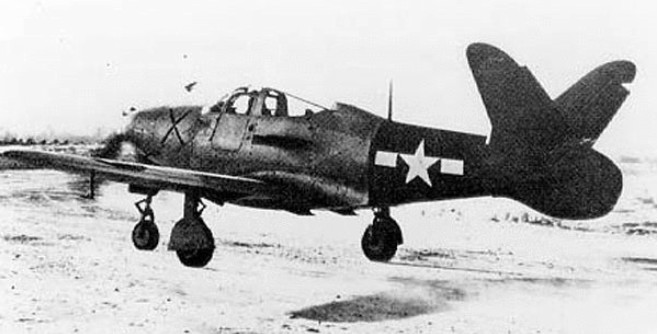
A P-63A was converted in 1945 as a test-bed for a V-tail.
The XP-63N was a 1948 RP-63G conversion for V-tail testing.
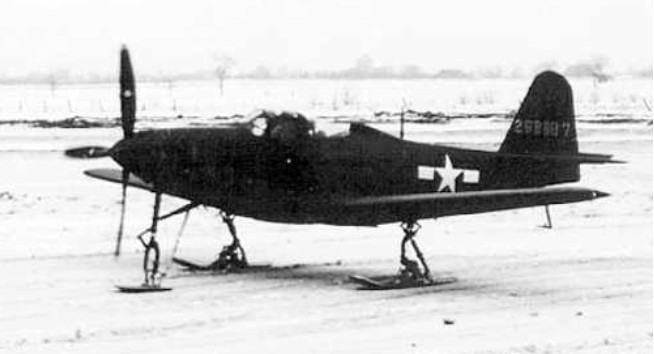
Bell P-63A on skis (S/N 42-68887)
The Soviets were the primary users of the P-63, obtaining about 2,400, air ferried by the Siberia route. P-63s shipped to the USSR never saw combat against the Nazi Reich; the Soviets had plenty of fighter aircraft at the time, and being intent on performing a thorough evaluation of the Kingcobra before putting it into service, it was not available to frontline units before the Nazi surrender in May 1945. Some Red Air Force pilots recollected seeing P-63s in service against the Germans, but no records confirm this.
The P-63 did see action in the brief Soviet campaign against the Japanese before Japan’s surrender in August 1945, primarily being used for escort and ground attack.
After the war, the P-63 remained in first-line Red Air Force service. It was seen as very useful in helping pilots convert to new jet fighters as they came into service, since the jets generally had tricycle landing gear. The Kingcobra lingered on the flightlines into the early 1950s. There are tales that US pilots encountered them during the war in Korea, but no documentation confirms that notion.
The only other serious export user of the Kingcobra was the French Armee de l’Aire, which received 114 P-63Cs at the end of World War II. They served in combat as ground-attack aircraft in the French war in Indochina, being finally retired in 1951 in favour of US-supplied Grumman F8F Bearcat piston fighters. Some P-63s lingered in liaison and other secondary roles for a few years after that.
The Kingcobra was out of military service by the mid-1950s, but a few surplus P-63s did have a new career as air racers in the postwar period. A number of Kingcobras survive as museum displays, while a few remain flying as airshow “warbirds”.
Including the Pinballs, a total of 50 + 20 + 130 + 150 + 200 + 445 + 730 + 5 + 95 = 1,825 P-63A machines was built.
P-63A Kingcobra Initial production machines Engine: one 988-kW (1,325-hp) Allison V-1710-93 inline piston Maximum speed 660 km/h (410 mph) at 7620m (25,000ft) Cruising speed 608 km/h (378 mph) Service ceiling 13110m (43,000 ft) Range maximum weapon load and internal fuel 724 km (450 miles) Ferry range maximum internal and external fuel 3541 km (2,200 miles) Empty weight: 2892 kg (6,375 lb) Maximum take-off 4763 kg (10,500 lb) Wing span 11.68m (38ft 4in) Length 9.96m (32ft 8in) Height 3.84m (l2ft 7in) Wing area 23.04sq.m (248 sq ft) Armament: one 37-mm M4 cannon, two wing-mounted and two nose¬mounted 12.7-mm (0.5-in) mg, plus up to three 237-kg (522-lb) bombs.
P-63A Kingcobra Wingspan: 11.68 m / 38 ft 4 in Wing area: 23.04 sqm / 248 sq. ft Length: 9.96 m / 32 ft 8 in Height: 3.84 m / 12 feet 7 in Empty weight: 2,892 kg / 6,375 lb MTO weight: 4,763 kg / 10,000 lb Max speed at altitude: 660 KPH / 410 MPH / 355 KT Service ceiling: 13,100 m / 43,000 ft Range: 725 km / 450 MI / 390 NMI
P-63A-l Engine: Allison V-1710-93 Armament: nose-mounted 37-mm M4 cannon and two 12.7-mm (0.5-in) machine-guns in underwing fairings; other sub-types had two additional 12.7-mm (0.5-in) guns mounted in the fuselage nose.
P-63A-1 284-litre (75-US gal) or 662-litre (175-US gal) drop tank, or a 237-kg (522-lb) bomb beneath the wing centre-section
P-63A-5 284-litre (75-US gal) or 662-litre (175-US gal) drop tank, or a 237-kg (522-lb) bomb beneath the wing centre-section
P-63A-6 284-litre (75-US gal) or 662-litre (175-US gal) drop tank, or a 237-kg (522-lb) bomb beneath the wing centre-section, underwing racks for two similar bombs or additional fuel
P-63A-7 Engine: Allison V-1710-93, 1325 hp
P-63A-10 Three air-to-surface rockets beneath each wing.
P-63C Engine: Allison V-1710-117/E21, 1342 kW (1,800 hp) / 1100 hp @ 25,000 ft. Length: 32.81ft (10m) Width: 38.39ft (11.70m) Height: 12.47ft (3.80m) Empty Weight: 6,834lbs (3,100kg) Maximum Take-Off Weight: 8,818lbs (4,000kg) Maximum Speed: 410mph (660kmh; 356kts) Maximum Range: 450miles (725km) Rate-of-Climb: 2,500ft/min (762m/min) Service Ceiling: 42,979ft (13,100m) Armament: 1 x 37mm cannon in propeller hub 4 x 12.7mm machine guns (2 x in nose; 2 x in wing assembly). Accommodation: 1 Hardpoints: 3 Number built: 1227
P-63C-5 Engine: Allison V-1710-117, 1325 hp Wingspan: 38 ft 4 in Wing area: 248 sq.ft Length: 32 ft 8.5 in Empty weight: 6694 lb Loaded weight: 10,700 lb Max speed: 410 mph at 25,000 ft
P-63D Engine: Allison 109/E22, 1100 hp @ 28,000 ft. Number built: 1
P-63E / Bell Model 41 Engine: Allison 109/E22, 1100 hp @ 28,000 ft
P-63F Engine: Allison V-1710-135, 1450 hp / 1081 kW
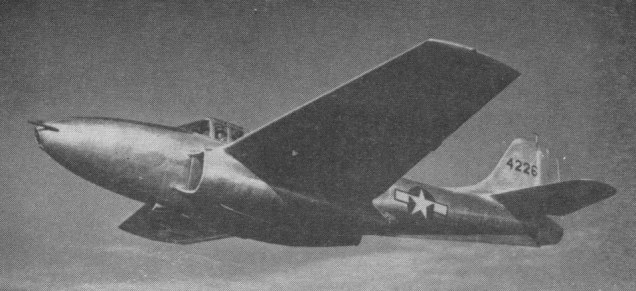
The XP59 Airacomet project was launched by USAF Major General Henry (Hap), Arnold on the 5th September 1941 began when he approached Bell Aircraft and asked them to build a new fighter based around the GE-1, a license made Whittle W2/B engine. The contract was signed on the 30th September with a deadline of eight months to produce the first of three prototypes designated XP-59A’s.
The Bell designers adopted a conventional approach which resulted in a preliminary design in just two months. This was approved and construction of the first prototype started which was shipped to Muroc Dry Lake (Now Edwards Air Force base) on the 12th September 1942 for ground tests. The engines called GE-1’s were built at the same time by General Electric and had an initial thrust of 1,250 lbs. This meant that two engines were required and in the Airacomet these were mounted side by side in the fuselage.
After being trucked out to Muroc Dry Lake, California, draped in tarpaulin with a fake propeller attached, the Airacomet was first flown on the 1st October 1942 by Robert M. Stanley, chief test pilot for Bell aircraft, although the official first flight was recorded as the 2nd of October.
The Airacomet was kept secret and it was only announced to the public in 1943.
XP-59
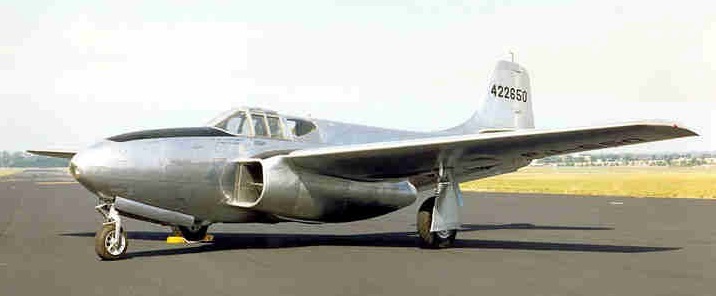
Named Airacomet, 13 development YP-59A aircraft followed during 1943-4 with the more powerful General Electric 1-16 (131) turbojet, and these were used primarily to provide basic flight data on turbojets. Production orders for 20 P-59A aircraft with J31-GE-3 engines and 80 P-59B aircralt with J31-GE-5 engines were awarded but, as a result of successful development of the Lockheed P-80 Shooting Star the last 50 of the latter were cancelled as superfluous, All production had been completed by the end of the war and many of the aircraft were issued to a special USAAF unit, the 412th Fighter Group, for use as drones or drone controllers, some aircraft having a second open cockpit in the nose for an observer. No P-59 ever achieved operational status, being found to lack adequate performance.
One XP-59A, a trade for a Gloster Meteor flown by the USAAF, was evaluated briefly by the RAF at Farnborough and wore British markings. Three more were flown by the US Navy under the designation XF2L-1.
Bell XP-59 Airacomet Span: 45ft 6in (13.87m) Length: 38ft 2in (11.63 m) Height: 12ft 4in (3.76 m) Powerplant: Two General Electric I-A’s (each 1,250lb (567kg) thrust) Maximum speed: 404 mph Weight: Empty 7,320lb (3,320 kg), Loaded 12,562lb (5,698 kg) Armament: 2x 37mm cannons Range: 400 miles
Bell P-59A Airacomet Engines: 2 x General Electric I-A turbojet engines generating 2,800lbs of thrust each. Length: 38.16ft (11.63m) Width: 45.51ft (13.87m) Height: 12.34ft (3.76m) Maximum Speed: 413mph (664kmh; 359kts) Maximum Range: 240miles (386km) Rate-of-Climb: 3,200ft/min (975m/min) Service Ceiling: 46,194ft (14,080m) Armament: 1 x 37mm cannon, 3 x 12.7mm machine guns Bombload: 2,000lbs. Accommodation: 1 Hardpoints: 2 Empty Weight: 7,937lbs (3,600kg) Maximum Take-Off Weight: 12,699lbs (5,760kg)
P-59B Airacomet Type: single-seat interceptor fighter Powerplant: two 907-kg (2,000-1b) thrust General Electric J31-GE-5 turbojets Span 13.87 m (45 ft 6 in) Length 11.62 m (38 ft 1.5 in) Height 3.66 m (12 ft 0 in) Wing area 35.84 sq.m (385.8 sq ft) Maximum speed 658 km/h (409 mph) at 10670 m (35,000 ft) Cruise speed: 560 km/h / 348 mph Climb to 3050 m (10,000 ft) in 3 minutes 20 seconds Service ceiling 14040 m (46,200 ft) Range 644 km (400 miles) Empty weight 3704 kg (8,165 lb) Maximum take-off 6214 kg (13.700 lb) Crew: 1 Armament: one 20-mm M4 cannon and three 12.7-mrn (0.5-in) machine-guns in the nose
Bell had been working on a single-seat fighter, the “Bell Model 3”, in response to a 1936 US Army Air Corps (USAAC) requirement. As the design emerged, it was a low-wing monoplane with tricycle landing gear, then an unusual feature, with the engine unconventionally mounted in mid-fuselage, turning the propeller through a driveshaft. This arrangement, which had been used in a few earlier experimental aircraft, was seen as enhancing agility by placing the engine at the machine’s center of gravity (CG), as well as permitting installation of heavy armament in the nose. There was some thought of putting the cockpit behind the engine, close to the tail – but that was quickly judged unrealistic, with the cockpit moved forward of the engine, this revision being designated the “Model 4”.
The Bell proposal was submitted to the Air Corps in May 1937, with the USAAC awarding a contract for a single prototype of what had by then become the Bell “Model 12”, more formally “XP-39”, in October of that year.
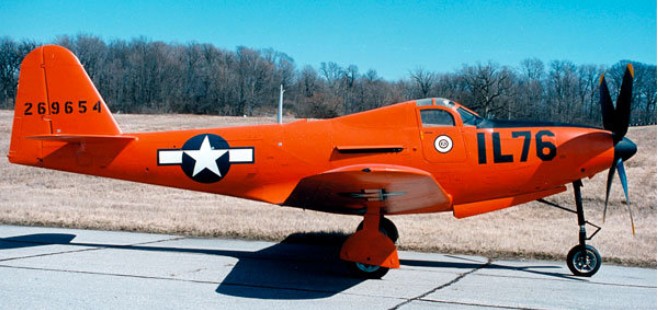
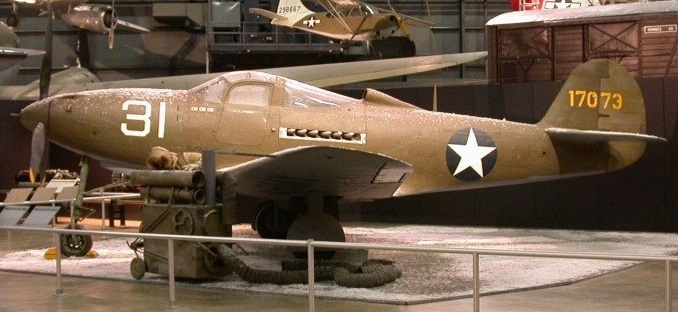
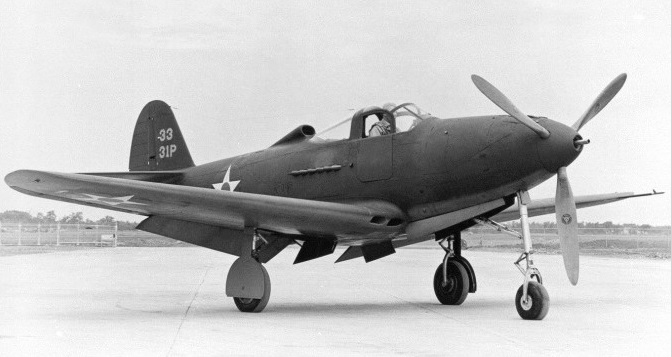
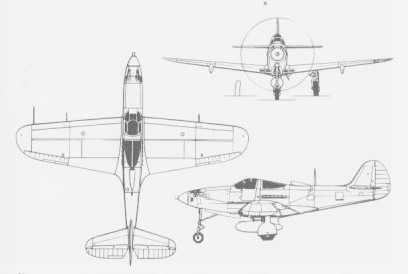
The 1938 Airacobra was single-seat fighter with a tricycle landing gear, a single Allison V-1710-17 liquid-cooled engine of 1,150 horsepower (860 kW) located behind and below the pilot and driving the propeller by means of an extension shaft, and a cannon firing through the hollow propeller shaft (in addition to fuselage-mounted machine-guns). A turbosupercharger was mounted on the port side of the fuselage. The aircraft featured a scoop on each side of the engine for the turbocharger system.
Though the XP-39 wasn’t armed armament was envisioned as an Oldsmobile M-4 37mm cannon mounted in the upper forward portion of the fuselage nose with the barrel protruding and firing out through the propeller hub, two 12.7mm Browning machine guns in the upper-forward portion of the fuselage and additional 12.7mm (.50 caliber) machine guns were added to either wing – one to a wing.
Initial flight of the XP-39 prototype was on 6 April 1939, with test pilot James Taylor at the controls.
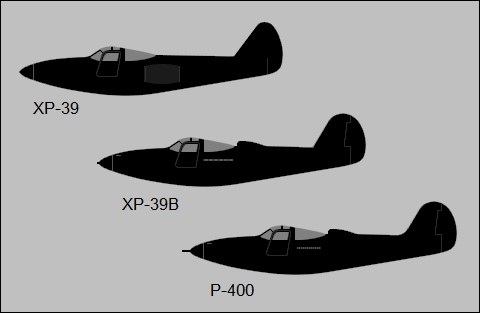
On the basis of satisfactory initial test flights, the Air Corps awarded Bell a contract to produce a dozen “YP-39” evaluation machines – with the order then augmented with a 13th machine that was originally planned as the “XP-39A” – to feature changes recommended in light of studies by the US National Advisory Committee for Aviation (NACA). While work went on to build these machines, the XP-39 was rebuilt to the “XP-39B” configuration, the primary change being that the turbocharger system was deleted, with the Allison engine reverting to its standard single-stage supercharger. The air intake was now moved to the upper portion of the fuselage and another Allison engine was selected for production that would provide better low-level performance. The XP-39 was the only Airacobra to be fitted with a turbocharger system.
It appears that NACA wind tunnel experiments showed the XP-39 turbocharger installation was so aerodynamically cluttered that it did more harm than good. The XP-39B deleted the scoops for the turbocharger, and instead featured a small but distinctive carburetor intake on the spine of the aircraft. The re-born XP-39B performed its initial flight on 25 November 1939.
The first of the batch of YP-39s performed its initial flight on 13 September 1940, with all delivered by the end of the year. They also used a supercharger instead of turbocharger; the later YP-39 machines in the evaluation batch featured armament. Even before the first flight of YP-39, the Air Corps had ordered a batch of production machines, originally designated “P-45” but then designated “P-39C”, their configuration being much like that of the armed YP-39s. The first P-39C flew in January 1941.
The P-39C really wasn’t suitable for combat, lacking armor and self-sealing tanks. 80 had been ordered, but only 20 were built, combat reports from Europe indicating that the P-39C was simply not up to combat duty. The remaining 60 machines in the order were built with armor, self-sealing tanks, and enhanced armament as the “P-39D”. The P-39C ended up being an evaluation type, with the P-39D being the first Airacobra to go into formal service with the Army Air Corps. It would also be the first “Cobra” variant to see action.
The initial production P-39 systems became the P-39C models and were quickly followed by the P-39D series. The aircraft almost took on the designation of P-45 due to the radical list of changes from the original proposal through it was eventually settled that the P-39 designation was sufficient in detailing the significant changes and additions. P-39C models had a pair of 7.62mm (.30 caliber machine guns) mounted in between the existing 12.7mm heavy machine guns. Sixty examples of the ordered P-39C models effectively removed the 12.7mm heavy caliber wing-mounted machine guns and replaced them with 4 x 7.62mm types (two machine guns to a wing with 1,000 rounds each) and became P-39D designations while still retaining their nose-mounted 12.7mm heavy machine guns (300 rounds each). The M4 37mm cannon (30 rounds) was still in place. The P-39C had only 15 rounds of ammunition. The P-39C also had two 7.62 millimeter Brownings on the bottom of the nose, but they were deleted for the P-39D.
The pilot got in and out of the cockpit through a car-style side door, with a door on each side. The doors even had roll-down windshields. They made access to the aircraft easy, though they also made escape a bit tricky in a pinch; and they were rigged so they could discarded to simplify bailing out.
Construction was mostly of aircraft aluminum, with some magnesium parts and fabric-covered flight surfaces. All the landing gear assemblies had single wheels, with the nose wheel castoring and ground steering by differential braking. The nose gear retracted backward and the main gear hinged in the wings to pivot towards the fuselage. The engine was a V-1710-35 Allison, also with 860 kW (1,150 HP) but with technical improvements, driving a three-bladed Curtiss Electric variable-pitch propeller. Self-sealing fuel tanks were fitted in the wings; trim considerations made installing fuel tanks in the fuselage problematic, the engine preventing them from being installed on the CG, and the relatively small size of the wing tanks meant modest range.
There was a centerline stores rack, capable of handling stores of up to 225 kilograms (500 pounds). Although the P-39D was used for trials of various configurations of belly tanks for ferry flights, it is unclear if the P-39D ever carried a belly tank in service.
A total of 429 baseline P-39Ds was built, followed by 336 “P-39D-1” machines, the primary difference being replacement of the M4 37 millimeter nose cannon with a 20 millimeter Hispano Mk.404 cannon with 60 rounds of ammunition. It appears the substitution was due to production difficulties with the 37 millimeter cannon. The P-39D-1 also featured a small fillet on the front of the tailfin where it merged with the top of the fuselage; sources are a bit unclear as to whether the fillet was actually fitted to the baseline P-39D, but it certainly didn’t appear on the P-39C.
Following the P-39D-1, Bell built 158 “P-39D-2” machines, much the same as the P-39D-1 but with very minor tweaks. In addition, a total of 26 P-39D-series aircraft was converted to a photo-reconnaissance configuration, the “P-39D-3”, by placing two cameras in the aft fuselage and adding a bit of armor. It is unclear if they retained full armament. They were followed by 11 similar “P-39D-4” conversions. Total production of the D-series was 429 + 336 + 158 = 923 aircraft.
Roughly in parallel with P-39D production, Bell manufactured a total of 675 “P-400” Airacobras for export. The French had bought a batch of P-400s in April 1940; the order was taken over by the British after the fall of France a few months later, with the British then substantially increasing the buy. The P-400 was very similar to the P-39D-1, with the 20 millimeter Hispano cannon, but instead of 7.62 millimeter Brownings in the wings it featured 7.7 millimeter (0.303 caliber) Brownings for compatibility with British ammunition.
While the P-39 Airacobra had established a record as a competent if unspectacular low-altitude fighter, the same could be said of most Russia-produced fighters. The P-39 was a welcome reinforcement but it brought nothing new to the table. What the Russians really needed was a fighter capable of higher-altitude operations. This would allow them to take the battle to the Luftwaffe whose fighter had a major performance edge above the 12,000 to 16,000 foot band where existing Russian aircraft peaked out. Addressing this requirement led to the development of the P-45 Kobrushka. Although the P-45 was essentially a development of the original P-39 prototype with its turbocharged engine, its development was the outcome of tactical considerations and early war experience. The usual statement that the P-45 Kobrushka formed an intermediate stage between the P-39 and the much more formidable P-63 Kingcobra is also only partly true and the two should be regarded as parallel developments.
Experience from the Russian front showed that the limited operational ceiling of the P-39 was a serious problem and that, when flying at its upper altitude limits, the Airacobra was extremely vulnerable to any enemy fighter with decent high altitude performance. In April, 1943, three P-39Ds were ordered modified with a 1,325 hp Allison V-1710-47 engine equipped with a turbocharger and driving an Aeroproducts propeller. This aircraft was designated the XP-39E and carried the same armament as the P-39D but featured a new wing with square-cut tips. This wing was redesigned internally to provide for the carriage of a .50 caliber machine gun within the wing rather than under it as with the P-39. Wing span and gross area were increased to 35 feet 10 inches and 236 square feet. The most noticeable feature was the provision of air intakes on the side of the fuselage for the turbocharger. These were designed so they contributed a small amount of thrust to the aircraft’s propulsion. Each of the three examples tested different vertical tail surfaces—the first being conical, the second being cut-off square and rather short, and the third being similar to the second but larger. The carburetor air intake was relocated and the wing-root radiator intakes were enlarged. The fuselage was lengthened by 1.75 feet to accommodate the longer -47 engine. These changes were so extensive that the aircraft was redesignated the P-45. Since it was primarily intended for supply to the Russian Air Force under lend lease, it was officially dubbed the Kobrushka
During tests, a maximum speed of 386 mph at 21,680 feet was attained, which was much better high-altitude performance than other Airacobra variants. An altitude of 20,000 feet could be reached in 6.3 minutes. The P-45 had a much better high-altitude performance than other Airacobra variants and no less than 4000 were ordered by the USAAF, mostly for supply to the Russians.
The P-45A was virtually identical to the XP-45 except that the 37mm cannon was replaced by an M2 20mm cannon with 100 rounds of ammunition. Experiments had shown that the tall, squared off tail fin offered the best characteristics and this was adopted for the production version. The first P-45As entered USAAF service in December 1943 and were enthusiastically received by their pilots who considered the type equal to the Me-109G and FW-190A. This experience led to a decision to issue the P-45A to selected USAAF units. Large numbers of P-45As were supplied to Russia and equipped the Guard (ie. elite) Fighter Regiments 16 GIAP, 19 GIAP, 21 GIAP, 72 GIAP, 100 GIAP, 213 GIAP (previously 508 IAP) and Fighter Regiments 196 IAP, 255 IAP, 508 IAP (later 213 GIAP). In Russian use, P-45s were often given to pilots who had proved their ability with the P-39. Several Russian Kobrushka aces are known. Lieutenant Colonel of the Guards Alexander I. Pokryshin, a Soviet ace with 59 kills to his credit, scored 48 of these in a P-45. He was awarded the Distinguished Flying Cross by President Roosevelt. There are eight other P-39 and P-45 pilots with at least 20 kills. Among top Airacobra aces were Grigorii A Rechkalov (44 kills) , Nikolai D Gulayev (36 kills), Ivan I Babak, Aleksandr F Klubov, Andrei I Trud, and the brothers Boris B Glinka and Dmitrii B Glinka
The Russian pilots preferred their 20-mm Shvak cannon over the 37mm of other P-39 Airacobra variants because of its greater reliability. In addition, the trajectory of the shells from the 20-mm cannon more closely matched that of the 0.50-inch guns, making for a greater concentration of fire. In the P-39G, the Soviets usually removed the wing guns or had them removed at the factory, preferring a better performance over the enhanced firepower. These considerations lead to the development of the P-45B that was built with a 20mm Shvak cannon replacing the M2 20mm gun. The P-45B retained the two nose-mounted .50 caliber machine guns. Two more .50s were mounted, one in each wing. Originally the P-45B was intended purely for Russian use but American pilots tried the aircraft and approved mightily of the new armament. Accordingly, production was increased and American units started to receive the P-45B. 20mm Shvak cannon were supplied for these aircraft by the Russians, the guns being flown back as cargo for return trips on the Air Bridge. Performance of the P-45B was identical to that of the A model.
The use of the 20mm Shvak cannon eased maintenance of Kobrushkas in Russian units so it was natural to consider a wholly-Russian-armed version of the aircraft. Accordingly, the P-45C was designed, equipped with a single 20-mm B-20 cannon and two or four 12.7mm Berezin UBS machine guns. The B-20 and UBS were virtually the same gun, simply being chambered for different rounds. This eventually led to a rationalization of the armament with the definitive P-45C carrying three 20mm B-20 cannon in the nose. Although all P-45Cs produced were shipped to Russian fighter units, late production P-45Bs in U.S. service had the B-20 gun in place of the heavier ShvaK. Many USAF P-45Bs were re-armed with three B-20 cannon in the nose and two .50 machine guns in the wings.
Produced for both the Russian and American air forces, the P-45D standardized on an armament of three 20mm B-20 guns in the nose. U.S. aircraft carried an additional two M2 or UBS .50 machine guns in the wings. The most obvious visual change was the replacement of the original cockpit with its characteristic side doors by a sliding bubble canopy.”
However, British expectations of the “Airacobra I” – as it was designated in Royal Air Force (RAF) service – had been set by performance figures established by the unarmed and unarmored XP-39 prototype. On evaluation, the P-400 turned out to be about 10% slower than advertised, and of course its high-altitude performance was pathetic. It should be noted, however, that Bell engineers were correct in believing the mid-mounted engine was good for maneuverability, the RAF report concluding that an Airacobra could easily out-turn a Messerchmitt Bf-109.
Only a portion of the P-400 order was delivered to the UK, serving for a short time with RAF Number 601 Squadron, “City Of London”. The RAF performed a single combat mission with the type before withdrawing it from service. The remainder of the batch was shipped to the USSR or was taken in to US Army Air Forces (USAAF) service – the “Air Corps” having been superseded by the “Air Forces” in June 1941. The P-400s saw combat in the South Pacific; it is likely they were fitted with 7.62 millimeter Brownings, though sources are unclear on the matter.
The completed P-39C and D models initially went to war with the 31st Pursuit Group (later becoming “Fighter” Group). As a bombing platform, a single 500lb bomb was mounted to the centerline fuselage
The P-39D left something to be desired in service, suffering from a range of teething problems such as gear that was unreliable or froze up and other deficiencies. Deficiencies were addressed in subsequent variants, initially with a confusing list of P-39 variants built in small or relatively limited numbers:
The “XP-39E”, which was a substantially modified experimental machine, with a 53 centimeter (21.3 inch) fuselage stretch, more fuel capacity, and wider wings plus tailplane. All flight surfaces had squared-off tips, with the tailfin fitted with a prominent leading-edge fillet later in development. It was supposed to have been used to evaluate the Continental V-1430 engine, but non-availability of such meant it was powered by an Allison V-1710-47 engine with a two-stage supercharger instead. Three were built; despite all the changes, its performance was no better than that of the P-39D, and so that line of investigation was abandoned.
The “P-39F” was almost identical to a P-39D with the M4 37 millimeter cannon, but had an Aeroproducts three-bladed prop, since Curtiss was having problems making deliveries. 210 were built, with 27 given minor improvements and redesignated “P-39F-2”.
There was an intent to build a “P-39G” variant, but the aircraft planned for that build ended up getting other designations. There was no “P-39H” nor “P-39I”; the USAAF didn’t like to use the “I” suffix because it was too easy to confuse with a “1” and end up with “P-391”, but what happened to the P-39H designation is unclear. That means the P-39F series was followed in production by the “P-39J”, which was much like the P-39F, but had a slightly improved Allison V-1710-59 engine. 25 P-39Js were built.
The “P-39K” featured the further improved V-1710-63 engine. 210 were built, all under the designation of “P-39K-1”, there apparently not being a P-39K (no block number) subvariant. Six were slightly modified as “P-39K-2” machines, with one P-39K-1 altered as the “P-39K-5” testbed, with a V-1710-85 engine, a wider Aeroproducts prop, and other changes.`
The “P-39L” was much the same as the P-39K, except for fit of a Curtiss Electric propeller with a diameter of 3.15 meters (10 feet 4 inches). 250 were built under the designation of “P-39L-1” – there was no P-39L subvariant – with 11 modified to “P-39L-2” reconnaissance machines.
The “P-39M” was similar to the P-39L, but had a V-1710-67 engine with improved high-altitude performance. 240 were built under the designation of “P-39M-1”, with 8 converted to “P-39M-2” reconnaissance machines. It appears that the P-39M was the first Airacobra to carry a centerline external tank as a normal fit, tank options being either 284 liters (75 US gallons) or 662 liters (150 US gallons).
P-39N
The baseline P-39N featured a V-1710-85 engine and a 3.18 meter (10 foot 4 inch) Aeroproducts prop; a P-39K was modified as the series prototype. 500 of P-39Ns were built, with all but the first 160 featuring elimination of three internal fuel cells to reduce weight. The P-39N could of course carry an external tank to compensate for the smaller internal fuel load, and service units that wanted the full internal fuel load back could install a field upgrade kit to restore the deleted fuel cells. Several further P-39N subvariants were built: The “P-39N-1” featured a wider 3.51 meter (11 foot 7 inch) Aeroproducts propeller. 900 P-39N-1s were built. The “P-39N-2” was a photo-reconnaissance conversion of 128 P-39N-1 machines. The “P-39N-3” was a photo-reconnaissance conversion of 35 baseline P-39N machines. The “P-39N-5” was a P-39N-1 with armor plate replacing the cockpit rear armor glass. 695 were built for a total P-39N production of 500 + 900 + 695 = 2,095 aircraft.
P-39Q
More P-39Qs built than the rest of P-39 production put together. Subvariants of the P-39Q included: The “P-39Q-1” was much like the P-39N, retaining the V-1710-85 engine, but replaced the two 7.62 millimeter machine guns in each wing with an underwing fairing stowing a single 12.7 millimeter machine gun — for total armament of four 12.7 guns plus the 37 millimeter cannon. Pilots had complained the 7.62 millimeter guns were ineffectual, with Soviet pilots calling them “paint scratchers”. 150 P-39Q-1 machines were built. The “P-39Q-2” was a photo-reconnaissance conversion of 5 P-39Q-1 machines. The “P-39Q-5” was much the same as the P-39Q-1 but restored the deleted fuel tankage. 950 were built. The “P-39Q-6” was a photo-reconnaissance conversion of 148 P-39Q-5 machines. The “P-39Q-10” was similar to the P-39Q-5 except for various minor tweaks, for example improved winterization — presumably at Soviet request, the bulk of P-39Q production going to the USSR. 705 were built. The “P-39Q-11” was a photo-reconnaissance conversion of 8 P-39Q-10 machines. The “P-39Q-15” was similar to the P-39Q-10 except for minor tweaks, such as reducing the number of oxygen bottles from 4 to 2. 1,000 were built. The “P-39Q-20” was in turn similar to the P-39Q-15 but with further minor tweaks. Most were delivered to the USSR, with the wing guns deleted from these machines; the Soviets thought that two 12.7 millimeter guns and the 37 millimeter cannon provided perfectly adequate armament, and wanted the wing guns deleted to save weight. In fact, they had been yanking the wing guns from earlier P-39Q machines after delivery. The wing guns were similarly deleted from later P-39Q subvariants sent to the Soviet Union. 891 P-39Q-20 machines were built. The “P-39Q-21” was similar to the P-39Q-20, but had a four-bladed Aeroproducts propeller. 109 were built. The “P-39Q-25” was similar to the P-39Q-21, but had a reinforced rear fuselage and tailplane. 700 were built. The “P-39Q-30” was similar to the P-39Q-25 but reverted to the three-bladed propeller; it also featured minor tweaks. 400 were built, for total P-39Q production of 150 + 950 + 705 + 1,000 + 891 + 109 + 700 + 400 = 4,905 aircraft.
The Airacobra was successfully operated with radio-control as a remote-controlled target drone. Two P-39Qs were actually obtained by the US Navy for use as radio controlled drones, being initially designated “XTDL-1” and then “XF2L-1K”.
Additional variations also included a dual-seat trainer version. Bell modified a P-39Q-5 to “TP-39Q-5” configuration by removing the armament, adding a forward cockpit with a side-hinged canopy up front for a flight instructor, and adding a ventral strake under the tail and an extended forward tailfin fillet to handle aerodynamic changes. It was rolled out in September 1943.
That experiment proving satisfactory, Bell converted 12 P-39Q-20 machines to a similar “RP-39Q-22” configuration, the “R” indicated “restricted”, as in not suitable for combat. A few were supplied to the USSR; the Red Air Force thought it a good idea, and so developed a few Airacobra trainer conversions of their own, designated “UTI P-39”; they had a different forward canopy arrangement.
The Soviets received 4924 P-39s. The P-39 made many-an ace for the Soviet Air Force where air-to-air battles along the East Front typically unfolded under the optimal 10,000 feet ceiling limit of the Airacobra. Aleksandr Ivanovich Pokryshkin, the third highest scoring Allied ace, earned 60 Luftwaffe victims flying in his P-39. Similarly, Grigori Rechkalov – the second top scoring Soviet ace – earned 44 such victories piloting a P-39. Initial P-39 deliveries to the Soviet Union arrived with the British-selected 20mm Hispano-Suiza nose cannon while later models came with the more potent American-endorsed M4 37mm cannon – the latter adjustment making quite a difference. The United States did not deliver the M80 AP round for these autocannons through Lend-Lease. In their place came 1.2 million rounds of M54 HE rounds, proving useful for air and soft ground targets. As such, the Soviet P-39s were not used in the dedicated “tank-busting” role.
With most Italian fighter production in the hands of the fascist state in northern Italy after the armistice of September 1943, the Allies had to provide the co-belligerent Italians of the south with any modern equipment, including fighters. Several Italian fighter squadrons were tasked with fighter-bomber support of the Yugoslav partisans during 1944, and these units were provided with 149 examples of the P-39 Airacobra. The two variants involved were the P-39N with the V-1710-85 engine and the P-39Q with the mixed machine-gun battery of earlier models replaced by a homogenous battery (two 12.7-mm/0.5-in guns in the nose cowling and single guns in the blister under each wing). Late aircraft also introduced a four-rather than three-blade propeller, and had altered fuel capacity and armour protection: The type was retired only in 1951.
Portugal interned eighteen P-39s that landed on their soil, ultimately applying payment to the United States for these captured systems at the end of the war.
The Royal Australian Air Force received a mix of D- and F-models pending the Japanese invasion of the Australian mainland. These were returned to the United States when the threat officially subsided.
The Free French obtained almost 250 Airacobras from mid-1943 in the Mediterranean theater, but they were phased out in favor of the Republic P-47 by late 1944.
The USAAF 31st Fighter Group was set up and comprised of the 307th, 308th and 309th Fighter Squadrons with P-39s. These arrived in England in July of 1942. Seeing prompt action, and in one fighter sweep, six of the twelve P-39s were lost to enemy action. It was not long after that the USAAF pulled the Airacobra form the theater, replacing the 31st Fighter Group P-39s with Supermarine Spitfires. Still, P-39s saw combat actions in support of the Operation Torch landings over North Africa and then over Italy. These primarily flew under the 10,000-foot ceiling limit, used in the close-support role and escorted by fighters.
One USAAF pilot, Lieutenant Bill Fiedler, became an ace in the Airacobra, while several other USAAF pilots scored kills with it.
The P-39 was set into service in the Panama Canal zone under fear of an attack from either ocean from Japanese or German submarine groups.
After the attack on Pearl Harbor (December 7th, 1941) the P-39 was pushed into the Pacific Theater of War and saw its first recorded combat with the 8th Pursuit Group. Following the initial P-39C and P-39D models were the P-39F and P-39G model series with Aeroproducts propellers.
Japan mounted an invasion across the Aleutian island chain off of Alaska in an effort to setup submarine replenishment points for actions in the Northeast Pacific. P-39s defensed against targets of opportunity including flying boats, shipping vessels, airfields and depots. In all, 20 enemy aircraft were destroyed for the loss of just one P-39.
Some 9,584 P-39s were produced at the cost of $50,666 dollars each. Production ran from 1940 to May of 1944.
P-400 No built: 675 With 20 mm cannon for RAF, most flown by USAAF.
P-39C No built: 20 Preproduction machines
P-39D Engine: Allison V-1710-3 Wingspan: 10.36 m / 34 ft Wing area: 19.79 sq.m / 213 sq.ft Length: 9.19 m / 30 ft 2 in Height: 3.61 m / 11 ft 10 in Empty weight: 2,475 kg / 5,460 lb MTO weight: 3,720 kg / 8,200 lb Max speed: 580 KPH / 360 MPH / 315 KT Service ceiling: 10,000 m 33,000 ft Range: 960 km / 600 MI / 520 NMI No built: 923 Initial full production variant
P-39F Engine: Allison V-1710-35 No built: 229 Like P-39D, but with Aeroproducts prop
P-39J Engine: Allison V-1710-59 No built: 25
P-39K Engine: Allison V-1710-63; E6 No built: 210
P-39L Engine: Allison V-1710-63, 1325 hp Wingspan: 34 ft 0 in / 10.37 m Length: 30 ft 2 in / 9.2 m Height: 11 ft 10 in / 3.63 m Empty weight: 5600 lb / 2540 kg Loaded weight: 7780 lb / 3530 kg Max speed: 380 mph / 612 kph ROC: 4000 fpm / 1220 m/min Service ceiling: 35,000 ft / 10,670 m Ferry range drop tank 160mph/256kph: 1475 mi / 2360 km Armament: 1 x 37mm cannon. 30rds / 2 x 0.5in Browning-Colt / 2 or 4 x 0.30in mg No built: 250 Like P-39K, but with wider Curtiss prop
P-39M Engine: 1 x Allison V-1710-83, 1,200hp. Length: 30.15ft (9.19m) Width: 33.99ft (10.36m) Height: 11.84ft (3.61m) Empty Weight: 5,611lbs (2,545kg) Maximum Take-Off Weight: 8,400lbs (3,810kg) Maximum Speed: 386mph (621kmh; 335kts) Maximum Range: 650miles (1,046km) Rate-of-Climb: 3,333ft/min (1,016m/min) Service Ceiling: 35,991ft (10,970m) Armament: 1 x 37mm Oldsmobile cannon with 34 rounds OR 1 x 20mm Hispano-Suiza cannon. 2 x 12.7mm machine guns upper forward fuselage with 200 rounds each. 4 x 7.62mm machine guns in wings (2 to a wing) with 1,000 rounds each. Bombload: 1 x 500lb Accommodation: 1 Hardpoints: 1 No built: 240
P-39N Airacobra Engine: 1 x Allison V-1710-85, 895 kW (1,200hp). Span: 10.36m (34ft). Length: 9.19m (30 ft 2in). Height: 3.8 m / 12 ft 6 in Wing area: 19.8 sq.m / 213.13 sq ft Ceiling: 10670 m / 35000 ft Max T/O weight: 3720kg (8,2001b). Empty weight: 2560 kg / 5644 lb Max speed: 399 mph at 9,700 ft. Operational range: 750 miles. Armament: 1 x 37-mm cannon, 2 x 12.7-mm (0.5-in) mg and 4 x 7.62-mm (0.3-in) mg plus provision for 1×227-kg (500-lb) bomb carried under the fuselage. No built: 2095 V-1710-85 engine, other changes
P-39Q Engine: Allison V-1710-85, 1200 hp Wingspan: 34 ft Wing area: 213 sq.ft Length: 30 ft 2 in Empty weight: 5968 lb Loaded weight: 8052 lb Max speed: 385 mph Cruise: 240 mph Max range: 675 mi Armament: 4 x 12.7-mm/0.5-in mg. No built: 4905
P-45A Kobrushka Engine: Allison V-1710-47, 1375 hp at sea level, 1,325 hp at 15,500 ft Wingspan: 34 ft 0 in Length: 32 ft 7 in Height: 12 ft 5 in Wing area: 223 sq.ft Empty weights: 5847 lb Normal loaded weight: 7900 lb Maximum loaded weight: 8500 lb Maximum speed: 330 mph at 5000 ft, 367 mph at 10,000 ft, 386 mph at 21,000 ft Climb to 5000 ft: 1.5 min Climb to 20,000 ft: 6.5 min Maximum range (clean): 425 miles at 20,000 feet at 270 mph Range one 145.7 Imp gal drop tank at 196 mph: 1025 miles Service ceiling: 37,500 ft Armament: 1x 20mm M2 cannon and 4 x .50 machine guns
P-45B Kobrushka Engine: Allison V-1710-47, 1375 hp at sea level, 1,325 hp at 15,500 ft Wingspan: 34 ft 0 in Length: 32 ft 7 in Height: 12 ft 5 in Wing area: 223 sq.ft Empty weights: 5847 lb Normal loaded weight: 7900 lb Maximum loaded weight: 8500 lb Maximum speed: 330 mph at 5000 ft, 367 mph at 10,000 ft, 386 mph at 21,000 ft Climb to 5000 ft: 1.5 min Climb to 20,000 ft: 6.5 min Maximum range (clean): 425 miles at 20,000 feet at 270 mph Range one 145.7 Imp gal drop tank at 196 mph: 1025 miles Service ceiling: 37,500 ft Armament: 1x 20mm M2 cannon and 4 x .50 machine guns
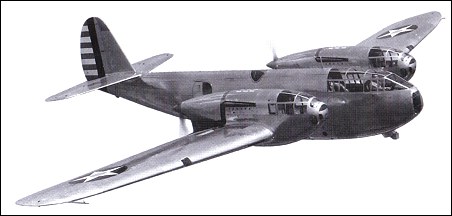
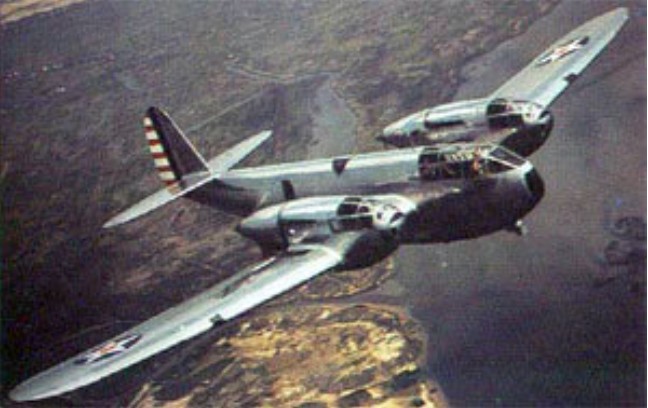
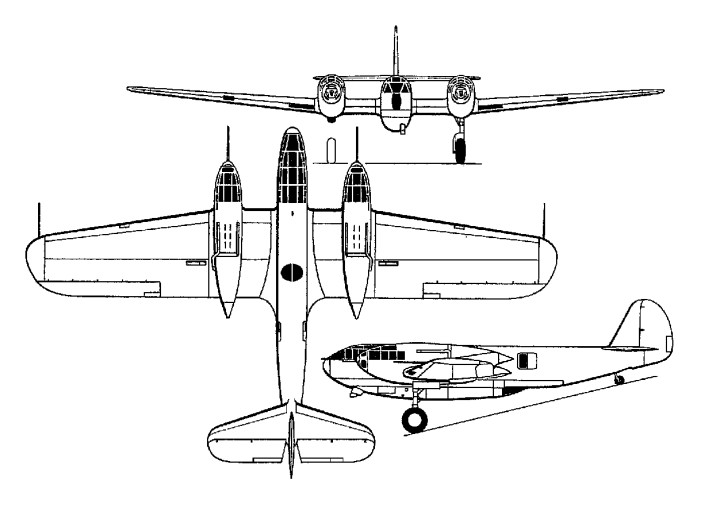
Designed by Robert J Woods, the FM-1 Airacuda was a five-seat long-range bomber destroyer powered by two engines mounted as pushers. The Airacuda accommodated two gunners in forward extensions of the engine nacelles, with access along wing crawlways to the fuselage in the event that it proved necessary to evacuate the nacelle gun positions.
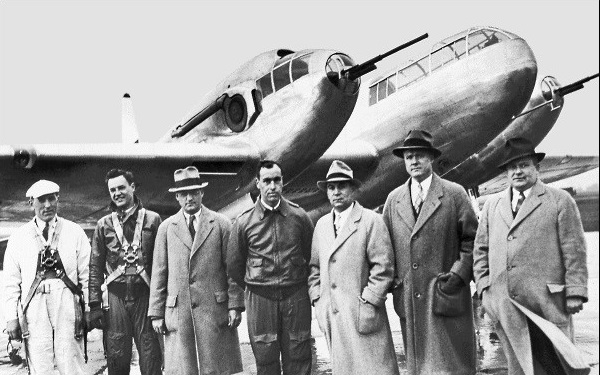
Airacuda with Larry Bell (3rd from right)
Initially, Larry Bell envisioned his aircraft to fly 300 miles per hour at about 20,000 feet with turbosupercharged Allison engines. This was drastically cut when the Air Corps ordered a scaled-down Allison to be used instead with the reason being that the turbosupercharger proved quite volatile and explosive in the YFM-1 when tested. This effectively destroyed any performance the Airacuda could achieve, bring the ceiling down to 12,000 feet and a top speed barely reaching 270 miles per hour.
The Airacuda was built around the ability carry a 37mm cannon in each nacelle position, manned by a crewmember. Additional weaponry consisted of 2 x 12.7mm heavy caliber air-cooled machine guns and 2 x 7.62mm general purpose machine guns.
It was found that a considerable amount of smoke filled the nacelle crewmembers position when the 37mm cannon armament was fired.
The prototype, the XFM-1 powered by two 1150hp Allison V-1710-13 12-cylinder liquid-cooled engines driving three-blade propellers via 1.62m extension shafts, was flown on 1 September 1937. Twelve evaluation models were ordered, nine as YFM-1s and three as YFM-1As which differed in having tricycle undercarriages. Power was provided by 1,150hp Allison V-1710-23s, but three YFM-1s were completed with V-1710-41s of 1,090hp as YFM-1Bs. The 12 YFMs were delivered to the USAAC between February and October 1940, and their armament was one 37mm T-9 cannon with 110 rounds in each engine nacelle, one 7.62mm M-2 machine gun with 500 rounds in each of the retractable dorsal turret and ventral tunnel positions, and one 12.7mm M-2 gun firing from each of the port and starboard beam positions. Twenty 13.6kg bombs could be accommodated internally.
Despite the shortcomings – and at least two being lost to accidents – the Airacuda fielded one entire operational squadron though only operating in 1938 through 1940 and were eventually removed from service in 1942 – used as ground crew trainers. Beyond several photo opportunities across the country, the Airacuda never fulfilled its purpose of bomber-interceptor and destroyer and never would see combat action in the Second World War. All were eventually scrapped with only 1 prototype and 12 production models ever existing.
XFM-1 Airacuda Engines: 2 x Allison V-1710-41, 1,150hp each. Length: 44.85ft (13.67m) Width: 69.85ft (21.29m) Height: 13.58ft (4.14m) Empty Weight: 13,375lbs (6,067kg) Maximum Take-Off Weight: 17,333lbs (7,862kg) Maximum Speed: 277mph (446kmh; 241kts) Maximum Range: 2,600miles (4,184km) Service Ceiling: 30,512ft (9,300m) Armament: 2 x 12.7mm machine guns 2 x 7.62mm machine guns 2 x 37mm cannon Bombload: 2 x 300lb Crew: 5 Hardpoints: 2
YFM-1B Take-off weight: 8618 kg / 19000 lb Wingspan: 21.33 m / 69 ft 12 in Length: 14.00 m / 45 ft 11 in Height: 3.78 m / 12 ft 5 in Wing area: 55.74 sq.m / 599.98 sq ft Max. speed: 431 km/h / 268 mph Range: 2687 km / 1670 miles Crew: 5
Larry Bell had been born in Indiana in 1894, but his family moved to California when he was 13. In 1912, he went to work for aviation pioneer Glenn L. Martin, rising to the vice-president position of the Martin firm by 1920. Martin wasn’t the easiest person to work for and Bell knew he’d never get into a partnership position with the company, so Bell quit in 1925. He couldn’t find steady work for three years, but then he landed a job at Consolidated Aircraft in Buffalo, New York, rising to become general manager.
When Consolidated moved its operations to California, Bell decided to stay in Buffalo along with a cadre of like-minded individuals, forming Bell Aircraft in 1935. Later Bell would admit that naming the company after himself wasn’t a good idea, since it made it more difficult to delegate authority and learned that “when your name’s out front, you have to do a lot of things that are a terrible bore.”
The first product built by Bell was an innovative machine, designed by a team under Bell chief engineer Robert Woods, named the “Airacuda”.
Original company of 1935, Bell Aircraft Corporation, responsible for P-39 Aircobra and P-63 Kingcobra of Second World War. Built first U.S. turbojet, the P-59 Aircomet fighter/trainer. Built the rocket-powered Bell X-1, in which USAF pilot Charles Yeager was the first to exceed the speed of sound, on October 14,1947. Subsequent X- 1A flown at 2,655km/h in 1953.
Company subsequently known as Bell Aerosystems, then on July 5,1960 became Bell Aerospace Corporation, a wholly owned subsidiary of Textron Inc., which had acquired the former Bell Aircraft Corporation.
Two lunar Landing Research Vehicles (LLRV) for NASA to train astronauts to land safely on the moon
Automatic Carrier Landing System (ACLS), used on U.S. Navy aircraft carriers; and was involved with an air-cushion landing system that was expected to enable military transports to land and take off from practically any surface.
The XA-38 was a developmental twin-engine heavy fighter produced by Beech. Only two XA-38 prototypes were ever built with the project ultimately shelved at the end of the war.
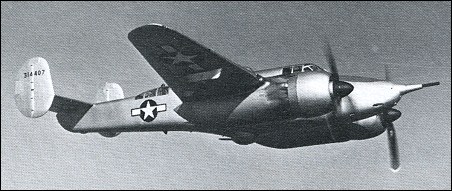
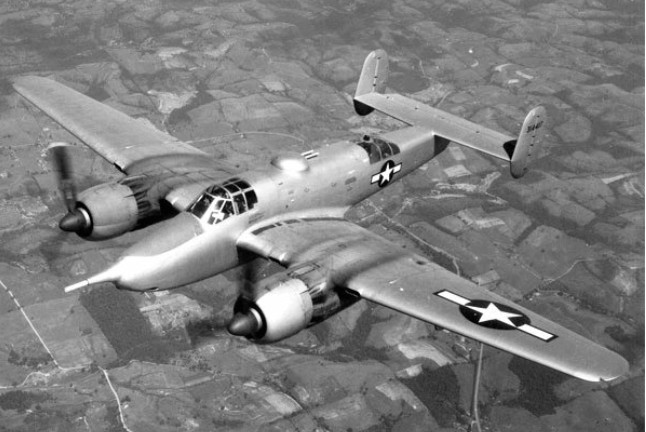
The United States Army Air Force entered into a contractual agreement with Beech Aircraft in December of 1942 after considering the company’s Beechcraft Model 28. The contract called for two initial prototypes to be built as the XA-38 to fulfill a requirement replacing the Douglas A-20 Havocs then in service. This new aircraft would have to exceed in all areas the A-20. The XA-38 achieved first flight on May 7th, 1944 with Beech test pilot Vern Carstens at the controls, from the Beech airfield in Wichita, Kansas. It was then flown to Elgin Field in Florida to undergo testing with the US Army.
Design of the XA-38 centered around the large 75mm cannon armament mounted in the nose. The cannon was positioned as such that the barrel protruded from the nose cone assembly of the all-metal airframe. The fuselage was of a conventional design featuring a forward cockpit area and a rear gunner station and fit together as four main sections for ease of maintenance and repairs. Wings were mid-mounted monoplane airfoil of NACA-2300 series, joining the fuselage to each side of the cockpit and designed with a heated leading edge and surfaces. On the wings were twin Wright R-3350-53 radial engines of 2,700 horsepower each, driving three-bladed, constant speed Hamilton Standard propellers. Cooling was provided for through circular cowlings and controlled via automatic flaps. The engine nacelles were fitted to the wing leading edges. The empennage was conventional and featured a horizontal tailplane with two vertical tail fins. The undercarriage was a typical “tail dragger”, with two forward single-wheeled landing gears and a single-wheeled tail system – all fully retractable via hydraulics with a backup pneumatic emergency system. Crew accommodations was the pilot and a gunner under separate glazed canopies. The gunner sat in a dorsal position on the empennage.
While the primary armament of the XA-38 was its nose-mounted 75mm cannon (the entire forward nose section was hinged to open upwards for easy access to the cannon), this was augmented by 6 x .50 caliber Browning air-cooled heavy machine guns. Two were fitted to the lower forward nose section in a forward-firing fixed position while the remaining four were placed in dorsal and ventral General Electric remote-controlled turrets (two machine guns to a turret). These turrets were tracked via periscope sights by the gunner in his rear cabin. Additional external stores could be carried. With its accessible hinged nose assembly, the XA-38 was envisioned to fit other adaptable armament systems.
The XA-38 posted stable flight characteristics but was most notable for her top speed. Her speed was comparable to the single-engine fighters of her day. The XA-38 fell by the wayside as the B-29’s took her engines, the need for dedicated attack craft dwindles and the war came to its inevitable close a year later. It is known that one of the XA-38 prototypes fell the way of the scrap yard while the whereabouts of the other prototype are unknown.
Beechcraft XA-38 Destroyer (Model 28) Engines: 2 x Wright GR-3350-43 Cyclone radial, 2,300 hp each. Length: 15.76 m / 51 ft 8 in Wingspan: 20.45 m / 67 ft 1 in Height: 5.33 m / 17 ft 6 in Maximum Speed: 370mph (595kmh; 321kts) Maximum Range: 1,625miles (2,615km) Service Ceiling: 27,800 ft Armament: 1 x 75mm T15E1, 6 x 12.7mm Browning machine guns External stores: 2,000lbs Crew: 2 Hardpoints: 2 Empty Weight: 22,481lbs (10,197kg) Maximum Take-Off Weight: 36,330lbs (16,479kg)










 All Aero