The Blackburn Aeroplane Company was founded by Robert Blackburn, who had designed and built his first aircraft in 1909. The Blackburn Aeroplane & Motor Company was created in 1914. A new factory was built at Brough, East Riding of Yorkshire in 1916.
November 1911
Throughout the company’s history the emphasis was on the design and production of naval aircraft; its first for the Royal Navy was the twin-engined GP seaplane of 1916. A similar landplane, the Kangaroo, was supplied to the RAF in 1918. Aircraft to serve with the Navy include the Baffin, Blackburn, Buccaneer, Dart, Firebrand, Ripon, Roc, Shark and Skua. In 1930 acquired Cirrus Hermes Engineering Co. By acquiring the Cirrus-Hermes company in 1937, Blackburn started producing aircraft engines – the Blackburn Cirrus range. Blackburn Aircraft Company founded 1936. The company’s name was changed to Blackburn Aircraft Limited in 1939.
During 1948, discussions between General Aircraft Ltd and the Humberside firm of Blackburn led to a merger of the two companies under the joint name of Blackburn & General Aircraft Ltd. The new company was formed on 1 January 1949 and it was proposed that all work in progress at the various factories be com¬pleted as originally planned.
Company name reverted to Blackburn Aircraft Ltd. in 1959, when Blackburn & General became the holding company. Its aircraft production operation was absorbed into Hawker Siddeley in 1960, and its engine operations into Bristol Siddeley, as part of the rationalisation of British aircraft manufacturers, and the Blackburn name was dropped completely in 1963.
The “302” reactive interceptor fighter was designed in 1940. It was the world’s first fighter with combined reactive powerplant.
This fighter appears interchangeably in the specialized literature as a product of MK Tijonrarov (head of the project design brigade and specialist of aerodynamic calculations during the construction of the prototype), AG Kostikov (main engineer of the RNII (NII-3) during the design of the project and main constructor of the OKB-55 during the construction process or MR Bisnovat (head of the OKB-55 designated for the development and construction of the model. In some literature it has also been called Kostikov KB-3 and Tijonrarov I-302.
Between 1939 and 1940 in the USSR began to develop a design process for aircraft powered by reactive engines. Due to the short working time of these engines, their use was conceived in the form of interceptors of very high speed and short radius of action. The three most prominent developments in this line were the Tijonrarov “302”, the “Malyutka” and the Bereznyak / Isayev BI. The three projects were conceived to use liquid reactive engines using kerosene as fuel and nitric acid as oxidizing agent, with powers between 1,100 and 1,200 kg. Of these three projects, only the BI was further developed. The projects “302” and Malyutka were kept as Secret for many years and information about them is scarce and little known.
The “302” appeared in 1940 as a project for the world’s first fighter with a combined reactive powerplant. The project was developed by a group of specialists led by MK Tijonrarov under the general direction of AG Kostikov, who at that time was serving as the chief engineer of the RNII (NII-3). In the spring of 1941 the project was presented to the technical council of the institute, being approved. After the defense of the project before the commission of the VVS, AG Kostikov directed the request for approval to the NKAP, where between June 17 and 18, 1942 it was approved by a commission made up of SA Jristianovich, AV Chesalov, SN Shishkin, VI Polikovski.
In the second half of 1942 the project was presented to Kliment Efremovich Voroshilov and that same day, during a reception with Stalin, the “302” was approved and Kostikov was appointed principal constructor of the OKB-55 and director of the experimental factory of the same name. As head of the OKB was appointed MR Bisnovat and as his replacement AA Andreyev. VD Yarovitsky was selected for the resistance calculations and the aerodynamic calculations were carried out by MK Tijonrarov.
Structurally the “302” was conceived as a low-wing cantilever monoplane. The construction was of wood. The wing had a RAF-34 profile with 15% at the root and NACA-230 with 8% at the wingtips. The tail was made of wood with a plywood coating. The fuselage was designed with a monocoque structure.
Structure of the “302”
The landing gear was designed as a traditional type with single wheels on all units. The retraction system was hydraulic.
The “302” was conceived as a fighter with a liquid reactive engine (ZhRD) RD-1400 produced by LS Dushkin and with 1400 kg of thrust located under the tail and two ramjets (PVRD according to its acronym in Russian and also known as Ramjets in English) designed by V.S. Zuyev, located under the wings.
The interceptor was armed with two ShVAK 20mm cannons located in the nose and two similar ones below the cockpit, all with 400 rounds. Under the wing were detachable mounts for unguided rockets (RS-82 and RS-132) or two FAB-125 bombs.
The “302P” during testing.
By the summer of 1943 it was found that the development schedule for Zuyev’s ramjet was seriously overdue. Only a 1: 2 scale model had been completed and the tests could not be executed. Dushkin’s 1100kg D-1 Liquid Reactive Engine, with an additional 450kg chamber, was not yet ready as testing had just begun. For this reason it was decided to equip the “302” with a RD-2M double chamber liquid reactive motor, which also presented problems.
Given the lack of availability of the engines, it was decided to finish the cell and test it in the form of a glider, which received the name ” 302P “. All the weapons and some of the equipment were removed from the plane in order to lighten it. In the tail section a model of a reactive single chamber engine was located, which was exposed, without the fairing.
Glider “302P”, rear view showing the reactive engine model
At the end of August 1943 in this configuration the ” 302P ” was delivered to the LII. The tests showed excellent stability characteristics and the “302P” was sent to the TsAGI, where it was tested in the wind tunnel. During the “blows” in the T-104 tunnel of the TsAGI, it was possible to obtain an aerodynamic quality K = 15, which promised excellent results. Several dozen flights were carried out towed by a Tupolev Tu-2 and a North American B-25 Mitchell. The evaluation given by the USSR honorary test pilot S. N. Anojin on the “302P” was highly positive. Positive evaluations were also received from other experienced test pilots such as ML Galai, BN Kudrin and VN Yelagin. In the tests it was possible to calculate a landing speed of 115 – 120 km / h. The powered flights were not carried out due to the lack of completion of the reactive engines.
The first motorization variant with one ZhRD and two PVRDs yielded a possible speed of 900 km / h, a ceiling of 9000 meters and a time to reach this ceiling of 2 minutes.
The calculations obtained with the “302P” yielded a speed of 800 km / h, a ceiling of 18000 m and a reach time of a height of 5000 meters of 2.1 minutes and 2.8 minutes for the 9000 meters. The calculated range was 100 km. The only real data obtained were the take-off with a run of 16 – 18 seconds and a speed of 200 km / h. The empty weight of the plane was 1502 kg and with a military load of projectiles for the 4 guns, 505 kg of fuel and 1230 kg of oxidant, the takeoff weight reached 3358 kg.
In 1944 a government commission led by AS Yakovlev made the decision to stop all work related to “302”. The results obtained during development were not lost and many of the constructive decisions employed during the construction of the “302P” were later employed by SM Alexeyev during the construction of the I-211 and I-215 fighters.
Model 302 Powerplant: 1 x ZHRD RD-1400 with 1,400 kg thrust + 2 x PVRD Wingspan: 11.4 m Length: 8.708 m Wing area: 17.8 m² Takeoff weight: 3800 kg Empty weight: 1856 kg Maximum speed at height: 900 km / h Time at 9000 m: 2 min. Service ceiling: 9000 m Armament: 4 x ShVAK 20 mm cannons Bombload: unguided rockets (RS-82 and RS-132) or two FAB-125 bombs Seats: 1
Model 302P Wingspan: 9.55 m Length: 8.708 m Wing area: 14.8 m² Takeoff weight: 3358 kg Empty weight: 1856 kg Total load weight: 1502 kg Weight of fuel and oil: 1735 kg Wing loading: 227 kg / m² Reactive fuel weight: 505 kg Oxidizer weight: 1230 kg Speed at sea level: 800 km / h Speed at altitude: 900 km / h Take-off speed: 200 km / h Time to 5000 m: 2.1 min Time at 9000 m: 2.8 min Service ceiling: 18,000 m Range: 100 km Armament: 4 x ShVAK 20 mm cannons Bombload: unguided rockets (RS-82 and RS-132) or two FAB-125 bombs Seats: 1
302 with dotted lines the initial version with combined reactive plant.
The SK-2 single-seat fighter was evolved from the SK-1 (skorostnoye krylo, or high-speed wing) aircraft tested during the winter of 1939-40 as a direct result of high-speed wing research conducted at the TsAGI (Central Aerodynamics and Hydrodynamics Institute) by a team headed by Matus Bisnovat. The SK was the smallest possible airframe capable of accepting a 12-cylinder Vee engine, with every effort made to reduce drag (eg, a flush-fitting cockpit canopy which could be raised, together with the pilot’s seat, for takeoff or landing). The SK-2, flown in October 1940, had a similar small-area wing and 1050hp Klimov M-105 12-cylinder liquid-cooled Vee engine, but with an orthodox cockpit, conventional carburettor and oil cooler air intakes, revised vertical tail surfaces and an armament of one 7.62mm and two 12.7mm machine guns. The SK-2 was of all-metal construction with dural pressed sheet stressed wing skinning and a semi-monocoque fuselage. Flight test results were allegedly promising, but not enough to warrant replacing established fighter types in production.
SK-2 Engine: 1 x 1050hp Êëèìîâ Ì-105 Take-off weight: 2300 kg / 5071 lb Empty weight: 1850 kg / 4079 lb Wingspan: 7.30 m / 24 ft 11 in Length: 8.28 m / 27 ft 2 in Height: 2.60 m / 9 ft 6 in Wing area: 9.57 sq.m / 103.01 sq ft Cruise speed: 530 km/h / 329 mph Ceiling: 10500 m / 34450 ft Range: 620 km / 385 miles Crew: 1 Armament: 1 x 7.62 mm, 2 x 12.7mm mg
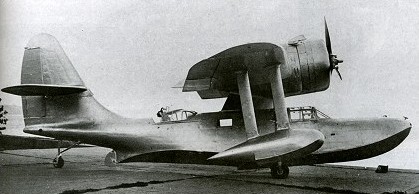
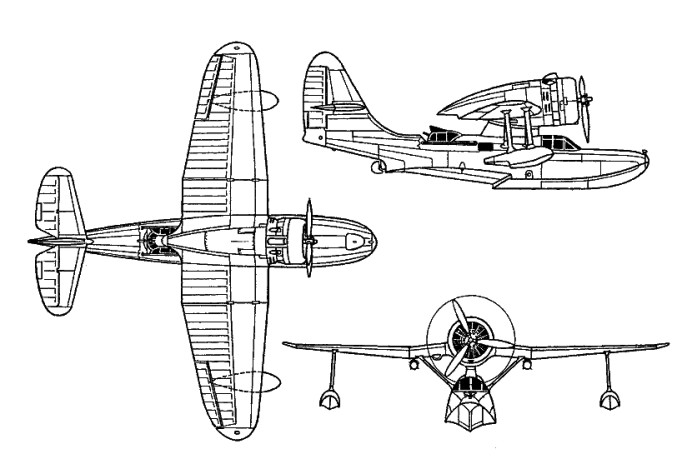
More or less in parallel with the construction and development of the KOR-1 floatplane, The Beriev bureau worked on the design of a small flying-boat intended to fulfil the same requirement as the hastily developed KOR-1, but to provide much enhanced performance. In configuration the Beriev KOR-2 was a parasol-wing monoplane, the wing pylon-mounted above the stepped flying-boat hull, and braced by two streamlined struts on each side. An inverted gull wing, with a wing-mounted engine and three-bladed controllable-pitch propeller. The tail unit was similar in configuration to that of the KOR-1, except that the high-mounted tailplane was a strut-free cantilever structure. First flown in 1940, this Beriev design was built in a factory at Taganrog, on the shore of the Sea of Azov, only a small number of these aircraft had been completed and delivered to the Soviet navy before the Taganrog area was over-run by the invading Germans in the autumn of 1941. Production of the KOR-2, or Beriev Be-4 as it had then been redesignated, was resumed at a Central Asian factory during 1942, but no records of the number constructed have so far been discovered.
Engine: 1 x Shvetsov M-62 radial, 671kW Take-off weight: 2760 kg / 6085 lb Empty weight: 2055 kg / 4531 lb Wingspan: 12.0 m / 39 ft 4 in Length: 10.5 m / 34 ft 5 in Height: 4.05 m / 13 ft 3 in Wing area: 25.5 sq.m / 274.48 sq.ft Max. speed: 360 km/h / 224 mph Ceiling: 8100 m / 26600 ft Range: 950 km / 590 miles Armament: 1 x 7.62mm machine-gun, 300kg of bombs
Starting seaplane design in 1928, Georgi. M. Beriev became the leading designer of Russian waterbased aircraft. Beriev had gained considerable expertise as an assistant to French designer, Paul-Aime Richard, during the latter’s stay in the Soviet Union from 1928 to 1930. Chief designer of the TsKB seaplane group and the bureau of G M. Beriev, at Taganrog on the Azov Sea. In 1930, he was responsible for the twin-engined MBR-2 flying-boat, Be-2 reconnaissance seaplane and Be-4 flying-boat. Beriev design bureau became center of Soviet seaplane development in 1945, a major flying-boat project being the twin-jet Be-10. Be-12 twin-turboprop antisubmarine and reconnaissance amphibian manufactured between 1963 and 1973 and used widely by Soviet/Russian Navy until about 1997, when withdrawn; several Be-12s have been modified for civil uses, including transport and firefighting. A-40/Be-40 Albatross Mermaid turbofan-powered intermediate-range antisubmarine, search-and-rescue and patrol amphibian, first flown December 1986 and ordered for the Russian Navy in 1992 but not funded. An improved search-and-rescue variant became the Be-42 (sometimes referred to in the West as A-45). A laser-gun test-bed aircraft based on the llyushin II-76 was produced by Beriev and has been flown since 1980s as A-60, while in 1978 the first flight took place of the Beriev A-50 Mainstay airborne early warning and control aircraft, also based on the II-76 and in Russian operational service since 1984. Beriev Be-32 16-passenger twin-turboprop transport (first flown 1976), similar to earlier Be-30 (first flown 1968), was still to enter production in 1998. Be-102 multipurpose amphibian designed in 1993 but remained project in 1998. Be-112 Pelican larger multipurpose amphibian under consideration for development, while Be-200 twin turbofan multipurpose amphibian (initially for firefighting) first flew in 1998. Be-103 six-seat light amphibian, also suited to cargo carrying, survey and other roles, first flew July 1997; has twin piston engines carried on mounts either side of the rear fuselage. Very heavy lift cargo and passenger amphibians have been projected as Be-1200 and Be-2500, possibly to fly next century. Company then named Joint Stock Company “Taganrog Aviation Scientific- Technical Complex named after G.M. Beriev,” and became part of the AVPK Sukhoi organization.
In the spring of 1940 the TsAGI held a conference for aeronautical designers related to the use of reactive rockets and ramjets. The main engineer of the OKB-293 Victor Fiodorovich Boljovitinov was invited to this conference, who attended accompanied by two of his collaborators A. Ya. Bereznyak and AM Isayev. Bereznyak was the head of the mechanics brigade and Isayev was the chief of the engine brigade. The cause of this hasty conference was based on the confirmation that an intercept fighter with reactive power plant had begun to be developed in Germany which appeared in the last period of the War as the Messerschmitt Me-163.
In July the Council of People’s Commissars (SNK) launched the request for the development of high-speed stratospheric aircraft powered by jet engines. Bereznyak and Isayev were excited about the prospect of designing a jet-powered aircraft and, after receiving Bolkhovitinov’s approval, in the fall of 1940 they went to work on a project that was originally known as ” G “.
In 1940 they visited the Reactive Research Institute, where they learned about the work carried out by the engineer Leonid Estepanovich Dushkin on a reactive liquid fuel engine for the “302” fighter project that was then being developed at this institute.
The design of the ” G ” was designed primarily in plywood and duralumin, had a takeoff weight of only 1500 kg capable of reaching 800 km / h.
The Bereznyak and Isayev aircraft was initially designed to use a 1,400 kgf thrust engine with a fuel injection system into the ignition chamber. In order to simplify the process and decrease the creation time of the apparatus, on June 21, 1941 Isayev proposed to replace the pump injection system with a simpler injection system based on compressed air at 145-148 atmospheres from 115-liter cylinders. This made it possible to reduce the dimensions of the engine and improve its characteristics. This new engine was renamed D-1A (A corresponds to Azot (Nitrogen in Russian) and responds to the type of oxidant used in the combustion process). As a counterpart, the need to include large volume and weight oxygen cylinders in the engine resulted in the necessary decrease in the amount of fuel, so that the engine’s working time decreased to about two minutes.
The beginning of the Great Patriotic War led to a reassessment of the need. Bereznyak and Isayev worked tirelessly and in three weeks they had the preliminary project completed. A group of specialists asked Boljovitinov to issue a letter to motivate attention to the model. On 9 July of 1941 a letter signed by seven specialists were found among those who sent Bereznyak, Isayev, Dushkin, the factory director Boljovitinov and the principal engineer Kostikov. And a short time later a notification was received for them to appear at the Kremlin. The proposal was approved and AI Shaxurin together with AS Yakovlev presented a draft decree that was approved in August.
Bolkhovitinov was ordered in the short period of 35 days (instead of the three months requested by Bereznyak and Isayev ) to have a reactive powerplant interceptor fighter ready and the Research Institute 3 (NII-3) led by AG Kostikov to create the RDA-1-1100 reactive engine for this aircraft. On this basis the order of the National Committee (Narkomat) of the Aviation Industry (NKAP) was created.
The creation of the fuel tanks and the reactive engine power system based on the system developed by the NII-3 was introduced in the task of the KB of Bolkhovitinov and the task of KB Dushkin (as a member of the NII-3) was to guarantee constant engine operating speed between 400 and 1100 kg thrust in multi-launch regime.
The task was assigned on August 1, but the work started from the end of July. The OKB was declared “quartered” and worked without leaving the factory for a month and 10 days. On the first of September the first copy of the new aircraft was ready to be directed to tests at NKAP. The aircraft was built with virtually no finished detail plans, building many parts by eye. This was made easier by the small size of the aircraft. The new design was named BI, short for Blizhny Istrebitel or Short Range Hunting, but many, even at that time, interpreted the initials as the initials of its creators.
The BI was designed as a single-seater monoplane with short wingspan (6.5 meters). The entire oval-shaped fuselage and monocoque structure, was constructed of wood and covered with 2 mm plywood covered with fabric.
The wing was integrally built and covered with plywood. The selected profile was TsAGI B-1-10 with a relative thickness of 12% and a trapezoidal plant. The ailerons, rudders and rudders were constructed of wood with textile coating, but the flaps were constructed of duralumin (on the BI-5 and BI-6 versions all control surfaces were made of duralumin).
The tail assembly incorporating a ventral fin and circular drifts at the ends of the outriggers. On the BI-1 the stabilizer was raised, but on later models it was released. The rudders were covered with fabric.
The project envisioned an armament of two 12.7mm Berezin machine guns and two 7.62mm ShKAS machine guns. These original plans were replaced by the installation of two ShVAK 20 mm cannons, providing for the possibility of their replacement in the series copies by two 23 mm cannons.
The retractable landing gear was fitted with wheels or skis. The main wheels had dimensions of 400 x 500 mm, while the skis were 1440 x 300 mm and featured a spring-loaded system. The main units were retracted towards the center line of the aircraft. The tail unit was located at the end of the ventral fin, being fixed but adjustable with dimensions 90x42mm. The retraction system was pneumatic.
The BI was powered by a 1,100 kg thrust Dushkin D-1A-1100 rocket engine. In the tail section there were five compressed air tanks and three tanks with nitric acid. These tanks, pressurized to 60 atmospheres, were constructed of a high resistance steel known as “Jromansil” consisting of an alloy of chromium, manganese and silicon with steel. Its fuel mixture of kerosene and nitric acid being not only dangerous to handle, but also causing corrosion of tanks and fuel lines. Despite its high hardness, this material was quite prone to corrosion, so the acid tanks had to be replaced periodically.
The compressed air from the tanks was also used to guarantee the retraction and deployment of the landing gear and for the firing of the cannons.
The pilot was located forward, in a cockpit with a transparent cover.
At the request of AS Yakovlev the glider of the BI fighter was tested in the wind tunnel of the TsAGI. This request considerably alarmed Bolkhovitinov’s team, aware of the harsh relations between their boss and Yakovlev. Despite this, the tests were carried out under the direction of GS Biushgens and AL Raij and after the results were completed, they were studied by Yakovlev himself and the aeronautical designer Ilya Florov, who suggested enlarging the rudder and adding two vertical fins in stabilizers to improve stability.
The first prototype, named BI-1, was only used as a glider without a motor towed by a Petlyakov Pe-2 to test the operating characteristics during landing. The first flight took place on 10 September 1941 piloted by Boris Nikolaevich Kudrin. During 15 flights it was possible to define all the main flight characteristics at low speeds. The tests showed that the behavior and the aerodynamic data corresponded with calculations.
The engine was not yet ready, mainly due to the complexities associated with technological innovation and the use of nitric acid. All safety measures needed to be observed to avoid toxicity, not only from the acid, but also from the vapors. There were even some cases of fire. Time constraints forced the autonomous testing of the engine to be skipped and went straight to testing it in the OKB test bed. The tests began in September 1941.
Before the evacuation, not much more could be done. On 16 October 1941 it was decided to evacuate the bureau and factory buildings of Boljovitinov to the Urals. The next day the engine test bed was dismantled and all documentation and materials were sent to the new location in Bilimbay, near Sverdlovsk (present-day Yekaterinburg). Also towards Sverdlovsk, about 60 km from the Bolkhovitinov location, on the 20th of the month the NII-3 with Dushkin was evacuated. The new test bed for the BI was installed on the shore of the frozen Lake Bilimbay.
Work continued at the new location. The pilot Kudrin fell ill and his position was taken by Gregory Yakovlev Bajchivandzhi. Dushkin at that time was immersed in the development of the powerplant for the new fighter developed under the direction of Kostikov himself and known as “302”, for which the engineer Arvid V. Pallo was appointed to supervise the engine works in the BI.
Nitric acid generated constant problems, corroding parts, causing skin burns and respiratory problems for mechanics. On 20 February 1942 during ignition of the engine in the test bed an explosion occurred. A jet of nitric acid was thrown at high pressure, hitting Engineer Pallo. The nozzle was thrown into the lake. The engine cover detached and flew off until it hit the pilot seat guard, loosening the mounting bolts. Bajchivandzhi was thrown forward, head banging on the instrument board. Only the quick action of the mechanics, who immediately put Pallo’s head in a container with soda and the use of glasses, prevented the accident from having further consequences. As a result of experience, a 5.5mm steel plate was installed at the rear of the pilot’s seat.
In March the test bed was repaired, and changes were made to the engine power system. Various hydraulic tests and 14 ignition tests were carried out on the engine destined to be located in the aircraft. On 25 April 1942 the aircraft was moved from Bilimbay to Koltsovo (to the Research Institute of the VVS ( NII VVS )) and 30 two starts were made to the engine and work began to prepare the BI for flight.
For the first flight of the BI a Government Commission was created with VS Pychnov. Included in the commission were Bolkhovitinov, the head of the NII VVS PI Fiodorov, the chief engineer of the BI project at the NII VVS, MI Tarakanovsky, the chief engine engineer AV Pallo. As chief pilot of the tests, G. Ya was appointed. Bajchivandzhi.
On May 2, the pilot, during a test run, lifted the BI slightly, to a height of about one meter, descending again due to low power.
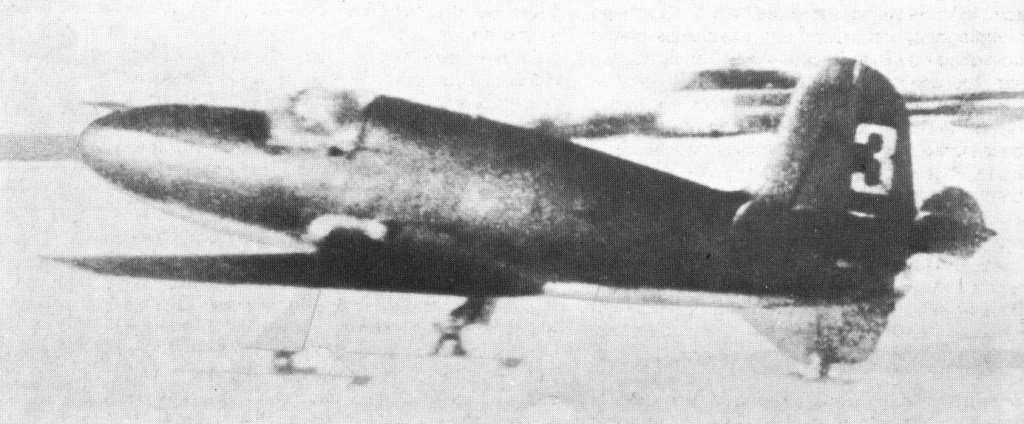
The BI-1, with the 1,100 kg Dushkin D-1A rocket engine, took off for the first time on 15 May 1942 at 19:02 local time, with a flight of 3 minutes 9 seconds, the first in the world that was done with a interceptor rocket propulsion. For this flight, the takeoff weight was set at 1,300 kg and the engine was set to 800 kgf thrust. As a result, an altitude of 840 km / h was reached and a speed of 400 km / h. The ascent speed was 23 m / second. The pilot Bajchivandzhi would later write that unlike conventional airplanes the flying of the BI was extremely pleasant, highlighting the absence of the propeller and the noise and gases from its engine and highlighting the excellent view from the cockpit. A minor landing gear failure at the end of the historic flight hampered the development program, with the tail being damaged.
Accident on May 15, 1942, at the end of the first flight.
The results of the first tests were so promising that the commission decided to order the construction of a pre-series of 50 BI-VS for military tests at the AS Moscaliov construction facilities at Factory No. 499 located in the city of Zavodoukovsk. As a basis for development, the four BI-4 prototypes were taken, having as the main difference with the prototypes in addition to the two cannons in the fuselage, a closed bay with a cassette for bombs was installed in front of the pilot’s cabin. In this bay could be located 10 small 2.5 kg bombs designed to be dropped on bomber formations in the air.
Boljovitinov, very happy with the test results, asked to film the BI development process. With the recordings made, a documentary film was created that was named “Flight to the Future” (in Russian: “Полет в будущее”). This film was shown not only to personalities, but to KB and factory personnel. This led to a very tense situation with the NKVD and was on the verge of provoking the indictment of Bolkhovitinov for revealing military secrets.
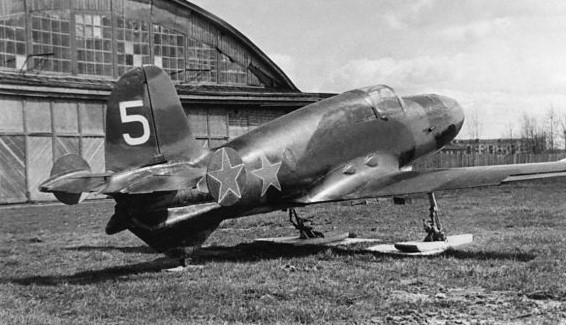
BI-1 at the Koltsovo airfield, Svierdlovsk in May 1942
Together with the decision to start serial production, the projects for the creation of training facilities in Sverdlovsk and Moscow were prepared, with the aim of preparing the pilots on the new aircraft. In 1943 it was expected to be able to create several units with the new fighter specialized in the interception of bombers.
The flight of the BI was fundamentally difficult due to the constant problems with nitric acid. On more than one occasion the acid leaked through the pipes or the walls of the tanks and the toxic gases also meant major problems that had to be constantly corrected, so the tests lasted throughout the winter of 1942 – 1943.
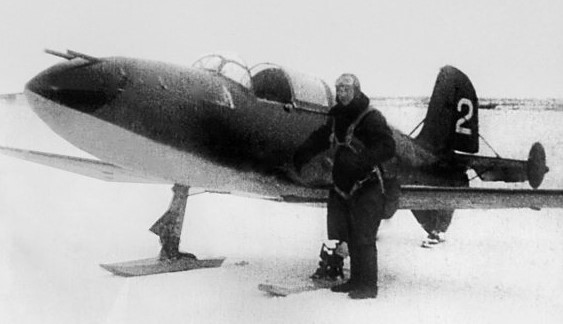
Due to the damage to BI-1 due to the corrosive action of nitric acid gases, the continuity of the program was carried out in the second, BI-2, and third, BI-3. These were built in the Factory No.293 in the winter of 1942 – 1943 and characterized by having a retractable landing gear with skis.
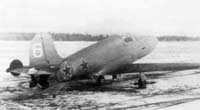
G. Baxchibandzhi with BI-2.
The second flight was performed with the BI-2, reaching an altitude of 1100 meters, but adjusted to not exceed 400 km / h. In this aircraft and in a short time, 4 flights were made, three by Bajchivandzhi (March 11, 14 and 21 1942) and another by KA Gruzdiev (January 12 1943). These flights reached a speed of 675 km / h (the calculated one was 1020 km / h at 10,000 meters), ascent speed of 82 m / s, flight ceiling of 4000 meters and flight time of 6 minutes and 2 seconds with 84 seconds engine working time. The flight of March 21 was carried out with the full load of ammunition. So far none of the prototypes had carried real weapons. There is evidence that the BI-4 was the prototype used to test the armament installation, although no firing tests were ever carried out with any of the prototypes.
The third prototype BI was fitted with retractable skis which could be interchanged with wheels depending on the ground conditions.
BI-3
On a Gruzdiev flight, when lowering the gear before landing, one of the skis fell off, but the BI was nevertheless able to land without complications.
The sixth and seventh flights were executed by Bajchivandzhi on the third BI-3 prototype. In the seventh flight, on 27 March of 1943, the planned tasks included a top speed of 750 or 800 km / h at 2000 meters. As observed from the ground, the flight remained normal until the completion of the engine work in 78 second of. After finishing the engine operation, the plane lowered its nose and plunged at a 50-degree angle until it hit the ground. Pilot Gregory Yakovlev Bajchivandzhi died in the accident.
The commission studied the catastrophe but could not determine its causes. As a result, the report included that the causes were motivated by phenomena not studied at speeds between 800 and 1000 km / h. In the opinion of the commission, at these speeds, new factors appeared that influenced the direction, stability and load on the controls.
By 1943 a new T-106-TsAGI aerodynamic facility for high speeds was installed at the TsAGI. In it, tests of aircraft models and their elements began to be carried out to analyze their behavior at high speeds. Among them, the BI model was tested to find the causes of the catastrophe. From the results obtained, it was clear that the BI was destroyed because the peculiarities of the straight wing and tail at speeds close to those of sound that led the aircraft to dive, were not taken into account. It was estimated that at the time of the accident the aircraft piloted by Bajchivandzhi reached 900 – 990 km / h. In 1973 Gregory Yakovlev Bajchivandzhi was posthumously awarded the title of Hero of the Soviet Union.
As a result of the accident, the entire production of 30 pre-series BI-VS in different stages of development was destroyed. Despite this, the flight test program was continued with a number of modifications, it was hoped, would ease the difficulties.
In May 1943 OKB-293 returned from evacuation to Moscow, being relocated to the Khimki area, Moscow District. By the following year, another 5 of the BI had been built, called BI-5 to BI-9.
The endurance of the BI was in adequate for operational use, but a two-chamber engine developed by Dushkin to overcome this deficiency with low (cruising) and high (combat) thrust settings was almost double the weight and considered unsuitable.
In order to study the possibilities of increasing the endurance of the aircraft beyond two minutes of rocket motor work, in 1943 – 1944 modification was planned using ramjets or ramjets at the wingtips. In spring 1944 the sixth BI-6 was fitted with two DM-4 ramjets designed by I. Merkulov and tested in the TsAGI-101 wind tunnel, but was never flown. This ramjet was also tested on the Yak-7B fighter.
Breznyak – Isayev BI-6 with ramjets during wind tunnel tests.
There was also an attempt at some point to seal the cabin by covering all the joints with resin bands, but this idea was scrapped.
After the loss of the Dushkin D-1-A-1100 engine, Isayev began to design his own engine, taking into consideration the advice received from Glushko and the experience accumulated during the tests of the BI. The new RD-1 engine was completed and tested in October 1944. In general, its dimensions were similar to those of the previous one, but it presented a large number of improvements and it was built with 12J13 steel with greater resistance to corrosion. The head had 85 injectors located in a honeycomb conformation that highly improved efficiency and featured an electric start system.
In January 1945, on Isayev’s BI-7 with ski landing gear and RD-1 powerplant, pilot BN Kudrin made two flights. In the first, on January 24, the plane was seriously damaged in an emergency landing due to a problem in the landing gear of the skid. On March 9, properly repaired and with some modifications, with a takeoff weight of 1800 kg and speed of 587 km / h, a climb speed of 87 m / s (4980 m / 16,340 fpm) was reached. The BI-7 revealed dangerous vibrations (flutter) in the tail section. To study the problem, on 29 March 1945, MK Baykalov conducted tests in the BI-7 in configuration as a glider. At that time, the BI had great damage caused by corrosion, so it was withdrawn.
The BI-5 and BI-6 specimens were modified to the same configuration as the BI-7 and flown as gliders towed by a North American B-25J. The BI-5 was tested with a ski undercarriage, being flown by BN Kudrin between March 10 and 25.
The BI-5 prototype on skis during testing in the spring of 1945.
Cockpit of the sixth BI prototype.
The BI-6 flew with conventional wheels, being piloted by MK Baykalov between April 25 and 29. During these tests no vibrations or other problems were observed, but by then it had already been decided to leave the program.
The Bereznyak – Isayev BI was flown with a reactive engine 9 times, 7 times with the Dushkin D-1-A-1100, and twice with the Isayev RD-1. It is argued that three more flights were made in the spring of 1944 with the DM-4 ramjets designed by I. Merkulov, but the truth of this claim has not been proven. These proposed flights were carried out by Kudrin to test ramjets, which were activated already in the air, after towing the BI-6 with another plane.
Flights with BI engine
Date
Model
Pilot
Power (kg)
Working time (s)
Height (m)
Speed km / h
A. Ascent (m / s)
May 2, 1942
BI-1
Bakhchivandzhi
500
13
1
—
—
May 15, 1942
BI-1
Bakhchivandzhi
600
66
840
400
23
January 10, 1943
BI-2
Bakhchivandzhi
800
63
1100
400
—
January 12, 1943
BI-2
Gruzdiev
1100
58
2190
675
—
March 11, 1943
BI-2
Backchivandzhi
1100
80
4000
600
82
March 14, 1943
BI-2
Backchivandzhi
1100
84
3000
+/- 650
—
March 21, 1943
BI-2
Backchivandzhi
1100
30
3000
– 160
—
March 27, 1943
BI-3
Backchivandzhi
1100
89
2000
+800
—
January 24, 1945
BI-7
Kudrin
1100
72.3
1250
587
87
March 9, 1945
BI-7
Baykalov
1100
73
3500
550
—
Note: This table does include the first “take-off” of May 2, 1942, although this was never considered an IB flight.
The Bereznyak – Isayev BI-1 exhibited at the Air Force Museum in Mónino.
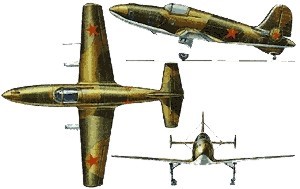
Berez-Isa BI Engine: one 1100-kg (2,425-1b) thrust Dushkin D-IA-1100 rocket Wing span: 6.48 m (21 ft 3 in) Wing area: 7. 00 sq.m (75.35 sq ft) Length: 6.40 m (21 ft 0 in) Height: 2.06 m Empty weight: 958 kg (2,112 lb) Maximum take-off weight: 1683 kg (3,7 10 lb) Fuel and reagent weight: 600 kg Max speed (estimated): 1000 km/h (621 mph) at 5000 m (16,405 ft) Climb to 10000 m (32,810 ft): 59 seconds ROC: 4920 m / min Endurance: 2 minutes powered Armament: two nose-mounted 20-mm ShVAK cannon Accommodation: 1
Formed originally as the Bennett Aircraft Corporation to manufacture aircraft from Duraloid, a new type of bonded plywood. Produced twin-engine eight-seat monoplane, the BTC-1, about 1940.
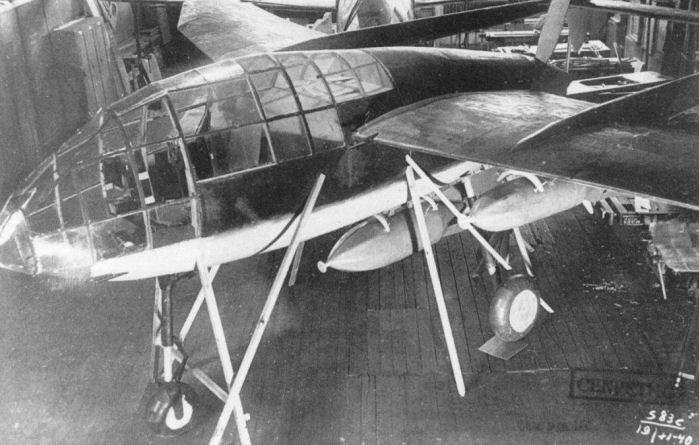
Under construction at Factory No.156 in Moscow on June 19, 1940.
In parallel with the EOI fighter, the Belyayev collective began work on a version of a dive bomber with fighter capability. From this combination the project was named PBI according stands for P ikiruyushi B ombardirovshik – I sterbitiel or bomber – Hunting.
The Belyayev PBI (Russian: Беляев ПБИ) main differences with respect to the EOI fighter were in the selection of the powerplant, the replacement of the flaps by dive brakes and the armament. This new model was to be powered by the M-107 engine, which was under development by Vladimir Yakovlevich Klimov’s bureau.
The armament included a cannon developed by Taubin and Baburin and a ShKAS machine gun, as well as a 500 kg bomb capacity (made up of two 250 kg FAB-250 bombs) and unguided RS-132 rockets.
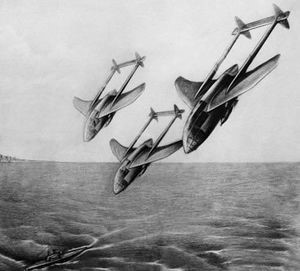
An artist’s conception of the PBI bombers in attack.
The plane was designed with the possibility of once the bombs were dropped it could be used as a fighter.
Construction of a life-size model was started in the second quarter of 1940 at Factory No. 156 in Moscow. By June it was practically finished.
The preliminary draft of the PBI was presented for analysis in November 1940. After analyzing the information presented, the commission determined that the GDP could not be included within the category of fighter aircraft for the next experimental production plan of 1941.
Conceptual drawing of the PBI dive bomber.
It was considered that the load of 500 kg of bombs required a structural reinforcement, with the corresponding increase in weight and therefore a decrease in performance. It was proposed to increase the surface of the horizontal tail plane by 55% to compensate for the possible impact on stability caused by the increase in load.
The conclusions presented by the NII VVS on 5 December 1940 was recommended not to include the aircraft GDP in the plan of experimental construction of the year 1941, pending the outcome of the EOI which was tested in that year. As a consequence of this decision, work on the project was stopped and the start of the war resulted in its being totally abandoned.
PBI Powerplant: Klimov M-107 Wingspan: 10.40 m Wing area: 16.11 m² Length: 8.66 m Maximum takeoff weight: 2850 kg Accommodation: 1 Armament: 1 Taubin – Baburin cannon, 1 ShKAS 7.63 mm machine gun Bombload: 500 kg and RS-132 unguided rockets.
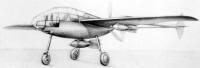
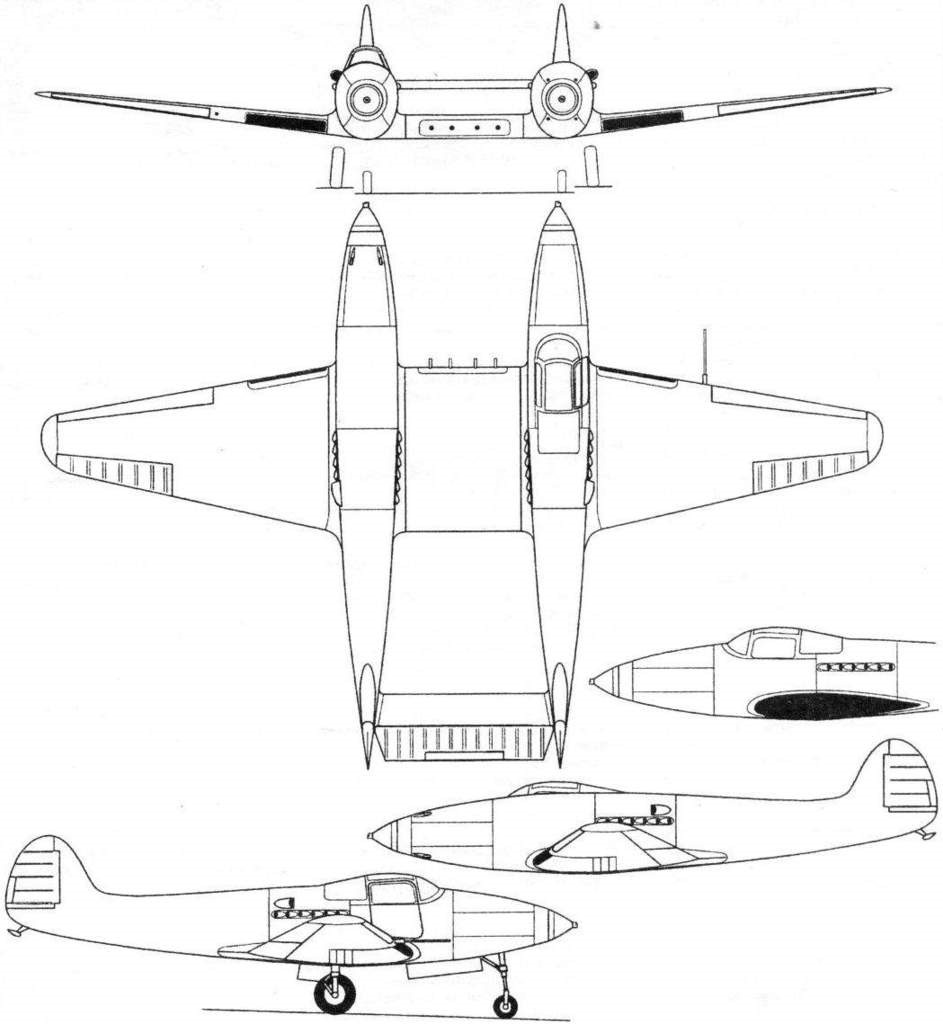
Designed by Viktor N. Belyayev, the Belyayev OI-2 had twin fuselages linked by a central wing section, allowing greater range and greater load than the model with a single fuselage. The design began in early 1941, before the USSR began receiving the American Airacobra. The plane would carry a single pilot in the right fuselage. In each fuselage was a Klimov M- 120UV 18-cylinder water-cooled engine.
The bomber could be armed with two 23 mm guns shooting through the propeller hubs, four 12.7 mm machine guns in the nose of the fuselage and 4 ShKAS 7.62 mm machine guns in the center section wing with 500 rounds each. It could also carry 4 FAB -100 100 kg bombs, or 8 of 50 kg or 16 of 25 kg, or 52 bombs of 10 kg under the center wing section, plus underwing supports on the outer wing sections for FAB 500 -500 kg or two FAB -250 of 250 kg.
It appears that the project was receiving by the VVS on April 22, 1941 receiving approval. Excellent visibility forward and to the right was found, but poor visibility as to the left. Another shortcoming was the arrangement of the machine guns. The conclusions of the commission proposed Belyayev deepen the design of the aircraft and submit a project ‘s finish, transfer the pilot to the left fuselage in order to improve visibility and increase range to 2000 km for use as a bomber escort. Soon after, the USSR came against Germany in World War II fighters and the project was canceled.
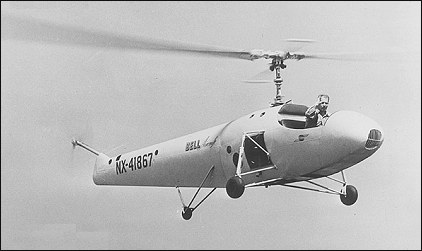
By the autumn of 1941, Arthur M Young had been testing helicopter scale-models on his farm in Pennsylvania for some thirteen years. After this period of research, many failures and his big breakthrough with the invention of the stabiliser bar, Young had perfected a design that would appeal to a manufacturer. Young’s first attempts at interesting aircraft companies in his machine met with little enthusiasm until one of his friends visited Bell’s factory. This led to an appointment for a demonstration on 3 September, 1941. Larry Bell and Arthur Young reached an agreement and, on 24 November, 1941, Young and his assistant, Bart Kelley, arrived at Bell to supervise the initial building of two prototypes as specified in the contract. On 23 June, 1942, Young and his team (some fifteen people) were installed in an old Chrysler agency and garage in Gardenville, a suburb of Buffalo. Dave Forman was assigned to supervise the project. The Model 30 structure was made of welded tubes with a four-legged undercarriage made of 3in aluminium tubing. The 160hp Franklin six-cylinder horizontally-opposed air-cooled engine was mounted vertically behind the cockpit within a steel-tube framework. The main two-blade rotor hub was mounted on a transmission mast by universal joint and was provided with a stabilising bar below and at right angles to the blades which were rigidly connected to the hub. This bar acted as a flywheel on a hinge. It kept the rotor blades level and independent from the movements of the fuselage, solving the problem of stability. The main rotor drive was done through a centrifugal clutch and a two-stage planetary transmission with a 9:1 reduction ratio. The blades, of symmetrical aerofoil section, were made of solid wood with a steel insert in the leading edge. The two-blade tail rotor (also made of solid wood) was mounted on a thin tube at the end of the fuselage. The roll-out of the first Model 30 (c/n 1, later to be registered NX41867) took place on 24 December, 1942; a secretary broke a bottle of champagne on the fuselage and the aircraft was named Genevieve. That day, the engine was run up at 150rpm. The first flight occurred on 29 December when Young flew the tethered Model 30 at an altitude of 1.5m; the same day Floyd Carlson also flew the aircraft. Early in January 1943, the prototype suffered an accident and its pilot, Bob Stanley, was badly hurt. The aircraft was repaired and on 26 June, 1943, the cable was removed and Carlson took Genevieve on its first free flight. The aircraft performed well and by July 1943 was flying at speeds of over 110km/h. At this time, a three-wheeled undercarriage was installed, the fuselage was covered and the aircraft was painted blue overall, so that it could be used for demonstration flights. While flights of the Model 30 No.1 were underway, aircraft No.2 was being built. Several modifications were introduced in this machine: new undercarriage, semi-monocoque fuselage and new tail rotor mounting, and an enclosed cockpit, with car-like doors, for the pilot and one passenger. Unfortunately a setback occurred in September 1943 when the No.1 crashed with Carlson at the controls. Carlson was unhurt but the badly damaged aircraft had to be rebuilt. It was flying again within six months. In late September 1943, aircraft No.2 (registered NX41868) replaced No.1 as the test vehicle. One of the first passengers to fly in this aircraft was Larry Bell. In 1944, Bell began a demonstration programme with aircraft No.2 which made its public debut in March 1944. On 10 May, Floyd Carlson flew the aircraft indoors in a Buffalo armoury before Civil Air Patrol pilots and cadets. By the spring of 1944, aircraft No.1 had been rebuilt and was designated No.1A. This helicopter was the star attraction at a soldier’s benefit show, staged at Buffalo’s Civil Stadium on 4 July 1944. On 5 January, 1945 the first rescue mission ever made by a Bell helicopter took place when Jack Woolams baled out of a P-59 Airacomet in trouble near Lockport. Floyd Carlson and Dr. Thomas C. Marriott took off in one of the Model 30s and, guided by Joe Masham flying a P-59, rescued the unfortunate pilot. But the first publicised rescue mission took place two months later, on 14 March, when two ice fishermen were rescued on Lake Erie. Carlson received the Treasury Department Silver Medal for this feat. The construction of a third aircraft introduced several improvements including a four-wheel undercarriage, an advanced instrument panel and a tubular tailboom, but it retained the open cockpit of No.1. This helicopter (c/n 3, registered NX41869) flew for the first time on 25 April, 1945, and performed well, so well that it proved to be the best of the trio to demonstrate, but the open cockpit was a real handicap. To overcome this Young had the idea of covering the cockpit with a Plexiglass bubble thus providing both comfort and outstanding visibility for pilot and passenger. The shape of this aircraft was now very near to that of the Model 47. Two of the Model 30s are still in existence: c/n 1A (NX41867) is on display at the National Air and Space Museum and c/n 3 (NX41869) is owned by Buffalo and Erie County Historical Society Museum, Amhurst, New York.
Model 30 Engine: 1 x Franklin 6-cylinder, 110.4kW / 160hp Main rotor diameter: 9.75m Main rotor: 2-blade wooden Length: 8.22m Height: 2.59m Empty weight: 518kg Crew: 1 Passengers: 1











 All Aero