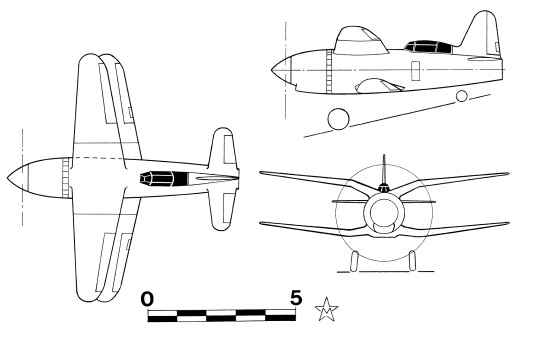
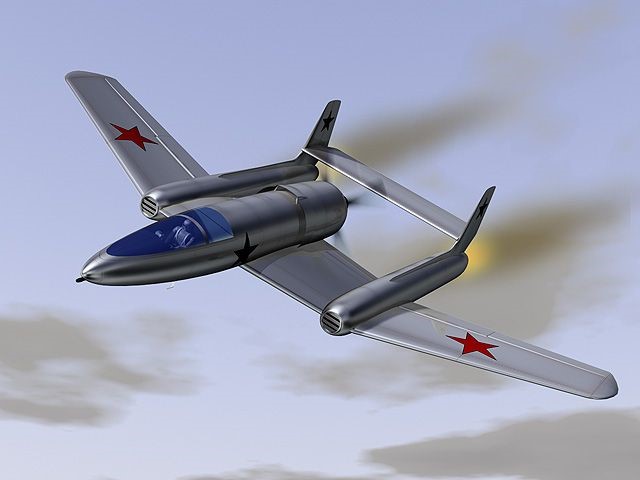
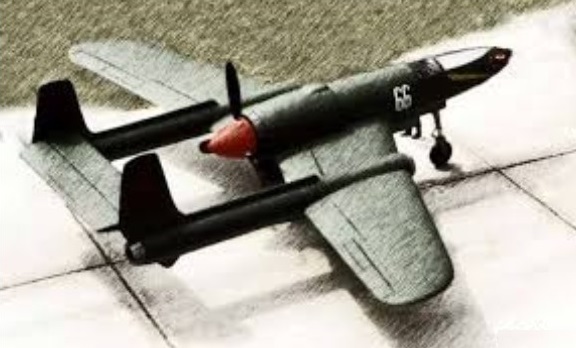
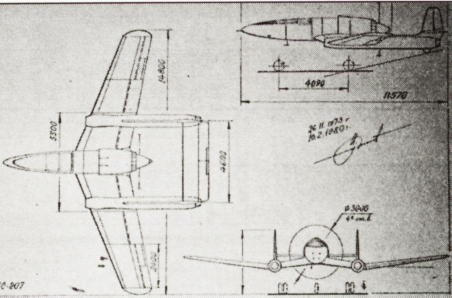
After the “Object 10” project, the Borovkov and Florov working group got to work on a new version known as “Object 11” or simply No.11. In some literature it has also been called I-207/6. This new project owed its origin to the intention to comply with the requirements issued by BN Yuriev during the review of the “Object 10” project as a way to achieve its serial production.
This new project returns to the conception of pure fighter with high manoeuvrability and to the conventional type landing gear. The armament included two 12.7 mm machine guns and two 7.62 mm ShKAS, but the possibility of carrying two FAB-250 250 kg bombs or instead two detachable containers with PTB-23 23 mm cannons remained.
It was smaller and lighter derivative of the “10”. Maintaining the same wing configuration of gull and inverted gull, the new model included two Merkulov DM ramjets in its metallic tail section, located side by side and with side gates for the air intakes. Instead of one large DM ramjet, it has two smaller ones placed side-by-side. This arrangement made it possible to install the tail wheel between them.
The project kept the Shvietsov M-71 engine, but in this case a variant with an elongated shaft was used, which made it possible to improve the aerodynamics of the forward section of the fuselage.
All efforts in the design of this new version were directed to obtain the lowest possible weight. The calculated speed of the project in fighter configuration at 5830 meters and without the auxiliary engines gave 654 km / h. With the bomb load the speed decreased to 611 km / h. The ascent time to 5000 meters was 3.7 and 4.5 minutes respectively.
The conceptual project for “Object 11” was presented in the fall of 1940. The evaluation commission considered that the calculated speed was a bit high and recalculated it to 630 km / h, leaving the speed with bombs at 585 km / h. The commission proposed to include the model in the plan of experimental works for the next year, obtaining the approval of AS Yakovlev.
In October 1940 the project was presented at the NII VVS and the conclusions of its evaluation were signed by PV Rychagov on December 9 1940. In general, the evaluation was positive and it was again recommended to include the fighter in the experimental construction plan for 1941 with the condition of increasing its range to 1000 km in normal version and 1400 km with auxiliary fuel (taking into account that “Object 11” it was not foreseen as an escort fighter, such range value was exaggerated and forced to considerably increase the weight of the aircraft in fuel).
The position of the GUAP, together with the negative perception of the industry and the air forces towards the biplane wing structure, resulted in the work on the project being closed. The deputy commissioner for experimental aviation AS Yakovlev, in a meeting informed the constructors of the decision not to include new proposals for two-plane configurations in the future work plans of the Narkomat.
Borovkov-Florov Object 11 Powerplant: One Shvietsov M-71 (1700/2000 hp) and two Merkulov DM ramjet Wingspan: 8.5 m Wing area: 22.0 m² Length: 7.85 m Flying weight: 3250 kg Wing loading: 148 kg / m² Maximum speed: 790 – 800 km / h Ascent time at 8000 m: 6 – 7 min Range: 800 km Accommodation: 1
Florov and Borovkov continued with the “Object 10” project airplane that had a clear influence of the I-207 fighter, which is why the literature has sometimes named it I-207/5.
The project for this aircraft was ready for 1940 and envisaged the use of a Shvietsov M-71 engine. The fundamental objective of this new project was to achieve a design capable of eliminating all the difficulties encountered during the I-207 tests.
The aim was to demonstrate the possibility of creating a highly maneuverable biplane fighter with minimal resistance to advance, capable of competing with the best monoplane fighters of the time. The selection of a biplane wing box, according to its creators, should guarantee a more compact aircraft with better visibility for the pilot.
On this occasion and in order to achieve a wing as thin as possible, the builders decided to use a gull-type wing configuration for the upper wing and inverted gull for the lower wing. As in the I-207, the use of any type of bracing or upright was not foreseen. According to calculations the “Object 10” should reach a speed of 650 km / h with a turn time of 14 – 16 seconds.
In an attempt to achieve the highest possible speed, the builders designed from the beginning of the design stage, the use of reactive engines.
As early as July 1939 the engine manufacturer Merkulov had proposed the use of auxiliary ramjets in piston-engined aircraft. These ramjets were characterized by using the same jet fuel as the main power plant. These motors were called DM, acronym for Dopolnitielni Motor or auxiliary motor.
DM motors were designed as short-term supports for those moments in combat when additional speed was required. The first tests of these auxiliary engines were developed on a Polikarpov I-15bis in late 1939. The results were promising and for this reason in 1940 the constructors Borovkov and Florov installed these engines on the I-207/3. The test pilot of Factory No.207, LM Maximov, carried out about twenty flights without difficulties on this plane.
In the “Object 10” project the DM was installed inside the rear fuselage, behind the cockpit. In this way, its installation did not affect performance during the flight under normal conditions. The DM could be switched on by the pilot. For this, some side doors were opened that allowed air access to the engine and it was turned on. An increase in speed was calculated to about 840 km / h.
Unlike the previous models, the tail section was designed as a monocoque duralumin structure with a structure similar to that used in the wing. This was due to the need to reinforce the tail for the installation of the DM engine and to the need to avoid possible fires caused by the hot exhaust gases from the ramjet.
The armament was designed in such a way that it could be added or removed depending on the mission. The initial version was armed with two ShKAS 7.62 mm machine guns and a BS 12.7 mm machine gun, which could be replaced in field conditions by two 23 mm guns in the ground attack version. The armament had to include the possibility of transporting 250 – 500 kg bombs and dropping them accurately during dive on the target.
In the design, 350 – 400 kg were estimated for the armor and the installation of the guns. The cockpit and vital organs of the plane had to be protected. In the fighter version, the pilot’s back was protected by 8.5 mm thick concrete armor capable of defending the pilot from the firing of normal caliber weapons. The frontal armor was provided by the radial motor. This, together with the small dimensions of the plane, guaranteed an important level of safety to the pilot. The fuselage fuel tank was also protected.
A feature was the retractable type tricycle undercarriage. This configuration had been successfully tested by the TsAGI on an SB bomber. As early as 1940, several Soviet models included this type of landing gear in their design. In the case of “Object 10” this decision was forced by the fact that the tail was occupied by Merkulov’s engine.
The “Object 10” project was handed over to the NKAP in the summer of 1940. This project envisaged the use of a Shvietsov M-71 engine and a maximum armament capacity of 1000 kilograms. The armament could be made up of 250 or 100 kilogram bombs, although the possibility of using eight RS-82 reactive rockets under the wings was envisaged. The armament was also composed of two 12.7 mm and two 7.62 mm machine guns.
The cockpit armor comprised a 4 – 4.5mm armored seat plus an 8.5mm cement plate at the rear of the seat.
The project data showed a speed of 658 km / h without the auxiliary engine in the fighter version. The ground attack model had to fly at a speed of 550 km / h.
The project was reviewed by a directed commission for academic BN Yuriev on 3 August 1940, which considered objective the construction of the aircraft in its hunting version high manoeuvrability and in its version with two FAB-250 or four FAB- 100. The commission noted that the actual speed to be reached without the auxiliary engine would be only 605 km / h.
With these results, this variant in general could become an excellent ground attack aircraft. The possibility of using the M-82 engine was also evaluated.
With the start of the war, neither this model nor its development known as “Object 11” were built.
Object 10 Engine: 1x Shvetsov M-71 (1700/2000 hp); 1x Merkulov DM ramjet Wing span: 9.5 m Wing area: 24.0 sq.m Length: 8.35 m Takeoff weight: 3500 kg Wing loading: 146 kg/sq.m Max speed w/out ramjet: 650 km/h Max speed with ramjet: 750-800 km/h Climb to 8000 m (with ramjet active): 8.0 min Flight range: 800 km Armament: 1x 12.7 mm Berezin BS, 2x 7.62 mm ShKAS or 2x 23 mm cannons. Crew: 1
The ‘D’ design was started in 1941 by Alexei Andreeyevich Borovkov & Ilya Florenteyevich Florov as a mixed power fighter with a piston engine and Merkulin ramjet booster. A 1,500 kW (2,000 hp) Shvetsov M-71 engine was intended to be the main powerplant but it is unclear how the thermodynamic cycles of the two engines were to be linked. Similar aircraft were built later in the German-Soviet War using the main engine to drive a propeller and a compressor to supply air to a ramjet/afterburner booster, both the Su-5 and MiG-13 were produced in limited numbers but the performance gains were limited and soon eclipsed by turbo-jet engines.
The ‘D’ was to have been a gull- winged monoplane with high set wing, of stressed skin construction with exceptionally smooth skin stabilised by underlying corrugated structure. The cockpit featured a pneumatic ejection system which rotated the seat downwards and fired it clear of the propeller arc.
A heavy armament of two 37 mm (1.457 in) Nudelman-Suranov NS-37 cannon and two 20 mm (0.787 in) ShVAK cannon was included, but all work was abandoned with the German invasion of 1941.
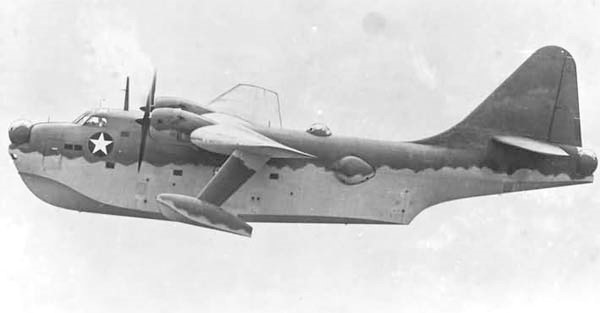
Well before the United States entered World War II, the Navy started a program to develop a long-range flying boat, able to cover the vast expanse of the Pacific Ocean. The Model 344 design offered by Boeing was chosen, and a contract for 57 aircraft was awarded on 29 June 1940.
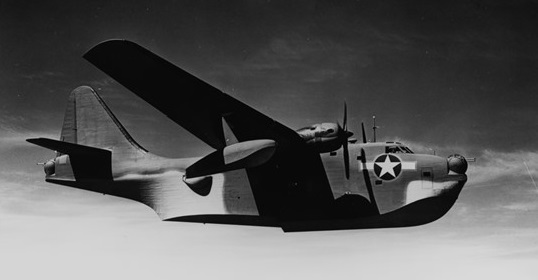
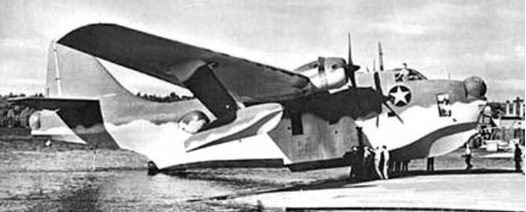
To build the large twin-engined XPBB-1 Sea Ranger (Boeing 344) flying boat Patrol Bomber prototype, Boeing started construction of a new lakeside factory in Renton, Washington, that was owned by the US Navy. The Navy owned 95 acres (38 hectares) on the south shore of Lake Washington in Renton, Wash. The waterfront site provided natural protection from prevailing winds, so it was easier to launch seaplanes directly from the plant. However, the prototype was constructed mostly in Seattle, and was moved to Renton only to be completed.
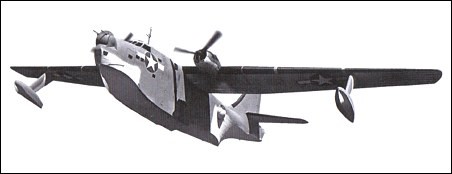
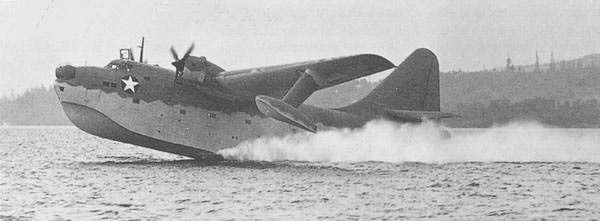
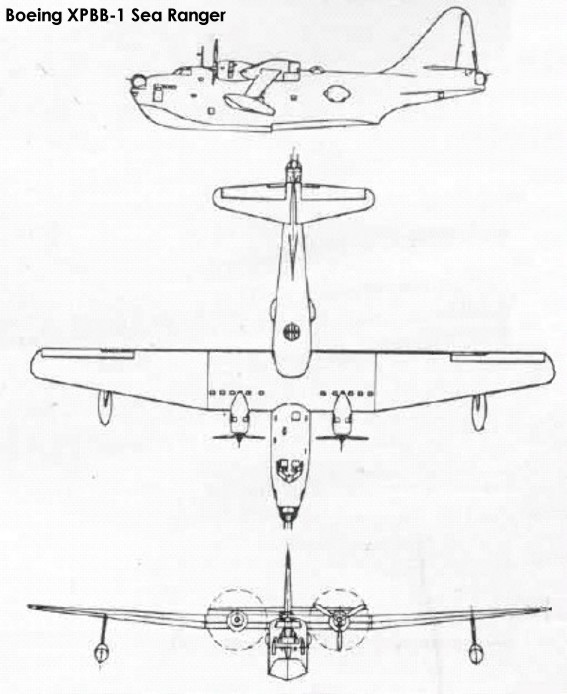
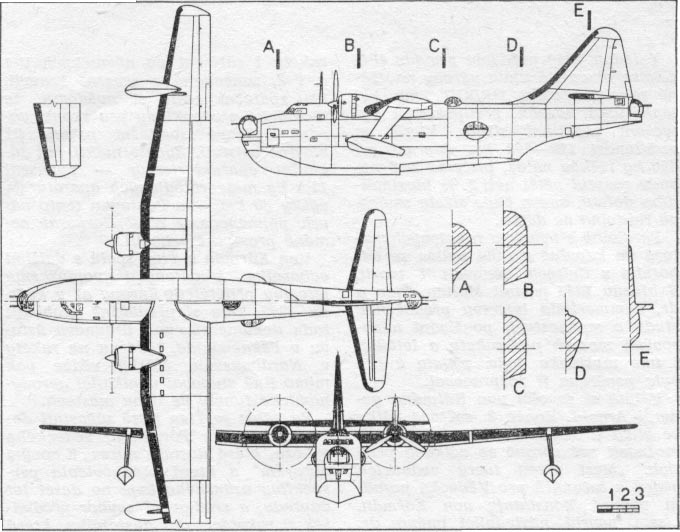
To achieve the desired long range, the PBB became a large aircraft, with a wing span of 139 feet 8½ inches (42.59 m) and a crew of 10. Despite this size, it was powered by just two Wright R-3350 Duplex Cyclone radial engines, driving three-bladed Curtiss Electric propellers. It was the largest twin-engined flying boat flown during World War II. For a flying boat, the PBB was aerodynamically clean, with a cantilever wing set high on the fuselage. The planing bottom had a single step, and the non-retractable outrigger floats were attached to streamlined, cantilever struts. The lower hull was divided in seven watertight compartments, and a short upper deck provided seating for the cockpit crew. The wing of the PBB was constructed in a centre section and two outer panels. The centre section carried the engine nacelles and contained the internal bomb bays, as well as fuel and oil tanks. The outer wing panels contained main and auxiliary, integral fuel tanks.
The defensive armament of the PBB consisted of five powered turrets equipped with Browning .50 M2 machine guns. They were installed in the nose, in the tail, on the upper fuselage just aft of the trailing edge of the wing, and in two waist positions on the rear fuselage. Except for the waist guns, the turrets had two guns each. Offensive armament could consist of up to 20,000 lb of bombs in internal bomb bays in the wing centre section (five bays on each side) or of two Mk.13 or Mk.15 torpedoes slung under the wing centre section.
The 1710 US gallon auxiliary outer and 1565 US gallon inner fuel tanks were intended to be used only in an overload condition, in which the PBB would use catapult-assisted take off to achieve a theoretical range of 11000 miles (17700 km). Normal range using the main fuel tanks was 4245 miles (6830 km).
The PBB was the first aircraft of the Patrol Bomber category built by Boeing for the Navy.
In March 1941 the Navy’s Bureau of Aeronautics asked the Naval Aircraft Factory for a catapult able to launch a PBB-1. The NAF duly prepared a design for a Mark VII catapult that would be able to launch a fifty-ton PBB-1 at a speed of 130 miles per hour. The catapult would be installed on a lighter, so that the flying boat could be lifted onto it with a large crane or hydraulic jacks. However, in the summer of 1942, while development of the Mk.VII catapult was still ongoing, the Navy cancelled the project because it considered JATO assistance at take-off more practical.
The prototype, designated XPBB-1 (hull number 3144), made its first flight on 9 July 1942 from Lake Washington. The aircraft handled very well and was considered technically successful.
The Boeing 25-year tradition of building seaplanes came to an end when the Lone Ranger flew out of Renton for the last time on Oct. 25, 1943, heading for the Navy base in San Diego, Calif.
However, already in 1942 the PBB programme had been cancelled: The need for a long-range flying boat had been reduced by the ability of land planes such as the Consolidated PB4Y to fly long-range missions over the ocean, and construction of a small number of PBB-1s would have a negative impact on the production rate of the B-29. The Navy allowed the Army to use the Renton factory for the production of B-29 bombers, in return for the use of another factory in Kansas.
The single XPBB-1 was handed over to US Navy in 1943, and was used in trials programmes at the naval base in San Diego until 1947, when it was finally retired to the Norfolk Naval Air Station in Virginia. It remained the single example of the type, and was accordingly nicknamed “Lone Ranger”.
The Navy traded the Renton site with the U.S. Army for a plant in Kansas City, Mo., and the Army took over the Renton plant, where Boeing workers subsequently produced 1,119 B-29 bombers. After the war, the Renton plant eventually became a manufacturing facility for Boeing commercial jet transports.
XPBB-1 Sea Ranger Engines: 2 × Wright R-3350-8 Double Cyclone, 2,300 hp (1,716 kW) Wingspan: 139 ft 8½ in (42.59 m) Wing area: 1,826 ft² (169.7 m²) Length: 94 ft 9 in (28.89 m) Height: 34 ft 2 in (10.42 m) Empty weight: 41,531 lb (18,878 kg) Loaded weight: 62,006 lb (28,185 kg) Max. takeoff weight: 101,130 lb (45,968 kg) Maximum speed: 186 knots (214 mph, 345 km/h) at sea level Cruising speed: 158 mph / 254 km / h Range: 6,300 mi (5,500 nm, 10,000 km) (maximum) Normal range: 3,691 NM, (4,245 mi, 6,834 km) Service ceiling: 22,400 ft (6,830 m) Rate of climb: 980 ft/min (4.98 m/s) Endurance: 72 hr Wing loading: 34.0 lb/ft² (166 kg/m²) Power/mass: 0.15 hp/lb (0.24 kW/kg) Armament: 8 × .50 in (12.7 mm) machine guns in bow and tail turrets and waist positions Bombload: 20,000 lb (9,100 kg) Crew: 10
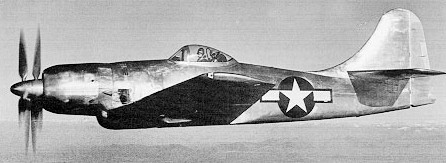
When the changing fortunes of war made it clear to the US Navy that they would need to attack the Japanese home islands, concern was expressed at the need to deploy carriers within easy range of large numbers of land-based aircraft. If the US Navy had available a long-range fighter/fighter-bomber, then it might be possible to engage the enemy without the need to bring the carriers within striking range of land-based defence aircraft. The requirement for such a category of aircraft was communicated to Boeing, which immediately began its design under the designation Boeing Model 400. Submitted to the US Navy, Boeing’s design study was sufficiently interesting to warrant the award of a contract for three XF8B-1 prototypes on 4 May 1943. The first of these aircraft made its initial flight during November 1944, and was immediately seen to be the largest single-seat piston-engine fighter to be built in the USA. In fact, it subsequently proved to be one of the most powerful single-engine fighters to be developed by any nation involved in World War II, for its powerplant consisted of a Pratt & Whitney XR-4360-10 radial piston engine, which had four banks of seven cylinders, the 2237kW power output being used to drive two three-blade contra-rotating metal propellers. Only the first prototype was completed and flown before the end of World War 11, but although the remaining two prototypes were completed and handed over after VJ-Day, the overriding interest in the development of turbine-engined aircraft meant that further test and evaluation of the XF8B-1s was abandoned.
XF8B Crew: 1 Engine: 1 x Pratt-Whitney R-4360-10, 2237kW Take-Off Weight: 9302 kg / 20508 lb Empty Weight: 6132 kg / 13519 lb Wingspan: 16.46 m / 54 ft 0 in Length: 13.18 m / 43 ft 3 in Height: 4.95 m / 16 ft 3 in Wing Area: 45.43 sq.m / 489.00 sq ft Max. Speed: 695 km/h / 432 mph Cruise Speed: 306 km/h / 190 mph Ceiling: 11430 m / 37500 ft Range: 4500 km / 2796 miles Armament: 6 x 12.7mm machine-guns or 6 x 20mm cannons, 1450kg of weapons
In March 1936, a team lead by Lysle Wood began work on an updated XB-15, the Model 316. This plane featured the all-glass nose that would make the B-29 distinctive. Designated the Y1B-20, it was 17 percent heavier than the eventual B-29. The Army was not interested. Boeing continued heavy bomber development in 1938 and 1939 with Models 330, 333, 333A, 333B, 334, and 334A. In August 1939 they began work on the Model 341, featuring a much improved wing: the Boeing Model 115 airfoil. Around 1938, General Henry H. ‘Hap’ Arnold, the head of the Army Air Corps, was growing alarmed at the possibility of war in Europe and in the Pacific. To prepare the Air Corps, Arnold created a special committee chaired by Brigadier General W. G. Kilner; one of its members was Charles Lindbergh. After a tour of Luftwaffe bases, Lindbergh became convinced that Nazi Germany was far ahead of other European nations. In a 1939 report, the committee made a number of recommendations, including development of new long-range heavy bombers. When war broke out in Europe, Arnold requested design studies from several companies on a Very Long-Range bomber capable of travelling 5,000 miles (8,000 km). Part of Arnold’s motivation for these studies was the fear that Britain might fall to the Nazis. In that event, it would be imperative that the Army Air Force have a bomber capable of flying round-trip from the U.S. East Coast to Europe to strike targets on the European mainland. Approval was granted on December 2. This request, R-40B, fitted perfectly with the research Boeing was doing at the time. On 29 January 1940, the Air Corps issued a request for proposals for a much larger bomber, which was to have the range for operation over the Pacific; this bomber would serve in the inevitable war with Japan. Four firms submitted design studies: the Boeing XB-29, Lockheed XB-30, Douglas XB-31, and Consolidated XB-32. Douglas and Lockheed soon withdrew, in part because Boeing was well ahead of them in the design process. On 6 September 1940 contracts were awarded to Boeing and Consolidated (later Convair) for the construction and development of two (later three) prototypes of their respective designs. Convair’s XB-32 Dominator was the first to fly, on 7 September 1942, but extensive development delayed its entry into service.
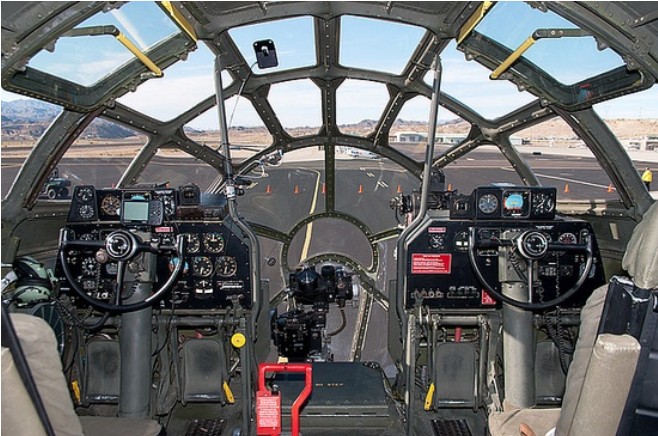
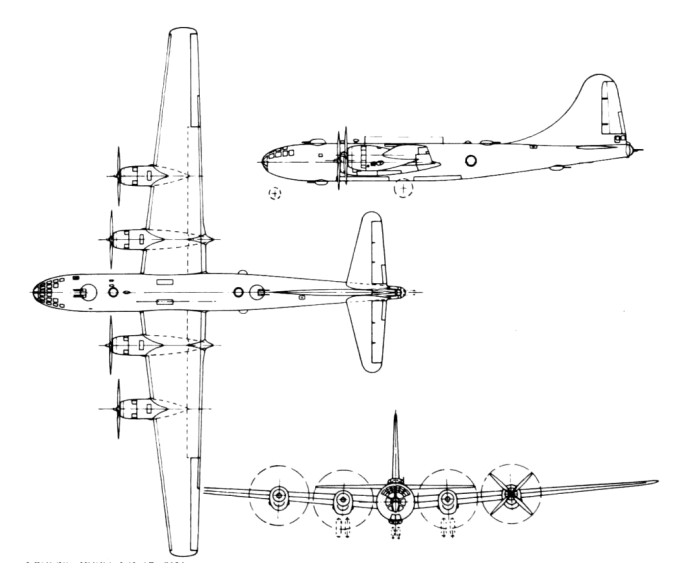
In early 1940, the Army Air Corps analysed the performance of bombers used in Europe against the Luftwaffe, and requested that the B-29 have self-sealing fuel tanks, more machine guns, and higher-caliber guns. Boeing incorporated these into a redesign of the Model 341, and resubmitted it to the Army Air Corps as Model 345, which would become the XB-29. Impressed by the mock-up completed in the spring 1941, the Army Air Corps had placed a massive order for 1,500 B-29s, a year before the prototype would fly for the first time on September 21, 1942. A long-range bomber was urgently needed, so service testing proceeded largely in tandem with production. The first B-29 rolled off the assembly line two months after the first service test flight. In under a year, the B-29 was in full-scale production. The USAAC’s specification had called for a speed of 644km/h, so the XB-29 had a high aspect ratio cantilever monoplane wing mid-set on the circular-section fuselage. Because such a wing would entail a high landing speed, the wide-span trailing-edge flaps were of the Fowler type which effectively increased wing area by almost 20%, thus allowing a landing to be made at lower speed. Electrically retractable tricycle landing gear was provided and, as originally proposed by Boeing, pressurised accommodation was included for the flight crew. In addition, a second pressurised compartment just aft of the wing gave accommodation to crew members who, in the third XB-29 and production aircraft, sighted defensive gun turrets from adjacent blister windows. The crew and aft compartments were connected by a crawl-tunnel which passed over the fore and aft bomb bays. The tail gunner was accommodated in a third pressurised compartment, but this was isolated from the other crew positions. Rather than the traditional bulky manned gun turrets, Boeing used small, remote-control units ‘networked’ together with an analog computer that compensated for factors such as air temperature and bullet drop. This system was very difficult to develop, but it proved effective. Each gun was served by a 1,000 round bullet belt.
The powerplant consisted of four Wright R-3350 Cyclone twin-row radial engines, each with two General Electric turbochargers mounted one in each side of the engine nacelle.
Prototype production was followed by 14 YB-29 service test aircraft, the first of these flying on 26 June 1943. Deliveries of YB-29s began almost immediately to the 58th Very Heavy Bombardment Wing (VHBW), a unit which had been established on 1 June in advance of the first flight. B-29 production was the most diverse aircraft manufacturing project undertaken in the USA during World War II, with literally thousands of sub-contractors supplying components or assemblies to the four main production plants: Boeing at Renton and Wichita; Bell at Marietta, Georgia; and Martin at Omaha, Nebraska.
Because of its highly advanced design, challenging requirements, and immense pressure for production, development was deeply troubled. The first prototype crashed during testing, killing the entire crew and several ground personnel. Changes to the production craft came so often and so fast that in early 1944, B-29s would leave the production lines and fly directly to modification depots for extensive rebuilds to incorporate the latest changes. This ‘battle of Kansas’ nearly sank the program, which was only saved by General Hap Arnold’s direct intervention. It would still be nearly a year before the aircraft was operated with any sort of reliability.
The most common cause of maintenance headaches and catastrophic failures, even more so than the advanced gunnery system, was the engine. Though the Wright R-3350 would later become a trustworthy workhorse in large piston-engined aircraft, early models were beset with dangerous reliability problems. It had an impressive power-to-weight ratio, but this came at a heavy cost to durability. Worse, the cowling Boeing designed for the engine was too close (out of a desire for improved aerodynamics), and the early cowl flaps caused problematic flutter and vibration when open in most of the flight envelope.
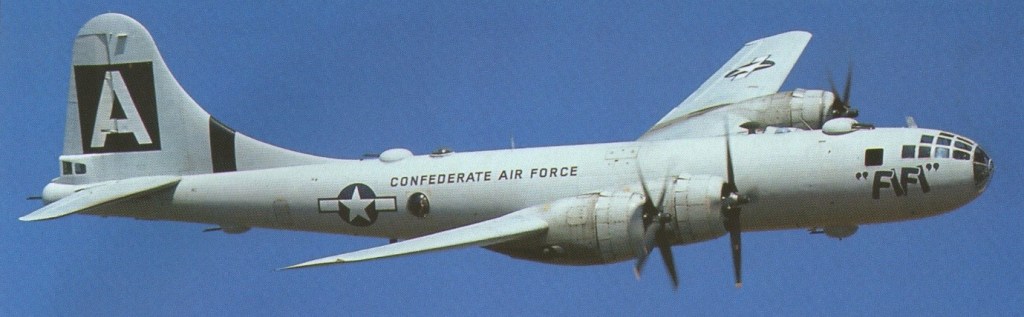
These weaknesses combined to make an engine that would overheat regularly when carrying combat loads; it frequently swallowed its own valves. The resulting engine fires were exacerbated by a crankcase designed mostly of magnesium alloy. The heat was often so intense the main spar burned through in seconds, resulting in catastrophic failure of the wing. This problem would not be fully cured until the aircraft was re-engined with the more powerful Pratt & Whitney R-4360 ‘Wasp Major’ in the B-29D/B-50 program, which arrived too late for World War II. Pilots, including the present-day pilots of the Commemorative Air Force’s Fifi, describe flight after takeoff as being an urgent struggle for airspeed. Radial engines need that airflow to keep cool, and failure to get up to speed as soon as possible could result in an engine failure and risk of fire.
The initial plan was to use B-29s to attack Japan from airfields in southern China, with the main base in India, and to attack other targets in the region from China and India as needed. This was an extremely costly scheme, as there was no overland connection available between India and China, and all the supplies had to be flown over the Himalayas. The first B-29s started to arrive in India in early April, 1944. The first B-29 flight to airfields in China (over the Himalayas, or “The Hump”) took place on 24 April 1944. The first B-29 combat mission was flown on 5 June 1944, with 77 out of 98 planes launched from India bombing the railroad shops in Bangkok (5 B-29s were lost to non-battle causes).
B-29 bomb aimer
On June 15, 1944, 47 B-29s launched from Chengtu in China bombed the Imperial Iron and Steel Works at Yawata, Japan. This was the first attack on Japanese islands since the Doolittle raid in April, 1942. The first B-29 combat loss occurred during this raid, with 1 B-29 destroyed on the ground by Japanese fighters after an emergency landing. Because of the extreme cost of operations, the raids against Japan from Chinese airfields continued at relatively low intensity. Japan was bombed on: 7 July 1944 (14 B-29s), 29 July (70+), 10 August (24), 20 August (61), 8 September (90), 26 September (83), 25 October (59), 12 November (29), 21 November (61), 19 December (36) and for the last time on 6 January 1945 (49). B-29s were withdrawn from airfields in China by the end of January, 1945. Throughout this period B-29 raids were also launched from China and India against many other targets throughout South-East Asia. However, the entire B-29 effort was gradually shifted to the new bases in the Marianas, with the last B-29 combat mission from India flown on March 29, 1945.
The need to use inconvenient bases in China for attacks against Japan ceased after the capture of the Marianas islands in 1944. On the islands of Tinian, Saipan and Guam a series of airfields were built, which became the main bases for the large B-29 raids against Japan in the final year of the war. The islands could be easily supplied by ship. The first B-29 arrived on Saipan on 12 October 1944, and the first combat mission was launched from there on 28 October 1944, with 14 B-29s attacking the Truk atoll. The first mission against Japan from bases in the Marianas was flown on 24 November 1944, with 111 B-29s sent to attack Tokyo. From that point ever more intense raids were launched regularly until the end of the war. These attacks succeeded in devastating all large Japanese cities and gravely damaged Japan’s war industries.
Perhaps the most recognized B-29 is the Enola Gay, which dropped the atomic bomb ‘Little Boy’ on Hiroshima on 1945 August 6. The Bockscar, also a B-29, dropped ‘Fat Man’ on Nagasaki three days later.
On Sunday 2 April 1944, the first B-29 Superfortress landed in Calcutta, India. It belonged to 58 Wing, 20th Bomber Command of the USAAF and had flown almost around the world, from the Boeing aircraft plant Wichita, Kansas to England, and then onto North Africa and the Orient. The plan was for B-29s to begin the strategic war against Japan.
On 16 June 1944 the US War Department announced the first wings of new US B-29 Superfortress bombers had taken off from bases in India, Burma and China, and have flown a massive raid on an “important target in Japan” from an altitude of 20,000 ft.
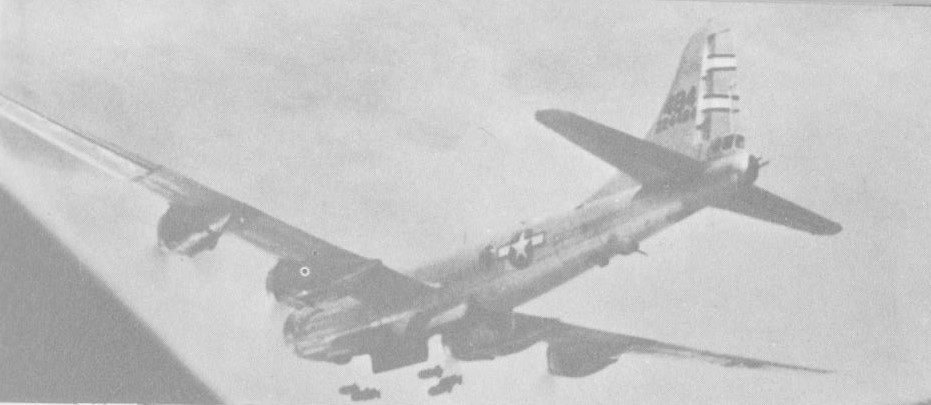
The B-29 was used in World War II only in the Pacific Theatre. It was later used in the Korean War, over the course of which they flew 20,000 sorties and dropped 200,000 tons (180,000 tonnes) of bombs. 3970 of the aircraft were built before they were retired in 1960. The B-29 was soon made obsolete by the development of the jet engine. With the arrival of the mammoth B-36, the B-29 suffered its first ignominy by being classified a medium bomber with the new Air Force. However, the later B-29D/B-50 variant was good enough to handle auxiliary roles such as air-sea rescue, electronic intelligence gathering, and even air-to-air refuelling. It was replaced in its primary role during the early 1950s by the Boeing B-47 Stratojet, which in turn was replaced by the Boeing B-52 Stratofortress. The final active duty variants were phased out in the mid 1960s. B-29 production totalled 1,644 from Boeing’s Wichita plant, with 668 built by Bell and 536 by Martin. The Renton plant produced only the B-29A variant, with a 12in wider span, later marks of the 2,200hp Wright R 3350 engines, changes in fuel capacity, and the addition of a four gun forward dorsal turret and armament: production continued until May 1946 and totalled 1,122 aircraft. The designation B-29B related to 311 of the aircraft built by Bell. These were reduced in weight by removal of all defensive armament except for the tail guns, which were then unmanned, being aimed and fired automatically by an AN/APG-15B radar fire-control system. The production total of 3970 B-29s of all versions saw a wide variety of employment in the post-war years, operating under several designations. A number of B-29s were used operationally during the Korean War.
B 29s were followed by several hundred of many versions of the B 50, with more powerful engines and other changes. These saw action only as tankers in the Vietnam War, but B 29s operated throughout the Korean War, the 22nd and 92nd Bomb Groups opening strategic missions as early as 13 July 1950. Though never more than 99 B 29s were on strength, the two groups flew 21,000 sorties and dropped 167,100 tons, more than the tonnage dropped by B 29s in World War II.
The US Operations Crossroads, with a budget of $1.3 billion, was to determine atomic bomb effectiveness using three tests. The first, Able, was air dropped, Baker detonated under water. Charlie, the third was later cancelled. For the first test site the Navy chose Bikini atoll. On 1 July 1946, the Able bomb was loaded into a B-29 Superfortress named ‘Dave’s Dream’. Just before 9am the bomb was released, exploding 518 ft above Bikini lagoon. The 23 kiloton test was a success, generating a 100,000 degree Fahrenheit fireball with the mushroom cloud reaching 40,000 ft.
B 29s force landed in Soviet territory were dissected in minute detail, and the Tupolev design bureau built first a simple transport, the Tu 70, followed in July 1947 by the first Tu 4 bomber. This was a B 29 except in having 23 mm cannon in its five twin turrets. About 400 were built, but they did not see action; their main importance was that they were the starting point for all today’s Tupolev strategic turboprop and jet bombers. Some of these remained in service into the 1960s in the Soviet Union. All but one of the Tu-4s were scrapped in the 1960s. The lone example of a Tu-4 known to exist today is located at the Yuri Gagarin Air Force Academy near Moscow, as a static display. This particular airplane was tasked with bombing the Budapest headquarters of the Hungarian rebel movement during the 1956 rebellion; but although the mission was rehearsed it was never put into play.
The last RB-29 was shot down by two MiG-15s above the east coast of Hokkaido, Japan, on 4 September 1954. The aircraft allegedly flew over Soviet territory on the Pacific coast, according to the Soviet. Ten or eleven of the crew survived.
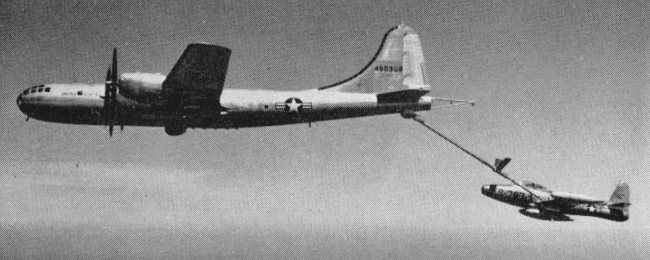
The KB-29 was the tanker version of the B-29, the SB-29 the search & rescue version, carrying a lifeboat; the DB-29 was a drone controller, the TB-29 a trainer, the RB-29 a reconnaissance aircraft. Some B-29s were also used as launch aircraft for research aircraft like the X-1 and X-2.
Boeing eventually converted about 100 to KB-29 tankers.
The KB-29P flying boom flight refuelling tanker version and the SB-29 search and rescue aircraft were still in service in 1955. The SB-29 equipped to carry an A.3 remote control lifeboat under its fuselage.
Boeing KB-29P
Eventually 4221 B-29 were built.
Events:
1 June 1943 The USAAF’s 58th Heavy Bombardment Wing was established. This wing was equipped with Boeing B-29 superfortresses for strategic attack on Japan.
15 June 1944 47 B-29s bombed the imperial iron and steel works at Yawata Japan.
20 November 1945 A new non-stop distance record of 7,916 miles was set by B-29 bomber “Pacusan Dreamboat” after flying from the island of Guam to Washington DC.
1 November 1954 The last B-29 in front-line service, based at Kadena, was retired. The B-29s were replaced by the B-47.
B-29 Engines: Four Wright R-3350-21 or -23 “Cyclone” radials each equipped with two type B-11 turbo superchargers; later B-29 models fitted with -23A, -41 or -57 Cyclone radials Engine gear ratio: 20:7 (.35) Take-off power: 2,200 hp at 2,600 rpm w/ manifold pressure of 47.5 in. Military power: 2,200 hp at 2,600 rpm w/ manifold pressure of 47.5 in at 25,000 ft. Normal rated power: 2,000 hp at 2,400 rpm at sea level Idling speed: 600 +/- 50 rpm (propeller at increase rpm) Propellers: Manufacturer: Hamilton Standard Propeller division of United Aircraft Corp. Type: 4-blade, full feathering Diameter: 16 ft. 7 in. Span: 141 ft. 2.76 in. Length: 99 ft. 0 in. Height: 27 ft. 9 in. (at rest) 27 ft. 6.7 in. (taxi position) Maximum fuselage diameter: 9 ft. 6 in. Height to centerline of propeller hub (taxi position) Inboard engines: 9 ft. 5.6 in. Outboard engines: 10 ft. 8 in. Ground clearance of inboard propeller tips (taxi position): 14.1 in. Airfoil section: Boeing 117 Root: 22% Tip: 7% Chord root: 17 ft. Chord tip (70 feet 10 inches from centerline of fuselage): 7 ft. 5 in. Incidence: 4 degrees Dihedral: 4 degrees 29 minutes 23 seconds Sweepback: 7 degrees 1 minute 26 seconds Stabiliser: Span: 43 ft. Maximum chord: 11 ft. 2.4 in. Areas: Wing (less ailerons): 1609.68 sq. ft. Wing (flaps extended, plus ailerons): 2070.88 sq. ft. Alierons (total, including tabs): 129.2 sq. ft. Flaps (total): 332 sq. ft. Stabilizer and elevators (including tabs): 333 sq. ft. Elevators (total including tabs): 115 sq. ft. Elevator trim tabs (total): 10.12 sq. ft. Vertical fin: 131.9 sq. ft. Dorsal fin: 40.6 sq. ft. Rudder (including tab): 65.5 sq. ft. Rudder trim tab: 5.79 sq. ft. Weight: 133,500 lbs. (maximum overload) 105,000 lbs. gross Armament: 10 or 12 .50-cal. machine guns and one 20mm cannon plus 20,000 lbs. of bombs. Fuel Tank Capacities: Regular wing (22 cells): 5608 US gals. (4669 Imp.) Auxiliary center wing (four cells): 1333 US gals. (1110 Imp.) Auxiliary bomb bay (four cells): 2560 US gals. (2133 Imp.) Net Total capacity: 9501 US gals. (7912 Imp.) Crew: Normal crew of 10 consists of Pilot, Co-Pilot, Flight Engineer, Bombardier, Navigator, Radio Operator, (2) Side Gunners, Top Gunner, and Tail Gunner Maximum speed: 357 mph at 25,000 ft. Cruising speed: 220 mph Range: 5,600 miles maximum ferry range and 3,250 miles with 20,000 lbs. of bombs Service ceiling: 33,600 ft.
B-29 Crew: 10 Engines: 4 x Wright R-3350-23-23A/-41 Cyclone 18, 1641kW Take-off weight: 56245 kg / 124000 lb Empty weight: 31815 kg / 70140 lb Wingspan: 43.05 m / 141 ft 3 in Length: 30.18 m / 99 ft 0 in Height: 9.02 m / 29 ft 7 in Wing area: 161.27 sq.m / 1735.89 sq ft Max. speed: 576 km/h / 358 mph Cruise speed: 370 km/h / 230 mph Ceiling: 9710 m / 31850 ft Range w/max.fuel: 5230 km / 3250 miles Range w/max.payload: 2880 km / 1790 miles Armament: 11 x 12.7mm machine-guns, 9000kg of bombs
B-29A Engines: 4 x Wrigth R-3350-23 (supercharged radial engines), 1600kW/ 2,200 hp Wing Span: 142.26ft (43.36m) Length: 99.02ft (30.18m) Height: 29.56ft (9.01m) Wing Area: 161.27 sq.m Empty Weight: 71,361lbs (32,369kg) Max.Weight: 141,102lbs (64,003kg) Maximum Speed: 358mph (576kmh; 311kts) Service Ceiling: 31,808ft (9,695m) Maximum Range: 4,100miles (6,598km) Rate-of-Climb: 526ft/min (160m/min) Wing loading: 337 kg/sq.m Armament: 1 x 20mm, 12 x mg 12.7mm, Bombload: 20,000lbs / 9072 kg Crew: 10 (pilot, co-pilot, flight engineer, bombardier, navigator, radio operator, side gunners (two), top gunner, and tail gunner)
B 29A Engines: 4 x four 2,200 hp (1641 kW) Wright R 3350 57 (or related) Duplex Cyclone 18 cylinder radials. Wing span: 43.05 m (141 ft 3 in). Length: 30.18 m (99 ft 0 in). Height: 9.02 m (29 ft 7 in). Wing area: 161.28 sq.m (1,736.0 sq ft). Weight empty: 31816 kg (70,140 lb). MTOW: 64002 kg (141,100 lb). Maximum speed: 576 km/h (358 mph) at high altitudes. Service ceiling: 9750 m (32,000 ft). Range with maximum bombload: 5230 km (3,250 miles). Armament: bombload of 9072 kg (20, 000 lb), plus 10 12.7 mm (0,5 in) machine guns and one 20 mm cannon in five turrets. Crew: 10.
B 29B Engines: 4 x four 2,200 hp (1641 kW) Wright R 3350 57 (or related) Duplex Cyclone 18 cylinder radials. Wing span: 43.05 m (141 ft 3 in). Length: 30.18 m (99 ft 0 in). Height: 9.02 m (29 ft 7 in). Wing area: 161.28 sq.m (1,736.0 sq ft). Maximum speed: 576 km/h (358 mph) at high altitudes. Service ceiling: 9750 m (32,000 ft). Range with maximum bombload: 5230 km (3,250 miles). Weight empty: 31816 kg (70,140 lb). MTOW: 64002 kg (141,100 lb). Armament: bombload of 9072 kg (20, 000 lb), plus 10 12.7 mm (0, 5 in) machine guns and one 20 mm cannon in five turrets. Crew: 10.
KB-29P Flight refuelling tanker. Engines: 4x 2,200 h.p. Wright R3350-57 or -83 Wingspan: 141 ft. 3 in Length: 99 ft. Max speed: 351 m.p.h. Ceiling: over 35,000 ft. Range: 4,600 miles
Designed to a US requirement for a four-engine bomber capable of long distance travel with a full 2,000lb bombload and reach speeds between 200 and 250 miles per hour. The result was the Boeing Model 229 which first flew in 1934, though was later lost to pilot error. Nevertheless, the US Army Air Corps pursued the design with an order for further developmental models fitted with differing powerplants. Early B-17 models were mostly developmental production variants that included the additions of seal-sealing fuel tanks, better armor protection and a redesigned tail.
America’s USAAC had been a little ahead of Britain in specifying their need for a four engined bomber, and the prototype Boeing Model 299 / XB 17 designed to meet this requirement flew for the first time on 28 July 1935. Powered by four 750 hp Pratt & Whitney Hornet engines, the prototype crashed three months later at Wright Field when the control locks were inadvertently left engaged before takeoff.
A pre production batch of 13 Y1B 17s was bought for evaluation.
It was not until 1938 that the USAAC was able to place an order for 39 production B-17B, the last of this batch entering service in March 1940. These were the first B-17 production aircraft to be equipped with turbocharged Wright Cyclone engines, providing a higher maximum speed and much increased service ceiling.
Of the B-17C which followed, a batch of 20 were supplied to the RAF (designated Fortress I) and used operationally in Europe for evaluation, leading to improved B-17D and B-17E aircraft with self-sealing fuel tanks and revised armour and armament.
The Royal Air Force used them to bomb the German naval base at Wilhelmshaven on July 8th, 1941, marking the B 17’s first hostile action.
In late Summer of 1941, Great Britain bought 20 of the B-17C bombers recently produced by the USA, but the RAF had nothing but bad experiences with them. The B-17C’s first war deployment was on Monday 8 September 1941, when they attacked several targets along the Norwegian coast from from close to 20,000ft / 9000m. But the Germans received radar warning of their presence and sent out Me 109s from 77 Sqn, 13th Fighter Wing (based on Stavanger), which shot down 2 Fortress Is and seriously damaged three. After other fiascos with the B-17C, British Bomber Command concluded that they were completely unsafe, ineffective and unsuitable for use in any serious missions.
Following an extensive redesign, to increase armour and armament, new versions were introduced and were widely used by the Americans, both in Europe and the Pacific.
Y1B-17
The initial definitive Flying Fortress model would arrive with 512 examples of the B-17E model which were the first to incorporated the twin .50 caliber tail armament for defense.
Many changes were made as a result of combat experience first by the RAF and then by the USAAF in Europe. Even the B 17E , armed with one 7.62mm and 12 12.7mm machine-guns for defence and able to carry a maximum 7,983kg of bombs, was given a mauling by the Luftwaffe when it first ventured over Europe in daylight: but the Americans stood by their beliefs in the effectiveness of day bombing added still more guns, learned new tactics and eventually made possible the crushing round the clock bomber offensive. This model was followed by the similar B-17F models of which 3,405 were produced.
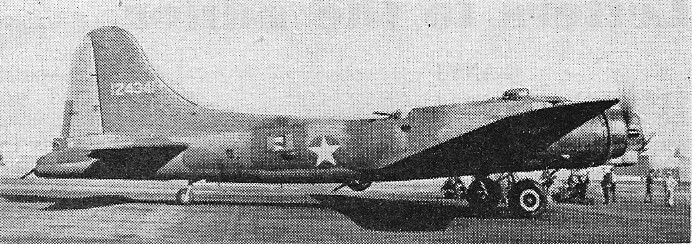
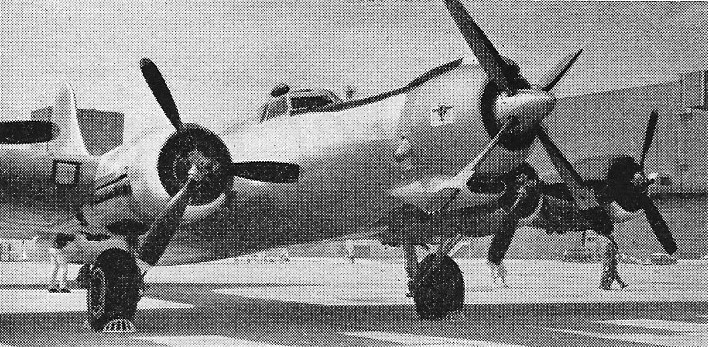
A further modification programme, this time to improve the bomber’s ability to repel air attacks from the front, produced the B17G with its twin-gun ‘chin’ turret which you can see clearly on this example.
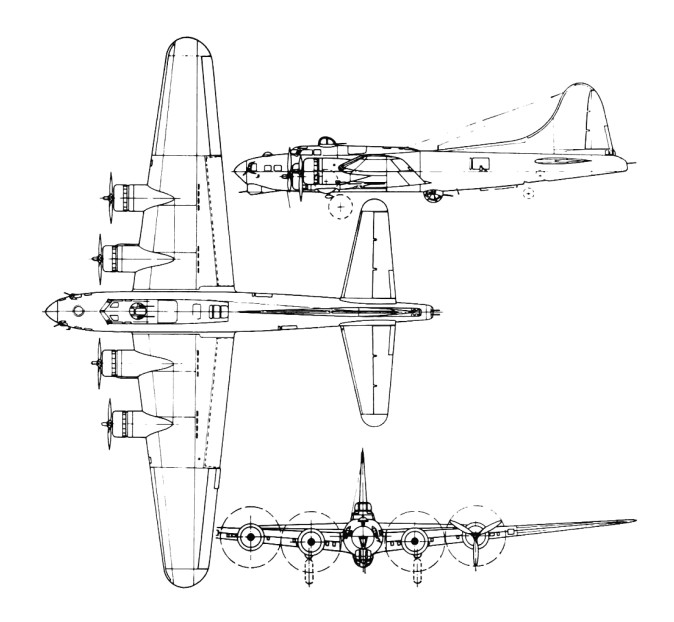
Most extensively built variant was the B-17G (8,680), built by Douglas (2,395) and Lockheed Vega (2,250) as well as at the Boeing plant, Seattle (4,035). The B 17G model, the seventh variation of the original design, was equipped Pratt & Whitney R-1820-97 radial engines with super-chargers that allowed the airplane to cruise at 35,000 feet at a maximum speed of 285 miles per hour. It also carried up to thirteen .50 caliber machine guns and 6,000 pounds of bombs. The addition of a chin turret below the nose (containing two 12.7mm machine-guns) provided better defence against the head-on attacks. U.S.forces used it primarily for high level daylight bombing over Europe. The formidable machine gun placement enabled B 17s to develop a highly effective defensive tactical formation. Production of the B-17G started in July 1943.
B-17G manufactured after January 1944 were no longer given a camouflage coating because they were lighter and faster without it
The bombardier sat on a type of swiveling stool with a Norden Bombsight before him. The navigator sat off-set to his rear at a small map-filled desk. Both were supplied with defensive .50 caliber machine guns with the Bendix chin turret under the bombardiers control in the G model and onwards. Access to the nose was accomplished through a smallish passage way underneath the main flight deck.
The pilot and co-pilot sat on the flight deck above and behind the navigator’s position with the pilot to the left and his copilot to the right with both offered equal control access and views of all four of the engines. To their rear was the top gunners position with a catwalk crossing between the payload in the bomb bay. Once past the bomb bay, the radio operators station and his equipment was apparent. The radio operator was also afforded a table and seating along with his communications equipment. Access to the belly turret was available following this area, which further opened up to the staggered waist gunner positions which might or might not have been covered by plexiglass depending on the model.
On 1 July 1942 the first heavy bomber of the American 8th Army Air Force laned in Britain by the North Atlantic route. B-17E “Jarring Jenny” landed at Prestwick airfield, Scotland,
The B-17 flew the 8th Air Force’s first combat mission out of England in August 1942. At 3:20pm on Monday 17 August 1942, 12 B-17E of the 97th Bomber Group (US 8th Air Force) took off on their first mission over Europe, flying with four RAF Spitfire squadrons to provide them cover. US Brigadier General Ira Eaker flew with them, in the plane of the Group Commander, known as ‘Yankee Doodle’. The bombers target was Sotteville-les-Rouen on the left bank of the Seine, site of a railway switch yard crucial to the supplying of Le Harve. The Flying Fortresses released their 166 ton bombload from an altitude of over 22,000 ft. all the bombers returned to base.
The British were skeptical about daylight bombing, but the American strategy was made possible by the ruggedness built into high-flying bombers like the B-17 and by the deadly accuracy of the Norden bombsight. Used as the spearhead of the U.S. Army Air Force’s attacks in Europe, the aircraft also saw combat duty in all theaters of war. Three days after Pearl Harbor, the Japanese convoys en route to Luzon in the Philippines were met by Flying Fortresses.
They flew high in huge formations, protecting each other with cross fire, and dropped 640,036 tons of bombs in Europe for a loss of 4,750 aircraft.
Special variants included the B-40 with up to 30 machine-guns/cannons, which was intended as a B-17 escort, but proved to be an operational failure; BQ-7 pilotless aircraft packed with explosives to be deployed against German targets by radio control, which failed due to unreliable control equipment; CB-17 and C-108 transports; and F-9 long-range B-17 equipped to serve as an air-sea rescue aircraft and able to deploy a lifeboat carried beneath the fuselage.
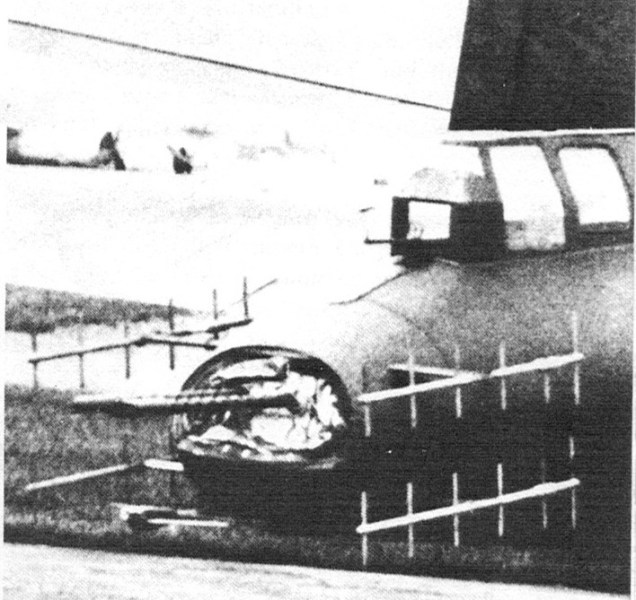
The YB-40 escort fighter variant airframe and engines were typical B-17 but the armament was 31 guns. The largest was a 40mm faired into the radio hatch. In each waist position was a 20mm cannon plus two 0.5in machine guns. A four-gun turret was in the nose and another in the tail. The upper turret had four more 0.5in, the ball turret two. There were 10 more 0.5in machine guns in various locations.
At the height of production Boeing’s Seattle plant alone produced a completed aircraft every ninety minutes. A total of 12,731 built by Boeing, Douglas, and Lockheed Vega of which just over two-hundred were supplied to the RAF.
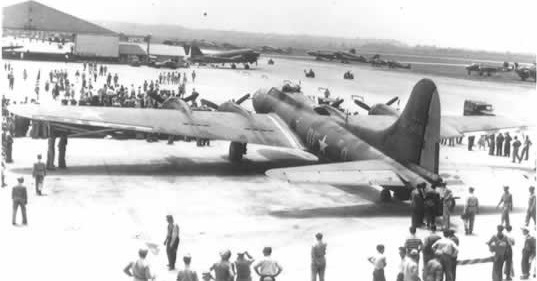
B-17 “Memphis Belle” would be stored at Altus AAF after public relations tour
RAF forces took several B-17 models with their applied “Fortress 1”, “Fortress 2” and “Fortress 3” designations, utilizing some in the electronic countermeasures role. Reconnaissance variants appeared with the US Army Air Corps, US Navy and US Coast Guard as well, each with differing designations shown below.
The B-17 Flying Fortress accounted for over 290,000 sorties with 640,000 tons of ordnance dropped during World War Two.
The German 200th Bomber Wing, KG200, carried out special transport missions using captured US B-24 Liberator and B-17 Flying Fortress which the Germans called by the code name Dornier Do 200.
Versions of the wartime Flying Fortress were still in service in 1955 include lhe U.S.A.F.’s QB-17G drone, SB-17 with an airborne lifeboat and CB-17G V.I.P. transport; and the U.S. Navy’s PB-1G air-sea rescue and PB-1W radar early-warning aircraft. All have four Wright R-1820-97 piston engines.
Boeing QB-17G Fortress
QB-17 testing guided missiles
US Navy and Coast Guard rescue version are similar to the SB-17G is designated PB-1G.
SB-17G
In New Mexico in 1950, Project Cirrus involved seeding rain clouds with dry ice from a B-17.
Project Cirrus
Project Cirrus
Project Cirrus
USAF Research & Development Command B-17G testbed with 3500hp Wright R-3350
XB-17 Engines: 4 x P&W Hornet, 750 hp Wingspan: 103 ft 9 in Length: 68 ft 9 in Take-off weight: 43,000 lb Bombload: 2570 lb Loaded range: 2000 mi at 204 mph
STANDARD DATA: Gross weight: 49,650 lb Empty weight: 30,620 lb Fuel capacity: 1,700 Usgals Engines: four 1,200 hp Wright Cyclone radials. Top speed: 323 mph Cruise speed: 250 mph Climb to 25,000 ft.: 41 min Range: 3,400 nm Ceiling: 37,000 ft.
B-17 Engines: 4 x Wright R 1820-97, 1,200 hp, 885kW Length 73.9 ft. (22.5 m) Height: 5.8 m / 19 ft 0 in Wing span: 103 ft 8 in (31.6 m) Wing area: 141.9 sq.m / 1527.40 sq ft Weight empty 32,250 lb. (14,630 kg) Max. bomb load: 9,600 lb (4,350 kg) Max. Speed 317 mph (510 kph) Cruise speed: 250 km/h / 155 mph Range 2,000 miles (3,220 km) with 4,000 lb. of bombs Ceiling: 10700 m / 35100 ft Crew: 10 Armament: Up to thirteen 0.30 and 0.50 in. machine guns
B-17E Engine: 4 x Wright R-1850-65 Cyclone, 1200 hp Wing span: 103 ft 9 in (31.62 m) Length: 73 ft 10 in (22.5 m) Height: 19 ft 2 in (5.84 m) Engines: 4 x Wright, 1200 hp Max TO wt: 53,000 lb (24,040 kg) Max level speed: 275 kts / 317 mph / 510 kph Service ceiling: 36581 ft / 11150 m Range: 2592 nm / 4800 km Crew: 9 Armament: 13x MG 12,7mm, 7985 kg Bomb
B 17G Engines: 4 x Wright Cyclone R-1820-97, 1,200 hp Wing span: 103 ft. 9.5 in / 31.62m Length: 74 ft. 9 in / 22.78m Height: 19 ft. 1 in / 5.82m Wing area: 1,420.0 sq ft / 131.92 sq.m Loaded weight: 66,000 lb Empty Weight: 36,136lbs (16,391kg) Maximum Take-Off Weight: 72,003lbs (32,660kg) Maximum Speed: 287mph / 462kmh; 249kts at 25,000 ft / 7,620 m Cruise speed: 182 mph Rate-of-Climb: 541ft/min (165m/min) Climb to 20,000 ft / 6,095 m: 37 min 0 sec Service Ceiling: 35,597ft (10,850m) Armament: 13 x 0.5in Browning mg Bombload: 8000 lb / 17,600 lb Crew: 10 Range: 3,400 miles / 5,470 km Range with 500lb load: 2100 miles / 3,220km
CB-17G
QB-17G Fortress Engines: four Wright R-1820-97 Span: 103 ft. 9 in Weight: 49,500 lb Max Speed: 295 m.p.h.
The first product, B & W Seaplane of 1916, was designed by William Boeing in conjunction with Conrad Westervelt. The company secured the first of many military contracts in June 1916, when it received an order from the Navy Department to build 50 HS-2L flying boats. First production order was for Model C seaplane trainer for U.S. Navy (first flown 1916), followed by Model EA land trainer of 1916 for U.S. Army. Name changed to Boeing Airplane Company April 26,1917. Improved Model C of 1918 was first mass-produced Boeing aircraft, built alongside Boeing-constructed Curtiss HS-2L flying-boats. First post-First World War design was the B-1 three-seat flying-boat (first flown December 1919), while in 1920 the first flight took place of the first of many Boeing-built DH-4s (based on British Airco D.H.4). Built ten U.S. Army-designed GA-1 armored ground attack triplanes (first flown May 1921) but just two GA-2s, followed by 200 Thomas-Morse MB- 3A pursuit aircraft (first flown 1922). The Boeing company has contracted with Thomas Morse to build the MB-3 fighter. With this experience Boeing undertook the development of their own PW-9 pursuit aircraft. Bid successfully for the San-Francisco-Chicago airmail route in 1927 and formed subsidiary Boeing Air Transport to operate the route. In 1928, Boeing Airplane and Transportation Corporation went pub¬lic and the stock sold quickly. As other airlines were acquired, this became Boeing Air Transport System. Merged with Pratt & Whitney, Standard Steel Propeller Co, and two small aircraft manufacturers to form United Aircraft & Transport Corporation in 1929. All continued to operate under original identities. Encouraged, Boeing formed the United Aircraft and Transport Corporation, which included Boeing Airplane Company, Pratt & Whitney, Chance Vought, Sikorsky, Hamilton Propeller, Pacific Air Transport. First real success with own-design military aircraft came in 1923, with the PW-9/FB-1 series, which had a fabric-covered welded-steel-tube fuselage. Other aircraft followed in quick succession, types of particular note including the Boeing Model 40, designed for carriage of airmail plus two (and later four) passengers, used by new Boeing Air Transport. Model 80 12-passenger transports with three Pratt & Whitney Wasp engines introduced by Boeing Air Transport in 1928. World’s first airline stewardesses introduced on these aircraft 1930. In 1929 Lloyd Stearman sold his Stearman Aircraft Company to the ‘United Aircraft and Transport Corporation’. Model 80A with more powerful Hornet engines and seats for 18 passengers followed. Biggest military order to that date (other than MB-3As) came in 1931, when U.S. Army ordered 135 P-12E single-seat fighters, and U.S. Navy 113 of the similar F4B-3: total of 586 aircraft in this series built by 1933 (prototype Model 83 for P-12 series had flown June 1928). Boeing Model 200 Monomail, mail/cargo aircraft, first flew May 1930; revolutionary aircraft with cantilever allmetal monoplane wing, retractable main landing gear and a specially designed antidrag cowling for its single Hornet engine. A second Monomail, Model 221, had six-seat passenger cabin. Military development of this aircraft resulted in YB-9 bomber (first flown April 1931), forcing evolution of new fighter types. Boeing produced P-26 single-seat all-metal monoplane fighter (first flown March 1932), of which 136 bought by U.S. Army. Biggest step forward came with the Model 247 (first flown February 1933), most advanced conception of a transport aircraft anywhere in the world at that time. Introduced wing and tail unit leading- edge de-icing, control surface trim tabs and, in production aircraft, controllable-pitch propellers and autopilot. It was the first twin-engined monoplane transport that could climb with a full load on the power of one engine. In 1934 legislation prevented aircraft and engine manufacturers from operating airlines. Boeing resigned as chairman, sold out his stock and the corporation was divided into three new companies in September 1934 United Air Lines to handle air transport, United Aircraft Corporation to take over the eastern manufacturing firms and Boeing Airplane Company to manage Western operations, together with Stearman, a wholly owned subsidiary. The name Boeing Airplane Company was readopted in 1948. In May 1961, following acquisition of Vertol in 1960, became known as The Boeing Company, which remained the name in 1999. Changes in the company structure took place in 1996, when on December 15 it was announced that a merger had been agreed with McDonnell Douglas. The two large organizations began operating as a single company from August 4,1997, under the Boeing name. Also in December 1996 Boeing purchased Rockwell International’s aerospace and defense units, these being retitled Boeing North American Inc. and subsequently becoming part of Boeing’s Space Systems business unit. Several internal restructures of the Boeing organization followed, the set-up comprising three main groups, namely, Information, Space, and Defense systems Group (ISDS), Boeing Commercial Airplane Group (BCAG), and Boeing Shared Services Group; the latter for information management and computing resources. Within ISDS are various business units comprising Aircraft and Missile Systems (to undertake Boeing’s military airplane and helicopter programs, plus oversee tactical missile development), Boeing Space Systems (to oversee Boeing’s space programs for DoD and NASA), Information and Communication Systems (programs include AWACS surveillance systems, communications systems and more), Phantom Works (a previous McDonnell Douglas unit for advanced research and development, with programs including research into hypersonic aircraft), and Business Resources. BCAG is headquartered at Renton but has units in various other locations. This group comprises Customer Services, Douglas Products Division (for manufacturing airliners that originated from McDonnell Douglas, such as the MD-80, MD-90, MD-11, and B717), Engineering Division, Fabrication Division (constructing components), Materiel Division (made responsible for materials and subcontracted components), Propulsion Systems Division (engine preparation for airliners), 737/757 Programs, 747/767 Programs, 777 Program, and Wichita Division (components and subassemblies). Significant military aircraft since the early 1930s have included the B-17 Flying Fortress bomber (first flown July 1935), of which 12,731 examples were built; B-29 Superfortress bomber (first flown September 1942); B-47 Stratojet medium jet bomber (first flown December 1947); B-52 Stratofortress intercontinental strategic bomber (first flown April 1952); E-4 National Airborne Operations Center aircraft (first flown June 1973); E-3 Sentry airborne early warning and control system aircraft (delivered from March 1977); E-6 Mercury survivable airborne communications system aircraft for the U.S. Navy (first flown February 1987); and EC-18 advanced range instrumentation and cruise missile control aircraft. The B-52H Stratofortress continues to form a major component of the USAF, and proposals were made in 1998 to re-engine 71 examples of this eight-engined bomber with four very powerful Rolls- Royce RB211-535E-4 turbofans each. Continuing military programs in 1999 include work in developing the AL-1A Airborne Laser aircraft based on the Model 747 Freighter; development of Boeing’s contender for the Joint Strike Fighter program to produce a multipurpose combat aircraft with CTOL/STOVL flight characteristics to replace a range of present warplanes from about the year 2008; new AWACS aircraft for export based on 737 and 767 airframes (first flight of an E-767 AWACS with structural AWACS features for Japan, August 1996); and production of the F-15 Eagle, F/A-18 Hornet and Super Hornet, Harrier II and II Plus, and T-45 Goshawk (all ex-McDonnell Douglas). Aircraft which have made important contributions to global air transport, in addition to those previously mentioned, include the Model 314 flying-boat (first flown June 1938); Model 307 Stratoliner with pressurization (first flown December 1938); Model 377 Stratocruiser (first flown November 1944 as XC-97 military transport); Model 367-80 turbojet transport (first flown July 1954) which was put into production as a military tanker-transport for the USAF as the KC-135 Stratotanker and as the Model 707 commercial airliner; Model 727 tri-jet short/medium-range airliner (first flown February 1963); Model 737 twin turbofan short-range airliner (first flown April 1967 and still in production in 1999 in advanced and Next Generation versions, with development continuing and over 4,000 sold); Model 747 four-jet wide-body high-capacity airliner (first flown February 1969 and given the press nickname “Jumbo Jet”; still in production in 1999 in latest 747-400 series versions, with new versions under development); Model 757 twin-jet medium-range airliner (first flown February 1982); Model 767 twin-jet wide-body medium/longrange airliner (first flown September 1981); and Model 777 twin-jet wide-body long-range airliner.
Since the merger with McDonnell Douglas, the Boeing aircraft range also includes the Model 717 (first flown 1998; formerly the McDonnell Douglas MD- 95), C-17A Globemaster III military heavy-lift and longrange transport (first flown September 1991; commercial version proposed as the MD-17); MD-11 medium/long-range tri-jet airliner (first flown January 1990); MD-80 twin-jet short/medium-range airliner (first flown October 1979 as follow-on to similar but older DC-9); MD-90 twin-jet medium-range airliner (first flown February 1993 as longer and advanced development of MD-80); F-15 Eagle; F/A- 18 Hornet and Super Hornet; Harrier II and II Plus; T-45 Goshawk; and various helicopters. Since taking over Rockwell International’s aerospace and defense units, the B-1B Lancer long-range variable-geometry strategic bomber is technically also a Boeing type, although production of 100 ended in 1988. Since the merger of Boeing and McDonnell Douglas, Boeing’s helicopter range has grown. However, Boeing took the strategic decision to concentrate on military helicopter programs and sold its 49% share in the Model 609 civil tilt-rotor transport to its development partner Bell Helicopter Textron (now called BA 609; the MD 500/520/530/Defender and MD 600N helicopter ranges thereafter (plus MD 900/902 Explorer/Combat Explorer not selected by Bell) remained for sale elsewhere, some using the unique NOTAR antitorque system. Boeing has sold its civil helicopter production line, formerly manufactured by McDonnell Douglas, to Dutch company MD Helicopters on 19 February 1999. The sale, coming only two years after Boeing themselves purchased the range through a merger. The sale includes the MD500E, 520N, 530F and 600N models, as well as the twin-engined MD Explorer and the licence to incorporate the no tail rotor (NOTAR) system on future aircraft. Boeing does, however, keep the ownership of the NOTAR technology. Boeing continued to produce the machines, under contract to the new Dutch owners, until early 2000. However, Boeing continued its partnership with Bell over development and production of the V-22 Osprey military tilt-rotor transport and multipurpose aircraft for the U.S. forces (first flown March 1989). Not for sale was the inherited AH-64 Apache attack helicopter, produced also in the U.K. in AH-64D Apache Longbow form. Boeing’s own H-47 Chinook continued in production, and Boeing remained partnered with Sikorsky in the development of the RAH-66 Comanche multirole battlefield helicopter for the U.S. Army (first flown January 1996).
Boeing enhanced its space prowess through the merger in 1997 with McDonnell Douglas and the acquisition the year before of the defense and space units of Rockwell International.
In 1998 Boeing was under contract to the United Space Alliance for shuttle orbiter production, modifications and operations, and for overall shuttle system and payload integration services, with additional responsibility for launch and mission support.
In 1999 Boeing operations were located in 27 states, and the company had employees in more than 60 countries. The company was organized into three major business segments: Boeing Commercial Airptane Group, Military Aircraft and, Missile Systems Group, and Space and Communications Group.
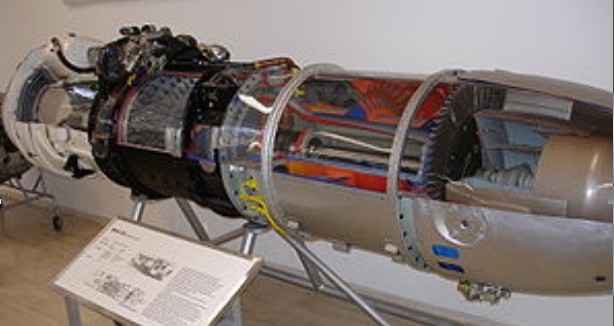
The practicality of jet propulsion had been demonstrated in Germany in early 1937 by Hans von Ohain working with the Heinkel company. Recognising the potential of the invention, the Reich Air Ministry (German: Reichsluftfahrtministerium, abbreviated RLM) encouraged Germany’s aero engine manufacturers to begin their own programmes of jet engine development.
The BMW 003 began development as a project of the Brandenburgische Motorenwerke (The Brandenburg Motor Works, known as “Bramo “) under the direction of Hermann Östrich and assigned the RLM designation 109-003 (using the RLM’s “109-” prefix, common to all jet and rocket engine projects). Bramo was also developing another axial-flow turbojet, the 109-002. In 1939, BMW bought out Bramo, and in the acquisition, obtained both engine projects. The 109-002 had a very sophisticated contra-rotating compressor design intended to eliminate torque, but was abandoned in favour of the simpler engine, which in the end proved to have enough development problems of its own.
Construction began late in the same year and the engine ran for the first time in August 1940, but produced less than half of the thrust expected, 2.5 kN instead of 6.3 kN. The first flight test took place in mid-1941, mounted underneath a Messerschmitt Bf 110. Problems continued, however, so delaying the program that while the Me 262 (the first aircraft intended to use the engine) was ready for flight-testing, there were no power plants available for it and it actually began flight tests with a conventional Junkers Jumo 210 piston engine in the nose. It was not until November 1941 that the Me 262 V1 was flown with BMW engines, which both failed during the test. The prototype aircraft had to return to the airfield on the power of the piston engine, which was still fitted.
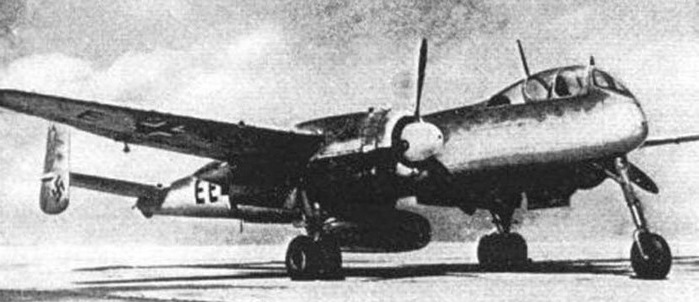
Heinkel He/219TL with BMW003 turbojet
The general usage of the BMW powerplant was abandoned for the Me 262, except for two experimental examples of the plane known as the Me 262 A-1b. The Me 262 A-1a production version used the competing Jumo 004 whose heavier weight required the wings to be swept back in order to move the center of gravity into the correct position. Work on the 003 continued anyway, and by late 1942 it had been made far more powerful and reliable. The improved engine was flight tested under a Junkers Ju 88 in October 1943 and was finally ready for mass production in August 1944.
The only production aircraft to use the 003 was the Heinkel He 162, which fitted a modified “E” version of the engine. This version was modified with ventral mounting points to allow it to be mounted atop the fuselage of an aircraft.
One late version of the engine added a small rocket motor (BMW 109-718) at the rear and usually just above the exhaust of the engine, which added some 9.8 kN (2,200 lbs/f) of thrust for take off and short dashes. In this configuration, it was known as the BMW-003R and was tested, albeit with some serious reliability problems, on single prototypes for advanced models of the Me 262 (Me 262 C-2b Heimatschützer II), and He 162 (He 162 E). Both prototypes flew under hybrid jet/rocket power during March 1945, though records do not indicate the results of testing with the 162 E.
The BMW-003 was intended for export to Japan, but working examples of the engine were never supplied. Instead, Japanese engineers used drawings and photos of the engine to design an indigenous turbojet, the Ishikawajima Ne-20.
Following the war, two captured BMW-003s powered the prototype of the first Soviet jet, the Mikoyan-Gurevich MiG-9. Blueprints for BMW engines had been seized by Soviet forces from the Basdorf-Zühlsdorf plant near Berlin and from the Central Works near Nordhausen. Production of the BMW 003 was set up at the “Red October” GAZ 466 (Gorkovsky Avtomobilny Zavod, or “Gorky Automobile Plant”) in Leningrad, where the engine was mass produced from 1947 under the designation RD-20 (reactivnyi dvigatel, or “jet drive”).
Herman Östrich’s team in charge of the development of the BMW 003 engine had moved to the town of Stassfurt, near Magdeburg, in February 1945. An underground production factory was being set up in a salt mine outside town by C.G. Rheinhardt in a desperate attempt to continue engine production in face of the now overwhelming Allied air campaign. This mine is well known historically as it was also being used for the storage of uranium compounds as part of the Nazi atomic bomb program. The town of Stassfurt surrendered to US forces on 12 April 1945, and Östrich hid much of the technical data in a local cemetery. The next day a ten-man team made up primarily of engineers from Pratt & Whitney arrived, and he handed the data over to them. Production restarted for US use while the war ground to a close, and the US forces cleared out the factory while they waited to turn the area over to the Soviets.
Östrich had by this time moved to Munich for further interrogation, and from there to England at the request of Roy Fedden. He had them work on the design of a turboprop engine for a proposed C-54 Skymaster-class four-engine transport. While working on this design, Őstrich was secretly approached by French DGER agents with an offer to take up further design of the 003 in France. The French forces had found a number of 003 engines in their occupation zone after the war, and were interested in setting up a production line. These discussions had not progressed very far when Őstrich was allowed to return to Munich, only to be brought back to England in late August, then returned to Munich again where the US offered him and a hand-selected team jobs in the US, but without their families.
Östrich instead accepted the French invitation, and by September had been set up at the former Dornier factories in Rickenbach in the French Zone. Here they were soon joined by other former BMW engineers, as well as those from a number of other German firms, bringing the team to about 200 members. The group was named the Atelier Technique Aéronautique Rickenbach, or ATAR. They worked on a new design that was based on the BMW layout, but considerably larger and more powerful. They completed the preliminary design of the ATAR 101 (model R.101) in October, and granted a production contract on the proviso that actual production would be carried out in France.
Some 500 BMW 003 engines were built in Germany, but very few were ever installed in aircraft.
BMW 003 A2 (TL 109-003) Initial production variant, 7.83 kN (1,760 lbf) / 9,500 rpm / sea level.
BMW 003 C (TL 109-003) Improved design, reduced weight A2, 8.81 kN (1,980 lbf) / 9,500 rpm / sea level
BMW 003 D (TL 109-003) Improved design C, 8.81 kN (1,980 lbf) / 9,500 rpm / sea level.
BMW 003 E With ventral mounting points for use on the Heinkel He 162 and Henschel Hs 132.
BMW 003 R (TLR 109-003) An A2 with a BMW 718 (R 109-718) booster fixed permanently above the jetpipe, running on R-stoff (a.k.a. Tonka or TONKA-250, 50% triethylamine and 50% xylidine) and SV-Stoff (aka RFNA: 94% HNO3, 6% N2O4). The R delivered a combined thrust of 20.06 kN (4,510 lbf) for 3 minutes.
Applications: Arado Ar 234 Heinkel He 162 Messerschmitt Me 262 (A-1b test version, and Heimatschützer II experimental interceptor only)
Specifications:
BMW 003A-2 Type: Axial flow turbojet Length: 3,632.2 mm (143 in) Diameter: 690.9 mm (27.2 in) Dry weight: 623.7 kg (1,375 lb) Compressor: 7-stage axial compressor Combustors: 1 annular combustion chamber Turbine: Single-stage axial Fuel type: J-2 diesel fuel or gasoline Oil system: Pressure feed at 586 kPa (85 psi), dry sump with 4 scavenge pumps with annular tank and cooler, using oil grade 163 S.U. secs (35 cs) (D.T.D 44D) at 38 °C (100 °F) Maximum thrust: 7.83 kN (1,760 lbf) at 9,500 rpm at sea level for take-off Overall pressure ratio: 3.1:1 Turbine inlet temperature: 770 °C (1,418 °F) Specific fuel consumption: 142.694 kg/kN/hr (1.4 lb/lbf/hr) Thrust-to-weight ratio: 0.0125 kN/kg (1.282 lbf/lb) Normal, static: 6.89 kN (1,550 lbf) / 9,000 rpm / sea level Military flight: 6.23 kN (1,400 lbf) / 9.500 rpm / 2,500 m (8,202 ft) / 900 km/h (559 mph; 486 kn) Normal, flight: 2.85 kN (640 lbf) / 11,500 rpm / 11,000 m (36,089 ft) / 900 km/h (559 mph; 486 kn)
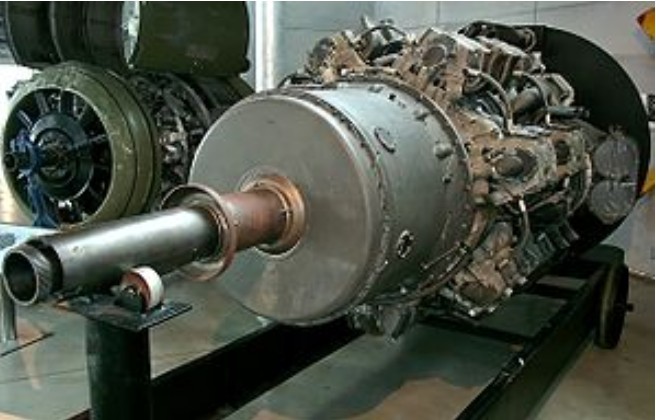
One problem with scaling up any piston engine design is that eventually a point is reached where the crankshaft becomes a major engineering challenge. This was a problem that affected almost all engines of the 2,500 hp (1,900 kW) class, including BMW’s own 18-cylinder BMW 802 project. For the 803 the engineers decided to avoid this problem by simply not using a common crankshaft, and driving a set of independent contra-rotating propellers. The front engine drove the front propeller directly, while the rear engine drove a number of smaller shafts that passed between the cylinders of the front engine before being geared back together to drive the rear prop. This layout resulted in a rather large gearbox on the front of the engine, and the front engine needing an extended shaft to “clear” the gearbox. With no common crankshaft it became more practical for all of the accessories to be powered by one engine alone, in this case the rear engine. The supercharger itself used up several hundred horsepower, so the rear propeller delivered considerably less power than the front one. The engine weighed 2,950 kg (6,490 lb) dry, and 4,130 kg (9,086 lb) fully loaded, displacing 83.5 litres. It delivered 3,900 PS (Pferdstärke) (2,868 kW). Although this made it the most powerful German engine design, its power-to-weight ratio was not impressive, at about 0.60 hp/lb, compared to other large designs like the Junkers Jumo 222 at 1.04 hp/lb. Specific power was likewise poor, at about 34.4 kW/l, compared to the 222’s 40 kW/l, as was specific fuel consumption, at 380 g/kWh (0.63 lb/hp·h). As with most coupled engines, the 803 was not a success on the test-bed, and did not enter production.
The engine was intended to be used only on the largest of designs, notably the Focke-Wulf Fw 238, the Focke-Wulf Ta 400 six-engined Amerika Bomber design competition competitor, and other large bombers. The May 1942-approved Amerika Bomber contract was for a trans-Atlantic range strategic bomber designed to attack New York City from European bases. A single example remains in the Deutsches Museum.
BMW 803 Type: 28-cylinder 7-bank liquid-cooled coupled inline radial engine Bore: 156 mm (6.14 in) Stroke: 156 mm (6.14 in) Displacement: 83.5 L (5,095 in³) Diameter: 160 cm (63 inches) Dry weight: 4 130 kg (9,100 lbs) Valvetrain: One intake and one sodium-cooled exhaust valve per cylinder Fuel system: Fuel injection Cooling system: Liquid-cooled Power output: 2 940 kW (3,950 hp) Specific power: 34.3 kW/L (0.75 hp/in³) Compression ratio: 6.5:1 Specific fuel consumption: 380 g/kWh (0.63 lb/hp·h) Power-to-weight ratio: 970 W/kg (0.59 hp/lb)









 All Aero