Valtion Myrsky

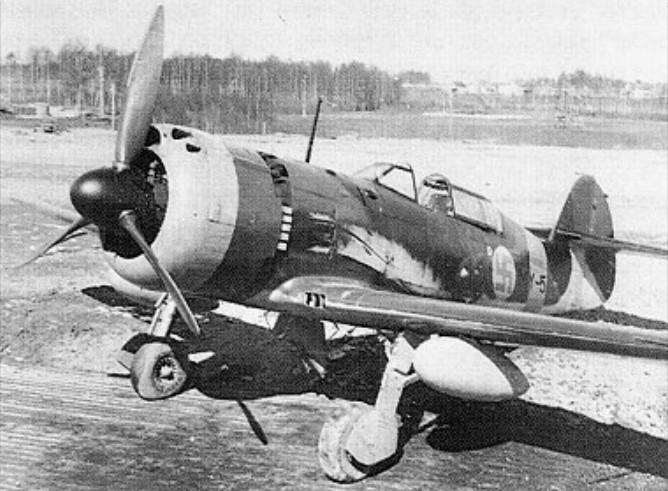
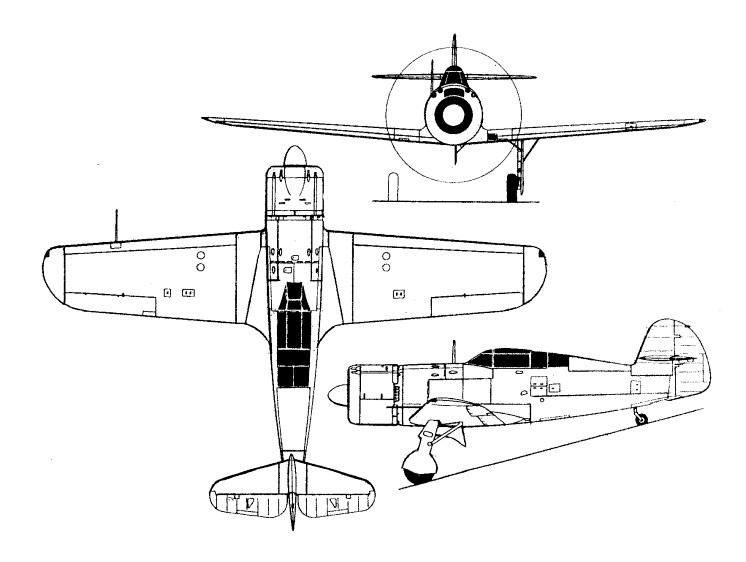
On 8 June 1939, the VL (Valtion Lentokonetehdas) received a contract from the Ministry of Defence to design a new single-seat fighter. Chief designer was Dipl Ing A Ylinen, who was assisted by T Verkkola and M Vainio, and, within nine months of receiving the definitive prototype contract on 20 December 1940, the prototype of the Myrsky (Storm) was in final assembly. A conventional low-wing cantilever monoplane, the Myrsky had a plywood-skinned two-spar wooden wing and a welded steel-tube fuselage covered by dural panels forward and fabric aft. Power was provided by a Pratt & Whitney R-1830-SC3-G Twin Wasp 14-cylinder radial rated at 1115hp for take-off. The prototype was flown on 23 December 1941, but immediately encountered the first of what were to be many teething troubles.
On 30 May 1942, the VL received a contract for three development aircraft which were to embody numerous detail structural and other changes, these including an increase in wing area of 1.3sq.m and a change in armament from two 12.7mm and four 7.7mm guns to three (in first and second) or four (in third aircraft) of the larger-calibre weapons. The first of these was completed on 30 April 1943, but crashed a week later, and the second suffered a wheels-up landing three months later, and broke up in the air shortly after resuming flight test. The third was evaluated in service, and, on 17 March 1944, lost both wings in a dive.
In the meantime, VL had initiated production of the first series model which was referred to as the Myrsky II Series. All the progressive changes that had been introduced in the pre-series aircraft were incorporated, armament was standardised on four 12.7mm LKK/42 guns, and by the end of July 1944 the VL had completed 14 of the II Series aircraft, a further 16 having been delivered by the truce of 4 September. Production continued after the truce and the last five of the 47 built were delivered straight to the Air Force Depot on 30 December 1944 without flight testing. The Myrsky II series was assigned to a tactical reconnaissance squadron (TLeLv 12) which received its first aircraft on 23 July 1944, 20 being delivered to the squadron before the Armistice, and a second squadron (TLeLv 16) initiating conversion to the Myrsky meanwhile. The Myrsky was flown operationally over Lapland against the Wehrmacht under the terms of the Finnish-Soviet agreement, but Ilmavoimat flew this fighter only to a limited extent, and the service’s doubts as to its durability and sturdiness, despite continuous reinforcement of various components, finally came to a head on 9 May 1947 when a Myrsky broke up in a dive, all aircraft of this type then being grounded.

Max take-off weight: 3213 kg / 7083 lb
Empty weight: 2337 kg / 5152 lb
Wingspan: 11.00 m / 36 ft 1 in
Length: 8.35 m / 27 ft 5 in
Height: 3.00 m / 10 ft 10 in
Wing area: 18.00 sq.m / 193.75 sq ft
Max. speed: 535 km/h / 332 mph
Range: 500 km / 311 miles
Valtion Lentokonetehdas / VL

Finland
Finnish State Aircraft Factory, created February 1928 from former IVL (Ilmailuvoimien Lentokonetehdas = Aviation Force Aircraft Factory) which, from its formation near Helsinki in 1921, had built Hansa-Brandenburg W.33 seaplanes and Caudron C 60 trainers under license for Finnish Air Force, plus the Finnish-designed Kotka maritime reconnaissance/bomber biplane. First VL product was the Saa’ski two-seat trainer, followed by license production of de Havilland Moths and Blackburn Ripons. After producing the Vima light trainer and Tuisku advanced training/ reconnaissance biplanes, the VL was reorganized in 1936 and moved to Tampere, where it produced Pyry monoplane trainers, Fokker C.X. biplanes, Fokker D.XXI fighters and Bristol Blenheim bombers under license. Next indigenous product was single-seat Myrsky fighter of 1942-1945. Became part of Valtion after Second World War.

  1. The names of aircrafts of the State Aircraft Factory (Valtion Lentokonetehdas) since 1933 are different kind of winds. Therefore “Humu” means “Whirl”.

UTVA

UTVA, Fabrica Aviona

Jugoslavia / Serbia

Utva Aircraft Industry (commonly known as UTVA) is a manufacturer of general aviation aircraft, located in Pančevo, Serbia. Utva in Serbian is the Ruddy Shelduck.

Utva was founded on 5 June 1937 in Zemun (a small town in former Austrohungarian empire), and produced simple gliders. In 1939 Utva began manufacturing light piston engine aircraft.

Four out of five Yugoslav aircraft plants were in close proximity to each other, built in and around Belgrade: Ikarus, Rogožarski, Zmaj and Utva. The fifth one was DFA (Državna Fabrika Aviona – State Aircraft Factory) which was located in Kraljevo. The plant was relocated to Pančevo (a town a few kilometers away from Belgrade, in Vojvodina autonomous province) in 1940. Until the April war, it mainly produced light gliders but it also produced 148 Bucker Jungmann Bu-131D-2 training planes and one acrobatic Bucker Jungmaister Bu-133. The plant escaped the devastation of the other aircraft plants (Ikarus, Rogožarski and Zmaj) and began producing it’s prewar gliders Čavka (Daw) and Ždral (Crane – the bird) and school airplanes Trojka (Three) and Aero 3. Utva also built a lot of Ikarus designs, notably the 212 and 213 models.

Utva produced light utility aircraft, including the Utva 56 four-seater, first flown in 1956, and thereafter developed through a number of U60 air-taxi/tourer/freight/agricultural/ ambulance and floatplane versions. The Utva 65 was originally an agricultural aircraft, developed as the U66 to serve various utility roles and including the armed U66V version. The Utva 75 two-seat trainer/glider-tug/agricultural aircraft entered production in late 1970s. Lasta 1 tandem two-seat piston-engined trainer first flew September 1985 but was superseded before production by the design of the refined Lasta 2. Development started of Utva 95 agricultural aircraft, probably based on Utva 75. Formerly fabricated components for the IAR-93/J-22 Orao and Super Galeb programmes, and produced items for various Boeing airliners.

During the NATO bombing of Yugoslavia in 1999, the factory was bombed several times and severely damaged.

The factory was heavily bombarded in 1999 and certain parts of it were still off limits due to the unexploded ordnance in 2012. All five original lasta 95 prototypes were destroyed in the factory and the only existing Supergaleb G4MD prototype was lightly damaged. 2012 was back to the basics for Utva. The plant produced Lasta 95 basic trainer and was developing Kobac (sparrow hawk) light COIN aircraft (first flight is expected in 2013).

In 2011, Utva Pančevo was a public company with the headquaters in Pančevo, Serbia, serving 301 employees.

Umbra M.B.902

Aeronautica Umbra’s design office was responsible for a heavy fighter of advanced and unorthodox design, the M.B.902 designed by Ing. Bellomo. The M.B902 was actually built, although flight testing had not commenced when the prototype was destroyed.

The construction of the M.B.902 was begun in 1942, and this single-seat fighter was unusual in being powered by a pair or 1,250 h.p. Daimler-Benz DB 605 liquid-cooled engines buried in the fuselage and driving twin contra-props mounted outboard on the wings via extension shafts. Featuring a retractable nose wheel undercarriage and carrying an armament of four 20-mm. and two 12.7-mm. guns, the M.B.902 had an estimated maximum speed or 429 m.p.h., and a maximum range of 1,056 miles.

Umbra A.U.T. 18

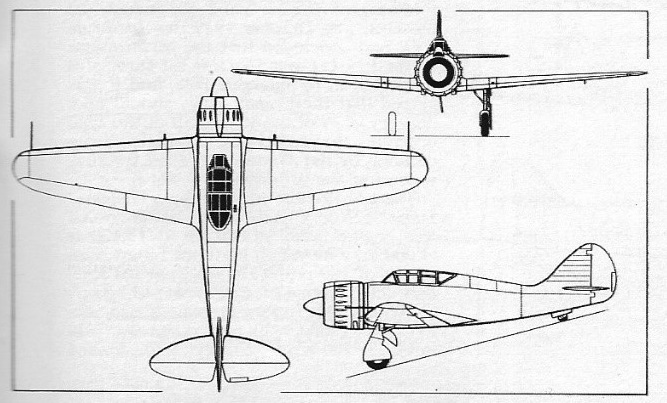
The A.U.T.18 – the designation signifying Aeronautica Umbra S.A., the manufacturer, Ing Felice Trojani, the designer, and the originally-planned wing area of 18sq.m – was an all-metal stressed-skin single-seat fighter, one example of which was ordered in 1936 for evaluation by the Regia Aeronautica. Unusual among contemporary Italian single-seat fighters in having its armament of twin 12.7mm guns mounted in the wings, the A.U.T.18 was powered by a Fiat A.80 R.C.41 18-cylinder radial engine rated at 1030hp for take-off, and flew for the first time on 22 April 1939. Initial trials were performed with an NACA-type engine cowling, but this was supplanted from April 1940 by a close-fitting cowling with the rocker arms partly enclosed by fairings. Evaluation of the sole prototype was completed on 5 November 1940, when the aircraft was delivered to the Regia Aeronautica, but the Ministero dell’Aeronautica did not consider that the Trojani fighter offered any advantages over the Macchi C.200 and Fiat G.50, both of which were in production, and further development of the A.U.T.18 was discontinued.

Umbra A.U.T.18 Article

Max take-off weight: 2975 kg / 6559 lb
Empty weight: 2320 kg / 5115 lb
Wingspan: 11.50 m / 38 ft 9 in
Length: 8.56 m / 28 ft 1 in
Height: 2.88 m / 9 ft 5 in
Wing area: 18.70 sq.m / 201.28 sq ft
Max. speed: 480 km/h / 298 mph
Range: 800 km / 497 miles

Umbra sa

Aeronautica Umbra S.A

Italy
The Aeronautica Umbra S.A. of Foligno was established in 1935 by Muzio Macchi, and was primarily concerned throughout the war years with sub-contract work for other aircraft manufacturers. Umbra built Savoia-Marchetti S.M.79 torpedo-bombers under licence. However, Aeronautica Umbra’s design office, which was responsible for the unsuccessful T.18 single-seat fighter of 1938, designed by Dr. Ing. F. Trojani, did undertake some original work, and a heavy fighter of advanced and unorthodox design, the M.B.902 designed by Ing. Bellomo, was actually built, although flight testing had not commenced when the prototype was destroyed.

The construction of the M.B.902 was begun in 1942, and this single-seat fighter was unusual in being powered by a pair or 1,250 h.p. Daimler-Benz DB 605 liquid-cooled engines buried in the fuselage and driving twin contra-props mounted outboard on the wings via extension shafts. Featuring a retractable nose wheel undercarriage and carrying an armament of four 20-mm. and two 12.7-mm. guns, the M.B.902 had an estimated maximum speed or 429 m.p.h., and a maximum range of 1,056 miles.

Postwar production comprised aircraft and systems components until work was begun, in 1968, on the AUM-903 three-engined STOL light transport project. Production concentrated on licence manufacture of the Scheibe SF-25B Motorfalke motor glider for the Italian and North African markets.

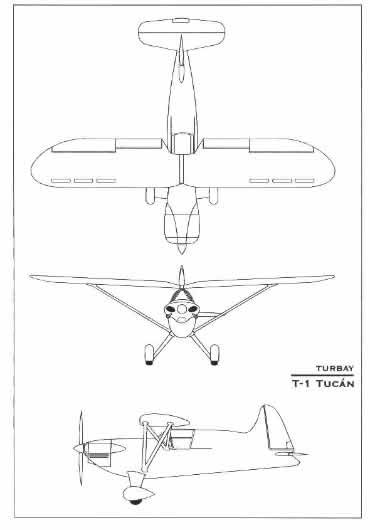
Turbay T-1 Tucan

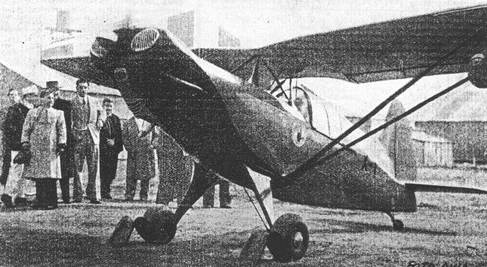
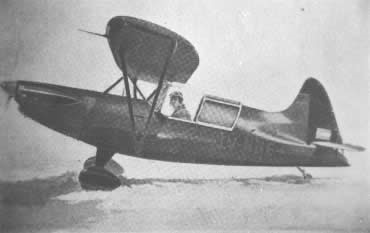
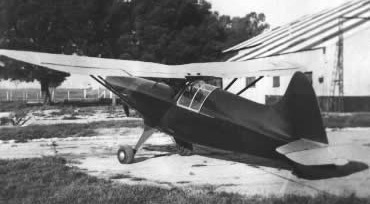
Designed by Alfredo Turbay and built by Sociedad Anonima Sfreddo & Paolini, the Tucán is a parasol-wing braced monoplane with a fixed cantilever type landing gear, tailwheel and powered by a 65 hp (48 kW) Continental A65 air-cooled piston engine. The design of the T-1 toucan started it in 1937, reaching its final form in 1939.

It had an enclosed cockpit just aft of the wing trailing-edge with a sliding canopy.

The first of January 1941 began with the construction of this prototype at the Technical Institute of the National University of Tucuman in the Popular Aviation Center founded by Los Tucanes Turbay himself and his colleagues a couple years earlier.

Construction was finished in April 1943 and between 2 and 5 February was statically tested and approved by the Directorate General of Civil Aviation granting the first experimental enrolment of registration, LV-X1.

The first flight was made on April 5, 1943 with an excellent performance, which made Turbay interested in taking it to Buenos Aires to get potential customers and try to manufacture in series. The plane arrived at Airfield San Fernando in Buenos Aires in May 1943 and on May 16 before national, military and aerospace Argentina and higher authorities. This made the Sfreddo and Paolini SA hire him as technical manager of the company. They planned to sell the aircraft at $10,000 National Currency each, which made it very accessible for the time. Turbay made some tweaks to the model and officially presented to the press and public at the airport on August 22 of that year.

Series production under license by Sfreddo and Paolini for the construction of 6 units were scheduled and minor modifications began with the works. The series aircraft would be equipped with the same engine as the prototype, the Continental A65 65 hp, but the Directorate General of Civil Aviation cancelled its commitment because of World War II for which production was suspended. Sfreddo & Paolini was seized and nationalized by the government.

While there were several attempts to build the plane in series, political and economic problems of the country prevented this. Plans to revive production in 1963 were thwarted. The prototype, once approved, was re-registered LV-NBE on September 13, 1944. On January 23, 1945 Turbay sold the aircraft to Bruno Zantini and to Orlando Harriet on September 25 of that year. On 22 November 1956 the record was transferred to Roberto Velazquez who completely destroyed it in an accident on April 18, 1957 in Bell Ville, province of Cordoba.

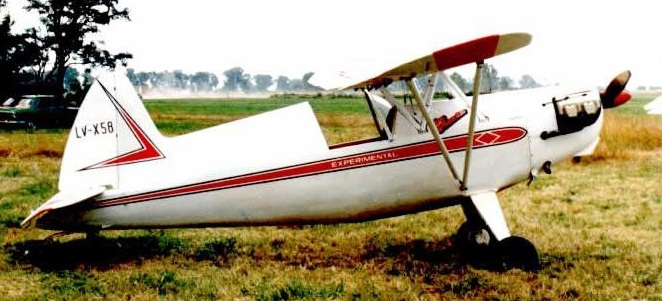
In 1975 Luis Fernandez finished building a second aircraft with planes bought in 1969 at the AVEX institution that Turbay. This aircraft was registered as LV-X58 and first flew on October 9, 1975.

Gallery

Engine: 1 × Continental A65, 48 kW (65 hp)
Length: 5.55 m (18 ft 2 in)
Wingspan: 7.22 m (23 ft 8 in)
Height: 1.90 m (6 ft 2½ in)
Wing area: 7.20 m2 (77.5 ft2)
Empty weight: 285 kg (627 lb)
Gross weight: 450 kg (990 lb)
Maximum speed: 205 km/h (127 mph)
Range: 1100 km (680 miles)
Endurance: 6 hours
Service ceiling: 4200 m (13780 ft)
Crew: 1