Another Breda design that progressed no further than the prototype stage was the Ba 201, which designation was, during the war years, erroneously applied to a supposed Italian-built version of the Ju 87B. In fact, although undoubtedly influenced by Junkers trends, the Ba 201 was an entirely original design.
The first mock-up built placed the cockpit at the rear with an IF Asso V-12. A second scheme had a forward-placed cockpit, IF Asso V-12 then 1,050 hp DB601 engine.
One prototype dive bomber (MM.451) flew July 1941, powered by a 1,050-h.p. DB 601 engine and featuring an inverted gull wing and retractable undercarriage. The Ba 201 was tested at Guidonia in 1940-41 but considered too slow without a gunner.
Engine: 1 x 1,175 hp DB 601A Span: 13 m Bombload: 1 x 500 kg Seats: 1
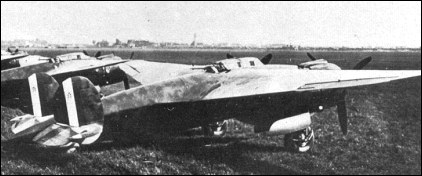
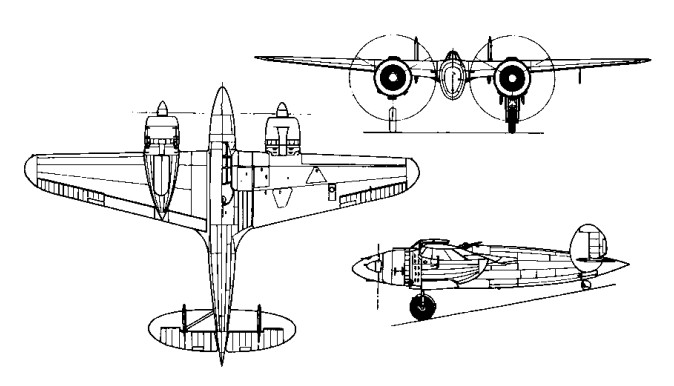
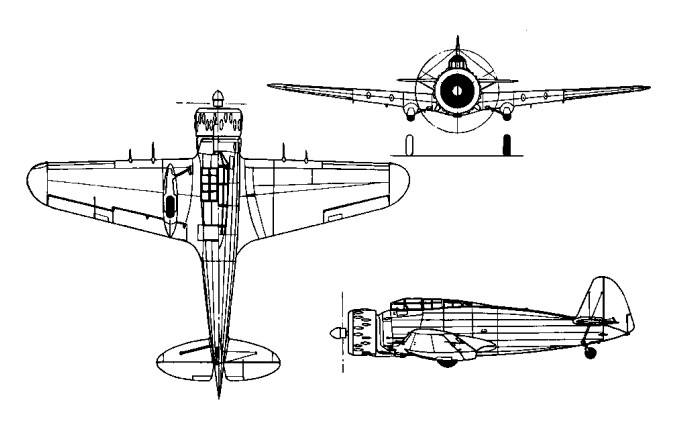
Initially, the prototype (MM.302) was flown with a single fin and rudder assembly, but poor stability necessitated the adoption of a rather cumbersome twin fin and rudder arrangement which marred the Ba 88s otherwise good aerodynamic form. The 1936 prototype was powered by two 900-h.p. Isotta-Fraschini K.14 radials and was one of the fastest aircraft in its class at the time of its appearance. A hybrid structure with stressed metal skin, shoulder-wing monoplane, the Lince had a structure of steel tube with a light metal outer skin.
Modified in 1937, the Breda Ba 88 Lince prototype, in December of that year, established several international records (with a load of 2,205 lb. flying 62 miles (100 km.) at 344.5 mph, and 621 miles (1,000 km.) at 326.3 mph).
Production orders for the Ba 88 were placed for the Regia Aeronautica and assembly lines were established by both Breda and 1.M.A.M. (Meridionali) with deliveries commencing late in 1938.
Regarded as an aeroplano di combattimento, suitable for attack, long-range reconnaissance or bombing operations, the Ba.88 then had its military equipment and weapons installed. Immediately, performance and flight characteristics fell off dramatically, but by then production orders were already in place. Bombs could be carried either in a bomb bay or semi-externally in recesses under the belly, and the Ba.88 could carry a 1000kg bomb load and four machine guns, three firing forward and a flexible gun in the rear cockpit. A window in the floor aided the pilot in aiming the bombs.
The production version featured considerable redesign and was powered by two 1,0000h.p. Piaggio P.XI R.C.40 radials which provided a maximum speed of 304 mph. Eight Ba.88 bicomando two-seat trainer version were built, with a raised instructor’s seat.
The first unit to receive the Ba 88 was the 7th Gruppo, which arrived in North Africa in September 1940.
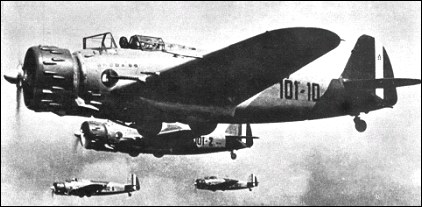
On 16 June 1940, just after Italy’s declaration of war on France and her allies, the twelve Ba.88 aircraft from the Regia Aeronautica’s 19° Gruppo Autonomo made bombing and machine-gun attacks on the principal airfields of Corsica; three days later nine Ba.88s made a repeat attack. Analysis of these operations showed that the Ba,88 had only limited value, and any remaining doubts were settled when Ba.88s of the 7° Gruppo Autonomo joined action in Libya against the British. Fitted with sand filters, the engines overheated and failed to deliver their designed power. Attacks on targets at Sidi Barram had to be aborted in September 1940, the aircraft failing to gain sufficient altitude or maintain formation, and reaching a speed less than half that claimed by the manufacturers. The Ba 88 being taken out of production after only 105 aircraft had been built. Eighty-one by Breda and twenty-four by IMAM Meridionali.
In 1938 a Ba.88 bis was proposed with two Alfa Romeo 135 engines for the Caccia Combattimento competiton. It was not proceeded with.
By mid-November 1940 most surviving Ba.88s had been stripped of useful equipment and were scattered around operational airfields as decoys for attacking British aircraft.
In 1941 Agusta substituted two 840-h.p. Fiat A.74 R.C.38 radials for the Piaggios, increased wing span by 2.00m and fuselage length, and began the construction of a small series under the designation Ba 88M as ground-attack aircraft. Nose armament was increased to four 12.7mm machine-guns, and dive brakes were installed. Only three aircraft of this type were completed. These Breda Ba.88Ms were delivered to the 103° Gruppo Autonomo Tuffatori (independent dive-bombing group) at Lonate Pozzolo on 7 September 1943. They were flight-tested by Luftwaffe pilots, but that was the last heard of the Breda Ba.88.
A total of 149 were built.
Breda Ba.88 Lince Engine: 2 x Piaggio P.XI RC 40, 986 hp Length: 35.4 ft / 10.79 m Height: 10.171 ft / 3.1 m Wingspan: 51.181 ft / 15.6 m Wing area: 358.872 sq.ft / 33.34 sq.m Max take off weight: 14883.8 lb / 6750.0 kg Weight empty: 10253.3 lb / 4650.0 kg Max. speed: 265 kts / 490 km/h Service ceiling: 26247 ft / 8000 m Wing load: 41.41 lb/sq.ft / 202.0 kg/sq.m Range: 871 nm / 1614 km Armament: 3x MG 12,7mm BredaSAFAT, 1x MG 7,7mm Breda SAFAT, 1000kg Bomb. int. / 3x200kg Bomb. ext.
By the time the Ba.64 had entered service, work had already begun on a more powerful evolution of the system which delivered the prototype for the much improved Ba.65 fighter-bomber. The prototype first flew in September of 1935, went into series production that same year and were essentially copies of the prototype version. The Italian Isotta-Fraschini license-produced the French Gnome-Rhone K-14 engine of 700 horsepower and the early Ba.65 production forms all were fitted with the type.
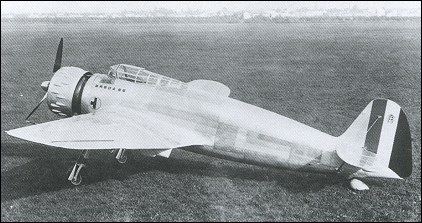
Design of the Breda Ba.65 was the engine in a forward compartment along the airframe with an identifiable oversized cowling. The cockpit was situated directly behind the engine and fitted well forward of the aircraft’s center. Wings were of a low-set monoplane design and their bulk fitted ahead of amidships, each wing sporting well-rounded tips. The fuselage was stout in appearance and tapered off gently to become the empennage. The tail was topped with a single, rounded edge vertical tail fin and a pair of high-set horizontal planes, these also well-rounded at their tips. The undercarriage consisted of two main landing gear legs and a tail wheel. Each leg was affixed with a single wheel and the main legs recessed rearwards though only partly under each wing, the wheels half-exposed during flight. The tail wheel unit remained lowered at all times, even during flight.
Armament for the Ba.65 was all contained in the wings and was primarily a mix of machine gun systems. These consisted of 2 x 12.7mm Breda-SAFAT heavy machine guns joined by a pairing of 7.7mm Breda-SAFAT general purpose machine guns. For its intended ground attack role, the Ba.65 could be fitted with up to 1,102lbs of conventional drop ordnance. Categorized a ground attack aircraft, the Ba.65 was the only such Italian aircraft to serve in this role during World War 2.
A second series of 137 aircraft was built by Breda (80) and Caproni-Vizzola (57), before production ended in July 1939. They differed from the first production batch by having Fiat A.80 RC.41 18-cylinder, twin row, air-cooled engine was introduced from the 82nd production airframe onwards, driving a three-bladed propeller. The Fiat engine improved output to a relatively impressive 1,000 horsepower. Six Fiat-powered Ba.65s and four more of the Gnome-Rhone-powered version were sent to the Aviazione Legionaria in Spain in 1938. Experience in Spain indicated that the Ba.65 was suited only to the attack role, and the type served with most of the eight squadriglie attached to the two Regia Aeronautica assault stormi (wings), the 5° and 50°.
Production of the Ba.65 would last until 1939 to which all were officially retired from 1941 onwards, the aircraft now being wholly outclassed by newer and better breeds of aircraft and limited the Ba.65 to the ground attack role when possible.
A large number of the Ba.65s serving with Italian units were of two-seat configuration, with an observer/gunner in an open cockpit above the trailing edge of the wing. A smaller number of the type had a Breda L type turret, but in either case the observer/ gunner operated a single 7.7mm machine-gun. While offensive armament could theoretically comprise up to 1000kg of bombs, the load usually carried was up to 300kg in the fuselage bomb bay or, alternatively, up to 200kg on underwing racks.
Following Italy’s entry into World War II in June 1940, Ba.65s were involved in the fighting in North Africa against the British. They had a low serviceability rate in desert conditions and the last serviceable aircraft was lost during the British offensive in Cyrenaica in February 1941.
Of 218 Ba.65 aircraft completed and delivered for use, exports included 25 Fiat-powered Ba.65 two-seaters to Iraq in 1938, two of them dual-control trainers and the remainder with Breda L turrets; 20 Ba.65s with Piaggio P.XI C. 40 engines to Chile later in the same year, 17 of them single- seaters and three dual-control trainers; and 10 Fiat-powered two-seater Ba.65 bis with Breda L turrets to Portugal in November 1939 (Fiat A.80 RC.41). A single Fiat-powered production aircraft was tested with an American Pratt & Whitney R-1830 engine in June 1937 in anticipation of an order from the Chinese Nationalist government, but this failed to materialize. The Iraqi Ba.65s saw limited action against the British during the 1941 insurrection in that country.
Ten were exported to the Soviet Union in 1939. Aviazione Legionairia Ba.65s were a mix of K.14- and A.80-powered types. Spain: 1939, 11 surviving Ba.65s* (of 23) transferred to Ejercito del Aire. But at least some (eg #551) were ‘doppio comando’ dual-control trainers.
The Ba.65 designation was used to signify the definitive single-seat production version while Ba.65bis marked both a two-seat bomber variant and its similar two-seat trainer derivative.
Ba.65 K.14 Engine: Isotta-Fraschini K.14, 900 hp Armament: 2 x 7.7mm + 2 x 12.7mm Breda-SAFAT Seat: 1
Ba.65 A.80 Engine: 1 x Fiat A.80RC.41 radial, 1,000 horsepower. Wingspan: 39.70ft (12.10m) Length: 30.51ft (9.3m) Height: 10.50ft (3.20m) Maximum Speed: 267mph (430kmh; 232kts) Maximum Range: 342miles (550km) Service Ceiling: 20,669ft (6,300m; 3.9miles) Armament: 2 x 12.7mm Breda-SAFAT heavy machine guns in wings. 2 x 7.7mm Breda-SAFAT machine guns in wings. Up to 661lbs of internal ordnance in bomb bay and 441lbs of external ordnance held underwing. Accommodation: 1 Hardpoints: 2 Empty Weight: 5,291lbs (2,400kg) Maximum Take-Off Weight: 6,504lbs (2,950kg) RAI Ba.65 A.80s were re-engined with 14-cyl. Isotta-Fraschini K.14s
Ba.65 bis 2-seat version with open gun position, increased fuel capacity
Ba.65 bis L 2-seat version equipped with enclosed Breda L dorsal turret
Ba.65 Dive-bomber conversions of 40 Ba.65bis by Caproni Vizzola
Societa Italiana Ernesto Breda The Societa Italiana Ernesto Breda was one of the largest members of Italy’s wartime aircraft industry, having plants at Sesto S. Giovanni (Milan), Torre Gaia (Rome), Apaulia and Brescia. Breda began the construction of aircraft in 1917. In the immediate post First World War years, when no production aircraft were being built, Breda concentrated on research and constructed a number of experimental aircraft, and began the construction of all-metal aircraft in 1922. Production aircraft have included Breda 15 two-seat lightweight sporting aircraft of 1930, Breda 25 and 28 training biplanes, and the Breda 33 two-seat sports monoplane of 1932, from which time production concentrated mainly on military aircraft. From the early ‘thirties this company was preoccupied with the development of ground attack aircraft, and two types were in production when ltaly entered the war, the Breda Ba 88 and the more elderly Ba 65.
Production orders far the Ba 88 were placed for the Regia Aeronautica and assembly lines were established by both Breda and 1.M.A.M. (Meridionali) with deliveries commencing late in 1938. Relatively poor performance and inadequate defensive armament resulted in the Ba 88 being taken out of production after only 105 aircraft had been built. In 1941 the Agusta concern substituted two 840-h.p. Fiat A.74 R.C.38 radials for the Piaggios, increased wing span and fuselage length, and began the construction of a small series under the designation Ba 88M. Only about three aircraft of this type were completed.
Filippo Zappata, responsible far the C.R.D.A. Cant series of bombers, joined the Breda design staff in 1941, and was subsequently responsible far several projects, few of which were actually built. His first design under Breda auspices was the Bz 301 long-range, all-metal medium bomber derived from the Cant Z.1018 but not built. The Bz 302 was a projected twin-engined heavy fighter of all-metal construction abandoned in favour of the Bz 303 night fighter. The Bz 303 was a sleek two-seat, low-wing monoplane of mixed construction with twin fins and rudders. The sole prototype was destroyed by the Germans.
Early Breda designations used prefix letters followed by numbers. But those numbers were duplicated and, in the case of the B.x series and M.1, do not appear to be consecutive with later Breda type numbers. Further duplication occurred when the designation B.1 was applied to an airliner conversion of a Breda-built Caproni Ca.5 bomber, B.1 having been previously applied to the Breda-Pensuit triplane.
Breda, itself, did not apply Ba. abbreviation to its designations, preferring the simpler Breda xx form (the familiar Ba. prefix was applied to Breda designations by the Ministero dell’Aeronautica and Regia Aeronautica). The Breda A.x numbers seem to be consecutive with later designations.
When Breda licenced-built aircraft, these usually retained their original designations. Examples are: the Caproni Ca.5 and Ca.44 bombers; the CAB C.1, C.2, SC.4, SC.5 light aircraft, etc. In other cases, where Breda modified an existing type, the designer’s name was simply added – as with the Breda Tebaldi-Zari fighter.
When the WWII started, all helicopter related jobs were concentrated in single OKB-3 headed by Ivan Pavlovich Bratukhin. Involved in helicopter development since the late 1930s, I. P. Bratukhin first designed a twin-rotor helicopter, with an engine and related rotor mounted at each end of an outrigger. Designated 2MG Omega, this was completed in 1941. Vibration problems resulted in construction of Omega II in 1943. A series of similar twin-rotor helicopters were built up to 1948.
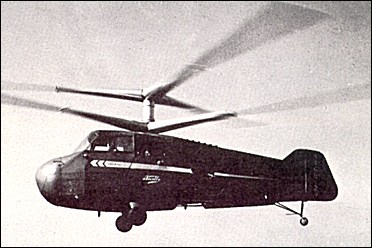
In 1943, N. P. Brantly began the design of a lightweight helicopter, built and flown in 1946 under the designation Brantly B-1. The B-1 was constructed by his employer, the Pennsylvania Elastic Company. Brantly used a coaxial twin-rotor configuration but the design was too heavy and complicated to appeal. With two co-axial contra-rotating three-bladed rotors, neither push rods nor cranks were visible in the rotary wing assembly. The collective, cyclic and differential controls were completely enclosed in the hubs and ran in an oil-bath. The three-blade rotors had a fixed pitch central “star” and a universal joint combining two hinges was 1.8 metres from the root of the blades. The radius of the non-flapping part of the blades was 1.8 metres. Each blade weighed only 5.5 kilos and the rotors normally turned at 320 r.p.m. The B-1 prototype (NX69125) was powered by a 150hp Franklin engine in the tube and fabric fuselage and had a fixed tailwheel undercarriage and directional control was achieved through a small rudder on the sternpost – because the twin main rotors were expected to neutralise the normal torque effect.
B-1 Number of seats: 2 Engine: 1 x Franklin 335, 150hp Rotor diameter: 9m Length: 5.33m Height: 2.36m Weight fully loaded: 907kg Empty weight: 601kg Cruising speed: 182km/h Range: 640km
Brantly Helicopter Industries Founded by N. P. Brantly, who designed the Brantly B-1, with co-axial rotors, in 1943. From this design he developed the improved Model B-2, using the rotor evolved for the B-1, a two-seat helicopter which first flew on August 14,1956. Subsequently entered production as Model B-2A, superseded by B-2B in 1963. Larger Model 305, a five-seat aircraft, first flew in January 1964. Company acquired by Lear Jet Industries Inc in May 1966. The Brantly helicopter interests, which had been acquired by Lear Jet Industries in 1966, passed to in 1969, and to Brantly Operations Inc in late 1970. On January 1, 1975 Michael K. Hynes founded Brantly-Hynes Helicopter Inc., having gained ownership of the Brantly interests, later becoming just Hynes Helicopter as division of Hynes Aviation Industries Inc. Production of Model B-2B two-seater and Model 305 five-seater continued. Rights to helicopters acquired by businessman James Kimura from Hynes Aviation Industries 1989, forming Brantly Helicopter Industries.
1998: Brantly Intrnational Wilbarger County Airport 12399 Airport Dr TX 76384 Vernon USA
On the sale of its assets and business to a public company on 30 June 1934, Boulton & Paul became Boulton Paul Aircraft Ltd. Plans were also at hand to build a new factory at Wolverhampton. A contract was received for the construction of Hawker Demons fitted with a Frazer-Nash hydraulically-operated turret, which effectively protected the gunner from the slipstream enabling him to better train and fire his gun. The rear top fuselage consisted of a turtleback cowl attached to the gunner’s harness which folded up and down according to his movements.
Although development of powered turrets continued, it would appear that funding was somewhat limited, notwithstanding the enthusiastic response from the Air Ministry. The companys patents in this field ended in the Secret List, thus severely limiting further progress. John D. North, the company’s chief engineer, adopted a French design which met little official interest in France. Designed by J.B.A de Boysson, a hydraulically-operated turret was developed by the Societe d’Applications des Machines Motrices (SAMM) and Boulton Paul acquired full rights for its manufacture and development within the British Empire. Two turrets were ordered from SAMM for further trials, fitted with Browning machine guns in place of the four Darne 7 mm guns of the original design. Meanwhile, an original (Darne-armed) Boysson turret was tested in the nose of Overstrand K8175, and a single 20mm Hispano cannon installation was also tested in another turret on K8176.
During this time of radical change in fighter design and tactics, the Air Ministry was probably not completely confident that the emerging category of single-seat monoplane fighters, armed with a battery of eight guns buried in the wings, could make the grade. The issue of Specification E9/35 called for a two-seat day and night fighter, which should have its armament concentrated in a power-operated turret. In spite of the turret’s weight penalty, the aircraft was expected to perform within performance parameters close to those of contemporary single-seaters not only in speed but also in range of action.
Apart from Boulton Paul, F.9/35 brought proposals from Hawker, Bristol and Armstrong Whitworth; of these only the first two made it beyond the design stage, with one prototype each being ordered in the autumn of 1935. Boulton Paul commenced construction of their E9/35 prototype (K9310) in 1936 at their new Wolverhampton plant, although design had begun at Norwich. Close attention had been given to aerodynamic cleanliness in order to minimise drag. Of conventional construction, its fuselage was built in two main sections, the forward section built up of four longerons and a number of bulkheads, while the rear section was made up of three units, the two side panels and the top decking. The forward section housed the pilot’s cockpit over the wing centre section. The rear half of the fuselage incorporated the turret which was faired fore and aft with wooden-framed hydraulically-operated fairings which automatically hinged down to allow the guns to traverse.
The wings, built around two spars, were broken down into five parts: a centre section, two outer wing panels and detachable wing tips. The centre section housed the fully-retractable main undercarriage members and self-sealing fuel tanks, one 52 Imp. gallon (236 litre) tank on either side of the radiator bath. This tankage was later increased by another pair of 27 Imp. gallon (123 litre) tanks further outboard in the outer wing sections.
Its all-metal structure was conventional in most respects, its only unusual feature being the method of attaching the light alloy skinning to the stringers and ribs and then attaching these to the fuselage frames and wing spars. This obviated the need to pre-form the skins and, by riveting them while flat and countersinking the rivets, an exceptionally smooth finish was obtained.
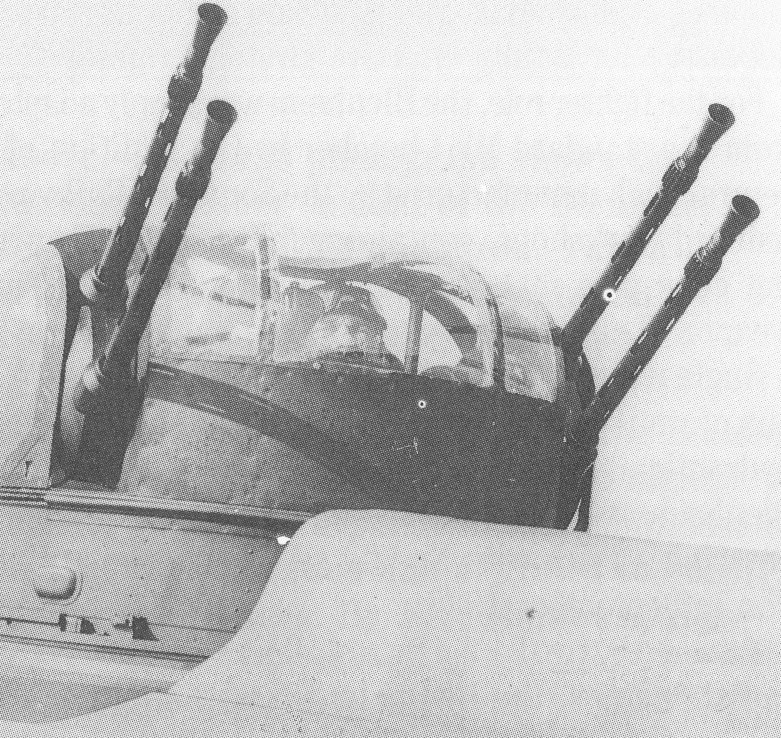
The Boulton-Paul A. Mk.IID turret was a self-contained, removable unit, fitted with four .303 Browning machine guns with 600 rounds per gun. This unit weighed 3601b (162kg) empty, to which 881b (39.6kg) of armament and 1061b (48kg) of ammunition had to be added. Its hydraulically-operated system was completely independent from any other system in the aircraft.
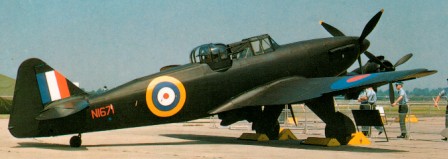
The Boulton Paul Defiant was only the RAF’s third monoplane aircraft and the Defiant became the RAF’s first four machine gun fighter. On 11 August 1937, chief test pilot Cecil Feather took the turret-less prototype up for its first flight. The aircraft weighed 7,5001b (3,375kg) without its turret at this stage and was powered by a 1,030-hp (768-kW) Rolls Royce Merlin 1 engine with which it attained a maximum speed of 302mph (485.6km/h) , at which point it was named the Defiant. With the turret installed, vertical tail area had to be increased slightly; meanwhile a second prototype had been ordered (K8620).
When it had been decided to abandon further development of the Hotspur, an initial order for 87 production aircraft of what by that time had become known as the Defiant, was placed on 28 April 1937. Although drawings began reaching the workshops by the end of that same year, completion of the second prototype was delayed due to a change in power plant, from Merlin 1 to Merlin II. Apart from the increased tail area, it also featured redesigned exhaust stacks and cockpit canopy, and modifications to the undercarriage doors, thus bringing it very close to production standard. This set the first flight of K8620 back to 18 May 1939.
The second prototype was fitted with a Type A four-gun turret based on a French design already licensed for use on Boulton Paul’s Overstrand bomber, and this version with but minor changes became the production Defiant Mk1. The turret was electro-hydraulically operated with a mechanical backup and carried 4 x .303 Browning machine guns, electrically fired with cut-off points in the turret ring preventing activation when pointing at the propeller disc or tailplane. Whilst the gunner could lock the turret forward and transfer firing control to the pilot, this was rarely practised given forward elevation restrictions and the lack of pilot gunsight. The machine guns were paired two to a side and the entire turret system could scan a 360-degree area above the aircraft. Six-hundred rounds of 7.7mm ammunition were afforded each gun.
This was followed by another engine update with the selection of the Merlin III, the version with a standardised shaft for DH or Rotol constant-speed propellers, for production Defiants. The first production aircraft (L6950) performed its maiden flight on 30 July 1939, and by September it was with the A & AEE at Boscombe Down for official trials. These included dive-bombing trials at Orfordness, as L6950 had been fitted with underwing racks to carry light bombs. L6951 was transferred to the Central Flying School for handling trials. The Defiant was described as having excellent handling qualities, with very few vices. It found to be quite stable, with very little trim change being necessary when the undercarriage or flaps were extended or retracted. As with most aircraft of the time, it had a tendency to swing to port during take off, something which could easily be corrected. Comparative trials with No.111 Squadron Hurricanes were performed at Northolt on L6952 in October 1939, where the real situation emerged: the Defiant proved to be at a distinct disadvantage when compared with a single-seat fighter. The report clearly stated that than any average pilot flying a Hurricane could carve up an aircraft with the power/weight ratio of the Defiant.
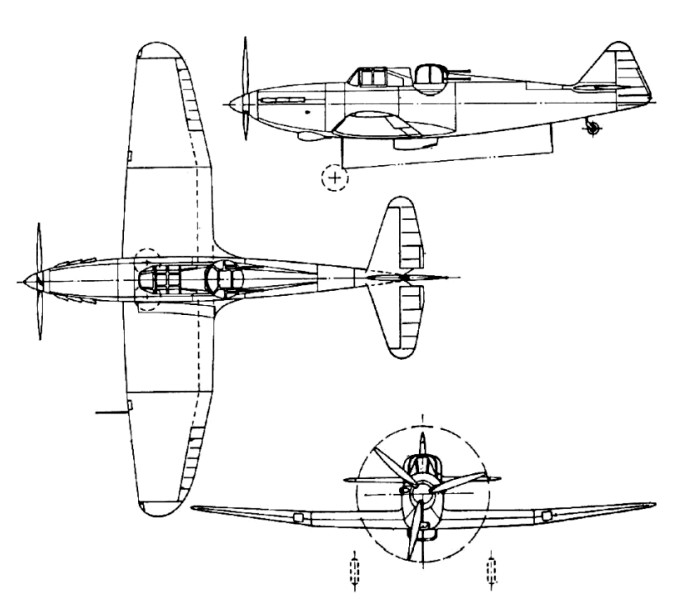
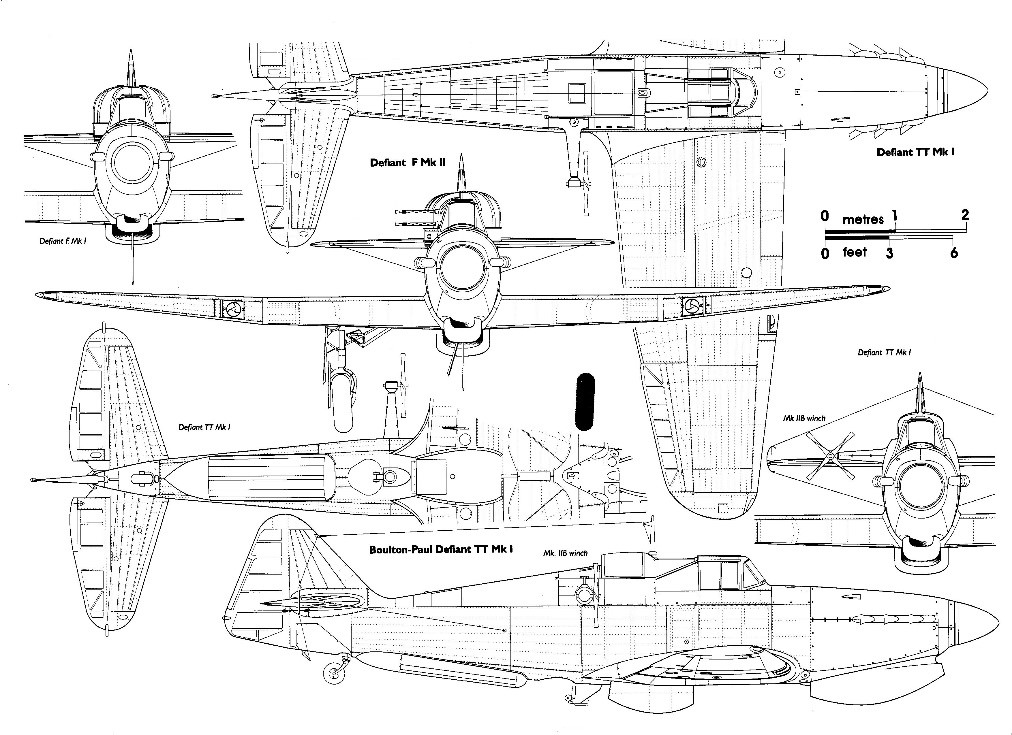
Defiant F Mk.1
The first unit to receive the Defiant was No.264 Squadron, which had been formed at Sutton Bridge in October 1939 from where it moved to Martlesham. There it received its first two aircraft on 8 December 1939. By that time, more than half of the first production order had been completed; two further orders had been placed, one in February 1938 for 202 aircraft and another in May of the same year for 161. More orders were placed in December 1939 (150), February 1940 (50) and July 1940 (280).
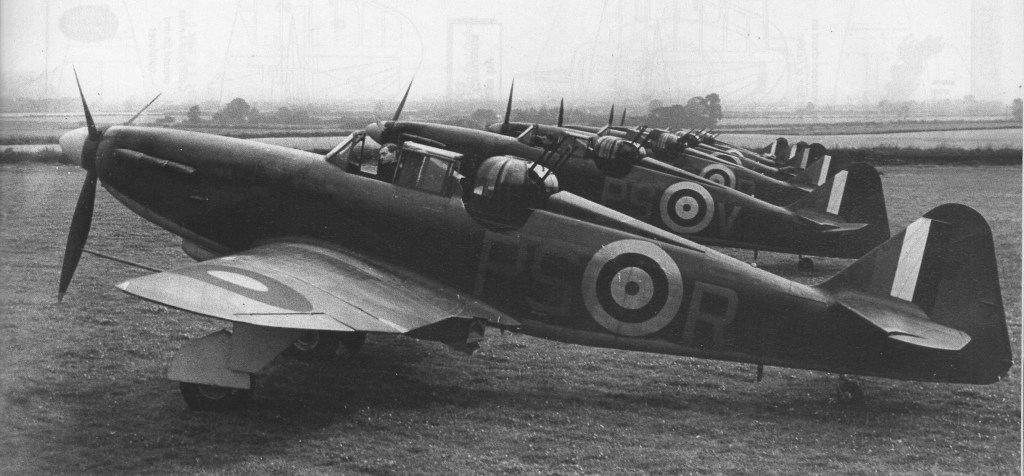
264 Squadron was grounded on 28 January after a series of engine difficulties and hydraulic problems, the ban being lifted during the first week of February 1940. Although not fully worked up, two of the squadron’s flights were posted to Wittering on 21 March to fly convoy patrols. On 10 May, the entire squadron moved to Duxford, while two days later a Flight proceeded to Horsharn St Faith. That day, six Defiants from this Flight patrolled the Dutch coast and after strafing ground targets, escorted by Spitfires from No.66 Squadron, drew first blood by shooting down a Ju 88A. On 13 May, B Flight went into action, engaging a formation of Ju 87Bs of which they claimed four destroyed, when the Defiants were bounced by Bf 109Es escorting the ‘Stukas’; only L6974 escaped to tell the tale. Between 27 and 31 May Deflants were ordered to participate in providing top cover at Dunkirk, across the Channel. During this period, 264 Squadron claimed 65 kills, 37 of which were supposed to have been achieved on 29 May. There is no doubt that these claims were grossly exaggerated.
No.141 Squadron was the second Defiant unit to be formed, becoming operational at Grangemouth on 3 June 1940. On 19 July, 12 aircraft from the unit moved to Hawkinge, nine of which were scrambled at 12.30hrs. They had the misfortune of being bounced south of Folkstone by Bf 109Es which practically decimated the formation; L7014, although badly shot up, was to be the sole survivor. Pilots of No.111 Squadron claimed that the Defiants had shot down four of the aggressors during the fight.
Defiants of No.264 Squadron RAF
During the height of the Battle of Britain, No.264 moved to Horchurch on 22 August; two days later the unit claimed three Ju 88s and a Bf 109E destroyed for the loss of two Defiants. On 26 August three Do 17s were shot down losing another Defiant in the process, while two days later four more of the turret fighters were lost.
Following the loss by 264 Squadron of 7 aircraft with 9 crewmen dead over the three days 26th to 28th August 1940, the Defiant was withdrawn from the day fighter role. On 28 August, 264 Squadron ceased operations and moved to Duxford the following day. Offensive patrols were cancelled and Defiant sorties were limited to anti-bomber patrols over the Channel from Matlesham Heath and Debden, until on 23 July the unit was retired to Kirton-on-Lindsey.
The Defiant Night Fighter No.141 Squadron pioneered night flying sorties with the Defiant on 1 July 1940, when L7997 flew a lone sortie. As the type had been withdrawn from daylight operations, both 141 and 264 Squadrons were operating practically as night fighter units by September. This coincided with the switch to night bombing by the Luftwaffe on London. B flight of No.141 Squadron moved to Biggin Hill, with A Flight taking up residence at Gatwick in October. Two He 111s were clairned by the unit as shot down on the night of 15/16 September. No 264 was similarly engaged, flying from Rochford, and later Debden. However, successes were few and far between and it was only with the arrival or airborne radar that the situation improved.
Defiants were now the Defiant NF.Mk I and were based on the standard Mk I marks. The NF.Mk IA followed soon afterwards with the AI.Mk IV / VI interception radar.
In the quest for better performance, Boulton Paul developed the Defiant F Mk II, more dedicated to the night-fighter role with the AI Mk IV airborne interception radar and powered by a 1,260hp Merlin XX. First flight of such an aircraft (N1550) was performed on 20 July 1940. Apart from the longer cowling to accommodate the new engine, both oil cooler and radiator were deepened and enlarged. The Mk II clocked a maximum speed of 315mph (506.5km/h) at 16,500ft (5,020m) during official trials. An order for 280 Mk Is placed in July was amended to cover the production of 63 Mk Is and 210 Mk IIs (a further seven Mk Is having been converted to Mk II standard on the production line).
Deliveries of the Mk II commenced in February 1941, by which time the Defiant had established itself in the night fighter role. By autumn of that year, AI Mk IV (and later Mk VI) radar was being fitted to Mk 1 Deflants (redesignated Mk IA) and Mk IIs (NF Mk II). Night fighter squadrons with the Defiant began to mushroom, these including No 96,125, 141, 151, 153, 264 and 410. By mid1942, the Defiant night fighter had been largely replaced by twin-engined types even in this role, No 153 and 256 Squadrons retaining their turret fighters up to the end of that year. A Flight of No 515 (Special Duties) Squadron kept its Defiants well into 1943.
As Defiants became surplus to needs of front line squadrons, they were transferred to Fighter Command air-sea-rescue units. Around 50 examples were fitted with an ‘M’ type dinghy stowage pack under each wing as ASR.Mk Is, serving with No 275, 276, 277, 278 and 281 Squadrons. After just six months of operations, these Defiants were withdrawn due to a number of problems.
The final production run covered 140 TT.Mk III target towing Defiants ordered in July 1941. A clear rearsliding canopy over the winch operator’s cockpit replaced the gun turret, a ‘B’ or ‘E’ type winch driven by a windmill was fitted to the starboard side of the fuselage while the target sleeves were housed in a faired pack fitted under the rear fuselage. First TT Mk 1 (DR863), based on the Merlin XX-powered Mk II, flew in January 1942. Apart from the order for new-build machines, the last 40 F Mk IIs on the production line were also completed as TT Mk Is, with the last (AA670) being delivered in May 1942. To these one has to add a further number of Mk IIs which, on being retired frorn squadron service, were converted for target-towing duties.
Quite a number of Deflants F Mk 1 were available for conversions to TT Mk III, a job assigned to Reid & Sigrist at Desford. N3488 became the development machine (rather than prototype) and apart from the Merlin III, distinguishable by its shorter nose, this version was similar to the TT Mk 1 in most other respects. About 150 Defiants were converted to Mk III standard between 1942 and 1943. Apart from most of the Gunnery Schools, where it replaced the Lysander, also the Royal Navy employed the Defiant target-tug overseas. For this purpose, in 1943 it became necessary to fit tropical filters to enable the Defiant to operate in hot and dusty climes.
At its peak of use, 13 RAF squadrons were Defiants equipped.
The Defiant also saw service with the Royal Navy and the air forces of Australia, Canada and Poland. A total of 1,064 machines were built.
Boulton Paul had embarked on a turret-less version way back in 1940, a single seat Defiant with a pair of .303in Brownings in each wing. The original prototype – K8310 – was modified to this standard; in fact one could say that it had reverted to the solid rear fuselage with which it had flown its initial flights. Notwithstanding that its performance would have been slightly better than that of the Hurricane, no official interest was shown in the single-seat Defiant.
At one time, a Merlin 24-powered version was under study, under the designation of TT Mk II; however the number of newbuild TT Mk Is and other conversions was considered as adequate for service needs, and the project did not proceed further.
Only one complete Boulton Paul Defiant example exists, this being held by the Royal Air Force Museum in Hendon, London.
Defiant Mk I Engine: one 1,030-hp (768-kW) Rolls-Royce Merlin III Wing span: 39 ft 4 in (11.99 m) Length: 35 ft 4 in (10.77 m) Height: 11 ft 4 in (3.45 m) Wing area: 250.0 sq ft (23.23 sq.m) Empty weight: 6,078 lb (2,757 kg) Maximum take-off: 8,600 lb (3,901 kg) Normal loaded weight: 8318 lb / 3773 kg Max speed: 259 mph / 302 kph at SL Maximum speed: 304 mph (489 km/h) at 17,000 ft (5,180 m) Cruising speed: 259 mph / 417 kph at 15,000 ft / 4572 m Initial climb rate: 1.900 ft (579 m) per minute Time to 15,750 ft / 4800 m: 8 min 30 sec Service ceiling: 30,350 ft (9,250 m) Range: 465 mi / 748 km at 259 mph / 417 kph Armament: four 0.303-in (7.7-mm) machine guns 600 rds each Crew: 2 Number built: 723
Defiant NF.Mk IA
Defiant TT.Mk I
Defiant Mk II Engine: Rolls Royce Merlin XX, 1262 hp/954-kW Length: 35.335 ft / 10.77 m Height: 11.319 ft / 3.45 m Wingspan: 39.337 ft / 11.99 m Wing area: 250.048 sqft / 23.23 sq.m Max take off weight: 8425.3 lb / 3821.0 kg Weight empty: 6282.0 lb / 2849.0 kg Wing load: 33.62 lb/sq.ft / 164.00 kg/sq.m Max. speed: 272 kts / 504 km/h / 313mph Cruising speed: 226 kts / 418 km/h Service ceiling: 30348 ft / 9250 m Rate-of-Climb: 1,900ft/min (579m/min) Range: 404 nm / 748 km Crew: 2 Armament: 4x cal.303 MG (7,7mm) Number built: 210
Defiant NF.Mk II Engine: Rolls-Royce Merlin XX, 1,280 hp Top speed: 313 mph Service ceiling: 30,350 feet Range: 465-mile
Established as a building constructor in Norwich, Norfolk, turned to subcontract construction of aircraft in First World War, including RAF F.E.2d, Sopwith 1/2-Strutter and Sopwith Camel. Known originally as Aircraft Department of Boulton & Paul Ltd. As the war neared its end, the company decided to continue in aircraft industry and the aircraft division of Boulton & Paul was incorporated as an independent company, Boulton Paul Aircraft in 1934. First original design P.3 single-seat biplane fighter which did not enter production. Designed and built P.6 research aircraft, which provided much data for later P.9. P.7 Bourges twin-engined fighter-bomber built at the end of 1918, followed later by similar Bugle. Neither entered RAF service. Continued to build small numbers of civil aircraft during inter-war years. Sidestrand 3/4-seat medium bomber entered RAF service with one squadron in April 1928. Replaced by improved Overstrands, with power-operated gun turret, in 1934. When production ended, in 1936, company re-established at Wolverhampton, Staffs. Name of Boulton Paul Aircraft Ltd. adopted 1934. Designed and built P.82 Defiant for RAF, prototype first flew 11 August 1937; two-seat fighter with power-operated gun turret was entirely new concept and enjoyed initial operational success. Production ended 1943 after more than 1,000 built. Designed P.108 Balliol three-seat advanced trainer for RAF, 162 built subsequently as two-seat Balliol T.2, of which 30 built under subcontract by Blackburn Aircraft Ltd. Built P.111 and P.120 for research into behavior of delta wing at transonic speeds. In 1961 the company became part of the Dowty Group.




 All Aero