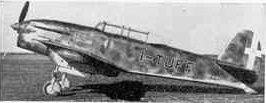
In 1940, C.A.N.S.A. produced two prototypes of the F.C.12 (first flown 1940), which was intended as a trainer for dive-bomber pilots but was also projected as a light attack bomber. The F.C.12 was a tandem two-seat monoplane powered by a 600-h.p. Fiat A.30 R.A. in-line engine. Armament comprised two 12.7-mm. guns in the fuselage and two 12.7-mm. guns in the wings, and a manually-operated 12.7-mm. gun in the rear cockpit.
Gabardini Sa manufactured a 80 hp rotary-engined two-seat monoplane at Novara in 1913, used for a non-stop flight between Milan and Venice. Company subsequently opened factory at Cameri in 1914 to build a military version of this monoplane, powered by a smaller engine. Also built biplane trainers. Nothing more heard of company until it produced a two-seat light cabin monoplane, the Lictor 90, in 1935. Name of Costruzioni Aeronautiche Novaresi SA assumed May 1, 1936 by former Aeronautica Gabardini SA. Head office and factory at Cameri; began with repair and maintenance work on aircraft and engines. First product was C.5 single-engined one/two-seat training biplane (Fiat or Alfa Romeo engine), built in some numbers in late 1930s for civil market. The C.6 was a less successful development. CANSA then became subsidiary of Fiat, producing small numbers of F.C.12 fighter/trainer monoplane (first flown 1940) and also the F.C.20 twin-engined ground- attack aircraft.
The Canadian Car and Foundry Company Ltd, called CCF and later Can-Car, was established in 1909 as a manufacturer of railway rolling stock, with its head office in Montreal and production facilities in several other locations. In 1937 acquired license to build Grumman GE-23 (FF-1) two-seat biplane fighters, in factory at Fort William, Ontario. Built prototype of FDB-1 fighter biplane in 1938. Orders for large numbers of Avro Ansons, Hawker Hurricanes, Avro Lancasters, and Curtiss Helldivers were received. Seven new factories opened by mid-Second World War. Early post-war obtained Canadian license for Burnelli “lifting fuselage” designs; flew prototype CBY-3 (twin Wasp engines) August 1945. Accommodation was three crew plus 38 passengers or 22 passengers and freight. Development of CBY-3 by subsidiary Cancargo. In 1947 acquired assets of Noorduyn Aviation Ltd.; continued manufacture of Mk V Norseman and variants until early 1950s; resold it to its designer in 1953. In early 1950s designated products “Can-Car,” beginning with North American Harvard Mk 4s built under license at Fort William for RCAF and NATO air forces. Gained contract to build 100 BeechcraftT-34A Mentor piston-engined trainers in 1952-1953 for USAF and also for RCAF. Retitled Canadian Car Company Ltd in mid/late 1950s.
Canadian Vickers Ltd was established 1911 at St Hubert, Montreal, as subsidiary of Vickers Ltd. Aircraft division formed 1922; first Canadian company to build aircraft commercially. First contract was for six U.K.-designed Viking IV amphibians for Canadian Air Force. These followed from 1924 by 61 Vedette single-engined flying-boats and amphibians, its most successful product, designed in Canada by W.T Reid. During the 1920s six other designs appeared: the Varuna, Vista, Vanessa, Velos, Vigil, and Vancouver. Of these, only the Varuna (eight) and Vancouver (six) flying-boats went into production. In the 1930s the company license-built Fairchild and Fokker designs and Northrop Deltas. During the Second World War built 40 Supermarine Stranraer flying-boats for the RCAF, 230 Consolidated OA-10 Catalinas for the USAAF, and 149 Canso amphibians for the RCAF, plus hulls for 600 more Catalinas and fuselages for 40 Handley Page Hampden bombers. Took over Canadian Associated Aircraft in 1941, and in following year moved to government factory at Cartierville, near Montreal. In December 1944 became a separate autonomous company under new name of Canadair Ltd. Formed December 1944 at Cartierville, Montreal, from Aircraft Division of Canadian Vickers Ltd., as a “Crown Company.” Purchased 1946 by Electric Boat Company of New York; later that year became a subsidiary of General Dynamics Corporation. First contract (1944) to build the DC-4m (Merlin-engined version of the Douglas DC-4) for the RCAF. Eventually built 71, including commercial versions, and converted many wartime C-47s into postwar commercial DC-3s. Since 1949 has license-built more than 1,900 North American F-86 Sabre jetfightersforthe RCAF and the U.S. Military Assistance Program; more than 700 Lockheed T-33 SilverStar jettrainers; 200 Lockheed F-104 Starfighters for the RCAF; and 240 Northrop F-5s for the Canadian Armed Forces and Royal Netherlands Air Force. Products of its own design have included the CL-28 Argus Maritime patrol aircraft (32 built); CL-41 jet trainer/ground-attack aircraft (210 for Royal Canadian and Malaysian Air Forces); 39 CL-44 Yukon and 44 military/civil transports; three prototypes of the CL-84 tilt-wing VTOL research aircraft; CL-215 twin piston-engined firefighting and utility amphibian (first flown October 1967) and its CL-215T twin-turboprop reengined derivative (first flown June 1989); and Challenger 600 wide-body business jet (first flown November 1978) and 601 follow up. Company was repurchased by the Canadian government in December 1975. Other programs included the CL-89 battlefield reconnaissance RPV, major subcontract work for the U.S. Navy’s P-3C Orion and its Canadian derivative, the CP140 Aurora, and manufacture of components for other companies. Canadair became part of Bombardier Aerospace Group in December of 1986, renamed Bombardier Inc. Canadair.
The first CallAir flew in 1941 and was designated the Model A. The last version was introduced in 1957 and was named the A-6. Throughout the years of its existence, the basic difference between any of the models was the powerplant; otherwise, the Model A-4 differed little externally from the original Model A. The CallAir was built with mixed construction: fabric-covered wooden wings and a fabric-covered steeltube fuselage.
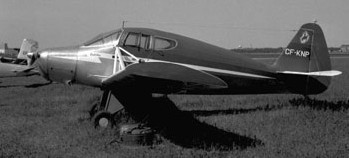
The Model A-2, with a 125-hp Lycoming, and the Model A-3, with a 125-hp Continental, were produced during the years between 1946 and 1948.
Call-Air 100 Model A-2
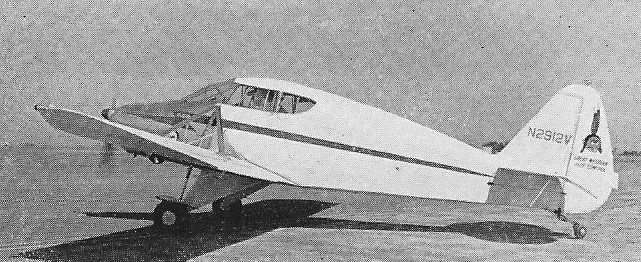
The first production models of the A-4 appeared in 1955, and the major refinement was the addition of 25 more horsepower with the installation of a 150-hp Lycoming. All models shared the same two-to three-seat cabin and low wing with exposed struts.
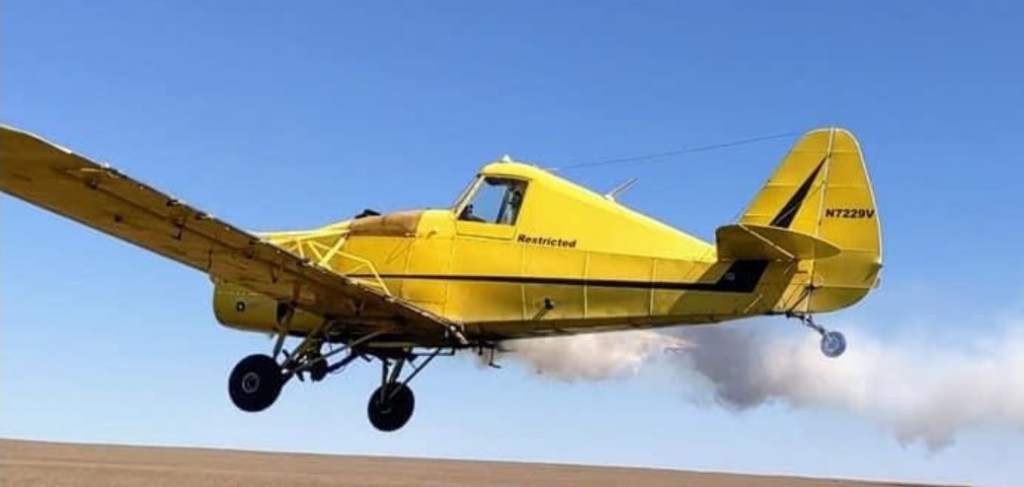
Another version of the CallAir was introduced in 1956 and was basically an agricultural development of the Model A-4. Designated the A-5, it was normally flown as a single-seater with the cockpit offset to the starboard side due to the inclusion of the dust hopper.
The Model A-6 flown in 1957 was identical, apart from another jump in horsepower to a 180-hp Lycoming.
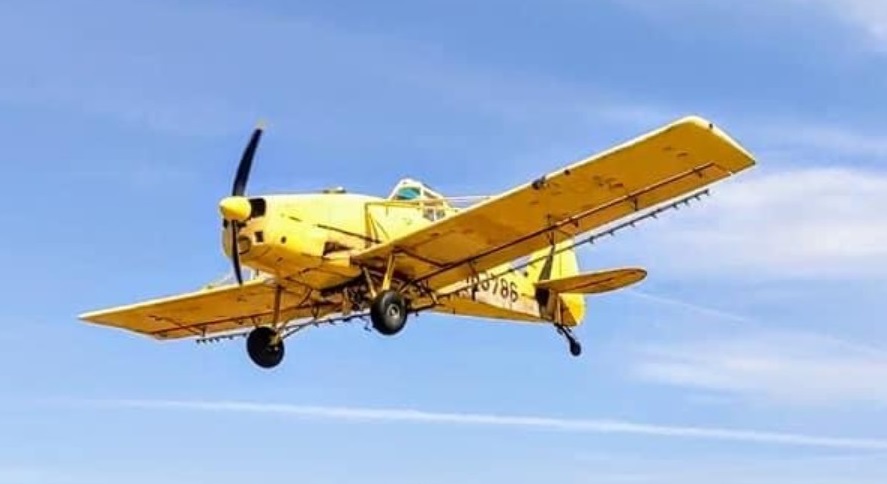
CallAir A-9 courtesy Larry in NC
The Intermountain Manufacturing Co. developed a series of low-priced agricultural aircraft from the CallAir, and the first airplane rolled off the production line in 1963. The A-9 featured a 235-hp Lycoming; its top speed was now 130 mph, and its climb rate was now 650 fpm. The dust hopper was moved to a position in front of the cockpit.
Call Aircraft Company formed originally as Call-Air in 1940-1941 by Renel, Ivan and Spencer Call to design and develop the Call-Air Model A two-seat light Cabin monoplane with Continental flat-four engine. Updated version with Lycoming flat-four certificated in 1946. Other models were the A-2 (Lycoming) and A-3 (Continental). Named changed to Callair Incorporated around 1950, producing the Model 150 (Callair A4) in 1955. A-5 and A-6 (uprated) were agricultural adaptations. Callair was purchased by Intermountain Manufacturing Company in 1962, and this company continued the development of aircraft for agricultural use.
In 1942 Dawydoff obtained the plans and the rights to produce the Slingsby Cadet under licence from Fred Slingsby. Dawydoff had the plans redrawn to US measurements, the structural strength increased, plus a new tow hook and wing rigging design. The wing is assembled using just one 4 ft (1.2 m) long pin per wing.
The UT-1 is built predominantly from wood, with the fuselage wooden framed and covered in plywood. The wing and tail are also wooden-framed and covered in doped aircraft fabric covering. The two-spar wing is supported by dual struts.
Dawydoff’s plan was to gain government support to provide the UT-1 in kit form for assembly by schools and clubs. The government money was not forthcoming and the post-war period saw a large number of surplus military training gliders saturate the market. As a result, only one UT-1 was completed, first flying in 1943. It is now located in the National Soaring Museum.
Wingspan: 38 ft 5 in (11.71 m) Wing area: 172.5 sq ft (16.03 m2) Aspect ratio: 8.5:1 Airfoil: Go 426 Empty weight: 276 lb (125 kg) Gross weight: 450 lb (204 kg) Maximum glide ratio: 14.7:1 at 30 mph (48 km/h) Rate of sink: 210 ft/min (1.1 m/s) at 28 mph (45 km/h) Wing loading: 2.6 lb/sq ft (13 kg/m2) Crew: one
World War II created a great demand for military transport aircraft in the United States. Because of initial fears of a shortage of aluminum, the War Department explored the use of other materials for aircraft construction. Budd, the developer of the shotweld technique for welding stainless steel and a manufacturer of stainless steel railroad cars, automobile, bus, and truck bodies, hired an aeronautical engineering staff and worked with the U. S. Navy to develop a new twin-engine transport aircraft constructed primarily of stainless steel. The U.S. Navy accepted the proposal for the new aircraft, and placed an order for 200, to be designated RB-1. The U.S. Army Air Forces (USAAF) followed with an order for 600, designated C-93.
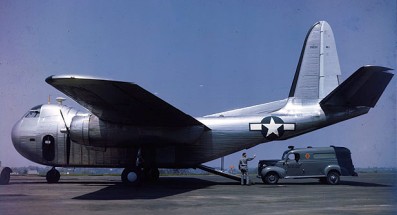
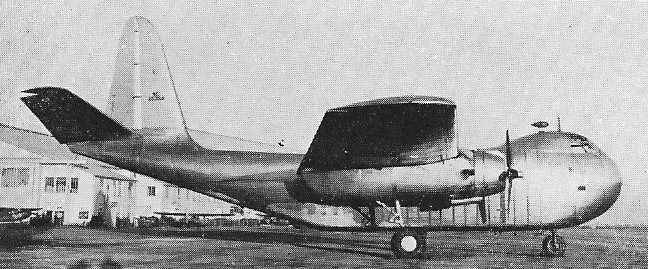
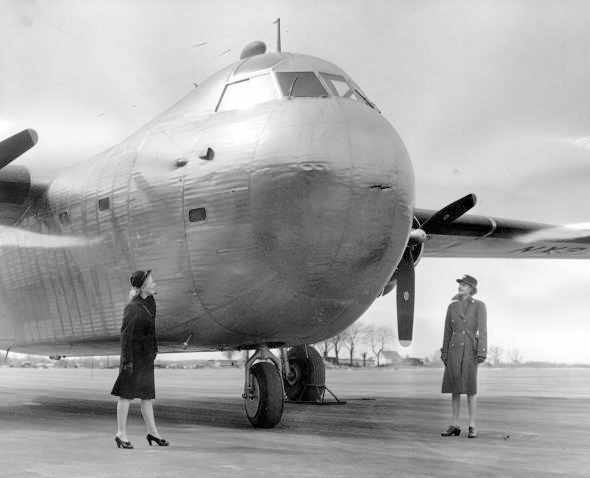
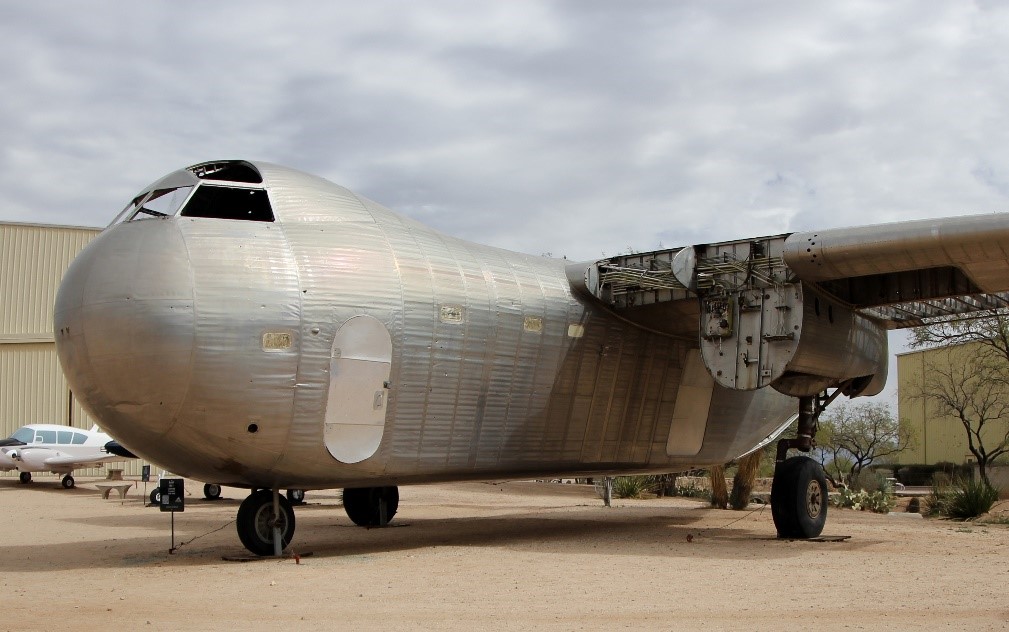
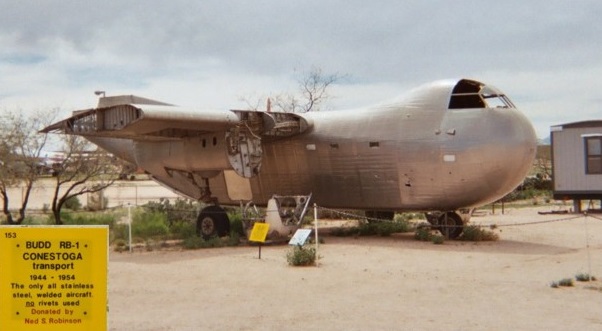
The Conestoga was a twin-engine high-wing monoplane with tricycle landing gear. The elevated flight deck was contained in a distinctive, almost hemispherical nose section. Its two 1,200 hp (890 kW) Pratt & Whitney R-1830-92 air cooled 14-cylinder, twin-row, radial engines, the same engines fitted to the C-47, drove three-bladed Hamilton Standard Hydromatic constant-speed, full-feathering propellers and powered a 24-volt electrical system. While the fuselage was thin-gauge stainless steel, only a portion of the wing was made of the metal; the trailing section of the wing and all control surfaces were fabric-covered.
The RB-1/C-93 introduced many of the features now standard in military transports. The flight deck could accommodate three crew members, pilot and co-pilot side-by-side, the navigator behind them. Stairs connected the flight deck to the cargo area, which was 25 feet (7.6 m) long with an unobstructed cross-section of 8 × 8 feet (2.4m) throughout its length.
Cargo loading and unloading could be accomplished in two ways: through 40 × 60 inch (102 × 152 cm) doors on both sides of the fuselage or by an electrically operated 10 × 8 foot (3.0 × 2.4 m) ramp at the aft end of the cargo area under the upswept tail, a similar development to what had been initially fitted to the Germans’ own Ju 90 four-engined transport aircraft as their Trapoklappe ramp in 1939.
The RB-1’s loading ramp, accessed by manually operated clamshell doors, along with the tricycle landing gear, meant cargo could be loaded/unloaded at truck-bed height. A manually operated two-ton (907 kg) hoist for unloading trucks and a one-ton winch for pulling cargo up the ramp were also provided in the cargo area. The aircraft could accommodate: 24 paratroopers, or 24 stretchers and 16 sitting wounded, or 9,600 pounds of cargo, or a 1½ ton truck, or The RB-1 could carry 9,600 pounds of payload, in addition to 390 US gallons of fuel.
The largest ambulance in use by the U.S. military.
The prototype first flew from the Budd Red Lion Factory Airfield in Philadelphia, Pennsylvania on 31 October 1943, piloted by Guy Miller. The prototype had a takeoff run when empty of just 650 feet (200 m), and could carry a maximum payload of 10,400 pounds (4,700 kg) with a takeoff run of 920 feet (280 m). However, the aircraft demonstrated greater than expected fuel consumption; the range with a standard payload was only 700 miles (1,100 km), 650 miles (1,050 km) with a maximum payload.
Three prototype aircraft: NX37097, NX41810, and NC45354 were built; one was used for testing radio equipment, while the other two were used for flight test evaluations. During testing, a few aircraft had difficulty with the simultaneous deployment of the right and left landing gear. With the same engines as the C-47, but 3,000 pounds (1,400 kg) heavier (empty), the aircraft was relatively underpowered.
At the Budd factory and airfield in Philadelphia, Pennsylvania, there were construction delays due to cost overruns and problems with stainless steel fabrication. By late 1943, aluminum production had been increased with the construction of new processing facilities, and other more conventional cargo aircraft (such as the Curtiss C-46 Commando and the Douglas C-47 Skytrain) were being produced in large numbers. This caused the Army to cancel its order for the C-93 and the Navy to reduce its RB-1 order from 200 to 25, of which 17 were delivered in March 1944.
On 13 April 1944, during a Naval Air Training Command (NATC) evaluation flight of RB-1 prototype U.S. Navy NX37097 at Patuxent River NAS, Maryland, the aircraft crashed, killing one of the crew. The aircraft was damaged beyond repair and written off, but the pilot reported that the stainless steel construction of the aircraft contributed to saving his life.
Production RB-1 aircraft never entered squadron service with the Navy, but a few were briefly used by Naval Air Stations as utility aircraft. With only 17 aircraft in inventory, the RB-1 was not feasible to maintain on the active list, and it was retired from U.S. Navy service in early 1945.
The extant RB-1s were then transferred to the War Assets Administration (WAA) to be sold as war surplus. In 1945, the WAA sold 12 Conestogas to the National Skyway Freight Corp for $28,642 each. The new company, founded by members of the AVG Flying Tigers immediately sold four RB-1 aircraft to other buyers, which paid for the entire WAA contract.
The seven remaining National Skyways aircraft were used to transport a variety of cargo, shipping fruit and furniture from its base in Long Beach, California. Pilots reported that the Budd transports were temperamental; in particular, exhaust stacks kept falling off and causing engine fires. There were three more crashes of Conestogas while in service with National Skyway Freight, one each in Virginia, New Mexico, and Michigan. The crash in Virginia was a belly landing at a country club brought on by fuel exhaustion following weather-related problems. The Albuquerque, New Mexico crash was due to a downdraft during a snow storm, 80 miles (130 km) from Albuquerque. Pilot and co-pilot were killed when they were thrown through the windshield and the aircraft skidded over them; the flight engineer survived.
In 1947, the U.S. Army (and later the U.S. Air Force) gave National Skyway Freight a large contract for trans-Pacific freight, for which it leased military aircraft. The company changed its name to Flying Tiger and replaced the RB-1s with C-47s for its U.S. freight routes; the RB-1s were sold off to other buyers. One of these aircraft, a prototype RB-1, “NC45354” was sold to the Tucker Motor Company to transport its demonstration 1948 Tucker Sedan to auto shows around the U.S.; it was reportedly later abandoned at an airfield in Oakland, California after repeated mechanical troubles.
In Brasil, Viação Aérea Santos Dumont started with the purchase of two Catalinas and a Budd Conestoga, both former Rubber development Corporation. The RB.1, registered PP-SDC “Tio Sam” was damaged in an emergency landing at Campo dos Afonsos on 04.01.1947, landing on one engine, declared unrecoverable and there scrapped.
A single unrestored Budd RB-1 BuNo 39307 is on display at the Pima Air & Space Museum in Tucson, Arizona.
RB-1 Engines: 2 × Pratt & Whitney R-1830-92, 1200 hp (890 kW) each Wingspan: 100 ft 0 in (30.48 m) Wing area: 1,400 ft2 (130.06 m2) Length: 68 ft 0 in (20.73 m) Height: 31 ft 9 in (9.68 m) Empty weight: 20156 lb (9143 kg) Gross weight: 33860 lb (15359 kg) Maximum speed: 197 mph (317 km/h) Cruise speed: 165 mph (266 km/h) Range: 700 miles (1127 km) Crew: 2 Capacity: 24

 All Aero