The wartime Caproni Ca 225 was a two-seat low-wing attack bomber powered by two 800-h.p. Isotta-Fraschini Delta R.C.1750 engines. The Ca 225 was not tested.
World War 2
Caproni Ca. 183
The wartime Caproni Ca 183bis high-altitude fighter was under construction in 1943 and powered by a DB 605 engine and a 700-h.p. Fiat A.3D engine, the latter buried in the fuselage aft of the pilot’s cockpit driving a compressor for a Campini ducted-fan type unit. The Ca 183bis was not tested.
Caproni Ca.101 / Ca.102
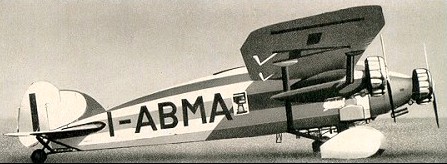
The Ca 101 appeared with various power plants as a civil transport aircraft.
Characterized by a steel tube, square section fuselage, the Ca 101 was a high-wing strut-braced cabin monoplane, underpowered, and its payload (defensive armament plus 500 kg (1102 lb) of bombs, or eight passengers in a transport role, in addition to the crew of three) was modest.
It was developed originally for use by the Regia Aeronautica’s colonial and night bomber squadrons, and entered service with the Stormi da Bombardamento before Italy’s invasion of Ethiopia, employed on both attack and supply missions. After that campaign, it was phased out of the combat units and transferred to transport and ancillary duties. Most of those produced for military use, were powered by three 240 hp Alfa Romeo D.2 9 cylinder radial engines, driving two blade metal propellers.
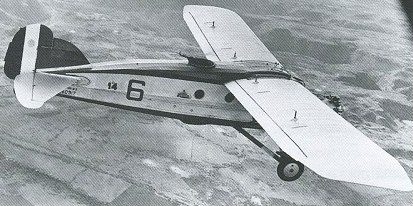
Armament consisted of a free mounted dorsal 7.7 mm (0.303 in) machine gun, with one or two similar guns mounted ventrally and, on occasion, two others firing through the side windows to protect it from beam attacks.
The Ca.101 D2 was powered by three 179kW Alfa Romeo D2 uncowled radial engines. Fitted with Handley Page leading-edge slats, the Ca.101s armament comprised four 7.7mm machine-guns firing from a retractable dorsal turret, a ventral bulge and lateral window ports. The bomb load was carried externally under the fuselage.
Overall production included 24 built by the Cantieri Aeronautici Bergamaschi, and some Ca 101s were still in service after Italy’s entry into the Second World War. These included about 20 supplied to the Hungarian air force, with which they served as transports on the Eastern Front until 1943, in spite of the relatively low payload which could be carried.
Also built in small numbers was a twin-engined derivative, the Ca 102, powered by a pair of 500 hp Bristol Jupiter radials. The Ca 102 quater was a variant of this with four engines mounted in tandem pairs. Although an experimental prototype only, it did serve operationally for a time with the 620 Sperimentali Bombardieri Pesanti (Experimental Heavy Bomber Squadron).
A few civil Ca.101s were flown on colonial passenger routes for several years (with various Walter, Piaggio and Alfa Romeo engines of 149-313kW).
Ca.101 D2
Engines: 3 x Piaggio “Stella VII”, 275kW
Max Take-off weight: 5135 kg / 11321 lb
Empty weight: 3435 kg / 7573 lb
Wingspan: 19.7 m / 64 ft 8 in
Length: 14.4 m / 47 ft 3 in
Height: 3.9 m / 12 ft 10 in
Wing area: 61.7 sq.m / 664.13 sq ft
Max. speed: 250 km/h / 155 mph
Cruise speed: 205 km/h / 127 mph
Ceiling: 6000 m / 19700 ft
Range w/max.fuel: 1000 km / 621 miles
Crew: 3-4
Armament: 2-4 machine-guns, 500kg of bombs

Caproni Ca.100 / KN-1

The Ca 100 has a lower wing of noticeably greater span than the upper wing, and about 700 aircraft were built from 1929. The type was bought by civil as well as military operators, and was flown with an assortment of engines including the original Gipsy, 63-kW (85-hp) Fiat A.50, 67-kW (90-hp) Blackburn Cirrus Minor, 86-kW (115-hp) Isotta Fraschini Asso 808, and 108-kW (145-hp) Colombo S.63.
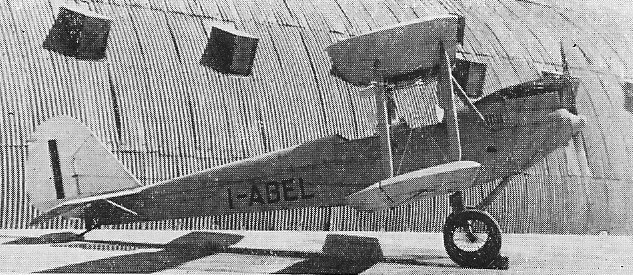
The Ca 100bis is a touring model powered by a 130 hp de Havilland Gipsy. Built by Macchi, the Ca 100 Idro was a twin-float seaplane trainer, and there was also a bomber trainer with a 97-kW (130-hp) radial engine and provision for a quartet of light bombs. The type was built under licence in Bulgaria as the KN-1, and also in Peru.
Ca 100
two-seat primary trainer.
Engine: l x de Havilland Gipsy, 63kW (85hp).
Span: 10m (32ft l0in).
Length: 7.30m (23ft 1.25in).
Max T/O weight: 680 kg (1,499 lb).
Max speed: 102mph at sea level.
Operational range: 435 miles.
Ca 100
Engine: Cirrus, 90 hp
Wingspan: 32 ft 10 in
Length: 23 ft 10 in
Height: 8 ft 11 in
Empty weight: 882 lb
Loaded weight: 1587 lb
Max speed: 102 mph
Cruise: 87 mph
Ceiling: 14,763 ft
Range: 435 mi
Caproni
One of the companies form¬ing part of the industrial empire founded by Count Gianni Caproni in 1908 was Caproni Vizzola, originally an important pilot training school, but from 1934 a design and construc¬tion organization as well.
Company’s founder, Count Gianni Caproni di Taliedo, built and flew his first aircraft in May 1910. Count Gianni Caproni di Taliedo designed his first heavy bomber in 1913. Caproni’s big biplane bombers had a demoralizing effect on ground troops during the Austro-Italian conflict, more by virtue of their size and threatening ap¬pearance than their destructive power, and led to a series of immense triplane bombers during World War I. The first was de¬signed in mid-1915 and was designated Caproni Ca. 40. A later development, the Ca.42.
At one time, largest aircraft manufacturer, the Caproni group comprised more than 20 companies, of which the principal aircraft building members were Aeroplani Caproni Trento, Caproni Aeronautica Bergamasca, Caproni Vizzola SpA, Compagnia Nazionale Aeronautica, Aeronautica Predappio SpA, and Officine Meccaniche Reggiane SpA. The Isotta-Fraschini aero- engine company was also part of the group.
The most prolific company in the group was the Compagnia Aeronautica Bergamasca, which began aircraft design in 1927, joining the Caproni group in the ‘thirties. The chief designer was Cesare Pallavicino, formerly chief designer to Ernesto Breda, and initially the original designs produced by Bergamasca were given Caproni-Bergamaschi designations, but later “Berga- maschi” was dropped and aircraft emanating from the Bergamo works could only be identified by their type numbers, which were in the 300 series.
After formation of Regia Aeronautica in associating with various partners until First World War. 1923 Caproni achieved success with such military aircraft as the Ca 1 -Ca 5 series of large tri-motor biplane and triplane bombers
During the 1920s, a retrospective series of manu¬facturer’s designations was applied to war¬time Caproni designs, in an endeavour to clarify different variants. Under this system the prototype Ca.1 was designated Ca 31 and the Fiat engined Ca 1 was allocated Ca 32; to avoid confusion between the two systems.
Achieved an international reputation with the Ca 36, Ca 73 and Ca 74. The following decade produced the Ca 101, Ca 111, and Ca 133 range of aircraft and a series of multipurpose reconnaissance/light bomber/transport types, production of which was shared with the Bergamasca subsidiary.
Early post-war publicity gained by Ca 60, an enormous eight-engined ‘triple-triplane’ of 1921, intended to carry 100 passengers, which was shared with the Bergamasca subsidiary.
Cantieri Aeronautici Bergamaschi had been absorbed by Caproni in 1931. Initially built Ca 100 and Ca 101, then built the new aircraft to the designs of Ing Cesare Pallavicino.
In the mid ‘thirties Caproni-Vizzola activities were expanded and a fully-equipped factory built. The plant was primarily engaged on sub-contract work building the Breda Ba 65 attack aircraft, but in 1938 its first original designs, the F.4 and F.5 single-seat fighters appeared, powered respectively by the 1,025-h.p. Isotta-Fraschini Asso 121 R.C.40 and the 840-h.p. Fiat A.74 R.C.38 radial. Designed by Ing. Fabrizi, a pre-production batch of fourteen of the radial-engined F.5 fighter was built immediately prior to Italy’s entry into the war, but like most of Italy’s fighters of this period the F.5 was under-powered (maximum speed being 326 mph) and under-armed (two 12.7-mm. guns). Nevertheless, a squadron was equipped with the F.5 for a short period and employed for the night defense of the area surrounding Rome.
One of the fourteen F.5 fighters was re-engined in 1941 with a 1,050-h.p. DB 601 engine. This conversion was designated F.6, but the most interesting development was the F.6Mz powered by the 1,250-h.p. Isotta-Fraschini Zeta engine (which was also to have been installed in the Reggiane Re 2004). The F.6Mz flew for the first time late in 1942 and was to have carried an armament of four 12.7-mm. guns or two 12.7-mm. and two 20-mm. guns. Maximum speed was 404 mph, but the Zeta engine was insufficiently developed for operational service, and the F.6Mz progressed no further than the prototype stage.
Major production types during 1934-1944 were A.P.1 single-seat fighter, followed by the family of multi-purpose twin-engined aircraft: Ca 309 Ghibli; Ca310/310 bis Libeccio; Ca 311 Libeccio; Ca 312 bis Libeccio; Ca 314, and 316.
More than 2,500 examples of the Ca 100 training/touring biplane were built during the 1930s; the Ca 161 bis, a single-seat single-engined biplane, set an international altitude record of 17,083m that remains unbeaten today in its class. The Caproni-Campini CC-1 of 1940 was Italy’s first and the world’s second aircraft to fly by jet propulsion, though it was not powered by a turbine. During the Second World War the company was chiefly concerned with the production and development of the Ca 310-Ca 314 multipurpose twin-engined aircraft and with the Reggiane Re. 2000-Re 2005 series of single- seat fighters. During the lifetime of the group some 180 different types were built, in addition to licensed construction of almost as many by other designers.
The parent company went bankrupt in 1950. Aeroplani Caproni Trento survived the bankruptcy and in May 1952 flew Italy’s first postwar jet light aircraft, the F.5, designed by Dott Ing Stelio Frati.
In 1969, Caproni – Vizzola began producing in his workshops 30,000 m² located near the airport of Milan – Malpenza.
Caproni Vizzola Costruzioni Aeronautiche SpA was formerly the Scuola Aviazione Caproni, the oldest flying school in Italy, and became the last surviving part of the company until bought by Agusta in 1983, producing the Calif series of sailplanes and finally the C22J Ventura two-seat very light basic trainer with two Microturbo turbojet engines, first flown 1980. Earlier it remodeled the Ca 133 for ambulance and military transport duties and assisted in production of the Breda Ba 65. Its first original design had been the F.4 single-seat fighter designed by Ing F Fabrizi, flown in 1940. Prototype F.6 had more powerful engine.
Cant Z.1018 Leone
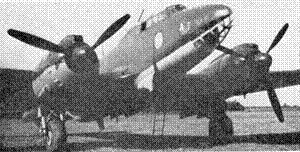
Concurrently with development of the production models of the Alcione, Zappata was engaged on the development of the twin- engined Z.1018, the first of several prototypes of which flew in 1939.
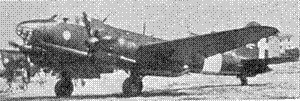
The Z.1018 broke away from previous C.R.D.A. practice in featuring metal construction, although one of two Piaggio P.VII- powered prototypes tested an alternative wooden fuselage. Several types of engines were installed in the prototypes, one having Piaggio P.XV radials, another having Alfa Romeo 135 R.C.32 radials, and yet another having Daimler-Benz DB 605 engines. Some prototypes had twin fin and rudder assemblies, but a single unit was adopted far the production model which, powered by 1,400-h.p. Atfa Romeo 135 R.C.32 radials, began to appear in service in 1943 but was too late to participate extensively in the air war prior to ltaly’s collapse.
Cant Z.1007 Alcione
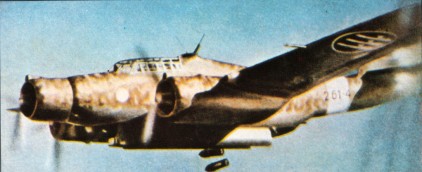
The Alcione (Kingfisher) was an Italian bomber of the Second World War, designed by the CRDA Cant, it was the company’s first landplane, and stemmed directly from the Z.506 Airone. The pro¬totype, flown in late 1937, had three Asso liquid cooled engines in annular cowls, but all production machines had radials, usually the 1000 hp Piaggio P.XIbis RC40.

Of all wooden construction, the Alcione had a long bomb bay under the wing able to carry up to 2000 (4410 lb). There were manual gun positions at front and rear of this bay (often the front position was used solely for bomb aiming) and most Alciones had a dorsal turret and two beam guns. The guns were at first all 7.7 mm, but by 1940 the dorsal and ventral guns were 12.7 mm. When Italy entered the war in 1940 there were 87 in service, and the type was being built by Cant, Piaggio and IMAM Meridionali. In 1941 the Z.1007bis appeared, with the fuselage 244 cm (96 in) longer, span 83 cm (33 in) greater and stronger landing gear. Many of these had twin fins.
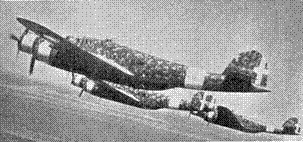
The Alcione operated from Tunisia to the Soviet Union, often carrying two 450 mm (1000 lb) torpedoes or in the strategic recon¬naissance role. A few Z.1007ter, with 1175 hp Piaggio P.XIX engines, entered service in 1942. Cant tried to improve performance by fitting the 1500 hp Piaggio P.XIX engine, and at the very end of Italian participation in the war produced the Z.1018 Leone (Lion).
CANT Z.1007bis Alcione (Kingfisher)
Engines: 3 x Piaggio P.XI RC.40 radial piston, 1,000 horsepower
Length: 60.20ft (18.35m)
Wing span: 81.36ft (24.80m)
Wing area: 807.300 sqft / 75.0 sqm
Wing load: 37.31 lb/sq.ft / 182.00 kg/sq.m
Height: 17.13ft (5.22m)
Maximum Speed: 301mph (485kmh; 262kts)
Maximum Range: 1,115miles (1,795km)
Range (max. weight): 945 nm / 1750 km
Service Ceiling: 24,606ft (7,500m; 4.7miles)
Armament: 3 x 12.7mm Scotti OR SAFAT heavy machine gun, 2 x 7.7mm SAFAT machine guns
Up to 2,645lbs of internal stores and up to 2,200lbs of external stores OR 2 x 1,800lb torpedoes.
Accommodation: 5
Hardpoints: 2
Empty Weight: 20,715lbs (9,396kg)
Maximum Take-Off Weight: 30,029lbs (13,621kg)
Cant Z.511

During the war years the C.R.D.A. completed two prototypes of the Z.511 commercial transport floatplane designed by Zappata before the war and intended far use on Alitalia’s South Atlantic route as the world’s largest floatplane. Construction of the Z.511 commenced in 1941 and the first prototype flew on 8th September 1943. The first prototype was destroyed when it struck a mine, and the second, commandeered by the Luftwaffe, was destroyed in Germany. The Z.511 was powered by four 1,500-h.p. Piaggio P.XII R.C.35 radials and had a loaded weight of 74,957 lb.
CANSA C.4
The Costruzioni Aeronautiche Novaresi S.A. at Cameri, a subsidiary of the Fiat Group, was primarily responsible for a series of trainers, such as the C.4 training monoplane of 1942.
CANSA F.C.20
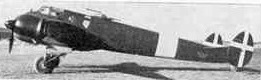
In 1941 C.A.N.S.A. produced the F.C.20 reconnaissance bomber powered by two 840-h.p. Fiat A.74 R.C.38 radials, and the F.C.20bis, which was intended for ground attack and carried a 37-mm. cannon in the nose. The final development of the design was the F.C.20quater of 1943, which was similar to its predecessor apart from the engines, which were two 1,150-h.p. Daimler-Benz DB 6O1s. These increased maximum speed from 261 m.p.h. to 311 m.p.h.
 All Aero