A 1944 2-seat tandem, 14.1 m span, experimental glider, 2 built
CM Jalon: n° 1 first flown Nov 1944, n° 2 first flown 22 Sept1945
Also known as CM-ONERA Jalon (n° 2 based at ONERA, Brétigny from 1947)
A 1944 2-seat tandem, 14.1 m span, experimental glider, 2 built
CM Jalon: n° 1 first flown Nov 1944, n° 2 first flown 22 Sept1945
Also known as CM-ONERA Jalon (n° 2 based at ONERA, Brétigny from 1947)
Pierre Mauboussin joined forces with glider designer Robert Castello in 1942, their designs being known under the Castel-Mauboussin name and assigned CM designations. Fouga had been producing designs by Mauboussin since 1936 and, in 1944, made Mauboussin their Director of Aviation Services working alongside Robert Castello.
Fouga retained the CM designation sequence (which was distinct from their earlier Castel C- numbers). In May 1958, Fouga was bought by Potez which also retained CM designations for Castello-Mauboussin designs and their derivatives.
Construcciones Aeronauticas SA formed 3 March 1923, with a factory at Getafe, to produce all-metal aircraft for the Spanish Air Force. Began by license-building Breguet XIX reconnaissance-bomber biplanes, followed by other aircraft of foreign design including Dornier Wai flying-boats (at Cadiz), Vickers Vildebeest torpedo-bombers, Gotha Go 145C biplane trainers, Junkers Ju 52/3m transports, Bucker Bu 131, and 133 aerobatic trainers and Heinkel He 111 medium bombers. Opened a design department after the Second World War; first series product was Dornier Do 27 general-purpose lightplane, followed by CASA-201 Alcotan, CASA-202 Halcon and CASA-207 Alcotan twin-engined transports of own design. Completed 70 Northrop F-5 fighters under license for Spanish Air Force. In 1972 took over Hispano Aviacion, followed by the ENMASA aero- engine concern in June 1973. Currently has three divisions, namely Aircraft, Maintenance, and Space: Aircraft division activities include design of aircraft and integrated structures; share in international Airbus, Eurofighter, and FLA programs; manufacture of structural parts and components for Boeing, Eurocopter, Northrop Grumman, and Saab aircraft; continuing development and production of C-101 Aviojet advanced and lead-in jet trainer/light attack aircraft (first flown June 1977), C-212 Aviocar (first flown March, and currently offered in Series 400 form as first flown April 1997) in transport and maritime versions, and development of the new ATX family of advanced trainers and light combat aircraft; and production of CN 235 via international Airtech company.
The O-155 engine built by Victor J Caron in 1941 was a 75hp 153.9ci horizontally opposed four-cylinder air-cooled aero engine.
Haverhill MA.
USA
Built an O-155 aero engine in 1941.
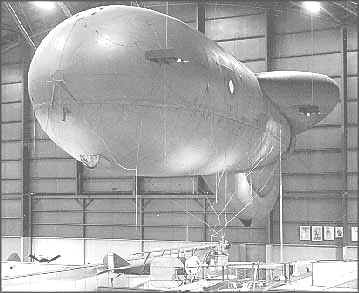
At the start of World War I observation balloons, the use of which was discontinued in France in 1912, were needed on the battlefield, and the Germans used them in large quantities called Drachen. The French who did not have any in their boxes therefore began to copy these German balloons.
While he was mobilized on 1st August 1914 to command the 21th company of balloonists, Albert Caquot performed some aerial observations in a spherical ball type from 1880, then found that the information given by the observers are not reliable due to the instability of the aerostats which makes them sick even in light winds. He then designed a new balloon stabilized by three inflatable rear lobes arranged at 120°. He then sent his plans and calculations to the Atelier de Chalais-Meudon in October 1914 and was received by the director of the establishment in November; but he is not convinced by his idea. Despite everything, he decides to entrust the realization of Caquot’s plans to a team of designers from his design office, they are carried out in a week. In the meantime General Hirschauer, who is in charge of aviation at the Ministry of War, orders that a test be carried out. Caquot then obtained authorization to build a prototype, which was done in February 1915.
The Caquot type L balloon is then compared to a spherical balloon and a copy of Drachen. It immediately proves to be more efficient, its hull offering minimum resistance to the wind. It managed to withstand winds of 90 km / h against only 54 km / h and 36 km / h for the Drachen and the spherical balloon. Its performance is due to the ovoid shape of the balloon which allows less aerodynamic resistance, and above all to its three inflatable tail units at the rear but based on an internal structure fixing them rigidly to the hull at an angle of 120°. This makes it possible to avoid the pendulum movement of the balloon during gusts of wind, which made observers sick.
Despite these conclusive tests, series production is not launched. However, an English naval officer, who attended the prototype tests, told Caquot that the British navy was trying to equip its fleet with captive balloons, but that they could not withstand bad weather. He then asks her to help them. By examining the constraints, Caquot realizes that the aerostats must resist winds of 125 km / h since in addition to the wind is added the speed of the ship. He then designed a specific braked winch that allowed the balloon to be carried away by too strong gusts and then return once the gust was over.
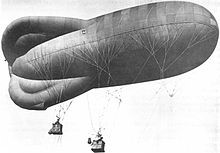
This ability proved itself in an account of a “free balloon” flight taken by Capt. F. H. Cleaver, commanding officer of the RFC’s No. 1 Kite Balloon Section on October 27, 1915:
The speed and direction of the wind was tested and found to be 15 m.p.h. by the air meter. The balloon was then let up and marched for 300 yards to the winch; it was easily controlled by the balloon party. The winch was shackled on and I and Lieut. Beaufort ascended; the wind appeared to be increasing, the speed was again taken from the balloon and found to be 30 m.p.h. The guy of the right sail carried away, which caused the balloon to oscillate considerably, thus increasing the strain on the cable and rigging. On this an order was immediately given to haul down. The winch, whose power is only 6 horse failed; the wind was rapidly increasing in strength and on again being tested the speed was found to be 40 m.p.h. Fortunately for the occupants of the balloon the cable then parted, had it not done so the rigging most certainly would have gone. The valve rope was immediately pulled and as soon as the end of the cable or any part of it touched the ground, the balloon in spite of the loss of gas naturally was lightened owing to being relieved of the weight of a portion of the cable, and ceased to descend and at times rose; this coupled with the heat of the sun causing the gas to expand and the balloon to become still lighter, was responsible for what might appear to be a long flight, which owing to the speed of the wind was carried out at 40 m.p.h. A perfect landing was effected in 45 minutes without any damage to the balloon, occupants and instruments.
These qualities quickly proved the Caquot to be the best balloon design on the Western Front and all the combatant nations eventually adopted it.
In June 1915, Albert Caquot became director of the mechanical aerostation workshop at Chalais-Meudon, where he had new aerostats built in large series according to his plans. On July 10, 1916, the British Aviation Inspector requested M type balloons from the War Department. Between July and the end of November 1916, 46 M type balloons were built in Chalais-Meudon for the British, subsequently ‘others are built in the UK. Three types of balloons with a capacity of 750 cu.m, 820 cu.m and 1000 cu.m. The first equip small ships used for the research of submarines, they are served by two men from an altitude of 500 m; the larger ones are used aboard squadron ships for the adjustment of fire and are served by a crew of three observers at 500 m altitude or two at 1000 m. This use of Caquot balloons allows the British Navy to reduce its losses. In 1917, the French navy, noting that its losses due to torpedoing were becoming higher than those of the British, then decided to adopt the Caquot balloons as well. The French Navy uses types P and P2 on its smaller units for protection against U-boat attacks, and the Type R to direct the fire of its larger ships. In July 1918, it had nearly 200 balloons and 24 units designed to work with them.
The French Army, for its part, trained 76 units during the war equipped with Caquot balloons. These balloons are used for artillery tuning and general observation of the battlefield.
In 1917, when the Germans began to bombard Paris with aircraft, Albert Caquot proposed to make barrages with low volume balloons, the cables of which would force the bombers to climb higher and reduce their load. This idea is taken up by the British in September 1917. At the end of the war, there are Caquot type of balloons, mainly with M 900 cu.m and R 1000 cu.m.
The Caquot balloon entered service in other Allied armies and then in others including the new Polish army.
In France, the production of balloons was 319 units per month in 1919. The first models are of type L and M, and finally the Caquot balloons are produced in four different formats:
P – 750 m³ (capacity – two observers at the height of 500 m)
P2 – 820 m³
M2 – 930 m³
R – 1000 m³ (capacity – two observers at the height of 1000 m or three at 500 m)
During the war, one of the British Caquot balloons fell into the hands of the Germans who made a copy called Ae 800 for Achthundert english 800 which was a reference to the cubic meter capacity.
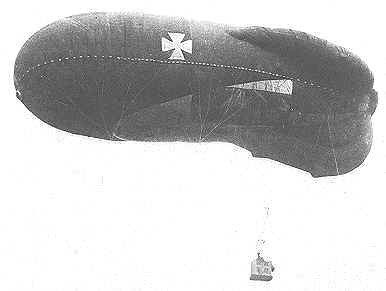
General Ernst von Hoeppner, commander of the German Luftstreitkräfte freely admitted that German balloons put in service after 1916 were patterned after a captured British example. Caquots and their German copies eventually served on all fronts and with naval forces operating in the Atlantic and Mediterranean. The improved Caquot could ride higher, and fly in higher winds than the Parseval-Sigsfeld, so it quickly replaced the Drachen, even among the Luftschiffertruppen.
During the war, France was from 1915 the leading power in the field of ballooning and built nearly 4,200 captive balloons: 1,700 observation balloons and 2,500 barrage balloons.
The Caquot balloon was manufactured in large numbers, including a thousand in the United States between 1918 and 1919.
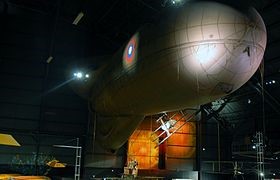
The United Kingdom built others during World War II where they were used until the 1960s to test parachutes, for non-combat aerial observation and photography.
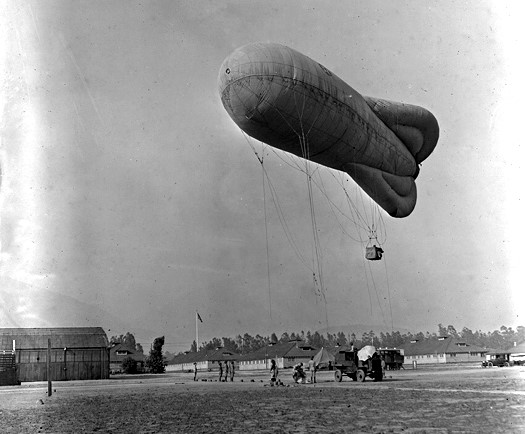
P
Capacity: 50 m³
Payload: two observers
Altitude: 500 m
P2
Capacity: 820 m³
M2
Capacity: 930 m³
R
Capacity: 1000 m³ / 32,200 cu.ft
Payload: two observers to 1000 m / three observers to 500 m
Length: 92 ft
Diameter: 32 ft
Cruising speed: 75 km / h
Max wind speed: 70 mph
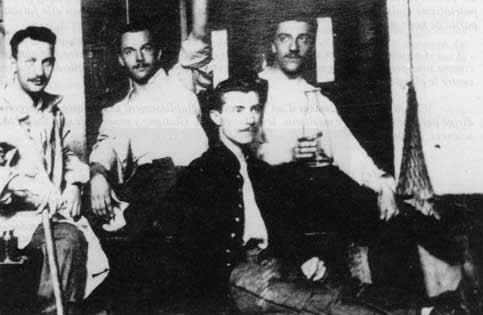
Albert Irénée Caquot, born on 1st July 1881 in Vouziers (Ardennes) and died on November 28, 1976 in Paris at 95, was considered “the greatest of living French engineers” for half a century.
Albert Caquot Article
Large landowners, his parents, Paul Auguste Ondrine Caquot and Marie Irma Cousinard 2 , wife Caquot, “run a large family farm, adjoining a mill on the banks of the Aisne”, in Vouziers in the Ardennes. His father opened this farm to modernism, installing electricity and telephones in his home in 1890.
Just one year after leaving the high school Reims, eighteen years, Albert Caquot received 29 e the entrance exam to the Ecole Polytechnique (class of 1899) which he graduated ranked 15th, and enters the body of bridges and roads.
From 1905 to 1912, he was a bridge and road engineer in Aube, in Troyes, and stood out for the important sanitation measures he developed. These saved many human lives and protected the city from the great flooding of the Seine in 1910.
In 1912, he joined the reinforced concrete design office of Armand Consideration as a partner, where he gave free rein to his talent as a designer of civil engineering structures. In 1914, after the death of Armand Considere, the office became “Pelnard-Considerere & Caquot”. It was in this same context that he worked from 1919 to 1928, from 1934 to 1938, then from 1940.
During his life, Albert Caquot taught for a long time the resistance of materials at the Ecole Nationale Superieure des Mines in Paris, the Ecole Nationale des Bridges et Chaussées and the Ecole Nationale Supérieure de l’Aéronautique.
During his career he produced more than three hundred civil engineering works of all kinds, several of which were then world records.
Two achievements contribute to its international reputation:
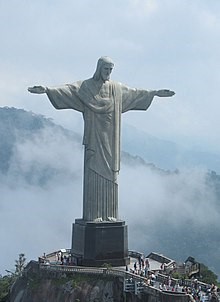
The internal reinforced concrete structure of the large statue of Christ the Redeemer on Mount Corcovado (1931, height 30 m and weight 1,145 t), in Rio de Janeiro, the work of French sculptor Paul Landowski and, for the head of Christ, by Romanian sculptor Gheorghe Leonida.
The George V Bridge in Glasgow (Scotland) on the Clyde for which Scottish engineers are asking for help.
He devoted his life to aeronautics and civil engineering in alternating periods at the pace imposed by the First and Second World Wars. Albert Caquot’s contributions to aeronautics are invaluable, from the development of the propeller engine and the opening up of the Air Ministry to technical innovations, to the founding of the first institutes of fluid mechanics. Marcel Dassault, who was commissioned by Albert Caquot to build a prototype of the postal three-engine program, wrote of him: “He is one of the best technicians that aviation has ever known. He was a visionary who, in all areas, looked to the future. He was ahead of everyone.”
From 1901 he carried out his military service in a battalion of balloonists. At the start of the Great War, he found a battalion of balloonists from Toul as captain. For a wind speed greater than 22 km/h, it highlights the great instability of the spherical balloon with which the units are equipped. In 1915, he produced a tapered tethered balloon model equipped with rear stabilizers on the Drachen principle developed by the German August von Parseval, allowing observation by winds of 90 km/h. The Chalais-Meudon aerostatic workshop then began to manufacture “Caquot balloons” for all the Allied armies. The winch with constant braking torque that it creates allows it to adapt its balloons to the Allied fleets (fire control and detection of submarines) and to make them withstand winds of up to 125 km/h. Also called a “sausage”, this captive balloon gives France and its Allies a major strategic advantage. In January 1918, Clemenceau appointed him technical director of military aviation.
In 1919, Albert Caquot was behind the creation of the French Air Museum, today the Air and Space Museum at Le Bourget. It is the oldest aeronautical museum in the world.
In 1935, he built a double canopy hangar 120 m long, 60 m wide by 9 m free height and its annexes for around 10,000 m2 at Fréjus on the naval air base.
In 1928, he became the technical director general of the newly created Air Ministry. It practices a policy of research, prototypes and mass production which gives France back the industry it deserves.
In 1934 he preferred to retire and devote himself again to civil engineering. In 1938, under the threat of war, Albert Caquot was recalled to assume the joint presidency of all the national aeronautical companies. In July 1939, he also took over the role of technical director general of the Air Ministry but, although he had spectacularly turned around the production of aircraft, the obstacles he encountered on the part of the staff and the management of the control led him to submit his resignation in 1940.
Numerous honorary distinctions from all countries that have been awarded to him, including the dignity of Grand Cross of the Legion of Honour in 1951.
He chaired many French scientific organizations for more than twenty years, such as the National Council of French Engineers and the Société d’Enouragement pour l’Industrie Nationale. He was also a director of Electricité de France for more than ten years.
He served 41 years in the Academy of Sciences and was its president in 1952.
In 1961, at the age of eighty, Albert Caquot voluntarily resigned from all the presidencies that he had always provided on a voluntary basis.
His name was given to an amphitheatre of the School of Bridges and Roads located in no 28 of the rue des Saints-Peres in Paris May 25, 1977. The new occupant of the premises, the Institut d’études politiques de Paris, renamed it in honour of Simone Veil on March 8, 2018.
The July 2, 2001, a stamp of CHF 4.50 and 0.69 € is issued for the 120th anniversary of the birth and the 25th anniversary of the death of Albert Caquot. Designed and engraved by Claude Andréotto, the stamp is printed in intaglio on sheets of forty and is distributed in 4.37 million copies.
Since 1989, the Albert-Caquot Prize has been awarded each year by the French Association of Civil Engineering (AFGC) to an engineer.
The 7th promotion of the National School of Engineers Military Infrastructure (ENSIM) was christened Albert Caquot to honour his contribution to the military works.
Distinctions:
Distinguished Service Order
Officer of the Order of the Crown of Italy
Commander of the Order of Leopold
Grand Officer of the Order of the Crown of Romania
Order of the White Eagle
Order of the Rising Sun
Order of Saint Michael and Saint -Georges
Croix de guerre 1914-1918
Distinguished Service Medal
Honorary fellow American Institute of Aeronautics and Astronautics (1937)
Grand Cross of the Legion of Honour (1951)
Wilhelm Exner Medal (1962)
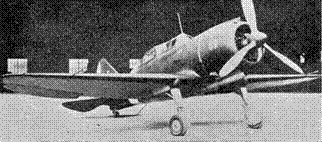
The experimental two seat Re.2003.
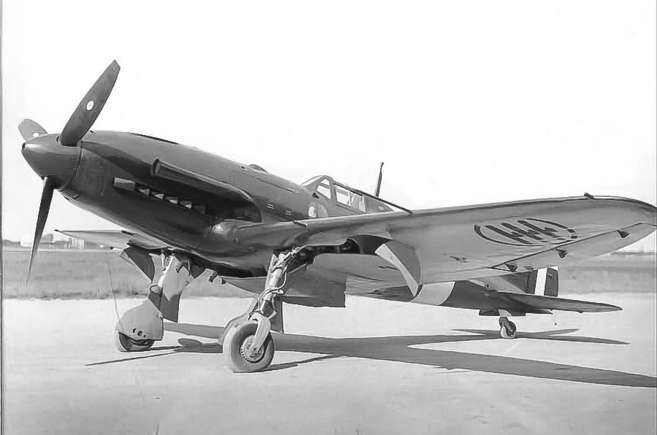
Following the Reggiane Re 2000, in 1941 there appeared the Re.2001 Falco II with a 783-kW (1,050-hp) Daimler-Benz DB 601A-1 inline, redesigned canopy and revised wing. After two prototypes had been completed in 1940 with German built DB 601A 1s, the fighter was ordered into production as the Re 2001 Falco II.
Caproni-Reggiane Re.2001 Article
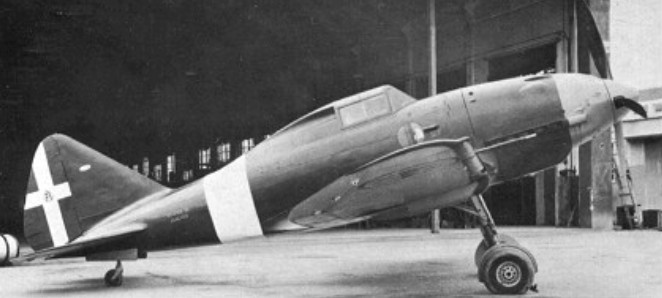
A total of 236 were built (including prototypes and 10 pre¬production aircraft), in various sub series, major versions being the Serie I (100 built), with two 12.7 mm (0.5in) Breda SAFAT machine guns over the engine; the Re2001CN (Caccia Notturna: night fighter) Serie II and III with an additional 7.7 mm (0.303 in) gun in each wing or two German 20 mm (0.79 in) MG 151 cannon in underwing fairings; and the Re 2001CN Serie IV, which could carry an under fuselage 640 kg (1410 lb) bomb or a drop tank.
Various experimental models of the Re2001 included a torpedo carrying fighter conversion (Re 2001G); an antitank conversion (Re 2001M; a prototype conversion with flush mounted leading edge wing radiators (Re 2001bis); two Serie Is converted for catapult launching trials; and a testbed for the Isotta Fraschini Delta RC 16148 engine.
The one prototype with the 840 hp Isotta-Fraechini Delta IV engine was test flown at Guidonia and the maximum speed attained was 320 mph at 14,760 ft and 252 mph at SL. During one test flight the engine overheated at 28,250 ft and the test pilot was forced to leave the aircraft when it burst into flames.
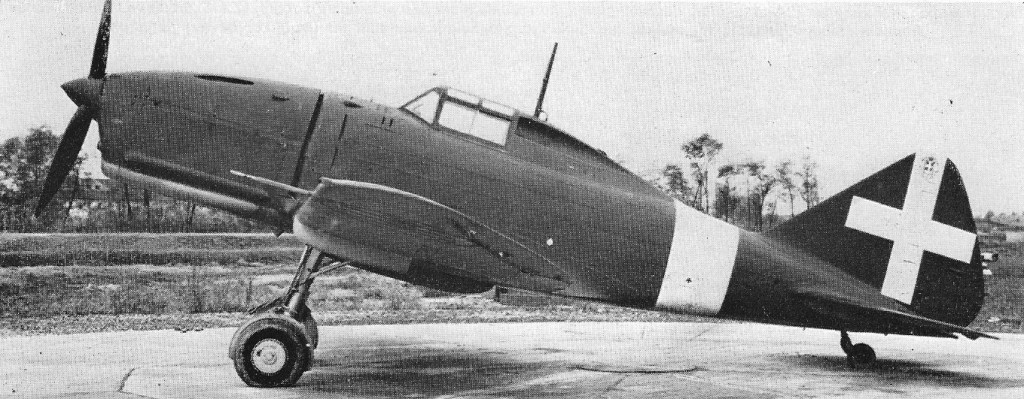
Production Serie I Re 2001s made their operational debut in attacks on Malta in the early summer of 1942, with subsequent production models following them into service later that year. Thirty nine Serie I aircraft were adapted as Re 2001CBs, able to carry a 640 kg (1410 lb) bomb or torpedo, and a further 12 as land based carrier trainers, fit¬ted with arrester gear. The most widely used version of all was the Re 2001CN (50 Serie II and 74 Serie III/IV), which from 1943 served with five Gruppi of the Regia Aeronautica as a defensive night fighter in central and northern Italy. But, by the armistice only 21 Falco IIs remained serviceable, of which eight were used subsequently by the Italian co belligerent air force.
The type was used in a large development programme with other engines, and the total of 237 aircraft included 224 production aircraft in two fighter, one fighter-bomber and one night-fighter series. There followed 227 Re.2002 Ariete (ram) fighter-bombers with the 880-kW (1,180-hp) Piaggio P.XIX RC 45 radial, and finally 37 Re.2005 Sagittario (Archer) fighters.
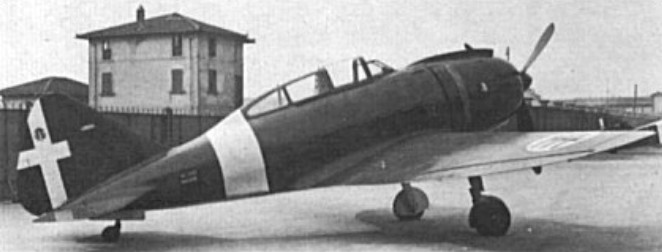
The Re.2002 Ariete (Ram) fighter-bombers with the Regia Aeronautica, these being powered by the 876kW Piaggio P.XIX RC 45 radial engine mounted in a slightly lengthened and strengthened fuselage. The type first saw operational service in 1942, suffering heavy losses while contesting the Allied landings on Sicily.
Caprione-Reggiane Re.2002 Article
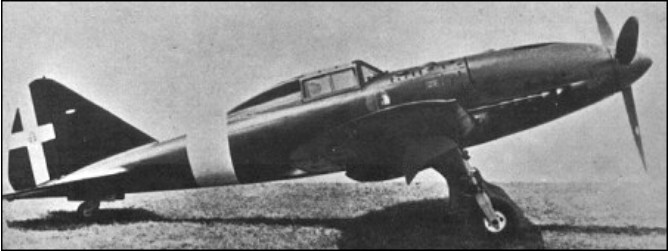
The Re.2005 Sagittario (Archer) had the same general configuration as its predecessors. However, its design incorporated considerable structural redesign, and refined landing gear, and the type reverted to the inline engine. First flown in September 1942 with a Daimler-Benz DB 605A-1, the Re.2005 led to a production model, of which deliveries began in 1943, with a licence-built version of this engine, the Fiat RA.1050 RC 58 Tifone. Only 48 had been delivered before finalisation of the armistice with the Allies, these aircraft fighting in the defence of Naples, Rome and Sicily, the survivors battling above Berlin.
Replica:
Tessore Regianne 2002
Re.2001 Falco II Prototype
783-kW (1,050-hp) Daimler-Benz DB 601A-1 inline
two built
Re.2001
Engine: Isotta-Fraechini Delta IV, 840 hp
Max speed: 320 mph at 14,760 ft
Max speed: 252 mph at SL
Re.2001 Falco II
Engine 1 x Daimler-Benz DB 601A-1 / Alfa Romeo RA. 1000 RC.41-1a Monsonie, 783-kW (1,050-hp).
Crew: 1
Re 2001 Falco II Serie III
Span: 11 m (36ft 1.75in).
Length: 8.36 m (27 ft 5.25in).
Gross weight. 3280 kg (7230 lb).
Max speed: 542 kph (337 mph).
Re.2002 Ariete
Engine 1 x Piaggio P.XIX RC 45 radial, 880-kW (1,180-hp)
Crew: 1
227 built
Re.2005 Sagittario
Single-seat fighter and fighter-bomber.
Engine: l x Fiat RA.1050 RC 58 Tifone, 1100kW (1,475hp).
Span: 11m (36ft 1 in).
Wing area : 219.586 sq.ft / 20.4 sq.m
Length: 8.73m (28 ft 7.75 in).
Height: 10.335 ft / 3.15 m
Weight empty : 5733.0 lb / 2600.0 kg
Normal TO weight: 3610 kg (7,960 lb).
Max take off weight : 7849.8 lb / 3560.0 kg
Max speed: 421 mph at 6,560 ft.
Service ceiling: 39993 ft / 12190 m
Wing load: 35.88 lb/sq.ft / 175.0 kg/sq.m
Operational range: 777 miles.
Armament: 3 x 20-mm cannon and 2 x 12.7-mm (0.5-in) mg, 1000 kg (2,205 Ib) bombs
Crew: 1
37 built
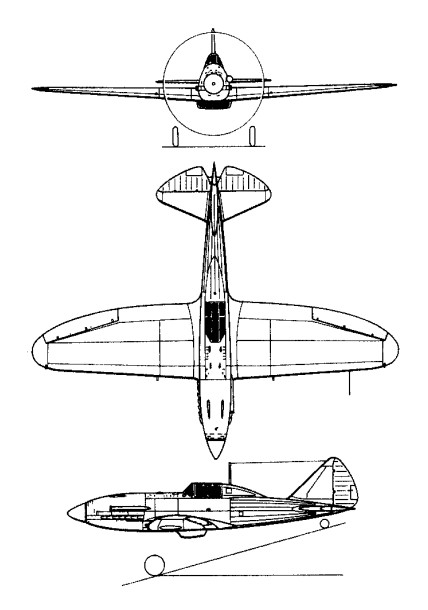
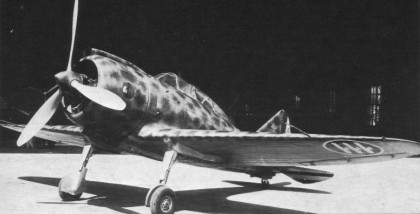
Designed by Roberto Longhi and Antonio Alessio in 1938, The Re 2000 Falco I (Falcon) was buily by Reggiane SA, a subsidiary of the Caproni group. The Re.2000 was the first aircraft designed by Reggiane that employed aluminum stressed skin rather than wooden or mixed wood and metal, with semi elliptical wings, with five spars and integral fuel tanks, and a tubby fuselage, the design was powered a 986 hp Piaggio P.XI RC 40 two row 14 cylinder radial in the Serie I production model. Reggiane Re.2000 had no fuselage tanks, but with the entire wing volume devoted to fuel, it had up to 460 kg (640 lt) gasoline, with a 900 1,100 km endurance. The armament was two 12.7 mm Breda’s (300 rounds each), plus the provision for bomblet-dispensers (spezzoniera).
Caproni-Reggiane Re.2000 Falco I Article
The Re.2000 prototype’s first flight was on 24 May 1939 at Reggio Emilia, flown by Mario De Bernardi,. The Re.2000, with 260 kg fuel (the maximum was 460 kg/640 lt) was quite light: 2,059 kg empty, 2,529 kg loaded. It reached 518 km/h at 5,250 m and 506 km/h/6,000 m, climbed to 6,000 m in 6,5 min, and had 11,500 m ceiling. During test flights the aircraft gave an excellent performance, and on several occasions, it performed better than other fighters then in production. In mock dogfights, it could successfully fight not only the slower Fiat CR.42 biplane, but even the more modern Macchi C.200 and the German Bf 109E.
In service, the Re.2000’s engine, a 986 hp (735 kW) Piaggio P.XI RC 40 radial, was not reliable. Moreover, it was not as rugged as the Macchi and its fuel tanks were vulnerable (they were not self-sealing). Consequently, the Regia Aeronautica rejected it.
The Falco was placed in production for export as the Re.2000 Serie 1 with minor modifications. Deliveries totalled 157 aircraft including 70 for Hungary and 60 for Sweden, beginning in in 1940.
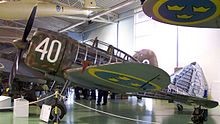
The Swedish purchases of various types of Italian warplanes in 1939–41 were an emergency measure resulting from the outbreak of war, as no other nations were willing to supply aircraft to this small neutral country whose domestic production did not become sufficient until 1943. The Swedish Air Force purchased 60 Re.2000 Serie Is, which received the Swedish designation J 20 and were delivered during 1941-43.
All of the J 20s were stationed at the F10 wing, Bulltofta airbase, Malmö, in the southern tip of Sweden in 1941-45. They were mainly used to intercept Axis and Allied bombers that violated Swedish airspace. One J 20 was lost in combat, shot down while intercepting a Luftwaffe Dornier Do 24 near Sölvesborg on 3 April 1945.
Its mechanical reliability did not meet Swedish Air Force requirements, with the aircraft having to spend a lot of time in maintenance. At the end of the war, the 37 J 20s that remained in service were so badly worn out that they were decommissioned in July 1945 and subsequently scrapped, while only one was kept for display purposes.
In December 1939 a British commission, led by Lord Hardwick and Air Ministry representatives, came to Italy to purchase (along with marine engines, armaments and light reconnaissance bombers) 300 Re 2000s. The Director of Aircraft Contracts confirmed the British order in January 1940. The German government approved the sale in March of the same year, but withdrew its approval the following month. The Italian and British governments then decided to complete the contract through the Italian Caproni’s Portuguese subsidiary, but the British order was cancelled when Italy entered World War II on 10 June 1940.
The Italian navy later accepted 10 Falco 1 Serie II aircraft which, strengthened for catapult launching and fitted with arrester hooks, underwent shipboard trials during 1942.
The Re.2000GA (Grande Autonomia) version, added extra 340 liters fuel tanks. This version was to have been used to reach Eastern Africa, but it wasn’t ready before the Italian defeat. Re.2000GAs were heavier and significantly slower than the standard production Re.2000s. At an empty weight was 2,190 kg compared to the Re.2000’s 2,080 kg, maximum speed was 520 km/h at 5,300 m. Armament was two 12.7 mm SAFAT with 600 rounds, and provisions for a Nardi dispenser with 88 2 kg bomblets (a typical ‘special armament’ for Re.2000s). The Re.2000GA was never really reliable (even for Re.2000 standards), especially its engine.
The Re.2000bis was equipped with the P XI bis engine built with only nine examples delivered when 377a Sq. was created, in August 1941.
In addition, 12 Serie III Falcos, with a modified cockpit hood, extra fuel, and internal improvements, were assigned to the Italian air force and deployed for overseas escort duties or as fighter bombers (with an under fuselage 200 kg [440 lb] bomb) from naval bases in Sicily. The Re.2000 Serie 3 long-range fighter had additional internal fuel and provision for an auxiliary tank or 2000-kg (4,405-lb) bomb load (12 Serie 1 conversions).
Only five Serie Is served in the Regia Aeronautica, including the prototype. They were organized into the Sezione Sperimentale Reggiane inside the 74a Squadriglia in Sicily. Later it was renamed 377a Squadriglia Autonoma Caccia Terrestre, and received nine further Serie III Re.2000bis; 12 of the 26 Reggianes were later converted to GA standard.
The few Re.2000 and 2000GA were used over Mediterranean Sea as escort and attack aircraft, sometimes with Macchi 200/202s and C.R.20 two-engine fighters. 377a was based in Sicily, and fought in Malta and Pantelleria, mainly in an escort role and protecting Axis ships almost until Tunisia (with a range up to 300–350 km), well beyond the other RA single seat-fighters; sometimes it was used to attack Malta with bomblets (spezzoni) and machine guns, typically at dawn. It reported a single ‘kill’ against a Bristol Blenheim. Overall, their service was not remarkable: there was at least one sudden fatal flat spin, while another Re.2000 had fatal engine damage (a piston was driven through the cylinder) and crash-landed, overturning, catching fire and almost killing its pilot (rescued by the ground crew). Although the Reggiane had a long range, it was disliked and even feared by ground crew and pilots, for its difficult maintenance and unpredictable engine reliability and handling. The last Re.2000 was sent back to the factory in September 1942.
The final fate of Re.2000 in Regia Aeronautica was to serve with 1° Nucleo Addestramento Intercettori (N.A.I.), based at Treviso, and serving for experimental purposes until the Armistice. The last two serviceable aircraft were demolished by the Germans, with another one destroyed after being captured at Furbara.
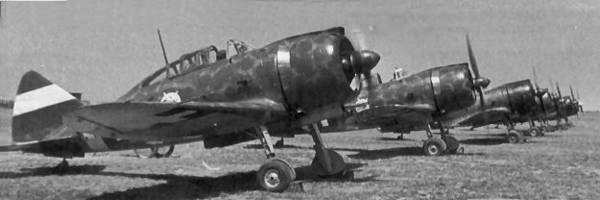
The Regia Marina (Italian Navy) experimented with a carrier version (Serie II) which was successfully launched by catapult. Lacking a carrier, Italy used a similar system to the British CAM ships equipped with Hurricanes. The first proposal was made in late December 1940, although the program officially began with an order issued in April 1943. The first modified Re.2000 Cat. (taken from the Swedish orders) flew on 27 June 1941, the last on 18 January 1942 (MM.8282-8288), but crashed on 10 September. There was another navalized Re.2000, the MM.471. It flew initially with a lower powered A.74 RC.38 engine, but it was lost too, during the travel from Reggio Emilia to Taranto (12 May 1941). The first launch was performed on 9 May 1942 with test pilot Giulio Reiner. The work to make suitable the Re.2000 Cat., nicknamed Ochetta (little goose) took considerable time and only at the beginning of 1943 were they used aboard the Littorio class, but not more than one for every ship (although capable of holding three aircraft). Initially the Re.2000 Cat. aircraft were issued to Littorio and Vittorio Veneto, while Roma followed only in the summer, after testing had taken place aboard the RN Miraglia.
The Re.2000 Cat. was slower than a standard Re.2000; instead of 515–530 kilometres per hour (320–329 mph; 278–286 kn), the maximum speed was only 505–520 kilometres per hour (314–323 mph; 273–281 kn) at 5,500 metres (18,040 ft) km/h at 5,500 m, and 390 kilometres per hour (240 mph; 210 kn) at sea level compared with 541 kilometres per hour (336 mph; 292 kn) for the Re.2000. The climb to 6,000 m was 7,75 min (vs 6,5-7 min), apparently there was not much difference in ceiling 10,000–11,100 m and endurance, range was 450 km, endurance 1,000 km (at 460 km/h), up to km 1,290 (at m 6,000, full loaded, km/h 430). Weights were 2,120–2,870 or, probably with the complete kit, 2,200–2,970 kg; the engine was the P.XIbis, that had 1,000 hp (750 kW) both at take-off and at 4,000 meters. Differing from the Serie I, both Serie II and III variants were equipped with radios. There was the usual Italian armament (two 0.50 caliber Breda machine-guns with 300 rounds each), and some provisions for external loads (tanks or bombs), apparently never utilized.
The Re.2000 were assigned to Squadriglia di Riserva Aerea delle FF.NN.BB. (air reserve squadron for naval battleships), led by Captain Donato Tondi. This was initially based at Grottaglie, then at Capodichino and finally at La Spezia, as air defence for naval bases. The squadron disbanded on April 1943 and was replaced by the 1° Gr. Riserva Aerea delle FF.NN.BB, led by now Maj. Tondi, with three flights. It had all the eight Re.2000s and several old fighters. Many of them were aboard the battleships: two for Vittorio Veneto and Roma, one for Littorio (summer 1943).
Six Re.2000 Cat.s were still available at the time of the Armistice and four were in service aboard the battleships Italia (Littorio before the fall of Mussolini), Roma and Vittorio Veneto (the normal load was only one, the battleship had up to three aircraft, but smaller than the Re.2000). The two left at La Spezia were demolished after September 1943 (they served with 1a Squadriglia). During the Roma ’s sinking (9 September 1943) only one was launched, as they were a single mission aircraft (forced to reach a land airfield); therefore, Do 217s attacked facing only anti-aircraft guns. The fate of the four Re.2000s was as follows: the one on Roma was lost with the battleship; the one of Italia was damaged and jettisoned from the ship, after the Fritz-X impact. One Re.2000 was launched from Vittorio Veneto to catch the intruders, but failed and finally crashed while landing near Ajaccio airfield. The last one survived and it is still existent, the only Re.2000 in Italy (another is in Sweden). This is the MM.8287.
The Serie II and III aircraft were converted from Serie Is and were powered by 1025 hp P.XIbis RC 40 engines. All three versions carried a fixed armament of two 12.7 mm (0.54in) Breda-SAFAT machine guns in the fuselage decking over the engine. These aircraft were known by the Hungarian air force as the Heja 1 (Hawk).
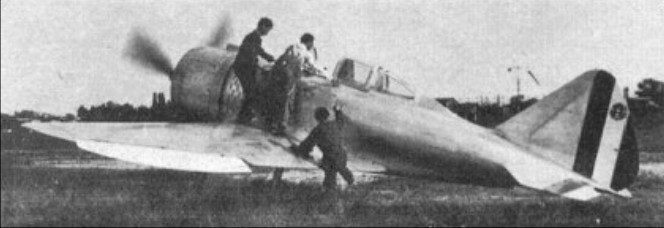
German leaders were reluctant to supply the Royal Hungarian Air Force (Magyar Királyi Honvéd Légierő), MKHL, which was seen to be focused on home defence and the possibility of conflict with Romania. Adolf Hitler expressed this in early 1942 when Hungary requested German-built fighters. “They would not use the single-seaters against the enemy but just for pleasure flights!… What the Hungarians have achieved in the aviation field to date is more than paltry. If I am going to give some aircraft, then rather to the Croats, who have proved they have an offensive spirit. To date, we have experienced only fiascos with the Hungarians.”
The MKHL consequently became a significant purchaser of Italian aircraft and was the main operator of the Re.2000. Hungary bought 70 Reggiane Re.2000 Falco Is and then also acquired the licence-production rights for this model to produce a total of 200 aircraft, known as MÁVAG Héja (“Hawk”) II built between 1940 and 1942.
The first aircraft were delivered Debrecen airport unassembled July 1940. In mid-April 1940, representatives of the Hungarian Ministry of Defense, visited the plant Reggiane, saw only a single fighter finished. (delivered 21 May 1940 and designated401 V. (V – Vadasz; Fighter)). The remaining aircraft were not even started because of production problems, including a lack of high-quality aluminum sheet “Alkled”. By December 1940 only seven had been delivered. Thirteen has been prepared for shipment, and the remaining 9 were expected. The total supply of 48 Re.2000 was completed by February 1941, and production of the remaining aircraft and spare parts continued until the end of the year.
August 5, 1941 the Hungarian Ministry of Defence to establish the Independent Fighter Group (Independent Fighter Group – IFG), which consisted of a half squadrons armed with seven new fighters. Formed in Szolnok (Szolnok), she was inducted into the “mobile body” (“Fast Corp”) of the Hungarian army. It included 12 Hejja squadron 1/1 Dongo (“Wasp”) formed in the same Szolnok. ‘Wasps’ commanded by Colonel Kalman Kshukash. The aircraft departed from Hungary July 1, 1942, and reached the front three days later contributing to the German offensive Fall Blau. The flight lost one aircraft which crashed while landing at stake. Another was slightly damaged in Kursk. The case was subject to the German Army Group “South”. The first seven Re.2000 were sent to the front on an experimental basis on 7 August 1941. Under the command of Captain Genesha Laszlo (Laszlo Gyenes) they arrived at Sutiski airfield, 20 km south of Vinnitsa. Squadron III had a proper name – “Ludas Matyi” (Lyudash Mati – the hero of Hungarian folk tales.) Flying alongside the Fiat CR.32s of 1/3 Fighter Company, the Reggiane pilots claimed eight kills, for one loss, during three months of combat, against Soviet Air Force.
Hejja flew escort bombers and assault jobs from August 11 until October 21, 1941, but due to the practical absence of the enemy had only a few dogfights. During this time they lost only one aircraft.
In the summer of 1942, Hungarian Air Force contributed with its 1st Repülőcsoport (aviation detachment) to the German offensive Fall Blau. 1/1 Fighter Group (1./I Vadász Osztály) equipped with 13 Re.2000s or Héjas, reached its first front base near Kursk on 2 July. By 3 August, 2/1 FS joined the other Hungarian fighter unit, that had moved to Ilvoskoje airfield. The Hungarians arrived to the location, but sent one plane, “the bride” to exclude mistaken identity with I-16 by the neighbouring Germans. This was ineffective and Hungarian planes often fired by their allies. Two 1/1 Hejja and were shot down, but the crew managed to jump with parachutes. The task of 2/1 was to escort short-range reconnaissance aircraft, while 1/1 would support bombing missions. Combat performance against the Soviet Air Force was satisfactory. On 4 August the Hungarians claimed their first kills, when Ens Vajda shot down two enemy aircraft. Caught in the dense anti-aircraft fire one aircraft (tail number V-420 pilot Gyula) was lost. The first Hungarian ace of the war, 2/Lt Imre Pànczél, claimed his first air victories while flying the Re.2000, three of them in one sortie, in 1942. However, the Re.2000’s flight characteristics were markedly different to the Fiat CR.32, from which Hungarian pilots frequently converted. The Re.2000 was much more prone to handling difficulties, especially stalls and spins, as well as reliability issues. All the 24 Re.2000s had suffered accidents (minor and major) within a month of combat deployment. Piaggio P.XI engine proved to be a mechanical nightmare for the mechanics. Landing and takeoff accidents were common on the rudimentary Russian airfields and due to the Re.2000 not having a rugged landing gear, compared to that of the CR.32. After a steel plate was added behind the cockpit to protect pilots, the shift in the aircraft’s center of gravity led to more frequent accidents.
In the summer of 1942, Hungarian Air Force. 1/1 Fighter Group (1./I Vadász Osztály) equipped with 13 Re.2000s or Héjas, reached its first front base near Kursk on 2 July. The day after the arrival the Hejja began to make trial flights and on July 5, 1942 1/1 squadron was declared combat-ready. The Germans initially entrusted the Hungarians for intelligence, though later added bomber escort. The fighters were transferred on July 13 to Stary Oskol, and four days later, were involved in a combat operation to provide air cover for an armoured regiment operating in the area. Over the next few days the Hungarians escorted aircraft spotters.
On July 30, 1942 at Kolozsvar came second squadron – 2/1 “Keresztes Pok” (Spider Araneus) consisting of eleven and two Re.2000 Vi-131, commanded by Captain Kerestesha Bela (Bela Keresztes). 2/1 and 1/1 squadron was deployed to Ilovskoe 3 and 5 August, respectively. 1/1 was assigned to escort bombers, while 2/1 – on cover of spotters. 1/1 squadrons had difficulties because of problems in the maintenance of aircraft and frequent equipment failures. The aircraft of lieutenant Peterffi Andorra was lost on August 7 in a dogfight over Korotoyak. On August 8, the division had only four combat-ready Hejja. During the last month of summer, Hungarian pilots declared victory over the five Soviet aircraft. They also had two and a “probable” victory in September.
In a much publicized mishap, 1/Lt István Horthy (the son of the Hungarian regent Miklós Horthy), serving as a fighter pilot with the Hungarian Second Army died flying a Re.2000 V-421 with 1/3 Fighter Squadron on 20 (on 18, according to other authors) August 1942, on his 25th operational sortie. After a pilot flying above asked Horthy to increase height, he pulled up rapidly, stalled and crashed. Nevertheless, the determined Hungarian pilots kept on flying combat missions and scoring a number of kills against the Soviet fighter, if they managed to force their Russian opponents into a dogfight, thanks to the maneuverability of the Italian built plane. The Hungarians Re.2000s had their most successful day on 9 August 1942. That day, near the village of Davidovka, 16 Ilyushin Il-2s and a similar number of LaGG-3S were intercepted by four Reggianes. The Hungarians downed four LaGGs, suffering the loss of the Re.2000 of Lt Takács, who crash-landed behind his own lines, wounded.
In October 1942, the 1/1 squadron was withdrawn for conversion and retraining on the Bf. 109F and later became part of the group III 52 fighter squadron of the Luftwaffe. At the same time they continued to fly at 2/1 with Hejja Ilovskogo. However, in early November of the squadron 2/1 four pilots were selected for transfer to Bf. 109. In December the squadron ubyla Hungary.
On October 20 Reggiane five went to home, however, over the Carpathian Mountains, they were in a thick fog. As a result, two cars crashed into a mountain, and one was badly damaged during a forced landing.
December 25, 1942 came 5 th Fighter Division in the squadron 5/2 (there were 13 Re.2000 and Ag.96). But after two weeks, only six of these fighters considered suitable to operate as three Hejja required new engines, three others had significant, though not fatal damage, and one embarked “on its belly”, in serious need of repair.
On January 12, 1943, Soviet troops launched an offensive in the area of the 2nd Hungarian Army northwest of Stalingrad. Re.2000, together with other aircraft tried in vain to stop the offensive. Two Re.2000 were sent to escort German bombers in the afternoon. The group left on purpose under the guise of cloud, but soon were linked fighters fight, but were able to avoid losses.
The Hungarian Reggianes flew their last sorties on the Soviet front on 14 and 15 January 1943, when they took off for uneventful patrols and reconnaissance missions. Between 16 and 19 January, with Red Army rapidly approaching Ilovskoje airfield, and with no time to heat the frozen Piaggio engine oil, mechanics blow up the last unserviceable Hejas.
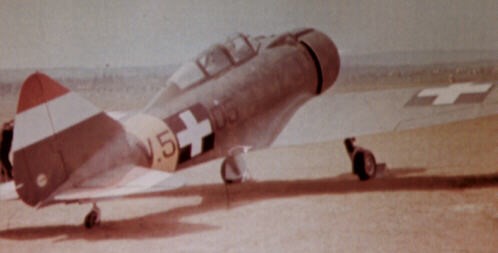
The surviving Reggianes were kept in Hungary for home defence. Production of licence-built Hejas continued: 98 were completed in 1943 and 72 in 1944 although the variant was regarded as no longer suitable for combat against the latest Soviet fighters. Hungary requested an additional 50–100 Re.2000 airframes made in Italy, as suitable engines and armament could be locally manufactured and other countries expressed interest, including Finland (100 examples), Portugal (50), Spain, Switzerland and Yugoslavia. However, no airframes were available.
Variants:
Re.2000
Initial prototype, one built.
Re.2000 Serie I / MÁVAG Héja I
Production model, 157 built. Serie I had modified windshield and slight equipment changes.
Re.2000 Serie II
Ship-borne version, 10 built. Serie II had a 1,025 hp Piaggio P.XIbis engine and arrester gear.
Re.2000 (GA) Serie III
Long-range fighter, 12 built. Serie III had redesigned cockpit, increased fuel capacity and option of a 170 l auxiliary fuel tank or a dispenser of 22 2 kg bomblets.
RE 2000 “Catapultabile”
Re 2000 aircraft modified for catapult launch from Regia Marina ships. On the day of the armistice, 8 September 1943, 6 Re 2000 “Catapultabile ” were in service, with two on the battleship Roma and one each on the Vittorio Veneto and Italia (formerly the Littorio).
Variation:
MÁVAG Héja II
Specifications:
Re 2000 Falco I (Falcon) / J 20 / Heja 1 (Hawk)
Engine: Piaggio P.XI RC 40, 986 hp (736 kW) (1000 CV) at 4,000 m (13,125 ft)
Propellers: Piaggion-D’Ascanio P.1001 three-bladed constant speed propeller
Propeller diameter: 3.10 m (10 ft 2 in)
Wing span: 11m (36 ft 1 in)
Wing area: 20.40 m² (219.6 sq ft)
Length: 7.99m (26 ft 2.5 in)
Height: 3.20 m (10 ft 5⅞ in)
Empty weight: 2,090 kg (4,585 lb)
Normal T/O weight: 2595 kg (5,722 lb)
Gross weight: 2850 kg (6285 lb)
Maximum speed: 530 km/h (268 knots, 329 mph) at 5,300 m (17,400 ft)
Cruise speed: 440 km/h (237 knots, 273 mph)
Range: 545 km (296 nmi, 340 mi)
Climb to 4,000 m (13,125 ft): 4 min
Service ceiling: 11,200 m (36,745 ft)
Endurance: 1.25 hours
Armament: 2 x 12.7 mm (0.54in) Breda-SAFAT machine gun
Crew: 1
Re 2000 Falco 1 Serie II
Engine: 1025 hp P.XIbis RC 40
Armament: 2 x 12.7 mm (0.54in) Breda-SAFAT machine gun
Crew: 1
Re.2000 Serie 3
long-range fighter
Engine: 1025 hp P.XIbis RC 40
Hard point load: 2000-kg (4,405-lb)
Armament: 2 x 12.7 mm (0.54in) Breda-SAFAT machine gun
Hard point load: 200 kg / 440 lb
Crew: 1
MAVAG Heja II
Engine: 986 hp WMK 14
Crew: 1
 All Aero