Vickers 284 Warwick

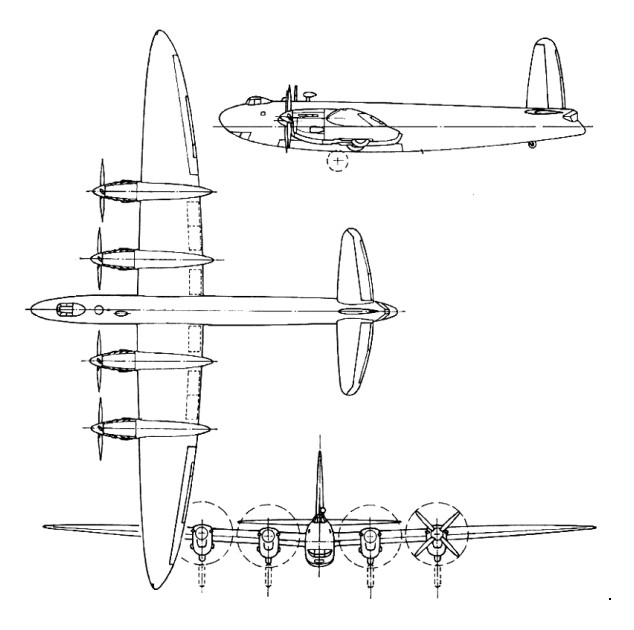
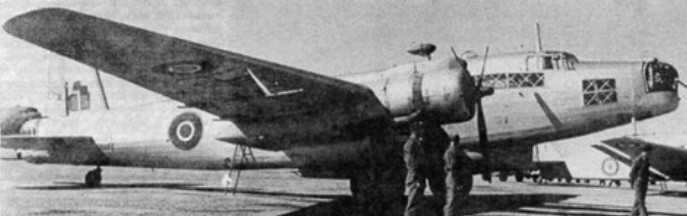
The Warwick was a slightly enlarged version of the Wellington and employed the same geodetic form of construction. It was designed originally to Specification B. 1/35 to replace the Wellington. But because the generation of four-engined bombers was also being produced at the same time, it was subsequently adapted for reconnaissance duties with Coastal Command and first went into service in 1943. Other models were built for transport and air-sea rescue duties. The final version, the GR.V, entered service in 1945 and carried bombs, mines or depth-charges. About 840 production Warwicks were built.

Warwick GR Mk.II
Engines: 2 x Bristol “Centaur VI”, 1864kW / 2466 hp
Max take-off weight: 23247 kg / 51251 lb
Empty weight: 14118 kg / 31125 lb
Wing load: 51.05 lb/sq.ft / 249.0 kg/sq.m
Wingspan: 29.48 m / 96 ft 9 in
Wing area: 1006.003 sq.ft / 93.46 sq.m
Length: 20.88 m / 68 ft 6 in
Height: 5.64 m / 18 ft 6 in
Max. speed: 228 kts / 422 km/h / 262 mph
Service ceiling: 5790 m / 19000 ft
Range: 3460 km / 2150 miles
Bombload: 6900kg
Crew: 6

Vickers 284 Warwick

Vickers 447 / 457 / 480 Winsor

The Barnes Wallis geodetic construction, introduced on the Vickers Wellesley and used later on the Vickers Wellington and Vickers Warwick, was highly successful. To exploit its physical characteristics fully, however, a very big aeroplane was desirable.
Vickers’ designer, Rex Pierson, used geodetics in evolving a four-engined bomber to meet Specification B.13/36, but the Short Stirling was awarded the contract. Another opportunity came with Specification B.1/39, but this was again unsuccessful, and it was not until the submission to Specification B.5/41 that the Vickers tender was accepted.
The requirement was for a high-altitude heavy bomber with pressurized crew compartment, and an ability to fly at 555km/h at 9450m. Two prototypes of the new bomber were ordered, but changes resulted in a new specification, B.3/42, being drawn up. Vickers designated their design the Type 447, and the name Windsor was given to the aircraft. Various armament trials were carried out on a Warwick prototype, and the first Windsor flew from Farnborough, where it had been assembled, on 23 October 1943. It attained a speed of 486km/h at 7620m, and had completed almost 34 hours of flight testing before being written off in a forced landing, caused by problems with a propeller constant-speed unit. The second prototype, Type 457, contained armour plating and other modifications, and flew from Wisley on 15 February 1944, demonstrating similar performance to the first aircraft. This aircraft was grounded in June 1946, and broken up.
A third Windsor, Type 480, was flown on 11 July 1944, with some further changes incorporated. This aircraft was fitted later with defensive barbettes in the outboard engine nacelles, each barbette having two remotely-controlled rear-firing 20mm cannon.
Trials for these were carried out by a Lancaster, but although further tests continued for some 10 months, the Windsor programme was cancelled on 15 March 1946, with the third aircraft finishing its days as an instructional airframe. A fourth Windsor, originally Type 471 but later changed to Type 483, was almost complete when the programme finished.

Engines: 4 x Rolls Royce Merlin 65, 1613 hp
Max take-off weight: 24500 kg / 54014 lb
Empty weight: 17500 kg / 38581 lb
Wingspan: 35.71 m / 117 ft 2 in
Length: 23.42 m / 76 ft 10 in
Height: 7.01 m / 23 ft 0 in
Wing area: 115.94 sq.m / 1247.97 sq ft
Max. speed: 275 kts / 510 km/h / 317 mph
Ceiling: 8305 m / 27250 ft
Range: 2511 nm / 4650 km / 2889 miles
Armament: 2 x 7.7mm machine-guns, 2 x 20mm cannon
Bombload: 5500kg

Vickers Windsor

Vickers (Aviation) Ltd / Vickers-Armstrong

Vickers was formed in Sheffield as a steel foundry by the miller Edward Vickers and his father-in-law George Naylor in 1828. Naylor was a partner in the foundry Naylor & Sanderson and Vickers’ brother William owned a steel rolling operation. Edward’s investments in the railway industry allowed him to gain control of the company, based at Millsands and known as Naylor Vickers and Company. It began life making steel castings and quickly became famous for casting church bells. In 1854 Vickers’ sons Thomas (a militia officer known familiarly as ‘Colonel Tom’) and Albert joined the business and their talents – Tom Vickers as a metallurgist and Albert as a team-builder and salesman – were key to its subsequent rapid development. “Its great architects,” the historian Clive Trebilcock writes, “Colonel T.E. (1833-1915) and Albert (1838-1919) Vickers… provided both inspired technical leadership… and equally astute commercial direction. Both men were autocrats by temperament, but neither shunned advice or avoided delegation; each, but particularly Albert, had a marked gift for the selection of talented subordinates.”

Vickers (Aviation) Ltd / Vickers-Armstrong Article

In 1863 the company moved to a new site in Sheffield on the River Don in Brightside.

The company went public in 1867 as Vickers, Sons & Company and gradually acquired more businesses, branching out into various sectors. In 1868 Vickers began to manufacture marine shafts, in 1872 they began casting marine propellers and in 1882 they set up a forging press. Vickers produced their first armour plate in 1888 and their first artillery piece in 1890.

Vickers bought out the Barrow-in-Furness shipbuilder The Barrow Shipbuilding Company in 1897, acquiring its subsidiary the Maxim Nordenfelt Guns and Ammunition Company. at the same time, to become Vickers, Sons & Maxim.

Ordnance and ammunition made during this period, including World War I, was stamped V.S.M.

The yard at Barrow became the “Naval Construction Yard”. With these acquisitions, Vickers could now produce a complete selection of products, from ships and marine fittings to armour plate and a whole suite of ordnance. In 1901 the Royal Navy’s first submarine, Holland 1, was launched at the Naval Construction Yard. In 1902 Vickers took a half share in the famous Clyde shipyard John Brown and Company.

Further diversification occurred in 1901 with the acquisition of a proposed business which was incorporated as The Wolseley Tool and Motor Car Company and in 1905 the goodwill and patent rights of the Siddeley car. In 1911 a controlling interest was acquired in Whitehead and Company, the torpedo manufacturers.

Vickers Airships Article

In 1911 the company name was changed to Vickers Ltd and expanded its operations into aircraft manufacture by the formation of Vickers Ltd (Aviation Department) on March 28, 1911, under Capt. H. F. Wood, and a Vickers School of Flying was opened at Brooklands, Surrey on 20 January 1912. Production rights for Esnault-Pelterie REP tractor monoplane obtained in 1911; several variants built before First World War.

In 1912 Vickers produced Type 18 Destroyer for Admiralty; pusher-engined gun-carrying fighter from which evolved, via successive E.F.B. (Experimental Fighting Biplane) prototypes, the F.B.5 and F.B.9 “Gunbus” fighters of First World War. Later front-gunned tractor-engined F.19 was less successful. During war also built RAF B.E.2 series, B.E.8, F.E.8, and S.E.5a and Sopwith 1 1/2-Strutters under license. Vickers Vimy of 1917 remained standard RAF bomber throughout 1920s: one used by Alcock and Brown for first non-stop Atlantic crossing by airplane on June 14/15 1919. Vimy Commercial was 11 -passenger airliner with enlarged fuselage; Vernon troop transport developed from this.

In 1919, the British Westinghouse electrical company was taken over as the Metropolitan Vickers Electrical Company; Metrovick. At the same time they came into Metropolitan’s railway interests.

Vimy and Vernon succeeded respectively by Virginia and Victoria in mid-1920s, followed by Pegasus engined development, the Valentia.

By the end of 1924 Armstrong’s was virtually bankrupt. The bank of England discreetly moved in, and eventually brought pressure to force a merger with Vickers, using the Sun Insurance Company as their front to guarantee the new company, now called Vickers Armstrong. It was a condition of the rescue that the new company would restrict themselves to ship building, heavy engineering, and predominantly armaments.

A reorganisation during 1926 led to the retention of the rolling stock group: Metropolitan Carriage wagon and Finance Company and The Metropolitan -Vickers Company and the disposal of: Vickers-Petters Limited, British Lighting and Ignition Company, the Plywood department at Crayford Creek, Canadian Vickers, William Beardmore and Co, and Wolseley Motors.

In 1927, Vickers merged with the Tyneside based engineering company Armstrong Whitworth, founded by W. G. Armstrong, to become Vickers-Armstrongs, Ltd. Armstrong Whitworth had developed along similar lines to Vickers, expanding into various military sectors and was notable for their artillery manufacture at Elswick and shipbuilding at a yard at High Walker on the River Tyne. Armstrongs shipbuilding interests became the “Naval Yard”, those of Vickers on the west coast the “Naval Construction Yard”. Armstrong Whitworth Aircraft was not absorbed by the new company.

In 1928 the Aviation Department became Vickers (Aviation) Ltd and four months later acquired Supermarine, which became the “Supermarine Aviation Works (Vickers) Ltd”. In 1938, both companies were re-organised as Vickers-Armstrongs (Aircraft) Ltd, although the former Supermarine and Vickers works continued to brand their products under their former names. Supermarine became Vicker-Supermarine in 1929. 1929 saw the merger of the acquired railway business with those of Cammell Laird to form Metropolitan Cammell Carriage and Wagon (MCCW); Metro Cammell.

Vickers’ own products continued in early 1930s with Vildebeest torpedo- bomber and Vincent general-purpose biplane. June 1935 saw first flight of Pegasus engined long-range Wellesley bomber, first RAF aircraft to use system of geodetic construction devised by Dr. B. N. (later Sir Barnes) Wallis, who remained head of research until early 1970s. Subcontract production included Armstrong Whitworth Siskin IIIAs (1929-1930), Hawker Harts (1932-1934) and Hart Trainers (1936). In March 1936 the prototype was flown of R. J. Mitchell’s supreme design, the Supermarine Spitfire; and in June 1936 prototype of Vickers Wellington twin-engined bomber.

Vickers’ main concern up to and during Second World War was production of Wellington bomber and Avro Lancaster; Wellington replaced at end of war and early postwar by its non-geodetic successor, the Warwick. In August 1946 came first flight of VC1 Viking, first postwar British transport to enter airline service. Subsequent products included four-jet Valiant (first British V-bomber); world’s first turboprop airliner to enter production/service, the Viscount; and in 1959 the four-turboprop Vanguard airliner.

In 1960 the aircraft interests were merged with those of the Bristol, English Electric Company and Hunting Aircraft to form the British Aircraft Corporation. This was owned by Vickers, English Electric and Bristol (holding 40%, 40% and 20% respectively). BAC in turn owned 70% of Hunting. The Supermarine operation was closed in 1963 and the Vickers name for aircraft was dropped in 1965. Under the terms of the Aircraft and Shipbuilding Industries Act BAC was officially nationalised in 1977 to become part of the British Aerospace group, which exists today in the guise of BAE Systems.

The Aircraft and Shipbuilding Industries Act also led to the nationalisation of Vickers’ shipbuilding division as part of British Shipbuilders. These had been renamed Vickers Armstrong Shipbuilders in 1955, changing again to Vickers Limited Shipbuilding Group in 1968. This division was privatised as Vickers Shipbuilding and Engineering Ltd (VSEL) in 1986, later part of GEC’s Marconi Marine. It remains in operation to this day as BAE Systems Submarine Solutions.

With their steelworking operations also nationalised into British Steel the remnants of Vickers became Vickers plc. In 1986, Vickers acquired the armaments manufacturer Royal Ordnance Factory, Leeds, which became Vickers Defence Systems. Other acquisitions included automotive engineers Cosworth in 1990, waterjet manufacturer Kamewa in 1986 and Norwegian marine propulsion and engineering company Ulstein in 1998. 1998 also saw the sale of Rolls-Royce Motors and Cosworth to Volkswagen Group for £430 million, beating out BMW’s offer of £340 million.

Vickers remained independent until 1999 when the then Vickers plc was acquired by Rolls-Royce plc who sold the defence arm to Alvis plc, which became Alvis Vickers. Vickers plc and the subsidiaries retained by Rolls-Royce were renamed Vinters in March 2003. This Vickers name lived on in Alvis Vickers, until the latter was acquired by BAE Systems in 2004 to form BAE Systems Land Systems.

BAE Systems announced on 31 May 2012 that the ex Vickers Defence Systems factory on Scotswood Road, Newcastle would close at the end of 2013.
Vernisse & Galtier VG 33

A variation on the VG 30 theme, the VG 33 actually attained production status, and although successive production orders for this type placed with the Chantiers Aero-Maritimes de la Seine on behalf of the Armee de l’Air raised contracts into four figures by the time of France’s collapse during WW2, only 19 actually rolled off the line.

Vega Aircraft Corp / Airover Co

Vega Airplane Company

USA
Vega Airplane Co was known formerly as Airover Company, Victory Blvd and Empire Ave, Burbank, California, formed at 923 E San Fernando Rd, Burbank, California, as associated company of Lockheed Aircraft Corporation in 1937. Began research/development experiments with light aircraft, devising (with Menasco) a unit called Unitwin; two small engines coupled side-byside to drive single propeller flight-tested in Lockheed Altair in 1938. Then designed five/six-seat Starliner twin-tailed low-wing cabin monoplane using similar powerplant. Small batch of radio-controlled targets built in 1939. Factory expanded 1940, and mid-year received contract to build large numbers of Lockheed Ventura bombers for RAF. Then, in conjunction with Boeing and Douglas, mass-produced Boeing B-17 Flying Fortress bombers; became wholly owned subsidiary of Lockheed in 1941 as Vega Aircraft Corporation (pres: Courtland S Gross).

From 1941 Vega Aircraft Corp became Vega Airplane Company; continued production of Lockheed-Vega B-34 Ventura twin-engined medium bomber for USAAF/USN/RAF and Boeing B-17 Flying Fortress for USAAF between 1941 and 1944. Absorbed into Lockheed Aircraft Corporation 30 November 1943; name Vega abandoned; Vega plant became Lockheed’s Factory A. Ventura B-34 production ended 1943; PV-1 naval version and Boeing B-17 manufacture continued until 1944 under responsibility of Lockheed.

VEF I-17

VEF I-17 at the VEF factory, 1940

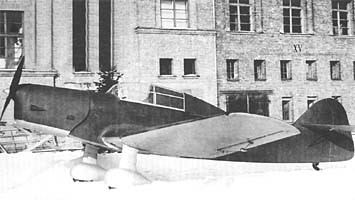
VEF I-17 was a Latvian trainer aircraft (intended also as a fighter) designed in 1939 by Kārlis Irbītis.The I-17 was test flown in early 1940 and almost immediately accepted by Latvian Air Force. It was produced by the VEF factory in Riga.

In 1939 Latvia ordered 39 Hawker Hurricane fighters from United Kingdom thus there was a need for monoplane pilots in Latvia. For this purpose Kārlis Irbītis designed the VEF I-17 among other trainer aircraft. Due to the start of Second World War in September 1939, the British Hawker Hurricanes never arrived in Latvia and this was an inducement for the Latvian Air force to encourage Latvian aircraft development instead.

First flying in 1940, but due to the pressures of the war, the I-17 prototype was accepted almost without testing and serial production was started.

Six examples of the I-17 were built and there was an order for another six but that was halted by the Soviet occupation of Latvia in June 1940.

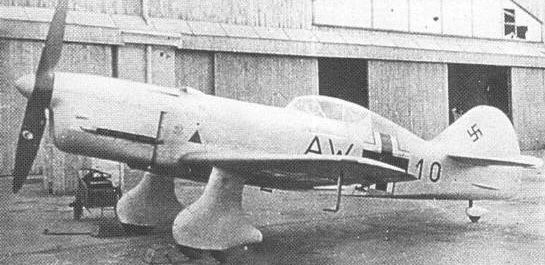
After the occupation the I-17 was tested by Soviet Red Army and some had Soviet M-11 engines installed. After the occupation of Latvia by Nazi Germany in July 1941, the I-17 was also examined and tested by the Luftwaffe and, like the VEF I-16, was used by the aviation school in Torun. It is believed five VEF I-17 were flown to Germany.

The further fate of the VEF I-17s produced is unknown.

Engine: 1 × Menasco Pirate C4, 93 kW (125 hp)
Propeller: 2-bladed fixed pitch
Wingspan: 9.80 m (32 ft 2 in)
Wing area: 19.20 m2 (206.7 sq ft)
Length: 8.20 m (26 ft 11 in)
Height: 2.90 m (9 ft 6 in)
Empty weight: 790 kg (1,742 lb)
Gross weight: 1,140 kg (2,513 lb)
Maximum speed: 230 km/h (143 mph; 124 kn)
Cruising speed: 189 km / h
Range: 592 km (368 mi; 320 nmi)
Service ceiling: 5,900 m (19,400 ft)
Wing loading: 59.4 kg/m2 (12.2 lb/sq ft)
Crew: one
Capacity: one passenger

VEF I-16

The VEF I-16 was a prototype Latvian fighter aircraft designed by Kārlis Irbītis and produced by VEF in 1939 costing about 130,568 Lats.

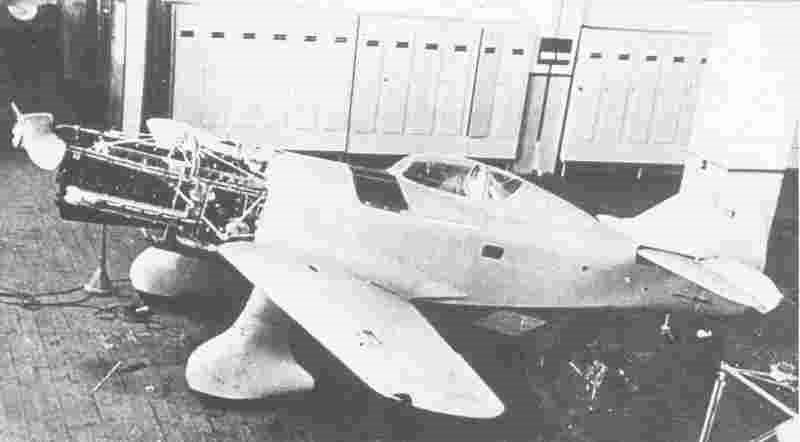
Design work on the I-16 began in the autumn of 1938, when Irbitis ordered a Czech Sagitta I SR supercharged air-cooled V12 engine. Irbitis selected an engine of low frontal area and technical simplicity for easy field servicing. This led to consideration of inverted V air-cooled engines, and the options were quickly narrowed down to the 450 hp Renault 12Roi series from Franc, or 460 hp Walter Sagitta I-SR from Czechoslovakia. A trade imbalance with France meant that the Czechoslovak engine was effectively selected by default. He also ordered a two-bladed, fixed-pitch propeller from Propellerwerk Schwarz for the prototype, but there were plans to switch to a three-bladed metal constant speed propeller to be installed later. Flight instrumentation was ordered from Kollsman in the USA. The I-16 was of conventional monoplane layout with a low set wing with rounded wingtips. The prototype had fixed undercarriage with aerodynamic fairings, but production models were to have retractable landing gear. The cockpit seat and controls were designed as one unit – they could be assembled totally separately from the rest of the aircraft and then installed as a unit with only six bolts. While the prototype was unarmed, there were provisions for two machine guns in the fuselage, along with the ability to carry one additional gun under each wing.

Construction of the prototype began in late 1938 but, as it took a long time for the engine and other parts to arrive, it was not ready for flight until the spring of 1940.

The first flight was made in the spring of 1940 by Konstantins Reichmanis. After about 20 minutes of trouble-free flight at about 1,000 metres the engine stopped. Reichmanis made a perfect deadstick landing. It was assumed that the engine problem was due to low pressure in the fuel feed. They worked on this problem and made 2-3 more flights before the Soviets invaded Latvia and all activity was stopped.

Immediately upon occupation of Latvia, the VEF was taken over by a small cadre of employees who were apparently members of the Communist underground. They formed a small militia which took control of security at the facility and watched over the activities of all other employees. After the occupation of Latvia in June 1940, the Soviet authorities ordered that all VEF aircraft be removed from Spilve Airport and, a few weeks later, all parts fabrication and assembly work was ordered suspended pending further instructions from Moscow.

Irbitis reports that they estimated a total of 36,456 man-hours of work had been devoted to the I-16, about a third of that being the engineering and design. The prototype cost 130,568 Lats (which was about $27,000 US), of which half was for the purchase of the engine and other imported parts.

In February 1941 a Soviet official, General-Major Feodorov, became aware of the VEF designs (particularly the I-15b and I-16) which had been stored in an abandoned warehouse. In March 1941, the I-16’s designer Kārlis Irbītis received orders to prepare one example each of the VEF I-12, VEF I-15a and I-15b, I-16, VEF I-17 (two variants) and VEF I-18 to be shipped to Moscow for evaluation. The I-16 still had engine problems and needed further testing, so was left behind and stayed in Riga. At about this time the Soviets began to purge VEF of ‘unreliable’ engineers and constructors, and one by one Irbitis’ colleagues began to disappear to prison and Siberia. This, and the engine troubles, kept the I-16 in Riga until the Germans invaded in June 1941. There is no evidence that the I-16 ever wore Soviet markings. Following the German invasion of the Soviet Union, the I-16 managed to make several test flights from an aerodrome in Kalnciems. Under the Germans, work was allowed to continue on the VEF types but, as soon as each was completed, it was claimed by the Luftwaffe. When the engine problems in the I-16 were sorted out test pilots Mikelsons and E.Rudzitis managed to make a few flights from the Kalnciems aerodrome before it, too, was confiscated by the Germans and tested by the Luftwaffe. The VEF I-16 was used as training aircraft at an aviation school in Torun until 1942.

Gallery

Engine: 1 × Walter Sagitta I-SR, 403 kW (540 hp)
Wingspan: 8.23 m (27 ft 0 in)
Wing area: 11.43 m² (123.0 ft²)
Length: 7.30 m (23 ft 11 in)
Height: 2.70 m (8 ft 10 in)
Empty weight: 1,100 kg (2,420 lb)
Loaded weight: 1,540 kg (3,388 lb)
Maximum speed: 483 km/h (261 knots, 300 mph) at 7,900 m (25,900 ft)
Range: 805 km (438 nmi, 500 miles)
Service ceiling: 8,100 m (26,600 ft)
Wing loading: 136 kg/m² (28 lb/ft²)
Power/mass: 220 W/kg (0.13 hp/lb)
Armament: 2x 7.9 mm Browning machine guns
Crew: One

Vedeneyev M14P

The Vedeneyev M14P is a Russian nine cylinder, four-stroke, air-cooled, petrol-powered radial engine. Producing 360 hp (268 kW), its design dates from the 1940s, and is itself a development of the Ivchenko AI-14 engine.

The engine’s intake system uses a gear driven supercharger and an automatic-mixture type carburetor. Power is transmitted to the propeller via a reduction gearbox.

In addition to the carburetor, the engine has a speed governor, two magnetos, mechanical fuel pump, generator, and an oil pump. It is started pneumatically, and remains fully operational during inverted flight. Unlike to most Western aero-engines, which turn to the right (clockwise) when viewed from the cockpit, the M14P rotates to the left (counter-clockwise).

A factory modification to the supercharger gearing results in the engine producing 400 hp, while non-factory modifications have it producing as much as 460 hp. Such non-factory engines may also incorporate other upgrades, such as electric starters and electronic ignition.

When operated in a certified aircraft, the TBO (Time Between Overhauls) for the M14P engine is 750 hours initially, and every 500 hours thereafter. On experimental aircraft, the engines are often run to their complete 2250-hour design life before overhaul.

The M14-V26 variant has been developed exclusively for the Kamov Ka-26, where “V” stands for vertolet (helicopter) and “26” for Ka-26. Power is rated at 239 kW (325 HP) for take-off. The engine has no integral gearbox; instead, the power is transmitted to the main reduction gearbox via an interconnect shaft.

The M14P has recently become increasingly popular in experimental aircraft and kit designs such as the Murphy Moose, Radial Rocket, Pitts Model 12, and others. Historically, the engine has been used extensively by the Yakovlev and Sukhoi Design Bureaus.
The M14PF is a 400 hp (298 kW) version of the M14P.

Applications:
Altitude Radial Rocket
Bear 360
Culp Special (Steen Skybolt variant)
Kensgaila VK-8 Ausra
Kimball McCullocoupe
Murphy Moose
Pitts Model 12
PZL 104 Wilga 35/A (WilgaBeast – Experimental Modified)
PZL-105 Flaming
Slepcev Storch
Sukhoi Sa-20P
Sukhoi Su-26
Sukhoi Su-29
Sukhoi Su-31
Yakovlev Yak-18T
Yakovlev Yak-50 (trainer)
Yakovlev Yak-52
Yakovlev Yak-54
Yakovlev Yak-55

Specifications:
M14P
Type: Nine cylinder, four-stroke, air-cooled radial engine
Bore: 105 mm (4.13 in.)
Stroke: 130 mm (5.11 in.)
Displacement: 10.16 L (620 cubic inches )
Length: 924 mm (36.4 in)
Diameter: 985 mm (38.7 in)
Dry weight: 214 kg (472 lb)
Supercharger: Centrifugal, single-stage, single-speed
Fuel system: Floatless carburettor
Fuel type: Minimum 91 octane Avgas
Oil system: Gear type pump
Cooling system: Air-cooled
Reduction gear: 0.658:1, left-hand tractor
Power output: 360 hp (268 kW) at 2,900 rpm
Compression ratio: 6.3:1

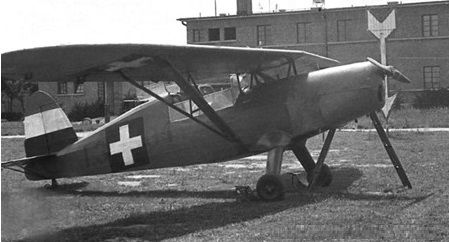
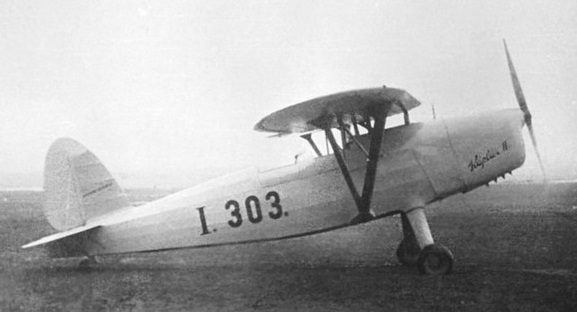
Varga Kaplar (Káplár)

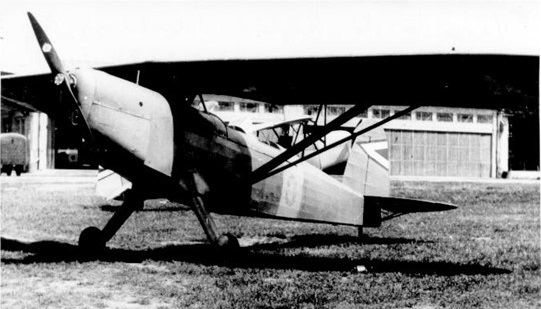
Varga “Káplár” was designed in the 1930’s by a team of engineers led by Laszlo Varga. Not departing from the general principles of the time the plane was a parasol monoplane with a double-open cockpit and Hirth HM-504\A2 engine. The aircraft to be used as a liaison and training.

The first flight of the prototype Varga “Kaplar” made in 1940.

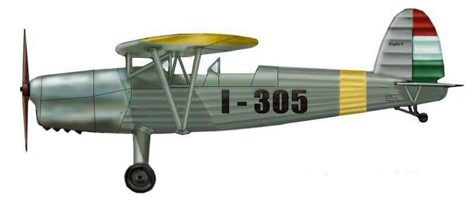
The Hungarian Air Force have expressed some interest in “Kaplar”, ordering a trial batch of aircraft to conduct evaluation tests. The contract for the construction of these machines were given to Aero-Ever and Szekesfehevar-Sosto, for four aircraft. Szekesfehevar-Sosto aircraft were designated “Kaplar I” and received a registrations I.301 – I.302. The remaining three aircraft – I.303, I.304 and I.305, are called “Káplár II”.

In general, this were simple enough to use, but the performance characteristics were not up to par. In the end, the Hungarian Air Force opted for serial production of Fabian “Levente”, which served until 1945. Although officially “Káplár” were not taken during the war, they were used for some time for auxiliary purposes.

Engine: Hirth HM-504 \ A2
Wingspan: 10.51 m
Length: 6.8 m
Height: 2.5 m
Maximum speed: 180 km \ h
Crew: 2
Armament: none

Valtion Humu

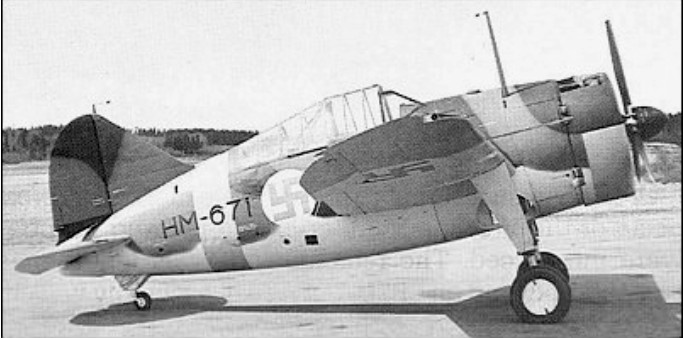
The Humu – literally “Reckless” – was produced by Valtion Lentokonetehdas. It was not that the Humu was unconventional in any respect. It was a copy of a seven-year-old American design adapted to make use of locally-available materials and captured equipment, and built without benefit of licence or assistance from the parent manufacturer. The Finnish air arm, Ilmavoimat, had acquired 43 Brewster B-239 shipboard fighters that had been declared surplus to US Navy requirements. These had proved singularly successful in Ilmavoimien service, and, in 1942, it was proposed that an attempt be made by the VL to remedy a shortfall of fighters of this type by producing a copy. Because of shortages of metal, this was to make as much use as possible of wood and to embody so-called “war booty” instrumentation and power plant – equipment captured from the Soviet forces by the Finns themselves and similar equipment captured by the Wehrmacht and sold to the Finns. The task of designing an entirely new wooden wing was assigned to M T Vainio, who was also responsible for the overall project, and, in October 1942, an order was placed with the VL for four prototypes, the intention at that time being to build a series of 90 aircraft. The chosen engine was the 930hp Shvetsov M-63, which was flown on 5 June 1943 in a B-239. Static testing of the wooden wing was not entirely satisfactory. Nevertheless, in September 1943, orders were confirmed for five prototypes of the Humu and 55 production aircraft. The wooden wing was found to add 250kg to air-frame weight, however, and the transfer of the fuel tanks from the wing to the fuselage shifted the CG aft, adversely affecting manoeuvrability. Initiation of series production was, therefore, delayed pending results of prototype tests, and in the summer of 1944 the programme was terminated as it was concluded that the Humu would have inadequate combat capability by the time it achieved service. Only one prototype Humu was completed, and this, having an armament of three 12.7mm guns and a mix of Finnish and Soviet instrumentation, flew on 8 August 1944. The M-63 engine failed to give its full power during subsequent flight testing, but 19 hrs 50 min were flown before, in 1945, the sole example of this aircraft was placed in storage.

The performance of VL Humu was not measured. The information of maximum speed is based on tests of wooden wing and M-63 motor in Brester 239 (BW-392) October 1942. BW-392 was 350 kg heavier than VL Humu and those days the Finns did not adjust the M-63 correctly due to lack of the instruction manual. The Finns got the instruction manual from Germany in 1943.

The prototype of VL Humu (HM-671) is in The Aviation Museum of Central Finland in Tikkakoski, Finland.

Max take-off weight: 2895 kg / 6382 lb
Empty weight: 2050 kg / 4520 lb
Length: 8.03 m / 26 ft 4 in
Max. speed: 430 km/h / 267 mph