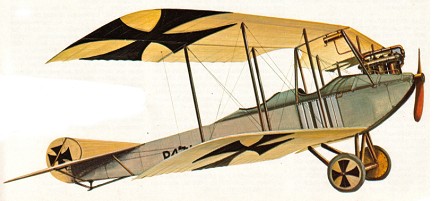
On the outbreak of the First World War, the company moved from Miffilhausen, which was near the Western Front, to Freiburg im Breisgau, on the other side of the Rhine. Here the B.I was designed, and flown in late 1914 (probably in November). A two seat biplane, it was powered by a 100 hp Mercedes D.1 six cylinder water cooled engine. A small series was built for the Imperial Air Service, supplementing the pre-war aircraft of similar design, one of which became the first aircraft to be shot down in air combat, on October 5, 1914.
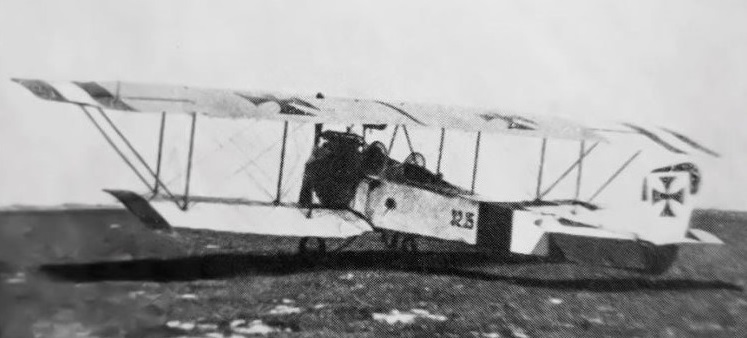
During the winter of 1914 15 the company’s Austro Hungarian subsidiary, Osterreichisch Ungarisch Flugzeugfabrik Aviatik of Vienna, designed and went into production with a developed version, the B.II. Powered by a 120 hp Austro Daimler, this differed mainly from the B.I in having angular elevators and rudder with large horn balances; it could also carry two 10 kg (22 lb) bombs, but guns were not originally fitted. Limited production, designated Serie 32, was undertaken for the Austro Hungarian Flying Service, and from about April 1915 the B.II was an observation machine on the Russian Front.
B.II Series 32
In the spring of 1915 production switched to the more powerful B.III, with a 160 hp Austro Daimler with the radiator repositioned above the cylinders. The wings were larger, with swept back tips, and pilot and observer sat in a single large cockpit, the observer having a rifle or often a 7.92 mm Schwarzlose machine gun either on an infantry tripod or a spigot mounting on the upper longerons. The B.III had a sluggish response to control, so production reverted to the Serie 34, which was virtually a B.II with the 160 hp engine (but B.II side radiator) and machine-gun; most Serie 33 (B.III) and Serie 34 had racks for three 10 kg bombs. Hundreds were delivered, but by 1916 they were all being relegated to training.
Span: 14.00 m (45 ft 11 in) Length 8.00 m (26 ft 3 in) (small variations according to sub type) Gross weight (B.I) 860 kg (1900 lb) Gross weight (B.II) 870 kg (1918 lb) Maximum speed (all): 110 km/h (68 mph) approx
Zentral-Aviatik Und Automobil Gmbh Oesterreichische-Ungarische Flugzeugfabrik Aviatik Automobil and Aviatik AG. was founded at Mülhausen (today in France) in 1910 by the Alsatian Georges Chatel, relocating to Freiburg in 1914 and to Leipzig in 1916. An Aviatik biplane crashed as early as June that year, but company named Aviatik in 1911. Automobil und Aviatik AG established a subsidiary in Vienna as Österreichisch-Ungarische Flugzeugfabrik Aviatik.
The Austro-Hungarian subsidiary also produced a number of its own designs, including fighters such as the D.I.
Made French Farman biplanes and Hanriot monoplanes, but developed original types also. From 1912, the factory started building its own successful biplanes, designed by Robert Wild. On outbreak of war in 1914 transferred works from Mulhausen, Alsace, to Freiburgim-Breisgau. Developed B.I reconnaissance aircraft from earlier Pi 5. Although unarmed, B I was used operationally. C.I-C.III series (1915 onwards) were armed, and reversed earlier pilot-at-back arrangement. C.III used for bombing also. Company also made a few twin-engined Gotha bombers before working on larger R types.
Designed postwar civil aircraft, but activities ceased 1919 under the Treaty of Versailles, and a new company formed to take over the concern, which went into liquidation.
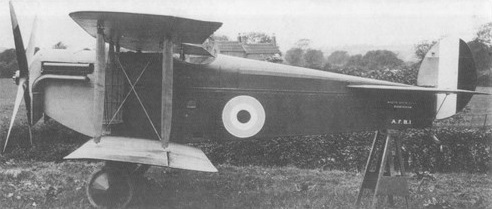
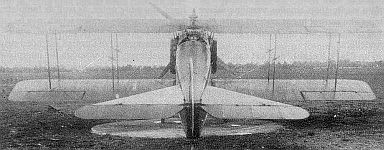
The A.F.B.1 pictured outside Austin’s Longbridge works
Albert Ball’s interest in fighter aircraft design predated his first aerial victory. As early as 14 April 1916, he had written home to his father about the plans for a new fighter “heaps better than the Hun Fokker”, although he made no claim that the plans were his own work. In a further letter he remarked that he could not post the plans, and was carrying them home the next time he received leave. Some writers have taken this to be an early reference to the design that eventually emerged as the A.F.B.1 (Austin Fighting Biplane); this has been since largely discounted, among other reasons because the A.F.B.1 was designed around the new Hispano-Suiza engine, which places the commencement of serious design at sometime after August 1916.
It would be six months before Ball received his leave; it seems to have been during this period he began drawing up his own ideas for specifications for a single-seat fighter aircraft; these he mailed to his father.
The Austin Motor Company was one of several firms not part of the pre-war aircraft industry to receive contracts to build aircraft for the war effort. An early contract for examples of the R.E.7 was followed by substantial contracts for the R.E.8 and the S.E.5a. Austins also opened their own design office sometime in late 1916; although several war-time Austin designed aircraft were built as prototypes none received production orders. The first of these was the A.F.B.1.
Albert Ball Sr, was (or had been) on the Board of Directors of Austins, and was certainly in a position where he might have presented plans for new aircraft to the company. The position of Ball’s biographer Colin Pengelly seems to be that he most certainly did present his son’s ideas and drawings to the company, and that these formed at least the basis of the design of the A.F.B.1. Whatever the nature and extent of Ball’s input, the bulk of the design work was carried out at Austins, under the leadership of C. H. Brooks.
Ball arrived on home leave on 5 October 1916, prior to taking up duty in England. By this time, Ball had scored 31 aerial victories, and was by far the most famous pilot in the RFC. In addition to his contacts with Austins, he used his celebrity to contact Sir David Henderson, Director-General of Military Aeronautics about the proposed fighter; Ball subsequently also lobbied General Sefton Brancker.
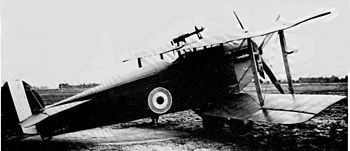
On 1 December 1916, events had progressed to the point of the War Office formally requesting technical data from the motor company. Ball visited the Austin works that month. He recommended arming the plane with two Lewis guns mounted on the centre section, and firing above the plane’s propeller; however, this arrangement was replaced by an installation patented by Herbert Austin, in which a Vickers machine gun fed by a 500 round belt of ammunition fired through a hollow propeller shaft, (A Lewis gun seems to have been actually mounted in this position in the prototype as completed). A supplementary Lewis gun stocked with four 97-round magazines was in the event mounted on the centre section. He also added a note at the end of the specifications sheet, dated 8 December 1916, that the finished plane should have “neutral flying characteristics”.An internal memo critiqued the proposed design, with an eye toward its fitness for production. It was noted that, in an attempt to lower the plane’s weight and thus increase its performance, it would only carry fuel enough for two hours running at full throttle. The relatively high design wing loading of 7 pounds per square foot might increase speed, but decrease manoeuvrability. Mounting of the engine exhaust pipes alongside the cockpit would hinder downward view, (In the event shorter exhausts were fitted, that discharged forward and downwards). The A.F.B.1’s “vaguely Germanic” appearance was also criticised. An endorsement atop the memo noted that Ball was to see Sefton Brancker.
On 13 February 1917, after Ball had seen Brancker, Austins requested a formal contract to produce the new fighter. It was issued soon after, for the fabrication of a pair of prototypes, although only one prototype was allocated a serial number, and this seems to have been after it was completed: suggesting it had been started, at least, as a private venture.
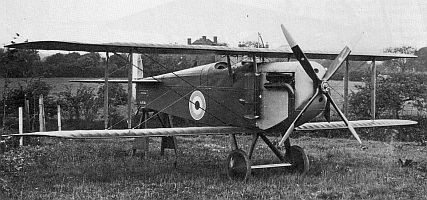
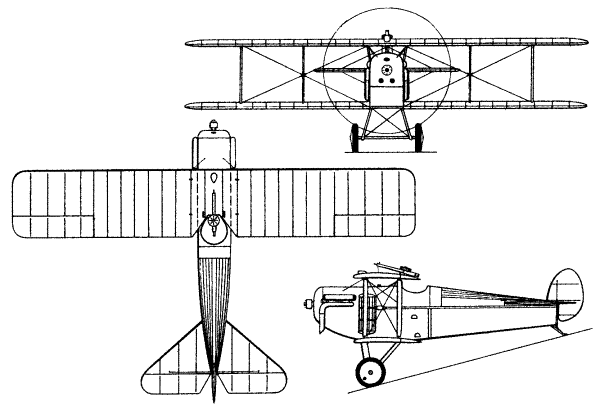
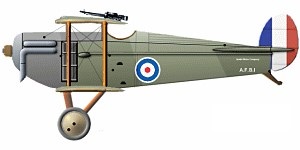
The A.F.B.1 was a biplane with un-staggered, equal-span wings. They had no dihedral but were slightly swept. The tailplane was triangular in shape – the rudder was small and balanced, with no vertical fin.
While the fuselage was of conventional construction it was deep, almost filling the gap between the planes. The dimensions of the fuselage made for a fairly clean engine installation – but the radiators were attached to the fuselage sides. Either could be bypassed to limit loss of coolant in the event of battle damage. An advanced feature was that the controls were operated by rods mounted within the airframe rather than cables carried externally. The small gap between the top wing and the fuselage gave the pilot excellent visibility above, but existing photographic evidence points to a fixed gun pointing up at a slight angle to clear the propeller arc. At the time Ball returned to combat on 6 April 1917, the prototype was still unfinished. Construction of the prototype was not completed until after Ball’s death; its first flight taking place on 27 July 1917.
Only a single prototype was built, assigned the serial number B9909, official flight testing started in July 1917 at RAF Martlesham Heath. Performance was excellent – it had about the same speed as the S.E.5a, but climbed rather better. The only complaints about its handling were of rather poor lateral control.
A.F.B.1 at Martlesham
The S.E.5a was by this time already in production, and was proving itself an excellent service type – it was however in chronically short supply, and this situation could only have been exacerbated by an attempt to introduce a new type that would have competed with it for production facilities (Austins already had a large SE.5a contract) and engines (since both fighters used the Hispano-Suiza 8, of which there was at this stage a severe shortage). The A.F.B.1 therefore had no real chance of being accepted for a production order.
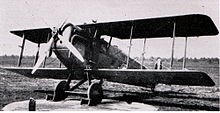
A photograph of an A.F.B.1 exists with straight SPAD-type wings, complete with the usual SPAD mid-bay reinforcing of the interplane bracing. They may well have been a pair of SPAD S.7 wings. Nothing is known about when and why this modification was tried, or if it improved the characteristics or performance of the machine in any way.
Austin-Ball A.F.B.1 with Spad style wings
At the end of October 1917, the testers at Martlesham Heath were instructed to remove the A.F.B.1’s engine and ship it to Ascot by train. The fate of the aircraft after that is not reported.
Engine: 1 × Hispano-Suiza 8, 200 hp (150 kW) Propeller: 4-bladed wooden fixed-pitch Wingspan: 30 ft (9.14 m) Wing area: 290 sq ft (27 m2) Length: 21 ft 6 in (6.55 m) Height: 9 ft 3 in (2.82 m) Empty weight: 1,525 lb (693 kg) Gross weight: 2,075 lb (941 kg) Fuel capacity: 31.5 imp gal (143 l; 37.8 US gal) Oil capacity: 5 imp gal (23 l; 6.0 US gal) Water capacity: 9 imp gal (41 l; 11 US gal) Maximum speed at sea level: 138 mph (222 km/h; 120 kn) Maximum speed at 10,000 ft (3,000 m): 126 mph (203 km/h; 109 kn) Endurance: 2 hr 15 min Service ceiling: 22,000 ft (6,706 m) Rate of climb: 1,120 ft/min (5.7 m/s) Time to altitude: 10,000 ft (3,000 m) in 10 minutes Wing loading: 7 lb/sq ft (34 kg/m2) Power/mass: 0.108 hp/lb (0.177 kW/kg) Armament 2 × fixed, forward-firing 0.303 in (7.70 mm) Lewis guns Crew: 1
The Austin Motor Company Limited was an English manufacturer of motor vehicles, founded in 1905 by Herbert Austin.
Centered at Northfield, Birmingham, Warwickshire, Austin Motor Company (1914) Ltd engineering company became a War Office contractor for airplanes during the First World War, building over 2,000 subcontract aircraft. In 1917 the aircraft department, managed by J. D. North (best known for his later Boulton Paul associations) contemplated aircraft of original design. The Austin-Ball A.F.B.1 (fighter) and Osprey (1918) was a triplane single-seater designed by C. H. Brooks; the Greyhound two-seat fighter was flown after the Armistice; and civil types were the Kestrel side-byside two-seater (awarded 2nd prize in an Air Ministry competition) and the tiny Whippet single-seater, for which high hopes were entertained but only five were built. Aircraft activities ceased 1920, but in 1936 the “shadow factory” scheme ensured that the Austin name once again had aircraft connections. Production of Fairey Battles began October 1937; first aircraft tested July 1938.
In 1952 it was merged with Morris Motors Limited in the new holding company British Motor Corporation (BMC) Limited, keeping its separate identity. The marque Austin was used until 1987. The trademark is currently owned by SAIC after being transferred from bankrupt subsidiary Nanjing Automotive which had acquired it with MG Rover Group in July 2005.

 All Aero