UK
Barclay, Curie & Company of Whiteinch, Glasgow, built 100 Royal Aircraft Factory B.E.2es under subcontract. Order also received for the construction of 50 Fairey F.22 Campania two-seat patrol seaplanes in 1917.
World War 1
Baldwin DN-1 / Connecticut Aircraft Corp DN-1
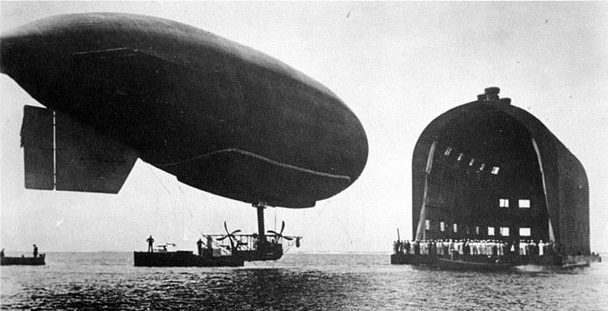
The DN-1 was the US Navy’s first airship. Captain Mark L. Bristol, the second Director of Naval Aviation, supported the development of the dirigible in the anti-submarine role. Victor Herbster, Holden Richardson and LCDR Frank McCrary drew up the specifications for the DN-1. The contract was awarded on 1 June 1915 to the Connecticut Aircraft Company of New Haven, CT. The U.S. Navy had no experience with airships and it seems neither had any of the principles of Connecticut Aircraft Company. They were a lawyer who was the financial backer, a amusement park owner who acted as manager; the technical staff was an Austrian, Hans Otto Stagel, who claimed to be a dirigible pilot and a German engineer and mechanic, who claimed to be Zeppelin experts. Jerome Clarke Hunsaker of MIT and his assistant Donald Wills Douglas, later founder of the Douglas Aircraft Company, aided the Connecticut Aircraft Company in the design of DN-1. The Chief Engineer was James F. Boyle and the Production Manager was J.J. DeLunay. The civilian inspector and designer was Thomas Scott Baldwin and the resident Navy inspector was Frank M. McCrary.
The DN-1 envelope was made of two layers of cloth, with rubber between them. The outer layer of fabric was yellow to prevent deterioration caused by light. The gondola control car, built by George Lawley & Son of Dorchester, Massachusetts, was a large rectangular box with two four-bladed propellers on outriggers. There were originally two engines, built by the B. F. Sturtevant Company of Hyde Park, MA, were mounted in the open gondola, and the propellers could be swiveled to provide thrust in either the horizontal or vertical planes. A 1-1/2 hp Indian engine was provided to maintain air pressure in the two ballonets when the engine was not running. The gondola was water-tight as the Navy intended to operate the DN-1 off water. The specification for the DN-1 provided for being capable of being moored to a mooring mast which had first been used with HMA No. 1 in 1911. The DN-1 was photographed beside a mooring mast but there appears to be no evidence it was ever moored to it.
The DN-1 was announced in the press before its flight program. The DN-1 was shipped to Pensacola, Florida, in late 1916 and assembled in a floating hangar constructed for it. The day of the planned first flight, the DN-1 was removed from its hangar, only to lose lift and sink. Crew member Petty Officer James F. Shade, up to his chin in the water, invited spectators to come aboard for “the first submerged flight of the DN-1.” The DN-1 was returned to its hangar and lightened. One step take to lighten the DN-1 was the removal of one engine.
When the test program began on 20 April 1917 the DN-1 was a disappointment. DN-1 lacked lift, barely met the speed requirement of 35 miles per hour (56 km/h) and the transmission overheated, melting the bearings. The DN-1 was piloted for its first flight by LCDR Frank M. McCrary USN, LT Stanley V. Parker assisted by PO Jimmy Shade. It was 27 April before the airship flew again. Two days later the handling party which was attempting to tow the airship across the water damaged the DN-1.The Navy decided that the airship was not worth repairing and the DN-1 was scrapped. The “The Rigid Airship Manual (GPO, 1928) commented upon the DN-1 “was so overweight that it could barely lift itself off the ground. It’s envelope leaked and the power plant functioned badly. It did, it did, however, actually fly and since the firm had built the ship in good faith and at a cost greatly in excess of the contract price[$45,636], it was formally accepted.”
The DN-1 forced the Navy to take a more effective approach to following airship development depending upon more reliable contractors and closer involvement of the Navy in design and management. The subsequent B, C, and D-Class airships were quite successful.
After its demise the DN-1 came to be considered the A class. Such designation was never officially used by the Navy, nor was it used during DN-1’s short life.
Engine: 1 × Sturtevant Model 5, 140 hp (104 kW)
Length: 175 ft 0 in (53.51 m)
Diameter: 35 ft 0 in (10.67 m)
Volume: 115,000 ft3 (3256.4 m3)
Maximum speed: 35 mph (56 km/h)
Babcock Potlatch Bug
The 1916 Potlatch Bug was a single place, open cockpit biplane, built as an exhibition plane for motion picture work. One example was built, powered by a 50hp Adams-Farwell rotary.
Avro 533 Manchester
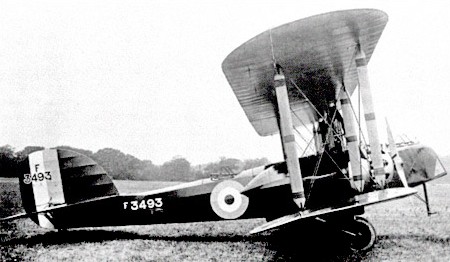
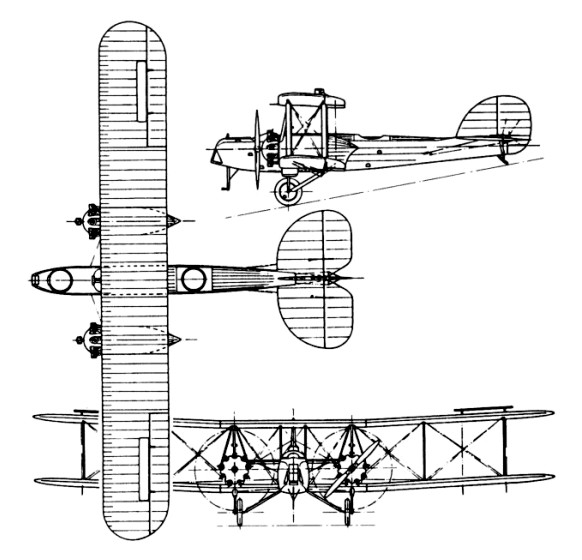
First flown in December 1918, and too late to participate in the war, the Avro 533 Manchester represented a final development of the Avro 523/529 concept. Generally similar to the Avro 529A, with the engines mounted on the lower wing, the design incorporated some refinements including a deeper fuselage, balanced ailerons, and an improved tail unit. The 533 had been designed around the A.B.C. Dragonfly radial engines. When these failed to materialise through development problems, two 300 hp / 224 kW Siddeley Puma were installed, the result being designated Avro 522 Mk.II. Thus, the Mk.II was to fly before the Dragonfly-engined Avro 533 Mk.I.
Both versions flew well in official tests but with the end of the war neither were produced.
A Mk.III was planned with 400 hp / 298 kW Liberty engines, but although the fuselage was completed, the engines were not installed.
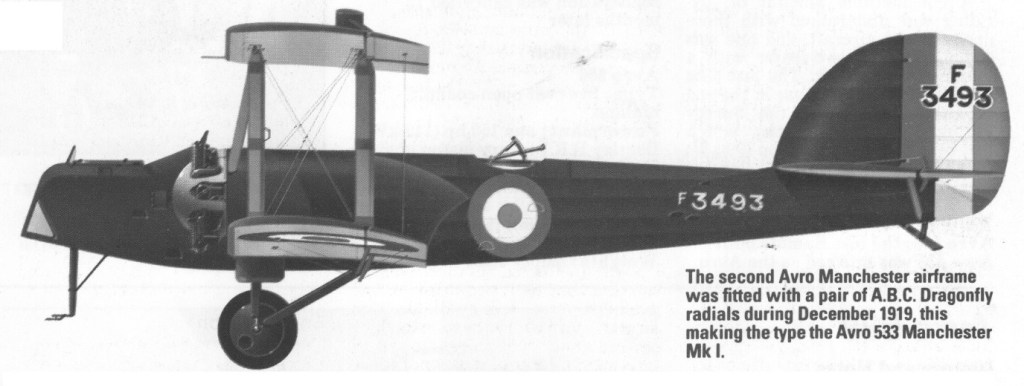
Avro 533 Mark I
Engine: 2 x 320hp ABC Dragonfly I
Wingspan: 18.29 m / 60 ft 0 in
Length: 11.28 m / 37 ft 0 in
Height: 3.81 m / 13 ft 6 in
Wing area: 75.53 sq.m / 813.00 sq ft
Take-off weight: 3355 kg / 7397 lb
Empty weight: 2219 kg / 4892 lb
Max. speed: 209 km/h / 130 mph
Climb to 10,000 ft / 3050 m: 14 min 20 sec
Ceiling: 5791 m / 19000 ft
Endurance: 5 hr 45 min
Crew: 3
Armament: 2 x 7.7mm machine-guns, 400kg of bombs
Avro 531 Spider
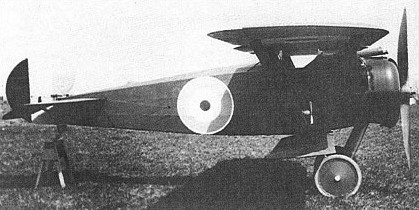
Designed by Roy Chadwick, the Avro 531 Spider was an unsponsored private-venture single-seat fighter. The Spider used a number of Avro 504 components and had a fabric-covered wooden structure with Warren-girder steel-tube interplane struts.
Originally the Spider was powered by a 110hp Le Rhone 9J nine-cylinder rotary engine and flown for the first time in April 1918. Overall performance was not sufficiently in advance of the Sopwith Camel to warrant quantity production. Armament was one fixed synchronised 7.7mm Vickers machine gun, and a 130hp Clerget 9B rotary was later fitted.
The Spider prototype ended its days in the experimental role.
Engine: 130hp Clerget 9B rotary
Wingspan: 8.68 m / 29 ft 6 in
Length: 6.25 m / 21 ft 6 in
Height: 2.38 m / 8 ft 10 in
Wing area: 17.55 sq.m / 188.91 sq ft
Take-off weight: 688 kg / 1517 lb
Empty weight: 437 kg / 963 lb
Max. speed: 193 km/h / 120 mph at SL
Climb to 5000 ft / 1525 m: 4 min
Service ceiling: 19,000 ft / 5970 m
Range: 250 mi
Armament: 1 x Vickers 0.303 in mg

Avro 530

The Avro 530 two-seat fighter was designed in 1916 to compete with the Bristol F.2A, and the first prototype was first flown in July 1917. Powered by a 200hp Hispano- Suiza 8Bd eight-cylinder water-cooled engine, the Avro 530 was of wooden construction with fabric skinning, and mounted an armament of a single fixed and synchronised 7.7mm Vickers gun, a 7.7mm Lewis gun was mounted on a Scarff ring in the rear cockpit.
Performance of the Avro 530 proved to be good, but not sufficiently on that of the Bristol F.2A to warrant production orders and priority in the supply of the Hispano- Suiza engine was being given to the S.E.5a. During 1918, one of the two Avro 530 prototypes was flown with a 200hp Sunbeam Arab engine, revised undercarriage, an extended tail fin and flapless wings of new section with long-span ailerons, but development was subsequently abandoned.
Engine: 200hp Hispano- Suiza 8Bd eight-cylinder water-cooled
Take-off weight: 1216 kg / 2681 lb
Empty weight: 769 kg / 1695 lb
Wingspan: 10.97 m / 36 ft 0 in
Length: 8.69 m / 29 ft 6 in
Height: 2.92 m / 10 ft 7 in
Wing area: 30.23 sq.m / 325.39 sq ft
Max. speed: 183 km/h / 114 mph
Time to 10,000 ft / 3050 m: 15 min
Service ceiling: 18,000 ft
Endurance: 4 hr
Armament: 1 x Vickers 0.303in / 7.7mm mg, 1 x Lewis 0.303in / 7.7mm mg

Avro 529

While the Admiralty had not placed an order for the Avro 523 Pike there was some interest in the Potential of the aircraft. During 1916, two prototypes were ordered for evaluation in a long-range bombing role and were in effect slightly larger version of the 523. Apart from dimensional changes, the wings were made to fold, from jus outboard of the engines, the tail unit was revised, and the powerplant of the first completed, as Avro 529, comprised two counter-rotating Rolls-Royce Falcon engines, mounted between the wings and driving tractor propellers. The second prototype, the Avro 529A, was similar except for the installation of two 230 hp / 172 kW Galloway-built B.H.P. inline engines mounted on the lower wing, and a revised fuel system. Forward-looking features of the design provided the front gunner / bomb aimer with dual controls, plus Gosport tube communication with the pilot so that he could guide him during a bombing attack. However, performance was not good enough, and only the two prototypes were built.
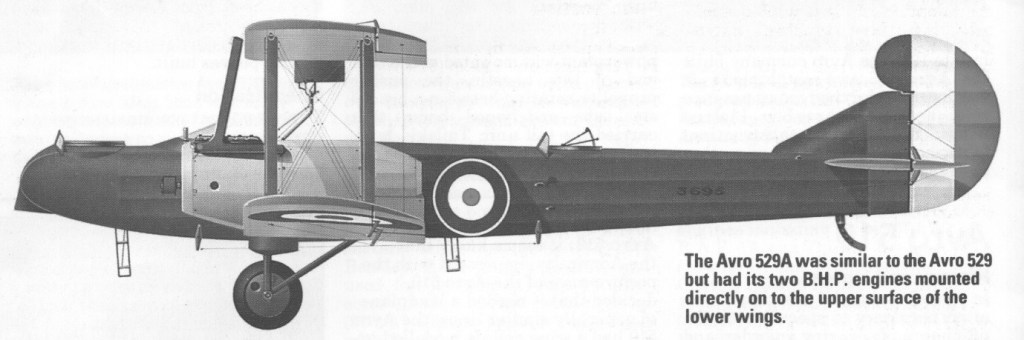
Avro 529
Engine: 2 x 190hp Rolls-Royce Falcon I water-cooled in-line
Take-off weight: 2864 kg / 6314 lb
Empty weight: 2150 kg / 4740 lb
Wingspan: 19.20 m / 63 ft 0 in
Length: 12.09 m / 40 ft 8 in
Height: 3.96 m / 13 ft 0 in
Wing area: 85.70 sq.m / 922.47 sq ft
Max. speed: 153 km/h / 95 mph
Ceiling: 4115 m / 13500 ft
Armament: 2 x 7.7mm machine-guns
Crew: 3
Avro 529A
Engines: 2 x BHP inline piston, 230 hp
Length: 39.67ft (12.09m)
Width: 62.99ft (19.20m)
Height: 12.99ft (3.96m)
Empty Weight: 4,736lbs (2,148kg)
Maximum Take-Off Weight: 6,310lbs (2,862kg)
Maximum Speed: 95mph (153kmh; 83kts)
Maximum Range: 360miles (580km)
Rate-of-Climb: 715ft/min (218m/min)
Service Ceiling: 13,501ft (4,115m)
Armament:
Standard:
1 x 7.7mm (0.303 caliber) Lewis machine gun on trainable mount in nose cockpit.
1 x 7.7mm (0.303 caliber) Lewis machine gun on trainable mount in rear dorsal cockpit.
Optional:
20 x 50lb conventional drop bombs. Up to 1,000lbs of bombs.
Accommodation: 3
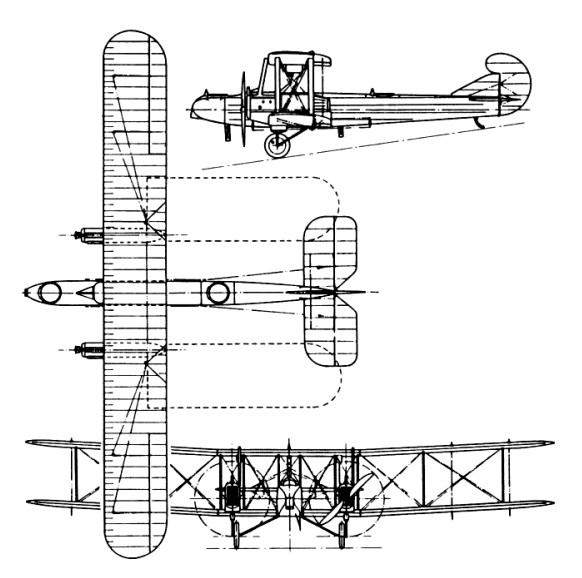
Avro 528
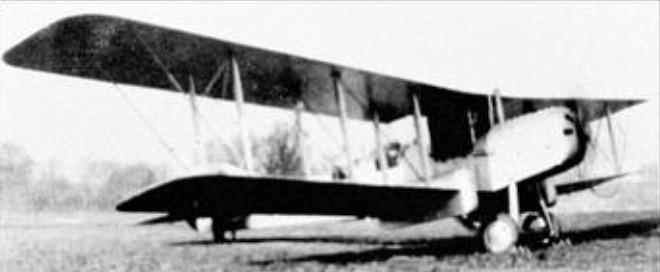
The Avro 528 was a two-seat single-engined biplane ordered by the Admiralty in 1915, and not even the task for which it was intended is recorded. It had some similarities with the Avro 519 (a single seater intended for the RFC) and the twin-seat 519A, built for the RNAS, though neither of these were armed and both had 150 hp Sunbeam Nubian engines rather than the 225 hp Sunbeam of the 528. Both the 519s and the 528 had some shared features with the Naval Avro 504.
It was a large three bay biplane with unswept, unstaggered and constant chord wings of unequal span, the lower plane having a span 10 feet 0 inches (3.05 m) less than the upper. Ailerons were carried on the upper wings; both wings folded for storage. The fuselage had similarities with the Naval 504s though the overall length of the 528 was greater by about 4 feet (1.2 m): both had a generous fixed fin in contrast to the all moving, comma shaped rudder of the RFC’s 504s. The vertical stabiliser was also close in size to that of the 504, but the rather rectangular horizontal tail was nearly 60% greater in span. Like the 519s, the top of the fuselage carried a raised decking that provided deeper cockpits for the pilot, placed under the trailing edge of the wing and the observer/gunner, in a separate cockpit close behind equipped with a ring mounted gun. The fixed single axle undercarriage had no central skid.
The Sunbeam engine drove a four-bladed propeller and had a single, central and near vertical exhaust pipe. There were two radiators, mounted edge on (longitudinally) between the wings, rather than the single but similarly mounted radiators of the Avro 519s and the Avro 527. Two tank-like features are shown in both image and diagram on the lower wings just inboard of the innermost interplane struts; they may be fuel tanks.
The first flight was on 19 December 1916 at Avro’s Hamble factory. The aircraft remained troublesome, with a variety of propellers being tried but the Admiralty lost interest and the 528 last flew in April 1917.
Engine: 1 × Sunbeam, 250 hp (187 kW)
Wingspan: 65 ft 0 in (19.82 m)
Length: 33 ft 8 in (10.26 m)
Gross weight: 5,509 lb (2,504 kg)
Crew: 2
Armament: 1× 0.303 in (7.7 mm) Lewis machine gun in rear cockpit provision for bombs in nacelles under lower wing
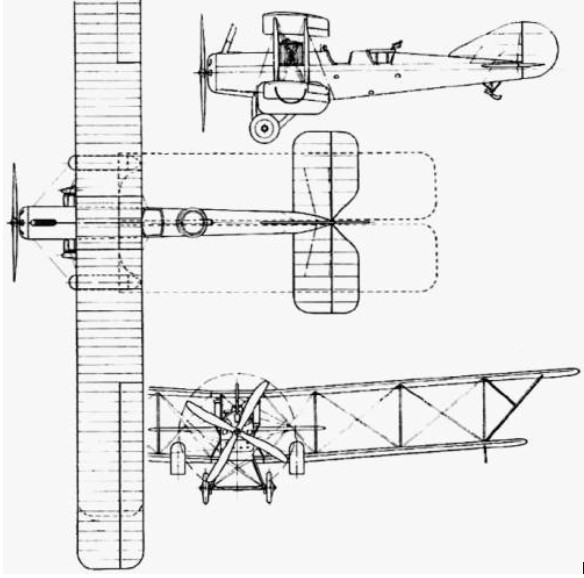
Avro 527
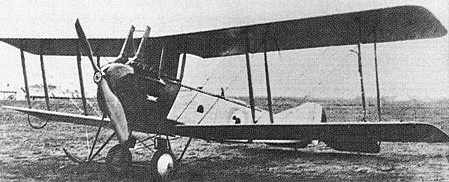
The two-seat Avro 527 fighter was built for the RFC and flown for the first time early in 1916 with a 150hp Sunbeam Nubian eight-cylinder water-cooled engine. The mainplanes, undercarriage and tail assembly, were basically similar to those of the Avro 504, but the fuselage differed. Proposed armament consisted of a single free-mounted 7.7mm Lewis gun in the rear cockpit. The Avro 527 displayed a poor climb rate and the pilot’s forward view was impaired by the twin exhaust stacks of the Nubian engine. Only one prototype was completed, and development was discontinued during the course of 1916, a version with a longer-span wing, the 527A, also discontinued at the same time.
Engine: 150hp Sunbeam Nubian eight-cylinder water-cooled
Wingspan: 10.97 m / 36 ft 0 in
Max. speed: 166 km/h / 103 mph
Avro 523 Pike
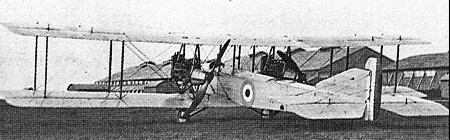
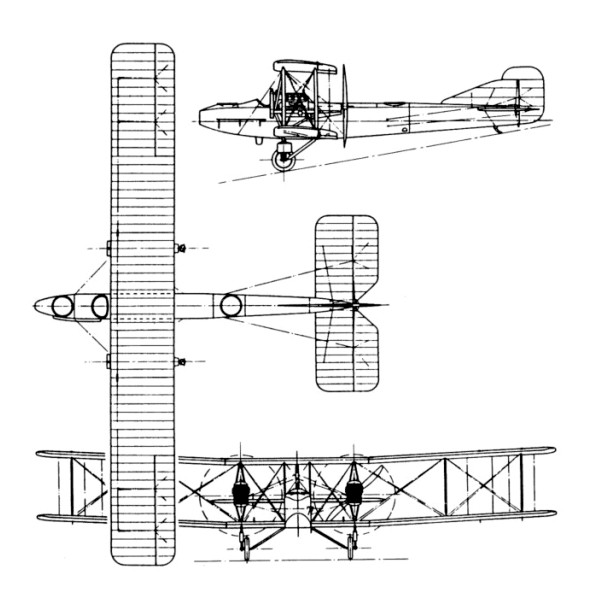
The Pike three-seat twin-engined biplane was designed primarily to meet an Admiralty requirement for a long-range escort and anti-airship fighter. Of wooden construction with fabric skinning, the first prototype Pike had two 150hp Sunbeam eight-cylinder liquid-cooled engines mounted as pushers driving two-bladed propellers via extension shafts and was flown for the first time in May 1916.
The pilot was seated just ahead of the mainplanes with gunners’ cockpits, each with a free-mounted 7.7mm Lewis, fore and aft. A second Pike, the Avro 523A, differed by having two 150hp Green six-cylinder liquid-cooled engines driving tractor propellers and a Scarff-type ring mounting for the forward Lewis gun. No production of the Pike was ordered following completion of official trials.
Avro 523
Engine: 2 x 160hp Sunbeam Nubian
Take-off weight: 2751 kg / 6065 lb
Empty weight: 1814 kg / 3999 lb
Wingspan: 18.29 m / 60 ft 0 in
Length: 11.91 m / 39 ft 1 in
Height: 3.55 m / 12 ft 8 in
Wing area: 75.71 sq.m / 814.93 sq ft
Max. speed: 156 km/h / 97 mph
Avro 523 A
Engines: 150hp Green six-cylinder liquid-cooled
Wingspan: 18.29 m / 60 ft 0 in
Height: 3.55 m / 12 ft 8 in
Wing area: 75.71 sq.m / 814.93 sq ft
 All Aero