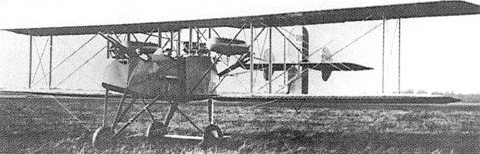
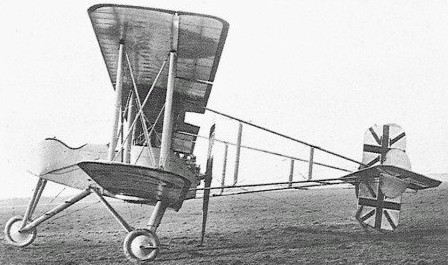
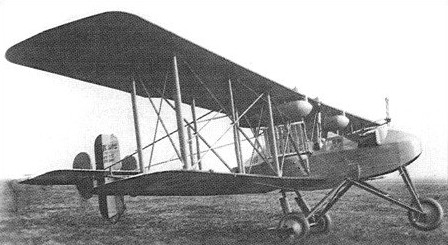
Developed during 1914 when French military planners began to express a preference for pusher- over tractor-configured aircraft, leading Breguet to cease further development of its original Type IV design and pursue military contracts with an aircraft of the preferred layout. The Bre.4 evolved indirectly from the BU3 two-seat twin-boom pusher biplane of late 1914 as a smaller and lighter development of its bomber derivative, the BUM (B=Breguet, U=Salmson engine and M=Michelin-built), the BUC (the letter “C” signifying Chasse) was intended primarily as a bomber escort. The Type IV was a two-bay, equal-span, unstaggered biplane that seated the pilot and observer in tandem open cockpits in a nacelle that also carried the pusher engine at its rear, and the tricycle undercarriage. As the prototype neared completion, the Breguet factory at Douai was threatened by the advancing German Army, and the machine and its builders were evacuated to Villacoublay where construction and testing were completed. At this point, André and Édouard Michelin approached the French government with an offer to sponsor the construction of 100 bombers for the Army, and were awarded a licence to the Breguet design. This was put into production as the BUM (B for pusher-driven, U for Canton-Unné-powered, M for Michelin), and later revised to the BLM as the definitive Renault-powered version. With the installation of a 220hp Renault 12Fb 12-cylinder water-cooled engine in place of the Salmson, prototype trials were performed in June 1915, a few additional aircraft being built under the designation BLC. Soon after the BUM had entered service, the French Army requested that an escort fighter version be developed to protect the bombers from interception. Breguet responded with a lightened design armed with a 37 mm (1.46 in) Hotchkiss cannon on a flexible mounting in the forward cockpit of the fuselage nacelle intended to pick off enemy fighters before they closed to within range of their machine guns. This entered production as the BUC (C for chasse, or pursuit) in its original 200hp Salmson Canton-Unné 14-cylinder radial powered version and BLC in its Renault version. Few of these escort fighters were built, as their performance and utility were discovered to be lacking, and the doctrine of the cannon-armed escort fighter was soon abandoned in favour of countering fighters with other similar fighters. A number of BUCs were also built for Britain’s RNAS using British engines. The performance of both the BUC and BLC versions of the Breguet de Chasse was unspectacular and, with fewer than 20 delivered, they were declared obsolete by the Aviation Militaire before the end of 1916. During that year, a 17 essentially similar aircraft were supplied to the Royal Naval Air Service. These differed from the BUC/BLC primarily in having the 225hp Sunbeam Mohawk 12-cylinder engine, armament being a single 7.7mm Lewis machine gun (which was an alternative weapon to the Hotchkiss on French machines). The RNAS was disappointed with the performance of the Breguet de Chasse, which proved unsuitable for employment in the fighting role, and the service withdrew the type from its first-line inventory in June 1916.
BLC Take-off weight: 1535 kg / 3384 lb Empty weight: 1160 kg / 2557 lb Wingspan: 16.40 m / 54 ft 10 in Length: 9.50 m / 31 ft 2 in Height: 3.70 m / 12 ft 2 in Wing area: 54.0 sq.m / 581.25 sq ft Max. speed: 138 km/h / 86 mph
Variants: Type IV (BU3) Breguet prototype. BUM (BrM2B.2) Michelin-built, Canton-Unné-powered bomber version. BLM (BrM4B.2) Michelin-built, Renault-powered bomber version. BUC Michelin-built, Canton-Unné-powered escort fighter version. BLC Michelin-built, Renault-powered escort fighter version. Breguet de Chasse Version of BLC for RNAS, powered by Sunbeam Mohawk or Rolls-Royce Falcon engine.
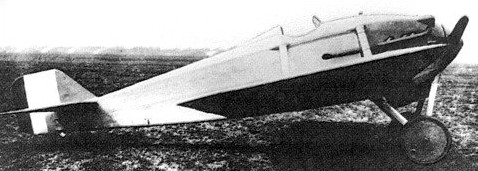
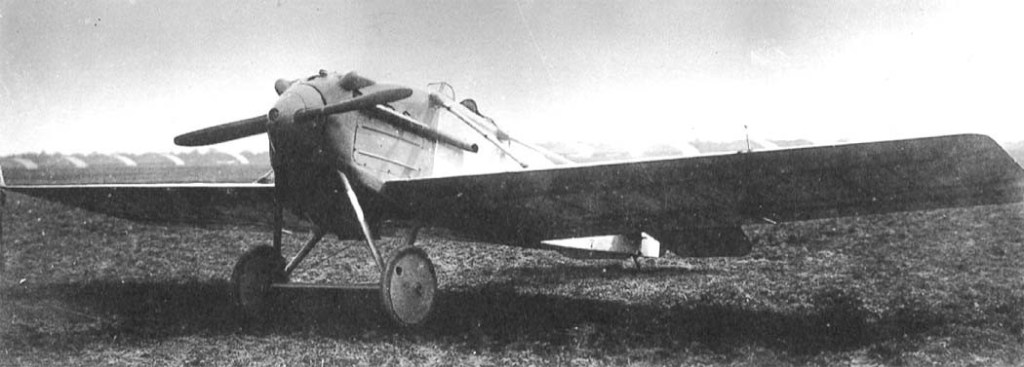
The Breguet LE (Laboratoire Eiffel) single-seat fighter monoplane was aerodynamically an advanced design with emphasis being placed on minimising drag in order to achieve high performance. The basis of the design was produced by the Director of the Laboratoire Eiffel in collaboration with the Breguet design staff, the Breguet company having overall responsibility for translating the basic concept into a prototype. The first prototype LE was fitted with a 180hp Hispano-Suiza 8Ab eight-cylinder water-cooled engine. Proposed armament consisted of a single 7.7mm Vickers machine gun totally enclosed within the fuselage, although this was never fitted. The LE made a short initial flight at Villacoublay in mid-March 1918, but the undercarriage failed on landing. After repairs, a further flight was made on 28 March, this terminating when the aircraft dived into the ground at full throttle, the pilot, Jean Saucliere, losing his life. Developments of the LE with a 220hp Lorraine-Dietrich and a 300hp Hispano-Suiza 8Fb were proposed, and construction of an airframe to take the latter power plant was nearing completion at the time of the loss of the first prototype, when further work was suspended.
LE Engine: 180hp Hispano-Suiza 8Ab Take-off weight: 700 kg / 1543 lb Empty weight: 495 kg / 1091 lb Wingspan: 9.78 m / 32 ft 1 in Length: 6.35 m / 21 ft 10 in Height: 2.00 m / 7 ft 7 in Wing area: 20.0 sq.m / 215.28 sq ft Max. speed est: 220 km/h / 137 mph
The Type 6 (Bre 6 Ca2) two-seat escort fighter of 1916 was a 225hp Salmson A9 water-cooled nine-cylinder radial engined counterpart of the Renault-powered Type 5, and resulted from a fear that Renault engine production would prove inadequate to meet demands. The Type 5 airframe was modified to take the Salmson engine mounted immediately above the rear undercarriage legs and driving the propeller by means of an extension shaft, the power plant being entirely enclosed. Armament of the Type 6 fighter normally consisted of a short-barrel 37mm Hotchkiss cannon in the forward fuselage. Performance, weights and dimensions were essentially similar to those of the Type 5.
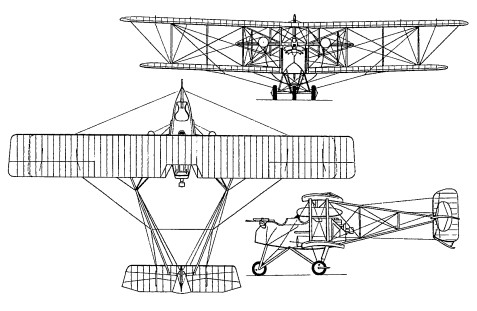
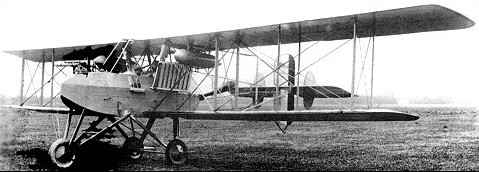
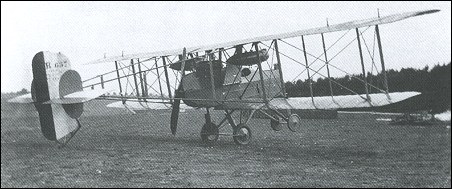
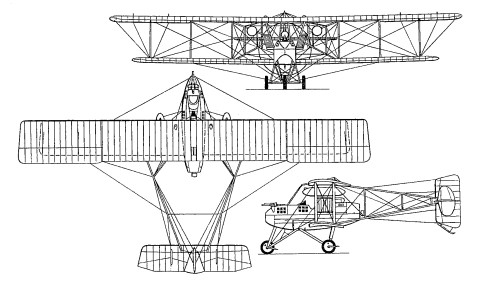
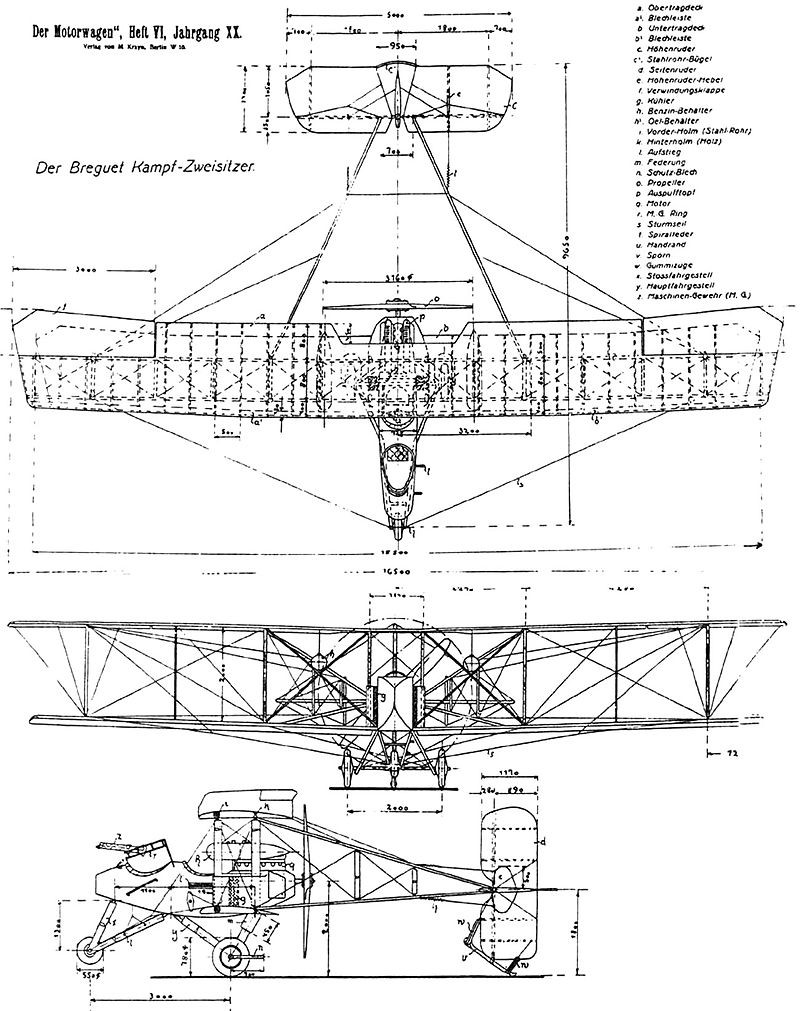
The relative success of the use of cannon in the Breguet BU.3 led the Breguet company to install it in their latest aircraft, the Breguet 5. This was a three-bay, unequal span biplane powered by a 225-hp Renault 12Fb engine. The tail section was the same as that of the Breguet BU.3, with four tail booms extending from the upper and lower wings. The Breguet Br.M5 series of biplane bomber was developed from the Breguet Br.M4 late in 1915 and was regarded by the Aviation Militaire as a two-seat escort fighter or reconnaissance-fighter.
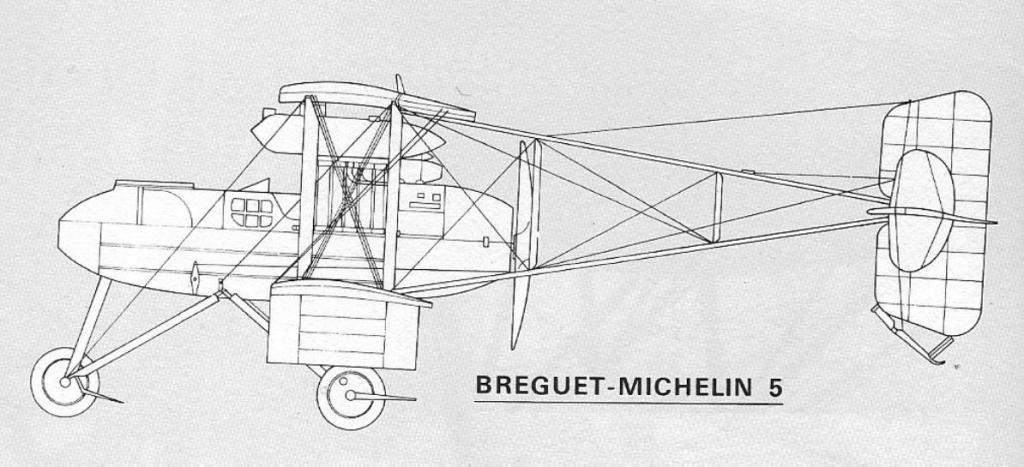
The Br.M5 was operated by a crew of two with the pilot seated in the middle of the aircraft and the gunner/observer to the front. The engine sat behind the crew area – directly behind the pilot and was a pusher driving a two-blade propeller. Design was with a bathtub-like fuselage, a static tricycle landing gear array and framework and cables leading out to the empennage.
The RNAS purchased 59 Breguet 5s from the Breguet factory and ordered an additional 3 from Graham-White Aviation Company (as Grahame-White Type XIX / G.W.19), but only 10 were ever built in Britain. Twenty-five of the Breguet 5s built in France had the 250-hp Rolls-Royce engine installed, the remaining models were powered by the 225-hp Renault engine.
In action, the Br.M5 was fielded primarily as a night bomber and used by both the French and English forces from 1916-1917 though it first appeared in the summer of 1915. The Type 5 fighter, or Bre 5 Ca2, never equipped a complete escadrille, a few aircraft of this type being issued to each of the units operating the Bre 5 B2 bomber version, for which it was expected to act as escort. Armament comprised a 37mm Hotchkiss cannon on a flexible mounting in the forward cockpit and a rear-firing 7.7mm Lewis gun on an elevated mounting over the leading edge of the upper wing. Eleven Type 5 fighters were operational with the Aviation Militaire by 1 February 1916, but the type was generally unpopular.
Bre.12
Breguet Br.M5 Engine: 1 x Renault 12Fb, 220hp or 1 x Rolls-Royce Eagle, 250hp. Wingspan: 17.50 m / 57 ft 5 in Length: 9.90 m / 33 ft 6 in Height: 3.90 m / 12 ft 8 in Wing area: 57.70 sq.m / 621.08 sq ft Take-off weight: 1890 kg / 4167 lb Empty weight: 1350 kg / 2976 lb Max. speed: 133 km/h / 83 mph Service Ceiling: 11,483ft (3,500m; 2.2miles) Armament: 1 x 7.7mm Lewis machine gun or 1 x 37mm cannon in forward observer/gunner position. Accommodation: 2 Hardpoints: 2
Breguet-Michelin 5 Engine: Renault, 220 hp Wingspan: 57 ft 8 in Length: 26 ft 1 in Max weight: 4235 lb Speed: 86 mph at SL Endurance: 5 hr Armament: 1 x mg, 1 x 37 mm cannon Bombload: 660 lb Crew: 2
Louis Breguet, founder of Societe Anonyme des Ateliers d’Aviation Louis Breguet in 1911, was a French pioneer of rotary-wing flight. The aircraft built by the Breguet brothers lifted a man off the ground on September 29,1907, but did not constitute a free flight. BU3 biplane bomber prototype of 1915 built under subcontract by Edouard and Andre Michelin as Breguet-Michelin BUM. Improved SN3 entered production with Michelin 1916 as BUC. Breguet 14 tractor biplane of 1917 was a significant French wartime bomber. Its successor, the Breguet 19 of 1921, remained in service until 1936. One specially prepared Breguet 19 (Question Mark), flown by Costes and Bellonte, made first east-west aircraft crossing of North Atlantic September 1930. Built Short Calcutta flying-boat under license during 1930s as Breguet Bizerte. Breguet elected not to be included in nationalized industry 1936; his factories were, however, incorporated. Les Mureaux, CAMS, and part of Breguet formed SNCAN in 1938.
Regained some independence in 1939 through purchase of former Latecoere factories. Avions Marcel Dassault became major stockholder June 28,1967. Anglo-French company Societe Europeenne de Production de I’Avion Ecole de Combat et d’Appui Tactique (SEPECAT) formed between British Aircraft Corporation and Breguet Aviation 1966 to design and develop tactical support/advanced trainer. Built four 941 unpressurized cargo/passenger transports, which used deflected slipstream technique to give STOL capability, for French Air Force trials. Breguet Type 1150 Atlantic maritime patrol aircraft selected by NATO, with prototypes ordered 1959; production aircraft built internationally by Belgium, France, Germany, Netherlands, and U.S.A..
Avions Marcel Dassault had merged with Breguet Aviation on 14 December 1971 to become Dassault Breguet Aviation.
Societa Italiana Ernesto Breda The Societa Italiana Ernesto Breda was one of the largest members of Italy’s wartime aircraft industry, having plants at Sesto S. Giovanni (Milan), Torre Gaia (Rome), Apaulia and Brescia. Breda began the construction of aircraft in 1917. In the immediate post First World War years, when no production aircraft were being built, Breda concentrated on research and constructed a number of experimental aircraft, and began the construction of all-metal aircraft in 1922. Production aircraft have included Breda 15 two-seat lightweight sporting aircraft of 1930, Breda 25 and 28 training biplanes, and the Breda 33 two-seat sports monoplane of 1932, from which time production concentrated mainly on military aircraft. From the early ‘thirties this company was preoccupied with the development of ground attack aircraft, and two types were in production when ltaly entered the war, the Breda Ba 88 and the more elderly Ba 65.
Production orders far the Ba 88 were placed for the Regia Aeronautica and assembly lines were established by both Breda and 1.M.A.M. (Meridionali) with deliveries commencing late in 1938. Relatively poor performance and inadequate defensive armament resulted in the Ba 88 being taken out of production after only 105 aircraft had been built. In 1941 the Agusta concern substituted two 840-h.p. Fiat A.74 R.C.38 radials for the Piaggios, increased wing span and fuselage length, and began the construction of a small series under the designation Ba 88M. Only about three aircraft of this type were completed.
Filippo Zappata, responsible far the C.R.D.A. Cant series of bombers, joined the Breda design staff in 1941, and was subsequently responsible far several projects, few of which were actually built. His first design under Breda auspices was the Bz 301 long-range, all-metal medium bomber derived from the Cant Z.1018 but not built. The Bz 302 was a projected twin-engined heavy fighter of all-metal construction abandoned in favour of the Bz 303 night fighter. The Bz 303 was a sleek two-seat, low-wing monoplane of mixed construction with twin fins and rudders. The sole prototype was destroyed by the Germans.
Early Breda designations used prefix letters followed by numbers. But those numbers were duplicated and, in the case of the B.x series and M.1, do not appear to be consecutive with later Breda type numbers. Further duplication occurred when the designation B.1 was applied to an airliner conversion of a Breda-built Caproni Ca.5 bomber, B.1 having been previously applied to the Breda-Pensuit triplane.
Breda, itself, did not apply Ba. abbreviation to its designations, preferring the simpler Breda xx form (the familiar Ba. prefix was applied to Breda designations by the Ministero dell’Aeronautica and Regia Aeronautica). The Breda A.x numbers seem to be consecutive with later designations.
When Breda licenced-built aircraft, these usually retained their original designations. Examples are: the Caproni Ca.5 and Ca.44 bombers; the CAB C.1, C.2, SC.4, SC.5 light aircraft, etc. In other cases, where Breda modified an existing type, the designer’s name was simply added – as with the Breda Tebaldi-Zari fighter.
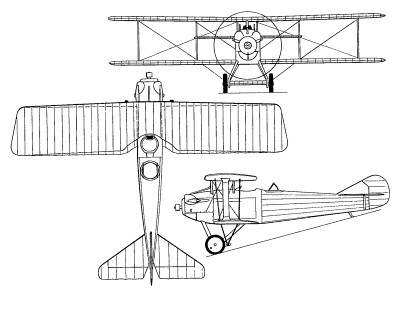
Designed by Charles Audenis and built by the Boncourt- Audenis-Jacob concern at Bron, the BAJ Type IV was a tandem two-seat fighter powered by a 300hp Hispano-Suiza 8Fb eight-cylinder water-cooled engine. The Type IV was armed with one synchronised 7.7mm Vickers machine gun and a pair of 7.7mm Lewis guns on a T.O.3 ring mounting in the rear cockpit. Of relatively clean design, with aerofoil-section single interplane struts and a close-cowled engine, the Type IV was officially ordered on 1 May 1918 by the Aviation Militaire. The first prototype was delivered to Villacoublay for official trials late in November 1918, but these were apparently delayed by the need for modifications which were undertaken by the Hanriot concern and completed on 28 January 1919. The first prototype was returned to the Boncourt-Audenis-Jacob concern for repairs in the summer of 1919, official trials being continued with a second prototype. No production order for the Type IV was placed and no specification for this type has apparently survived
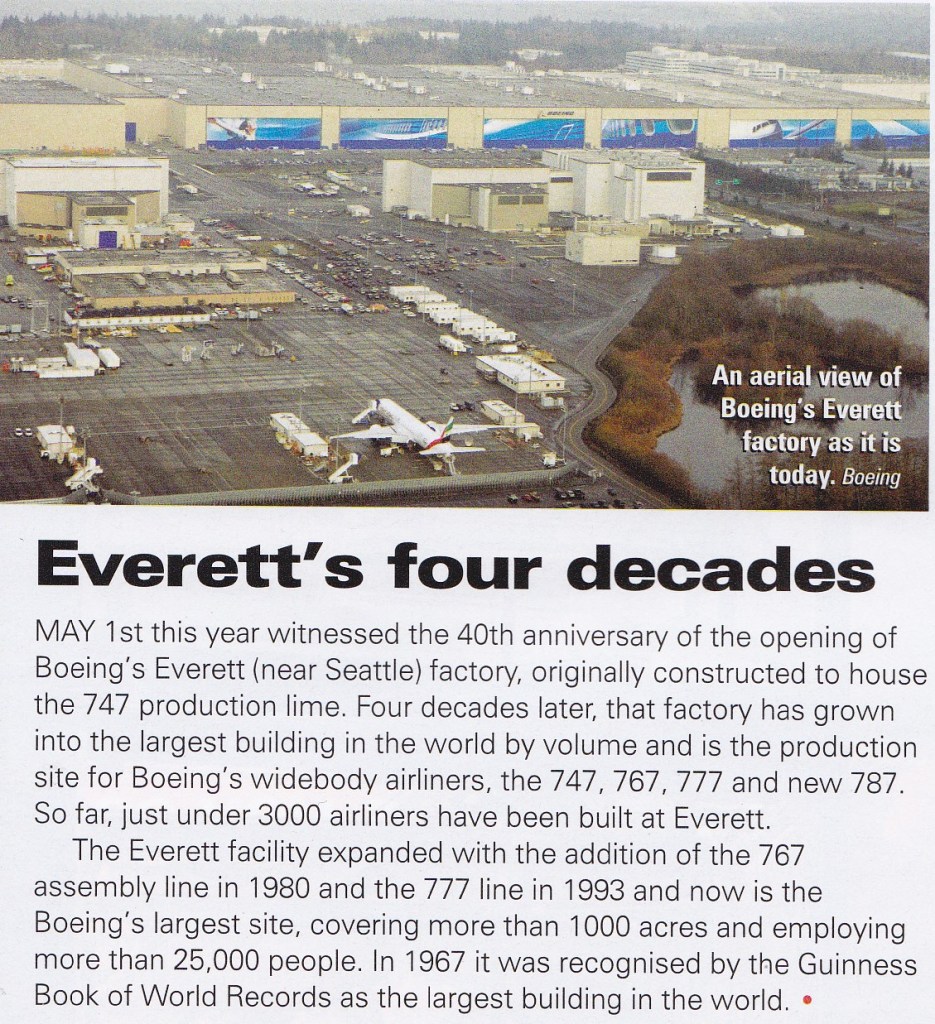
The first product, B & W Seaplane of 1916, was designed by William Boeing in conjunction with Conrad Westervelt. The company secured the first of many military contracts in June 1916, when it received an order from the Navy Department to build 50 HS-2L flying boats. First production order was for Model C seaplane trainer for U.S. Navy (first flown 1916), followed by Model EA land trainer of 1916 for U.S. Army. Name changed to Boeing Airplane Company April 26,1917. Improved Model C of 1918 was first mass-produced Boeing aircraft, built alongside Boeing-constructed Curtiss HS-2L flying-boats. First post-First World War design was the B-1 three-seat flying-boat (first flown December 1919), while in 1920 the first flight took place of the first of many Boeing-built DH-4s (based on British Airco D.H.4). Built ten U.S. Army-designed GA-1 armored ground attack triplanes (first flown May 1921) but just two GA-2s, followed by 200 Thomas-Morse MB- 3A pursuit aircraft (first flown 1922). The Boeing company has contracted with Thomas Morse to build the MB-3 fighter. With this experience Boeing undertook the development of their own PW-9 pursuit aircraft. Bid successfully for the San-Francisco-Chicago airmail route in 1927 and formed subsidiary Boeing Air Transport to operate the route. In 1928, Boeing Airplane and Transportation Corporation went pub¬lic and the stock sold quickly. As other airlines were acquired, this became Boeing Air Transport System. Merged with Pratt & Whitney, Standard Steel Propeller Co, and two small aircraft manufacturers to form United Aircraft & Transport Corporation in 1929. All continued to operate under original identities. Encouraged, Boeing formed the United Aircraft and Transport Corporation, which included Boeing Airplane Company, Pratt & Whitney, Chance Vought, Sikorsky, Hamilton Propeller, Pacific Air Transport. First real success with own-design military aircraft came in 1923, with the PW-9/FB-1 series, which had a fabric-covered welded-steel-tube fuselage. Other aircraft followed in quick succession, types of particular note including the Boeing Model 40, designed for carriage of airmail plus two (and later four) passengers, used by new Boeing Air Transport. Model 80 12-passenger transports with three Pratt & Whitney Wasp engines introduced by Boeing Air Transport in 1928. World’s first airline stewardesses introduced on these aircraft 1930. In 1929 Lloyd Stearman sold his Stearman Aircraft Company to the ‘United Aircraft and Transport Corporation’. Model 80A with more powerful Hornet engines and seats for 18 passengers followed. Biggest military order to that date (other than MB-3As) came in 1931, when U.S. Army ordered 135 P-12E single-seat fighters, and U.S. Navy 113 of the similar F4B-3: total of 586 aircraft in this series built by 1933 (prototype Model 83 for P-12 series had flown June 1928). Boeing Model 200 Monomail, mail/cargo aircraft, first flew May 1930; revolutionary aircraft with cantilever allmetal monoplane wing, retractable main landing gear and a specially designed antidrag cowling for its single Hornet engine. A second Monomail, Model 221, had six-seat passenger cabin. Military development of this aircraft resulted in YB-9 bomber (first flown April 1931), forcing evolution of new fighter types. Boeing produced P-26 single-seat all-metal monoplane fighter (first flown March 1932), of which 136 bought by U.S. Army. Biggest step forward came with the Model 247 (first flown February 1933), most advanced conception of a transport aircraft anywhere in the world at that time. Introduced wing and tail unit leading- edge de-icing, control surface trim tabs and, in production aircraft, controllable-pitch propellers and autopilot. It was the first twin-engined monoplane transport that could climb with a full load on the power of one engine. In 1934 legislation prevented aircraft and engine manufacturers from operating airlines. Boeing resigned as chairman, sold out his stock and the corporation was divided into three new companies in September 1934 United Air Lines to handle air transport, United Aircraft Corporation to take over the eastern manufacturing firms and Boeing Airplane Company to manage Western operations, together with Stearman, a wholly owned subsidiary. The name Boeing Airplane Company was readopted in 1948. In May 1961, following acquisition of Vertol in 1960, became known as The Boeing Company, which remained the name in 1999. Changes in the company structure took place in 1996, when on December 15 it was announced that a merger had been agreed with McDonnell Douglas. The two large organizations began operating as a single company from August 4,1997, under the Boeing name. Also in December 1996 Boeing purchased Rockwell International’s aerospace and defense units, these being retitled Boeing North American Inc. and subsequently becoming part of Boeing’s Space Systems business unit. Several internal restructures of the Boeing organization followed, the set-up comprising three main groups, namely, Information, Space, and Defense systems Group (ISDS), Boeing Commercial Airplane Group (BCAG), and Boeing Shared Services Group; the latter for information management and computing resources. Within ISDS are various business units comprising Aircraft and Missile Systems (to undertake Boeing’s military airplane and helicopter programs, plus oversee tactical missile development), Boeing Space Systems (to oversee Boeing’s space programs for DoD and NASA), Information and Communication Systems (programs include AWACS surveillance systems, communications systems and more), Phantom Works (a previous McDonnell Douglas unit for advanced research and development, with programs including research into hypersonic aircraft), and Business Resources. BCAG is headquartered at Renton but has units in various other locations. This group comprises Customer Services, Douglas Products Division (for manufacturing airliners that originated from McDonnell Douglas, such as the MD-80, MD-90, MD-11, and B717), Engineering Division, Fabrication Division (constructing components), Materiel Division (made responsible for materials and subcontracted components), Propulsion Systems Division (engine preparation for airliners), 737/757 Programs, 747/767 Programs, 777 Program, and Wichita Division (components and subassemblies). Significant military aircraft since the early 1930s have included the B-17 Flying Fortress bomber (first flown July 1935), of which 12,731 examples were built; B-29 Superfortress bomber (first flown September 1942); B-47 Stratojet medium jet bomber (first flown December 1947); B-52 Stratofortress intercontinental strategic bomber (first flown April 1952); E-4 National Airborne Operations Center aircraft (first flown June 1973); E-3 Sentry airborne early warning and control system aircraft (delivered from March 1977); E-6 Mercury survivable airborne communications system aircraft for the U.S. Navy (first flown February 1987); and EC-18 advanced range instrumentation and cruise missile control aircraft. The B-52H Stratofortress continues to form a major component of the USAF, and proposals were made in 1998 to re-engine 71 examples of this eight-engined bomber with four very powerful Rolls- Royce RB211-535E-4 turbofans each. Continuing military programs in 1999 include work in developing the AL-1A Airborne Laser aircraft based on the Model 747 Freighter; development of Boeing’s contender for the Joint Strike Fighter program to produce a multipurpose combat aircraft with CTOL/STOVL flight characteristics to replace a range of present warplanes from about the year 2008; new AWACS aircraft for export based on 737 and 767 airframes (first flight of an E-767 AWACS with structural AWACS features for Japan, August 1996); and production of the F-15 Eagle, F/A-18 Hornet and Super Hornet, Harrier II and II Plus, and T-45 Goshawk (all ex-McDonnell Douglas). Aircraft which have made important contributions to global air transport, in addition to those previously mentioned, include the Model 314 flying-boat (first flown June 1938); Model 307 Stratoliner with pressurization (first flown December 1938); Model 377 Stratocruiser (first flown November 1944 as XC-97 military transport); Model 367-80 turbojet transport (first flown July 1954) which was put into production as a military tanker-transport for the USAF as the KC-135 Stratotanker and as the Model 707 commercial airliner; Model 727 tri-jet short/medium-range airliner (first flown February 1963); Model 737 twin turbofan short-range airliner (first flown April 1967 and still in production in 1999 in advanced and Next Generation versions, with development continuing and over 4,000 sold); Model 747 four-jet wide-body high-capacity airliner (first flown February 1969 and given the press nickname “Jumbo Jet”; still in production in 1999 in latest 747-400 series versions, with new versions under development); Model 757 twin-jet medium-range airliner (first flown February 1982); Model 767 twin-jet wide-body medium/longrange airliner (first flown September 1981); and Model 777 twin-jet wide-body long-range airliner.
Since the merger with McDonnell Douglas, the Boeing aircraft range also includes the Model 717 (first flown 1998; formerly the McDonnell Douglas MD- 95), C-17A Globemaster III military heavy-lift and longrange transport (first flown September 1991; commercial version proposed as the MD-17); MD-11 medium/long-range tri-jet airliner (first flown January 1990); MD-80 twin-jet short/medium-range airliner (first flown October 1979 as follow-on to similar but older DC-9); MD-90 twin-jet medium-range airliner (first flown February 1993 as longer and advanced development of MD-80); F-15 Eagle; F/A- 18 Hornet and Super Hornet; Harrier II and II Plus; T-45 Goshawk; and various helicopters. Since taking over Rockwell International’s aerospace and defense units, the B-1B Lancer long-range variable-geometry strategic bomber is technically also a Boeing type, although production of 100 ended in 1988. Since the merger of Boeing and McDonnell Douglas, Boeing’s helicopter range has grown. However, Boeing took the strategic decision to concentrate on military helicopter programs and sold its 49% share in the Model 609 civil tilt-rotor transport to its development partner Bell Helicopter Textron (now called BA 609; the MD 500/520/530/Defender and MD 600N helicopter ranges thereafter (plus MD 900/902 Explorer/Combat Explorer not selected by Bell) remained for sale elsewhere, some using the unique NOTAR antitorque system. Boeing has sold its civil helicopter production line, formerly manufactured by McDonnell Douglas, to Dutch company MD Helicopters on 19 February 1999. The sale, coming only two years after Boeing themselves purchased the range through a merger. The sale includes the MD500E, 520N, 530F and 600N models, as well as the twin-engined MD Explorer and the licence to incorporate the no tail rotor (NOTAR) system on future aircraft. Boeing does, however, keep the ownership of the NOTAR technology. Boeing continued to produce the machines, under contract to the new Dutch owners, until early 2000. However, Boeing continued its partnership with Bell over development and production of the V-22 Osprey military tilt-rotor transport and multipurpose aircraft for the U.S. forces (first flown March 1989). Not for sale was the inherited AH-64 Apache attack helicopter, produced also in the U.K. in AH-64D Apache Longbow form. Boeing’s own H-47 Chinook continued in production, and Boeing remained partnered with Sikorsky in the development of the RAH-66 Comanche multirole battlefield helicopter for the U.S. Army (first flown January 1996).
Boeing enhanced its space prowess through the merger in 1997 with McDonnell Douglas and the acquisition the year before of the defense and space units of Rockwell International.
In 1998 Boeing was under contract to the United Space Alliance for shuttle orbiter production, modifications and operations, and for overall shuttle system and payload integration services, with additional responsibility for launch and mission support.
In 1999 Boeing operations were located in 27 states, and the company had employees in more than 60 countries. The company was organized into three major business segments: Boeing Commercial Airptane Group, Military Aircraft and, Missile Systems Group, and Space and Communications Group.
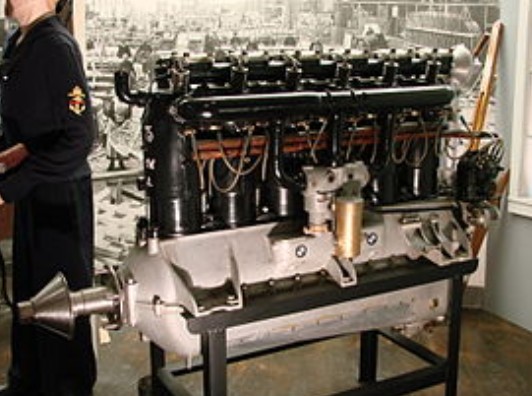
BMW IIIa was an inline six-cylinder, water-cooled aircraft engine, the first-ever product from BMW GmbH. Its success laid the foundation for future BMW success.
On 20 May 1917, Rapp Motorenwerke (which later that year became BMW GmbH) registered the documentation for the construction design for the new engine, dubbed BMW III. Designed by Max Friz and based on the Rapp III engine, it was an SOHC in-line six-cylinder, just as the earlier Mercedes D.III was, which guaranteed optimum balance, therefore few, small vibrations. It was designed with a high (for the era) compression ratio of 6.4:1.
The military authorities were also responsible for the fact that the first BMW product, due to its power output, was designated with a three instead of a one. At the beginning of 1917 the IdFlieg introduced uniform model designations for aeroengines. The Roman numeral referred to the performance class. IdFlieg’s Class 0 engine power category was for engines of up to 100 bhp (75 kW), such as the Gnôme Lamba-clone 80 hp (60 kW) Oberursel U.0 rotary engine, Class I was reserved for engines from 100 to 120 bhp (89 kW), with Class II for engines of between 120 and 150 hp (110 kW). The BMW engine was 185 bhp (138 kW) and was assigned to category III.
The engine was successful, but the real breakthrough came in 1917, when Friz integrated a basically simple throttle butterfly into the “high-altitude carburettor”, enabling the engine to develop its full power high above the ground. Burning a special high octane fuel of gasoline blended with Benzole, the carburettor adjusted the richness of the fuel-air mixture according to the aircraft’s altitude. It enabled the engine, now dubbed BMW IIIa, to develop a constant 200 horsepower (150 kW) up to an altitude of 2000 meters -a decisive advantage over competitors’ engines.
German and British horsepower ratings apparently differed. Postwar British tests put the rating of the BMW IIIa at 230 hp. This corresponds to British ratings of the Mercedes DIIIa engine being rated by the British as 180 hp (German rating of 170 hp) and the DIIIau at 200 hp (German-180 hp). This discrepancy may explain the significant difference in performance of the BMW IIIa equipped Fokker D.VIIF both against Mercedes powered D.VII’s and their Allied opponents. The standard German Pferdstärke metric horsepower unit was expressed in the early 20th century as being a unit of almost exactly 735.5 watts, while the British unit for mechanical horsepower was based on the older 33,000 ft-lb/min figure, which translates to 745.7 watts instead.
The first design drawings were available in May, and on 17 September the engine was on the test rig. After a successful maiden flight for the IIIa in December 1917, volume production started up at the beginning of 1918. The ability to gain power at higher altitudes was why this engine had unique superiority in air combat. It was primarily used in the Fokker D VII and in the Junkers Ju A 20 and Ju F 13. When equipped with the BMW IIIa engine, the Fokker D VII could outclimb any Allied opponent it encountered in combat. Highly maneuverable at all speeds and altitudes, it proved to be more than a match for any of the British or French fighter planes of 1918. The water-cooled in-line 6-cylinder engine’s reputation grew very quickly after is abilities were proven in air combat by Jasta 11, the “Red Baron’s” squadron. Ernst Udet, squadron leader of Jasta 11 in WWI, acknowledged the outstanding performance of the BMW IIIa engine:
“There can be no doubt that the BMW engine was the absolute highlight in power unit development towards the end of the war. The only bad thing was that it came too late.”
About 700 engines were built by BMW, however, a large demand for the new BMW IIIa aircraft engine in Munich (coupled with a lack of production capacity) caused part of the production to be transferred to the Opel factory in Rüsselsheim.
On September 13, 1919, Franz Zeno Diemer set up a world altitude record for a passenger aircraft (eight people on board, 6750 meters) in a Ju F-13 powered by a BMW IIIa aircraft engine.

 All Aero