Chalais-Meudon Fleurus / CBV

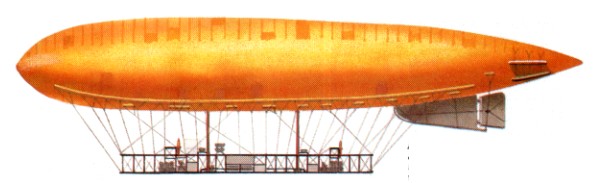
When war broke out in 1914, French airship equipment was entirely of the non-rigid pattern, and it was one of these that became the first Allied airship to carry out an air raid. This was the Fleurus, which had been built (like all French army craft of the lighter-than-air type) in the workshops at Chalais¬Meudon two years earlier, being re¬garded as a smaller sister ship to L’Ad¬jutant Vincenot (C.B.IV).
The Fleurus (or C.B.V. as it was officially known), had for the period a good aerodynamically efficient shape as it had been de¬signed as a result of wind tunnel tests conducted at the Eiffel laboratory. While these results were applied to the contours of the envelope, Clement¬Bayard was responsible for the design of the motor and the gondola, hence the initials of the alternative designa¬tion.
During the last year of peace, great use was made of the vessel, which par¬ticipated in the army manoeuvres of that summer. It also left its base at Pau on 23 September at the beginning of a flight to Saint-Cyr, a journey which it completed in 16 hours, averaging a speed of 54 km/h (33.7 mph), rather less than its maximum, for the distance of 680 km (423 miles) at an altitude nev¬er more than 1000 m (3,281 ft).
When making its historic raid from Verdun, the F]eurus was officially an army airship, there being no equiva¬lent naval air arm; but with effect from 1 January 1917 this was rectified and the army vessels were handed over to establish the new branch of the navy. Of the six non-rigids involved, four were at once deployed for sea patrol in much the same manner as the British ‘North Sea’ and similar types, but by now the C.B.V was five years old and obsolescent, so that with another airship it was relegated to training duties. The base for this work was far from the area where the newer airships operated — North Africa’s Mediterranean coast — being instead no further afield than Rochefort. It was here the Fleurus ended its days, destroyed in a fire as a result of an air raid in June 1918.
National insignia had not been adopted at the time of the first flight to be made by Fleurus, but when it was introduced this vessel was one of the earliest in France to be thus marked.

Chalais-Meudon Fleurus I
Engines: two 59. 7-kW (80-hp Clement-Bayard four-cylinder water-cooled piston
Diameter 12 40 m (40ft 8.2 in)
Length 77.0m (252 ft 7.5in)
Contained volume : 229580 cu.ft / 6500 cu.m
Max. speed : 32 kts / 59 km/h
Service ceiling 1005 m (3,281 ft)
Range 680 km (423 miles)
Useful lift 5200 kg (11.464 lb).
Central Aircraft Co Ltd

UK
Founded in London late 1916, subsidiary of established joinery company, R. Cattle Ltd. Aircraft and components built during 1918 under license. Produced in 1919, at Northolt, Middlesex, small biplane trainers designed by J. S. Fletcher, the company manager. Original designations were CF, later changed to Centaur. The Centaur IV (C.F.4) was a three-seat Renault-engined tourer. The next model was the Centaur Ha (C.F.2A) a twin-engined commercial transport biplane with Beardmore engines. Two were built, equipped with seats for six/seven passengers or to carry half a ton of mail or freight.

Caudron C 23 / P.23          

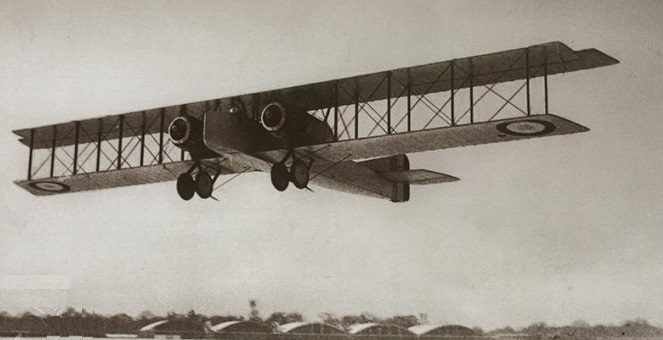
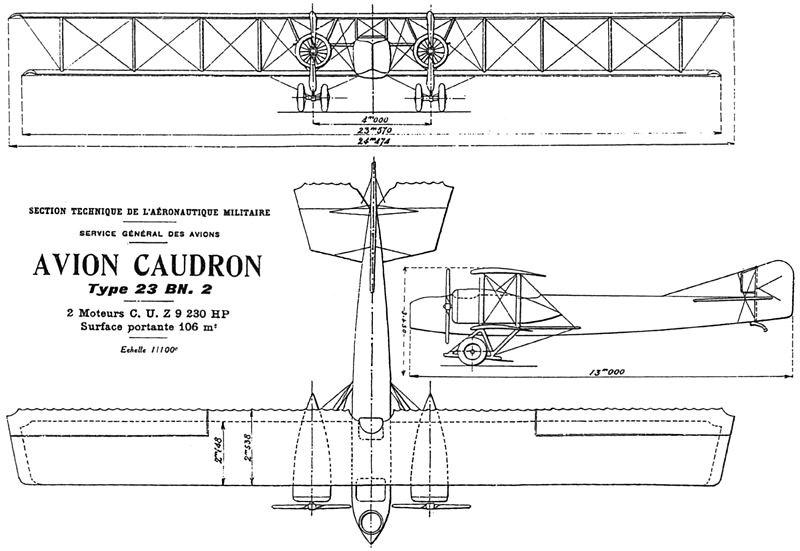
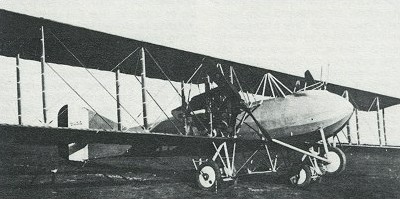
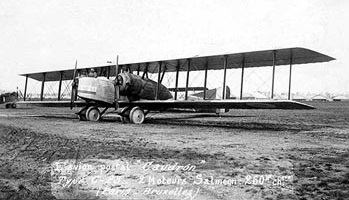
The P.23 was designed by Paul Deville to be a night bomber able to reach Berlin with a 600 kg (1,323 lb) bomb load. The French BN2 military category indicated a two seat night bomber but the P.23 had a crew of three. It had a much in common with the Caudron C.22 but was almost 50% larger in span, requiring an extra bay and more powerful engines. It was a large five bay biplane, with fabric covered, constant chord, unswept wings with angled tips. The upper wing, which carried the ailerons, had a slightly greater (4%) span and a smaller chord. There was no stagger, so the sets of parallel interplane struts were vertical; flying wires braced each bay. Pairs of V-form engine bearing struts, which supported the two cowled 194 kW (260 hp) Salmson 9Z nine cylinder water-cooled radial engines just above the lower wing, defined the inner two bays.

The P.23 had a flat sided fuselage. There was a gunner’s position in the nose, equipped with twin Lewis guns. A roomy open cockpit was positioned under the wing leading edge, with a separate gunner’s cockpit behind it under a large, rounded trailing edge cut-out. This was fitted with another pair of Lewis guns and a further gun firing downwards through a trapdoor in the floor. A low, broad fin carried a broad balanced rudder which extended down to the keel. The tailplane, angular in plan and of very low aspect ratio, was mounted on top of the fuselage and its elevators had a cut-out for rudder movement.

The bomber had a fixed tailskid undercarriage, with mainwheels in pairs . Their axles were mounted on longitudinal bars attached to the wing under the engines by N-form struts.

The Caudron C.23 first flew in February 1919, piloted by Jules Védrines. Higher power engines, the 447 kW (600 hp) Salmson 18Z or the 224 kW (300 hp) Hispano-Suiza 8Fb, were considered in April 1918 but the Salmson was not yet fully developed and trials of the Hispano led nowhere.

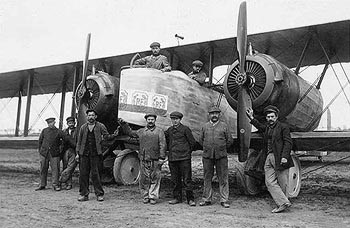
The P.23 received orders for a total of 1000 under the designation C.23BN.2, but by the time of the Armistice in November 1918 fifty-four C.23s had been delivered and its serial production canceled. Some served with the 22nd squadron, stationed in Lyuksoyle, until their replacement by the more powerful Farman Goliath in February 1920.

Very soon after the war some C.23s not used by the French Air Force were modified to carry twelve passengers in an open cockpit formed by an opening between the cockpit and mid-upper gunner’s position. On 10 February 1919 one made the first passenger flight between Paris and Brussels, carrying five passengers tightly packed together in an open cockpit. One C.23, designated C.23 bis, was modified to carry fifteen passengers internally, flying between Paris and London.

Védrines and his engineer Guillian were killed in a C.23 when an engine failed whilst trying to establish a route from Paris to Rome.

Gallery

Variants:

C.23 BN2
Bomber

C.23
12 seat transport

C.23 bis
15 seat cabin transport

Specifications:

C.23 BN2
Engines: 2 × Salmson 9Z 9-cylinder, 190 kW (260 hp)
Propellers: 2-bladed
Upper wingspan: 24.50 m (80 ft 5 in)
Lower wingspan: 23.57 m (77 ft 4 in)
Wing area: 107 sq.m (1,150 sq ft)
Length: 13.00 m (42 ft 8 in)
Height: 3.40 m (11 ft 2 in)
Empty weight: 2,341 kg (5,161 lb)
Gross weight: 4,170 kg (9,193 lb)
Fuel capacity: 980 lt (216 imp gal; 259 US gal) and 132 l (29 imp gal; 35 US gal)
Maximum speed: 143 km/h (89 mph; 77 kn) at sea level
Cruising speed: 122 kph
Stall speed: 82.2 km/h (51 mph; 44 kn)
Endurance: 6.75 hr
Service ceiling: 3,500 m (11,483 ft)
Time to altitude: 41 min to 4,000 m (13,123 ft)
Crew: Three
Armament: two 7.7-mm machine gun Lewis
Bombload: 600 kg (1,323 lb)

Caudron R.IV

While the G.3 and G.4 had been credited largely to Gaston Caudron, the R.4 was mostly the work of Rene Caudron. Appearing in prototype form in June 1915, the R.4 had a full-length fuselage and single fin and rudder. The unequal-span wings had three bays on each side, with ailerons on the upper wing only. As well as the twin-wheel main landing gear units and tailskid, there was a single nose-wheel intended to protect the propellers. Power was from twin 97kW Renault i2Db engines. The three-man crew included nose and midships gunners each provided with twin Lewis machine-guns.
Intended originally as a bomber, it served mainly as an A.3 category three-seat reconnaissance aircraft, frequently engaged in photographic work. Its climb rate was not impressive, and a few aircraft were built with more-powerful 112kW Hispano-Suiza 8Aa engines in an attempt at improvement.
The production aircraft began to reveal a structural weakness. Among the crashes that happened, on 12 December 1915, a series aircraft under test was destroyed and Gaston Caudron, who was piloting the aircraft, was killed.
In early use Escadrille C.46 had claimed 34 German aircraft brought down with its R.4s in an eight-week period, but it was soon clear that in addition to structural redesign, improved ceiling and greater manoeuvrability were highly desirable. The new Caudron chief designer, Paul Deville, designed a new improved development which was to emerge as the R.11.
Production of the R.4 was terminated after 249 had been built. In the reconnaissance escadrilles it was replaced by the more-powerful Letord 1 during 1917.

Engine: 2 x 97kW Renault 12Db inline piston engines
Take-off weight: 2330 kg / 5137 lb
Empty weight: 1710 kg / 3770 lb
Wingspan: 21.1 m / 69 ft 3 in
Length: 11.8 m / 38 ft 9 in
Wing area: 70 sq.m / 753.47 sq ft
Max. Speed: 136 km/h / 85 mph
Ceiling: 4600 m / 15100 ft
Armament: 4 x 7.7mm machine guns, 100kg of bombs

Caudron G.IV

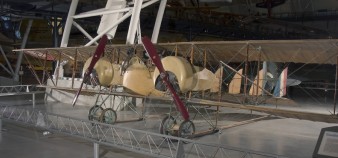
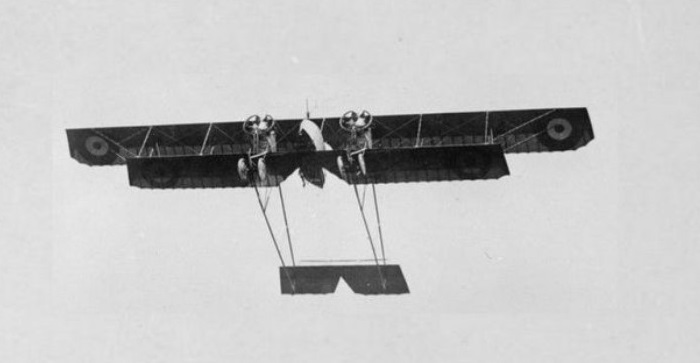
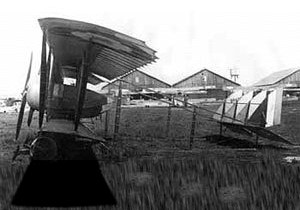
The limitations of the G.3 and its inability to lift a worthwhile bomb load led to the development of the twin-engined Caudron G.IV as a dedicated bomber, which first appeared in March 1915. Structurally similar to the G.3, the G.4 had increased wing span, a tail-plane with four rudders instead of two, and twin engines mounted on struts between the wings. Power was provided by either 80 hp / 60kW Le Rhone rotary engines with circular cowlings, or by uncowled 75kW Anzani radials. The short crew nacelle had an observer/gunner’s cockpit in the nose, though the field of fire was limited by the proximity of the engines, and a bomb load carried underwing. Defensive armament was limited to usually the one 7.7mm machine gun and the bombload capacity varied between 220lbs and 250lbs. As well as a 7.7mm Lewis or Vickers machine-gun on a ring mounting in the front cockpit, some G.4s had a second Lewis gun mounted over the upper wing centre section for rear defence. This second gun could only be operated by the gunner standing at full stretch in his cockpit.

The G.4 was ordered into large-scale production and two versions were built, the Cau 4 B.2 day bomber and the Cau 4 A.2 artillery observation and reconnaissance aircraft. A number of the G.4 A.2 version had wireless installed.
The appearance of the G.4 was delayed by production problems and first appeared in service with the French Aviation Militaire in November 1915 as the Cau 4B.2. This particular model, however, suffered from a high loss rate and would be phased from service by November of 1916. The Cau 4A.2 followed and was put to more successful use in the reconnaissance and artillery spotting role.
The British Royal Naval Air Service purchased 55 of the type, 43 imported and 12 were built by the British Caudron Company. Flown by Nos 4 and 5 Wings, they were used in 1916 and early 1917 in attacks on German seaplane and airship bases in Belgium. The RNAS G.4s were replaced by Handley-Page O/100s in the autumn of 1917.
The Italian Aeronautica Militare received imported G.4s and was also supplied with 51 examples built by the A.E.R. company at its factory near Turin. In May 1917 the 48a Squadriglia was the first unit to re-equip with the G.4, to be followed by the 49a and 50a Squadriglie. Italian G.4s operated in the mountainous Alpine areas, demonstrating their good climb qualities and suitability for flying at altitude.
During the war the type established several Italian altitude records. A number of Caudron G.4s were also supplied to the Imperial Russian Air Service, with which they flew in the reconnaissance role with onboard radio.

Towards the end of World War I G.4s were relegated to training duties, and 10 of the type were bought for that purpose by the United States Air Service in France in early 1918. The G.4 was used for a number of notable post-war flights and some hundreds were sold to private owners and flying clubs in France and Italy post-war.
In France 1,358 of the G.4 were produced of the 1,421 G.IV built in all.

Caudron G.4A.2
Engines: 2 x Le Rhone 9C rotary, 80hp
Length: 23 ft 8 in (7.16m)
Wingspan: 56 ft 5 in (17.20m)
Wing area: 36.8 sq.m / 396.11 sq ft
Height: 8 ft 6 in (2.60m)
Maximum Speed: 82mph (132kmh; 71kts)
Service Ceiling: 14,108ft (4,300m; 2.7miles)
Armament: 1 or 2 x 7.7mm machine guns, 220lbs of external ordnance
Accommodation: 2
Hardpoints: 2
Empty weight: 733 kg (1,616 lb)
Maximum Take-Off Weight: 1,232 kg (2,716 lb)

Caudron G.4A.2
Engines: 2 x Anzani 10-cylinder radial, 100hp
Length: 23 ft 8 in (7.16m)
Wingspan: 56 ft 5 in (17.20m)
Wing area: 36.8 sq.m / 396.11 sq ft
Height: 8 ft 6 in (2.60m)
Maximum Speed: 82mph (132kmh; 71kts)
Service Ceiling: 14,108ft (4,300m; 2.7miles)
Armament: 1 or 2 x 7.7mm machine guns, 249lbs of external ordnance
Accommodation: 2
Hardpoints: 2
Maximum Take-Off Weight: 2,932lbs (1,330kg)