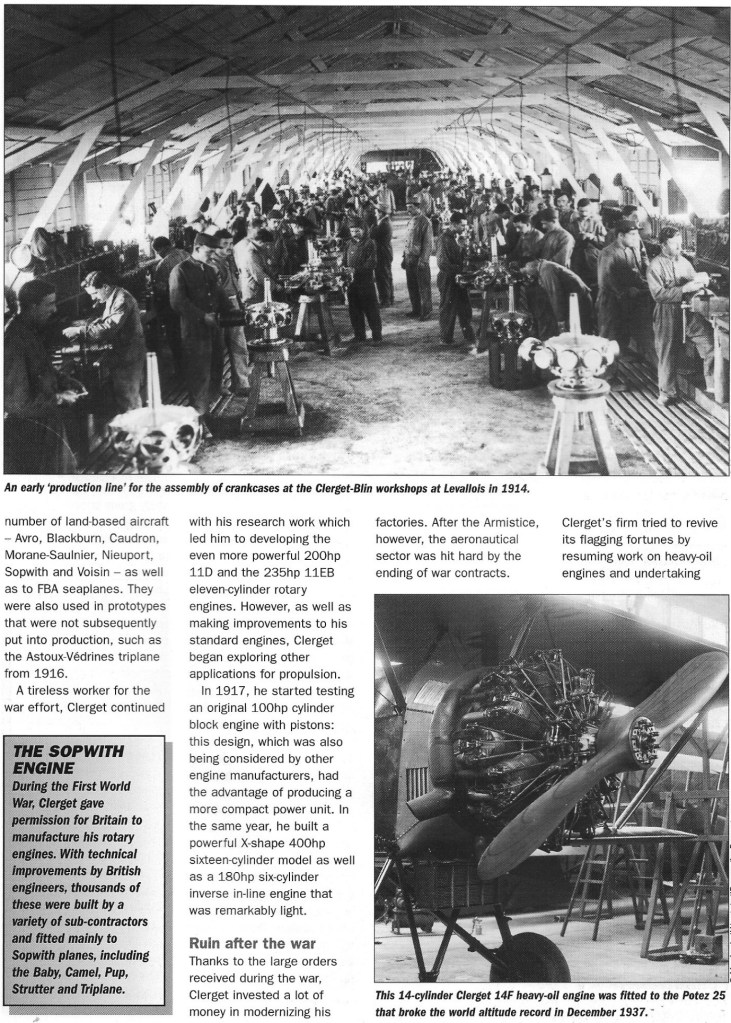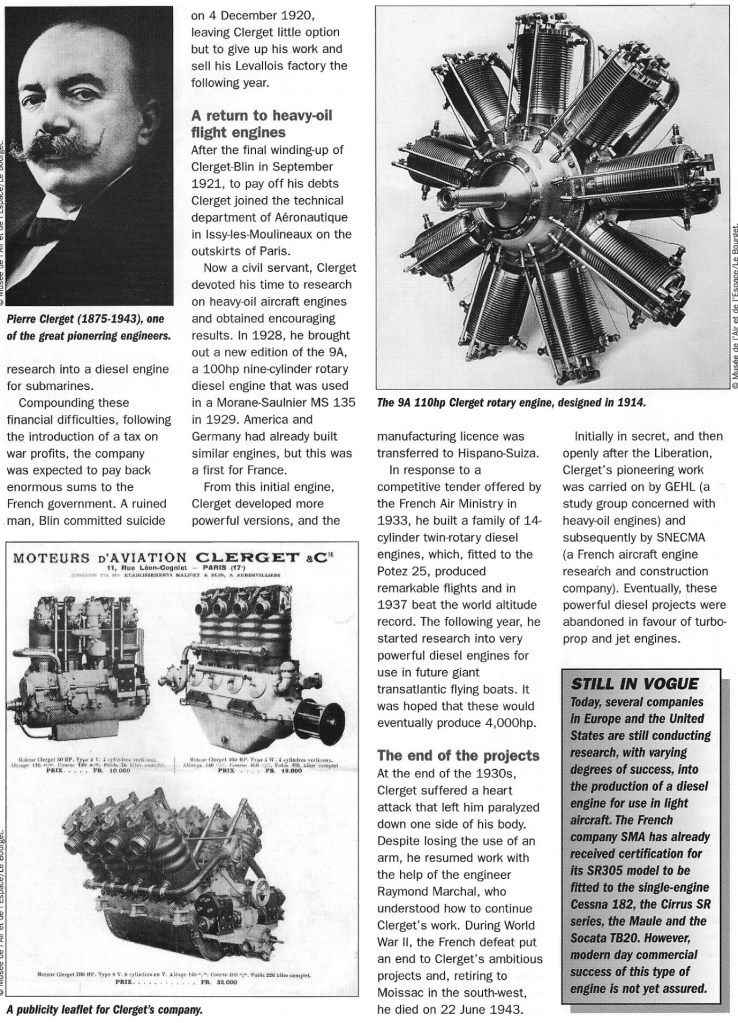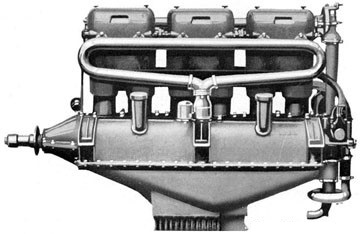
Clergêt 9B

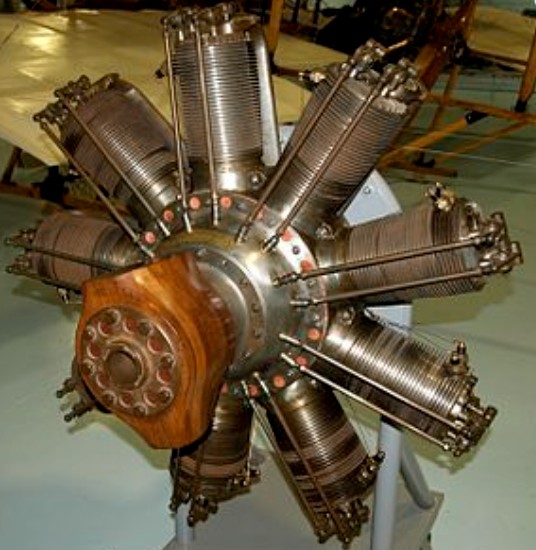
First run in 1913, the Clerget 9B was a nine-cylinder rotary aircraft engine of the World War I era designed by Pierre Clerget. Manufactured in both Great Britain (Gwynne Limited) and France, it was used on such aircraft as the Sopwith Camel. The unit cost of the 9B was £907.50 in 1915. British production totalled 3,650.
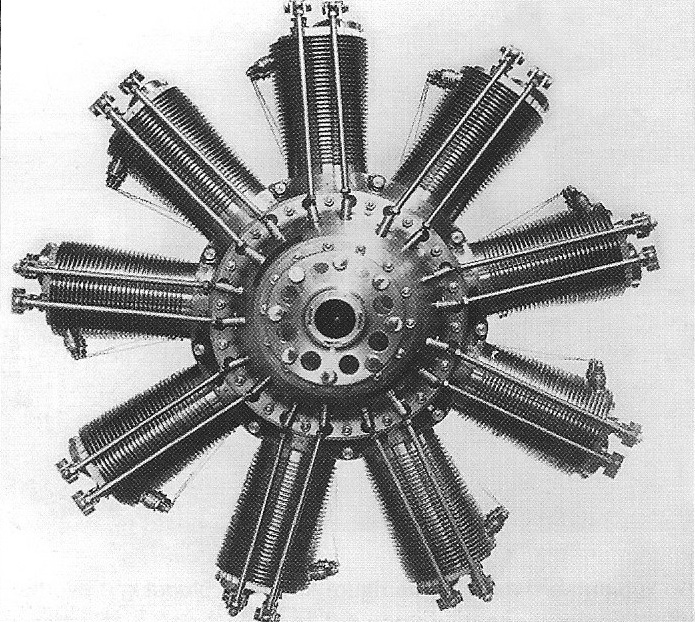
130 hp Clerget 9B

The Clerget 9Bf was an increased stroke version.

Variants:

Clerget 9B
(1913) 130 hp (97 kW). 1,300 produced by Ruston Proctor & Co Ltd of Lincoln

Clerget 9Bf
(1915) 140 hp (104 kW). Extended stroke (172 mm (6.75 in)) version, increasing capacity to 17.5 lt (1,066.5 cu in). 1,750 produced by Gwynnes Ltd. and 600 produced by Ruston Proctor.

Applications:

Clerget 9B
Armstrong Whitworth F.K.10
Avro 504
Avro 531
Bristol M.1
Cierva C.6
Cierva C.8
Fairey Hamble Baby
Nieuport 12
Nieuport 17
Nieuport Triplane
Sopwith Baby
Sopwith Camel
Sopwith Scooter
Sopwith Triplane
Sopwith 1½ Strutter

Clerget 9Bf
Sopwith Camel

Specifications:

Clerget 9B
Type: Nine-cylinder air-cooled rotary engine
Bore: 120 mm (4.72 in)
Stroke: 9B: 160 mm (6.30 in), 9Bf: 172 mm (6.77 in)
Displacement: 9B: 16.29 l (994.08 cu in), 9Bf: 17.5 l (1,067.92 cu in)
Length: 920 mm (36.22 in)
Diameter: 9B: 1,020 mm (40.15 in), 9Bf: 1,030 mm (40.55 in)
Dry weight: 173 kg (381 lb)
Valvetrain: Single inlet and exhaust valves operated by pushrods and rockers
Fuel system: Bloctube carburettor
Fuel type: Gasoline mixed with Castor oil lubricant
Oil system: Castor oil mixed with fuel
Cooling system: Air-cooled
Power output: 9B: 96.94 kW (130 hp) at 1,250 rpm, 9Bf: 104.40 kW (140 hp) at 1,250 rpm
Specific power: 9B: 0.1308 hp/cu in (5.953 kW/l), 9Bf: 0.131 hp/cu in (5.966 kW/l)
Compression ratio: 9B: 4.56:1, 9Bf: 5.3:1
Specific fuel consumption: 9B: 0.564 l/kW/hour(0.74 pt/hp/hour), 9Bf: 0.45 l/kW/hour(0.59 pt/hp/hour)
Oil consumption: 9B: 0.0686 l/kW/hour (0.09 0.11 pt/hp/hour), 9Bf: 0.0838 l/kW/hour (0.11 pt/hp/hour)
Power-to-weight ratio: 9B: 0.563 kW/kg (0.341 hp/lb), 9Bf: 0.556 kW/kg (0.337 hp/lb)
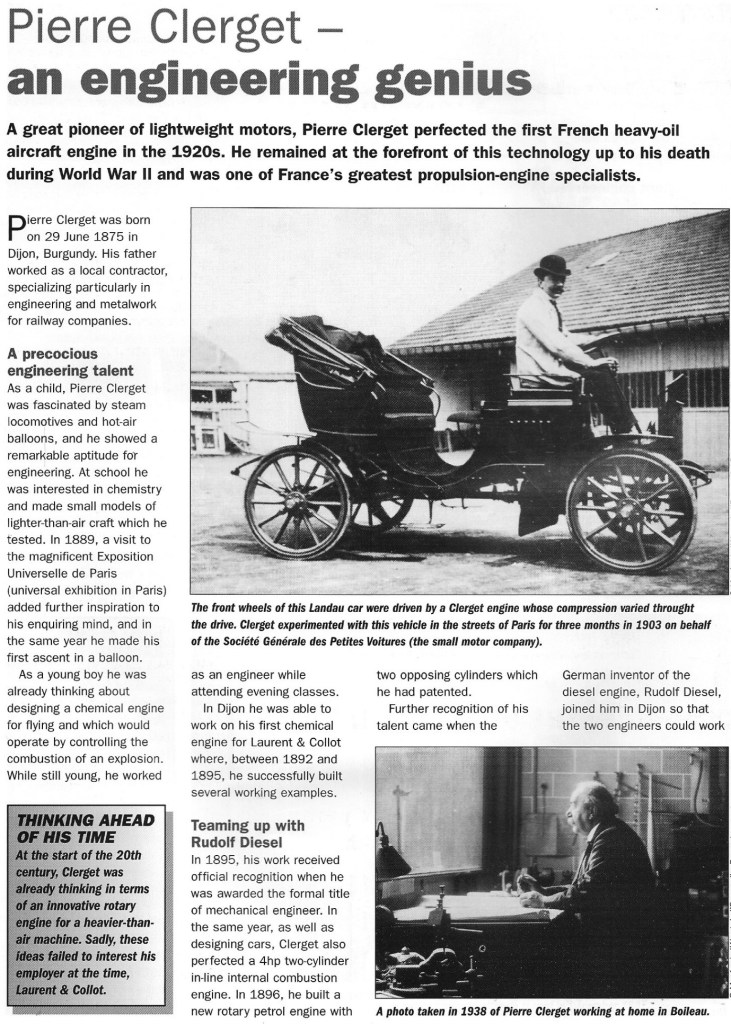
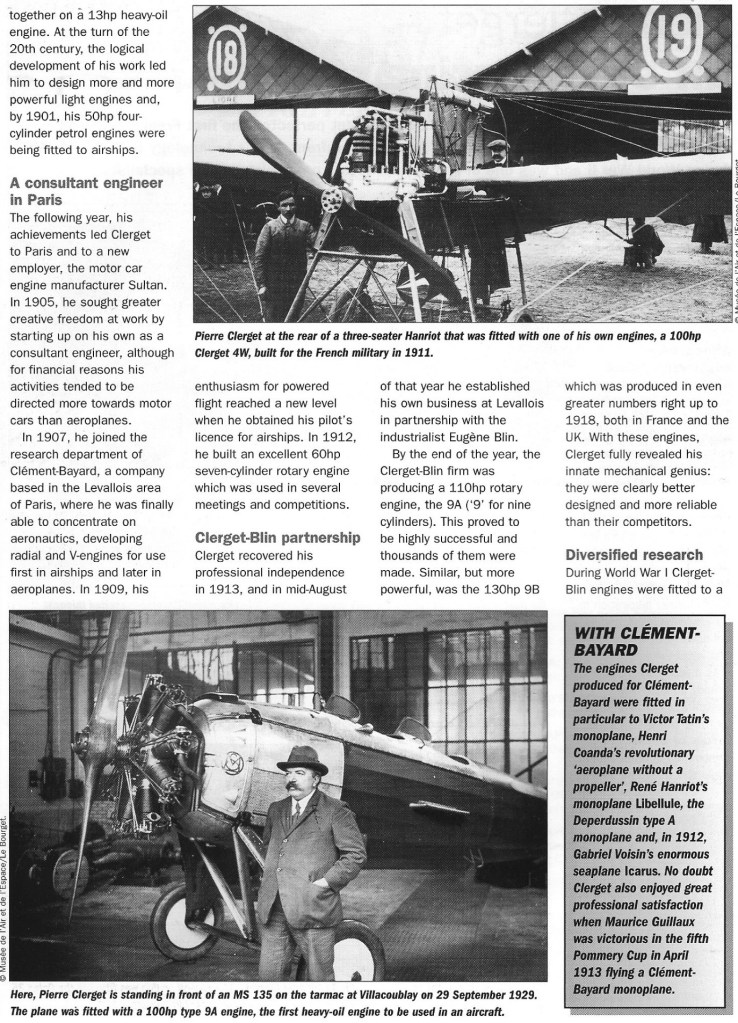
Clergêt 7Z

The Clerget 7Z was a seven-cylinder rotary aircraft engine of the World War I era designed by Pierre Clerget. First run in 1911 it was nominally rated at 80 horsepower (60 kW). 347 examples were jointly built in Britain by Gordon Watney & Co Ltd of Weybridge and Gwynnes Ltd of Hammersmith.

Applications:
Avro 504
Beardmore W.B.III
Bristol Scout
Grahame-White 20
Royal Aircraft Factory B.E.8
Royal Aircraft Factory S.E.2
Royal Aircraft Factory S.E.4
Sopwith Pup

Specifications:

Clerget 7Z
Type: Seven-cylinder air-cooled rotary engine
Bore: 120 mm (4.72 in)
Stroke: 150 mm (5.91 in)
Displacement: 11.88 l (724.96 cu in)
Diameter: 914 mm (35.98 in)
Dry weight: 106 kg (234 lb)
Valvetrain: 1 each overhead inlet and exhaust valves operated by pushrods and rockers
Fuel system: Bloctube carburettor
Fuel type: Gasoline with Castor oil lubricant
Oil system: Castor oil mixed with fuel
Cooling system: Air-cooled
Power output: 70.84 kW (95 hp) at 1,300 rpm (maximum power)
Specific power: 0.1314 hp/cu in (5.98 kW/l)
Compression ratio: 4.3:1
Specific fuel consumption: 0.564 l/kW/hour(0.74 pt/hp/hour)
Oil consumption: 0.0762 l/kW/hour (0.1 pt/hp/hour)
Power-to-weight ratio: 0.67 kW/kg (0.406 hp/lb)

CKD-Praga

Ceskomoravska-Kolben-Danek, maker of aero engines from 1915, including several marketed under the name Praga. Began aircraft construction in 1931, subsequent products including the Praga E.40 two-seat training biplane and E.45 single-seat fighter biplane, and a family of two/four-seat light cabin monoplanes designated E.114 Air Baby, E.115, E.210, and E.214. Factory overrun by German invasion, but operated by Germany as Bb’hmisch- Muhrische Maschinenfabriken AG. (Bohemian-Moravian Engineering Works). Reestablished postwar under new title of Zavody Letecke Praga, producing, inter alia, updated models of the E.114 and E.210/211.

Cierva

Juan de la Cierva was born in Murcia, Spain on September 21, 1895, and by 1908-9, had decided to make aviation his career. In 1911 he enrolled at the Civil Engineering College of Madrid (Caminos, Canales y Puertos) and in 1912 with his friends “Pepe” Barcala and Pablo Diaz constructed the first Spanish airplane, the BCD-I, known as “EI Cangrejo” – the “Red Crab”, becoming the “Father of Spanish Aviation.”

By the mid 1920s Cierva’s success became known worldwide, and he was invited to Britain to demonstrate his machines to the Air Ministry.

Transferring operations to England in 1925 and forming Cierva Autogiro Ltd. on March 24,1926 with prominent Scottish industrialist James G. Weir, his brother Viscount William Weir of Eastwood and Sir Robert M. Kindersley, Cierva continued to improve the Autogiro and in early 1929 licensed the technology and rights to his patents to Harold Frederick Pitcairn of Bryn Athyn, P A. Early models of which were based on surplus Avro 504Ks. British, French, German, American, Japanese and Russian companies built Cierva type autogiros.

Two best known craft were C.8L, first rotorcraft to fly the English Channel, and C.30A, built by A. V. Roe as Rota for RAF. Production of other Autogiros licensed by Cierva to Airwork (C.30, C. 30P); Avro (C.6, C.8, C.9, C.12, C.17, C.19, C.30A, C.30P); British Aircraft Manufacturing Co (C.40); Comper (C.25); de Havilland (C.24, C.26); George Parnall & Co. (C.10, C.11); and Westland (CL.20).

Weir formed a separate company (G. & J. Weir Ltd.) in 1933, and reestablished Cierva Company in 1944.

In 1936, Cierva was killed in the Croydon KLM airliner accident when the aircraft in which he was a passenger crashed after taking off in fog. From 1936 to 1939 James Allan Jamieson Bennett was Chief Technical Officer of the company. Dr. Bennett carried through with Cierva’s intention to offer the Royal Navy a gyrodyne, which Cierva had argued would be simpler, more reliable and efficient than the proposed helicopter. Bennett’s design, the C.41, was tendered to the Air Ministry (Specification S.22/38) but preliminary work was abandoned with the outbreak of World War II. Bennett joined Fairey Aviation in 1945, where he led the development of the Fairey FB-1 Gyrodyne.

After Second World War evolved (jointly with above company), the W.9, a two-seat helicopter using jet thrust to counteract torque. The W.11 Air Horse three-rotor design was built for Cierva by Cunliffe-Owen; designed specifically for crop-spraying, it was first flown December 8,1948. The first prototype of the Air Horse crashed killing Alan Marsh, Cierva’s manager and Chief Test Pilot John “Jeep” Cable, Ministry of Supply Chief Helicopter Test Pilot, and J. K. Unsworth the Flight Engineer. This led Weir to cease further investment in the company and its development contracts were transferred to Saunders-Roe.

The W.14 Skeeter, small two-seat helicopter, first flown October 8,1948. Both designs taken over in 1951 by Saunders-Roe, together with other Cierva projects. Company then concentrated on research; eventually reemerged as Cierva Rotorcraft Ltd, and bought up Rotorcraft Ltd. in April 1966 and Servotec Ltd. in 1968.The prototype CR.LTH-1 flew October 18,1969, but was not produced due to lack of funds.

J.Weir maintained a working association with J.S.Shapiro, and in 1961 63 Servotec built a man carrying helicopter model to embody Weir’s ideas of a non stalling rotor, which emerged from many years of model tests. In the course of this collaboration, Weir became aware of the CR Twin development and in 1965 decided to give this development financial support. This combination of interests was cemented in a take over of Rotorcraft Ltd by the Cierva Autogiro Co, which was thereupon renamed the Cierva Rotorcraft Co. The largest shareholders were Weir and Shapiro.

Christofferson Hydro

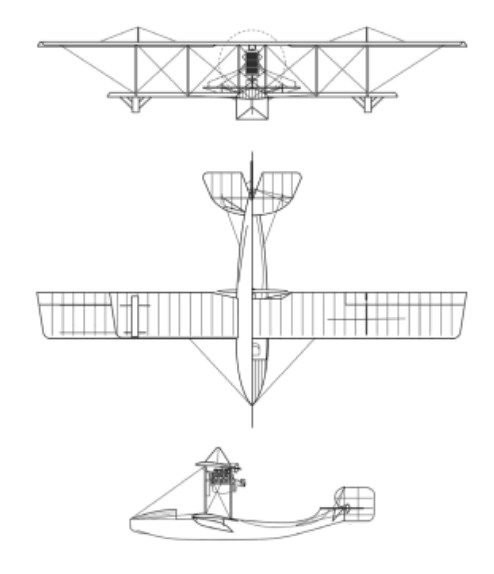
The Hydro flying boat built by Christofferson Aviation flew in 1913, and was probably designed by Alan Loughead who worked for Christofferson at the time.

A two-bay biplane, of the three or four examples known to have been completed in 1914, two were sold to explorer Roald Amundsen for a proposed Arctic flight (that never happened), and one was used by Silas Christofferson’s San Francisco-Oakland Aerial ferry in 1914. This was the second scheduled airline to operate in the US.

Another Hydro is listed as having been sold to Japan.

Engine: Hall-Scott V-8, 120 hp
Span: upper: 49′ lower 33’6″
Length: 28′

Christmas Bullet

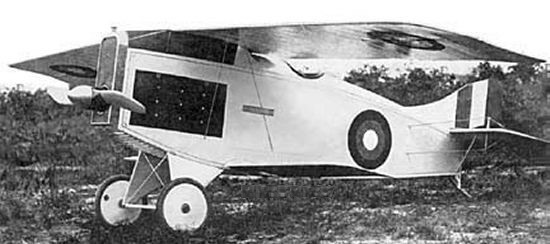
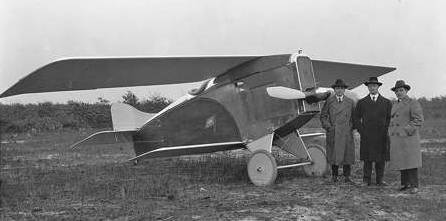
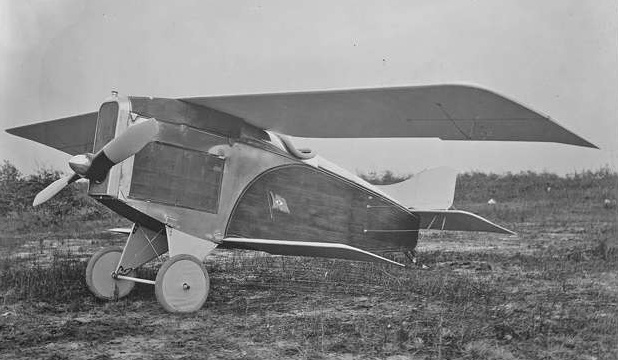
Co-designed with aviation pioneer, Vincent Burnelli (who only admitted to designing the fuselage), the Christmas Bullet was intended to meet a requirement for a military scout plane. The single-engine biplane was fitted with unbraced cantilevered wings designed to flex during flight. This gross lack of wing strength led to in-flight structural failures of both aircraft on 30 December 1918 and 1 May 1919.

This failure aside, the Bullet was noteworthy for being the first or one of the first aircraft to introduce a veneer-clad fuselage to reduce skin-friction drag and interconnected movable ailerons on the wing trailing edge.
Christmas received a patent for the Bullet design in 1914, a fact which he used to make the claim that he had invented the aileron. Dr. Christmas even claimed that the US government bought the rights to his movable ailerons in 1923 for $100,000 to avoid a copyright infringement suit, but there appears to be no evidence to support this claim. In fact, Christmas is only one of many early pioneers who claim to have invented the aileron, including the Wrights and Glenn Curtis.

Christmas seemed to have persuaded his backers to finance him based on two previous aircraft, for which no evidence ever existed.

Christmas managed to find funding to build two ‘proof of concept’ aircraft to demonstrate his ‘ideas’ of a deliberately flexible wing inspired by those of birds, and tepid support from the US Army, which loaned an engine for ground-testing and the services of a test-pilot, Cuthbert Mills. A flight was attempted in the first aircraft, whereupon the wings peeled off during take-off, and the aircraft crashed, killing Mills. Christmas claimed that the aircraft had reached a speed of 197mph.

A second aircraft was built, and a propeller issued by the Army, despite the loaned engine having been destroyed during the unauthorised flight as Christmas had kept this secret. The second aircraft also crashed, also fatally. Christmas was still trying to sue people for claiming the aircraft had killed its pilots as late as 1930 and insisted the aircraft had reached a speed of 222mph.