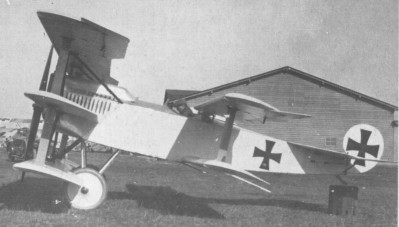
In September 1917 Fokker produced the V.8 quin¬tuplane. Presumably he figured that, as his triplane had met with suc¬cess, more wings would reap more success. After a few short hops it was demolished.
In September 1917 Fokker produced the V.8 quin¬tuplane. Presumably he figured that, as his triplane had met with suc¬cess, more wings would reap more success. After a few short hops it was demolished.
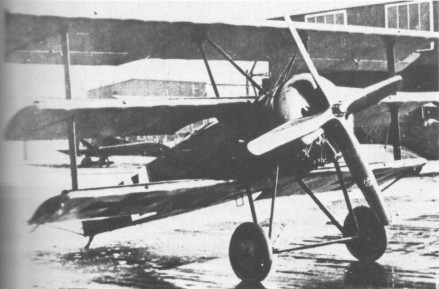
The V. 7 was an experimental version of the Dr.I with a 160 hp Siemens Halske engine and a four bladed propeller. Four of these machines were built.
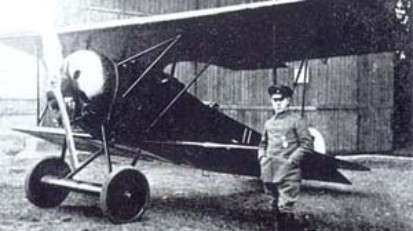
During the middle of 1917 the principal German fighters, the Albatross D-III and D-V, lost their superiority in the skies of the Western Front, and now the Sopwith Camel and S.E.5a dominated in the air. At this time the German Air Command (Idflieg) called all manufactures to take part in the Fighter Competition planned for January 1918. Fokker Flugzeugwerke, led by the genius Anthony Fokker, had a strong reputation among pilots because by this time the Fokker Dr-1 had already become a legend of the air. When the Fighter Competition started at Adlershoft on January 20, 1918, Fokker Flugzeugwerke proposed eight prototypes. Many of them were very ambitious, but all German manufactures at this time had a common problem: the lack of a powerful engine. All the new designs were based on ‘good old’ engines like the air-cooled Oberursel Ur-II or the inline Mercedes D-IIIa. During the competition none of the all-new designs achieved the desired results but Fokker’s V.13 design. Developed from the Fokker V.9, it showed some promise and was declared a winner. Some aspects of its performance like climb were unsatisfactory, but other fighters like the Pfalz D-VI had rather worse figures. Idflieg announced a new Fighter Competition but for now Fokker received an initial contract for 120 aircraft, which received the official designation Fokker D-VI.
The first production example was accepted on April 26, 1918 and by August sixty aircraft of this type had been produced. Contracts for sixty more were cancelled because at this time the Fokker D-VII entered service. This new design was superior to the D-VI in every way.
The majority of all 60 D-VIs built were delivered to the Kampf Einsitzer Staffeln, special units created mainly for the intercepting of Allied Bombers. The Fokker D-VI which had an air-cooled engine and could take-off without delay was a good choice for this role. But the climbing ability of the D-VI was still poor and the fighters were dispersed in the Alsace-Lorraine region where bombing raids were less frequent. Other machines were delivered to the training units; and Austria-Hungary purchased seven aircraft of this type. After the end of the war at least two D-VIs were tested in France and the USA.
Replica:
Airdrome Airplanes Fokker D-VI
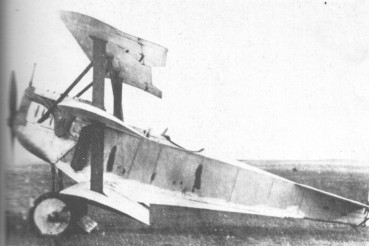
The D.VII (also known as the V. 6) was a triplane with a 160 h.p. Mercedes engine. Owing to the heavier engine it was a larger aeroplane. It was not satisfactory, and did not go into production.
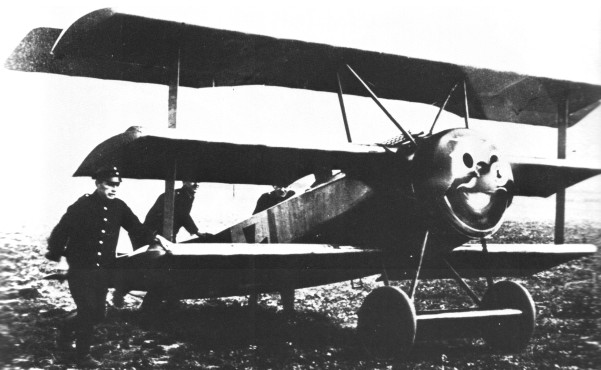
When the Sopwith Triplane first entered operational service with the RNAS in France in January 1917, it made an immediate impact on the aerial combat scene. The aircraft designer Anthony Fokker visited Manfred von Richthofen’s Jagdstaffel 11 during April that year, and was shown a captured example of the Sopwith, and urged to produced an equally good design. Fokker passed on this request to Reinhold Platz his chief designer. Platz was privately reluctant to produce a triplane configuration, but pro¬ceeded to design the Fokker V.3 with a fabric-covered welded steel tube fuselage, a large triangular tailplane, the standard ‘comma’ rudder without a fixed fin, and cantilever plywood/fabric-covered wooden wings, which required no interplane strutting. It had a 110 hp Le Rhone rotary engine.
The wings vibrated badly in flight, and the V.4 introduced lightweight interplane struts as well as aerodynamic improvements. The V.3 was slightly redesigned to incorporate increased span wings and single plank inter¬plane struts. In this guise the V.4, as the second configuration was designated, was ordered into production and the first two examples, No 102/17 and 103/17, officially designated as the F.1, a designation soon changed to Dr.1, were issued to JG 11 for operational trials. On August 30, 1917, Leutenant Werner Voss made the first operational flight of the Fokker, Dr. 1. Flying 103/17, he claimed a victory during his patrol. On September 1 von Richthofen himself took up 102/17 and claimed his 60th victory.
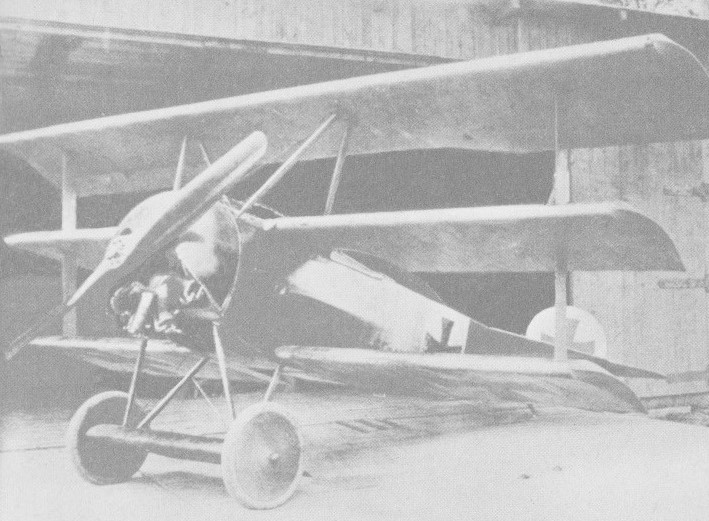
In mid-October 1917, a total of 17 Dr.1s were delivered factory fresh to front line Staffeln but by the end of that month several more crashes included Heinrich Gontermann of Jasta 15, and Leutnant Pastor of Jasta 11. Both men were killed by structural failure in the Dr.1s they were test flying. Immediate technical investigation proved that the deaths were caused by poor workmanship at the Fokker factory. All Dr.1s were grounded until properly manufactured wings had been produced.
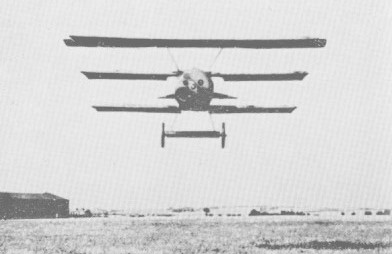
Once the faults in production had been cured, from April 1918 onwards Dr.1s began to reequip many units along the Western Front, and their pilots soon came to regard the little triplane as an ideal dogfighter. In pure technical terms the Dr.1 was slower than its main contemporary Albatros D.V scout, but the ‘Dreidecker’s’ powers of manoeuvrability and fast climb found favour among Germany’s fighting pilots.
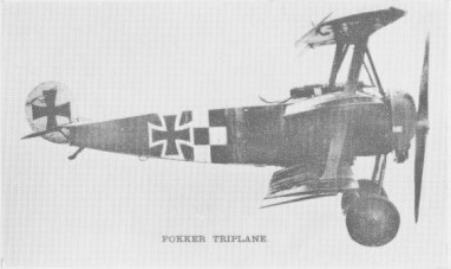
The most important unit to fly the Dr.1 was Jagelgeschwader 1 (Fighter Squadron 1), the so called “Richthofen Circus”.
Flying the Fokker Dr.1 – Frank Tallman
A total of only 320 Fokker Dr.1s were actually produced, the last of these coming off` the production lines in May 1918. By that time, the new and superior Fokker D.VII biplane was beginning to reach German stations in France. However, Dr.1s continued on operational service until well into the summer of 1918. One German ace, Josef Jacobs of Jasta 7, retained two examples, doped all back for his personal use, until late September 1918, while his Staffel flew D.VIIs.
Attempts to improve the overall performance of the Dr.1 were concentrated mainly on installing more powerful engines in the basic structure. Several such fitments gave excellent results under initial test conditions, but by mid 1918 Germany’s general shortage of such vital fuels as lubrication oils precluded any possibility of large scale production or use of the improved variants. At least one freak result of the Dr.1s’ success was the Fokker V.8 variant an impractical quintuplane which Fokker himself insisted on having designed and built. Tests of the V.8, however, proved disastrous and the project was immediately abandoned.
Total production was only 230 aircraft, and it was replaced by the Fokker DVII.
Replica:
Redfern Fokker Dr.1
Airdrome Airplanes Fokker Dr-1 75%
Airdrome Airplanes Fokker Dr-1 100%
Bitz Flugzeugbau Fokker Dr.1
Dr I
Engine: l x Oberursel Ur.ll or Thulin-built Le Rhone 9, 82kW (110 hp).
Span: (Top) 7.2 m (23 ft 7 in)
Span (Middle) 6.2 m (20 ft 4 in)
Span (Bottom) 5.7 m (18 ft 8 in).
Wing chord: 3 ft. 3 in.
Length: 5.77m (l8ft 11.25 in).
Height: 3 m (9 ft 10 in).
Weight empty 893 lb. (405 kg.)
Max T/O weight: 585 kg (1,290 lb).
Max speed: 103 mph at 13,125 ft.
Service ceiling: 19,600 ft (6,000 m).
Time to 10,000 ft: 6 min
Range: 135 nm / 250 km
Operational endurance: 1 hr 30 min.
Armament: 2 x 7.92-mm (0.312-in) MG 08/15 mg.
Seats: 1
The Air Force took an interest in the V.3, and on 14th July 1917 the first batch of 20 triplanes was ordered, including three prototypes, comprising a second D.VI and two V.IVs (later the V.4).
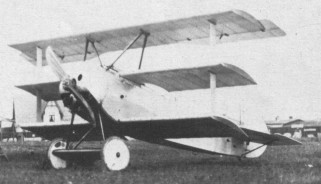
In June 1917 Fokker decided to design a triplane. A demon¬stration machine, the D.VI biplane (werknummer 1661) was under construction for Austria Hungary, and this was completed with a third wing. At first this D.VI (which was later designated V.3) had no interplane struts. Its powerplant was the 110 h.p. Oberursel rotary engine (Fokker had a share in the Oberursel Engine Works). The D.VI was flown by Lt Werner Voss, who was enthusiastic about the type. The Air Force took an interest, and on 14th July 1917 the first batch of 20 triplanes was ordered, including three prototypes, comprising a second D.VI and two V.IVs (later the V.4).
The first D.VI (V.3) triplane was sent to Austria Hungary after its tests.
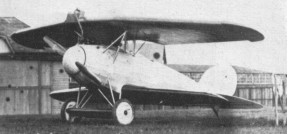
The V.2 was a development of the V.I. It was purely an experimental aeroplane.
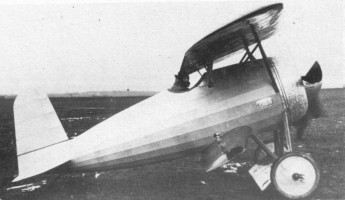
The V.I was the first aeroplane completely designed by Platz. The V. 1 (Verspanungslos 1 = cantilever wing), was a very advanced machine for its time, but unsuitable for military purposes. It was purely an experimental aeroplane, as was the V.2, a similar design with an in line engine.
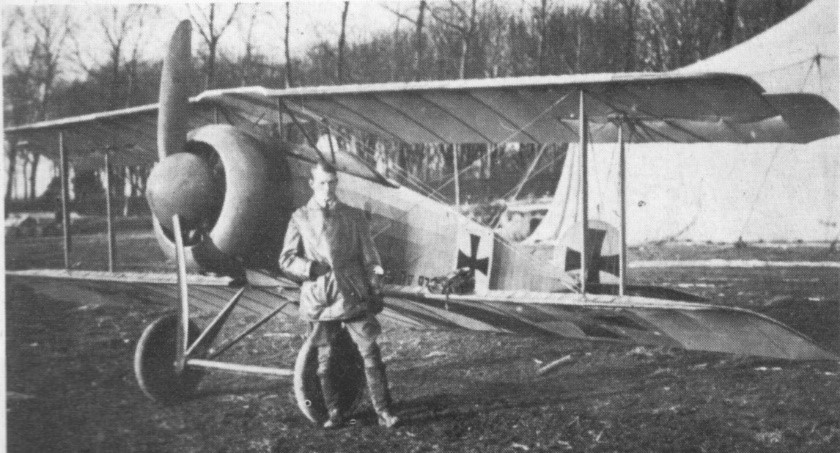
The D.V (M.22E), armed with a single machine gun, was a design by Reinhold Platz. It was the most manoeuvrable aeroplane of its time, but owing to problems with the Oberursel engine it was not a success. Of the 300 built, most were used for training purposes.
The final D V was a refined version of the D III with the U.l engine, and was used as a trainer.
Engine: Oberursel U.l rotary, 75-kW (100-hp).
 All Aero