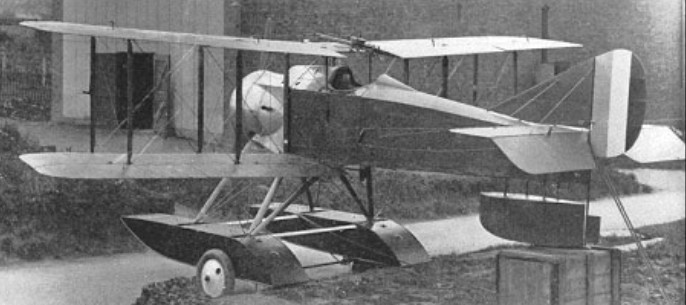
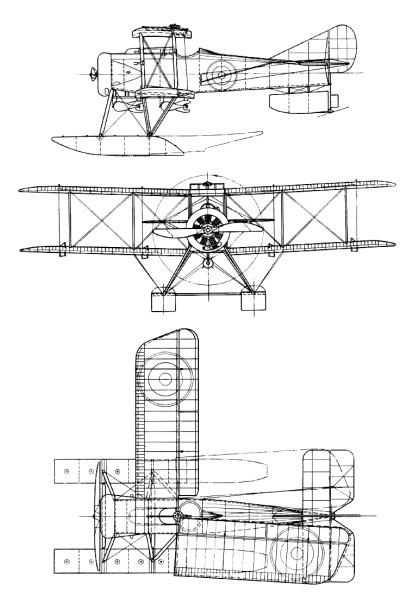
Petters Ltd, an engineering company founded 1910, undertook government aircraft construction in 1915 as Westland Aircraft Works at Westland Farm, Yeovil, Somerset. Produced Short 184, Short 166, Sopwith 1 1/2-Strutter, Airco D.H.4, and D.H.9 biplanes; adapted the last for Liberty engine as D.H.9A. Also built Vickers Vimy. First of its own designs were the single-seat N.1b scout and Wagtail and the two-seat Weasel, but the war’s end prevented production. First civil aircraft, the four-seat cabin Limousine, was followed by a naval D.H.9A development, the Walrus, and the 1923 Dreadnought, a very advanced but unsuccessful monoplane based on Woyevodsky’s flying-wing theory. The Woodpigeon and Widgeon I and II that followed were Westland’s only attempt to enter light-aircraft market. Apart from Westland IV / Wessex three-engined airliners of 1929-1931, the rest of the designs from Yeovil were military fighters or general-purpose aircraft. Wapiti, built from 1927, was basically a modernization of the D.H.9A and was followed in 1931 by an improved version, the Wallace. The Westland P.V.3 private prototype for the Wallace was used on the Houston Everest expedition of 1933. From the P.V.7 monoplane, the last general-purpose type, the army cooperation Lysander was developed, the best-known company design of Second World War. Company became Westland Aircraft Ltd. in July 1935. Westland fighters included the twin-engined Whirlwind, which saw limited squadron service in Second World War, followed by the high-altitude Welkin, which did not enter service. Following the war, four naval strike squadrons were equipped with the turboprop Wyvern, the last fixedwing aircraft built by the company.
In the 1930s Westland had built two autogiros for Juan de la Cierva, and in 1946, with declining sales of fixedwing aircraft, decided to concentrate on rotary-wing designs. Negotiated with Sikorsky a license to build a modified version of the four-seat Sikorsky S-51. Re-engined and altered in detail, it was produced as the Dragonfly in 1948. Followed by the S-55 Whirlwind and in 1959 Westland’s first turbine-powered helicopter, the Gnome engined Whirlwind. In the reorganization of Britain’s aircraft industry Westland acquired the helicopter interest of Bristol Aircraft (1960), Fairey Aviation (1960), and Saunders- Roe (1959). From this came production contracts for the army Belvedere and Scout and Royal Navy Wasp, while the Sikorsky designs, enhanced increasingly by Westland improvements, resulted in the S-58 Wessex. Beginning in 1966 the company was known as Westland Helicopters Ltd.
Activities included production of the Sea King, developed from the Sikorsky S-61 to Royal Navy requirements; Commando army version of Sea King; and Gazelle and Lynx, which formed part of the Anglo-French helicopter cooperation program with Aerospatiale. Gazelle production started in 1971 and Lynx in 1975 (naval, military, and civil versions constructed). Following the construction of 40 Aerospatiale/Westland Pumas for the RAF, the company continued to produce Puma component for French assembly lines.
By 1995, Agusta and Westland had a joint venture in EH Industries, producing the EH.101.
Early 2001 Finnmeccana of Italy and GKN of the UK completed merging their Agusta and Westland helicpoter divisions as AgustaWestland.
Westland Helicopters Ltd became GKN Westland Ltd and operated three divisions as: GKN Westland Aerospace Ltd. with activities including manufacture of structures (airframe or nacelles) for Lynx and EH 101 helicopters, and many airliners including Airbus A330/A340, Boeing 737/747/767/MD-11/C-17, Saab 2000, Fairchild Dornier 328, Bombardier Dash 8 and Global Express, Lockheed Martin C-130J, and IPTN N250, plus helicopter and engine transmissions; GKN Westland Helicopters Ltd., manufacturing Boeing Apache Longbow as WAH-64 for British Army, EH 101 (company has 50% holding with Agusta of Italy), and operates GKN Westland Heliport; and GKN Westland Technologies Ltd. Lynx general-purpose army and naval twin-turboshaft helicopter first flown March 1971 as joint program with Aerospatiale of France, and continues in production (some 400 built). Sea King first flown May 1969 as medium multirole type, derived from Sikorsky S-61, and 326 delivered up to end of production in late 1990s (including Commando tactical assault derivative).
 All Aero