Germany
Formed in 1915 at Berlin-Oberschoneweide with capital of 80,000 marks. Built number of allegedly inherently stable monoplanes during First World War.
World War 1
GAZ / Leningrad North Factory State Enterprise / GAZ No.3 Krasni Liotchik
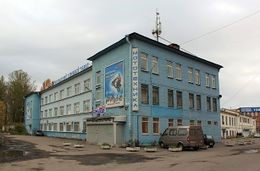
The V. A. Liebediev Aviation Factory Stock Company was created on the outskirts of Petersburg, near the village of Novaya Dirievnya and very close to the Komendantski airfield. Its origins are linked to the sportsman and aviation lover V. A. Liebediev. A law student at the University of Petersburg, he decided to abandon his studies and cycling to study aviation at the Farman School in Paris, France. Upon returning to Russia in 1909, he decided, together with his brother and Captain S. A. Ulyanin, to create the Petersburg Aviation Society (PTA), with the financial support of the businessman Lomach.
In 1914 Liebediev built several productive buildings next to the village of Novaya Dirievnya and very close to the Komendantski airfield, which formed the basis of the new aviation factory known as the “VA Liebediev Aviation Stock Company” and intended primarily for the construction of low-cost aviation models. license, although a short time later, models of their own design began to emerge, which carried the brand “Lievied” (Swan).
By 1917 Liebediev decided to increase production, but unfortunately his plot at the Komendantski airfield did not allow an increase, so he was forced to build new facilities in Taganrog, Penza and Yaroslavl.
By that time around the Komendantski airfield, several aviation factories had already sprung up with their assembly workshops and hangars. Among them the “Gamayún” factory of S. S. Schetinin, the Russian-Baltic Wagon Factory, the factories of Slysarienko, Porojóvchkov, Meltser, Zass, Lanski. By 1918, more than half of the country’s aeronautical technology factories were located around this aerodrome.
On March 13, 1918, by order of the newly created Soviet government, it was decided to close all the aeronautical factories in Petrograd, move the production of the “Ilya Muromets” bomber to the interior of the country and evacuate all the machinery and equipment from the city. This measure affected the small factories of Slyusarienko, Porojovschikov and Grigorovich, which were closed and their personnel and machinery transferred to other factories.
By the decree published on June 28, 1918, all aviation factories were nationalized and the Main Directorate of the Aeronautical Industry known as Glavnoavia was created for their direction. This organization, which began to function on January 1, 1919, was originally subordinated to the United Council of the Economy (VSNJ according to the acronym of Vsiesoyuzni Soviet Narodnovo Jozyaistva), but as of December 22, 1919 it was led by the Council of the Military Industry (SVP).
Created in Saint Petersburg in 1919 as GAZ No.3 “Krasni Liotchik”, on the basis of the nationalized Russian-Baltic Wagon Factory (RBVZ), Slyuzarienko Factory, Schetinin “Gamayún” Factory and V. A. Liebediev Factory. Between 1925 and 1927 it was the productive base of the OMOS directed by D. P. Grigorovich.
The first task of the new organization was to continue the development of hydrofoils for naval aviation. It was decided to develop new models on the basis of the successful Grigorovich / Schetinin M-9. In the “Gamayun” factory in Petrograd there were still several M-9s in different stages of construction, as well as parts and pieces of these models. Unfortunately on June 16, 1921 this factory caught fire, being practically destroyed. The little that was saved was sent to the RBVZ and the old factory in Lievediev.
After the restructuring of the economy and by Resolution of the SNJ SR of December 17, 1918, the aviation factories of Schetinin, Liebediev, Slyusarienko, Grigorovich, Meltser, Semionov, Russo-Baltic and Russian Renault were unified into a productive group under the Directorate of the Petrograd Aviation Factories Directorate (“Aviapravlenie”), subordinate to the SNJ Metal Section in the Northern Region. The balance report of this organization relating to the period between September 1918 and October 1919 defined:
“In January of this year the large factories of the Petrograd region were nationalized: Aeronautical Stock Company of SS Schetinin (“ Gamayún ”), Aeronautical Stock Company of VA Liebediev, aeronautics department of the Russian Wagon Factory -*Baltic. Small factories such as the Grigorovich Experiment Factory and the Porojovchikov Experiment Station were closed and their personnel and materials transferred to other factories in Petrograd. The plans were partly delivered to the “Gamayún” dedicated to naval airplanes and partly to Mosca, which builds the Porojóvchikov-4 training aircraft. The machine tools have been distributed among other factories. The factories of the Petrograd region have been unified in terms of management under Aviachast and Glavnoavia, being subordinate to the latter ”.
In April 1919 the “Aviaprablenie” was reorganized as the Directorate of the North Region and on December 22, 1919, in correspondence with Resolution No. 1171 of the Presidium of the VSNJ, Glavnoavia and its 10 companies were transferred to the jurisdiction of the Council of the Military Industry (SVP), known as Promsoviet, with the main objective of supplying the Red Army and the Fleet. The unified Petrograd factory was renamed the State Aviation Factory (GAZ) No.3 “Krasni Liotchik” (Red Pilot).
In 1920 the Directorate of the North Region became the First Unified State Aviation Factory and between 1921 and 1923 the Directorate of the First Central Unified Aviation Factory of the PSNJ in Petrograd.
In 1924, Factory No.3 was damaged by a flood, destroying several models and damaging the hangars and workshops. At the end of that year, D. P. Grigorovich arrived in Petrograd from Moscow, who engaged in work to recover this facility and here in 1925 he would organize the Experimental Department of Naval Construction (OMOS according to the acronym of Otdiel Morskovo Opytnovo Samoliotostroyenia).
OMOS brought together the best Soviet specialists in the construction of naval aviation and most of them some years later would end up becoming successful aeronautical constructors. In October 1925 as Grigorovich’s second was A. N. Sidielnikov; construction manager – V. L. Korvin; aerodynamic and resistance calculations – K. A. Vigand and V. N. Belyayev (for a short time), A. L. Guimmelfarb and Z. I. Zhurbin; builders – P. D. Samsonov and V. B. Shavrov; drawing bureau – N. G. Mijelson. The group numbered only a few dozen people.
The first major task of the GAZ No.3 was the preparation for the serial construction of the I-2 fighter and its development I-2bis. This model remained in production together with the U-1 and its version with MU-1 floats.
The OMOS would be responsible for the design and construction of a series of experimental models that accumulated failure after failure, so that at the end of November 1927 Grigorovich and his collective were transferred to Moscow, located at Factory No.22 in Fili, in a new structure subordinate to the TsKB, which received the designation OPO-3 (Opytni Otdiel – 3 or Experimental Department – 3).
Until the mid-1920s the facilities at the Komendantski airfield were used solely for aeronautical maintenance and repair.
As of February 1925, GAZ No.3 became subordinate to the State Trust of the Aeronautical Industry of the USSR VSNJ.
On October 1, 1927, aeronautical construction became subordinate to the NKAP. In this period all the factories (not only those of aviation), began to work in the closed (secret) military system and received a new name. The GAZ No.3 was renamed NKAP Factory No.23. With the beginning of the Great Patriotic War she was evacuated to Novosibirsk (a small part to Kazan). Only repair shops remained in Leningrad.
On September 22, 1944, in the facilities of repair bases No.1 and No.2 of the evacuated Factory No.23 a new aviation factory was created, which received number 272 from the NKAP.
This factory mass-produced various models of light and trainer aircraft, primarily designed by A. S. Yakovlev’s OKB. These models include the Yak-11, the Yak-12 multipurpose aircraft, the Yakovlev Yak-18 trainer and multifunctional aircraft, and the Yak-24 heavy twin-rotor helicopter.
After the end of the war, the Aviation Factory No.272 was established in its facilities, which at the end of the 1950s was reoriented to the production of anti-aircraft systems. From 1967 it was renamed the North Leningrad Factory.
From 1967 the factory was renamed the North Leningrad Factory.
In 1976 the factory became the North Leningrad Factory Productive Union.
Since the late 1970s the company began production of the advanced S-300 PMU multi-channel launch container missiles. In parallel and as part of the diversification of production towards the civil market established by the CPSU congress, the manufacture of some 20 lines of electrical appliances and household utensils was assumed.
As of November 1994, the factory changed its name again to the Leningrad North Factory State Enterprise.
In the company since 1994 began the introduction into production of the motorcycle “Pegas”. Currently the factory continues to produce a whole family of motorcycles with domestic and imported engines.
Gallaudet C-2
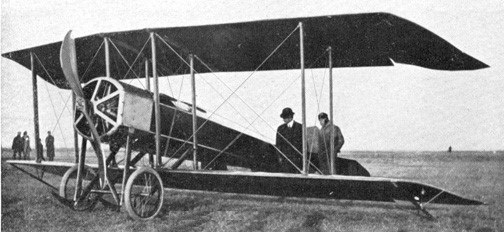
1918
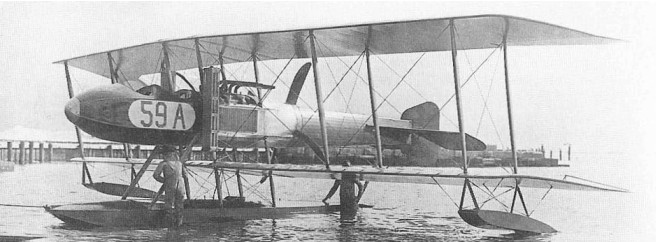
Gallaudet 59-A
The 1926 Gallaudet 59-A of the USN had the propeller mounted amidships in the fuselage. The first flight was on 19 July 1916, piloted by Ltjg G D Murray.
Gallaudet D-4
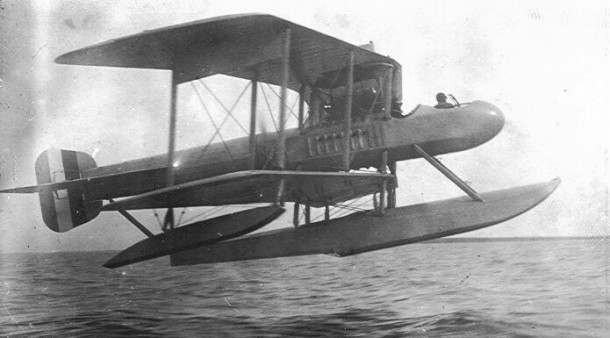
In an effort to produce an aircraft with the best possible forward visibility for the observer, Gallaudet developed the D-2 into the D-4, which placed the observer in the nose, followed by the pilot, with the propeller attached to a ring that circled the fuselage behind the wings. The four blades spun around the fuselage just behind the pilot.
Power for the D-4 was a 360-hp Liberty L-12 engine buried within the fuselage, just behind the pilot. A large pontoon was mounted below the fuselage, and small outboard floats were mounted near the tips of the swept-back wings.
Two D-4 were built for the Navy (A2653, A2654). The prototype crashed during flight testing on 19 July 1918, but the second was accepted by the U.S. Navy. No further aircraft were built, as Gallaudet turned their attention to constructing Curtiss HS-2L flying boats.
Engine: 1 × Liberty L-12, 360 hp ( kW) each
Wingspan: 46 ft 5 in ( m)
Wing area: 260 sq.ft ( sq.m)
Length: 33 ft 6 in ( m)
Height: 11 ft 8 in ( m)
Empty weight: 4,228 lb ( kg)
Gross weight: 5,440 lb ( kg)
Maximum speed: 119 mph ( km/h)
Range: 390 miles (628 km)
Endurance: 3 hr 30 min
Service ceiling: 14,000 ft
Crew: 2 (pilot, observer)
Armament: None
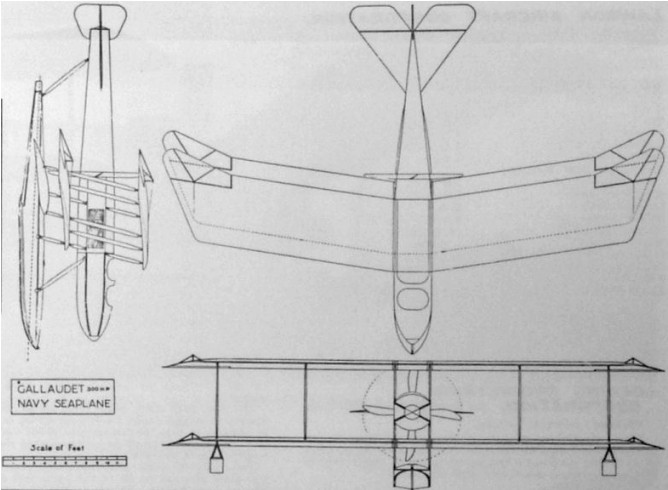
Gallaudet D-1 / D-2
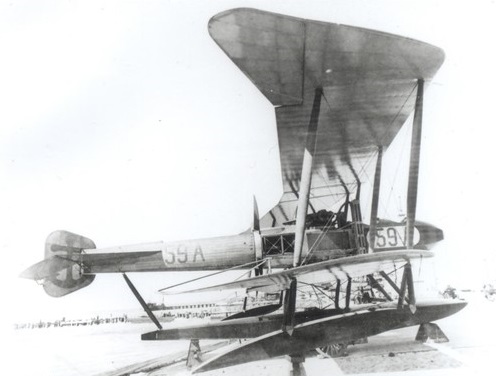
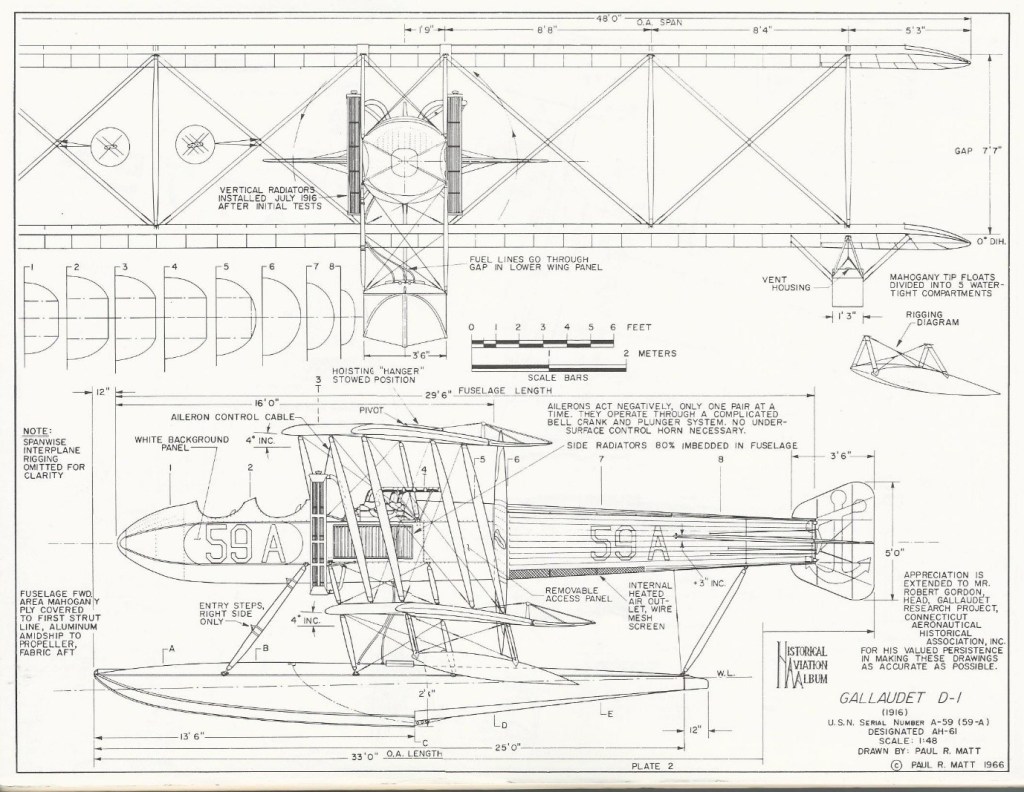
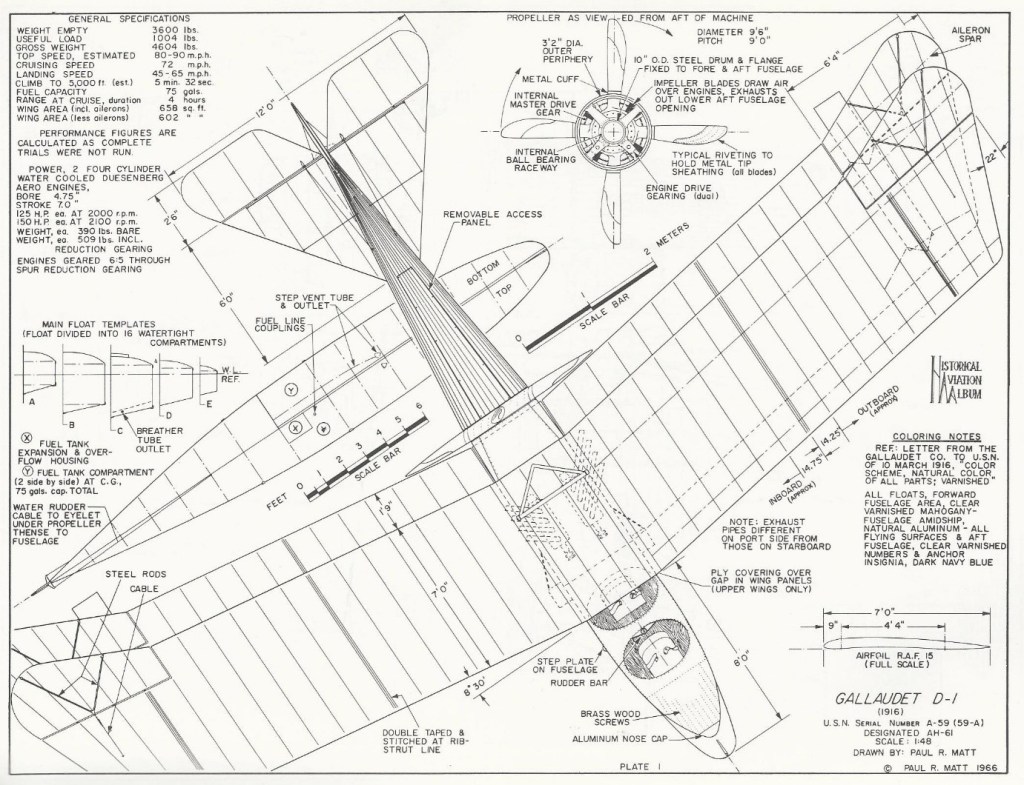
In response to a requirement by the U.S. Navy for light floatplanes capable of being launched off catapults by ships underway, the Gallaudet Aircraft company began development of the “D-4”, based on the earlier Gallaudet D-1. The D-1 (A59) was powered by two 150 hp Duesenberg engines mounted side by side, and first flown on 17 July 1916. Following delivery of the D-1 in January 1917, the firm reorganized as Gallaudet Aircraft Corporation, and moved to Greenwich, Rhode Island.
Despite numerous mechanical difficulties the Army bought four of the improved D-2 version.
In an effort to produce an aircraft with the best possible forward visibility for the observer, Gallaudet developed the D-2 into the D-4.
D-1
Wingspan: 48 ft
Length: 33 ft
Gross weight: 4,604 lb
Max speed: 90 mph
Gallaudet Airplane Corp
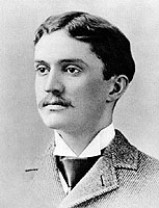
Edson Gallaudet was a grandson of Thomas Hopkins Gallaudet, specialist in education of the deaf and co-founder of what evolved into Gallaudet University in Washintgon, D.C. He earned a Ph.D. in electrical engineering in 1896 and was a physics instructor at Yale from 1897 to 1900.
The Gallaudet Kite of 1898 was built by Edson Fessenden Gallaudet, an engineer (PhD) and then working as a physics instructor at Yale, this hydro-bike kite was built to test wing-warping controlled by a system of gears and rods. Its wingspan was 11 and ½ feet, its length just over eight feet.
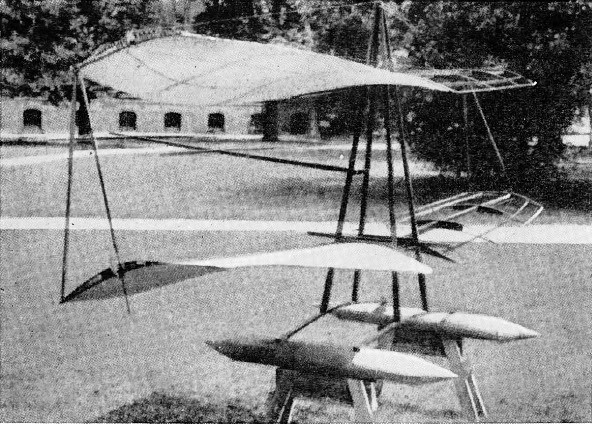
The original is currently on display at the Early Flight Gallery in the National Air and Space Museum.
Gallaudet worked for several engineering firms from 1900 until 1908. Then he founded Gallaudet Engineering Company in Norwich, Connecticut, and evidently wasted no time. His first airplane came a year later, with others to follow.
1908: (Edson) Gallaudet Engr Co Inc, Norwich CT., USA
His 1912 A-1 Bullet was a sleek monoplane of pusher layout. The motor, a 100-hp Gnome rotary, was enclosed in the fuselage and drove its three-blade rear-mounted prop through a lengthy driveshaft.
In 1916, Gallaudet’s D-1 floatplane optimized ship-catapult launching with its uniquely positioned propulsion. Dual Duesenberg 125-hp 4-cylinder engines were side by side amidships in the D-1’s fuselage. A four-blade propeller was in the middle as well, driven by a 6:5 spur gear and seemingly splitting the fuselage in two.
The U.S. Army bought four of its D-2 variants. A pair of D-4s followed, with the observer given the forward cockpit for a better view. The D-4 swapped dual Duesenbergs for single Liberty power. A prototype crashed in flight testing; the second one was accepted by the U.S. Navy for observation duties.
Gallaudet then turned his company’s attention to constructing Curtiss HS-2L flying boats, many serving in anti-submarine patrols during World War I.
Following delivery of the D-1 in January 1917, the firm reorganized as Gallaudet Aircraft Corporation, and moved to Greenwich, Rhode Island. Later built 5-seat biplane tourer, the Liberty Tourist, and rebuilt 25 DH-4s for U.S. Army.
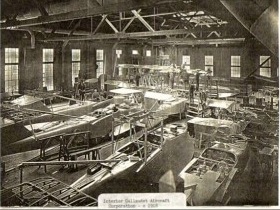
A 1919 catalog for the Gallaudet Aircraft Corporation lists the Chummy Flyabout. This was a two-place land-based monoplane, again with Gallaudet-unique propulsion. Two Indian motorcycle engines, each producing from 18 to 20 hp, were mounted in the nose and drove a pair of pusher props.
Later, in 1923, Gallaudet designed and built an aircraft of all-metal construction.
Gallaudet retired in 1924, keeping scientific memberships and a low profile until his death at age 74 in 1945. His company evolved into Consolidated Aircraft, renowned for the B-24 Liberator heavy bomber and PBY Catalina flying boat.
Friedrichschafen N.I
Friedrichshafen’s only other large bomber design was the N.1, a mammoth single-¬engined biplane which was built in 1917. Virtually a scaled up two seater, the N.1 employed markedly sweptback wings and a composite undercarriage. The sole power came from a 260 hp Mercedes D IVa engine in the nose, resulting in the pilot’s cockpit being located almost halfway back along the narrow fuselage, with a consequent hopeless forward view for landing and takeoff.
Friedrichschafen G.IV
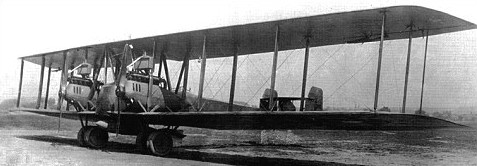
The final version of the Friedrichshafen’s G bombers was the G.IV of 1918, which was basically similar to the G.IIIa but had a slightly shorter wing span, a modified and rounded fuselage nose and D.IVa engines mounted in tractor configuration.
The front gunner’s cockpit was dispensed with, leaving the main fuselage snub-¬nosed, and com¬pound tail surfaces, as in the G.IIIa, were employed. One or two examples may have seen limited operational trials, but this is unconfirmed.
Engines: 2 x 260 hp Mercedes D IVa.
Span: 22.6 m (74 ft 1.5 in).
Length: 12 m (39 ft 4.5 in).
Endurance: 5 hrs.
Armament: Bombload up to 1496 kg (3300 lb); 1 Parabellum machine gun in rear.
Friedrichschafen G.III
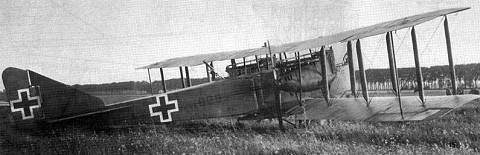
The G.III bomber was a twin 194kW Mercedes D.IVa engined scaled up version of the G.II which saw much operational service from early 1917. Its wings of increased span incorporated three bays outboard of the motors. The undercarriage comprised two pairs of wheels, with a fifth wheel immediately under the nose gunner’s cockpit the latter assisting any heavily loaded takeoff, but mainly preventing a nose over landing on the crude runways of the period. Construction of the G.III was a typical contemporary mixture of wood, plywood and steel tubing, and the three man crew consisted of a pilot and a ‘bombing officer’ in a side by side cockpit, with two cockpits mounting guns in the nose and mid fuselage connected by an internal passageway for the third crew member. Capable of lifting a 1500 kg (3310 lb) bombload, the main weight of bombs was carried externally below the main nacelle, but internal racks, each for five 10 kg (22 1b) bombs, were located either side of the communicating passage aft of the pilot’s cockpit.
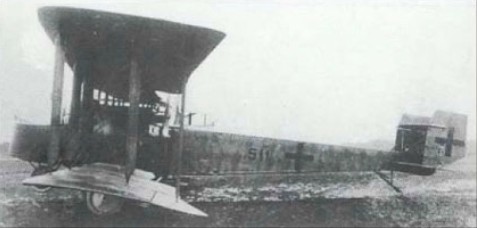
For the final 18 months of the First World War, Friedrichshafen G.IIIs, in company with the better known Gotha G.V bombers, formed the real strength of German heavy bomber units, particularly on the Western Front in France. Used mainly in long¬distance night raids, G.IIIs are known to have attacked such principal targets as Paris, and are believed to have participated in some of the well publicized attacks against Eng-land.
During 1917 Friedrichshafen concentrated on the production of the G.III and G.IIIa with many others being built under contract by Daimler and Hansa. An improved variant was the G.IIIa, built under licence by the Daimler works. This differed from the G.III only in minor structural changes to the tail unit and wing tip configuration.
It is not known how many G.IIIs and G.IIIas were built in total, but more than 330 were produced by the subcontractors.
Span: 23.7 m (77 ft 9 in).
Length: 12.8 m (42 ft).
Endurance: 5 hrs.
Powerplants: 2 x 260 hp Mercedes D IVa
Armament: Bombload up to 1496 kg (3300 lb); 1 Parabellum machine gun in nose; 1 Parabellum machine gun in rear
Maximum speed: 135 km/h (84 mph)
 All Aero