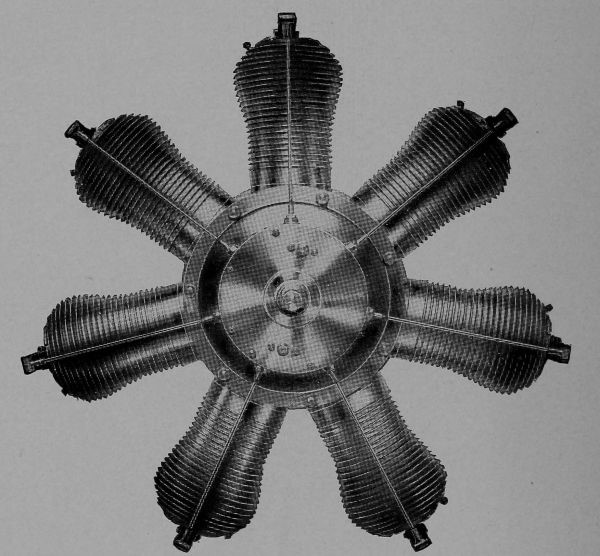
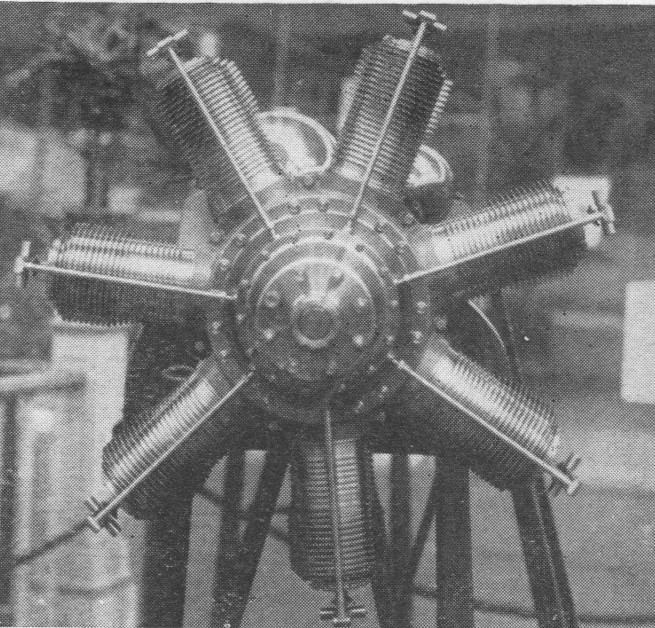
Société des Moteurs Gnôme was founded in 1905 by Louis Seguin. In 1915, this firm merged with the Société des Moteurs Le Rhône, founded three years earlier by Louis Verdet, to form Gnôme & Rhône. While Gnôme had continued to produce rotary engines in the 50 to 100 horsepower range, Rhône had refined its fixed-cylinder engines to produce 200 horsepower. However, both these lines of engines were being outclassed in terms of reliability, economy, or power by several contemporary engine manufacturers.
Seguin brothers of Gnome-Rhone Article
Nevertheless, the two merged companies were quite successful commercially, thanks to licensed production in Great Britain, Russia, the United States, Sweden, Germany, and Japan, as well as joint ventures in Italy and elsewhere.
A number of factors hit Gnôme & Rhône (G&R) hard after the war. A huge tax burden was levied based on the firm’s previous international success. At the same time, a mass of war surplus engines glutted the market.
Unlike its other domestic rivals, Gnôme & Rhône lacked experience in areas apart from aero engines, a market now glutted by thousands of surplus motors. A variety of schemes, from making sewing machines to engines for farm tractors or cars, all failed. In constant francs, the company’s sales in 1921 were almost half those of 1913, though the factories were five times larger, notes one scholar in the journal Entreprise et Histoire. In that year, the already legendary company reduced its employment from 6500 workers to 1200.
Production of motorcycles under the Gnôme & Rhône was one area that produced quite satisfactory results in the marketplace; in fact these machines gained a devoted following. In 1922 the English firm Bristol licensed to G&R the right to produce its powerful air-cooled radial engines producing up to 450 horsepower, as well as the freedom to sell them anywhere in the world except for the United States and the territories of the British Empire. With the support of its banks, G&R was able to retool its workshops to build engines, including the new Jupiter introduced in 1923. At the time, G&R had also taken a significant holding in a French-Romanian airline, which helped establish its engines in Eastern Europe.
Between 1924 and 1928, sales increased more than sixfold. At the same time, the air, sea, and land branches of the French military were deciding their outdated equipment was in need of replacement, hence, another blossoming market at home. Expanding commercial fleets produced still more demand. The radial Jupiter engines earned a reputation for being simple to run and easy to fix, even if in-line and V-8 engines made by Hispano-Suiza and Lorraine-Dietrich were more powerful. A novel program, instituted in 1924, allowed for the lease of the engines for a given number of flight-hours, which relieved designers and manufacturers some of the financial strain associated with bringing out new models of aircraft. The popular Jupiter engine was subsequently licensed for production in several European countries as well as the Soviet Union and Japan.
G&R introduced its K family of engines in 1928. In terms of power, this series culminated in the 750 horsepower 14K licensed to a Soviet factory for eventual use in Antonov transports. G&R’s designers evolved L, M, and N families of engines by 1939; one of the latter achieved 1150 horsepower.
Air power played a determining role World War II, and G&R engines had a significant part to play. The Soviet Union’s Molotov factory was producing 300 licensed G&R engines a month in 1940 for use in biplanes and Sukhoi fighters. In Japan, Mitsui illegally copied the 850 h.p. 14K engine, producing the “Suizei” powerplant found in the Mitsubishi Zeroes that attacked Pearl Harbor. During the Nazi occupation of France, G&R became a subsidiary of BMW. Emmanuel Chadeau writes in Entreprises et Histoire that G&R thereby influenced 16 manufacturers in 14 countries during the war; this off-shore production nearly equalled G&R’s own output of 8,000 motors a year, together accounting for a quarter of the worldwide market.
The high share price that G&R commanded prevented it from being nationalized before the war. However, this did come to pass after the Liberation. SNECMA, la Société nationale d’étude et de construction de moteurs d’aviation, was thus created on May 29, 1945. The company was an amalgamation of diverse design bureaus and workshops; it inherited a work force of 10,000 mostly part-time employees. Along with G&R, Snecma was given some of the factories of the Société des moteurs et automobiles Lorraine, formerly Lorraine-Dietrich, which had been nationalized as la Société nationale des moteurs and had been relegated to making parts for tanks. Some of Snecma’s other facilities had been devoted to the production of German Junkers engines by the thousands during the Nazi occupation. G&R also owned a factory of the Aéroplanes Voisin firm, which had gone bankrupt in 1938.

 All Aero