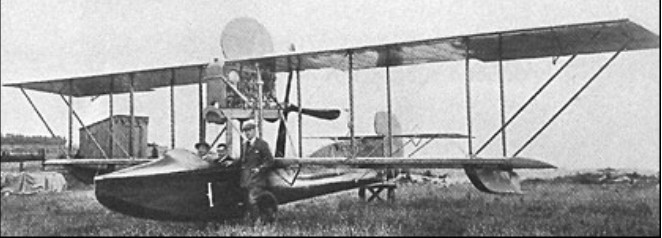
1914
1914
Based at Bognor, Sussex. Acquired U.K. rights to products of Curtiss Aeroplane Company. Built Short S.38 trainers under subcontract in 1914. About 1910 had designed and built an unsuccessful aircraft with wings covered in sheet aluminium. Registered 1912 as private company; designed and built one- and two-engined flying-boats for the Admiralty in 1914.

At the end of 1916, the Whitehead Aircraft Company completed, at its Richmond, Surrey, works, a small single-seat fighting scout. Not unlike the Camel in general appearance – and perhaps inspired by the Sopwith type, for the production of which Whitehead was a major contractor – the aircraft was a compact single-bay biplane, with ailerons on all four wings. The fuselage was faired to a near-circular cross section and the engine was an 80hp Le Rhone nine-cylinder rotary. The name Comet was bestowed upon the fighter by its manufacturer, although it was also known within the works as the Boyle Scout, in an allusion to its principal designer, Edwin Boyle. It is not clear if it was designed by T. Navarro, who left Whitehead Aircraft to work on another scout project at Thomas Lowe & Sons, or if the designer was the then 23 year old Edwin Boyle. If it was known in the works as the Boyle Scout, that does suggest Boyle.
No details of the planned armament appear to have survived, nor of any flight testing, although the Comet was reported to have flown.
UK
Established at Richmond, Surrey, built Airco D.H.9 and RAF B.E.2a and B.E.2b under subcontract during First World War. Was a major supplier of Sopwith Pups. Built a prototype only of own-design Comet single-seat scout.
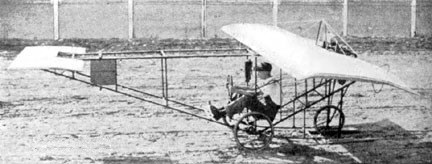
The 1916 Baby White built by George D White was a single seat monoplane, powered by an approximately 15hp motorcycle engine and chain-driven pusher propeller. Of canard configuration with trailing-edge ailerons and reverse tricycle gear, it was test-flown at the Ascot Speedway in Los Angeles.
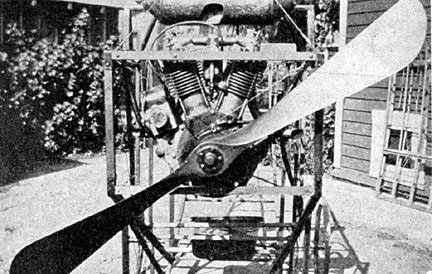
The first kit-form aircraft offered in the US, one was built, plus an unknown number of kits for home-builders.
Engine: 15hp motorcycle
Wingspan: 18’0″
Length: 16’0″
Speed: 50 mph
Seats: 1
France
Charles Weymann designed and built in 1916 an all-metal biplane with conventional fuselage. In 1929 joined with lePere, and Weymann-lePere was formed from the remains of a separate company called Avimeta which had closed in 1928. Weymann-lePere held a Cierva license; when lePere left in 1930 Weymann reverted to original name.
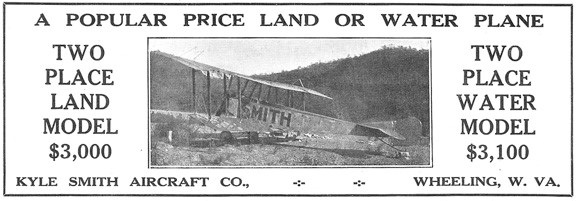
The West Virginia Aircraft Co biplane, built circa 1918, was a twin-tail, headless Wright-type design, with trailing-edge ailerons on upper wing.
A single-place open cockpit, it was powered by a pusher motor.
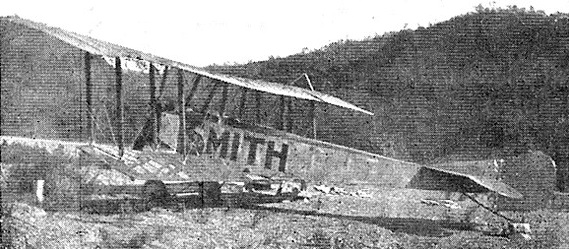
A two-place, open cockpit biplane built in 1917.

In April 1918, Westland gained a three-prototype contract for a two-seat fighter-reconnaissance aircraft that was designed to provide a successor to the Bristol F.2b fighter. In configuration, the new fighter, to which the name Weasel was given, closely resembled a scaled-up Wagtail. The pilot was located beneath the trailing edge of the upper wing, with the observer/ gunner close behind, with a single 7.7mm Lewis gun on a Scarff ring. Two fixed and synchronised forward-firing Vickers guns of the same calibre were provided for the pilot. The Weasel had a two-spar wooden wing and a wire-braced wooden fuselage, with fabric covering for all but the ply-covered front fuselage. In common with the competing Austin Greyhound and Bristol Badger, the Weasel was powered by the 320hp ABC Dragonfly nine-cylinder air-cooled radial engine, which (like the ABC Wasp in the Wagtail) proved so unsatisfactory as to rule out any possibility of production, even if the ending of World War I had not removed the urgency from the requirement. Flight testing did not begin until November 1918 and a Weasel went to Martlesham Heath in April the following year, followed by the third prototype in November. Subsequently, two of the Weasels were used for engine development at the RAE Farnborough, one being re-engined with a 385hp Cosmos Jupiter II nine-cylinder radial and the other with a 350hp Armstrong Siddeley Jaguar II 14-cylinder radial. A Jupiter II was also used to power a fourth Weasel, which was ordered in August 1919 and delivered in 1920 with full armament, although also used primarily for engine development.
Engine: 320hp ABC Dragonfly
Max take-off weight: 1393 kg / 3071 lb
Empty weight: 847 kg / 1867 lb
Wingspan: 10.82 m / 36 ft 6 in
Length: 7.56 m / 25 ft 10 in
Height: 3.07 m / 10 ft 1 in
Wing area: 34.19 sq.m / 368.02 sq ft
Max. speed: 210 km/h / 130 mph
Ceiling: 6310 m / 20700 ft

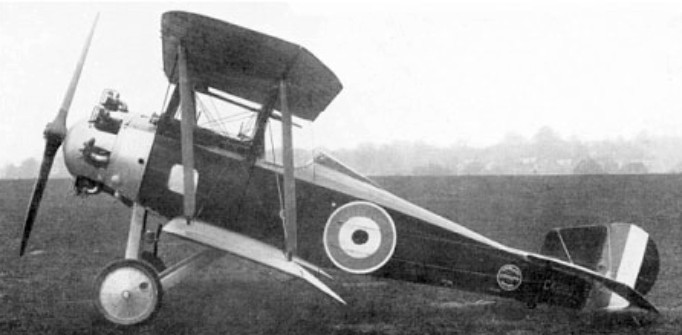
A contemporary of the Sopwith Snail and the BAT Bantam, the Wagtail was similarly designed to comply with the A.l(a) Specification drawn up by the Air Board in 1917 to define its requirements for a single-seat fighter. Emphasis was to be placed upon manoeuvrability and climb, with the ability to achieve 217km/h at 4570m when carrying oxygen equipment and three machine guns. Like its competitors, the Wagtail was powered by the 170hp ABC Wasp I seven-cylinder radial, an engine that eventually thwarted further development of all three A.l(a) types. A well-proportioned, diminutive single-bay biplane, the Wagtail gained a contract for three prototypes late in 1917, and the first was flown in April 1918. Construction was of fabric-covered wood, with metal-framed rudder and elevators, and two synchronised 7.7mm Vickers guns were fitted. An overwing Lewis gun was planned, but not fitted to the prototypes. Whereas the first Wagtail to fly had equal dihedral (2° 30″) on upper and lower wings, the second and third were completed (and the first later modified) to have a larger cutout in the upper wing centre section with 5° of dihedral on the outer panels of the upper wing and a flat lower wing. Destroyed in a fire at Yeovil soon after its first flight on 29 April 1918, the second Wagtail had to be replaced later that year; the third went to Martlesham Heath on 8 May, but problems with the Wasp limited flying. In October 1918, the engine was officially abandoned, and with it any plans to produce Wasp-engined aircraft. Two more Wagtails were ordered from Westland in 1919, to serve as test-beds for the 160hp Armstrong-Siddeley Lynx seven-cylinder radial engine. Unarmed, these two aircraft were delivered to the RAE in September/October 1921.
Max take-off weight: 603 kg / 1329 lb
Empty weight: 338 kg / 745 lb
Wingspan: 7.06 m / 23 ft 2 in
Length: 5.77 m / 19 ft 11 in
Height: 2.44 m / 8 ft 0 in
Wing area: 17.65 sq.m / 189.98 sq ft
Max. speed: 201 km/h / 125 mph

 All Aero