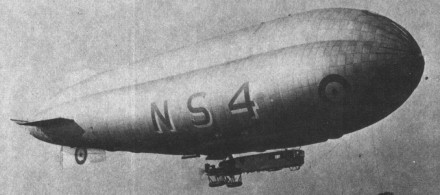
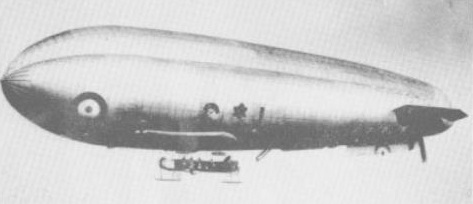
Another trefoil-section vessel, the ‘North Sea or ‘NS’ class was the last non-rigid airship type to be built for the Royal Navy, the first being ordered in January 1916 and delivered to the naval air station at Pulham in February 1917. The original idea had been for an airship which could carry out convoy duties and also co-operate with naval surface vessels, a concept that was never put into practice, the whole ‘NS’ fleet being used for patrol duties. One reason for this decision was the trouble that was experienced with the Rolls-Royce engines first fitted, the problem lying with the over-long shafting, about 3.05 m (10 ft) in length. It was only when this complicated transmission and the engines had been exchanged for direct-drive Fiats, that the type was able to prove its usefulness; previously only 18 were delivered, a mere 12 being with operational units. Although a variety of car configurations was encountered, all of them were of similar lines, with the power-plant mounted in a separate nacelle joined to the crew quarters by a wooden catwalk. This forward part of the car had been designed with some consideration to the comfort of its occupants. Such additions as a chart table and bunks were now essential, since the 10 men aboard were expected to operate as two watches, five being on duty while the remainder rested. From July 1917 the small number of North Sea airships then in use were all based on the Firth of Forth at East For¬tune, but by the end of the war over 100 had seen service. An early example (NS14) had gone to the United States and become A5580, while NS6 became a familiar sight to Londoners as a result of its frequent appearances over the capital; and in 1919 NS11 established an endurance record for a non¬stop cruise of 6437 km (4,000 miles) in 101 hours. Although its primary duty was to attack U-boats with its cargo of bombs, an historic use for NS7 and NS8 was to make up the aerial force with the British fleet sent to accept the surrender of the German naval forces on 21 November 1918. All convoy protection and coastal patrol airships carried about 181 kg (400 lb) of bombs with which to attack U-boats, but the useful load varied with the water ballast carried. Earlier models of the ‘NS’ class were powered by a pair of 186.4-kW (250-hp) Rolls-Royce engines, while latterly NS12 to NS18 received 223.7-kW (300-hp) Fiats.
Type: convoy escort airship. Powerplant: two 186.4-kW (250-hp) Rolls-Royce Eagle III V-12 or 193.9-kW (260-hp) Fiat A.12 six-cylinder water-cooled piston engines Maximum speed 93 kph (55 mph) Service ceiling about 7010 m (23,000 ft) Range 4828 km (3,000 miles) Useful lift 3810 kg (8,400 lb) Width 17.30 m(56 ft 9 in) Length 79.86 m (262 ft 0 in) Volume 10194 cu.m (360,000 cu ft) Armament: four or five 7.7-mm (0.303-in) Lewis machine-guns on free mountings, plus bombs
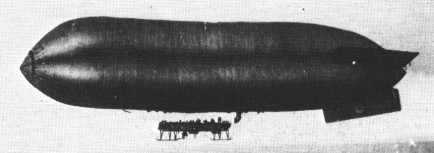
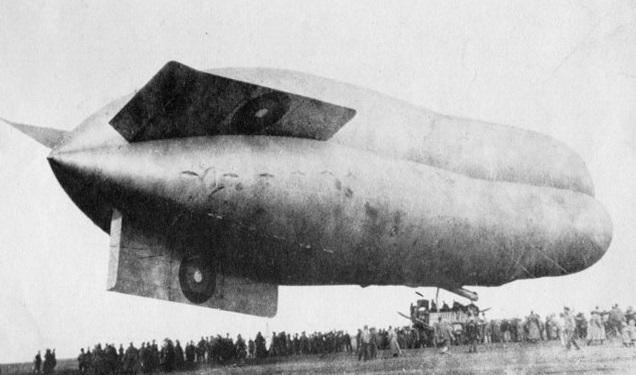
Designated the ‘C’ class from its anticipated use as a coastal type (‘Coastal’ class was an alternative name), this non-rigid type was of medium size and constructed with a trefoil envelope section, frequently known as the Astra Torrès type. The first of the pattern was ordered in June 1915 from Kingsnorth where it was assembled in the following September. The choice of envelope construction posed problems that were overcome in an interesting manner. Among these was the method of car suspension: the cables for this purpose were attached along the intersection line of the lobes and from here ran through the bottom of the covering to the car. And it is noteworthy that though the gas cells were contained in a non-rigid structure, it was possible to site one of two defensive gun positions on top.
Pembroke was the first naval air station to have the type, and the first flights took place from here in June 1916, other bases being Pulham, Howden. Mullion, East Fortune and Longside. The seas that came under the care of the ‘Coastal’ class airship patrols were those off the Norfolk coast, Lands End, the mouth of the Humber, the Firth of Forth and Aberdeen. Although the work of these vessels was largely unspectacular, one was the subject of an interesting set of experiments which were carried out on 6 September 1916. These were made with the first of the type, C1, in conjunction with the light cruiser HMS Canterbury, and were conducted offshore to look into the question of future developments, whereby an airship might be refuelled from a surface vessel.
A total of only 26 airships of this class were delivered, although these remained in service for lengthy periods. Thus they enjoyed a reputation for longevity as well as for extended flight times, the endurance of the design being as much as 12 hours. The crew of these airships consisted of five men, four of them in the car which also contained the two engines, fore and aft, driving tractor and pusher propellers respectively. The men’s accommodation was very considerably more comfortable than that of the fifth man, the upper gunner who had a special climbing tube through the envelope to reach his lofty position. ‘C’ class airships gave good and reliable service once the problems of cooling for the rear engine and blowing in of the nose cone had been solved.
When engines of differing powers were fitted in any one ship, the more powerful was normally that at the rear, while it is interesting to note that the cars were constructed from a pair of Avro 510 fuselages. Cl alone differed from the others in having a 57.9-in (190-ft) envelope with a 3964.4-cu.m (140,000-cu ft) capacity. The type had small variations of airscoop position and car details.
Naval Airship No.3
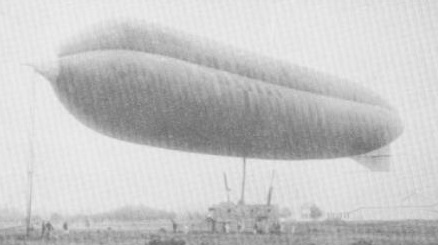
Four 1916-built Coastal airships were purchased by Russia in 1916, named Chernomor-1, 2, 3 (Name of the character of Russian fairy tale). The envelope volume was 4500 cu.m and the highest speed 80 km / h with two 173 h.p. engines.
Chernomor-1
In 1916, Chernomor-1 was at the very beginning of the next flight over the Black Sea, when engine failed. When returning to the base, the second engine failed. The situation was complicated by a decrease in the temperature of hydrogen in the envelope, which occurred as a result of the dense cloud covering the sun. The airship began to descend rapidly. The discharge of ballast and heavy equipment did not correct the situation. The gondola collided with water 10 km from the shore near the Kherson lighthouse, a boat coming to the rescue, and towed the airship to the Round Cove. When transporting the airship to the boathouse a strong wind rose, and in order to avoid the danger of damage, Chernomor-1 was dismantled. After that, it was never reassembled.
In one of the Chernomor-2 test flights, one engine failed. It was decided to land at the airfield Kachinskaya Aviation School. When landing, the second engine also failed. Despite this, the landing was done. Due to the increased wind and lack of space for safe parking, the airship “Chernomor-2” was dismantled. After that, it was never reassembled.
Chernomor -2
In the end, “Black Sea-3” was burned at the boathouse, and the “Black Sea-4” was not completed.
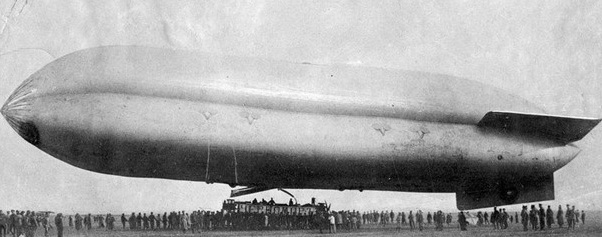
The C-Star class (sometimes written as C* class) of non-rigid airships or “blimps” were used by Britain’s Royal Naval Air Service for convoy escort duties during World War I. Developed from the Coastal class (often referred to as the “C class”), the Star in their designation indicated a modification of the original class which they slowly replaced in service.
C Star
The C-Star class were slightly larger than their predecessors. With an endurance of up to 30 hours, and more powerful (and reliable) Renault engines, the C*s had the same basic layout as the Coastal Class, with the same trilobe envelope. However, the envelope tapered towards the rear, as on the SSZ class, which greatly improved stability, as did the larger control surfaces.
‘C’ class Type: sea patrol airship Powerplant: two 111.9-kW (150-hp) Sunbeam six-cylinder water-cooled piston engines, or one 179-kW (240-hp) Fiat and one 82.0-kW (110-hp) Berliet water-cooled piston engines Maximum speed 80 kph (50 mph) Service ceiling 2134 m (7,000 ft) Useful lift 1608 kg (3,545 lb). Width 12.04 m (39 ft 6 in). Length 59.66 m (195 ft 9 in) Volume 4813.9 cu.m (170,000 cu ft). Armament: two 7.7-mm (0.303-in) Lewis machine-guns, plus bombs.
Chernomor Volume: 4,500 cu.m Max.speed: 80 km/h
C-Star Powerplant: 1 × tractor-mounted Berliet, 110 hp (82 kW) & 1 × pusher-mounted Fiat, 260 hp (193 kW) Volume: 210,000 cu ft (6,000 cu.m) Length: 218 ft 0 in (66.46 m) Width: 49 ft 3 in (15.01 m) Height: 57 ft 3 in (17.53 m) Useful lift: 4,030 lb (1,830 kg) Maximum speed: 58 mph (93 km/h, 50 kn) Endurance: at half speed 20 hours; at full speed 10 hours Service ceiling: 9,500 ft (2,900 m) Crew: Five
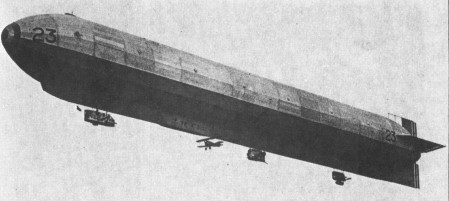
When His Majesty’s Airship No. 9 (HMA No.9) was delivered in the clos¬ing months of 1916 it was almost obso¬lete as a result of the lengthy political vicissitudes that had bedevilled its production. It served a useful purpose, however, it had become the basic pat¬tern on which the four rigid airships for the Admiralty were later to be based. The first of these ‘23’ class airships, HMA No. 23, was subsequently deli¬vered from Vickers Limited, Barrow¬-in-Furness, to Pulham on 15 Septem¬ber 1917. Design work had started in June of the previous year, the first flight being planned for that autumn, but consider¬able redesign had to be carried out when the original specification re¬sulted in a vessel that was something like 3493 kg (7,700 lb) too heavy, the greater part of this excess being attri¬butable to the choice of engines. The first trial flight of No. 23, four days after delivery, turned out to be something of an anticlimax, for it was clear that she too was at least obsoles¬cent, as might be expected from the original design source, and her mod¬ern counterparts had a lifting capacity some nine times greater than that of which she was capable. It is hardly surprising, therefore, that the planned total of 10 airships of this type was final¬ly cut back to six, while No. 23 was relegated to training duties. The other units of the class were HMA No. 24 (Beardmore), HMA No. 25 (Armstrong Whitworth), HMA R26 (Vickers), HMA R27 (Beardmore) and HMA R29 (Arm¬strong Whitworth), the last pair being of the improved ‘23X’ class without an exterior keel. No. 26 was the first to receive the ‘R’ prefix for rigid airships. Mindful that in the mid-months of 1918 there was a possibility of aerial confrontations between airships of the opposing nations, experiments were carried out with Sopwith Camel air¬craft suspended beneath the envelope of No. 23; the plan in the event of an attack was for the two fighters to be released to defend the mother vessel. There was no provision at the time for the aircraft to be reclaimed. In the spring of 1919 No. 23 was strengthened for tests at a mooring mast, but before they could be carried out she was broken up in September.
HMA No. 23 Type: naval training airship. Powerplant: four l86.4-kW (250-hp) Rolls-Royce Eagle III 12-cylinder water-cooled piston engines. Maximum speed 84 kph (52 mph) Service ceiling 914 m (3,000 ft) Range 3219 km (2,000 miles) Useful lift 6000 kg (13,228 lb) including four 45-kg (100-lb) bombs Diameter 16.15 m (53 ft 0 in) Length 163.07 m (535 ft 0 in) Volume 26674.4 cu.m (942,000 cu ft) Armament: provision for 7.7-mm (0.303-in) Lewis gun on free mounting above forward portion of hull, plus bombs.
Hellmuth Hirth (1886 – 1938) worked for a short time as a foreman at aviation pioneer August Euler in Darmstadt. However, since Euler had difficulties with his Voisin-type flying machine, Hirth returned to Stuttgart to build himself a Blériot machine. Because of the too weak engine, this did not go beyond small aerial jumps, causing Hirth to go to Vienna to fly the Etrich Taube together with Illner. He then became designer at Rumpler and Gotha, before turning to engine development.
1998: Göbler-Hirthmotoren Postfach 62 D 71726 Benningen / Neckar Germany
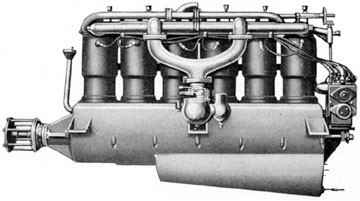
In 1914 Otto Hieronimus manufactured the six-cylinder Hiero E, also known as the Hiero 6 engine which was derived from earlier 4-cylinder engines. The Hiero engine like the Austro-Daimler powered many of Austria’s World War I aircraft. Hiero aircraft engines were designed by Otto Hieronimus, a famous Austrian auto racer of the early 1900s. His initial designs were liquid-cooled inline engines built by the Laurin & Klement Automobile Works of Austria.
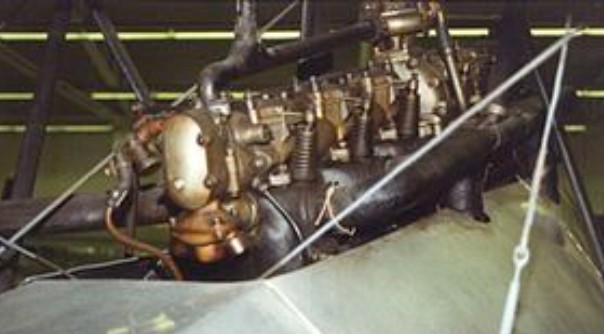
The Hiero E had a 135 mm x 180 mm bore/stroke (15.46L / 943.4cuin) and delivered 200-230 hp. The engine had the typical features of an inline vertical 6-cylinder: aluminum bed, cast iron cylinders, one inlet and one exhaust valve per cylinder controlled by bars and rockers, with the cam-shaft in the bed, and dual ignition by two Bosch magnetos. During World War I, the highly regarded Hiero engines were built under license by Essler, Warschalowski & Company of Vienna and the Breitfeld-Daněk company of Czechoslovakia. A point of recognition of Hiero engines compared with other Central Powers OHC inline’s is that the intake was on the right and the exhaust on the left. After World War I, production was continued by the Avia company and powered a number of their early aircraft.
Variants: Hiero 145hp: 145 hp (108.1 kW) (probably designated Hiero B or Hiero C ) Hiero 185hp: 185 hp (138.0 kW) (probably designated Hiero D) Hiero E: 200 hp (149.1 kW) – 230 hp (171.5 kW)
Hiero E Type: 6-cyl in-line Water-cooled Bore: 135 mm (5.31in) Stroke: 180 mm (7.09in) Displacement: 15,459 cc (943cu in) Designer: Otto Hieronimus Valvetrain: overhead-cam Cooling system: water Power output: 200 – 230 hp (149 – 172 hp)
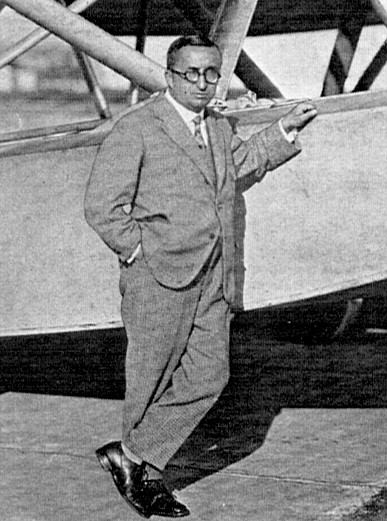
Ernst Heinkel was born in Grunbach, Germany, today a part of Remshalden. As a young man he became an apprentice machinist at a foundry. Heinkel studied at the Technical Academy of Stuttgart, where he initially became interested in aviation through a fascination with Zeppelins. In 1909, after he attended an international airshow in Frankfurt am Main, he determined flight was the future of transportation, and the following year, he built his first aircraft.
Ernst Heinkel established his own company shortly after the liquidation of Hansa Brandenburg, building a series of single-engined seaplanes (He 1 to He 8) in Sweden to circumvent the ban on the construction of military aircraft in Germany.
Heinkel, created in 1922, dealt with design, building of prototypes and small series. Large-scale production was not available, since all its production areas were limited to old aviation hangar in Varnemyunde. The general practice was using HD designations for Heinkel Doppeldeckers (biplanes) and HE designations for Heinkel Eindeckers (monoplanes) was dropped in favour of He designations. The He 51 biplane fighter went into production for the Luftwaffe in the 1930s and served with the Condor Legion in Spain. When the Heinkel He 70 passenger/mailplane appeared in 1932, ostensibly for Deutsche Lufthansa, it was the most advanced aerodynamic design then seen in Europe. A natural outgrowth of this design was the Heinkel He 111 twin-engined bomber which served with the Luftwaffe throughout the Second World War. A Rolls-Royce Merlin-engined version of the He 111 was built by CASA in Spain, and served with the Spanish Air Force until the late 1960s. Heinkel also produced late in the war the He 162 Volksjager (People’s Fighter), a lightweight turbojet fighter constructed almost entirely of wood. Heinkel had designed, built and flown the world’s first jet aircraft, the He 178, in 1939. Other significant Heinkel projects included the He 177 Greif heavy bomber and the He 219 Uhu nightfighter. Heinkel joined VFW in 1965.
Circa 1915, Harriman Motor Works produced a 100hp@1400rpm from 589.05ci aero engine. The inline 6-cylinder was air-cooled and had a dry weight of 355 lb.
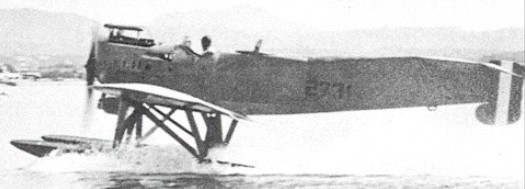
Continuing the line of two-seat patrol fighter monoplanes initiated with the W.29, the W.34 was the final WWI development of the series of float seaplanes designed for the Hansa- und Brandenburgische Flugzeug- Werke by Ernst Heinkel and Hans Klemm. Essentially a scaled-up W.33 intended for the 300hp Basse und Selve BuS IVa six-cylinder water-cooled engine, only one prototype of the W.34 had been completed by the end of the War. Additional examples powered by the 300hp Fiat A 12bis engine were built after the termination of hostilities.
Max take-off weight: 2270 kg / 5005 lb Empty weight: 1534 kg / 3382 lb Wingspan: 16.60 m / 54 ft 6 in Length: 11.10 m / 36 ft 5 in Wing area: 49.0 sq.m / 527.43 sq ft Max. speed: 175 km/h / 109 mph
 All Aero