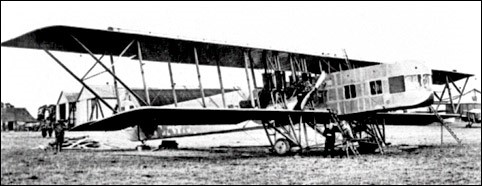
Kennedy Giant

The Kennedy Giant was a British biplane heavy bomber designed by Kennedy Aeroplanes Ltd. during the First World War. The design was an imitation of works by Igor Sikorsky, with whom the owner of Kennedy Aeroplanes Ltd., Chessborough J. H. Mackenzie-Kennedy, had ostensibly worked prior to setting up the company.
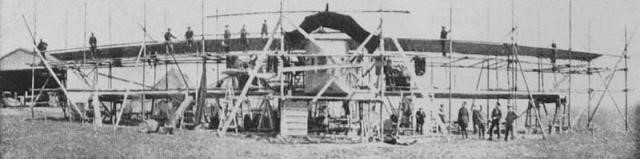
The four-bay, unstaggered wings spanned 142 feet; ailerons were fitted to the upper wings only, their control rods extending along the top of the leading edge, and the wing overhang being braced by pairs of outraked struts. The four engines, mounted in tandem pairs in nacelles on the lower wings, were very early British-built examples of the Canton-Unne/Salmson Z9 nine-cylinder water-cooled radials, each of which was provided with a pair of large vertical radiators on the sides of the nacelles.
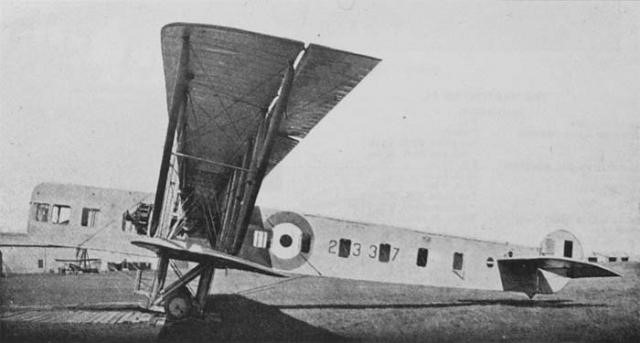
The fuselage was of rectangular section over its entire length and tapered towards the tail only in plan. It provided fully-enclosed accommodation for the crew, the pilot being situated in the extreme nose, with individual compartmented cabins aft. The tail surfaces were of inadequate area, the tiny rudder (later enlarged) being unbalanced and without a fixed fin. The undercarriage was a complicated structure of multiple V-struts and skids.

The aeroplane was a notorious failure; its size meant that construction had to take place in an open field at the Fairey factory at Heston as none of the hangars near Hayes, Middlesex, where the prototype was assembled, were large enough to house it.

Supply of the Sunbeam engines, manufactured under licence by the Dudbridge Iron Works Ltd of Stroud, were afforded very low priority (and were not subject of official trials until May 1919). Early examples were rated at only 200hp and, with these, the Giant was made ready for flight at Hendon late in 1917.

Movement needed two trucks and seventy men, but these efforts broke the tail of the aircraft. It was repaired, but the fuselage shortened by 10 feet (3,048 m).
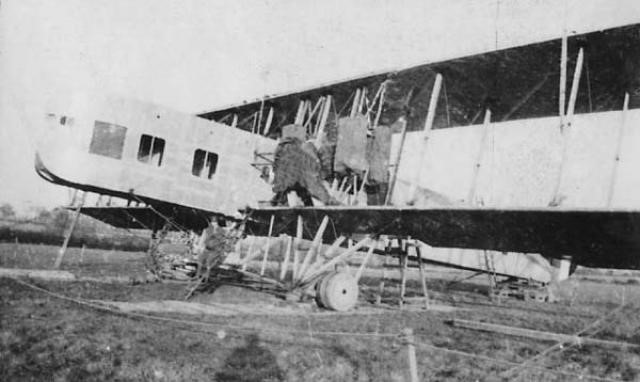
This power proved insufficient to gain true flight, and despite being taxied at full throttle downhill, the pilot, Lieut Frank T Courtney, only managed to lift the mainwheels off the ground for a short hop with the tailskid still dragging along the ground. The prototype was left derelict at Northolt Aerodrome for a number of years.

Engines: Canton-Unne Salmson Z9, 200hp / 150 kW
Propellers: two tractor and two pusher two-blade
Wingspan: 142 ft 0 in / 43.28 m
Length: 80 ft 0 in / 24.38 m
Height: 23 ft 6 in / 7.16 m
Empty weight: 19017 lb / 8626 kg
Crew: 3
Kennedy Aeroplane Ltd

Founded early in First World War by Chessborough J. H. Mackenzie-Kennedy, with offices in South Kensington, London, following establishment of the Kennedy Aeronautic Company in Russia in 1909. In 1911 the founder met Igor Sikorsky and shared enthusiasm for large aircraft. Was associated in the English company with T. W. K. Clarke, well known in British aeronautics. With War Office permission, construction started on the Kennedy Giant by the Gramophone Company Ltd. Late in 1916 components were sent to Northolt Aerodrome for erection in the open. In 1917 attempts to fly the underpowered machine resulted in a “hop”. Building of a bomber was started at Newcastle- on-Tyne, but financial failure came in 1920.

Kawasaki

Kawasaki aircraft was formed in 1918 as subsidiary of the heavy-industrial complex Kawasaki Jukogyo to build aircraft and aero engines. Based at Kobe, in the early 1930s built Salmson biplanes and engines as well as own designs. Kawasaki had a Dornier license for all-metal construction, and in December 1924 the first Kawasaki-Dornier Wal flying-boat made a notable flight with a German pilot. Thereafter made aircraft mainly for the Japanese Army.
A designer of Kawasaki landplanes was German Dr. Richard Vogt, with the company from 1923 unitl 1933. Vogt designs were Type 88 reconnaissance biplane (1927), Type 92 single-seat biplane fighter (1930), and Ki-3 single-engined biplane bomber. Japanese designed were Ki-10 single-seat fighter biplane (1935), Ki-32 single-engined monoplane bomber (1937), Ki-45 fast and widely used twin-engined fighter (1939), Ki-48 twin-engined light bomber (1939), Ki-61 single-seat fighter (liquid-cooled engine and showing German influence (1941), Ki-100 radial-engined development (1944), and Ki-102 twin-engined fighter (1944).
After the war, in March 1954, a new company of the same name was founded by the merger of Kabushiki Kaisha Kawasaki Gifu Seisakusho and Kawasaki Kikai Kogyo Kabushiki Kaisha. The Kawasaki KAL-1 (July 1953) was the first postwar all-metal aircraft of Japanese design. Early production covered 210 Lockheed T-33 jet trainers, 48 Lockheed P-2H Neptunes and 239 Bell Model 47 helicopters, all built under license from the USA. Also made major components for the NAMC YS-11 turboprop transport.
1962:
38 Akashi-machi,
Ikuta-ku,
Kobe

The company reorganized in April 1969 as Kawasaki Jukogyo Kabushiki Kaisha. In November 1970 flew the C-1 twin turbofan military transport, production aircraft later going to the JASDF. Went on to complete 82 P-2Js (derived from Neptune), 211 KH-4 helicopters (derived from the Model 47), 160 KV107 helicopters (derived from the Boeing Vertol 107 Model II), and many Hughes/McDonnell Douglas Model 500D and OH-6DA helicopters (production continued through 1998). Produced the Lockheed Martin P-3C Orion for the JMSDF; 101st and final aircraft delivered in 1997, when four EP-3/UP-3D electronic intelligence/training variants remained to be delivered up to the year 2000. Kawasaki produced 16 CH-47J examples of Boeing Chinook for the JASDF and compled delivery of 52 CH-47JAs to the JGSDF. It was s prime contractor on the OH-1 Kogata Kansoku armed scout, observation and attack helicopter (first flown August 1996), and had almost completed manufacture of some 200 T-4 intermediate jet trainers and liaison aircraft for the JASDF by 1998. Also constructs components and assemblies for the F-15J and various Airbus and Boeing airliners. Kawasaki teamed with Eurocopter on the BK117 helicopter, and has engine and space programs.

Kawasaki Heavy Industries, Limited is an international corporation and has headquarters in both Chūō-ku, Kobe and Minato, Tokyo. As of 31 March 2013 Kawasaki had 34,010 employees, total assets of ¥ 1.3 trillion at March 31, 2012, and a nett income ¥ 23.3 billion at March 31, 2012.

Junkers Larsen

John M. Larsen immigrated to the U.S. in 1892 from Denmark. As an engineer he designed, produced and sold cooling machines in the U.S.A. In 1919 he intended to sell U.S. aircraft in Denmark, but during his stay in Europe he also saw the Junkers F13 and was interested in selling the Junkers F13 within the USA. Together with Junkers he founded the Junkers Larsen Corporation in 1920, which was responsible for the marketing of Junkers aircraft in the USA. Larsen managed to sell some of the modified F13 as JL6 to the U.S. Army and to the U.S. Postal Office. But due to a series of crashes the JL6 was grounded by both. Larsen also converted one JL6 to a war machine as JL12, but the U.S. Army was not interested in this aircraft and the joint venture was stopped after a few sales, in 1920.

Junkers J.10 / J.11 / CL.1

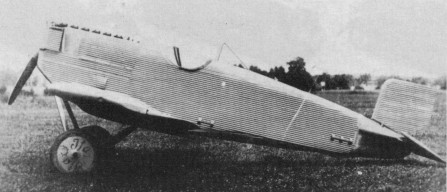
The J8/J10/J11 series were very much just two seat adaptations of the J7/J9 single seat fighters. All derived their origin from the innovative J1 of 1915. They were all metal low wing cantilever monoplanes, the J10/J11 was powered by a 185hp BMW or Benz engine. Typical for their appearance was the corrugated light duralumin skin and the flat radiator in front of the engine.

The J.11 was a float equipped derivation of the J10 two seat escort and ground attack fighter, which had been built in quantity during 1918 as the Junkers CL.I.

Junkers J.8

The J8 was the prototype for the J.11.
The J8/J10/J11 series were very much just two seat adaptations of the J7/J9 single seat fighters. All derived their origin from the innovative J1 of 1915. They were all metal low wing cantilever monoplanes. Typical for their appearance was the corrugated light duralumin skin and the flat radiator in front of the engine.

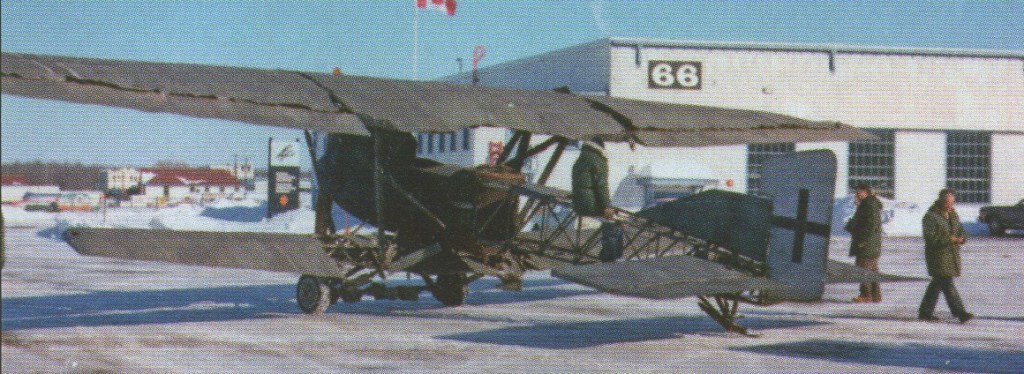
Replica: Haig Junkers J8

Junkers J.IV

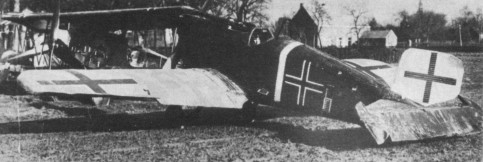
The Junkers J.IV, which flew for the first time early in 1917 and became operational at the beginning of 1918, was an all-metal biplane designed for close support and tactical reconnaissance.
When ordered for the German Army, Junkers was not geared for mass production. Junkers-Fokker-Werke was formed at Dessau on October 20,1917, with equal shares held by Junkers and Anthony Fokker. Manufacture was shared between the Junkers and Fokker factories, which produced a total of 227 aircraft between them.
Conflicts of personality caused Fokker and Junkers to separate in 1918, and the Junkers re-formed following April as Junkers FlugzeugwerkeAG.
A ground-attach and observation machine, the crew was protected by 5mm steel plating. Instead of radio equipment, early J.IVs carried two downward-firing Parabellum machine guns, but these were deleted because of problems with accurate aim.

Engine: 1 x 200hp Benz Bz.IV
Wingspan: 16.00 m / 52 ft 6 in
Length: 9.10 m / 29 ft 10 in
Height: 3.40 m / 11 ft 2 in
Max. speed: 155 km/h / 96 mph
Ceiling: 6000 m / 19700 ft
Range: 310 km / 193 miles
Armament: 3 x 7.62mm machine-guns
Crew: 2

Junkers J.I Blechesel / Tin Donkey

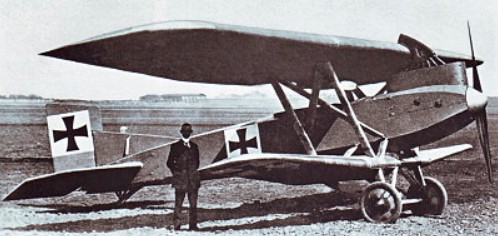
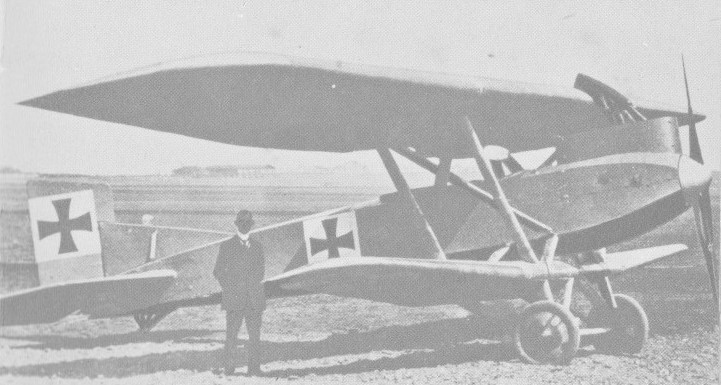
Professor Hugo Junkers (1859-1935) became convinced that all metal structure was the ultimate answer to successful aircraft design, he produced the experimental J.1 “Blechesel” (Tin Donkey) to exemplify his 1910 patent for a cantilever all-metal wing.

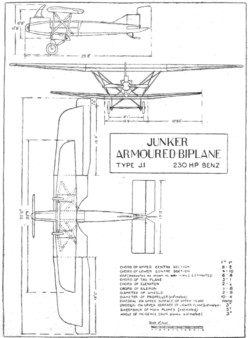
An all-metal semi-cantilever biplane, the multi-spar metal wings were covered with corrugated light alloy sheet. The entire forward part of the fuselage to the rear of the cockpits was made of 5 mm sheet steel armour. The front fuselage alone weighed 1030 lb. The rear fuselage was a light alloy tube structure, covered with fabric on most aircraft. Control surfaces were all metal, with ailerons on the top wing only.

The J.1 first flew on December 12, 1915, giving unexpectedly stable performance.

Altogether, 227 J.1 were built, serving from late 1917 until the end of the war.

Engine: Benz Bz.IV, 200 hp
Wingspan: 52 ft 6 in
Wing area: 531.5 sq.ft
Length: 29 ft 10.5 in
Height: 11 ft 1.75 in
Empty weight: 3895 lb
MTOW: 4797 lb
Max speed: 97 mph at SL
Endurance: 2 hr
Armament: 1 x Parabellum mg