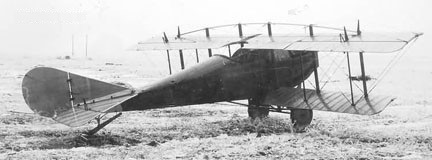
Two Lanzius L II were built in 1919 to the Air Service for evaluation (AS40034 and 40036). Contracts for two more (AS40036 and 40037) were assigned but not built.
Engine: Packard 1A, 350hp
Seats: 1
Two Lanzius L II were built in 1919 to the Air Service for evaluation (AS40034 and 40036). Contracts for two more (AS40036 and 40037) were assigned but not built.
Engine: Packard 1A, 350hp
Seats: 1
The 1917 L I Variable Speed Aeroplane was a two-place open cockpit biplane powered by a 140hp Duesenberg.
The 1918 Variable Speed Aeroplane was a single-place open cockpit biplane and a monocoque fuselage and a three-quarter-span beam-type bracing on the top wing. Likely an OX-5 or Hisso for power, or with a less-rounded fuselage and with that truss arrangement duplicated on the underside of the lower wing.
USA
A New York company, formed to design and build biplanes with variable-incidence wings. Built aircraft to government contract 1917-1918.
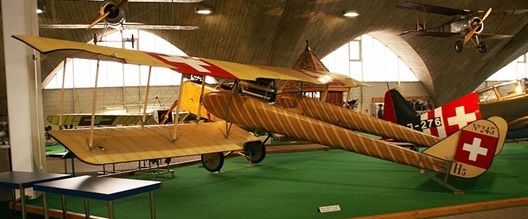
In 1915 the Federal Construction Works (Eidgenoessische Konstruktionswerkstaette, K+W) set up their aircraft department at Thun, Switzerland and employed August Häfeli as chief engineer. Häfeli had previously designed the AGO C.I and AGO C.II, German reconnaissance biplanes. His first design was the Häfeli DH-1, similar in concept to his designs for AGO Flugzeugwerke.
The DH-1 reconnaissance biplane was a three-bay biplane of wood and fabric construction, it had a fuselage pod with tandem seating for the two-man crew and twin booms mounting the tail. The DH-1 was powered by an Argus As II engine built under licence by Buhler Brothers Limited. Six aircraft were built for the Swiss Air Force.
Six DH-1s were built during 1916 but within a year three had been destroyed in accidents. The survivors were withdrawn from service in 1919 and scrapped.
Engine: 1 × Argus As II, 120 hp (89 kW)
Wingspan: 42 ft 0 in (12.80 m)
Wing area: 409.04 ft² (38 m²)
Length: 28 ft 11¼in (8.82 m)
Height: 9 ft 10 in (3 m)
Empty weight: 1,653 lb (750 kg)
Max. takeoff weight: 2,480 lb (1125 kg)
Maximum speed: 78mph (126 km/h)
Range: 155 miles (250 km)
Service ceiling: 9,840 ft (3000 m)
Crew: two
Armament: one 0.293 in (7.45 mm) machine-gun
A parasol monoplane.
A single-seat fighter biplane of 1918
Germany
Designed and built military aircraft in First World War, including D I and D 7 single-seat fighter biplanes (1918 and 1917 respectively), and E III parasol monoplane.
In October 1916 Kondor Flugzeug-Werke was awarded an order for 50 Albatros B.IIa (Kon.) s/n 390-439/16 or use as trainers. The B.IIa designation denotes a change in engine and Kondor did some redesign of the empennage.
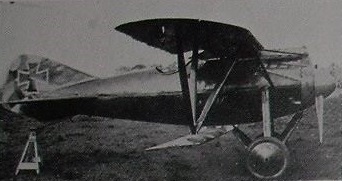
The Kondor Dreidekker, first flown in October 1917, was not a success. Instead, Kondor used the fuselage, empennage and lower wing of the Dreidekker to produce over the winter of 1917-18 a biplane or sesquiplane called the D.7 designed by Walter Rethel.
The common fuselage was a tube steel internal structure with plywood skin, rounded in cross-section. At the front the fuselage reduced smoothly in diameter to a large spinner with a two blade propeller driven by a 160 hp (120 kW) six-cylinder, liquid-cooled upright inline Mercedes D.III engine, though there are hints in the records suggesting an earlier, different engine. The upper part of the engine protruded above the fuselage, enclosed in its own cowling. At the rear the tailplane was mounted at mid-fuselage under a long chord fin with a strongly swept leading edge, carrying a deep rudder. There was a shallow ventral fin. The D.7 had a fixed conventional undercarriage, with each mainwheel’s leg placed vertically and mounted at mid-fuselage, assisted by a forward leaning strut attached under the nose. A long tailskid reached rearwards from the forward edge of the ventral fin.
The wings of the D.7 had constant chord and the upper one was supported just above the fuselage on a cabane. The cockpit was aft of its trailing edge, where there was a central rounded cut-out to assist the pilot’s upward and forward view. The lower wing, narrower in chord, was not directly attached to the fuselage but supported centrally by rear leaning struts from the undercarriage structure. The interplane struts were also unusual; three struts were attached at the same point on the lower wing, spreading out upwards into an inverted tripod or pair of Vs.
The date of the D.7’s first flight is not known though it must have been after October 1917, when the Dreidekker was flying, and before May 1918 when a report from the Idflieg said the D.7 was about to recommence testing with the Mercedes engine. It was not entered into the second D-type (fighter) competition of June 1918, suggesting Kondor were beginning to concentrate on the monoplane designs suggested by the success of the Fokker D.VIII, a process that led to the Kondor E.III.
The D.7 remained a prototype and its development was soon abandoned.
Engine: 1 × Mercedes D.III, 120 kW (160 hp)
Propeller: 2-blade
Wingspan: 8.50 m (27 ft 11 in)
Wing area: 15.70 m2 (169.0 sq ft)
Length: 6.20 m (20 ft 4 in)
Height: 2.30 m (7 ft 7 in)
Empty weight: 590 kg (1,301 lb)
Gross weight: 785 kg (1,731 lb)
Maximum speed: 180 km/h (112 mph; 97 kn)
Endurance: 1.45 hr
Crew: One
In the summer of 1917 Kondor followed the lead of Fokker’s Dr.I July 1917 triplane with one of their own. Known only as the Kondor Dreidekker this aircraft, first flown in October 1917, was not a success; its development programme was soon abandoned because of severe vibrational problems. Instead, Kondor used the fuselage, empennage and lower wing of the Dreidekker to produce a biplane or sesquiplane called the D.7.
The common fuselage was a tube steel internal structure with plywood skin, rounded in cross-section.
Lillestrømmen Aeroplanværksted (Lillestrøm Airplane Workshop)
Hærens Flyvemaskinfabrik (Army Flying Machine Factory)
This state-owned factory was established in 1914 at Kjeller airfield at Lillestrøm north of Kristiania (Oslo). The original name was Lillestrømmen Aeroplanværksted (Lillestrøm Airplane Workshop), in 1915 it become the Hærens Flyvemaskinfabrik (Army Flying Machine Factory) which had relocated from Sagene in Kristiania.
The name Kjeller Flyfabrikk didn’t appear until Aug 1927.
The Norwegian Army Aircraft Factory, located at Kjeller. Built under license during the 1930s Fokker C.V as the F.F.7 Hauk (Hawk) and de Havilland Gipsy Moth and Tiger Moth. Also did repair and overhaul of military-aircraft equipment, and experimental work.
 All Aero