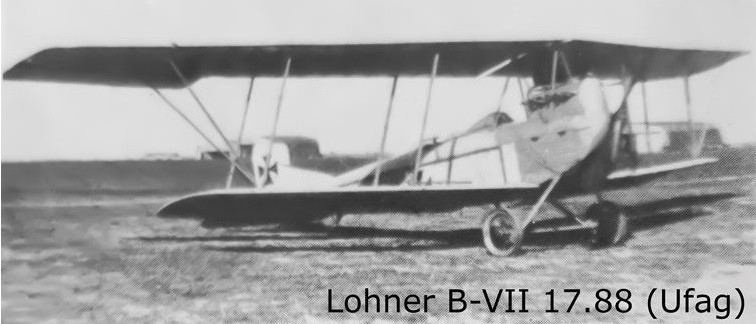
Lohner B.VII
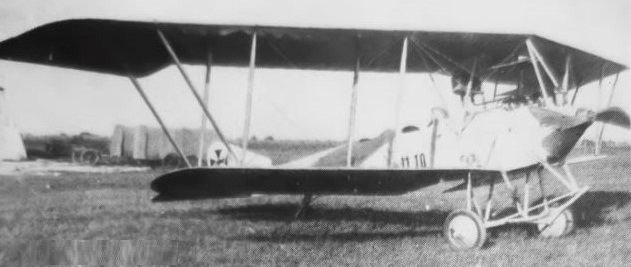
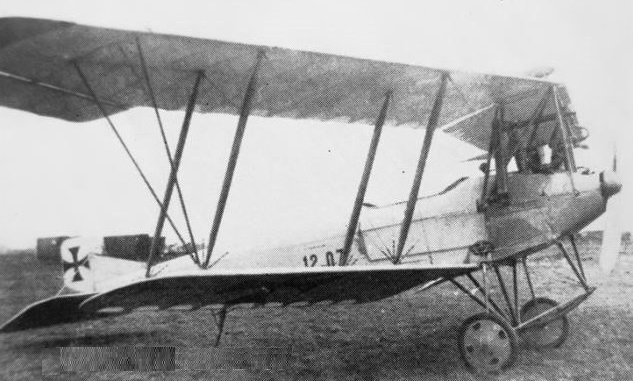
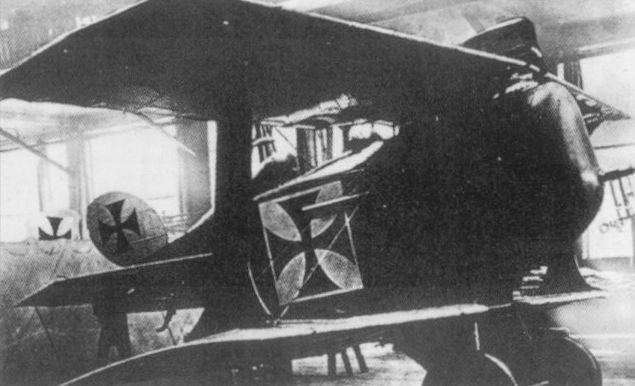
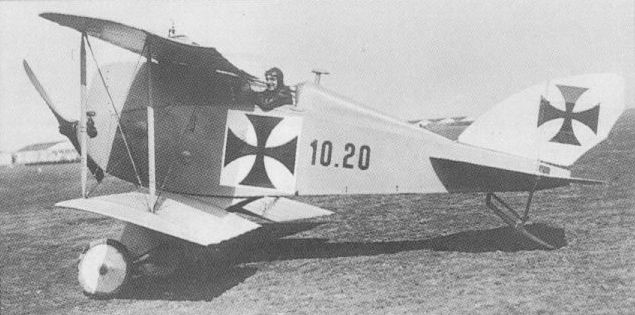
During 1916, the Lohnerwerke of Vienna received a contract from the K.u.K.Luftfahrttruppen (Imperial and Royal Air Service of the Austro-Hungarian Army) for four single-seat fighter prototypes powered by the 185 hp Austro-Daimler six-cylinder inline engine. The first of these, the Lohner 10.20, or Typ AA, appeared at Aspern on 5 September 1916. A single-bay biplane with an armament of twin synchronised Schwarzlose machine guns, the Lohner 10.20 was characterised by a singularly abbreviated and deep, slab-sided fuselage. This was suspended between the wings by a short, inverted-Vee cabane and the faired struts supported the undercarriage. The wing cellule had broad, aerofoil-section I-type struts, and the vertical tail possessed no fixed surface. Taxying trials revealed insufficient control. The rudder area was increased several times and the fuselage lengthened before the aircraft flew on 29 December 1916. The fighter demonstrated poor stability, and, after suffering severe damage in February 1917, was returned to the Lohnerwerke for repair and extensive modification. The aircraft re-emerged in the following month as the Lohner 10.20A, the lower wing having been raised to the base of the fuselage, the cabane being eliminated, a twin-strutted wing cellule being adopted, the fuselage being lengthened and the redesigned tail surfaces embodying a fixed fin. The Lohner 10.20A was destroyed in a crash on 6 June 1917.
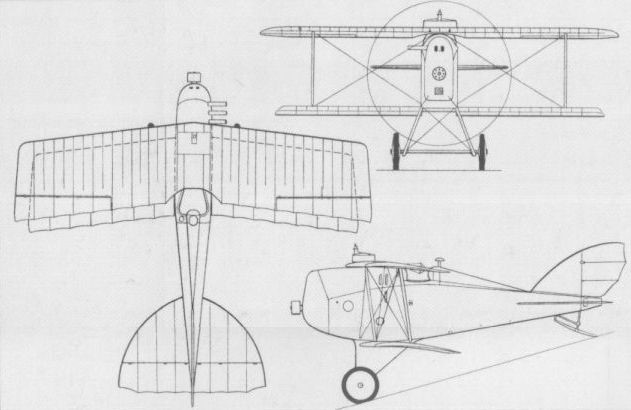
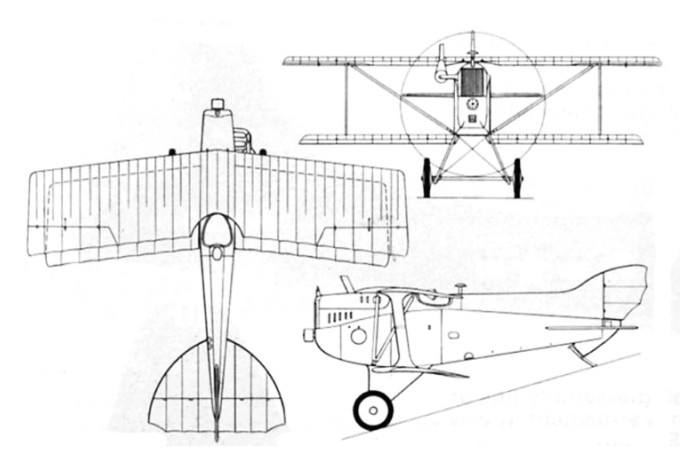
The second fighter prototype from the Lohnerwerke, the 10.20B (later redesignated 111.02), possessed essentially similar wing and tail surfaces to those of the 10.20A. It had a “wireless” wing cabane, however, which reverted to aerofoil-section I-struts supplemented by inclined Vee-struts. It also introduced a deep dorsal fin. Powered by a similar 185 hp Austro-Daimler engine to that of its predecessor and carrying a twin-Schwarzlose gun armament, the Lohner 10.20B made its initial flight at Aspern on 2 June 1917. The prototype was taken over by the K.u.K.Luftfahrttruppen in August 1917, and official trials continued through October when further development was halted. No data relating to this type are available.
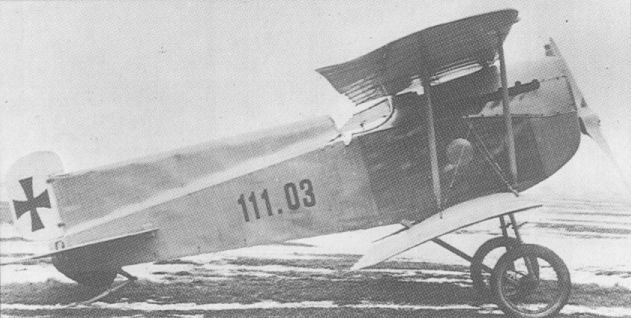
The third Typ AA series prototype produced by the Lohnerwerke, the 111.03 differed from its immediate predecessor, the 10.20B alias 111.02, in having a conventional wire-braced wing cellule, a redesigned rudder and unfaired undercarriage strutting. Retaining the 185 hp Austro-Daimler engine, the Lohner 111.03 was flown for the first time on 28 June 1917, and flight testing continued through October. At this stage, the Lohnerwerke was assigned a manufacturing licence for the Aviatik D I, and further development of the Typ AA series was ended.
Max speed, 120 mph (193 km/h).
Time to 3,280 ft (1 000 m), 2.66 min
Range, 240 mis (386 km).
Empty weight, 1,373 lb (623 kg).
Loaded weight, 2,085 lb (946 kg).
Span, 24 ft 11 1/4 in (7.60 m).
Length, 20 ft 10 in (6,35m).
Height, 9 ft 10 1/8 in (3.00 m).
Wing area, 215.28 sq ft (20.00 sq.m)
Lohner 10.20B
Engine: 1 x Austro-Daimler AD 6 series 18000, 136 kW / 185 hp
Wingspan: 7.30 m / 23 feet 11,39in
Length: 6.00 m / 19 feet 8,21in
Height: 2.95 m / 9 ft 8,14in
Wing area: 17.98 sq.m / 193.54 sq.ft
Crew: 1
Austria-Hungary
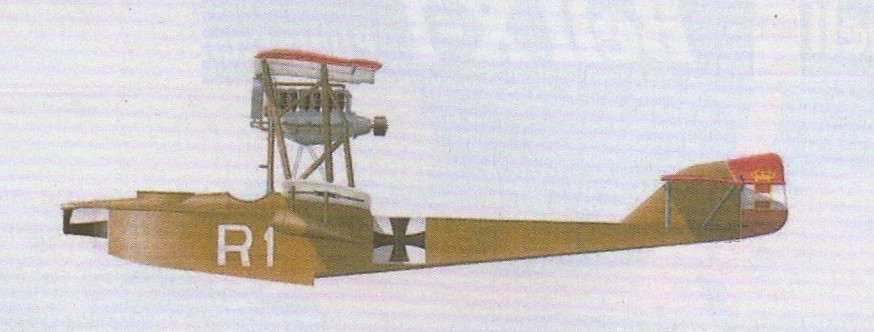
Built one-, two-, and three-seat reconnaissance flying-boats during First World War. Early Macchi designs were copies of Lohner flying-boats
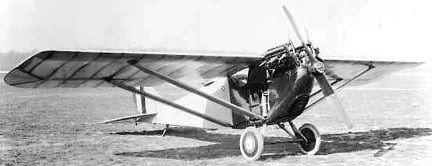
The Wright-Martin M-8 was a contract-built Loening M-8. Production was cancelled by WW1 Armistice, but the one for USN (A5631) was likely modified as a Pulitzer racer.
Grover C. Loening formed Loening Aeronautical Engineering Company in 1918, and built his first Air Yacht amphibian (based on prewar design).
In 1922 a Loening Air Yacht was used as a demonstration bed for the 350 horsepower Wright built Hispano engine.
Grover C. Loening built a monoplane flying-boat in 1911. Formed company in 1918, and built his first Air Yacht (based on prewar design). A two-seat monoplane fighter with very advanced features was ordered by the Government, but contract for 2,000 canceled at war’s end. Produced very popular line of single-float, biplane flying-boats based on Air Yacht for civil and naval use.
In 1920, Grumman joined the Loenings as test pilot for their famous Air Yacht amphibians, and over the next several years, he took over full responsibility for the company’s aircraft design.
The Loenings sold out their company in 1929 and backed Grumman in a venture of his own.
Merged with Keystone Aircraft Corporation in 1928. Built monoplane and biplane pursuits for the Army. After takeover by Keystone, Loening set up the Grover-Loening Aircraft Company at Garden City, New York, as consultant, and built small amphibian flying-boat XS2L for U.S. Navy in 1931. Delivered XSL-2 experimental submarine-borne version in 1933.

The original Lockheed Com¬pany built the moulded-plywood monocoque fuselage S-1 sports plane in 1916. Far ahead of its day, it could not compete with cheap war-surplus aircraft, and the company suspended manufac¬ture in 1920.
A commercial flop in spite of its innovative monocoque fuselage and folding wings.
Allan and Malcolm Loughead built the F-1 twin-engined flying-boat in 1918. With the help of designer Jack Northrop, Lockheed built the F1, but it was turned down by the Navy.
 All Aero