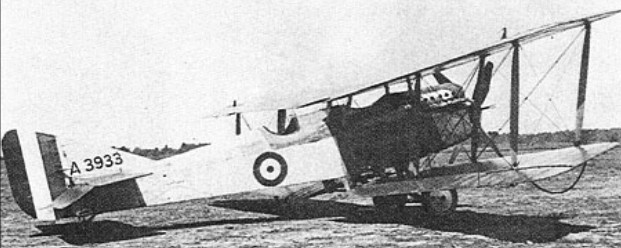
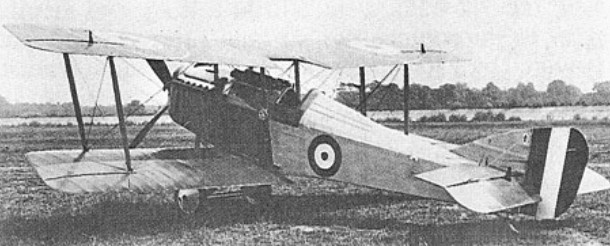
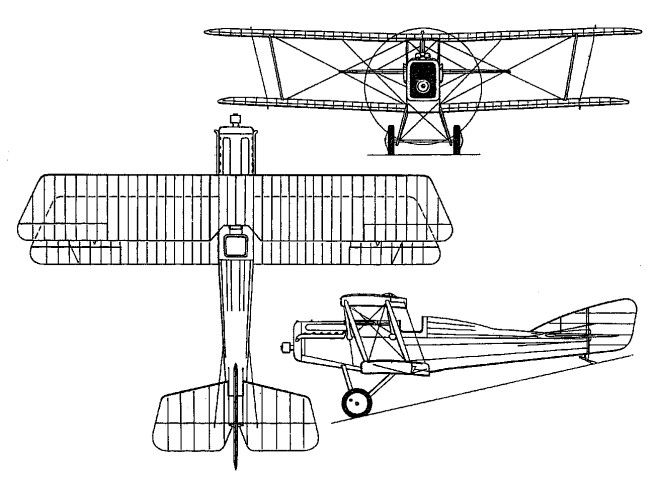
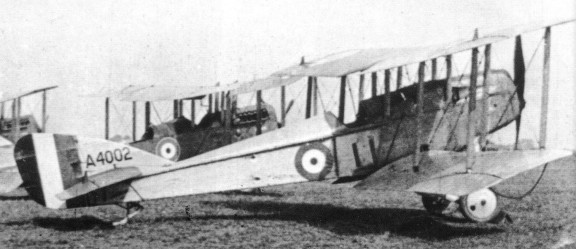
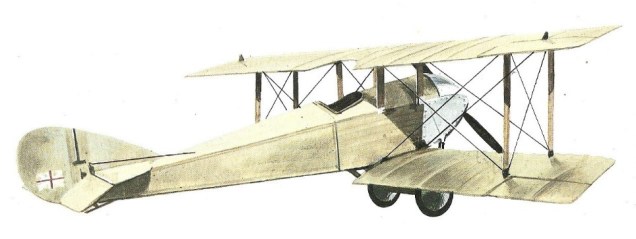
The F.1 two-seat fighter was conceived late in 1915 as a tractor biplane in which the gunner occupied the forward cockpit and stood upright to fire a 7.7mm Lewis gun on a mount built into the upper wing centre section.
Two prototypes were ordered on 16 September 1916 under WO Contract No87/A/435, Serial Numbers A3933 & A3934.
A3933 was tested at CFS Upavon 11.6.17 to 22.7.17 Exp Stn Orfordness, HD Patrol 22.8.17; HD Patrol from Rochford 29.9.17; AP Hendon by April 1918; Hendon 9.4.18; Orfordness 12.4.18; Hendon 1918; RAE Farnborough 21.6.18 last mention 18.3.19 (Petrol system tests)
Powered by a 250hp Rolls-Royce Mk III engine (later to become known as the Eagle III), the F.1 suffered a somewhat protracted development and, by the time that it was officially tested in July 1917, it was already obsolete. Obviously not acceptable for operational use, the F.1 was not further developed.
Max speed, 109 mph (175 km/h) at 6,500 ft (1 980 m) Time to 10,000 ft (3 050 m), 13.66 min Endurance, 3.75 hrs Empty weight, 2,198 lb (997 kg) Loaded weight, 3,260 lb (1 479 kg) Span, 44 ft 6 in (13,56 m) Length, 29 ft 1 in (8,86 m) Height, 8 ft 6 in (2,59 m) Wing area, 467 sq ft (43,38 sq.m)
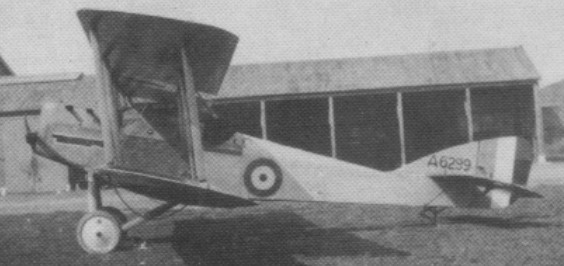
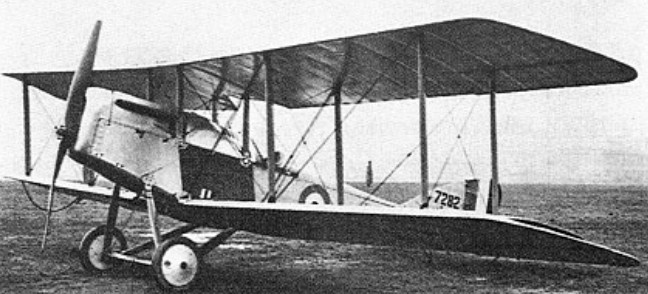
Derived from the Elephant via a single-bay experimental variant of the earlier design by A A Fletcher, the R.G. bore a close resemblance to its predecessor and was initially flown late in 1916 with a 190 hp Rolls-Royce Falcon I 12-cylinder water-cooled engine. Armament comprised a fixed 0303-in (7,7-mm) Vickers gun on the port upper longeron, outside the cabane struts, and a Lewis gun on the starboard side of the cockpit. After official trials in February 1917, the R.G. was revised in a number of respects. The cockpit was moved aft and the centre section cut-out was enlarged, the span of the lower wing was reduced, the rear top decking was raised, armament was revised and consisted of two 0303-in (7,7-mm) Vickers guns immediately in front of the cockpit, and a 275 hp Falcon III engine was fitted. In this form, the R.G. had, according to the official report, a “performance … far and away better than any other machine manufactured”. However, develop¬ment was discontinued in favour of the superior F.3.
Span, 32 ft 0 in (9,75 m) Length, 25 ft 10 in (7,87 m) Height, 9 ft 10 in (2,30 m) Wing area, 310 sq ft (28,80 sq.m). Empty weight, 1,740 lb (789 kg) Loaded weight, 2,261 lb (1 026 kg) Max speed, 132 mph (212 km/h) at 6,500 ft (1 980 m) Time to 10,000 ft (3 050 m), 7.33 min Endurance, 2 hrs
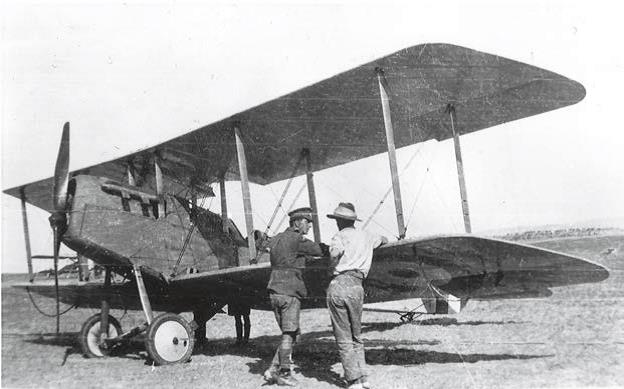
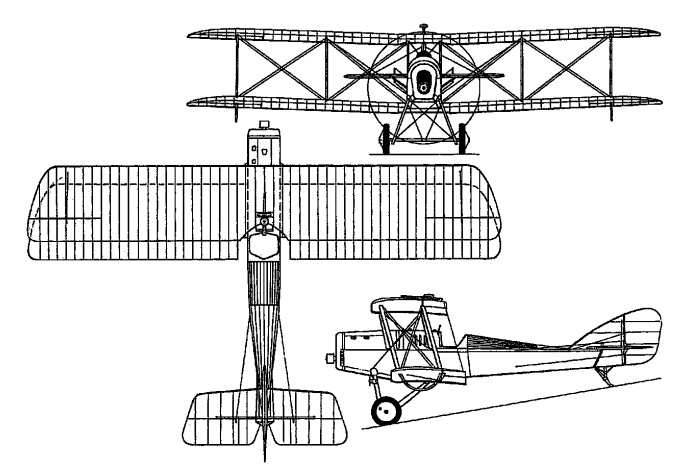
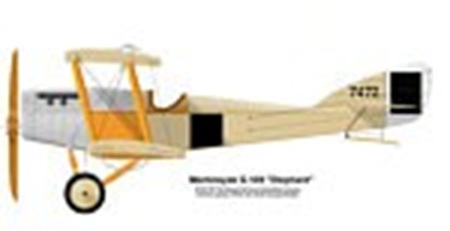
An unusually large aircraft by contemporary standards for a single-seater, the Elephant two-bay equi-span staggered biplane was designed by A A Fletcher of the Martinsyde Company, a prototype powered by a 120 hp Austro-Daimler engine entering test in the autumn of 1915. The G.100 featured two spar wings and wooden fuselage. The entire airframe is fabric covered, except for plywood side panels on the fuselage between the wings. Conventional control surfaces with ailerons on all four wings.
The initial production version, the G.100, was powered by a 120 hp six cylinder Beardmore engine and was armed with a single 0.303-in (7,7-mm) Lewis gun mounted above the centre section (this later being augmented by a similar weapon bracket-mounted to port behind the cockpit), deliveries to the RFC commencing in 1916.
The G.100 was succeeded by the G.102 version which differed in having a 160 hp Beardmore engine doubling the bombload and replaced the lower-powered model progressively.
The G.100 and G.102 Elephant was used in both France and the Middle East, although only 27 Squadron RFC squadron was completely equipped with this type, a total of 271 being manufactured. They flew G.100/102s from March 1916 until December 1917 on operations in France, and the squadron’s unique equipment is per¬petuated today in 27 Squadron’s official badge motif of an elephant. Many other individual ‘Elephants’ saw active service in Palestine and Macedonia with 14, 30, 63, 67 and 72 Squadrons of the RFC. Larger than most contemporary single seaters, the ‘Elephant’ was renowned for good flying characteristics, while its endurance of approximately 4.5 hours, fully loaded, was considered excellent for what were then regarded as reconnaissance and bombing sorties. Although not particularly successful as a fighter owing to its poor agility by comparison with its smaller contemporaries, the Elephant performed a useful service as a bomber, carrying up to 230 lb (104 kg).
The Martinsyde G.100 was operated as bomber and escort machine by the Australian 1 AFC in the Middle East, and was the type flown by Lt F.H. McNamara when he was awarded the VC.
G.100 Engine: Beardmore, 120 hp Wingspan: 38 ft Wingbarea: 410 sq.ft Length: 26 ft 6 in Height: 9 ft 8 in Empty weight: 1759 lb MTOW: 2424 lb Max speed: 95 mph at 6000 ft Service ceiling: 14,000 ft Endurance: 5 hr 30 min Armament: 2 x Lewis mg Bombload: 112 lb
G. 102 Max speed, 103 mph (166 km/h) at sea level Time to 3,000 ft (915 m), 3.5 min. Endurance 4.5 hrs Empty weight, 1,793 lb (813 kg) Loaded weight, 2,458 lb (1115 kg) Span, 38 ft 0 in (11,58 m) Length, 26 ft 6 in (8,08 m) Height, 9 ft 8 in (2,95 m) Wing area, 410 sq ft (38,09 sq.m) Armament: 2 machine-guns, 118kg of bombs
The first original wartime design was S.1 single-seat scout, built October 1914.
Engine: Gnome, 80 hp Wingspan: 27 ft 8 in / 8.43 m Length: 21 ft / 6.40 m Height: 8 ft 2 in / 2.49 m Max speed: 84 mph / 135 kph Armament: 1 x mg Crew: 1
Based at Woking, Surrey, with premises at Brooklands, the partnership of H. P. Martin and G. H. Handasyde built series of monoplanes from 1908 to 1914. Martinsyde Ltd. was registered in 1915 and undertook subcontract production of RAF B.E.2c and S.E.5A.
The first original wartime design was S.1 single-seat scout, built October 1914. The G.100, a large single-seat fighter with Beardmore engine, appeared in late 1915. Later examples with more powerful Beardmore engine were designated G.102; both known colloquially as Elephant, derived from their size.
Six prototypes of the F.3 fighter were ordered in 1917, and developed into the F.4 Buzzard which was ordered in quantity although only 52 had been delivered by Armistice in 1918. Some civil use in developed forms, some sold to overseas air forces.
The company went into liquidation 1921.
With the liquidation of the Martinsyde company in February 1924, and the acquisition of its stores, stocks and goodwill by the Aircraft Disposal Company (A.D.C.), the latter continued development of the Buzzard (see Aircraft Disposal Company A.D.C.1).
After withdrawal from Wright Martin Aircraft Corporation, Glenn L. Martin formed his own company at Cleveland, Ohio, in 1917, occupying a new factory at Baltimore, Maryland, in 1929.
MB-1 twin-engined biplane bomber first flown 17 August 1918, followed by improved MB-2. Other inter-war military aircraft included MO-1 three-seat observation aircraft, PM-1 and PM-2 flying-boats for the U.S. Navy and the B-10 and B-12 bombers. Latter developed into Model 167, supplied to RAF from 1940 as Maryland, and Model 187 which RAF used as Baltimore. B-26 Marauder bomber, first flown November 25,1940, ordered from drawing board, of which total production exceeded 4,700.
During Second World War operated U.S. government plant at Omaha, Nebraska.
U.S. Navy flying-boats included five Mars transports, Mariner and Marlin patrol flying-boats, and XP6M-1 Seamaster four-jet flying-boat flown 14 July 1955. U.S. Navy acquired AM-1 Mauler carrier-attack and P4M Mercator patrol aircraft, USAF ordered English Electric Canberras license-built as Martin B-57 from 1953. Civil production comprised Martin 130 26- seat flying-boats for Pan American 1934-1935, and Model 2-0-2 and 103 Model 4-0-4 airliners from 1947.
Aircraft production ceased December 20,1960 when the last P5M- 2 Marlin was handed over to U.S. Navy. The Martin Company became Martin Marietta Aerospace in 1961.
UK Seventeen-year old R. Mann designed M.1 two-seat fighter-reconnaissance biplane, built with assistance of R. P. Grimmer and test-flown at Hendon February 19,1915. Conventional radial engine, nose-mounted, but facing aft so that propeller shaft extending through fuselage drove interplane strut-mounted twin pusher propellers via chain drives. Wrecked November 16,1915, development discontinued.

 All Aero