The Naval Air Establishment was a division of the Chinese Navy established in 1918 in Mamoi to develop seaplanes for maritime reconnaissance, training, and torpedo-bombing. It was transferred to Shanghai in 1931.
Organization: Captain Yu Tsao Barr Captain Tseng Yee King – Director General from 1931 onwards Captain Wong Tsoo Lieutenant S F Wong
Early aircraft produced by the NAE were made of timber and fabric with assistance of foreign designers. Two principal aircraft types were built: the Chiang Hung two/three-seat touring seaplane, which first flew in July 1931, and the Chiang Gae’n two-seat reconnaissance biplane or advanced military trainer.
Aircraft produced include: Chiang Hung (1930) – 2 or 3 seat touring plane and reconnaissance aircraft Chiang Hau (1932) – powered with single 165 hp Wright Whirlwind engine Chiang Gaen Nin Hai DH.6 like seaplane Beeng (1918?)- tractor biplane/float fighter bomber with single 360 hp prop engine Char1918 – 2 seat primary trainer seaplane Ding (1934) – 2 seat bombing/torpedo seaplane using a single 360hp Rolls Royce engine Wu (1918?) – general purpose observation aircraft Yee (1918?) – 2 seat advance trainer and variant of Char seaplane
USA The U.S. Naval Aircraft Factory at Philadelphia, Pennsylvania, was authorized in 1917 and established in early 1918. Its first, and major, task was the construction of 150 Curtiss H-16 patrol flying-boats. Built improved H-16s as F-5L, as well as Hanriot seaplanes and Loening two-seat monoplanes. Original designs of NAF include the PT-1/2 torpedo seaplanes of 1922; TS-1/3 carrier-based biplane fighters of 1922; and extensively-built N3N-1/3 primary trainer biplanes, which originated in 1934 and remained in service for 27 years. Production in Second World War included 300 Vought-designed OS2 N-1 observation/scout monoplanes, and 156 Consolidated PBN Nomads (better known as the PBY Catalina).
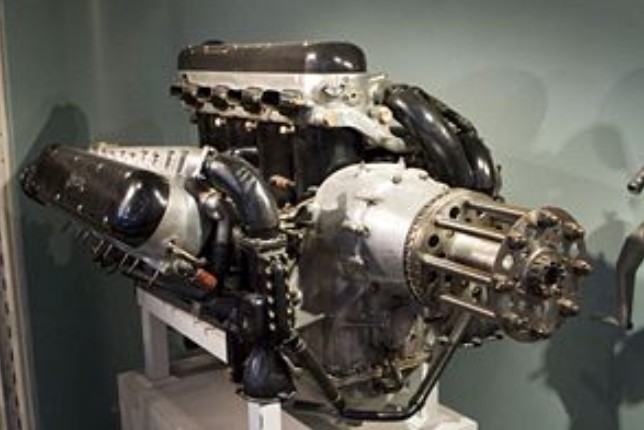
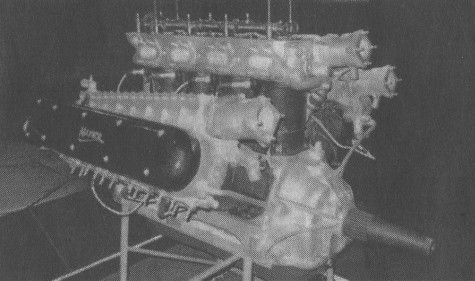
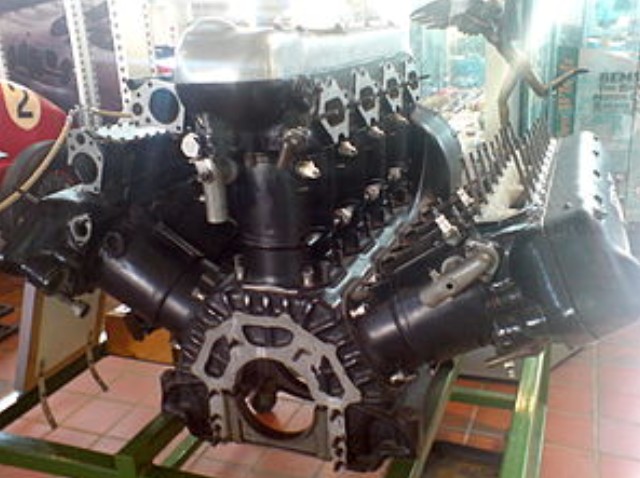
Early in the First World War Napier were contracted to build aero engines to designs from other companies: initially a Royal Aircraft Factory model and then Sunbeams. Both proved to be rather unreliable, and in 1916 Napier decided to design their own instead. Reasoning that the key design criteria were high power, light weight, and low frontal area, the engine was laid out with its 12 cylinders in what they called a “broad arrow”—three banks of four cylinders sharing a common crankcase. This suggested the design’s first name, the Triple-Four. These designs are sometimes referred to as a W-block, although that designation applies more correctly to an engine in which a common crankcase is shared by not merely three but in fact four rows of cylinders (since a “W” is made of four lines or bars). The engine was also advanced in form, the heads using four valves per cylinder with twin overhead camshafts on each bank of cylinders and a single block being milled from aluminium instead of the more common separate-cylinder steel construction used on almost all other designs.
Under A. J. Rowledge, the design of the newly renamed Lion was completed in 1917, and the first hand-built prototypes ran later that year. It was fitted to a de Havilland built DH.9 in early 1918, proving to have many cooling problems. In addition the milled block turned out to be difficult to build with any accuracy and they reverted to separate cylinders, although they remained aluminium. Both of these problems were worked out by the middle of the year and the engine entered production in June 1918. The first Lion I versions delivered 450 hp (335 kW) from their 24 litres. As the most powerful engine available (particularly after a turbocharger became an option in 1922), the Lion went on to be a huge commercial success. Through the years between the wars Napier manufactured little else. Between the wars it powered over 160 different types of aircraft.
In highly-tuned racing versions the engine could reach 1,300 hp (970 kW), and it was used to break many world records: height, air speed, and distance in aircraft, boats, delivering 1,375 hp (1,025 kW) in a highly tuned Lion for a water speed record of 100 mph (160 km/h) in 1933. In land speed records, Lion engines powered many of Sir Malcolm Campbell’s record breakers including a record of over 250 mph (400 km/h) in 1932 and John Cobb’s 394 mph (634 km/h) Railton Mobil Special in 1947 – a record that came well after the Lion had passed its prime and stood until the 1960s. The record had been held by British drivers for 32 years. Lions powered successful entrants in air racing, the Schneider Cup, in 1922 and 1927, but were then dropped by Supermarine in favour of a new engine from Rolls-Royce, the Rolls-Royce R which had been especially designed for racing. It was a Lion that powered the Supermarine S5 that won the 1927 Schneider Trophy for seaplane speed racing.
It was still being fitted to planes in 1929 and it was still being put into boats in 1933.
During the 1930s a new generation of much larger and more powerful engines started to appear, and the Lion was clearly past its prime. Gradually, they fell further and further behind. By the time the Bristol Hercules and the Rolls-Royce Merlin arrived in the late 1930s, the Lion was too small and old-fashioned.
A marine version of the Lion, unsurprisingly called the Sea Lion, was used to power high speed air-sea rescue launches operated by the RAF.
Another adaptation for the Lion aero engine was propeller-driven motor sleighs, which were used for high-speed transport and SAR duties on sea ice by the Finnish Air Force and Navy.
Napier Lion W12
Lion models:
Lion I 1918 450 bhp (340 kW) at 1,950 rpm geared, also related IA and 1AY
Lion II 1919 Works No: E64 450 bhp (340 kW) at 2,000 rpm
Lion IIII experimental geared Gloster Gorcock
Lion V 470 bhp (350 kW) at 2,000 rpm 500 bhp (370 kW) at 2,250 rpm VA had increased CR to 5.8 Mainstay engine of the RAF in the late 1920s, replaced by Lion XI
Lion VS Works No: E79 Turbocharged, intercooled
Lion VIS 1927 Turbocharged Application: Gloster Guan
Lion VII 1925 700 bhp (520 kW) (racing) Application: Gloster III (Schneider Trophy entrant) Supermarine S.4
Lion VIIA 1927 Works No: E86 900 bhp (670 kW) (racing) Application: Golden Arrow Blue Bird (1927) Miss England I Supermarine S.5 Gloster IV
Lion VIIB 1927 875 bhp (652 kW) (racing) geared Application: Supermarine S.5 Gloster IV
Lion VIID 1929 Works No: E91 1,350 bhp (1,010 kW) at 3,600 rpm (racing) Supercharged, about 6-8 built Application: Blue Bird (1931) Fred H Stewarts Enterprise Betty Carstairss Estelle V powerboat Miss Britain III Gloster VI (Schneider Trophy entrant) Railton Special (John Cobb’s land speed record car)
Lion VIII 1927 direct drive Gloster Gorcock
Lion XIA 1928 580 bhp (430 kW) at 2,585 rpm, 6:1 CR RAF production model Application: Napier-Railton
Lioness Works No: E71 Inverted layout, for better visibility. At least some were built turbocharged, for racing.
Sea Lion 1933 500 and 600 bhp (370 and 450 kW) Marine version of Lion XI British Power Boat Company Type Two 63 ft HSL
Applications: Aircraft Alliance P.2 Seabird Avro Bison Blackburn Blackburn Blackburn Dart Blackburn Pellet Blackburn Ripon Blackburn Velos Boulton Paul Atlantic Boulton Paul Bodmin Boulton Paul Bolton English Electric Kingston flying boat (prototype) Fairey III Fairey Fawn Fokker C.IV-W Fokker C.V Fokker D.C.I Fokker D.XIII Gloster Gorcock Gloster Guan Handley Page H.P.31 Harrow Handley Page Hyderabad Mitsubishi B1M Parnall Pike Parnall Possum Parnall Puffin Supermarine S.4 Supermarine S.5 Supermarine Seagull Supermarine Southampton Tarrant Tabor Vickers Vernon Vickers Valparaiso Vickers Victoria Vickers Virginia Vickers Vixen Westland Walrus
Other applications British Power Boat Company Type Two 63 ft HSL British Power Boat Company 60 ft 4 in
Specifications: Lion II Type: 12-cylinder water-cooled W-block (3 banks of 4 cylinders) aircraft piston engine Bore: 5.5 in (139.7 mm) Stroke: 5.125 in (130.17 mm) Displacement: 1,461.6 cu.in (23.9 L) Length: 57.5 in (1460 mm) Width: 42.0 in (1067 mm) Height: 43.5 in (1105 mm) Dry weight: 960 lb (435 kg) Valvetrain: Two intake and two exhaust valves per cylinder actuated via double overhead camshafts per cylinder block. Cooling system: Water-cooled Power output: 480 hp (358 kW) at 2,200 rpm at 5,000 ft Specific power: 0.32 hp/cu.in (15.0 kW/L) Compression ratio: 5.8:1 Power-to-weight ratio: 0.5 hp/lb (0.82 kW/kg)
Around 1915, the Nanyuan Gun Bus No. 1 appeared, perhaps an indigenous design, perhaps based on imported aircraft. The Gun Bus was a single-engine pusher aircraft with a crew of two, a pilot and a gunner. It might have found service in China’s civil unrest at the time.
In 1917, Chikuhei Nakajima set up the “Airplane Institute” at Ojima Town in Gunma Prefecture. In 1918 they built their first airplane; the “Nakajima Type 1” with a U.S.A. made engine.
In 1917, Chikuhei Nakajima (33 years old at that time), who retired as Engineering Captain of the Navy, contemplating developing a public aircraft industry, set up the “Airplane Institute” at Ojima Town close to Ota Town in Gunma Prefecture (currently Ota City). The building was a simply remodeled sericultural hut along the Tone River. In the beginning, there were only nine members, but in the following year they built their first airplane; the first “Nakajima Type 1” with a U.S.A. made engine. But the first Type 1 sadly crashed after take off. The second Type 1 also failed, and the third one finally did take off, but hit a ditch upon landing and also crashed. In that age, it was said that there was a pasquinade in Ota Town, “Too much paper money, too high a price for rice. Everything goes up, except Nakajima planes”.
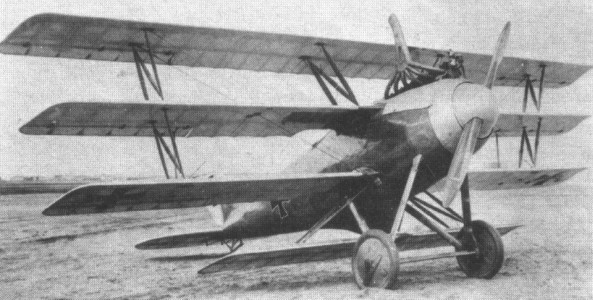
The DII quadruplane built by the Naglo Werft of Pichelsdorf, near Berlin, was designed by Ing Gnädig (who was, at the time, still in the employ of the Albatros Werke) and participated in the second D-type contest at Adlershof in the summer of 1918 (the debriefing minutes of which indicating that it was to appear for further testing after modification). Powered by a 160 hp Mercedes six-cylinder water-cooled engine and inten¬ded to carry an armament of two LMG 08,15 machine guns, the Naglo DII appears to have been based on an Albatros DV type fuselage. The bottom wing, completely independent of the three main lifting surfaces, being attached to an extruded keel and braced with splayed struts. Official type testing was undertaken on 24 May 1918, and during the D-type contest, evaluation pilots praised the excellence of the construction and workmanship of the D II while calling for an improvement in the flight characteristics.
Engine: Mercedes 6 cyl, 160hp Empty weight: 1,596 lb (724 kg). Loaded weight: 2,015 lb (914 kg Span: 29 ft 6 1/3 in (9,00 m). Wing area: 241.12 sq ft (22.40 sq.m).
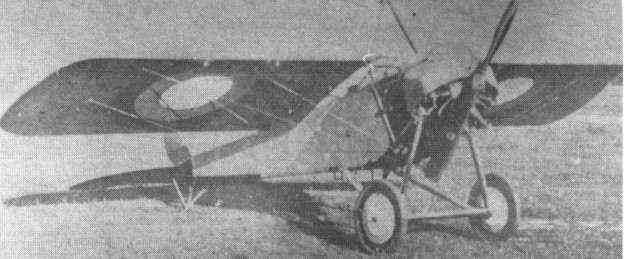
First original design was the Mosca MB, first flown in July 1915, a single-seat high-wing monoplane fighter evolved from the Morane J. During the course of 1916, the MB Mosca-Bystritsky (Moskva-MB) developed a single-seat fighter derivative of its two-seat reconnaissance monoplane. Appreciably smaller and more powerful than the two-seater, the Mosca-B bis fighter retained such features as wing warping for lateral control and detachable flying surfaces permitting the aircraft to be towed along roads. Powered by either an 80 hp Le Rhône or Clerget rotary engine, the Mosca-B bis was delivered both with a 7,7-mm unsynchronised forward-firing machine gun with propeller-mounted steel bullet deflectors and with a similar weapon mounted above the cockpit and firing clear of the propeller disc. A total of 50 Mosca-B bis fighters had been built up to 1918, and a few additional aircraft of this type were reportedly built after the revolution.
Max speed, 81 mph (130 km/h) Time to 3,280 ft (1000 m), 35 min Empty weight, 710 lb (322 kg) Loaded weight, 1,074 lb (487 kg) Span, 25 ft 11 in (7,90 m) Length, 20 ft 1/8 in (6,10 m) Wing area, 12917 sq ft (12,00 sq.m)
The Mosca Moscow Aviation Works was first established in Russia by F. E. Mosca, Savoia’s designer. By late 1916 this factory was building about five aircraft per month, these being Nieuport and Morane types built under license. First original design was the Mosca MB, first flown in July 1915, a single-seat high-wing monoplane fighter evolved from the Morane J. Followed by MB bis with forward-firing synchronized machine gun.
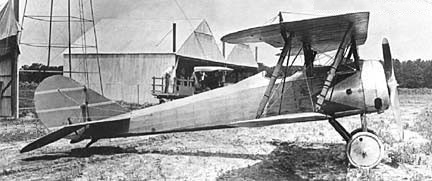
Designed by B D Thomas, the S-4 was evaluated for combat, but rejected and used as a trainer. The S-4 civil prototype (possibly still extant as NR66Y) was powered with a 100hp Gnôme and first flew in June 1917, piloted by Paul D Wilson. Twelve went to the USN, A395 to A406.
S-4 prototype
Thomas brothers, backed by Morse Chain Company, built three civil S-4B and 97 S-4B single-seat biplane advanced trainers for the Army, AS4276 to AS4372, plus ten for the USN, A3235 to A3244.
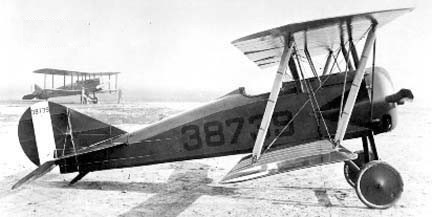
The improved S-4Cs were built powered by 80hp Gnôme B-9 or 80hp LeRhône C-9 engines. Priced at $5400, six civil, 461 for Army (AS38637 to AS38979, AS39882, AS41359 to AS41408, and AS44608 to AS44674), and four with twin floats for USN (A5855 to A5858); 50 with Gnôme and 447 with LeRhône, were built.
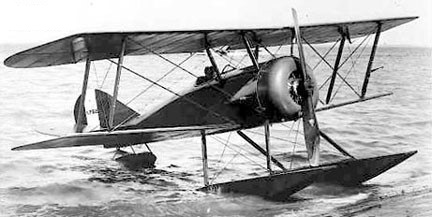
The designation S-5 was applied to S-4B fitted with two short main floats and a tail float. Six, A757 to A762, went to the US Navy in 1917.
Thomas-Morse S-5 A-762
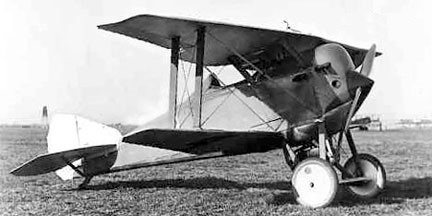
Thomas-Morse S-4E
The 1918 S-4E had a tapered wings and redesigned landing gear and a 110hp LeRhône. One was built for evaluation as an aerobatic trainer but was rejected and used as a racer ‘Space-Eater’ with a 135hp Aeromarine V-8, piloted by Basil Rowe.
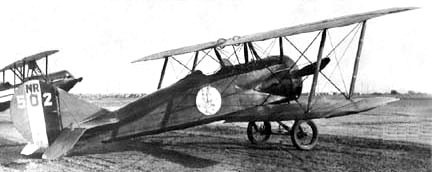
Thomas-Morse S-4C as civil racer NR502
The S-4 was in considerable varied civil use from war surplus with about 60 show on records, with many converted to 90hp Curtiss OX-5.
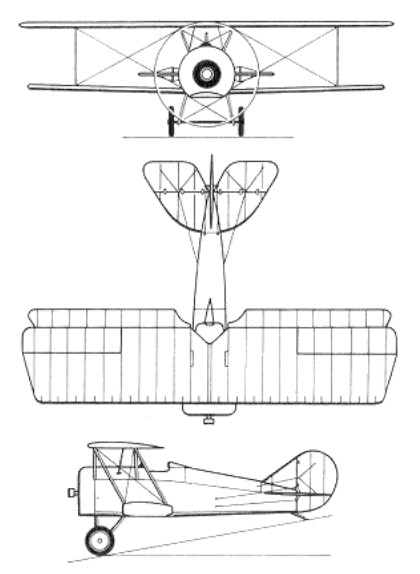
S-4C Engine: 1 x 80hp Le Rhone 9C or 80hp Gnôme B-9 Max take-off weight: 623 kg / 1373 lb Empty weight: 438 kg / 966 lb Wingspan: 8.08 m / 26 ft 6 in Length: 6.05 m / 19 ft 10 in Height: 2.46 m / 8 ft 1 in Wing area: 21.7 sq.m / 233.58 sq ft Max speed: 83 kt / 153 km/h / 95 mph Ceiling: 4500 m / 14750 ft Initial climb rate: 826.77 ft/min / 4.2 m/s Range: 217 nm / 402 km Armament: 1 x .30CAL 7.62mm machine-gun Crew: 1
Established at Ithaca, New York, in January 1917. Thomas brothers, backed by Morse Chain Company, built 100 S- 4B single-seat biplane advanced trainers developed from Thomas S-4 prototype fighter, followed by 497 improved S-4Cs. 200 Morse MB-3A fighters built by Boeing 1921 -1922, in addition to 50 built by Thomas-Morse. O-19 two-seat observation aircraft built 1928-1931. Thomas Brothers Aeroplane Co merged January 1917 with Morse Chain Company to form Thomas-Morse Aircraft Corporation

 All Aero