A Curtiss headless type single place open biplane was built in 1915 by college student Forrest E Wysong using written instructions sent to him by Lincoln Beachey.
First flown on 16 March 1915, it was flown four times before his father ordered him to “get rid of the dangerous machine.”
The sole 1916 Wright-Martin V, designed by Chance Vought, was built for military trials, but the project was never pursued. It was sold to a private party after WW1.
It has been reported as powered by a 150hp Hisso driving two tractor props.
Engine: Wright-Simplex A, 150hp Wingspan: 39’9″ Length: 27’2″ Useful load: 595 lb Speed: 90 mph Range: 300 mi Seats: 2
The two-place Wright-Martin R was built in 1917 as a landplane and a single pontoon floatplane. The land version was used briefly in the Mexican Border campaign, and seaplanes went to the Philippines.
Fourteen were built (AS108 and 109, and AS522-533) but some records show the total as 27, which might indicate prior production of 13 by Martin in 1916, before the merger.
Some versions had diagonal end-struts replacing the wire bracing.
USA Formed in 1916 at Los Angeles, California, by merger of Glenn L. Martin Company, Simplex Automobile Company, General Aeronautical Company, and Wright Aeronautical Company/Current Martin designs of 1917 produced under Wright-Martin name; 1920 Pulitzer racer built to designs of Loening, but then reverted to Martin name.
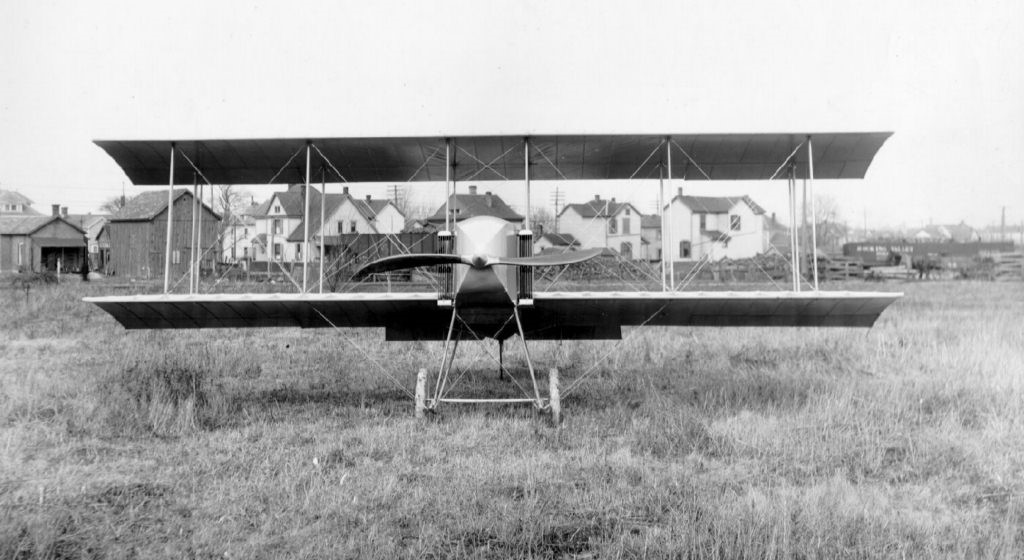
The 1915 Wright L was a two-place, open cockpit biplane primary trainer with standard control surfaces. Powered by a 100hp Hall-Scott A-7, it was similar to the Dayton-Wright FS-1 except for a longer wing.
The Model L was inferior to many other biplanes that were being produced at the time. It failed to secure any military orders and few were produced.
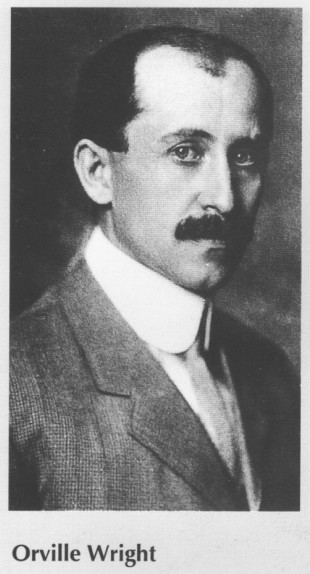
This was the last airplane produced by the Wright Company under that name. By this time Orville Wright no longer owned the company, but he was retained as a consultant and may have had some input on the design of the Model L.
Wright Model L Engine: 100hp Hall-Scott A-7, 75 hp at 1400 to 1560 rpm Propeller: Single direct-drive, 8 ft (244 cm) Wingspan: 29 ft (8.8 m) Wing area: 360 sq ft (33.4 sq. m) Wing chord: 6.5 ft (198 cm) Wing separation: 5.7 ft (174 cm) Camber: 1:20 Length: 24.2 ft (7.4 m) Horizontal rear elevator: 20 sq ft (1.9 sq m) Twin movable vertical rear rudders: 8.5 sq ft (0.8 sq m) Weight: 850 lbs (386 kg) Speed range: 25 to 80 mph (40 to 129 kph)
The Wright K of 1916 featured chain-driven, interwing-mounted twin props, powered by a 60-70hp Wright engine. One was built, going to the USN as AH-23 / A51.
The 1915 Wright J, or Long Bull (Burgess), was a two-place, open-cockpit, biplane floatplane similar to the Aeroboat. It was a license-built civil version of the Burgess-Wright C.
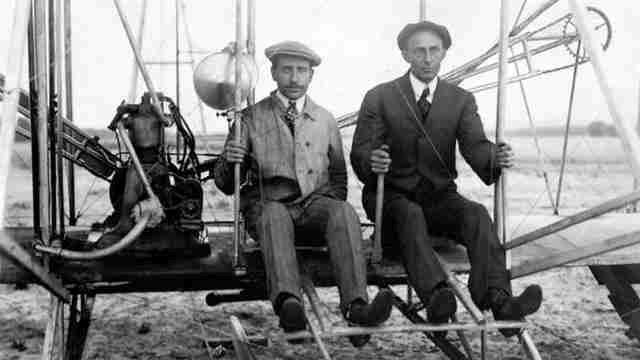
In 1899, the Wright brothers wrote to Dr. Samuel P. Langley that they were about to begin aviation experiments and they wanted to know how to build and fly gliders. Langley replied that they should read Progress in Flying Machines and contact Chanute in Chicago.
The Wright brothers received their copy of Chanute’s book personally from the author, who became both their friend and advisor. At their invitation, Chanute visited the Wrights at Dayton, Ohio and Kitty Hawk, North Carolina. It was Octave Chanute who, at a meeting in December, 1903, of the American Association for the Advancement of Science announced to the world that the Wright Brothers had flown in a heavier than air machine.
The Wright brothers built first successful aircraft in the world, 1903; first practical model 1905. The invention was patented in 1906 and the Wrights sold first military aircraft in world to U.S. Army Signal Corps 1908.
There were countless personal modifications of the Wright machines in the US, such as Beckworth-Wright, J S Berger-Wright, Lemp-Wright, Parmelee-Wright, with owners often claiming hyphenated name credits, as in similar cases with many Curtiss and Burgess planes. Most were essentially A and B Fliers.
1909: Wright Co; Wright Aeronautical Co Inc.
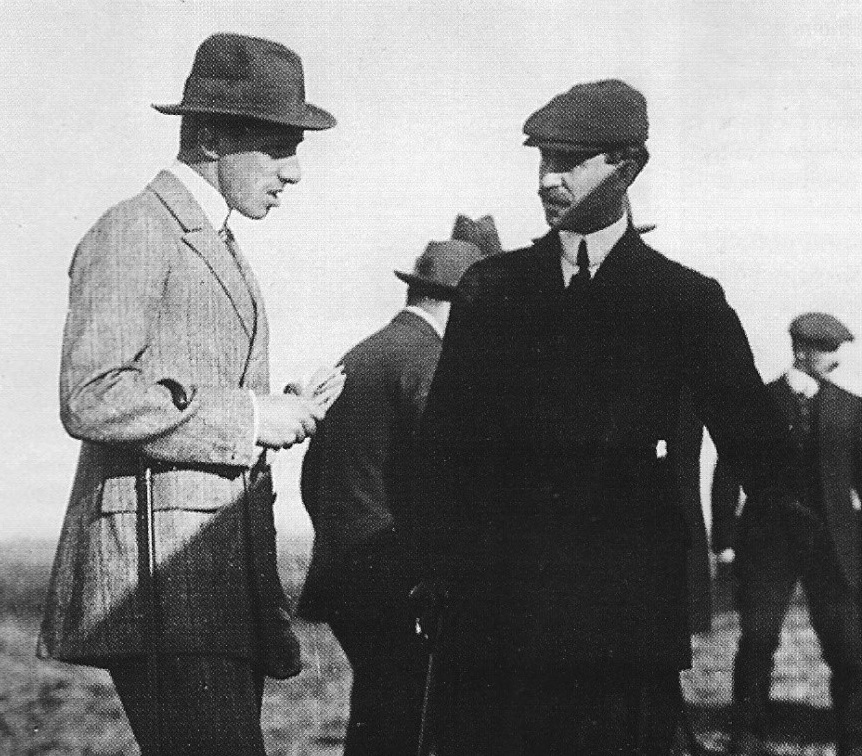
King Alfonso XIII and Orville Wright at Pau airfield, 1909
Continued producing same basic and outdated type though later, from Model I tractor biplane, aircraft were more conventional. Sold a few aircraft to U.S. Navy 1914.
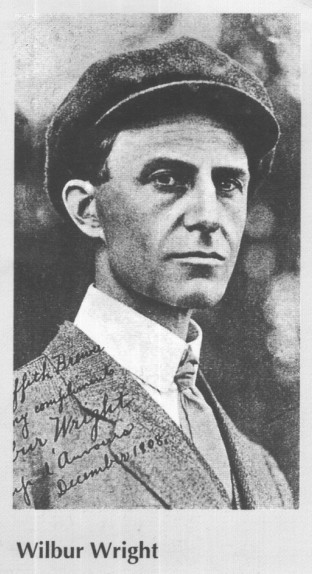
Mainly an engine manufacturing company. After Wilbur’s death, 1912, Orville continued at Dayton plant as independent experimenter. Built to official designs and produced Hispano-Suiza engines during the First World War. Giuseppe Bellanca joined 1924 and Wright-Bellanca monoplane and Apache shipboard fighter produced in 1925. Bellanca left 1927 to re-form his own company (see Bellanca Aircraft Corporation).
Although the 1915 Model L was a commercial failure, the Wright Company refocused on the development of high-powered engines for airplanes and automobiles. In 1916, they acquired the Crane-Simplex Automobile Company and the Glenn L. Martin Aircraft Company. All three companies merged to become the Wright-Martin Aircraft Corporation.
In 1916 the company was sold to a NYC investment group. Became Wright-Martin Aircraft Corporation of California in 1916 when merged with Glenn L Martin Co and Simplex Automobile Co to build Hispano-Suiza motors under license from France.
In 1920 reorganized as Wright Aeronautical Corp.
In 1929 Wright Aeronautical Corp and Curtiss Aeroplane and Motor Company combined to form Curtiss-Wright Corp and in 1931 the engine divisions of Curtiss and Wright merged.





 All Aero