Known originally as the Royal Aircraft Factory, Farnborough, under the direction of Mervyn O’Gorman, was authorized only to repair a crashed experimental 60 h.p. E.N.V. Bleriot monoplane. By the time the “repair” work was finished it had turned into a tail first biplane classified S.E.1 – the “S” standing for Santos Dumont, in deference to the inventor of the tail first formula. (As the S.E.1 was the only tail first type built by the Factory, the letters S.E. were later taken to mean Scout Experimental.) Faced with a fait accompli, the War Office wound up the Balloon Section R.E. on April 1st, 1911, and replaced it by the Air Battalion; three weeks later they renamed the Balloon Factory the Army Aircraft Factory. One of the Factory’s first jobs was to “repair” the Duke of Westminster’s Voisin pusher biplane, which emerged as the B.E.1 (Bleriot Experimental No. 1) tractor biplane, designed by F. M. Green and “D.H.”
At the same time, it was decided to inaugurate the designations R.E. (Reconnaissance Experimental, two seat tractor biplane), T.E. (Tatin Experimental monoplane with pusher propeller at tail), and B.S. (Bleriot single seat Scout) for future use.
Was involved in dirigible construction and repair before First World War. It was renamed Royal Aircraft Establishment during the war and initiated biplane designs for the Royal Flying Corps, including the B.E.2 and F.E.2 series, F.E.8, R.E.8, and finally the S.E.5 fighter.
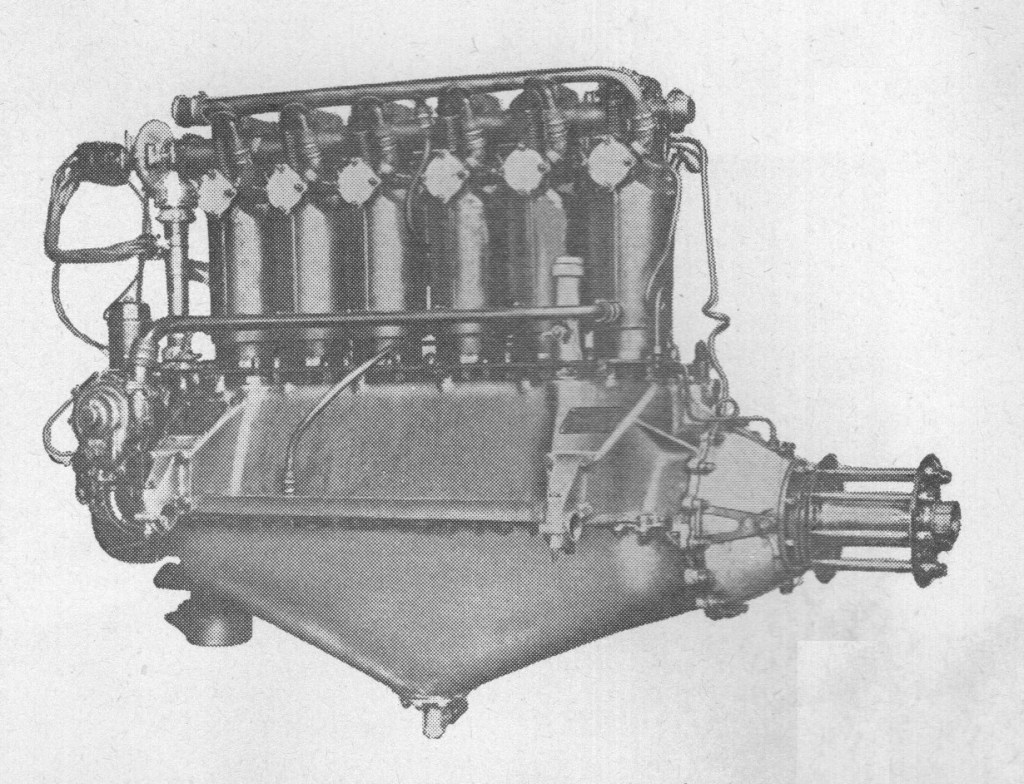
Originally intended for use in training aircraft, this engine became far better known as the power-plant of Naval airships. It was designed, in 1915, for an output of 75 h.p. at 1,350 r.p.m., but ratings soon increased. In February 1916 it was giving 91 h.p.; in October 1918, 94 h.p.; and later in the same month, at 1,500 r.p.m., 105 h.p.
In the R.N.A.S. volume dealing with the S.S. Zero airship one reads: “The Rolls-Royce Hawk type engine of 75 h.p. was adopted as possessing a degree of reliability and other properties of particular suitability higher than other makes available.”
Of 55,700 hours flown by British airships, 36,000 were put in by Hawk-engined craft. In August 1918 a flight of 50 hr 55 min duration was recorded, and patrols of 23-30 hr were not uncommon. Heavicr-than-air machines fitted with the Hawk included the Sage trainer Type III, a few B.E.2Es, and Avro 50417s.
A six-cylinder, ungeared, vertical water-cooled unit, the Hawk had one magneto and one carburettor. Oil consumption was half a gallon an hour. An official Rolls-Royce description ran: “It is usual, when starting this small engine, to turn it by means of the propeller for filling the cylinders after the induction pipes have been primed. The operation of the hand magneto (supplied by Messrs. Rolls-Royce) then starts the engine. The Rolls-Royce Patented Device is supplied for priming. This is a light and simple apparatus, embodying a hand pump, which can be fixed in any convenient position near the pilot’s seat, or as desired. One priming device may serve two or more engines with the use of a change-over cock. When required, a starting handle can be supplied, arranged in line with the crankshaft at the timing gear end of engine, and connected thereto by a reduction gear. This apparatus is specially suitable for airship installations.”
Data for the Hawk with a nominal output of 100 h.p. at 1,500 r.p.m. were: max. permissible r.p.m., 1,700; fuel consumption at normal power, 6.5 gal/hr; weight, 405 lb.
In April 1916 came the Falcon-virtually a scaled~down Eagle. Again ratings increased and in April 1916 the figure was 205 h.p.; in May, 228 h.p.; in February 1917, 247 h.p.; and in April 1917, 262 h.p, all at 1,800 r.p.m. By November 1917 the output had risen to 278 h.p. and by July 1918 to 285 h.p.-in both instances at 2,000 r.p.m. Official data for the Falcon I were: weight, 650 lb; b.h.p. at normal r.p.m., 228; fuel consumption (gal/hr), 16.6. Corresponding figures for the Falcon II were: 665. 255, 18.25, and for the Falcon III (by far the most famous member of the family) 660, 270, and 18.75.
An unusual feature of this engine is the epicyclic propeller reduction gear which contains a clutch designed to limit the maximum torque, thus protecting the reduction gears.
Constructional particulars for the Eagle VIII apply generally to the Falcon III. First run in 1915, production of the Falcon began in September 1916 and was so successful that it was also manufactured under licence by Brazil Straker in Bristol. Production continued until 1927, by which time 2,185 had been built.
The best-known application of the Falcon was to the Bristol Fighter F.2B, wherein the Series Ill engine became standard and remained in service until the 1930s. Other British military installations were made in the Martinsyde F.1, F.3 and F.4, R.E. 6 and 7, Armstrong Whitworth F.K.12, Avro 523C and 529 Pike, Blackburn S.P. and G.P. seaplanes, Kangaroo and Sprat, D.H.4, Fairey F.2, Sopwith tractor triplane, Parnall Perch, improved Short 184, and Vickers Vendace.
Production ceased in 1927 after 2,185 were built. The unit cost in 1918 was £1,210.
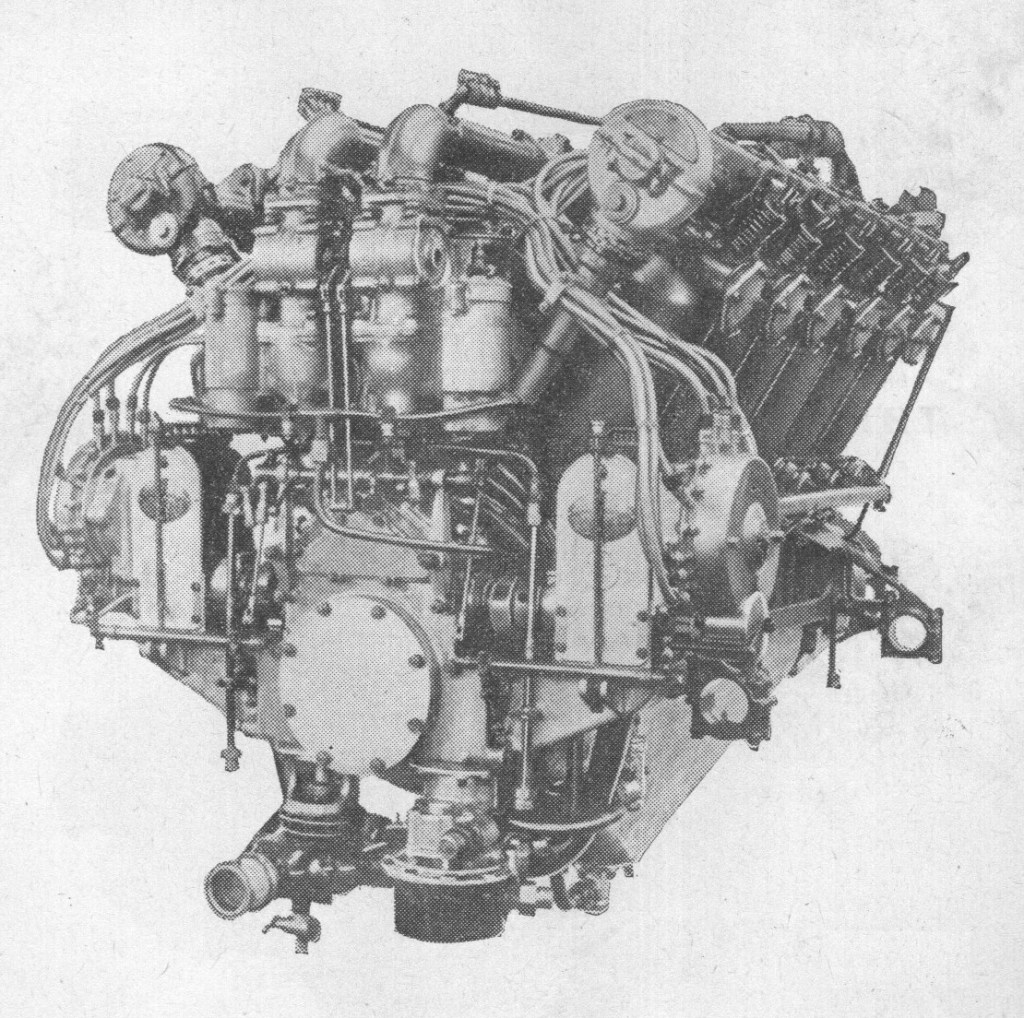
Rolls-Royce Falcon III
Variants: Falcon I (Rolls-Royce 190 hp Mk I) (1916-17), 230 hp, 250 engines produced in both left and right hand tractor versions.
Falcon II (Rolls-Royce 190 hp Mk II) (1917), 253 hp, carburettor size increased. 250 built at Derby.
Falcon III (Rolls-Royce 190 hp Mk III) (1917-1927), 285 hp, increased compression ratio (5.3:1), twin carburettors replaced with four Rolls-Royce/Claudel-Hobson units. 1,685 built at Derby.
Applications: Armstrong Whitworth F.K.12 Avro 523C Pike Avro 529 Blackburn G.P. Seaplane Blackburn Kangaroo Blackburn Sprat Bristol Type 12 F.2A Bristol Type 27 F.2B Coupe Bristol F.2 Fighter Bristol Type 86 Greek Tourer Bristol Type 96 de Havilland DH.37 Fairey F.2 Fairey N.9 Martinsyde F.3 Martinsyde R.G Martinsyde Buzzard Parnall Perch Royal Aircraft Factory F.E.2 Royal Aircraft Factory R.E.7 Vickers F.B.14 Vickers Viking Vickers Vendace Vickers Vedette Westland Limousine Westland Wizard
Specifications: Falcon III Type: 12-cylinder liquid-cooled 60 deg. Vee aircraft piston engine Bore: 4 in (101.6 mm) Stroke: 5.75 in (146 mm) Displacement: 866.5 in³ (14.2 L) Length: 68 in (1,727 mm) Width: 40.3 in (1,024 mm) Height: 37.2 in (945 mm) Dry weight: 715 lb (324 kg) Valvetrain: Overhead camshaft, two valves per cylinder Fuel system: Four Rolls-Royce/Claudel-Hobson carburettors Fuel type: 40-50 octane petrol (pre-1923) Cooling system: Liquid-cooled Power output: 288 hp (215 kW) at 2,300 rpm at sea level Compression ratio: 5.3:1 Fuel consumption: 18.5 Imp gal/hr (84 L/hr) Oil consumption: 0.75 Imp gal/hr (3.4 L/hr) Power-to-weight ratio: 0.4 hp/lb (0.66 kW/kg)
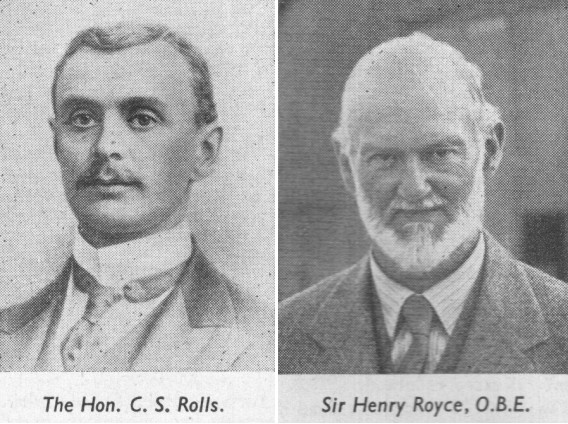
Rolls and Royce, met in Manchester in 1904. Rolls-the Hon. Charles Stewart Rolls-possessed wealth, an Eton-and-Cambridge education, a degree in mathematics and applied science, and a fine record as a motorist. He was a sportsman he had consistently displayed a daring at the wheel and a determined approach to the technical problems of motoring.
In the business of C. S. Rolls and Co., which he established with Claude Johnson in 1902. In 1903 he set a world speed record of 93 m.p.h.; but the car was a 70 h.p. Mors, and by the following year, when his books showed orders for a hundred Continental cars, he could still not find a British product which measured up to his standards.
At ten years of age Henry Royce started work as a telegraph boy, later attending a technical college, and serving a few years in the Great Northern locomotive shops at Peterborough. After a spell in an engineering works at Leeds, he set up a business in Manchester, making arc lamps and dynamos. The slump after the Boer War caused him to turn his ambition to cars. Disappointed with a foreign model which he acquired, he decided to put his own ideas into practice, and in 1903 he completed a two-cylinder car of 10 h.p., having handled much of the precision work himself.
One of his first three cars went to Henry Edmunds, who arranged the meeting in Manchester. The two men took to each other immediately, and having tried out Royce’s car, young Rolls undertook to sell its maker’s entire output. But he began to ply his partner with suggestions and demands.
The “two Rs” were first officially linked in business association at Christmas 1904, by a working agreement between the two firms; and thenceforth the Rolls-Royce car began.
By 1906 Royce’s production was large enough to allow Rolls to stop his sales of other makes of car, and Rolls-Royce, Ltd., was founded. Royce’s old partner, A. E. Claremont, became chairman; Rolls was technical managing director; and Royce was nominated chief engineer and works director.
Charles Stewart Rolls
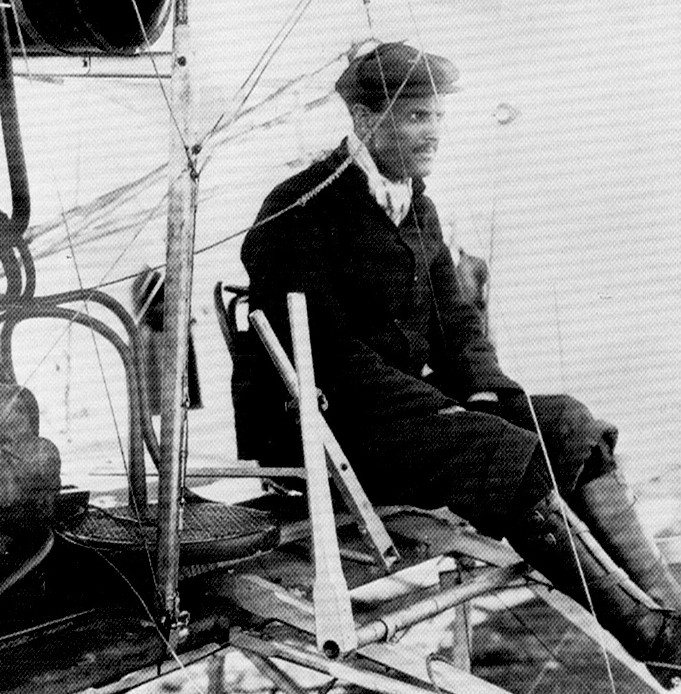
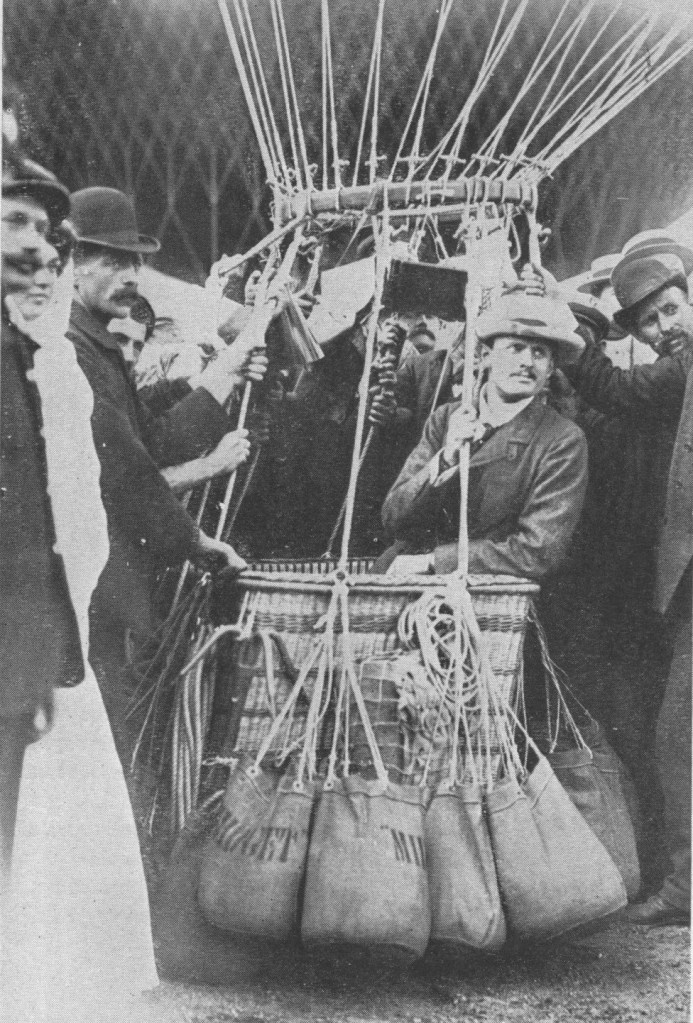
Rolls, who had become a member of the Aeronautical Society in 1901, was already a keen balloonist; then, having met the Wright brothers, he turned to heavier-than–aircraft. He was awarded his pilot’s certificate (No. 2) on March 8th, 1910-the very same day that Lord Brabazon received his No. 1. On the Wright biplane he made the first heavier-than-air crossing of the Channel by an Englishman, and the first double crossing by any aeroplane in history; but soon afterwards-on July 12th, 1910, he crashed to his death at the Bournemouth flying meeting, only 33 years of age. He was the first Englishman to die in an accident to a powered, heavier-than-air machine. His Wright Flyer broke up at 20 ft agl and he cracked his skull.
C.S. Rolls
In 1910 Royce became seriously ill and thereafter was absent for long periods from his new factory at Derby. He worked on in the south of France and on the south coast of England.
Following the British Schneider victory of 1929-made possible by the “R” engine-a baronetcy was conferred upon him, and he heard from his bed how an improved engine of this type sent a Supermarine S.6B to final victory in the Schneider Race of 1931. He died on April 22nd, 1933.
1914 Design of first Rolls-Royce aero engine-later named Eagle started. Company making engines of official pattern at Derby.
1915 Eagle on test six months after design initiated. Hawk designed and developed. Falcon designed
1918 Condor on test at 525 h.p.
1919 Alcock and Brown, in a Vickers Vimy (two Rolls-Royce Eagle Vills), mode first direct crossing of North Atlantic; flying time, 16 hir 12 min. Ross Smith and Keith Smith, in an Eagle-Vimy, made first flight from England to Australia11,130 miles in 124 hr flying time.
1920 Van Ryneveld and Quintin Brand, also in an Eagle-Vimy, made first flight from England to South Africa-6,281 miles in 92 hr 58 min flying time.
Between 1915 and 1924 Rolls-Royce Aero-engine production was: Eagle, 4,674; Hawk, 200; Falcon, 2,185; Condor, 327.
1925 Design of Rolls-Royce “F” series of engines (later called Kestrel) started.
1926 First “F” engine tested and delivered.
1927 The ” H ” engine-later the Buzzard-under development.
1929 Air Ministry decided in February to compete in Schneider Trophy Contest; Rolls-Royce asked to develop a racing engine. Within six months “R” engine was delivering 1,900 h.p. for a weight of 1,350 ]b. Installed in Supermarine S.6, which won Schneider Contest at 328.63 m.p.h.
1931 Rolls-Royce again asked to develop a Schneider Trophy engine to help secure a third victory, which would gain Trophy outright for Gt. Britain. Outcome was improved “R” engine of 2,360 h.p., weighing 1,630 lb. Schneider Trophy won outright. Later “R” engine gave 2,530 h.p. and enabled world speed record to be raised to 407.5 m.p.h.
By 1931, during the Great Depression, Bentley was having financial difficulties. When funds ran out in 1931, the receivers were negotiating with D.Napier & Sons Ltd for the sale of the remains of Bentley. However, Rolls-Royce put in a secret bid through a Liechtenstein company, and secured Bentley Motors for £125,256. For this, Rolls-Royce got the factory equipment, a number of incomplete car chassis, and the services of Walter Bentley for three years.
1932 Design of the P.V.12 engine (later called Merlin) started. (P.V. denoted private venture.)
1934 Merlin completed its first 100 hr run at 790 h.p.
1936 Merlin completed Service Type Test at 975 h.p.
1938 Building of Crewe factory started.
1939 First Merlin built at Crewe. Design and development work started on 37.V.12 engine, later named Griffon. Building of Glasgow factory begun in August. 1
1940 First Merlin built at Glasgow. First test run of Griffon.
1942 Quantity production of Griffon started.
1943 First Rolls-Royce turbojet-the Welland-passed its 100 hr type test; thrust, 1,700 lb, weight, 850 lb. Design of Derwent 1 started.
1944 Deliveries of Welland begun, for installation in Gloster Meteor. Design and development of Nene started.
1945 Meteor powered with Derwent Vs broke world air speed record at 606 m.p.h. In September a Meteor was flown with two Rolls-Royce Trent turboprops, being the first turboprop aircraft to fly. By this year power of Merlin had increased to over 2,000 h.p.
1946 World airspeed record again broken by a Derwent-Meteor; speed 616 m.p.h.
1947 Pratt and Whitney signed licence agreement for manufacture of Rolls-Royce Nene and Toy. Nenes in production at Derby. Trans-Canada Airlines started operations with Merlin powered Canadair North Stars.
1948 First public appearance ofAvon turbojet at S.B.A.C. Display. Belgium signed licence agreement for manufacture of Derwents.
1949 Dart turboprop type-tested at 1,000 h.p. B.O.A.C. intro- duced Merlin-powered Argonauts (similar to North Stars).
1950 Australia signed licence agreement to build Nene and Avon. Hispano signed agreement to make Nene and Toy.
1951 English Electric Canberra, with two Rolls-Royce Avons, made first non-stop transatlantic crossing by a jet aircraft the first of numerous record flights by Avon-Canberras.
1952 Sweden signed licence agreement to build Avon.
1953 Avon-Canberra flew from London Airport to Darwin, Northern Australia, in 22 hr 21 sec. Avon-powered Hawker Hunter established world air speed record of 726.6 m.p.h.; Avon-powered Supermarine Swift later raised record to 735.7 m.p.h. Ministry of Supply opened new factory at East Kilbride, Lanarkshire, to augment production of Avons for the R.A.F. (in addition, Avons were being made by the Bristol Aeroplane Co., Ltd., D. Napier and Son, Ltd., and the Standard Motor Company.)
1954 By May 1954 British-built Rolls-Royce gas turbines had completed 23 million flying hours; Merlins had cornpleted over 5.1 million flying hours in commercial service. By the end of the year over 185,000 Rolls-Royce piston and gas-turbine engines will have been built.
LHTEC (Light Helicopter Turbine Engine Company) is a joint venture between Rolls-Royce and Honeywell founded in 1985. The company was originally a partnership between the Allison Engine Company and AlliedSignal Aerospace . In 1995 Rolls-Royce acquired Allison, and AlliedSignal merged with Honeywell in 1999, and adopted its name.
Rockwell-Standard Corp North American Rockwell Corp Rockwell International Corp
In 1919, Colonel W.R. Rockwell reorganised a bankrupt axle company in Oshkosh, Wisconsin. Following the Colonel’s development of the first double reduction axles for heavy-duty vehicles, Timken-Detroit Axle company acquired his axle company in 1928.
In 1953, Timken-Detroit merged with Standard Steel Spring Company to form Rockwell Spring and Axle Company. In 1958, the name of the company was changed to Rockwell-Standard Corporation. Rockwell-Standard embarked on a plan of diversification in the late 1950s and 60s and by 1967, it was a major independent producer of a wide-range of automotive components.
In 1965 Rockwell-Standard acquired Snow Aeronautical, continuing to produce agricultural aircraft at Olney as Snow Commanders (as division of Aero Commander), and acquired Intermountain Manufacturing Company (IMCO) 1966. Single-engined Model 112 delivered to customers from 1972. Low-wing twin-engined Rockwell Commander 700 produced jointly with Fuji in Japan. Thrush Commander was very notable specially-designed agricultural aircraft. The entire Thrush Commander range sold to Ayres Corp and then became known by the Ayres name. Shrike Commander 500S terminated 1980 but Commander Jetprops continued by Gulfstream American Corporation.
In 1967, Rockwell-Standard Corporation and North American Aviation merged to create the North American Rockwell Corporation.
Following company reorganization, the former Aero Commander division of Rockwell became part of NAR, and its Shrike, Commander 685 and Turbo Hawk Commander twin-engined business aircraft were marketed under the new company name, together with Quail, Sparrow, Snipe and Thrush Commander agricultural aircraft, and the Darter and Lark Commander single-engined lightplanes.
The Model 112 Commander lightplane and B-1 swing-wing supersonic bomber projects were started before the company name was changed to Rockwell International in 1973.
In 1973 North American Rockwell and Rockwell Manufacturing Company merged to become Rockwell International Corporation. Aircraft production after the 1967 merger included the Aero Commander line of single and twin-engine aircraft, the turboprop OV-10 Bronco armed reconnaissance aircraft, T-2 Buckeye jet trainer, B-1B Lancer supersonic swing-wing bomber, and the Sabreliner executive and light jet transport. Company’s aerospace and defence units purchased by the Boeing Company on December 6,1996, becoming Boeing North American. Similarly, Rockwell Australia became Boeing Australia Ltd.
In 1977 Rockwell International sold its agricultural airplane operation to the Ayres Corporation of Albany, Georgia. The new owners will continue to manufacture the Models 600 and 800 Thrush Commanders. Fred Ayres, who developed the Turbo Thrush PT6 retrofit, plans to begin producing that airplane at his new plant.
1984: Sabreliner Corporation, a new company formed to acquire the former Sabreliner Division of Rockwell International.
UK Engineering company in Lincoln, Lincolnshire, which built Sopwith Gunbus and Farman Longhorn biplanes and Short 184 seaplanes to Admiralty orders in First World War, and also designed and built its own single-seat scout and two prototypes of a “Fighting Machine” with two manned gun positions in upper wing.
The founder of Rex Smith Aeroplane Company, Rex Smith (1862–1923), was an inventor and a patent attorney. He placed his offices in Washington D.C., and operations at College Park Airport, Maryland. The company was capitalized with $500,000 in 1910 with Victor J Evans as president and Rex Smith as Vice president.
(Rexford) Rex Smith Aeroplane Co, College Park MD. USA
In 1911, Rex Smith moved his hangar to line up with the Army Aviation School, and hired Frank Kastory from Anzani, and Abraham Whalomie Raygorodsky from Russia. He test flew Smith aircraft alongside Fox engine powered Curtiss aircraft. Rex also hired Tony Jannus, and Paul Peck as test pilots. In a stroke of coincidence, flying at the same airport at the same time was another military aviator, Paul W. Beck.
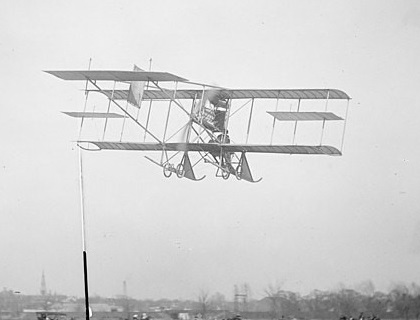
Rex Smith plane in flight
Two Rex Smith Biplane were built and used in the successful April 3, 1911 U.S. Army Signal Corps experiments in wireless communications. Potomac river pontoon experiments on April 5, were not as successful, with the aircraft plowing into the water headfirst nearly drowning the test pilot Jannus. Just two days later the machine was ready again. Janus took up actor Nat M. Wills, and later two female passengers at the same time. Marking the first time an aircraft flew with more than one passenger.
The Signal Corps did not buy any Smith Biplanes, they did however use them from time to time to train pilots to fly the Curtiss aircraft at the same field.
Operations continued until 1916 in building several other Curtiss-type biplanes.
Germany An aircraft works and flying school formed early in First World War by Dr. Friedrich Hansen for construction of aircraft, chiefly Bristol and Morane monoplanes.
The Renault 70 hp or Type WB was a British V-8 aero engine that first ran circa 1913. The engine was manufactured by Renault Limited of West Brompton, London between August 1914 and December 1918, three other companies, including Rolls-Royce, also produced the engine. A variant known as the Type WC used an external oil pump as opposed to the internal pump of the Type WB.
The Renault V-8 engines were noted as inefficient but reliable, the inefficiency being mainly due to the excessively rich fuel/air mixture used to assist cooling. A total of 227 were built.
Applications: Airco DH.1 Armstrong Whitworth F.K.2 Armstrong Whitworth S.S.27 airship Blackburn Type E Bristol B.R.7 Caudron G.3 Central Centaur IVA Farman MF.7 Longhorn Farman Shorthorn Flanders F.4 HMA no.2 airship, short-lived modification Royal Aircraft Factory B.E.2 Royal Aircraft Factory F.E.2 Royal Aircraft Factory R.E.1 White & Thompson Bognor Bloater
Specifications: 70 hp Type: Inline air–cooled, upright, 90-degree, V-8 piston engine Bore: 3.72 in (96 mm) Stroke: 4.72 in (120 mm) Displacement: 423.76 cu in (7 L) Length: 45.5 in (1,156 mm) Width: 29.8 in (757 mm) Height: 32.8 in (833 mm) Dry weight: 396 lb (180 kg) Valvetrain: Single overhead exhaust valve, single side inlet valve per cylinder Fuel system: Single carburettor Fuel type: 40–50 octane petrol Cooling system: Air-cooled Reduction gear: 0.5:1, left hand tractor Power output: 70 hp (52 kW) at 1,750 rpm (takeoff power) Specific power: 0.17 hp/cu in (7.4 kW/L) Compression ratio: 4.12:1 Power-to-weight ratio: 0.18 hp/lb (0.28 kW/kg)

 All Aero