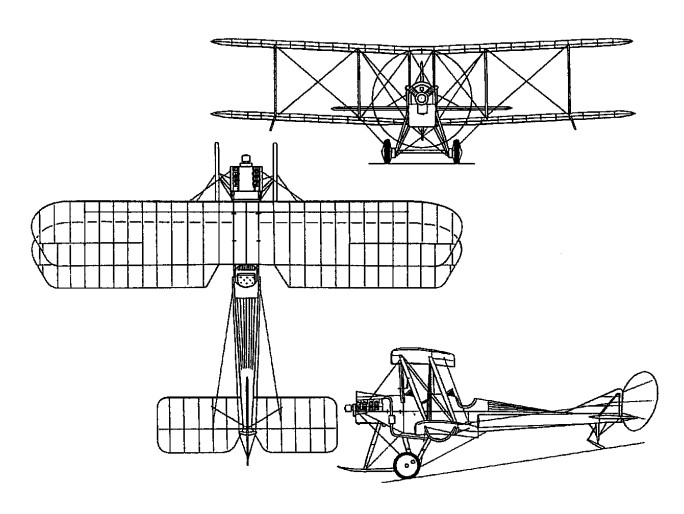
1915 Fighter. Gunner’s ‘pulpit’ cockpit in front of airscrew; one only
Engine: 1 x 90-h.p. R.A.F.1a
Span: 35ft 0in
Seats: 2
1915 Fighter. Gunner’s ‘pulpit’ cockpit in front of airscrew; one only
Engine: 1 x 90-h.p. R.A.F.1a
Span: 35ft 0in
Seats: 2
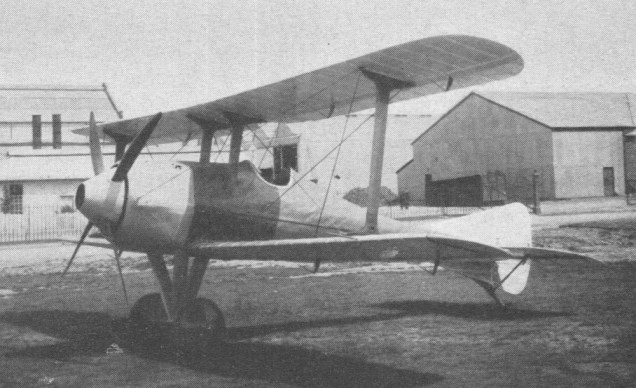
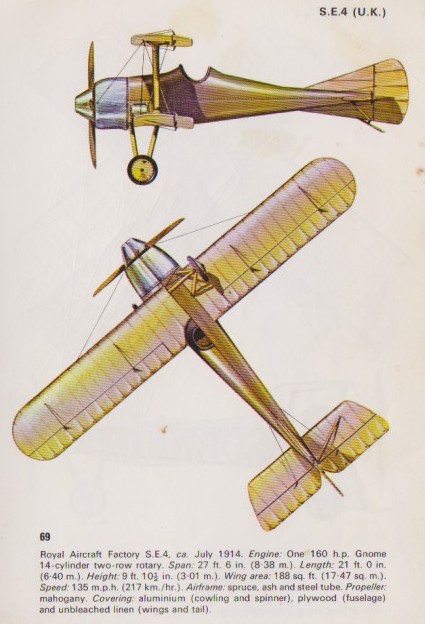
1914 Scout. At the Royal Aircraft Factory H. P. Folland’s S.E.4 scout set up an unofficial world speed record of 131 m.p.h. with a 160-h.p. Gnome. Its engine was fan-cooled; the variable camber wings could be used as landing flaps; and it had a celluloid cockpit cover, an N.A.C.A. cowling, single I type wing struts, streamlined bracing wires, and fairings on its axle and wheels and over the aileron, elevator and rudder gaps. Other engines were also fitted.
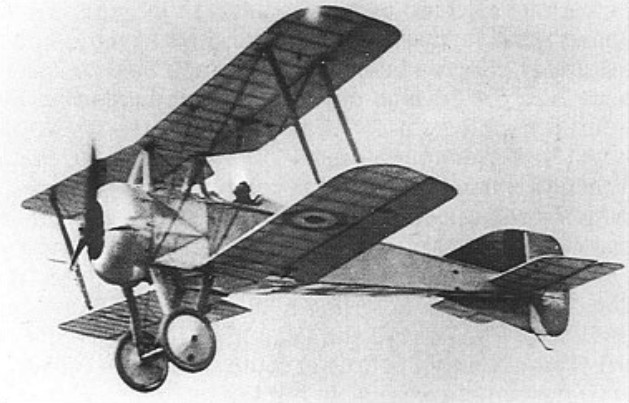
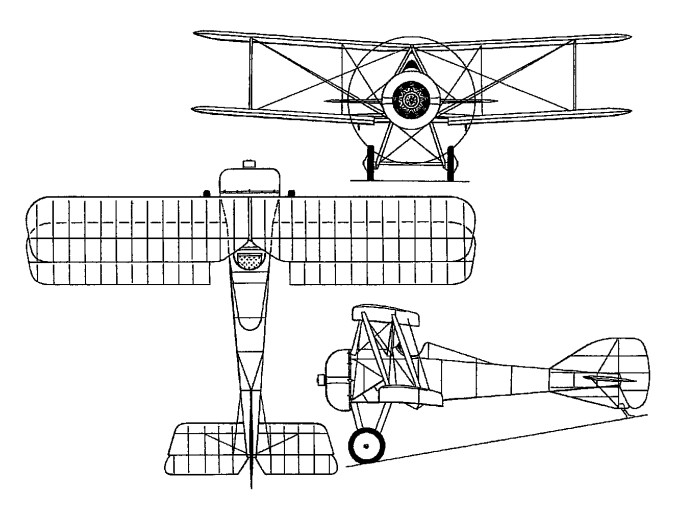
Designed at Farnborough by H P Folland at the end of 1914, the S.E.4a was one of a series of “Scouting Experimentals” used to study the interplay of stability and manoeuvrability. Unrelated, except in configuration and design authorship, to the high performance S.E.4 of mid-1914, the S.E.4a was a sturdy little single-bay biplane with equi-span wings incorporating 3.5 degrees of dihedral and having no centre section. The square-section fuselage was of conventional spruce construction with steel tubes to accept the loads from the lower wings, and, like the wooden wings and tail unit, was fabric-covered. Full-span ailerons were fitted to both sets of wings, and power was provided by an 80hp Gnome seven-cylinder rotary in a fully circular shortchord cowling.
The first of four S.E.4a’s built at the RAF flew there on 25 June 1915, and differed from its successors in having faired fuselage sides and an outsize spinner. The fourth and last S.E.4a flew on 13 August that year. The third, flown on 27 July, was at first fitted with an 80hp Le Rhone engine, the Gnome being substiprovided with an 80hp Clerget. In the hands of the RFC, at least one of the S.E.4a’s was armed with a 7.7mm Lewis gun mounted on the centre line above the upper wing to clear the propeller disc.
SE.4
Engine: 1 x 160-h.p. Gnome
Span: 27ft 6in
Speed: 135 mph
Seats: 1.
SE.4a
Engine: 1 x 80-h.p. Gnome
Span: 27ft 5.25in
Length: 6.37 m / 21 ft 11 in
Height: 2.87 m / 9 ft 5 in
Seats: 1
1914 Experimental.
Engine: 1 x 275-h.p. R.-R. Falcon
Seats: 3
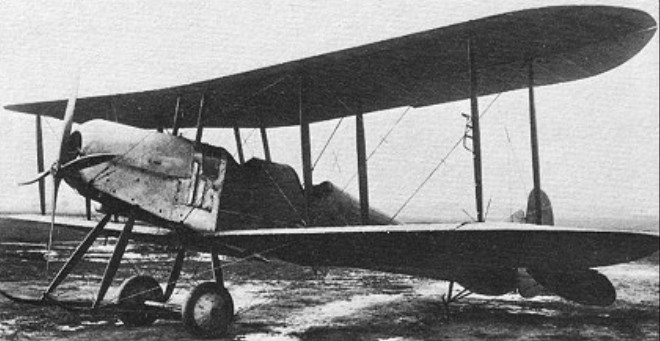
The R.E. designation indicated ‘Reconnaissance Experimental’ and the R.E.5, only 24 of which were built for the RFC, was operated successfully as a reconnaissance and light-bombing biplane during the early stages of World War I. Power was provided by an 89kW engine, giving a maximum speed of 125km/h.
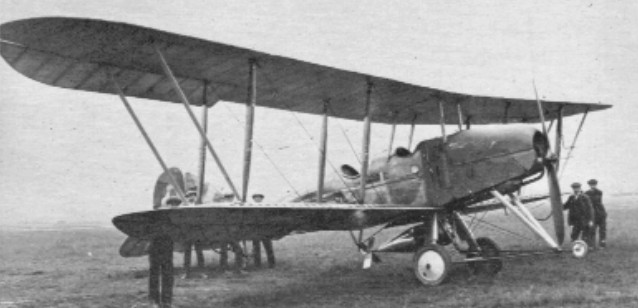
Engine: 1 x 120-h.p. Austro-Daimler
Span: 44ft 6in
Speed: 78 mph
Seats: 2
Engine: 1 x 120-h.p Beardmore
Span: 44ft 6in / 13.56 m
Length: 26 ft 2 in / 7.98 m
Height: 9 ft 9 in / 2.95 m
Max speed: 78 mph / 126 kph at SL
Bombload: 60 lb / 27.2 kg
Seats: 2
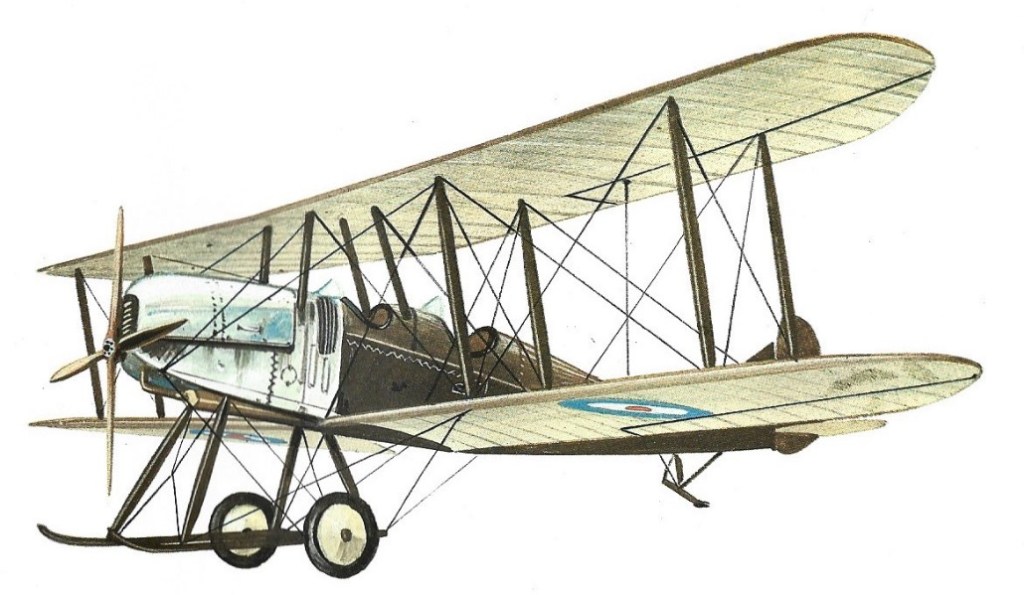
1914 Experimental.
Engine: 1 x 120-h.p. Austro-Daimler
Seats: 2
1914 Experimental. Development of HRE.2
Engine: 1 x 120-h.p. Austro-Daimler
Span: 45ft 3.5in
Seats: 2
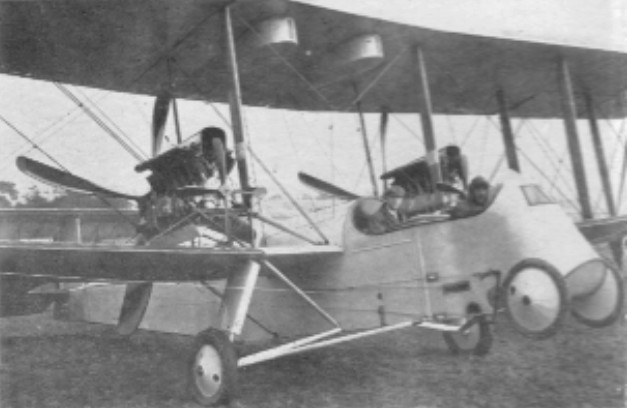
The twin engined F.E.4, of which two were built in 1916, was intended to be a ground attack aircraft. To carry 1.5-lb. C.O.W. cannon. Other engines also fitted
Engine: 2 x 150-h.p. R.A.F.5
Span: 75ft 2in
Loaded wt: 5,988 lb
Speed: 84 mph
Seats: 3
Of similar construction to the F.E.3, the F.E.6 was built in 1914 and was powered by a 120hp Austro-Daimler six-cylinder water-cooled engine. Standard R.E.5 components were used for the wings, which were of equispan, and the tail unit was carried on a cantilever boom, without bracing wires.
The F.E.6 was flown at Farnborough on 14 November 1914 but this may have been its only flight, and, if fitted, the COW gun that it was designed to carry was not fired.
Engine: 1 x 120-h.p. Austro-Daimler
Wingspan: 15.03 m / 49 ft 4 in
Length: 8.99 m / 30 ft 6 in
Height: 4.57 m / 15 ft 0 in
Wing area: 50.35 sq.m / 541.96 sq ft
Max take-off weight: 1193 kg / 2630 lb
Empty weight: 907 kg / 2000 lb
Seats: 2
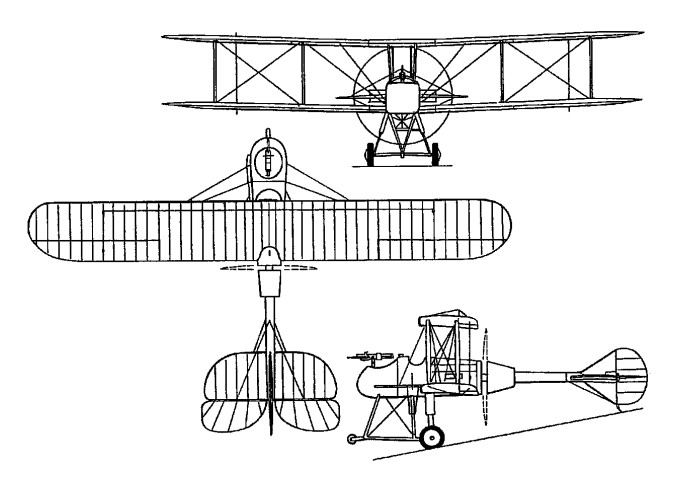
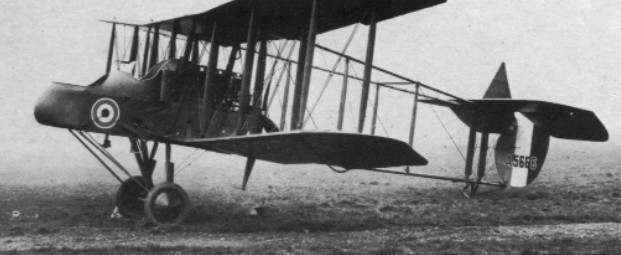
The first aircraft to carry the F.E. designation was the F.E.1 (Farman Experimental No. 1), designed by Geoffrey de Havilland in 1910 and named Farman Experimental because of its resemblance to contemporary Farman pusher biplanes. The F.E.1 was rebuilt as the F.E.2 after a crash in 1911 with a Gnome instead of its original 45 h.p. de Havilland Iris engine, and the F.E.2 was itself rebuilt, to a different design but with the same designation, in 1913.
The first of the Royal Aircraft Factory’s series of F.E. fighters, the F.E.2a designed in the summer of 1914, had nothing but the basic fact of being a pusher propelled biplane in common with the earlier machines, notwithstanding the similarity of the designations.
Twelve F.E.2as were ordered from the Royal Aircraft Factory in August 1914, and the first machine emerged in January 1915 as a large two bay biplane with accommodation for the pilot and observer in an armoured nacelle forward of the wings and a 100 hp Green engine mounted above the lower wing driving a two blade wooden pusher propeller. The centre section of the upper wing was hinged aft of the rear spar and could be lowered to act as an air brake, while an even more radical innovation was a small tail¬braking parachute tried on the first 2a. The tail assembly, with distinctive triangular fin, was mounted on converging booms extending aft from the upper and lower wing spars, while the oleo undercarriage incorporated a small nosewheel. A mounting for a 7.7mm Lewis machine gun was provided in the observer’s front cockpit, and it was the unobstructed forward field of fire provided by the pusher configuration and cockpit arrangement that was to make the later F.E.2s so successful over the Western Front.
The Green engine proved to have a poor power to weight ratio and later F.E.2as were modified to take the 120 hp Beardmore engine. This modification delayed completion of the remaining aircraft, and the last of the 12 was not finished until November 1915, by which time the first F.E.2bs had begun to appear.
The early 2b was essentially a simplified version of the 2a, having the same two-spar wings, identical to the B.E,2, but without the centre section air brake, and a somewhat smaller nacelle mounting the same engine and armament as the earlier type.
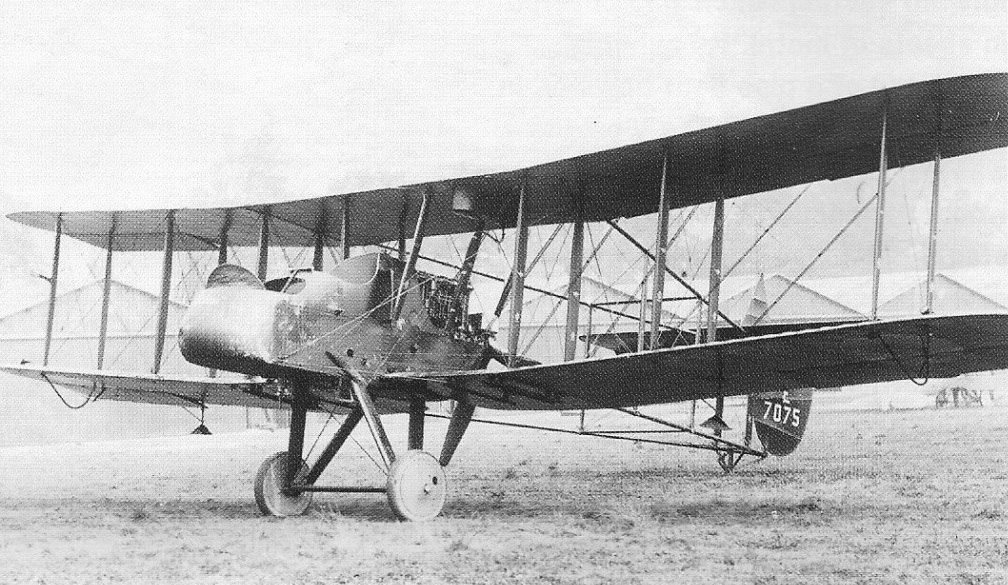
Later 2bs had modified wings of the same section as those fitted to the F.E.2c, and the 160 hp Beard¬more was fitted in place of the 120 hp in order to improve performance, while other engines were fitted experimentally.
The first F.E.2a flew on 26 January 1915 with a 100hp Green six-cylinder inline water-cooled engine but proved underpowered and the 120hp Austro-Daimler built under licence by Beardmore became the standard for 11 more F.E.2a’s and early production examples of the F.E.2b. The latter was the “productionised” version with the Beardmore engine, trailing-edge flap deleted, simplified fuel system and other changes to facilitate large-scale production by inexperienced companies. These comprised, apart from the RAF itself (which built only 47 F.E.2b’s): Boulton & Paul (250); Barclay Curie (100); Garrett & Sons (60); Ransome, Sims & Jefferies (350); Alex Stephen and Sons (150) and G & J Weir (600). A 160hp Beardmore engine was adopted later, and the oleo u/c with nose wheel gave way to a simplified form without the nosewheel or, later, a non-oleo V-strut arrangement. All 12 F.E.2a’s and almost a thousand F.E.2b’s went to RFC squadrons in France, where they engaged in offensive patrols over the enemy lines in the role of fighter escort for unarmed reconnaissance aircraft. Over 200 were issued to Home Defence units, some of these flying as single-seaters, and service use of the F.E.2b continued until the Armistice in November 1918.
In 1916, the War Office in the UK arranged for “a 120 hp Beadmore-engines Gun Biplane (Type F.E. 2B) together with Gun and proportionate spare parts…” to be provided, at a cost of £3,175. The aircraft was packed and shipped (at extra cost), and before arriving in Australia, caused some concern as it was noted as being too great a wingspan to fit in the existing hangers at the Central Flying School, Point Cook, Australia. The aircraft had arrived by mid March, but sans gun, and bomb.
Many experimental armament installations were made in F.E.2bs, including a 1 pdr Vickers quick firing gun in a raised cowling, twin Lewis mountings, additional Lewis mountings between the cockpits to give a rearward field of fire and a 0.45 in (11.43 mm) Maxim, and some examples were modified for home defence with a single cockpit and two internal Lewis guns firing through the nose. As the 2b became obsolescent as a fighting scout by early 1917 it was developed as a night bomber and antisubmarine aircraft, with the result that it remained in production until the end of the war. Bombload of the fighter/reconnaissance version was up to eight 9k kg (20 lb) bombs; for night-bombing missions the 2b could carry a variety of bombs in combinations ranging from 14 11.4 kg (25 lb) to a single 104 kg (230 lb).
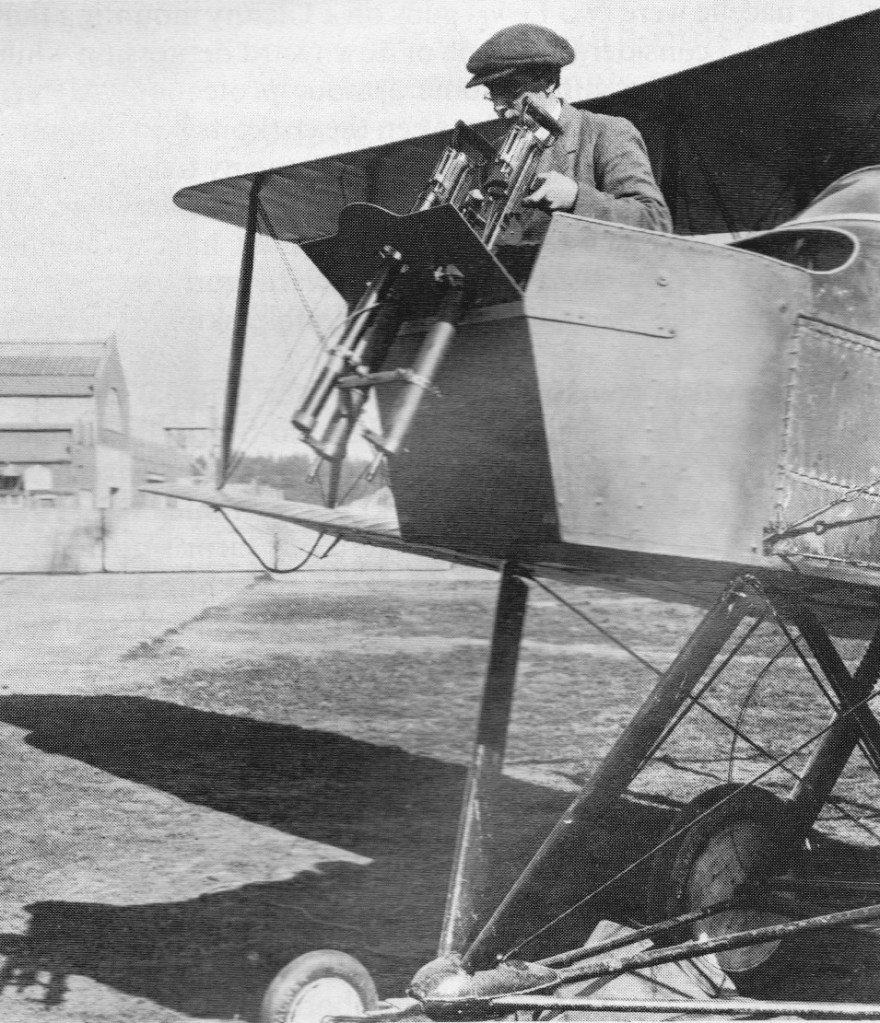
Many F.E.2bs were built by contracting firms with little or no previous experience of building aircraft, notably Boulton & Paul, G & J Weir and Ransome, Sims and Jeffries, and at least 1000 were produced, the official total of 19 39 probably including conversions of earlier aircraft for bombing, experimental and training purposes.
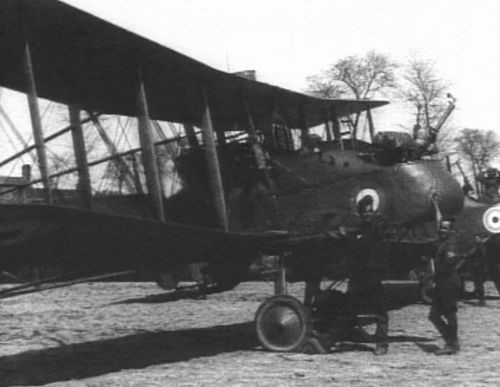
Among the 12 F.E.2a’s sent to France in 1915, where they were flown by No 6 Squadron RFC and sometimes known by the alternative official designation of Fighter Mark I, one had its seating arrangement reversed. The pilot occupied the front cockpit – located a little farther aft than in the F.E.2a and 2b – and the gunner was in an elevated aft position. An additional Lewis gun was fitted in the nose, remotely controlled by the pilot. In this form, the aircraft was designated F.E.2c. Conversion of a small number of F.E.2b’s to 2c configuration was put in hand at the RAF, Farnborough, but only two are thought to have been completed as the F.E.2c was found to offer no advantage over the F.E.2b. Six more 2b’s were converted to 2c’s in late 1917, however, to serve as night bombers with No 100 Squadron, for which role the improved view for the pilot outweighed the difficulties posed for the gunner.
On 7 April 1916, a version of the F.E.2b was flown at the RAF Farnborough, fitted with a 250hp Rolls-Royce Mk I (later, Eagle I) 12-cylinder water-cooled V-type engine, becoming thus the prototype F.E.2d. Compared with the 160hp F.E.2b, the Rolls-Royce-engined version had better rate of climb and ceiling and slightly improved speed performance, and although the heavier engine adversely affected manoeuvrability and field performance, the F.E.2d was ordered into production as an interim supplement for the F.E.2b. Eighty-five were built at Farnborough and 270 by Boulton & Paul, although many of these were completed, in the event, with Beardmore engines as F.E.2b’s. In those F.E.2d’s completed, several versions of the Rolls-Royce engine were fitted; as well as the Mk I these comprised the 250hp Marks III and IV (later, 284hp Eagle III and IV) and the 275hp Marks I and II (later, 322hp Eagle V and VI). The first few F.E.2d’s had the oleo undercarriage with nosewheel extension, but the modified oleo type without the nosewheel was soon adopted. The F.E.2d was in service in France by July 1916, and the type also served with Home Defence units, although its low speed performance made it an ineffective Zeppelinchaser.
The additional power also permitted increased armament, and 2ds were equipped with various arrangements of Lewis guns, some having one or two fixed guns in the nose in addition to one or two free guns fired by the observer. Most F.E.2d’s were armed with two Lewis guns, one on a flexible mounting in the nose and another fixed forward-firing for the pilot; in some cases a third gun, on a telescopic pillar mounting, was also provided between the two cockpits.
The F.E.2a had been designed from the outset as a fighting aircraft, and the distinguished record of the series over three years of war in a number of roles testifies to the soundness of the basic design. The first operational unit to fly 2as in France was 6 Squadron RFC, which had four on its strength by September 1915.
F.E.2bs continued to more than hold their own, but the effect of the introduction of the F.E.2d in June 1916 was adversely affected when the first machine to go to France was landed by mistake on the German airfield at Lille after the pilot had lost his way in fog. Nevertheless, the fixed forward firing guns enabled 2ds to be flown as true fighters and they gained a number of successes. By the spring of 1917 F.E.2s were clearly becoming outclassed as fighters and the 2bs were withdrawn from offensive duties in April, though the 2d continued in front line service until the following autumn.
Towards the end of 1916 the first night-bombing expeditions were being mounted, and F.E.2bs carrying bombs or heavy guns proved eminently successful in attacks on such targets as enemy airfields, railway stations and trains. Bombing raids were continued through 1917, and from mid 1917 onwards the number of F.E.2b equipped night bomber squadrons in France was steadily increased. Frequent raids against enemy communications and other targets continued until almost the end of the war.
The type was not so successful at home defence, since its ceiling of 3350 m (11000 ft) was too low to permit the interception of enemy aircraft and airships. However, another use was found for the 2b in early 1918, when two flights were based on the north-eastern coast of England to carry out coastal patrols. On the evening of May 31, one of these aircraft spotted the German submarine UC49 moving submerged near Seaham, Co Durham, and dropped his two 45 kg (100 lb) bombs near the vessel. The destroyer Locust, attracted by the explosions, was guided by the F.E.2b, and depth charged and sank the submarine.
When the RAF was formed on 1 April 1918, there were seven squadrons of F.E.2s serving as night bombers and a further four squadrons of the type used for night flying training. The last of the type in front-line service served with occupation forces in Germany until March 1919. Used in offensive patrols over enemy lines to escort unarmed reconnaissance aircraft, with a 160hp Beardmore engine giving a maximum speed at sea level of 147km/h/91.5 mph the F.E.2s were generally outperformed by German fighter aircraft by late 1916 which led to their night-time rather than daytime use.
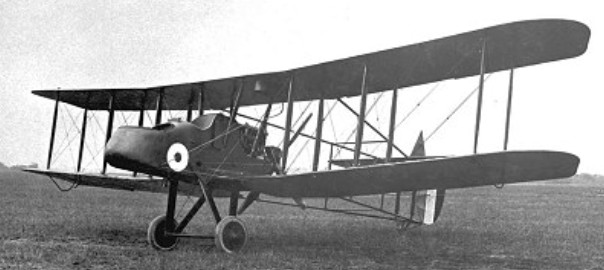
Eventually 1939 F.E.2b’s and at least 250 F.E.2d’s, with 250 hp Eagle engines, were built.
Replica:
The Vintage Aviator Ltd F.E.2b
F.E.2
Engine: 1 x 50-h.p. Gnome
Span: 33 ft 0in
Loaded wt: 1,200 lb
Speed: 47 mph
Seats: 2
FE.2a
Engine: 1 x 100-h.p. Green
Span: 47ft 9in
Loaded wt: 2,680 lb
Speed: 75 mph
Seats: 2
FE.2b
Engine: 1 x 160-h.p. Beardmore
Prop: 4 blade
Span: 47 ft 9 in
Wing area: 494 sq.ft
Length: 32 ft 3 in
Height: 12 ft 7.5 in
Empty weight: 2061 lb
Loaded wt: 2,967 lb
MTOW: 3037 lb
Fuel capacity: 50 Imp.Gal
Max speed: 91 mph at SL
Service ceiling: 11,000 ft
Endurance: 2 hr 15 min
Seats: 2
Armament: 3 x Lewis guns
Bombload: 1 x 230 lb or 2-3 x 112 lb bombs
F.E.2b
Engine: 1 x 160-h.p. Beardmore
Max take-off weight: 1378 kg / 3038 lb
Empty weight: 935 kg / 2061 lb
Wingspan: 14.56 m / 47 ft 9 in
Length: 9.83 m / 32 ft 3 in
Height: 3.84 m / 13 ft 7 in
Wing area: 45.89 sq.m / 493.96 sq ft
Max. speed: 147 km/h / 91 mph
Ceiling: 3353 m / 11000 ft
FE.2c
Engine: 1 x 160-h.p. Beardmore
Span: 47ft 9in
Loaded wt: 3,037 lb
Speed: 91 mph
Seats: 2
FE.2d
Engine: 1 x 225-h.p. R.-R. Eagle 1
Span: 47ft 9in
Length: 9.83 m (32ft 3 in)
Loaded wt: 3,549 lb
Speed: 92 mph
Seats: 2
F.E.2d
Engine: 1 x 250-h.p. R.-R. Eagle 1e
Max take-off weight: 1574 kg / 3470 lb
Empty weight: 1138 kg / 2509 lb
Wingspan: 14.55 m / 48 ft 9 in
Length: 10.13 m / 33 ft 3 in
Height: 3.85 m / 13 ft 8 in
Wing area: 45.89 sq.m / 493.96 sq ft
Max. speed: 151 km/h / 94 mph
Ceiling: 5334 m / 17500 ft
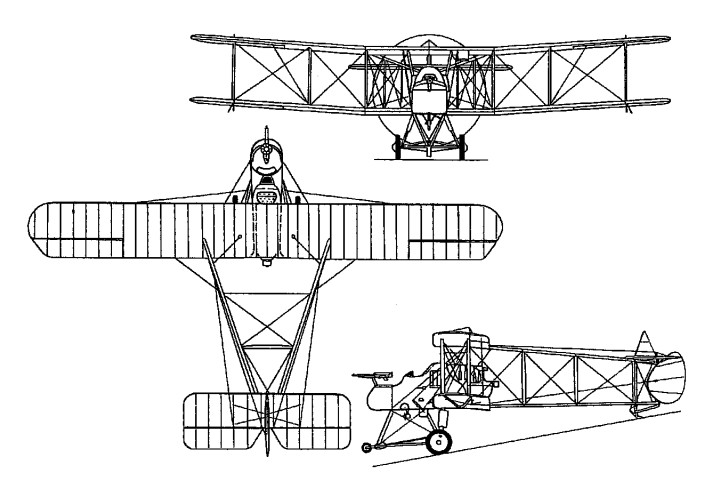

About two years after it dispensed with the services of Dunne and Cody, the War Office began to realise that it might be cheaper to build its own aeroplanes than to buy them. So it renamed the Balloon Factory the Army Aircraft Factory (later Royal Aircraft Factory) and began by rebuilding crashed aircraft. Some of the “rebuilds” were rather ex¬tensive, under the influence of young designers like Geoffrey de Havilland. From the B.E.1 in 1912, was developed the very similar B.E.2, with 70 h.p. Renault.
Several were built and Geoffrey de Havilland took one along to Salisbury Plain to measure its performance against the machines entered for the Military Trials. It was clearly the best aircraft there, but was not allowed to compete officially, being an official product. This made little difference, for it was ordered just the same and led to the whole B.E.2 series.
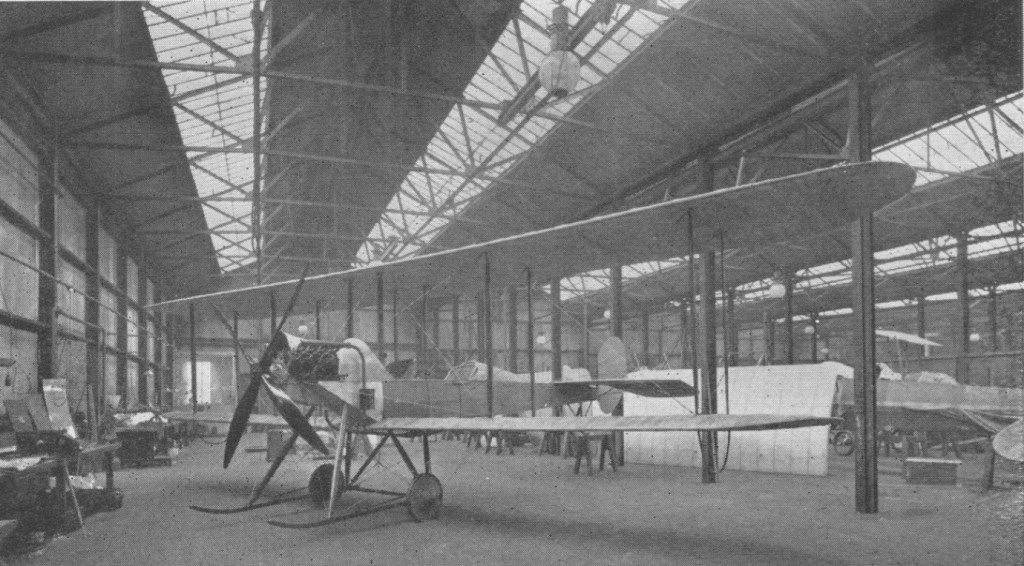
The B.E. designation at first indicated ‘Bleriot Experimental’, Louis Bleriot being credited with having originated the tractor-engined aeroplane. With the appearance of aircraft from the Royal Aircraft Establishment it was taken to mean ‘British Experimental’.
The original B.E. was designed by and built under the supervision of Geoffrey de Havilland, later Capt de Havilland of the RFC and chief designer for the Aircraft Manufacturing Company. A later type of the same general design was the B.E.2, a tandem two-seat biplane with incredibly stable flying characteristics which, in several versions, was employed throughout World War I as a reconnaissance aircraft.
Established a British altitude record of 10,560 ft at Lark Hill (Salisbury Plain) piloted by de Havilland. In August 1912 de Havilland’s BE.2, basically the B.E.1 with a more powerful engine, bettered the performance of Cody’s 120 h.p. Austro Daimler-engined biplane, the official winner of the War Office Military Aeroplane Competition.
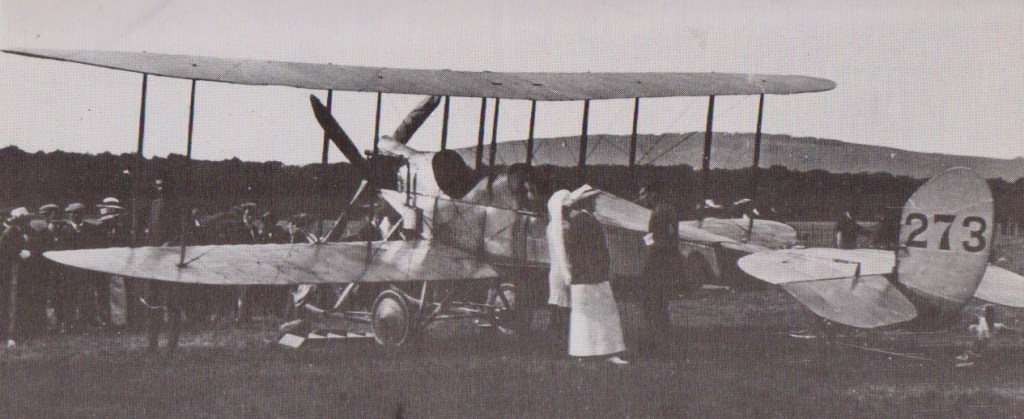
It was ordered into production as the BE.2a for the RFC.
The first version built in reasonable numbers was the B.E.2b. It was produced by outside contractors from 1914. It had an improved fuselage giving the crew a little more ‘comfort’ and the arrangement of the elevators and rudder controls was revised. Wing warping was retained for lateral control and the 70hp Renault engine was kept as standard. Development continued and eventually wing warping was replaced by ailerons.

In August 1914 three squadrons equipped with this reconnaissance and light bomber were immediately sent to France on the outbreak of the First World War. The early BE2a and 2b aircraft remained in operational service into 1915. Lacking any defensive armament it soon became an easy target. When withdrawn from squadron service they were transferred to flying training establishments.
It is impossible to say how many BE2, 2a and 2b aircraft were built because of the early practice of rebuilding damaged aircraft but it is thought to be in the order of 150.
With modifications to enhance the inherent stability of the basic design, the B.E.2c was developed in 1914, first flying in June 1914, and many of the 1,216 of this variant built were to serve with various ad hoc armament installations from April 1915. The B.E.2c was a two-bay biplane with unstaggered equispan wings, a conventional tail unit with separate fin, rudder, tailplane and elevators, and an undercarriage incorporating skids to help prevent nose-overs. Wing dihedral was introduced. The 70hp Renault eight-cylinder Vee-type engine powered early production aircraft, but the 90hp RAF la eight cylinder Vee-type soon became standard. Construction of the B.E.2c was of wood throughout, with fabric covering. A variety of mounts was evolved for a single 7.7mm Lewis machine gun in the observer’s (front) cockpit, primarily for self-defence.
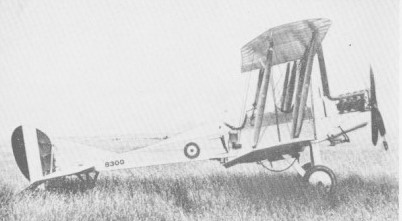
More specifically to serve as a fighter with Home Defence squadrons of the RFC and the RNAS, numerous B.E.2c’s were modified as single-seaters, armament comprising a single Lewis gun mounted to fire upwards behind the wing centre section or, in some cases, on the side of the fuselage alongside the cockpit, angled outwards to clear the propeller disc. By 1915 the BE.2c had replace earlier aircraft and at least 12 RFC Squadrons were equipped with it, as well as a Royal Naval Air Services Wing. The BE2c continued to serve until 1917 when it was finally replaced in the front line squadrons. The last BE.2c was delivered from Blackburns on 3 July 1917, to be used for training purposes.
Flying by night, despite a lack of nocturnal flight aids, B.E.2c’s shot down five raiding Zeppelins over the UK during 1916. B.E.2c’s were also used for a number of armament experiments.

About 1300 B.E.2c were built, including under sub-contract to Grahame-White Aviation, and 111 sub-contracted to Blackburn in Leeds.
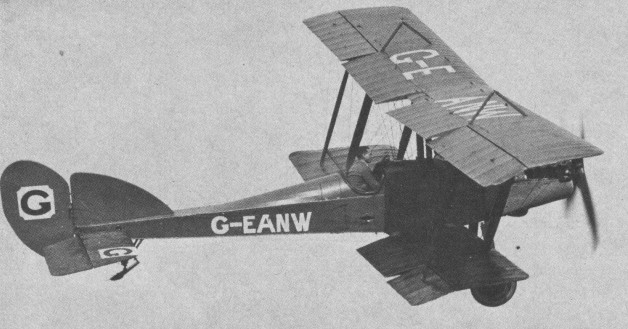
First flown in February 1916 and destined to be built in larger numbers than the B.E.2c, the B.E.2e differed from the former in having single bay wings of unequal span and a new tailplane. Provision was made for extra fuel in a tank under the port upper wing and for dual controls, but the former was seldom fitted. The large upper wing overhang was braced from inverted-Vee kingposts above the interplane struts, and the standard engine remained the 90hp RAF la, as the 105hp RAF lb that was intended to be used in the B.E.2e did not reach production. From production totalling 1,320 aircraft (plus some B.E.2c and 2d conversions), B.E.2e’s were issued to 11 Home Defence squadrons of the RFC (as well as many units on the Western Front and elsewhere). Like the B.E.2c, the 2e often carried a single Lewis gun in the front cockpit, for which assorted mountings were available. An alternative armament tried by some of the Home Defence aircraft for anti-Zeppelin patrols comprised a quartet of Le Prieur rockets, the launching rails for which were attached to the interplane struts, two each side and angled upwards.
With the B.E.2d/e in service, the B.E.2c (and earlier versions) was flown as a training aircraft, and a number were employed successfully at home in attacking airships and used on other fronts.

Little success was achieved by the B.E.2e as a fighter, its performance being inadequate for aerial combat by 1916, and heavy losses were suffered by the RFC squadrons flying the type in France. Retroactively, the designations B.E.2f and B.E.2g were applied to distinguish, respectively, between those B.E.2e’s converted from 2c’s and those built as 2e’s or converted from 2d’s, as their fuel systems and capacities were significantly different.
1,793 B.E.2a, b, c and d and 1,801 B.E.2e aircraft were built by over 20 contractors including Vickers and Ruston, Proctor & Co Ltd, in a variety of models with few visible differences. The last model was about 5km/h faster than the first. They were, used for reconnaissance and bombing throughout most of the 1914 18 War. Unfortunately, the quality that made them safe and easy to fly their inherent stability helped to make them death ¬traps for their crews, because they lacked the manoeuvrability to dodge enemy fighters. It proved a sitting duck and was the main victim during the so-called ‘Fokker Scourge’ which lasted the winter of 1915-16 and again during ‘Bloody April’ in 1917.
Two examples of the BE.2 were used as trainers at CFS Point Cook, Australia, during WW1.
Replica:
The Vintage Aviator Ltd / TVAL Be.2
Boddington BE.2
BE.2
Engine: 1 x 70-h.p. Renault
Span: 38 ft 7.5in
Length 29 ft. 6.5 in.
Wing area 374 sq. ft
Weight empty about 1,300 lb
Loaded wt: 1,650 lb
Speed: 72 mph
Seats: 2
Endurance: 3 hrs
BE.2a
1912
Engine: 1 x 70-h.p. Renault
Span: 38 ft 7.5in (o 35 ft 0.5in/10.68m)
Length: 29 ft 6.5 in / 9 m
Height: 10 ft 2 in / 3.1 m
Loaded wt: 1,600 lb / 725.75 m
Speed: 70 mph / 112.6 kph at SL
Ceiling: 10,000 ft / 3048 m
Endurance: 3 hr
Bombload: 100 lb / 43.35 kg
Seats: 2
BE.2b
1914
Engine: 1 x 70-h.p. Renault
Span: 35 ft 0.5in
Wing area: 352 sq.ft
Length: 29 ft 6.5 in
Height: 10 ft 2 in
Empty weight: 1274 lb
MTOW: 1600 lb
Max speed: 70 mph at SL
Service ceiling: 10,000 ft
Endurance: 3 hr
Seats: 2
Bombload: 100 lb
BE.2c
1914
Engine: 1 x 90-h.p. R.A.F. la.
Wingspan: 11.23 m / 37 ft 10 in
Wing area: 36.79 sq.m / 396.00 sq ft
Length: 8.30 m / 27 ft 3 in
Height: 3.45 m / 11 ft 4 in
Max take-off weight: 972 kg / 2143 lb
Empty weight: 621 kg / 1369 lb
Max. speed: 116 km/h / 72 mph at 6500 ft
Service ceiling: 10,000 ft
Climb to 6500 ft: 20 min
Endurance: 3 hr 15 min
Armament: 1 x Lewis gun
Seats: 2
BE.2d
1915
Engine: 1 x 90-h.p. R.A.F.1a
Span: 36ft 10in
Loaded wt: 1,950 lb
Speed: 89 mph
Seats: 2
BE.2e
1916
Engine: 1 x 90-h.p / 67kW R.A.F.la.
Max take-off weight: 953 kg / 2101 lb
Empty weight: 649 kg / 1431 lb
Wingspan: 12.42 m / 41 ft 9 in
Length: 8.31 m / 27 ft 3 in
Height: 3.66 m / 12 ft 0 in
Wing area: 33.44 sq.m / 359.94 sq ft
Max. speed: 145 km/h / 90 mph
Ceiling: 2745 m / 9000 ft
Armament: 1 x 7.7mm machine-gun
Seats: 2
BE.2f

 All Aero