Salmson Type 2 / 2A.2 / Limousine / Type 2 Berline / Type 4 / Type 5 / Type 7 / Latécoère Laté 1 / Laté 2 / SAL 2 / 2A.2 / Kawasaki Army Type Otsu 1 / Kawasaki-Salmson

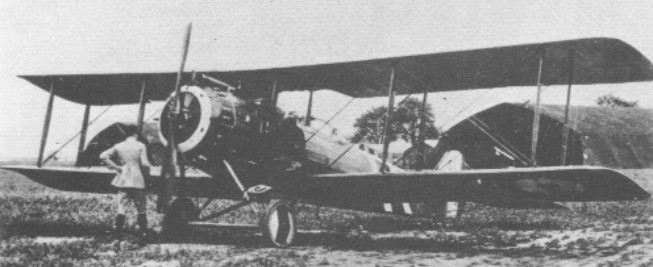
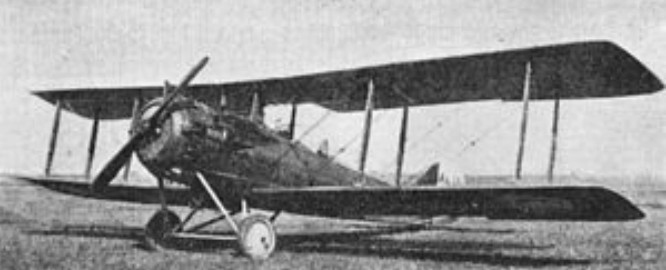
The Salmson 2 (given the military designation Salmson 2 A2) developed from a requirement to replace the Sopwith 1½ Strutter and Dorand A.R. reconnaissance aircraft in the A2 (tactical reconnaissance) role to a 1916 requirement. Salmson had built the 1½ Strutter under license, and the Salmson 2, while an original design, owed more to the Sopwith than to the earlier Salmson-Moineau. The aircraft was of conventional construction with a two-bay biplane configuration, powered by the company’s own Salmson 9Z water-cooled radial engine of 230 bhp. Some minor control problems were quickly resolved in early testing, but the main defect of the Salmson 2 was that the pilot and gunner were seated rather far apart, making communication difficult.

Tested early 1917, with a Salmson (Canton-Unne) engine, production was ordered after trials on 29 April 1917, and deliveries were underway by October of that year. Around 3,200 Salmson 2s were built in France, 2,200 by Salmson and the remainder by the Latécoère, Hanriot, and Desfontaines, companies. Some of these were Salmson 2 D.2 dual control advanced training aircraft.

Along with the Breguet 14, it was the main reconnaissance aircraft in use with the French army and the American Expeditionary Force’s aviation units in 1918. At the end of the First World War, one-third of French reconnaissance aircraft were Salmson 2s.

In addition to its service with the French army, the Salmson 2 served during the First World War with United States air units. Some 700 were purchased, and were generally successful.

Post-war, Salmson 2s were purchased by Czechoslovakia, and remained in service until 1924. Others were transferred to Poland, but were withdrawn by 1920, and replaced by Bristol F.2Bs. Japan undertook license production as the “Army Type Otsu 1”, also known as the Kawasaki-Salmson. The number of aircraft built in Japan is unclear: 300 were built by Kawasaki, and the same quantity by the Imperial Japanese Army’s Tokorozawa supply depot, although the total number of aircraft produced may have been as high as 1,000.
Variants:
Salmson 4
An enlarged version fitted with light armour, designed to meet the Ab 2 ground attack role. Limited production in 1918, but cancelled at the end of the war.

Salmson 5
Modified Salmson 2 for A2 role, no production.

Salmson 7
Modified Salmson 2 for A2 role. The main change was that the pilot and gunner were seated back-to-back in a single cockpit. Production was planned on a very large scale, but the end of the war resulted in cancellation of the contract.

Salmson Limousine
Also known as Salmson 2 Berline. After the First World War, a number of ex-military Salmson 2s were converted into civilian passenger aircraft.

Military operators
France
United States – American Expeditionary Force
Belgian Air Force – One aircraft only.
Czechoslovakia
Imperial Japanese Army
Peruvian Air Force – One aircraft only.
Polish Air Force
Spain – One aircraft only.
Soviet Air Force

Specifications
Engine: 1 × Salmson 9Za radial piston engine, 172 kW (230 hp)
Length: 8.5 m (27 ft 10½ in)
Wingspan: 11.75 m (38 ft 6½ in)
Height: 2.9 m (9 ft 6 in)
Wing area: 37.27 sq.m (401 sq.ft)
Empty weight: 780 kg (1,716 lb)
Loaded weight: 1,290 kg (2,838 lb)
Maximum speed: 188 km/h (101 knots, 116 mph) at sea level
Range: 500 km (270 nm, 310 mi)
Service ceiling: 6,250 m (20,500 ft)
Time to altitude: 2,000 m (6,562 ft) in 7 minutes 13 seconds
Armament: 1 × forward synchronized 0.303 in Vickers machine gun, 2 × rear, ring-mounted 0.303 in Lewis Guns
Crew: Two, pilot and gunner
Salmson SM-1 / Sal. 1 A3 / S.M.2 S2 / Salmson-Moineau SM-1

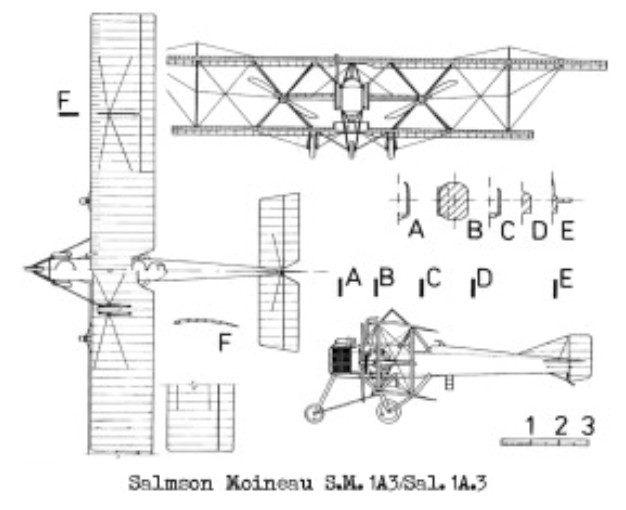
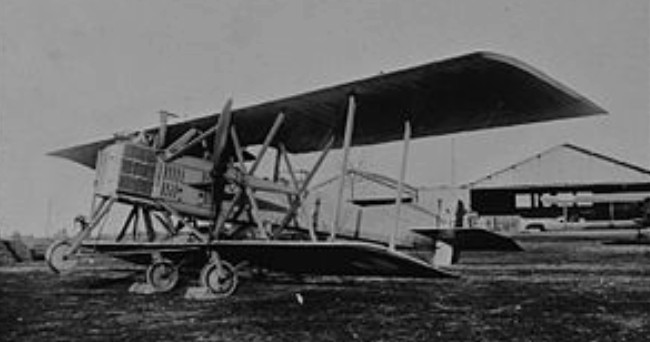
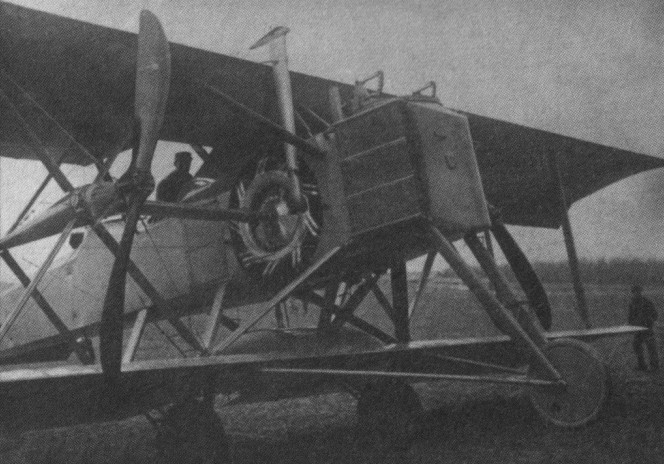
In late 1915 Salmson turned to airplane construction. The Salmson company’s first entry into aircraft design came with the 1916 Salmson-Moineau S.M. 1. The S.M.1 A3 (later re-designated Salmson Sal. 1 A3) was developed by René Moineau for the Salmson company from 1915 to meet the French military A3 specification, which called for a three-seat long range reconnaissance aircraft with strong defensive armament. The S.M.1 was unconventional, powered by a single Salmson 9A liquid-cooled radial engine mounted in the fuselage powering two airscrews mounted between the wings with a system of gears and drive shafts. This layout was chosen by Moineau to minimise drag. The twin airscrew layout allowed a wide field of fire for the two gunner-observers, one seated in the nose and one behind the pilot. Both gunners operated ring-mounted flexible 37 mm APX cannon built by Arsenal Puteaux. The airframe itself was relatively conventional, the boxy fuselage mounted on a system of struts between the wings. The undercarriage included a nose wheel, intended solely to prevent the aircraft nosing over, and a tail skid.

One aircraft may have been fitted experimentally with a Salmson (Canton-Unne) P.9 engine. A single S.M.2 S2 aircraft, with an additional Salmson 9A engine in the nose driving a conventional tractor airscrew, was tested with poor results, due to inadequate engine cooling, in 1918.

The aircraft was tested in early 1916 and was sufficiently successful to receive an order for 100 aircraft although the performance was inferior to the Sopwith 1½ Strutter. In service the S.M.1 was not successful. The nose-wheel undercarriage would collapse if misused and this caused many accidents. The complicated transmission system was difficult to service in the field and the performance of the aircraft was poor. It appears that around 155 S.M.1s were built in total. The type was largely withdrawn from service in 1917 but a small number of aircraft remained in use until late 1918. Some S.M.1s were supplied to the Imperial Russian Air Service, but they were no better liked in Russia.

Gallery

Variants

S.M.1 A3
The production 3-seat reconnaissance aircraft, powered by a single Salmson 9A2c radial engine laterally mounted in the fuselage driving two propellers via shafts and gearboxes.

S.M.2 S2
An enlarged S.M.1, for the S2 2-seater ground attack role, with extended upper wings with additional bracing, reinforced undercarriage and a second Salmson 9A2c in the nose driving a 2-bladed tractor propeller directly.

Specifications:
S.M.1 A3
Engine: 1 × Salmson 9A2c, 180 kW (240 hp)
Propellers: 2-bladed fixed pitch propellers, one each side driven by shafts via gearboxes
Wingspan: 17.475 m (57 ft 4 in)
Wing area: 70 m2 (750 sq ft)
Length: 10 m (32 ft 10 in)
Height: 3.8 m (12 ft 6 in)
Gross weight: 2,050 kg (4,519 lb)
Crew: 3
Endurance: 3 hours

Salmson 3 cyl. / 3Ad / British Salmson AD.3

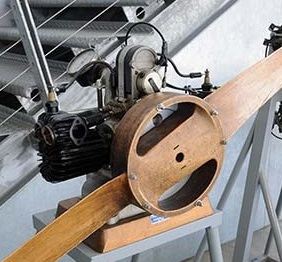
After their successful water-cooled radial engines, developed from 1908 to 1918, Salmson changed their focus to air-cooling to reduce weight and increase specific power (power per unit weight). The majority of the engines produced by Salmson were of radial type with a few other arrangements such as the Salmson T6.E. In common with other engines produced by this manufacturer, the air-cooled radial engines featured the unorthodox Canton-Unné internal arrangement that dispensed with a master rod in favour of a cage of epicyclic gears driving the crankpin. Built from 1920, production ended in 1951 with the liquidation of the manufacturing company.

The 3,7 and 9 cylinder Salmsons were license built in Great Britain, during the 1920s and 1930s, by the British Salmson engine company as the British Salmson AD.3, British Salmson AC.7, British Salmson AC.9, and British Salmson AD.9.

In common with several other French aero-engine manufacturers Salmson named their engines with the number of cylinders then a series letter in capitals followed by variant letters in lower-case.

3 Ad

Salmson (Societe des Moteurs Salmson)

Founded 1912 at Billancourt, Seine, by Emile Salmson (1859-1917) to develop radial type watercooled engines jointly designed by Canton and Unne as installed in French, British and Russian aircraft. In late 1915 Salmson turned to airplane construction. First was unorthodox Salmson- Moineau SM-1 of 1916, designed by Rene Moineau, with “buried” engine and twin tractor propellers. The Type 2 conventional two-seat reconnaissance tractor biplane was tested early 1917, with Salmson (Canton-Unne) engine. As the 2A2 it served with French and U.S. squadrons and 2,300 were built. At Armistice 2A2 converted to Limousine, used by several European airlines. In mid-1930s Salmson turned to light aircraft, producing D6 Cricri parasol monoplane with small Salmson air-cooled radial engine.

Sage, Frederick & Company Ltd

UK
Frederick & Sage Company Ltd engaged originally in fine woodwork. In early 1915 was asked by Admiralty to build aircraft, and was first concerned with airships. In June 1915 received order for Short 184 floatplanes, and carried out modifications to, and built, Avro 504K trainers. Built own-design Sage Type II, two-seat biplane fighter, with enclosed crew and gunnery arrangements (flown 1916); Type III was trainer for Admiralty (flew 1917); Types 4a, b and c were patrol and trainer floatplanes; none entered production.