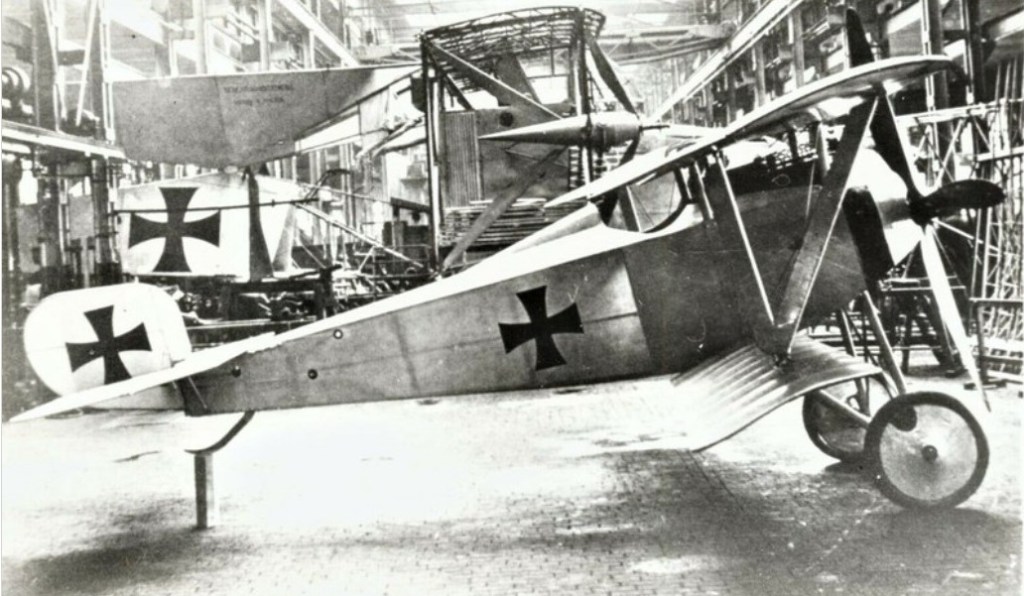
A German copy of the Nieuport 11. Some 150 were ordered into production of which only 94 became operational due to improved aircraft coming into service by mid-1917.
Replica Ultralight: Circa Reproductions Siemens Schukert
Siemens-Schuckert Werke GmbH Began airship construction in 1907. In 1909 manufactured airplanes, but poor results stopped work in 1911. Airplane department reopened 1914. In October started design of four-engined aircraft similar to that of Sikorsky in Russia. As entirely new venture company sponsored designs by two Steffen brothers leading to giants R.I-VII of 1915-1917. R.VIII, which did not fly, was then world’s largest airplane with span of 158 ft (48.16 m), and had experimental rotating gun-turret. Other advanced projects included steam-turbine monoplane and wire-guided flying bombs. Company also made E-l monoplane single-seat fighter and D-l copy of Nieuport. D-III and D-IV also built in quantity. Fighters were technically very advanced.
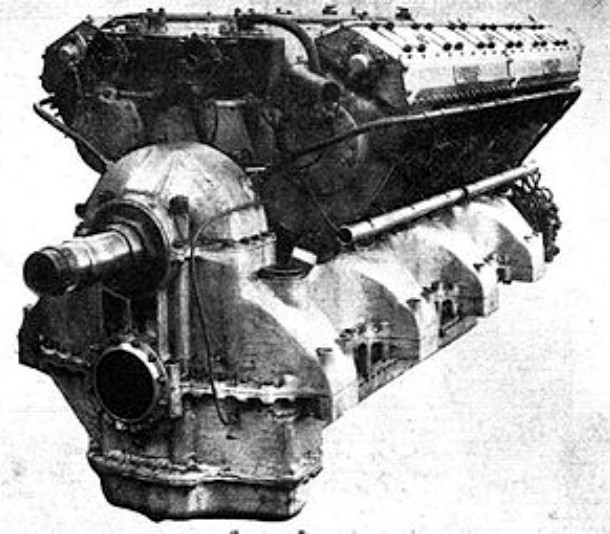
The Siddeley Tiger was an unsuccessful British aero engine developed shortly after the end of World War I by. Problems encountered during flight testing caused the project to be cancelled.
Developed using two modified cylinder banks from the Siddeley Puma, the Tiger was a liquid-cooled 60 degree V12 engine with the advanced feature of an electric starter motor protected by a friction clutch. A reduction gear arrangement was provided for the propeller drive with a ratio of 0.559:1. The company claimed a power output of 600 hp (447 kW) but this was regarded as optimistic. First run in 1920, flight testing by a Royal Aircraft Establishment test pilot, Frank Courtenay, revealed problems and his opinion of the engine was low as the following quote shows: ‘The engines could never be persuaded to run simultaneously for any length of time’ —Frank T.Courtenay, Lumsden – British Aero-Engines and Their Aircraft
The Tarrant Tabor, a giant triplane bomber was designed to use the Tiger but redesigned to use other engines when it became clear the Tiger would not be available soon enough. The only aircraft in which the Siddeley Tiger flew was the ill-fated prototype of the twin-engined Siddeley-Deasy Siniai of which three were planned to be produced. Major problems with both the engines and this experimental bomber aircraft led to cancellation of the projects.
The Siddeley Tiger marked the end of the aero engine line started by Beardmore and Siddeley-Deasy. The name was later re-used for an Armstrong Siddeley radial engine.
Specifications: Tiger Type: 12-cylinder liquid-cooled inline piston engine Bore: 6.3 in (160 mm) Stroke: 7.1 in (180 mm) Displacement: 2,657 in³ (43.5 L) Length: 81.34 in (2,066 mm) Width: 33.46 in (850 mm) Height: 39.57 in (1,005 mm) Dry weight: 1,400 lb (635 kg) Valvetrain: Overhead camshaft, 4 valves per cylinder Fuel system: Twin carburettors Fuel type: Petrol Cooling system: Liquid-cooled Power output: 600 hp (447 kW) Power-to-weight ratio: 0.42 hp/lb (0.7 kW/kg)
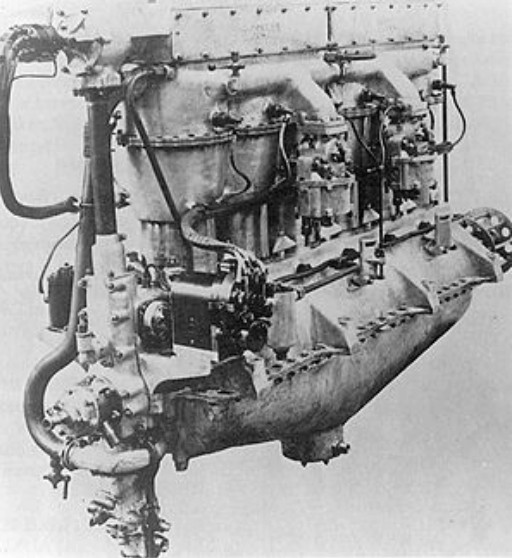
The Siddeley Puma was a British aero engine developed towards the end of World War I and produced by Siddeley-Deasy. The first engines left the production lines of Siddeley-Deasy in Coventry in August 1917, production continued until December 1918. At least 4,288 of the 11,500 ordered engines were delivered, orders were cancelled following the Armistice. Production was continued under the name Armstrong Siddeley Puma when the manufacturer was bought by Armstrong Whitworth and became Armstrong Siddeley.
The engine was based on a previous B.H.P engine.
Applications: The Puma engine was used in the British World War I bomber aircraft, the Airco D.H.9. In use it proved to be highly troublesome, making the aircraft significantly inferior to the type it replaced. The engine was also installed untidily, with the cylinder heads protruding. The D.H.9, as a type, was improved by replacing the Puma engine with the Liberty 12 to make the D.H.9A.
The unit was used in the first prototype of the Airco DH.10 in a twin-engined pusher configuration but as performance was unsatisfactory, alternative engines were used in a subsequent prototype of the type and production models.
Short Silver Streak (1920)
Puma Type: 6-cylinder water-cooled inline aircraft piston engine Bore: 5.71 in (145 mm) Stroke: 7.48 in (190 mm) Displacement: 1,149 in³ (18.832 L) Length: 69.9 in (1,175 mm) Width: 24 in (610 mm) Height: 43.6 in (1,107 mm) Dry weight: 645 lb (293 kg) Fuel system: Carburettor Cooling system: Water-cooled Power output: 250 hp (186 kW) at 1,400 rpm for takeoff 265 hp (198 kW) at 1,500 rpm for short-term maximum power Specific power: 0.23 hp/in³ (10.5 kW/L) Fuel consumption: 14 US gal/h (54 L/h) at cruise 67 US gal/h (258 L/h) at short-term maximum power Power-to-weight ratio: 0.41 hp/lb (0.67 kW/kg)
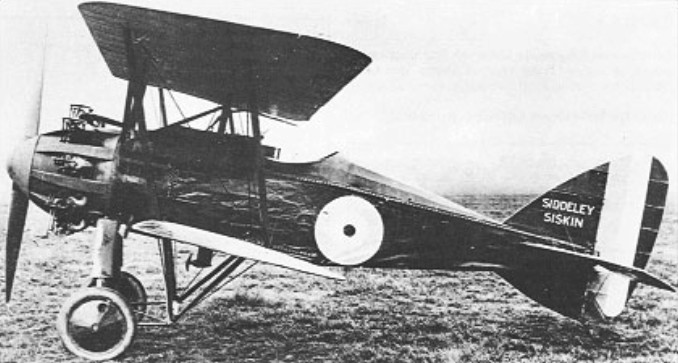
When, in January 1917, Capt F M Green became chief aeronautical engineer of the Siddeley-Deasy Motor Car Company, he began the design of a single-seat fighter, the S.R.2. A compact single-bay sesquiplane predominantly of wooden construction with fabric skinning, the S.R.2 was powered by a 320hp A.B.C. Dragonfly nine-cylinder radial engine. Armament comprised two synchronised 7.7mm machine guns.
A contract for six prototypes was reduced to three in mid 1918, the first of these flying in April 1919, by which time the fighter had been officially named Siskin. The first prototype Siskin was subsequently re-engined with an Armstrong Siddeley Jaguar, development in this form continuing after Siddeley Deasy acquired in 1921 the name and goodwill of Sir W G Armstrong Whitworth & Co Ltd, and the Armstrong Whitworth Siskin II emerging in 1922.
Max take-off weight: 989 kg / 2180 lb Empty weight: 664 kg / 1464 lb Wingspan: 8.38 m / 27 ft 6 in Length: 6.48 m / 21 ft 3 in Height: 2.97 m / 9 ft 9 in Wing area: 22.95 sq.m / 247.03 sq ft Max. speed: 233 km/h / 145 mph Ceiling: 7255 m / 23800 ft
In 1909, J. D. Siddeley resigned from Wolseley and took over the Deasy Motor Co and the company became known as Siddeley-Deasy. During World War I the company produced trucks, ambulances, and staff cars. In 1915 airframes and aero-engines started to be produced as well.
Major F.M. Green served as chief engineer at the Royal Aircraft Factory and then become a part of the Siddeley-Deasy Motor Car Company. Not limited to the production of motor vehicles, the Siddeley-Deasy brand also delved into manufacture of engines and aircraft. The company was based out of Coventry and was founded by Henry Hugh Peter Deasy. While Deasy left in 1908, J D Siddeley came aboard and changed the company name to Siddeley-Deasy. From there, the company would gradually morph into the Armstrong Whitworth Aircraft firm (known formally as the Sir W.G. Armstrong Whitworth Aircraft Co. Ltd after their 1920 merger with Armstrong Whitworth) and became responsible for a large portion of Siskin production thereafter.
In April 1919 Siddeley-Deasy was bought out by Armstrong Whitworth Development Company of Newcastle upon Tyne and in May 1919 became Armstrong Siddeley Motors Ltd a subsidiary with J. D. Siddeley as Managing Director.
Based at Coventry, Warwickshire; was concerned in production of RAF R.E.7 and R.E.8 and Airco D.H.10 during First World War. Own experimental types included R.T.1 of 1917-1918, a redesigned R.E.8; S.R.2 Siskin, developed from ideas of Major F. M. Green and precursor of famous Armstrong Whitworth line of fighters; and Sinaia twin-engined bomber, completed 1921, also associated with Armstrong Whitworth. In 1919 Armstrong Whitworth and Siddeley-Deasy combined to form in 1920 Sir W. G. Armstrong Whitworth Aircraft Ltd.
Societa Idrovolanti Alta Italia Siai-Marchetti Societa Per Azioni
The original company was founded in 1915 as SIAI (Società Idrovolanti Alta Italia – Seaplane company of Northern Italy). After World War I gained the name Savoia, when it acquired the Società Anonima Costruzioni Aeronautiche Savoia, an Italian aircraft company founded by Umberto Savoia in 1915.
The name Marchetti was added when chief designer Alessandro Marchetti joined the company in 1922. Savoia-Marchetti gained prominence with the successful S.55 flying boat. Savoia-Marchetti became famous for its flying boats and seaplanes, which set numerous endurance and speed records. Favoured by Air Marshal Italo Balbo, the company began rapidly prototyping and developing a number of other aircraft, increasingly focusing on warplanes in the lead-up to World War II. However, most of S.M.’s manufacturing capabilities were destroyed in World War Two. It was renamed SIAI-Marchetti in 1943.
Since 1946 engaged in overhaul and repair work and developed new aircraft. SIAI-Marchetti only survived in postwar Italy by building trucks and railway equipment. However it still struggled with insolvency for 6 years after the war before declaring bankruptcy in 1951.
In 1953, the company reopened. Types have included SA.202 Bravo trainer produced jointly with FFA in Switzerland; S.205 four-seater and S.208 development. First flew SF.250 aerobatic trainer in July 1964; became highly successful SF.260 production aircraft for civil and military use (initials in SF.260 denoted design by Stelio Frati). In 1968 company formed a Vertical Flight Division, but increasing helicopter work became associated with Agusta and Elicotteri Meridionale. SM.1019 light multipurpose high-wing monoplane followed 1969, SF.600 Canguro transport 1979 (recently taken over by VulcanAir), and S211 jet trainer and light attack aircraft 1981.
Agusta, which had acquired 30% of SIAI-Marchetti in 1970, had increased its stake to about 60% by 1973 and reached complete ownership in 1983.
The R31 class of British rigid airships was constructed in the closing months of World War I and comprised two aircraft, His Majesty’s Airship R31 and R32. They were designed by the Royal Corps of Naval Constructors – with assistance from a Herr Müller who had defected to Britain and previously worked for the Schütte-Lanz airship company – and built by Short Brothers at the Cardington airship sheds. The airship frame was made from spruce plywood laminated into girder sections, weatherproofed with varnish, and also fireproofed. These enclosed 21 gas bags. R31 was the largest British airship to fly before the end of the war, and the class remains the largest mobile wooden structures ever built.
As the airships were intended for fleet protection operations, they were to be fitted with defensive machine guns on top of the envelope, at the stern and in the gondolas. A 12-pounder gun was to be fitted in a special position centrally below the airship for use against U-boats. In the event, this armament was only fitted to R31, as R32 was only completed after the armistice with Germany. It had also been intended to fit a bomb load of two 520 lb (240 kg) bombs and four 230 lb (100 kg) bombs. but with the end of hostilities these were never installed on either airship.
R31 made its first trial flight, lasting two hours, in July 1918 under the command of Squadron Leader W.C. Hinks. A top speed of 70 mph (110 km/h) was achieved, well above the expected 50–55 mph (80–89 km/h) and faster than any other airship then in service. It was originally powered by six 275 hp (205 kW) Rolls-Royce Eagle engines, but in view of the performance and to reduce fuel consumption one was removed, reducing the maximum speed to a still satisfactory 65 mph (105 km/h); similarly the R32 was built with six engines and later converted to a five-engine configuration.
The airship was finally commissioned on 6 November 1918, just before the armistice with Germany, after having spent four hours in the air. It set off, again under the command of Squadron Leader Hincks, for the airship base at East Fortune in Scotland. On the journey she encountered bad weather and it was feared that some of the plywood girders were failing, so she diverted to the airship base at Howden in the East Riding of Yorkshire for examination and repair. Unfortunately, the sheds had not been repaired since the R27 had caught fire three months earlier and the roof leaked badly. This caused the glue holding the plywood together to deteriorate; as a result the airship became unairworthy and was beyond repair. In February 1919 it was dismantled. The covering was removed and returned to Cardington while the frames were sold for £200; these were broken up and sold for firewood but due to the fireproofing treatment they had received they would not burn.
R31
After being formally accepted by the Royal Navy, R32 made its first trial flight on 3 September 1919 and then on 6 September went to RNAS Pulham, Norfolk, which at the time was a centre for training and experimentation. On 10 September in formation with the R33 she made a flight over the Netherlands, Belgium and Northern France and back to Pulham. In October 1919 the R32 with the rest of the airship fleet was formally handed over to the Royal Air Force. The ship was flown from Cardington on September 16th 1919 with Major Elmsley in charge. George Meager reports that a week later he was on board as navigator when the R32 flew across to Amsterdam – he recalls another crew member named Scroggs on this flight. He took a further two flights a month later naming Flt Lt Ivor Cecil Little as the Captain and Scroggs as First Officer. The airship was used by the National Physical Laboratory for structural testing. On 20 March 1920 it was flown to Howden to be refurbished and used for crew training by the American party who had come to accept the R38 (ZR-2). When the metal-framed R80 became available, the use of the by now obsolete wooden-framed R32 stopped and, to save money, it was decommissioned and used to assess the effect of a gas-bag bursting. Once the covering had been removed and the engines taken away, cell No.18 was overpressurised until the expansion caused the bracing and structure to fail. The frame was subsequently dismantled.
The R32 leaving the shed at Cardington.
Powerplant: 5 × Rolls-Royce Eagle, 275 hp (205 kW) each Volume: 1,547,000 cu ft (43,976 m3) Length: 615 ft 0 in (187.5 m) Diameter: 65 ft 6 in (19.97 m) Useful lift: 36,960 lb (16,800 kg) Maximum speed: 65 mph (104 km/h, 56 kn)
Engine: 1 x 375hp Rolls-Royce Eagle VIII Max take-off weight: 5512 kg / 12152 lb Empty weight: 3319 kg / 7317 lb Wingspan: 52 ft Length: 35 ft Height: 13.3 ft Wing area: 791 sq.ft Max. speed: 93 km/h / 58 mph Ceiling: 10000 m / 32800 ft Crew: 1 Armament: one torpedo


 All Aero