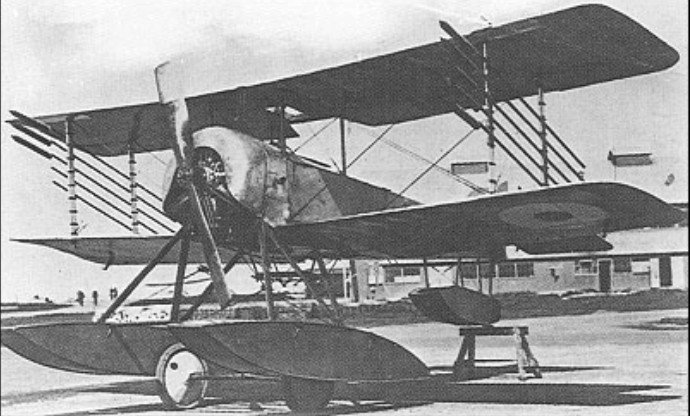
Sopwith Baby

Derived from the Schneider single-seat fighter seaplane, the Baby first appeared in September 1915, and differed from its predecessor primarily in having a 110hp Clerget nine-cylinder rotary in place of the 80 hp Monosoupape Gnome, this being accommodated by a horseshoe-shaped open-fronted cowling.

As on late production Schneiders, ailerons replaced wing warping for lateral control, and armament usually consisted of a single 7.7mm machine gun synchronised to fire through the propeller, although a few Babies retained the arrangement of the Schneider with the gun attached to the centre section and firing upward to clear the propeller.

Several Babies were fitted with two 7.7mm guns side by side over the wing; one batch of Blackburn-built Babies was fitted with Ranken explosive darts as anti-airship weapons, and at least one was fitted with Le Prieur rockets, 10 of these devices being attached to the interplane bracing struts. Two 29.5kg bombs could also be carried.

1916 Sopwith built Baby N2078

The Baby was widely used by the RNAS to provide fighter aircraft for use with patrol.ships, as escorts for two-seaters and for operation from early aircraft carriers.

A total of 286 Babies was built of which 195 were produced by Blackburn at Leeds – and sometimes known as Blackburn Babies – 105 of the latter being fitted with the 130hp Clerget engine, and, of these, 40 were fitted (initially) to carry the Ranken dart and no gun armament. A more extensive modification of the Sopwith float fighter was the Fairey Hamble Baby.

Replica ultralight:
Circa Reproductions Sopwith Tabloid / Baby

Engine: Clerget, 130 hp
Wingspan: 6.90 m / 23 ft 8 in
Length: 7.01 m / 23 ft 0 in
Height: 3.05 m / 10 ft 0 in
Wing area: 22.30 sq.m / 240.03 sq ft
Max take-off weight: 778 kg / 1715 lb
Empty weight: 556 kg / 1226 lb
Max. speed: 161 km/h / 100 mph
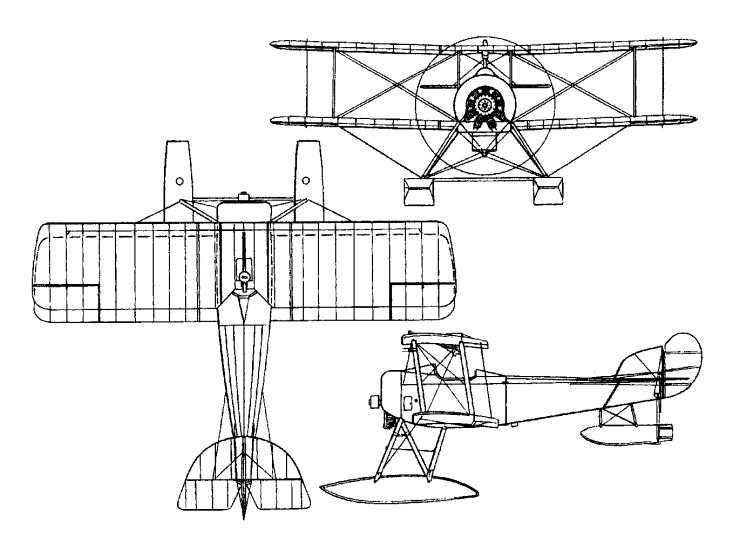
Sopwith Baby

Sopwith Schneider

Derived from the Tabloid float seaplane which won the Schneider Trophy contest in April 1914, the Schneider, the single-seat twin-float seaplane ordered into production in November 1914 for the RNAS resembled closely the aircraft that had gained the Trophy at Monaco. Retaining the same 100hp Gnome Monosoupape nine-cylinder rotary – the upper half of which was enclosed by a ‘bull-nose” cowling – and wing-warping lateral control, the Schneider had a larger fin and rudder, reinforced float bracing and an aperture in the centre section for an upward-angled 7.7mm machine gun.

The RNAS ordered 136 Schneider floatplanes for reconnaissance and light bombing duties, the aircraft entering service in 1915.

Used for patrol duties against enemy airships from seaplane stations around the British coast, the Schneiders were provided with incendiary ammunition and operated against Zeppelins from early 1915. Schneiders were also carried aboard light cruisers of the North Sea Patrol for anti-Zeppelin operations, and served at the Dardanelles, in the Aegean and in the Eastern Mediterranean. Two Schneiders operated from the carrier Ark Royal in April 1915 at Mudros, and the type was still serving in the Aegean as late as November 1916, one shooting down an enemy aircraft which had attacked the airship shed at Mudros on the 21st of that month.

A total of 136 Schneiders is believed to have been built, progressive development resulting in the Baby.

Max take-off weight: 694 kg / 1530 lb
Wingspan: 7.82 m / 26 ft 8 in
Length: 6.90 m / 23 ft 8 in
Height: 2.97 m / 10 ft 9 in
Wing area: 22.30 sq.m / 240.03 sq ft
Max. speed: 143 km/h / 89 mph

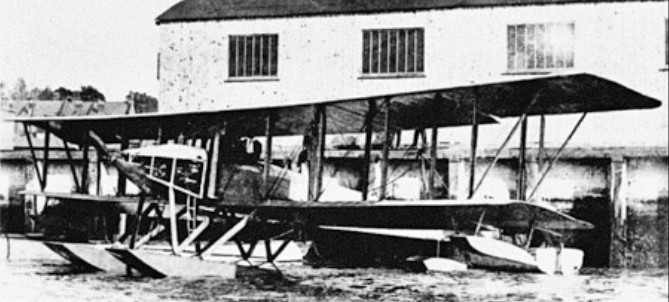
Sopwith Special / Type C

Type C

The Sopwith Type C and the Sopwith Special were actually two virtually identical designs built to two different contracts – the Type Cs were ordered in July 1914, whilst the ‘Special Tractor Biplane Seaplane’ was ordered first in February 1914. Despite appearing after the Special, the Three Type Cs were allocated the RNAS serials 157 to 159 and the Special received the serial number 170. The photo above shows the Sopwith Special number 170.

The Special and Type Cs were the first purpose built British aeroplanes capable of carrying a torpedo, unfortunately they were not capable of lifting said torpedo into the air! The design was generally considered a failure because of this rather embarrassing character trait. In 1914 commander of the Calshot naval air station Cmdr Arthur Longmore of the Royal Naval Air Service and other RNAS pilots carried out torpedo carrying practice with 14-inch weapons in what Longmore described as the Sopwith Canton-Unné seaplane in August 1914 during experiments at Calshot. Its name was derived from its powerplant.

Engine: 1 x 205hp Canton-Unne (Salmson) 14-cylinder water-cooled radial engine
Max take-off weight: 1963 kg / 4328 lb
Wingspan: 20.12 m / 66 ft 0 in
Length: 10.97 m / 36 ft 0 in
Wing area: 72.93 sq.m / 785.01 sq ft
Crew: 2

Sopwith Gun Bus

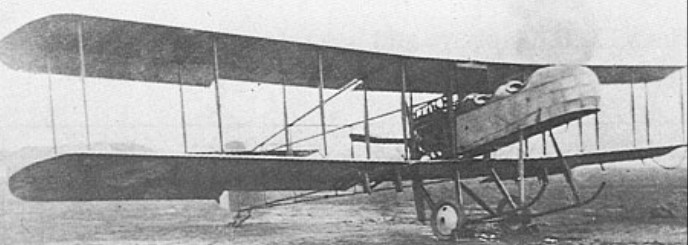
The Gun Bus was essentially a landplane derivative of the S.P.Gn (Sopwith Pusher, gun. The Gun Bus, intended for the fighting role, carried a 7.7mm machine gun on a flexible mount in the forward cockpit and was powered by a 100hp Gnome Monosoupape rotary engine. A more powerful version, with a 150hp Sunbeam eight-cylinder water-cooled engine, was developed specifically for the RNAS, this having a redesigned nacelle and a revised undercarriage. Six of the Sunbeam-powered Gun Buses were built for the RNAS by Sopwith, a further 30 being ordered for the service from Robey & Company, these last being intended for bombing (and possibly anti-submarine) duties as distinct from fighting. The pilot was moved forward to the front cockpit, a bombing panel being let into the floor and four bomb carriers being fitted beneath the lower wing.

Wingspan: 15.24 m /50 ft 0 in
Length: 9.90 m / 33 ft 6 in
Height: 3.45 m / 11 ft 4 in
Wing area: 44.03 sq.m / 473.93 sq ft
Max. speed: 129 km/h / 80 mph

Sopwith Gun Bus

Sopwith Aviation Co

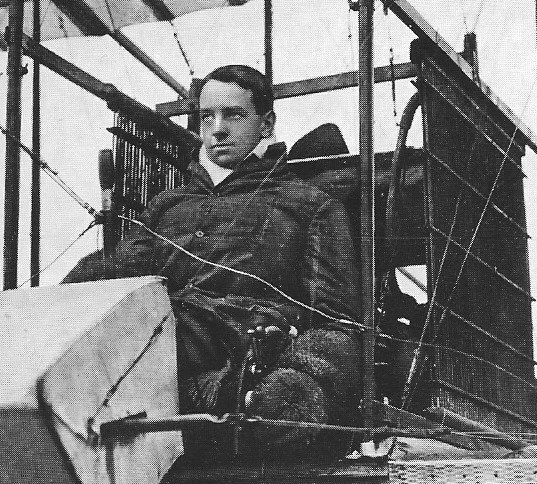
The Sopwith Aviation Company Ltd in Kingston-on-Thames was founded in a shed at Brooklands in 1912 by Tommy, Thomas Octave Murdoch Sopwith.

Tommy Sopwith

Sopwith rebuilt early aircraft before First World War, began development of own types and formed important associations with F. Sigrist (engineer and largely responsible for future success) and H. G. Hawker (pilot). Company registered March 1914.

Sopwith Aviation Co Article

Bat Boat of 1913 was notable flying-boat and Tabloid landplane of same year gained renown as floatplane by winning 1914 Schneider Trophy. Wartime developments were Schneider and Baby floatplanes.

Became world famous for fighter aircraft, built in great numbers by many companies, though first landplane fighter built in great numbers was two-seat 1 1/2-Strutter. Pup was smaller single-seater. Triplane of 1916 excelled in climb. Two-gun Camel, in service 1917, excelled in maneuverability; shipboard version had detachable rear fuselage. Cuckoo of 1917 was world’s first deck-landing torpedo-bomber. Snipe was intended to succeed Camel late in war, and remained in RAF service until 1926: Salamander was similar but armored for ground attack.

With an output of 90 ships a week at Kingston alone, due for commercial reasons this company had to end its activities in 1920 and the busi¬ness had to liquidate.

Sopwith wanted to stay in aviation and couldn’t start a company with the same name. So he called the new company the Hawker Engineering Company, with a capital of 20,000 pounds.

Sommer, Roger

France

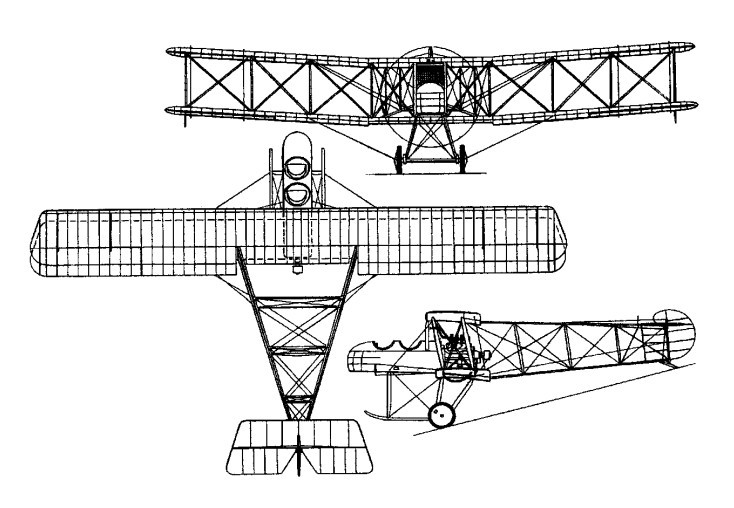
Roger Sommer had built an aircraft of his own design in 1908, achieving a few short straight-line flights in early 1909. This was housed at Châlons, where Sommer had a hangar between those occupied by Gabriel Voisin and Henri Farman. In May 1909 Sommer bought a Farman III aircraft, and on 7 August 1909 he gained fame in this by breaking the endurance record held by Wilbur Wright, making a flight lasting 2 hr 27 min 15 sec. Later that year he made a successful appearance at the Doncaster flight meeting, winning the prize for the greatest distance flown during the meeting. Meanwhile, he had started building an aircraft of his own design at Mouzon in the Ardennes, where his family had a felt-making business.

First began aeronautical work in 1904. Special Sommer biplane of 1911 lifted 13 persons. After a dormant period the company resumed aircraft construction 1915, and at the Armistice the Sommer works was claimed to have been producing up to 200 aircraft per month under subcontract.

Societe D’emboutissage et de Constructions Mecaniques / SECM

Founded 1916 by Felix Amiot. During First World War built Morane, Breguet and Sopwith types. After war repaired Breguets, and from 1921 helped in construction of early Dewoitine monoplane fighters. Specialized in metal stamping and press-work. Lutace of 1921 was side-by-side two-seater biplane using special form of steel-tube construction of SECM design. SECM 12 was two-seat single-engined night bomber (developed as SECM-Amiot 120B.N.2); 22 was trainer for French competition of 1923; 23 was 3- seat tourer; 24 an elementary trainer. Firm also made Lorraine-Dietrich aero engines, as fitted in Amiot-SECM (or Amiot) 122 series of late 1920s.