Sunbeam Gurkha

The Gurkha was developed as a replacement for the Mohawk with a bore of 100 mm (3.94in) and the gear ratio was reduced to 1.86:1, giving 240 hp (179 kW) at 2000 rpm. Production ended in October 1916, after 74 units had been supplied to power the Short 184 seaplanes of the Royal Naval Air Service.

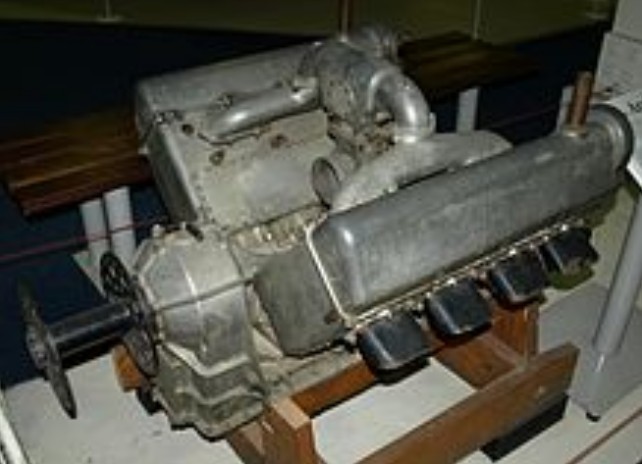
The Gurkha engine preserved at the Fleet Air Arm Museum, Yeovilton, Somerset, England, is the only surviving Sunbeam side-valve engine in the world. It is installed in the Short 184, aircraft number 8359, that played a minor role in the Battle of Jutland at the end of May 1916. The pilot on that occasion was Flight Lieutenant Frederick Rutland (who was ever after known as “Rutland of Jutland”),

Sunbeam Crusader / 100 hp / 110 hp / 150 hp / 160 hp / 200 hp / 225 hp / Zulu / Mohawk

The Sunbeam Crusader, originally known as the Sunbeam 150 hp, Sunbeam 110 hp or Sunbeam 100 hp (variations on the engine may also have been referred to as Sunbeam 120 hp or Sunbeam 135 hp), was an early British, side-valve, water-cooled, 90 degree, V-8 aero engine first marketed in 1913.

First run in December 1912, the first aero-engine from Louis Coatalen was the 110 hp, a water-cooled V-8 with side-valve cylinders of 80mm (3.15 in) bore and 150mm (5.9 in) stroke. The later versions of the engine, which had 90mm (3.5 in) bore cylinders, were known as the 150 hp until the Sunbeam naming system labelled it the Crusader in 1917. The 80mm bore versions were produced in limited numbers, mostly for civil use, but later 90mm bore engines had limited success in civil applications, with more than 226 built for military aircraft.

Production examples were rated at 150 hp (112 kW) at 2,000 rpm, had a Bore of 90mm (3.5 in), stroke of 150mm (5.9 in), two valves per cylinder, and weighed 480 lb (220 kg) dry. The engine was used in a wide variety of British military aircraft during the first years of World War I, most notably the Short 827 seaplane for which six of the original versions were ordered followed by 107 of the more powerful type.

Produced from 1912 to July 1916, over 228 were built.

Further development of the Crusader resulted in the Sunbeam Zulu and V-12 Sunbeam Mohawk and Sunbeam Gurkha.

Variants:
110 hp
Early versions of the V-8 side-valve engine with 80mm (3.15in) bore, variations were rated at 100 hp (75 kW), 110 hp (82 kW) and 120 hp (89 kW).

150 hp
Introduced late in 1914, the 90mm (3.5in) bore versions were referred to as the 150hp and could be rated at 135 hp (101 kW) or 150 hp (112 kW).

160 hp
Original designation for the 100mm (3.94in) bore Sunbeam Zulu, derivative of the Crusader.

200 hp
Initial version of the V-12 Mohawk built with 80mm (3.15in) bore, developing 200 hp (149 kW). The Admiralty required more powerful engines than the Crusader, so Coatalen designed the Sunbeam 225 hp (168 kW) as a 60 degree V-12 using blocks of three cylinders instead of the twin-cylinder blocks of the Crusader.

225 hp
Production versions built with 90mm (3.5in) bore, rated at 225 hp (168 kW). Short seaplanes using this engine were often called “225s”. During 1917 this engine was re-named as the Sunbeam Mohawk.

Crusader
The name Crusader was applied to the engine in 1917 after production had ceased, and officially referred only to the later ‘150hp’ version.

Zulu
Outwardly dentical to the Crusader, the Zulu was developed during 1915, the bore was increased from 90 mm to 100 mm and the reduction gear ratio was changed to 1.86:1, allowing the engine to develop 160 hp (119 kW) at 2000 rpm. 75 Zulus were built.

Mohawk
The Mohawk was the Sunbeam 225hp re-named.

Applications
Avro 510
Avro 519
Avro 523 Pike (Zulu)
Avro 527
Blackburn GP
Coastal-class airship(Crusader and Zulu)
Curtiss H-4
Curtiss R-2
Maurice Farman Longhorn (Sunbeam 110hp)
Handley Page Type O – two ordered 28 December 1914, (1372 and 1373), but later cancelled.
Radley-England waterplane No.2 (Sunbeam 110hp)
Royal Aircraft Factory RE.5
Short Type 827 (Crusader and Zulu)
Sikorsky Ilya Mourometz
Sopwith Type 806 Gunbus (110hp) & (150hp)

Specifications:
150hp / Crusader
Type: V-8, side-valve, water-cooled, piston engine
Bore: 90mm (3.5in)
Stroke: 150mm (5.9in)
Displacement: 7.6l (464cu in)
Length: 1,219mm (48in)
Width: 838mm (33in)
Height: 759.5mm (29.9in)
Dry weight: 218kg (480lb) dry, 286kg (630lb) running
Designer: Louis Coatalen
Valvetrain: Push-rod operated side-valve, two valves per cyl
Fuel system: 2x Claudel-Hobson CZ 42mm carburettors
Cooling system: water-cooled by radiator
Power output: 150 hp (112 kW) at 2,000 rpm
Sunbeam Manitou

The Sunbeam Manitou was a further development of the V-12 Maori Mk.III; work on it began by Louis Coatalen in 1917, using aluminium alloy rather than cast iron blocks, cast in blocks of three cylinders, a typical Sunbeam feature. Bore was increased to 110 mm (4.33 in), but stroke remained at 135 mm (5.31 in). The cylinder bank were at a 60° vee, with twin overhead camshafts on each bank operating four valves per cylinder. Two Claudel-Hobson carburettors and two BTH magnetos delivered mixture to the cylinders and ignited it. Fitted with a reduction gear for aircraft the engine developed 300 hp (224 kW)at 2,000rpm., later increased to 325 hp (242 kW). Unsuccessful as an aero-engine, it is best known for having powered the Sunbeam 350HP racing car.

Despite large orders for 840 Manitous, only 13 were built before production stopped. Those that were built found favour as motor-boat power-plants and only one flew trials in a Short 184 seaplane. Four were fitted to the ‘Maple Leaf V’ and a specially built Manitou was fitted to the 350hp Sunbeam racing car.

Sunbeam Maori

A direct development of the Afridi, the Sunbeam Maori was far more successful. In similar fashion to Coatalens development of Sunbeam’s side-valve engines he increased the bore to 100 mm (3.94 in) retaining the stroke of 135 mm (5.31 in), displacing 12.27 l (748.8 cu in) for a power output of 260 hp (194 kW) at 2,000rpm driving a geared propeller.

Production of the Maori began in April 1917, including 100 Afridis which were converted to Maoris on the production line as the Maori Mk.I, with new-build Maoris designated as Maori Mk.II. Converted Afridis, (Maori Mk.I), were rated at 250 hp (186 kW) at 2,000rpm, whilst new-build Maori Mk.IIs were rated at 260 hp (194 kW) at 2,000rpm.

Maoris found favour with Short and Fairey seaplanes as well as Handley Page O/400 bombers, with development continuing to give the Maori Mk.III and Maori Mk.IV. The Maori Mk.III introduced cylinder banks with exhaust ports on the outside rather than the inside of the Vee and the carburettors on the inside. The Mk.III was rated at 275 hp (205 kW).

The final Maori version was designed specifically for use in airships as the Maori Mk.IV, with controls mounted directly on the rear of the engine, flywheel, enlarged cooling system and water-cooled exhaust pipes. Fitted to R33 and R34, five Maori Mk.IVs were fitted to each airship in gondolas, allowing the engines to be tended by on-board mechanics.

Applications:
Avro 529 Silver King
Curtiss H.12
Fairey F.2a Patrol
Fairey F.22 Campania
Fairey III
Grahame-White E.IV Ganymede
Handley Page O/100
Handley Page O/400
HM Airship R.33
HM Airship R.34
Parnall Zeppelin-Strafer
Royal Aircraft Factory CE.1
Royal Aircraft Factory RE.9
Short N.2B
Short Type 184
Vickers FB.27 Vimy
Wight Tractor seaplane

Specifications:
Maori II
Type: V-12 Water-cooled 60 degree piston engine
Bore: 100 mm (3.94 in)
Stroke: 135 mm (5.31 in)
Displacement: 12.27 l (748.8 cu in)
Length: 1,612.9 mm (63.50 in)
Width: 850.9 mm (33.50 in)
Height: 873.76 mm (34.40 in)
Dry weight: 490 kg (1,080.27 lb)
Designer: Louis Coatalen
Valvetrain: Twin overhead camshafts, four valves per cylinder
Fuel system: Gravity feed to four Claudel Hobson CZS 38 mm (1.50 in) carburettors
Fuel type: Gasoline
Oil system: Dry sump pressure feed
Cooling system: Water-cooled by radiator
Power output: 260 hp (194 kW)at 2,000rpm
Compression ratio: 5.3:1

Sunbeam Afridi

Conceived to replace the Crusader/Zulu on the production lines, Louis Coatalen designed a companion engine for the V-12 Cossack, giving it the name Afridi. The Afridi was a much smaller engine than the Cossack and also spawned a whole family of derivative engines.

The major attributes of the Afridi were a bore of 92 mm (3.62 in) and stroke of 135 mm (5.31 in) displacing 11.476 l (700.3 cu in) for a power output of 200 hp (149 kW)at 2,000rpm. The twin overhead camshafts were driven by gears, directly operating two inlet and two exhaust valves per cylinder. Two Claudel-Hobson carburettors on the outsides of the blocks fed mixture to the cylinders, where it was ignited by the dual ignition system energised by four 6-cyl magnetos.

Three hundred Afridis were ordered, of which 299 were delivered and 100 converted to Sunbeam Maoris. Service use was mainly in Curtiss R.2 tractor biplanes and various Short seaplanes.

Applications:
Armstrong-Whitworth FK.10
Avro 519
Curtiss R.2
Short Improved Navyplane
Short N.2A Scout

Sunbeam Arab / Bedouin / Kaffir / Dyak

Sunbeam Arab

By 1916 the demand for aero-engines was placing huge demands on the manufacturing industry. To help ease the pressure the War Office standardised on engines of about 200 hp (149 kW), one of these was a 90 degree V-8 water-cooled engine from Sunbeam known as the Arab. Using cast Aluminium alloy cylinder blocks and heads with die-cast Aluminium alloy pistons, the V-8 Arab had a bore of 120 mm (5 in), and stroke of 130 mm (5 in) for a capacity of 11.76 l (718 cu in) litres, developing 208–212 hp (155–158 kW) at 2,000 rpm.

First bench-run in 1916, the Arab was obviously inspired by the Hispano-Suiza V-8 engines but with very little in common when examined in detail. After submission to the Internal Combustion Engine Committee of the National Advisory Committee Sunbeam received an order for 1,000 in March 1917, increased to 2,000 in June 1917 as well as another 2,160 to be built by Austin Motors (1,000), Lanchester Motor Company (300), Napier & Son (300) and Willys Overland (560) in the United States of America. Bench testing revealed defects which required rectification, delaying completion of production drawings. Despite the delays one of the first flight-ready Arab flew in a Martinsyde F.2 two-seat fighter/reconnaissance aircraft in mid 1917.

Service use of the Arab was coloured by poor reliability and persistent vibration problems, causing some 2,350 orders to be cancelled and remaining orders ‘settled’, compensating manufacturers for costs incurred. 1,311 were built1917–1918.

Developed from the Arab were the inverted V-8 Sunbeam Bedouin, straight six Sunbeam Dyak, W-12 Sunbeam Kaffir and 20 cylinder radial Sunbeam Malay.

Variants
Arab
The production engine loosely based on the Hispano-Suiza 8 V-8 engines.

Bedouin
In common with many other contemporary engine manufacturers the Arab was re-designed to run inverted and given the name Sunbeam Bedouin. Intended to provide better forward visibility for single-engined aircraft there is no evidence that the Bedouoin was fitted to an aircraft or flew.

Kaffir
A W-12 broad arrow engine using blocks, heads and valve-gear from the Arab, giving 300 hp (224 kW). Bore remained the same at 120 mm (5 in), but with a stroke of 135 mm (5 in).

Dyak
A straight six extrapolation of the Arab retaining the 120 mm (5 in) stroke and 130 mm (5 in) bore of the Arab, but with only two valves per cylinder as opposed to the three valves on the Arab.

Applications:
Armstrong-Whitworth F.K.10
Avro 530
Bristol F.2b Fighter
Bristol Scout F
Fairey F.2a
Fairey N.2a
Grain Griffin
Martinsyde F.2
Norman Thompson N.2c
Norman Thompson NT.2b
Royal Aircraft Factory AE.3 Ram
Royal Aircraft Factory SE.5a
Sage 4B Seaplane Trainer
Short Improved Navyplane
Sopwith Cuckoo
Sunbeam 1917 Bomber
Supermarine Baby

Specifications:
Arab I
Type: 8-cylinder, upright, 90 degree Vee engine
Bore: 4.72 in (120 mm)
Stroke: 5.12 in (130 mm)
Displacement: 717.65 cu in (11.76 l)
Length: 43.5 in (1,100 mm)
Width: 31.9 in (810 mm)
Height: 35.5 in (900 mm)
Dry weight: 530 lb (240 kg)
Valvetrain: single overhead camshaft, three poppet valves/cylinder (one inlet, two exhaust)
Fuel system: Single Claudel-Hobson carburettor
Cooling system: Liquid-cooled
Reduction gear: 0.6:1, Left-hand tractor/Right Hand pusher
Power output: 208 hp (155 kW) at 2,000 rpm (takeoff power)
Compression ratio: 5.3:1