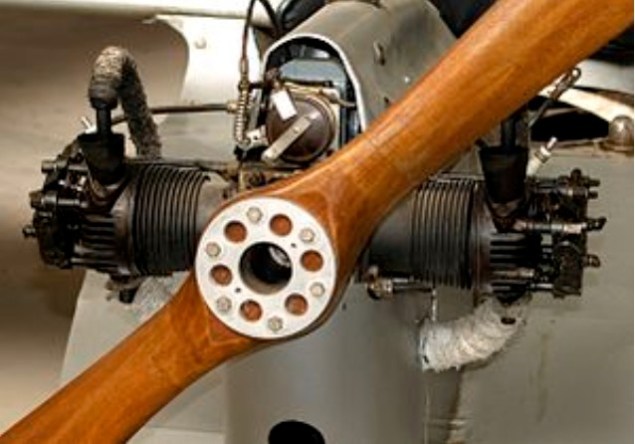
ABC 8 hp

The ABC 8 hp is an 8 hp (6 kW) two-cylinder aero engine designed by British engineer Granville Bradshaw for use in ultralight aircraft. The engine was derived from a specially tuned motorcycle unit and was built by ABC Motors, first running in 1923.
The ABC 8 hp was used in the English Electric Wren and Handley Page H.P.22. In theEnglish Electric Wren, with barely enough power to maintain flight, the aircraft is assisted into the air by a team of volunteers using bungee cord, after which the Wren lands straight ahead following a short ‘hop’.

Components:
Valvetrain: Overhead valve, two valves per cylinder
Fuel system: Carburettor
Fuel type: Petrol
Cooling system: Air-cooled

Type: 2-cylinder air-cooled flat-twin
Bore: 2.72 in (69 mm)
Stroke: 2.13 in (54 mm)
Displacement: 24.76 cu in (404 cc)
Dry weight: 41 lb (18.6 kg)
Power output: 8 hp (6 kW) at 4,500 rpm
Power-to-weight ratio: 0.2 hp/lb (0.32 kW/kg)

ABC Motors

Walton-on-Thames, UK

ABC Motors Limited (All British (Engine) Company) of Hersham, Surrey, England was a manufacturer of cars, aircraft, motor scooters, and engines for road and air. Established by Ronald Charteris in Hersham, Surrey in 1912, its chief designer was Granville Bradshaw. It was absorbed into Vickers in 1951 and the factory finally closed in the 1970s although some of the premises survived as part of the Hersham Trading Estate and were occupied by the Ian Allan publishing company.

The ABC radial aero engines of the World War I period were advanced for their time, and were initially thought to be very promising. They were all more or less plagued by problems – and although a number of types for the Royal Air Force were designed around ABC engines (especially the ill-fated Dragonfly) none of these types were to see squadron service with the RAF.

ABC also made a large number of engines for electrical generators and other purposes – mostly with a flat twin cylinder layout and unusual exhaust-over-inlet valve configuration. These smaller ABC engine have the distinction of being possibly the first airborne APUs- the Coastal class blimp (first flown in 1916) had a 1.5-horsepower unit installed to provide electricity for the onboard wireless set, while a similar engine was used to power the searchlight of the Supermarine Nighthawk ‘Zeppelin killer’ of 1917.

30 hp

60 hp

100 hp

Gadfly

Hornet

A.B.C. Military Biplane

The rationale of the name, A B C, is firstly, that it contains the initials of those associated in the development of the machine; Anient, Buranelli & Carisi, and, secondly, that it expresses the constructional simplicity, which is a prominent feature of the machine.

In April 1915, a machine to be known as the A B C Military Biplane (pusher”), was to make its debut shortly. Mr. Robert S. Anient, a well-known newspaper artist, was directing the exploitation, and Messrs. John Carisi and Yincent J. Buranelli were responsible for the design and construction of the machine.

The airplane was designed to especially facilitate quick assembling, and the machine, being a pusher, has a splendid range of vision, and for military work gives the gunner a sweep of 180 deg. The machine is a two-seater, seats arranged side by side, and dual controls are provided. The fuselage is covered entirely with duralumin. The landing chassis has four wheels, two in front, to facilitate running over rough ground.

The top wing warps from the end uprights out, similar to a monoplane. The power plant was to be a 100-hp specially built A B C aviation motor.