Ago / Aerowerke Gustav Otto / Aeroplanbau G. Otto and Alberti
Ago, the initials of Aerowerke Gustav Otto (founded 1912), was first applied in 1911 to products of Aeroplanbau G. Otto and Alberti.
Early products were modified biplane of Gustav Otto (German aviation pioneer, 1883-1926) and developments of Farman designs, but in 1912/13 a seaplane of original design was followed by other types. During 1915/16 Ago developed three pusher reconnaissance types: C.I, C.II and C.III with twin tails.
The C.IV was tractor biplane with sharply tapered wings; about 70 serviceed during 1917/18. Experimental types included seaplanes. The Ago name disappeared until late 1930s, but during the Second World War was again current for Ago 192 Kurier light twin-engined monoplane (built 1938).
World War 1
Aeromarine L-8
The L-8 eight cylinder water cooled Vee of 1918 produced 192hp@1750rpm from 737.67ci and dry weight of 556.5 lb.
Aeromarine L-6
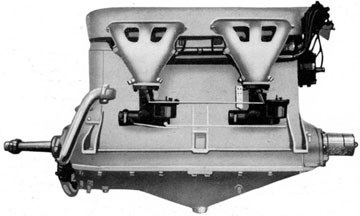
The 1917 L-6 gave 130hp@1625rpm to 215hp@3000rpm. A six cylinder inline water cooled engine of 553.25ci.
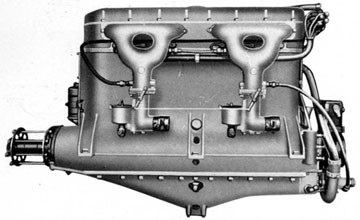
The L-6-D and L-6-G of 1917 were “D” for Direct-drive and “G” for geared-drive with dry weights of 400-500 lb.
Aeromarine B-90
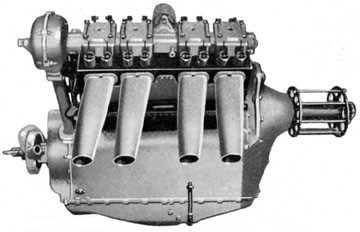
The 1915 Aeromarine B-90 was a 423.2ci geared eight cylinder water cooled Vee. Cast iron cylinders were set at 90° and the propshaft was mounted on two tapered roller bearings capable of end thrust in either direction. Geared prop speed at .571.
148hp@2275rpm
166hp@2635rpm
Dry wt: 460 lb
Aeromarine B-45
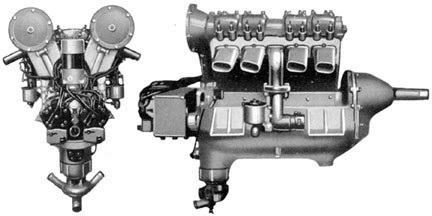
The 1915 B-45 was a water cooled eight cylinder Vee. The cast aluminum cylinders were set at 45° and the geared prop speed at .571.
150hp@2275rpm
170hp@2635rpm geared
Dry wt: 420 lb
Aeromarine 90 hp / K-6
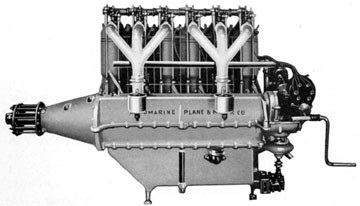
Built in 1914, a geared version was K-6. The prop speed was reduced by .571 gear ratio.
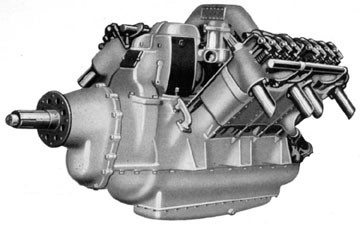
Aeromarine 90hp
Power: 85hp@1400rpm
Capacity: 449.16ci
Cylinders: 6 inline
Cooling: water
Dry weight: 430 lb
Aeromarine K-6
Power: 100hp@2000rpm
Capacity: 449.16ci
Cylinders: 6 inline
Cooling: water
Dry weight: 435 lb
Aeromarine SS / Sea Scout
A seaplane design was built for the US Navy in 1916. Three built; A439-441.
Aeromarine 40 / 41
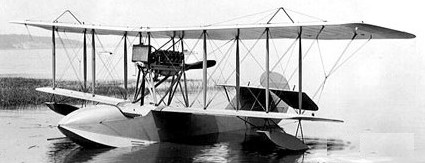
The Aeromarine Model 40 was a two-seat floatplane trainer aircraft serving the United States Navy. The aircraft was produced by the Aeromarine Plane and Motor Company of Keyport, New Jersey, and had already made a name for itself by supplying the US Navy with its first carrier-landed aircraft in the Aeromarine Model 39. Whereas the Model 39 could be utilized as a land-based and floatplane aircraft equally (requiring the conversion of the undercarriage to suit each task), the Model 40 was a dedicated flying boat using wing panels and struts of Model 39 on a new flying boat hull.
One or two 40-F may have been tested by the Coast Guard.
Design was conventional for the time, consisting of a contoured boat-like hull fitted to a boxy fuselage mounting a large unequal-span biplane wing configuration. Single pontoons were fitted as outrigger floats, one per each lower wing assembly. The upper and lower wing assemblies were joined by parallel struts making up two bays and fitting appropriate cabling. The student and instructor sat side-by-side just behind the nose and in front of the wing structure in an open-air cockpit. The view was superb from this position with their forward views protected by two simple curved windscreens. The empennage was adorned with a conventional large-area vertical fin and horizontal tailplane system showcasing rounded edges. The powerplant was placed within a strut configuration supporting the upper and lower wing assemblies at mid-span. The engine was situated well above and just behind the pilots, sporting a two-bladed pusher propeller system powered by a single Curtiss OXX-6 series V-8 water-cooled engine producing an output of roughly 100 horsepower (some later Model 40’s were known to fit a Hispano-brand engine in its place). Performance from this pusher arrangement allowed for speeds of up to 71 miles-per-hour with a service ceiling of nearly 1,900 feet. Endurance was listed at about 4.5 hours of flight time.
The Model 40 was designed and built in response to a 1918 Navy Department order for a two-seat seaplane trainer, 200 Model 40’s were initially ordered by the US Navy in 1918.
Very similar in general design to the Curtiss model MF trainer, which it was intended to augment, serialed A5040-5089, fifty 40-Fs were built.
Although the first civil model 40 may have flown in 1918 with a 150 hp Aeromarine U-8 engine, the first documented flight of the Navy model 40F occurred in 1919. When World War I ended, the original Navy order for 200 aircraft was reduced to 50, and all examples were delivered after the armistice. The model 40-F was operated by the US Navy as a trainer. The end of the war in November ultimately signified the end of the production contract, leaving only 50 Model 40 examples produced. Model 40’s still managed to see service in the post-war world solely with the United States Navy. Overall, their operational use proved the airframe too fragile for the constant rigors of water-born operations, to which these results helped in future American flying boat designs. During service, some model 40Fs were reportedly refitted with 150 hp Hispano-Suiza engines to improve performance and payload.
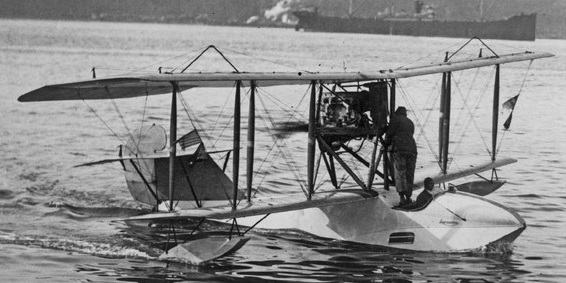
The civil versions (40 and 40B, 140 hp Hispano-Suiza engine; 40C, 150 hp Aeromarrine engine; 40L 130 hp Aeromarine L engine; 40T, 100 hp Curtiss OXX-6 engine; and 40U, 100 hp Aeromarine U-6 engine) were produced in 1919 and sold for around $9000 each. An estimated six civil models were built.
The Aeromarine Model 40 was further developed into the Model 41 to which some existing Model 40’s were converted to this newer design.
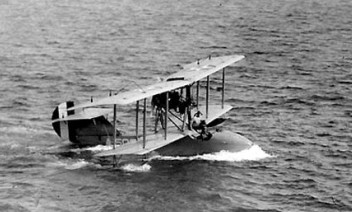
The Aeromarine 41 flying boat were conversions of Model 40s mentioned in 1922.
40
1919
Engine: Hisso, 150hp
Span: 48 ft 4 in
Length: 28 ft 11 in
Seats: 2
Speed: 85 mph
New price: US$9,000
40
Engine: Curtiss OXX-6, 100 hp
Prop: 2 blade wooden fixed pitch
Upper wingspan: 48 ft 6 in
Length: 26 ft 11 in
Empty weight: 201 lb
Loaded weight: 2592 lb
Max speed: 71 mph at SL
Ceiling: 3500 ft
Range: 250 mi
40-B
1919
Engine: Hisso, 150hp
Span: 48 ft 4 in
Length: 28 ft 11 in
Seats: 2
Speed: 85 mph
New price: US$9,000
40-C
1918
Engine: Aeromarine U-8, 150hp
Seats: 2
40-F
1919
Engine: Curtiss OXX-6, 100hp
Wing span: 48 ft 6 in / 14.80m
Length: 28 ft 11in / 8.8m
Height: 11.48ft / 3.50m
Empty Weight: 2,061lbs / 935kg
Maximum Take-Off Weight: 2,590lbs / 1,175kg
Maximum Speed: 71mph / 114kmh / 62kt
Maximum Range: 314miles / 506km)
Service Ceiling: 1,903ft / 580m)
Seats: 2
New price: US$8,100
40-L
1918
Engine: Aeromarine L, 130hp
Seats: 2
Speed: 80 mph
Payload: 560 lb
40-T
1919
Engine: Curtiss OXX-6, 100hp
Seats: 2
40-U
1919
Engine: Aeromarine U-6D
Seats: 2

Aeromarine 39 / M / Sportsman
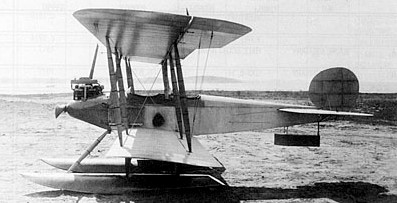
The Aeromarine 39 was a seaplane primary trainer version of the M-1 with the wingspan increased to carry the weight of twin floats. One was built.
In 1917 the Navy placed with the Aeromarine Plane and Motor Company of Keyport, NJ, what was at that time the largest single order for Navy aircraft – 50 of the Model 39-A and 150 39-B trainers. These were conventional two-bay wood and fabric biplanes and could be fitted with wheels or floats. The 39-As used the four-cylinder Hall-Scott A-7A engine of 100 hp and the seaplane versions had twin wooden floats. The 39-B was powered by the 100 hp Curtiss OXX-6 engine, the seaplanes having the single main pontoon with small wingtip floats for stability which the Navy preferred for its training and service seaplanes and was to retain until seaplane trainers were dropped from the inventory in 1960.
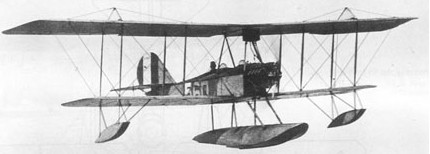
Fifty of the originally built designs were reassigned under the designation of 39A. The 39A models featured twin floats and the plane was powered by a Hall-Scott A-7 engine. Fifty were built with the 100hp Hall-Scott A-7 [A450/499]. The Hall-Scott A-7 was an early aircraft engine with a straight 4 configuration and could produce a maximum of 100 horsepower (75 kW). These engines suffered from consistency problems and many were prone to catch fire while in operation forcing the manufacturer to start using the Curtiss OXX powerplant. The Aeromarine 39-A was equipped with various engines: Aeromarine, Beardmore, Hisso, OX-5, OXX-6.
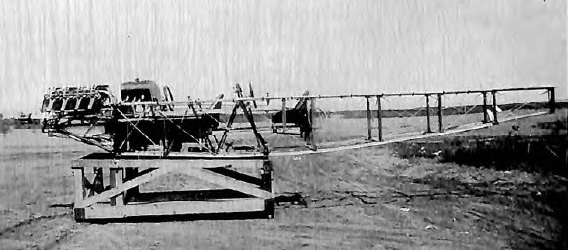
Other redesigns increased the wingspan for more lift needed for those water take-offs. This became known as the 39B. Additional changes included a single pontoon with outrigger floats, plus an enlarged vertical tail surface.
The single Sportsman built in 1917 was a civil version of Aeromarine 39-B by Burnelli. Refitted with floats, it made the first aerial delivery of mail to a ship at sea on 14 August 1919.
In 1917 Aeromarine received from US Navy largest single order for aircraft then placed by that service: 50 Model 39-A and 150 Model 39-B biplane trainers (wheel or float undercarriage).
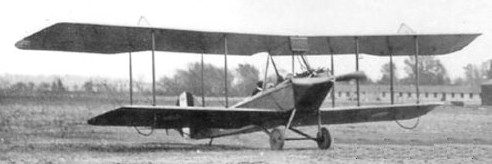
In 1921 they cost US$9650 and 150 were built (A500-A649).
The Aeromarine 39 was purchased by the USN for $9,688, sold surplus in 1921 for $1,500, and reduced to $800 in 1928. About 30 of these received registration.
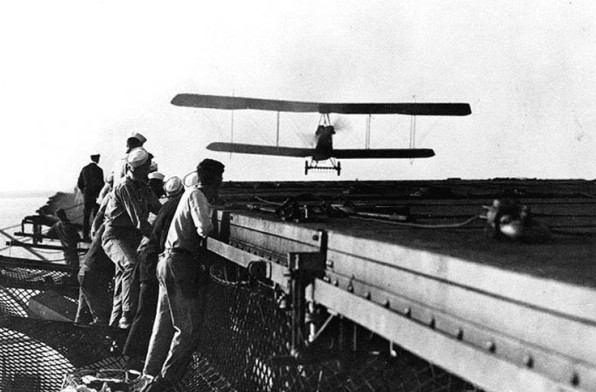
A number of the 39-Bs survived World War I, and two were used for the Navy’s early experiments in deck landing. Various types of arrester gear were tried on a dummy carrier deck at Langley Field, Virginia, in 1921. The aeroplane was fitted with the forerunner of the modern hook that engaged the cross-deck arrester cables, while alignment hooks were fitted to the undercarriage to engage longitudinal wires on the deck to keep the machine running straight. In anticipation of forced landings at sea in the course of later operations from shipboard, a hydrovane was fitted ahead of the wheels to prevent nosing over on alighting.
On October 26, 1922, a 39-B piloted by Lt Cdr Geoffrey DeChevalier, Naval Aviator No.7, made the first landing on the deck of the Navy’s first aircraft carrier, the USS Langley, a converted collier. De.Chevalier circled the USS Langley as the ship was underway at 10 knots. Chevalier successfully landed his plane on the moving deck of the Langley. The first such landing on an American carrier. This was nine days after the first take-off had been made in a Vought VE-7.
The 39-BL was also a two seat trainer.
The 1921 39-R sold for US$10,300 and 14 were built.
Aeromarine 39A
Engine: 1 x Hall Scott A-7, 100 hp
Length: 30 ft 4 in (9.25m)
Wingspan: 46.98ft (14.32m)
Height: 14.76ft (4.50m)
Empty Weight: 1,940lbs (880kg)
Maximum Take-Off Weight: 2,504lbs (1,136kg)
Maximum Speed: 73mph (117kmh; 63kts)
Maximum Range: 273miles (439km)
Service Ceiling: 8,202ft (2,500m)
Armament: None.
Accommodation: 2
39-B
Engine: Curtiss OXX, 100hp
Wing span: 47 ft 0 in
Length: 30 ft 5 in
Speed: 68 mph
39-BL
Seats: 2
Sportsman
Engine: Aeromarine V-8, 100 hp
Wing span: 47 ft 0 in
Length: 26 ft 8 in
Payload: 700 lb
Max speed: 78 mph
Stall speed: 48 mph
Seats: 2
39-R
Aeromarine Plane & Motor Co Inc. / Aeromarine-Klemm Corp / Boland Aeroplane Co
The beginnings of the company dated to 1908, when Inglis M. Uppercu began to finance aeronautical experiments by a small firm at Keyport, New Jersey.
In 1914, Aeromarine Corp itself was founded at Keyport with Uppercu as president. Aeromarine built mostly military seaplanes and flying boats, the most significant of which were the models 39 and 40. The company broke new ground in aviation by offering some of the first regularly scheduled flights. Aviation promoter Harry Bruno worked with Aeromarine to commercialize the transportation potential of airflight.
1914: Renamed Aeromarine Plane & Motor Co (fdr: Inglis M Uppercu);
1917: Relocated to Keyport NJ.
1920: Aeromarine West Indies Airways Inc, Key West FL, established.
After the war, converted D.H.4s, built 25 Martin bombers (completed winter 1923/24) and undertook flying-boat conversions for civil use.
In 1923 built metal-hulled flying-boat and biplane mail-carrier.
1921: Became distributing agent for $4 million surplus USN aircraft and motors.
1924: Ended aircraft operations, and established Healey-Aeromarine Bus Co, Nutley NJ.
1928: Formed as a component of Aeromarine Plane & Motor Co Inc. to begin aircraft production as (Frank) Boland Aeroplane Co, Newark NJ; acquired manufacturing rights to Klemm L.25 and the name, Aeromarine-Klemm, came into use. The firm renamed itself Aeromarine-Klemm Corporation in 1929 and began producing mostly Klemm aircraft designs, until the Great Depression forced its closure in 1930.
1931: Receivership (assignor W L Dill), with employees reorganizing as Aeromarine Plane & Motor Co.
The firm also built aero engines.
1935: Assets sold to Burnelli Aircraft Corp.
1936: Engine rights sold to Lenape Aircraft & Motors Inc, Matawan NJ.
1937: Design briefly revived by Keane Aircraft Co, Keyport.
 All Aero